Answers and Solutions: 22 – 1
Chapter 22
Mergers and Corporate Control
ANSWERS TO END-OF-CHAPTER QUESTIONS
22-1 a. Synergy occurs when the whole is greater than the sum of its parts. When applied to
mergers, a synergistic merger occurs when the post-merger free cash flows exceed the
sum of the separate companies’ premerger free cash flows. A merger is the joining of
two firms to form a single firm.
c. A friendly merger occurs when the target company’s management agrees to the merger
and recommends that shareholders approve the deal. In a hostile merger, the
management of the target company resists the offer. A defensive merger occurs when
one company acquires another to help ward off a hostile merger attempt. A tender offer
is the offer of one firm to buy the stock of another by going directly to the stockholders,
frequently over the opposition of the target company’s management. A target company
is a firm that another company seeks to acquire. Breakup value is a firm’s value if its
assets are sold off in pieces. An acquiring company is a company that seeks to acquire
another firm.
Answers and Solutions: 22 – 2
expensed for Federal income tax purposes, but may not be expensed for shareholder
reporting.
f. A white knight is a friendly competing bidder that a target management likes better
than the company making a hostile offer, and the target solicits a merger with the white
knight as a preferable alternative. A proxy fight is an attempt to gain control of a firm
by soliciting stockholders to vote for a new management team.
i. A holding company is a corporation formed for the sole purpose of owning stocks in
other companies. A holding company differs from a stock mutual fund in that holding
companies own sufficient stock in their operating companies to exercise effective
working control. An operating company is a company controlled by a holding
company. A parent company is another name for a holding company. A parent
company will often have control over many subsidiaries.
22-2 Horizontal and vertical mergers are most likely to result in governmental intervention, but
mergers of this type are also most likely to result in operating synergy. Conglomerate and
congeneric mergers are attacked by the government less often, but they also are less likely
to provide any synergistic benefits.
Answers and Solutions: 22 – 3
22-4 An operating merger involves integrating the company’s operations in hopes of obtaining
synergistic benefits, while a pure financial merger generally does not involve integrating
the merged company’s operations.
Answers and Solutions: 22 – 4
SOLUTIONS TO END-OF-CHAPTER PROBLEMS
22-1 a. rsL = rRF + b(RPM) = 4% + 1.6(7%) = 15.2%
22-2
Year 1
Year 2
Year 3
FCF
$715
$750
$805
a.
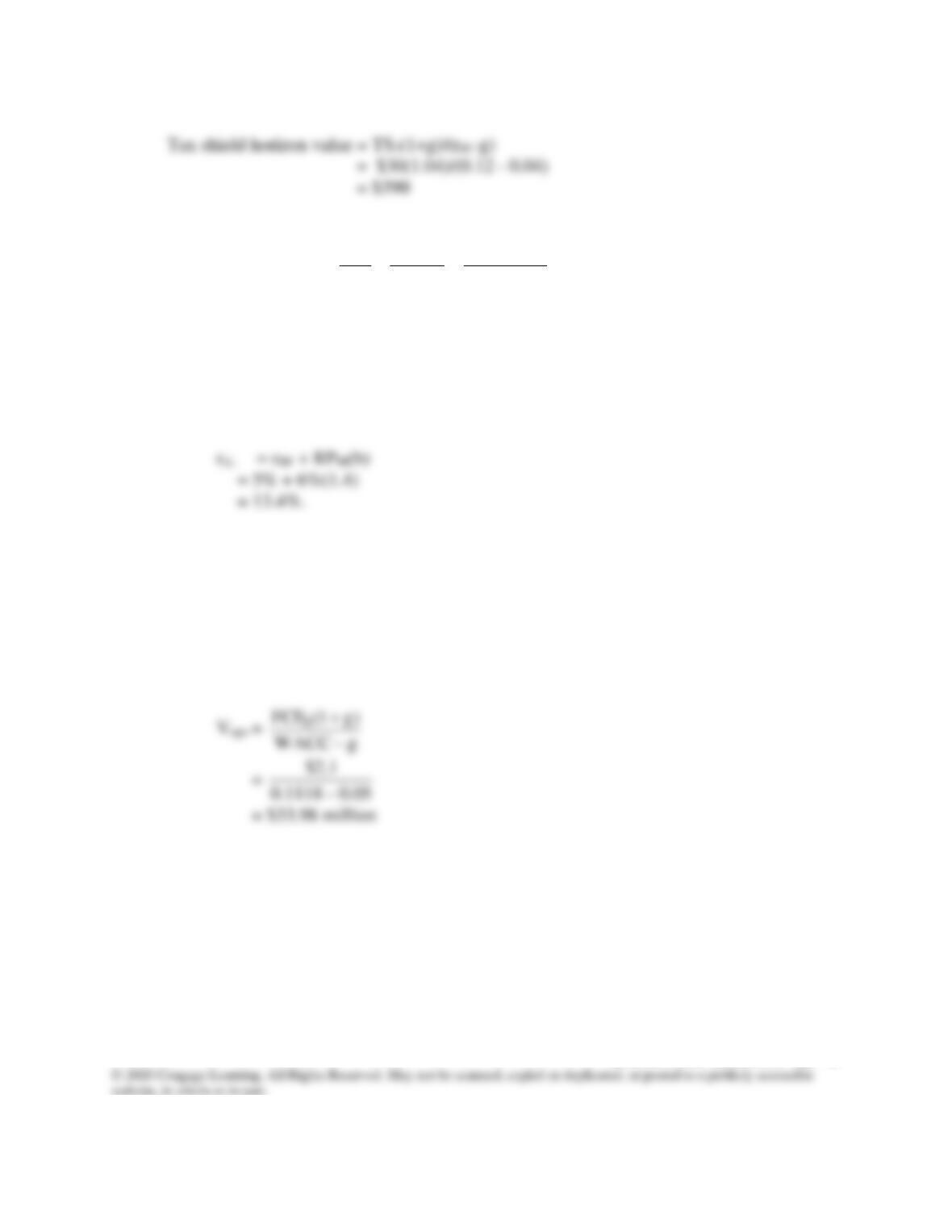
22-3 a. The annual tax savings are equal to the tax rate multiplied by the interest expense. For
example: Tax savings in Year 1 = 25%(80) = 20.
Answers and Solutions: 22 – 5
b.
Value of tax shields =
23
$20 $
1.1
$25 30 3
2(1.1 2
$ 90
2) (1.1 )
++
+
= $336.7347 million.
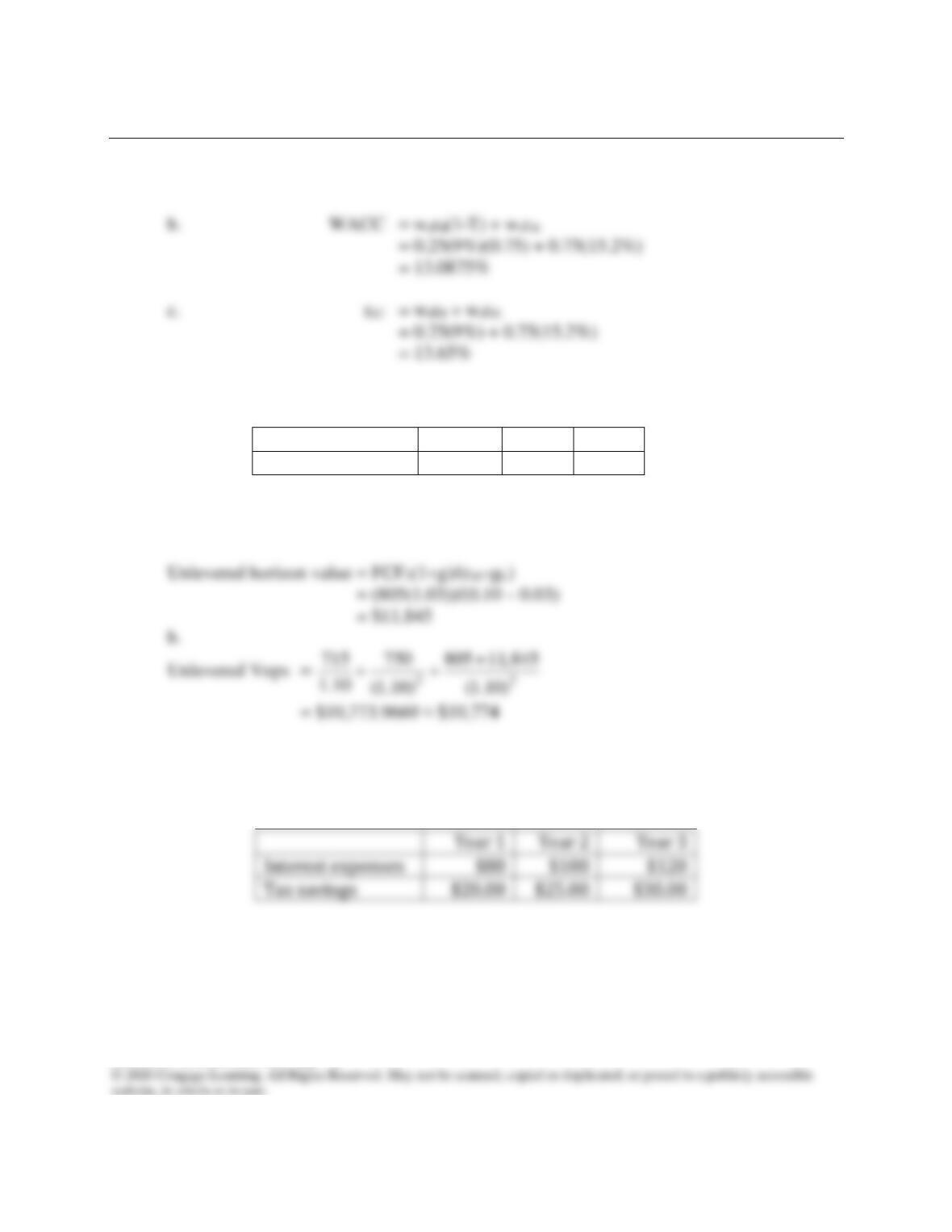
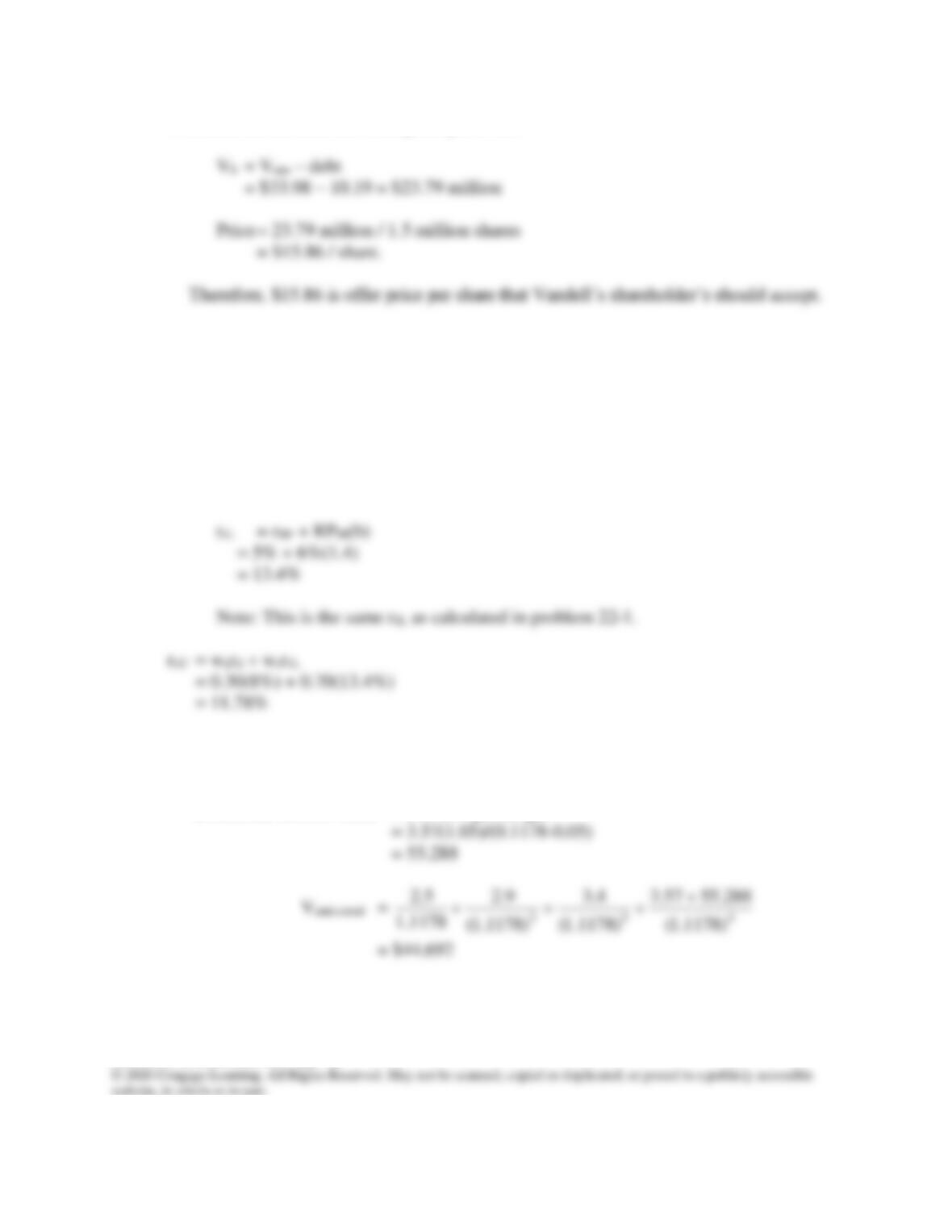
22-4 FCF1 = 2.00(1.05) = $2.1 million; gL = 5%; b = 1.4; rRF = 5%; RPM = 6%; wd = 30%; T =
25%; rd = 8%
a. Determine the cost of equity:
b. Determine the weighted average cost of capital:
WACC = wdrd(1-T) + wsrs
= 0.30(8%)(0.75 ) + 0.70(13.4%)
= 11.18%
c. Determine the intrinsic value of operations:
Answers and Solutions: 22 – 6
c. Determine the intrinsic stock price per share:
22-5 Current b = 1.4; rRF = 5%; RPM = 6%; current wd = 30%; T = 25%; rd = 8%,
FCF1 = $2.5 million, FCF2 = $2.9 million, FCF3 = $3.4 million, and FCF4 = 3.57 million;
FCF4 grows at gL = 5% forever.
Interest payments at Years 1 through 3 are $1.5 million each year; interest payments at
Year 4 are $1.472 million and grow at the long-term rate of 5%. Purchaser will assume
$10.19 million in old debt.
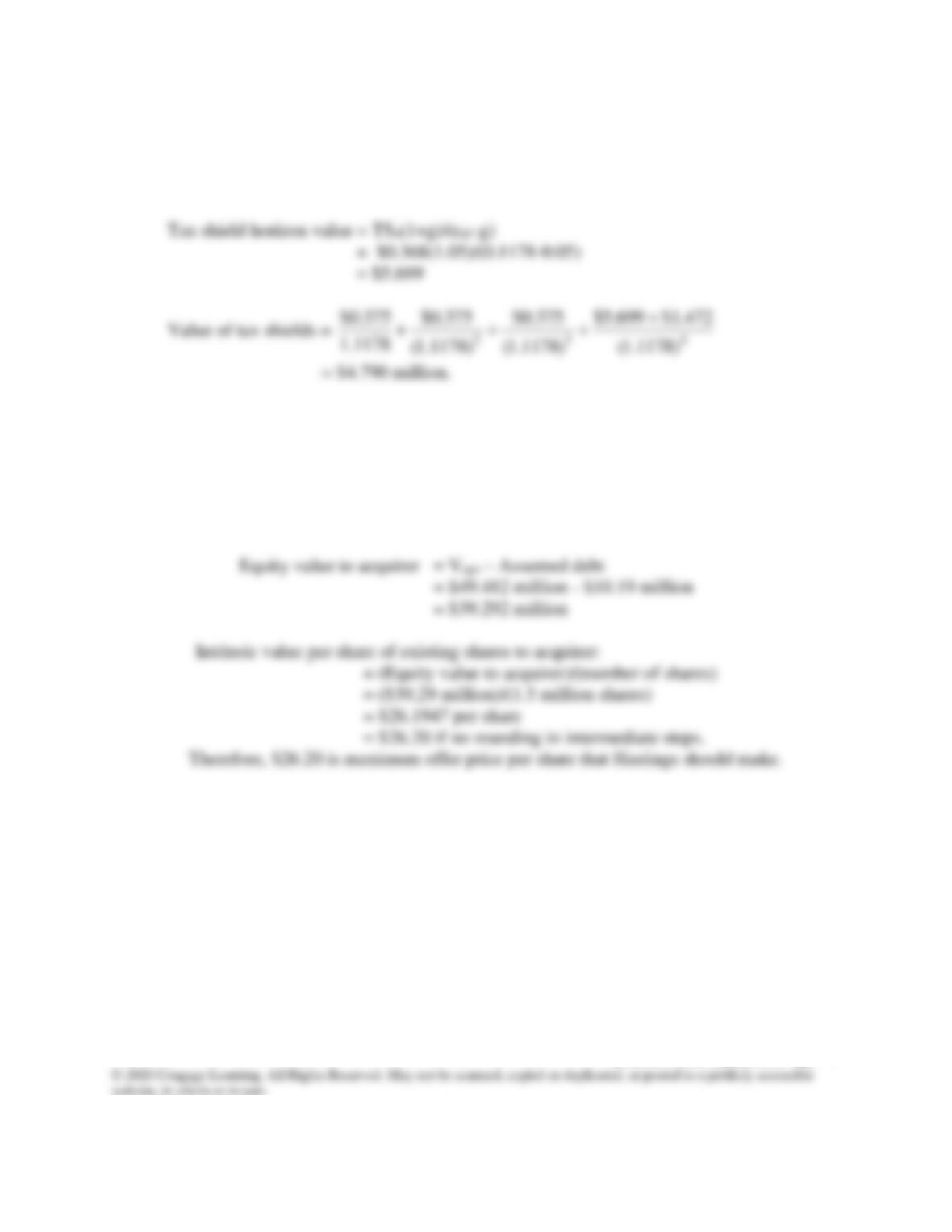
a. Determine Vandell‘s pre-acquisition cost of equity and the unlevered cost of equity:
b. Determine the unlevered value of operations:
Unlevered horizon value = FCF4(1+g)/(rsU–gL)
Answers and Solutions: 22 – 7
c. Determine the value of the tax shield:
Tax shields are TS1 = Interest x T = $1.5(0.25) = $0.375; TS2 = TS3,= TS1 = $0.375; and
TS4 = $1.472 (0.25) = $0.368.
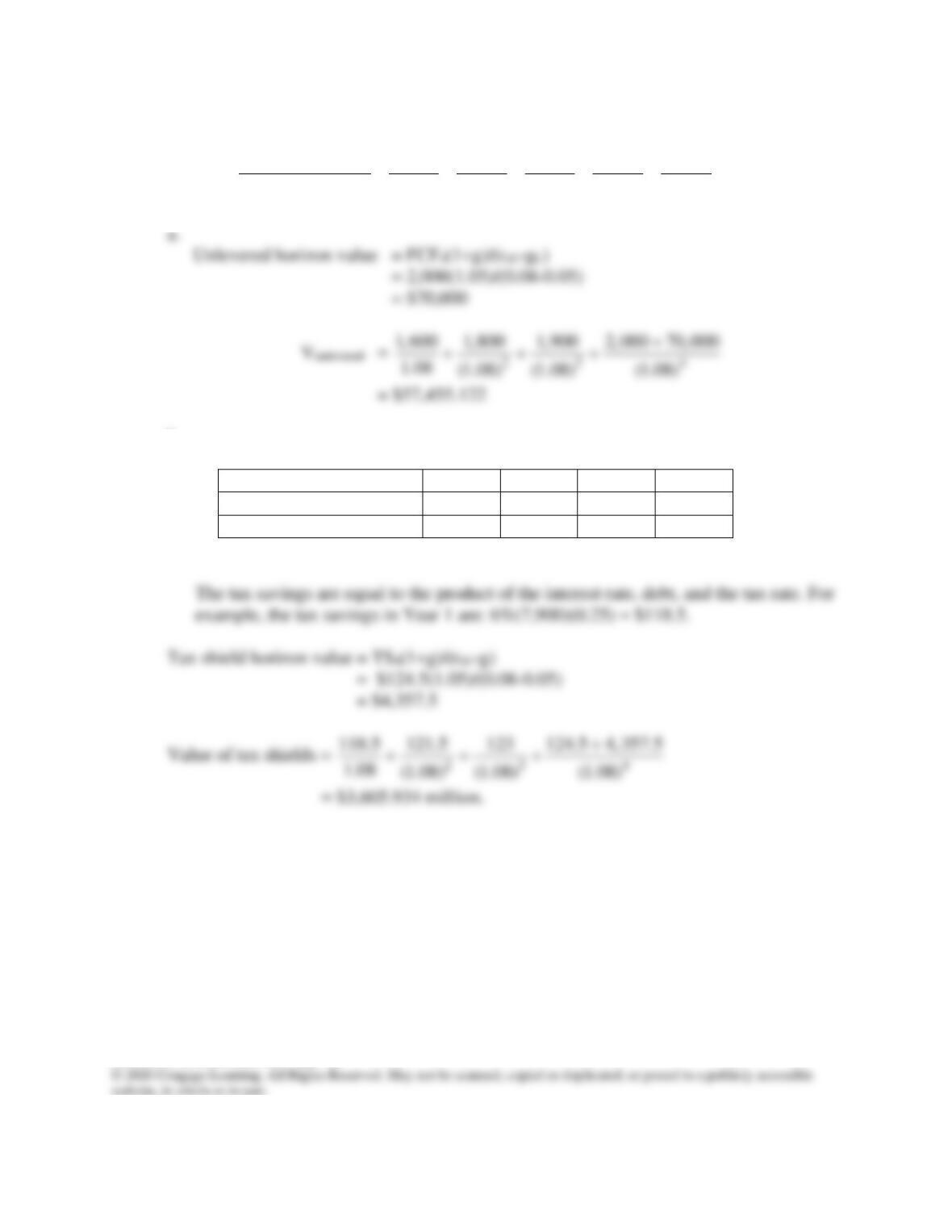
d. Determine the Year 0 total intrinsic value, intrinsic value of equity to acquirer, and
intrinsic stock price:
Total intrinsic value = unlevered Vops + value of tax shields
= $44.692+ $4.790
= $49.482 million
Note: Since the capital structure isn’t changing after the horizon, we could use the FCF
corporate valuation model to calculate the value of operations at the horizon. The total
value is equal to the present value of the value of operations at the horizon plus the present
values of the FCFs and tax shields in the first four years.
Answers and Solutions: 22 – 8
22-6
Frost: Pre-merger
Year 0
Year 1
Year 2
Year 3
Year 4
FCF (millions)
$1,400
$1,600
$1,800
$1,900
$2,000
Debt (millions)
$7,700
$7,900
$8,100
$8,200
$8,300
b.
Intermediate calculations
Year 1
Year 2
Year 3
Year 4
Interest payment
$474
$486
$492
$498
Tax shield
118.500
121.500
123.000
124.500
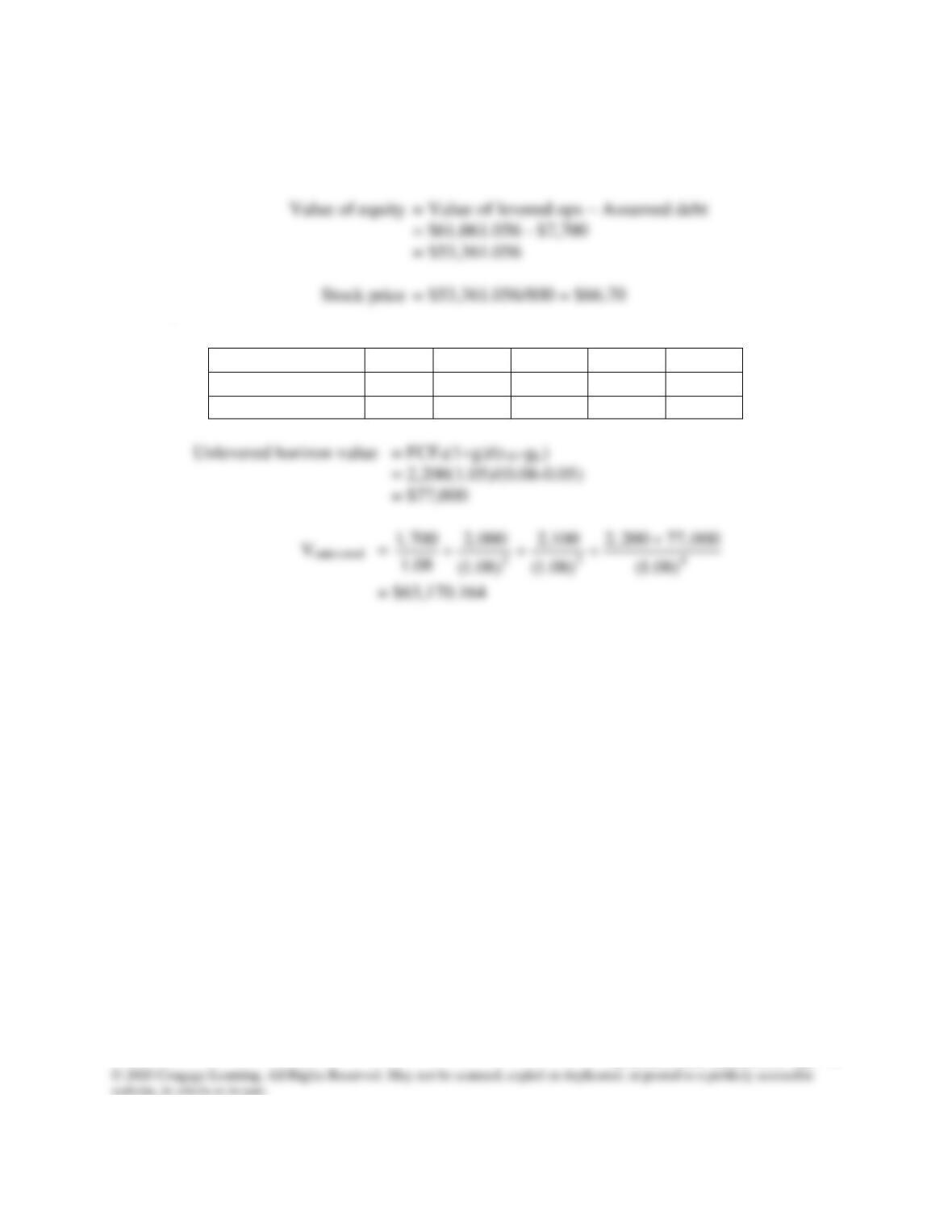
Answers and Solutions: 22 – 9
c. Value of levered ops = Unlevered Vops + Value of tax shields
= $57,455.122 + $3,605.934
= $61,061.056
d.
Frost: Post-merger
Year 0
Year 1
Year 2
Year 3
Year 4
FCF (millions)
$1,400
$1,700
$2,000
$2,100
$2,200
Debt (millions)
$7,700
$22,000
$22,300
$22,400
$22,500
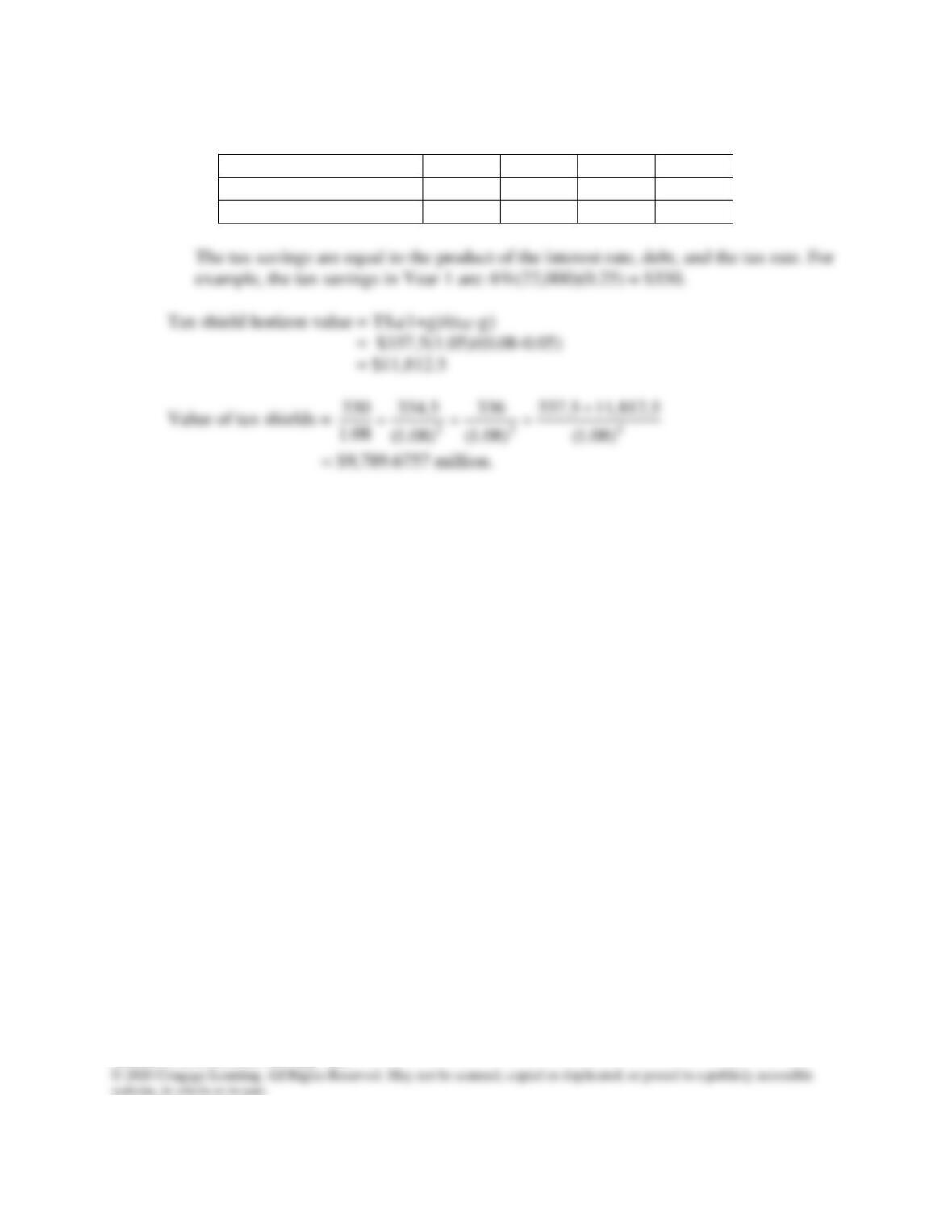
Answers and Solutions: 22 – 10
e.
Intermediate calculations
Year 1
Year 2
Year 3
Year 4
Interest payment
$1,320
$1,338
$1,344
$1,350
Tax shield
330.000
334.500
336.000
337.500
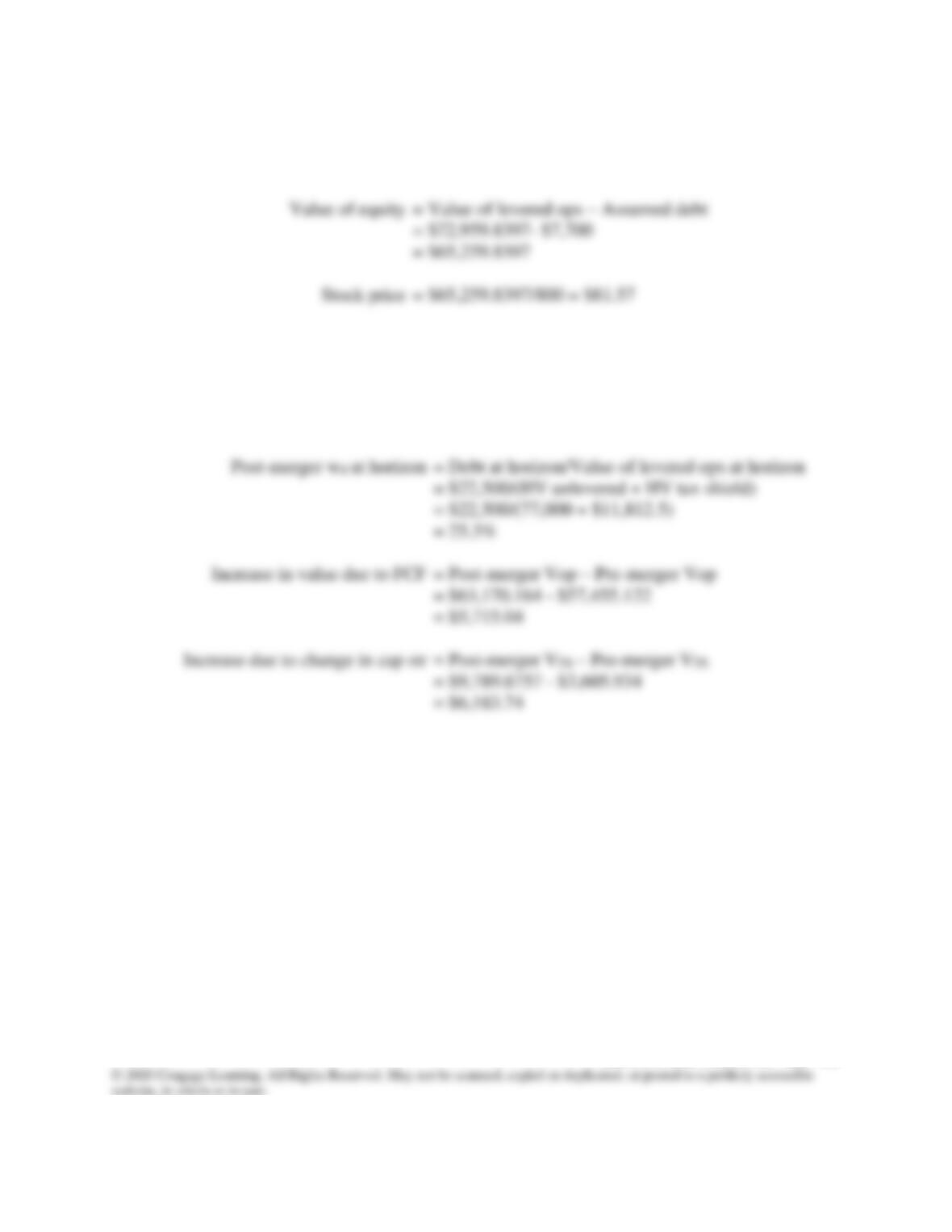
Answers and Solutions: 22 – 11
f. Value of levered ops = Unlevered Vops + Value of tax shields
= $63,170.164 + $9,789.6757
= $72,959.8397
g. Pre-merger wd at horizon = Debt at horizon/Value of levered ops at horizon
= $8,300/(HV unlevered + HV tax shield)
= $8,300/(70,000 + $4,357.5)
= 11.2%

Answers and Solutions: 22 – 12
SOLUTION TO SPREADSHEET PROBLEMS
22-7 The detailed solution for the spreadsheet problem, Ch22 P07 Build a Model Solution.xlsx,
is available on the textbook’s Web site.