Introduction to Corporate Finance, Fourth Edition Booth, Cleary, Rakita
Chapter 21: Capital Structure Decisions
Multiple Choice Questions
1. Section: 21.1 Financial Leverage
Learning Objective: 21.1
Level of difficulty: Intermediate
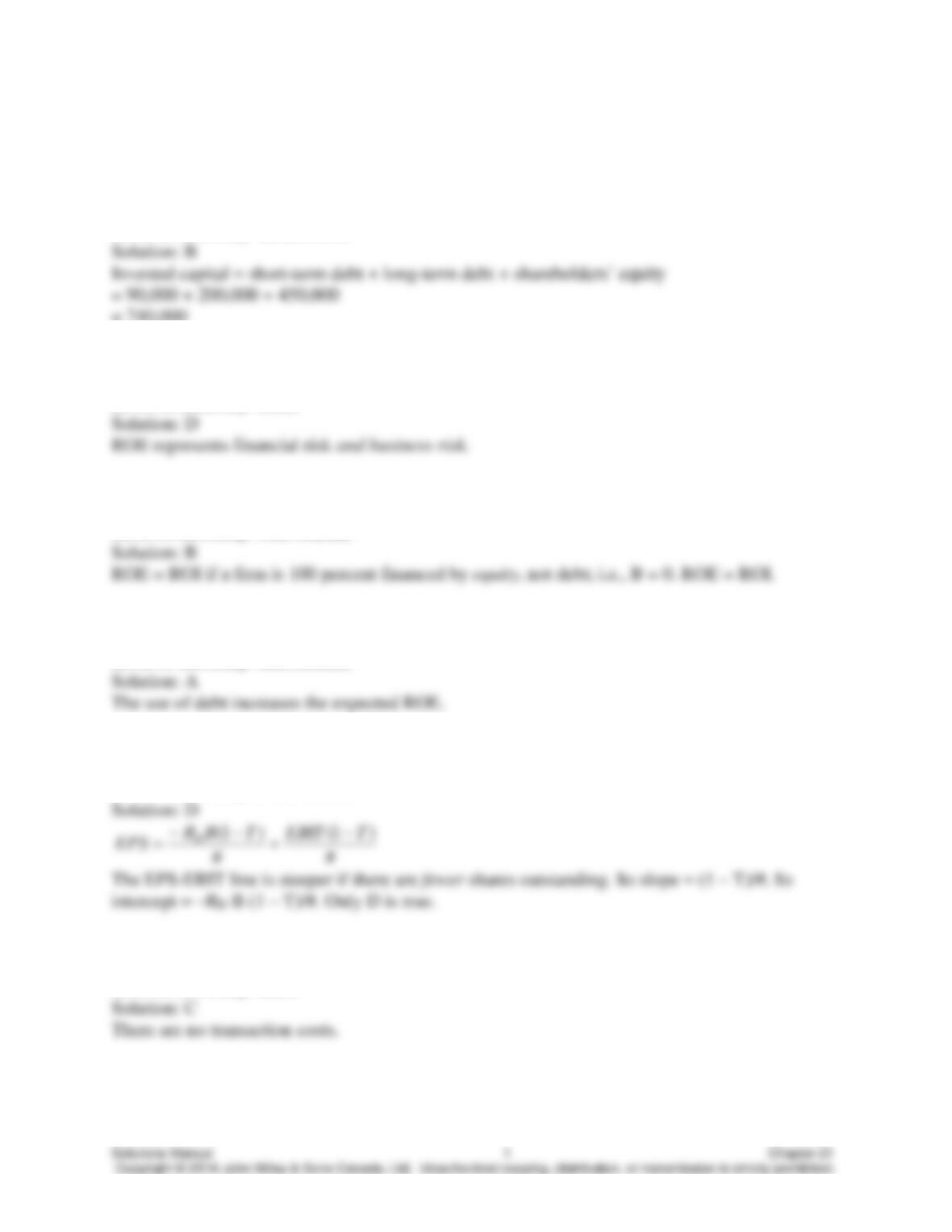
= 740,000
2. Section: 21.1 Financial Leverage
Learning Objective: 21.1
Level of difficulty: Basic
3. Section: 21.1 Financial Leverage
Learning Objective: 21.1
Level of difficulty: Intermediate
4. Section: 21.1 Financial Leverage
Learning Objective: 21.1
Level of difficulty: Intermediate
5. Section: 21.1 Financial Leverage
Learning Objective: 21.1
Level of difficulty: Intermediate
6. Section: 21.1 Financial Leverage
Learning Objective: 21.1
Level of difficulty: Basic
7. Section: 21.2 Determining Capital Structure
Learning Objective: 21.2
Introduction to Corporate Finance, Fourth Edition Booth, Cleary, Rakita
Level of difficulty: Intermediate
8. Section: 21.4 The Impact of Taxes on Capital Structure
Learning Objective: 21.4
Level of difficulty: Intermediate
9. Section: 21.4 The Impact of Taxes on Capital Structure
Learning Objective: 21.4
Level of difficulty: Intermediate
10. Section: 21.7 Capital Structure in Practice
Learning Objective: 21.7
Level of difficulty: Intermediate
Practice Problems
Basic
11. Section: 21.1 Financial Leverage
Learning Objective: 21.1
Level of difficulty: Basic
Solution:
Rule #1: For value-maximizing firms, the use of debt increases the expected ROE so
12. Section: 21.3 The Modigliani and Miller (M&M) Irrelevance Theorem
Learning Objective: 21.3
Level of difficulty: Basic
Introduction to Corporate Finance, Fourth Edition Booth, Cleary, Rakita
Solution:
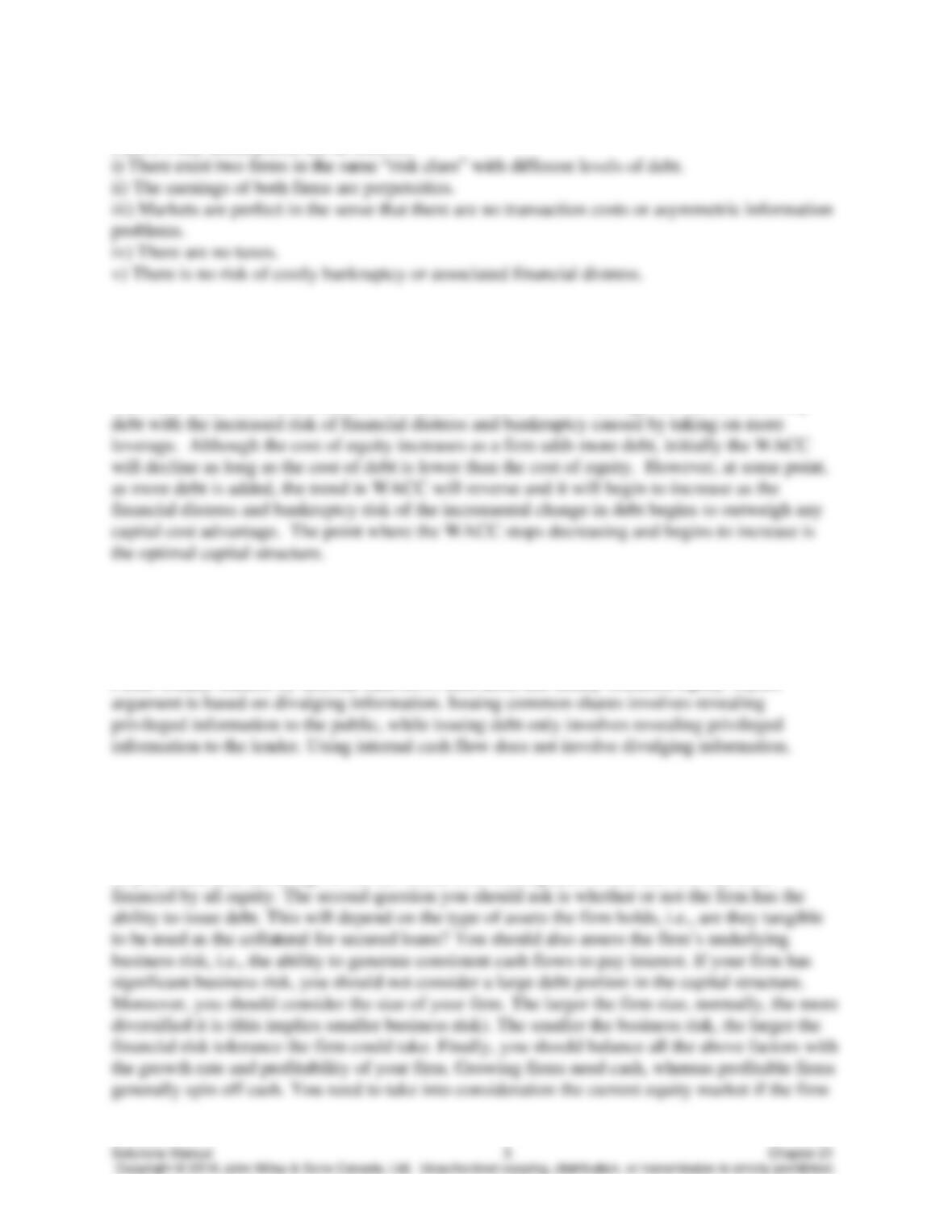
M&M’s key assumptions are as follows:
13. Section: 21.5 Financial Distress, Bankruptcy, and Agency Costs
Learning Objective: 21.5
Level of difficulty: Basic
Solution:
The static trade-off model balances the benefit of lower WACC through the use of less-costly
14. Section: 21.6 Other Factors Affecting Capital Structure
Learning Objective: 21.6
Level of difficulty: Basic
Solution:
Firms usually finance by internal cash flow, then debt, and finally common equity. Myers’
15. Section: 21.7 Capital Structure in Practice
Learning Objective: 21.7
Level of difficulty: Basic
Solution: The first question you should ask yourself is whether or not the firm is profitable. If it
is, you could take advantage of the tax shield from issuing debt. If not, the firm has to be
Introduction to Corporate Finance, Fourth Edition Booth, Cleary, Rakita
Intermediate
16. Section: 21.1 Financial Leverage
Learning Objective: 21.1
Level of difficulty: Intermediate
Solution:
17. Section: 21.1 Financial Leverage
Learning Objective: 21.1
Level of difficulty: Intermediate
Solution:
18. Section: 21.1 Financial Leverage
Learning Objective: 21.1
Level of difficulty: Intermediate
Solution:

Introduction to Corporate Finance, Fourth Edition Booth, Cleary, Rakita
19. Section: 21.1 Financial Leverage
Learning Objective: 21.1
Level of difficulty: Intermediate
Solution:
20. Section: 21.1 Financial Leverage
Learning Objective: 21.1
Level of difficulty: Intermediate
Solution:
Method 1
Method 2
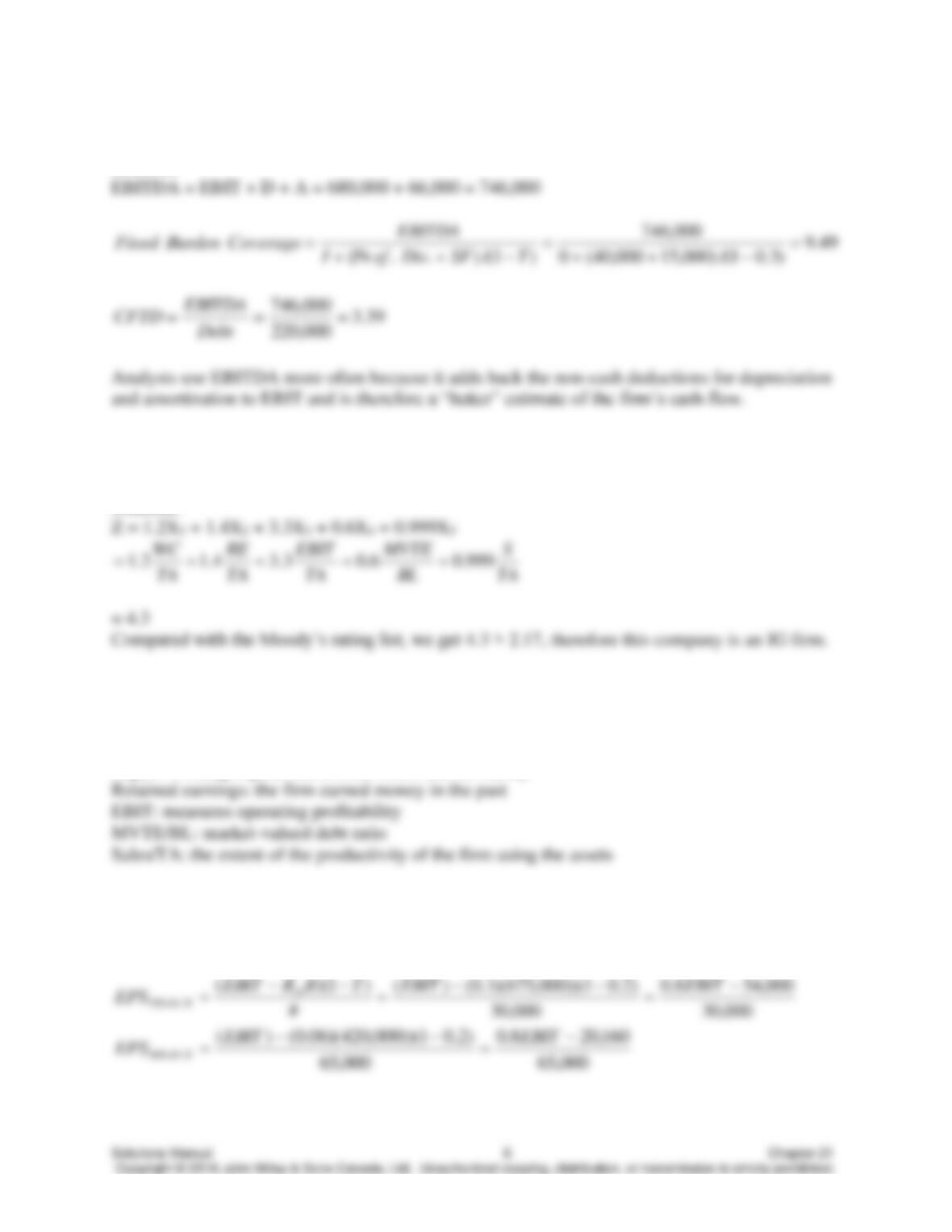
21. Section 21.2 Determining Capital Structure
Introduction to Corporate Finance, Fourth Edition Booth, Cleary, Rakita
Learning Objective: 21.2
Level of difficulty: Intermediate
Solution:
22. Section: 21.2 Determining Capital Structure
Learning Objective: 21.2
Level of difficulty: Intermediate
Solution:
23. Section: 21.2 Determining Capital Structure
Learning Objective: 21.2
Level of difficulty: Intermediate
Solution:
Higher working capital: more receivables and inventory
24. Section: 21.2 Determining Capital Structure
Learning Objective: 21.2
Level of difficulty: Intermediate
Solution:
Introduction to Corporate Finance, Fourth Edition Booth, Cleary, Rakita
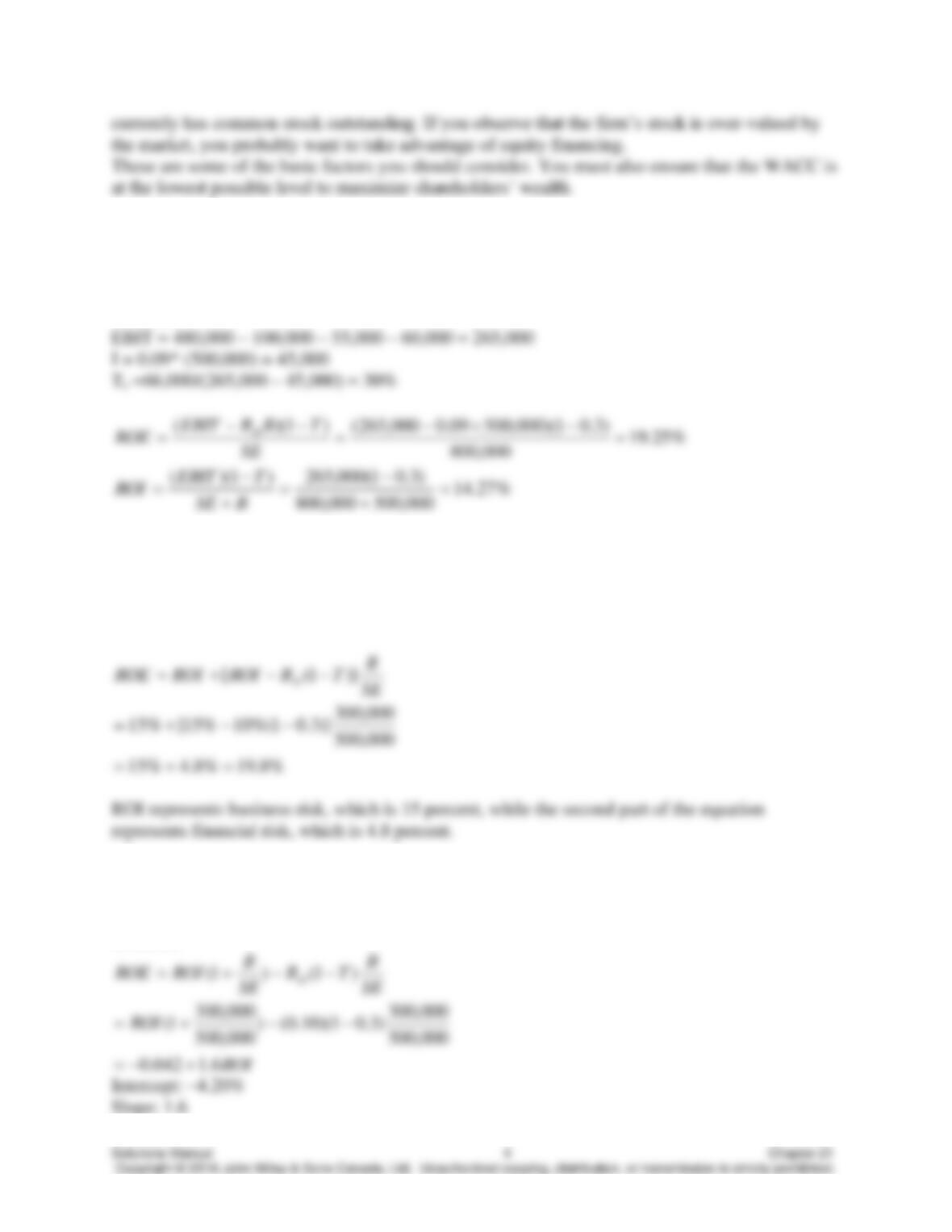
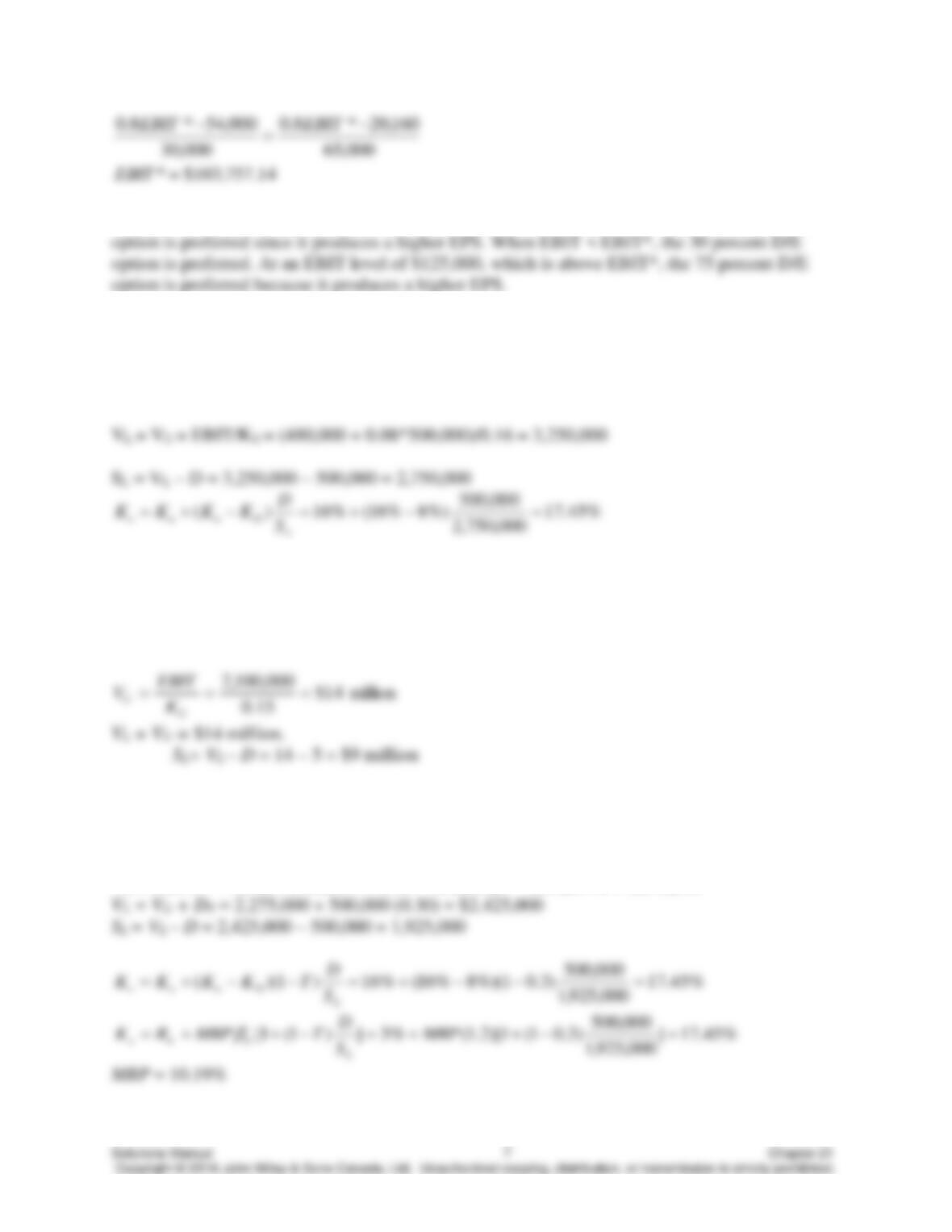
This point is where the two EPS-EBIT lines intersect. When EBIT > EBIT*, the 75 percent D/E
25. Section: 21.3 The Modigliani and Miller (M&M) Irrelevance Theorem
Learning Objective: 21.3
Level of difficulty: Intermediate
Solution:
26. Section: 21.3 The Modigliani and Miller (M&M) Irrelevance Theorem
Learning Objective: 21.3
Level of difficulty: Intermediate
Solution:
27. Section: 21.4 The Impact of Taxes on Capital Structure
Learning Objective: 21.4
Level of difficulty: Intermediate
Solution:
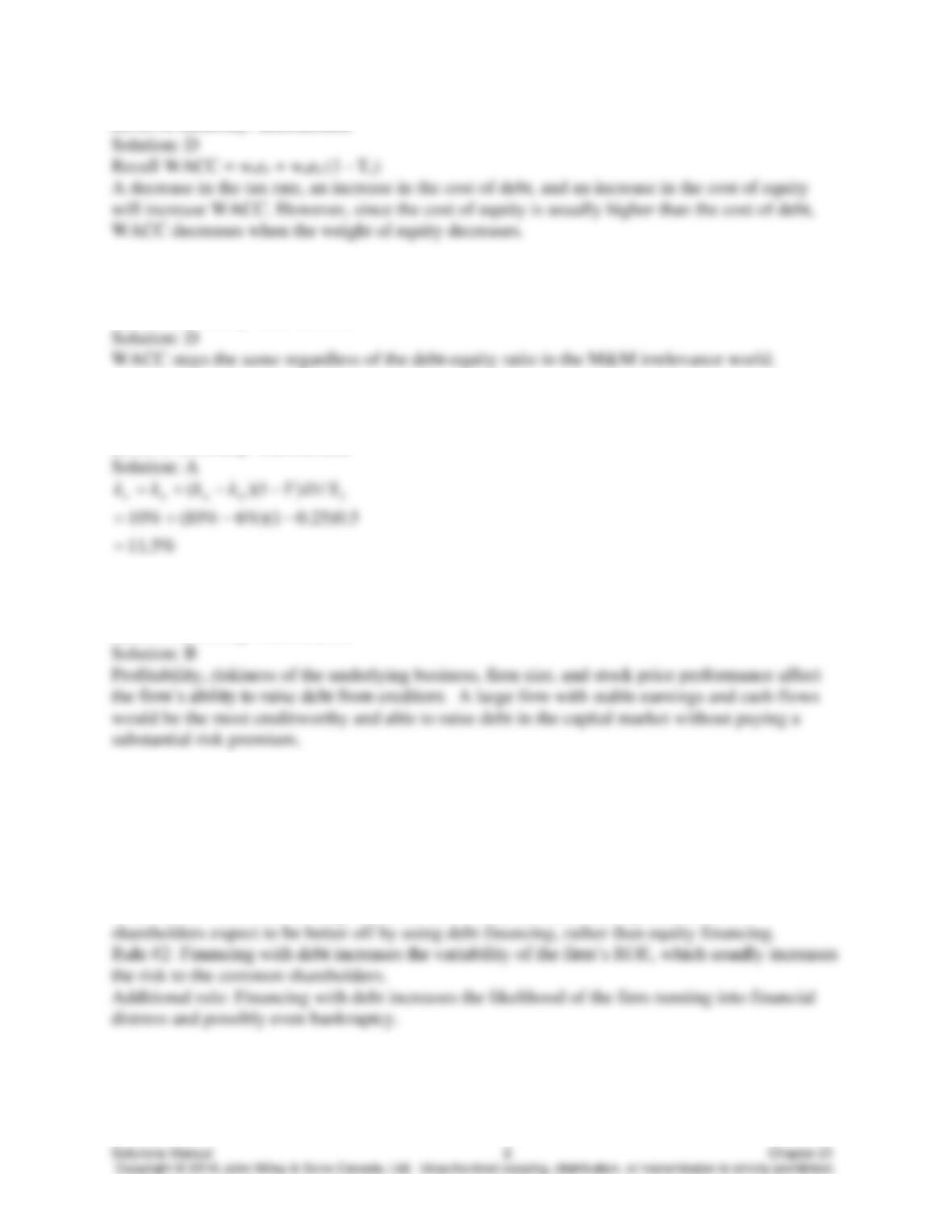
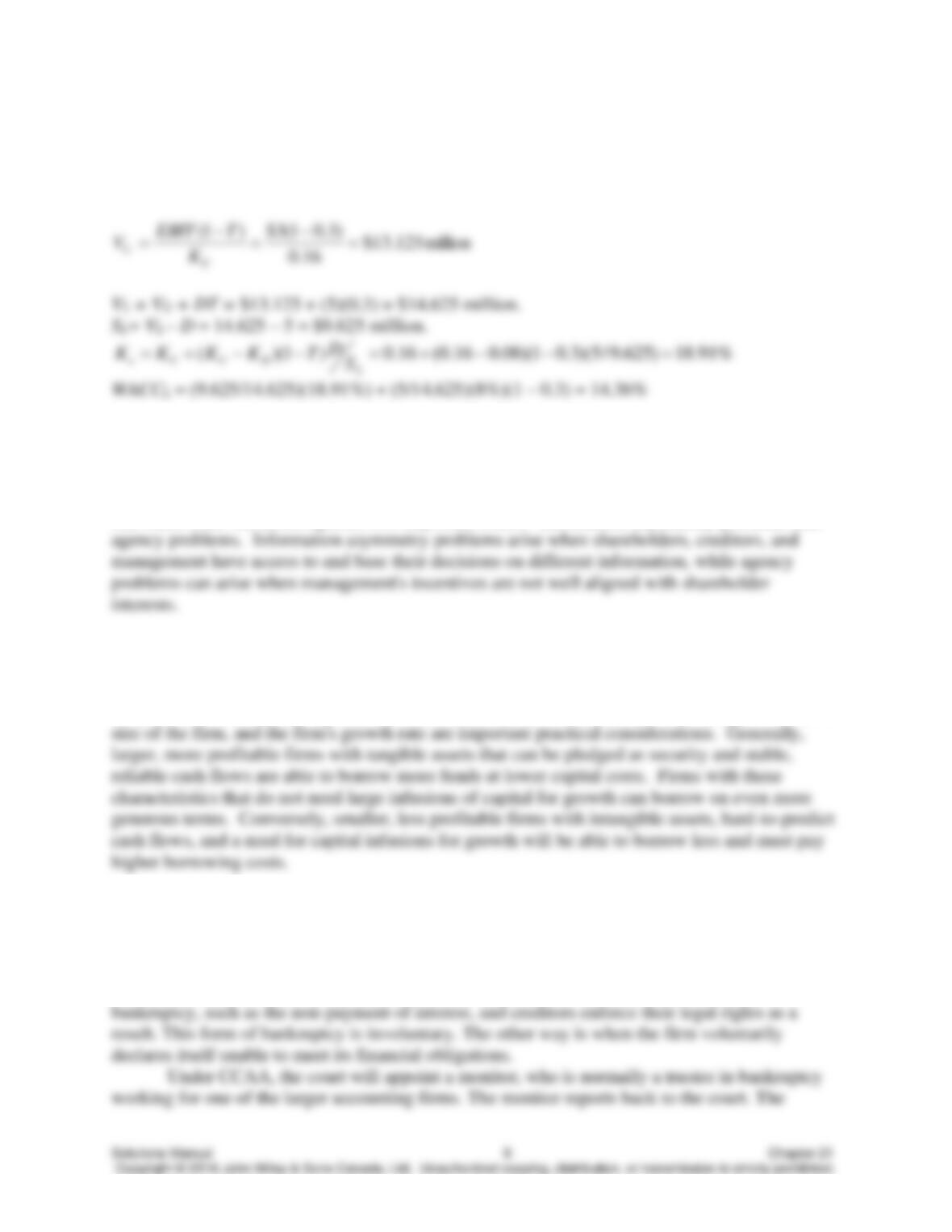
VU = EBIT(1 – T)/KU = (480,000 + 0.08 * 500,000)(1 – 0.30)/0.16 = 2,275,000
Introduction to Corporate Finance, Fourth Edition Booth, Cleary, Rakita
28. Section: 21.4 The Impact of Taxes
Learning Objective: 21.4
Level of difficulty: Intermediate
Solution:
29. Section: 21.5 Financial Distress, Bankruptcy, and Agency Costs
Learning Objective: 21.5
Level of difficulty: Intermediate
Solution:
The static trade-off model ignores two important issues: information asymmetry problems and
30. Section 21.5 Financial Distress, Bankruptcy, and Agency Costs
Learning Objective: 21.5
Level of difficulty: Intermediate
Solution: Profitability, the type of assets a firm has, the risk of the firm’s underlying business, the
31. Section: 21.5 Financial Distress, Bankruptcy, and Agency Costs
Learning Objective: 21.5
Level of difficulty: Intermediate
Solution:
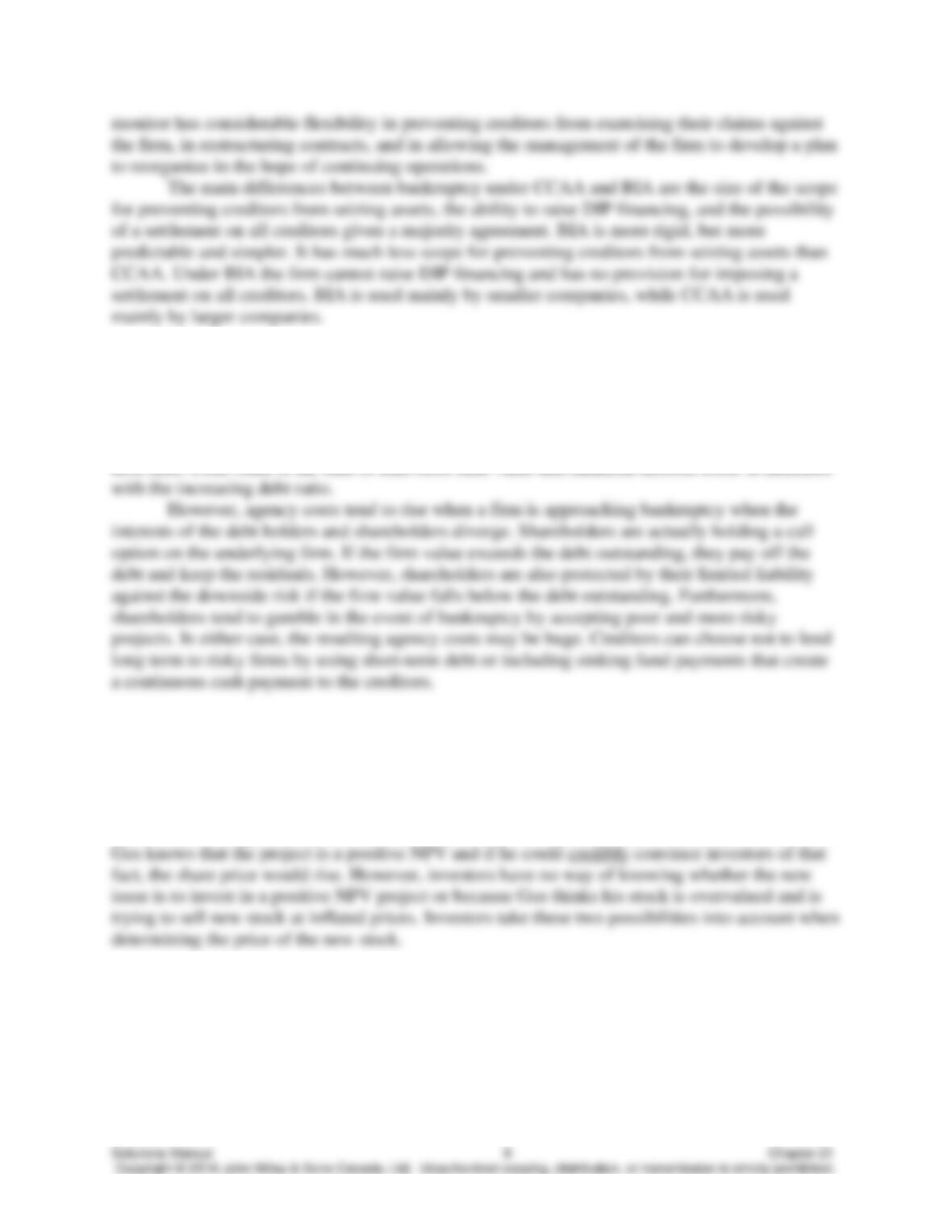
There are two ways bankruptcy occurs. The first way is when the firm commits an act of
Introduction to Corporate Finance, Fourth Edition Booth, Cleary, Rakita
32. Section: 21.5 Financial Distress, Bankruptcy, and Agency Costs
Learning Objective: 21.5
Level of difficulty: Intermediate
Solution:
As Figure 21-8 indicates, under the bankruptcy world, distress costs rise as the firm increases its
debt ratio. Firm value is the sum of unlevered firm value and financial distress costs. It increases
33. Section: 21.7 Capital Structure in Practice
Learning Objective: 21.7
Level of difficulty: Intermediate
Solution:
In an efficient market (semi-strong form) the price of the stock reflects all publicly available
information. The problem here is the information asymmetry between the firm and the investors.
34. Section: Appendix 21A: Personal Taxes and Capital Structure
Learning Objective: 21.8
Level of difficulty: Intermediate
Solution: Your cousin is mixing corporate and personal taxes. If the investor does not pay taxes,
then, with corporate taxes, we want the firm to maximize the tax shield earned from debt.
However, with personal taxes there is a trade-off between the tax shield earned by the
Introduction to Corporate Finance, Fourth Edition Booth, Cleary, Rakita
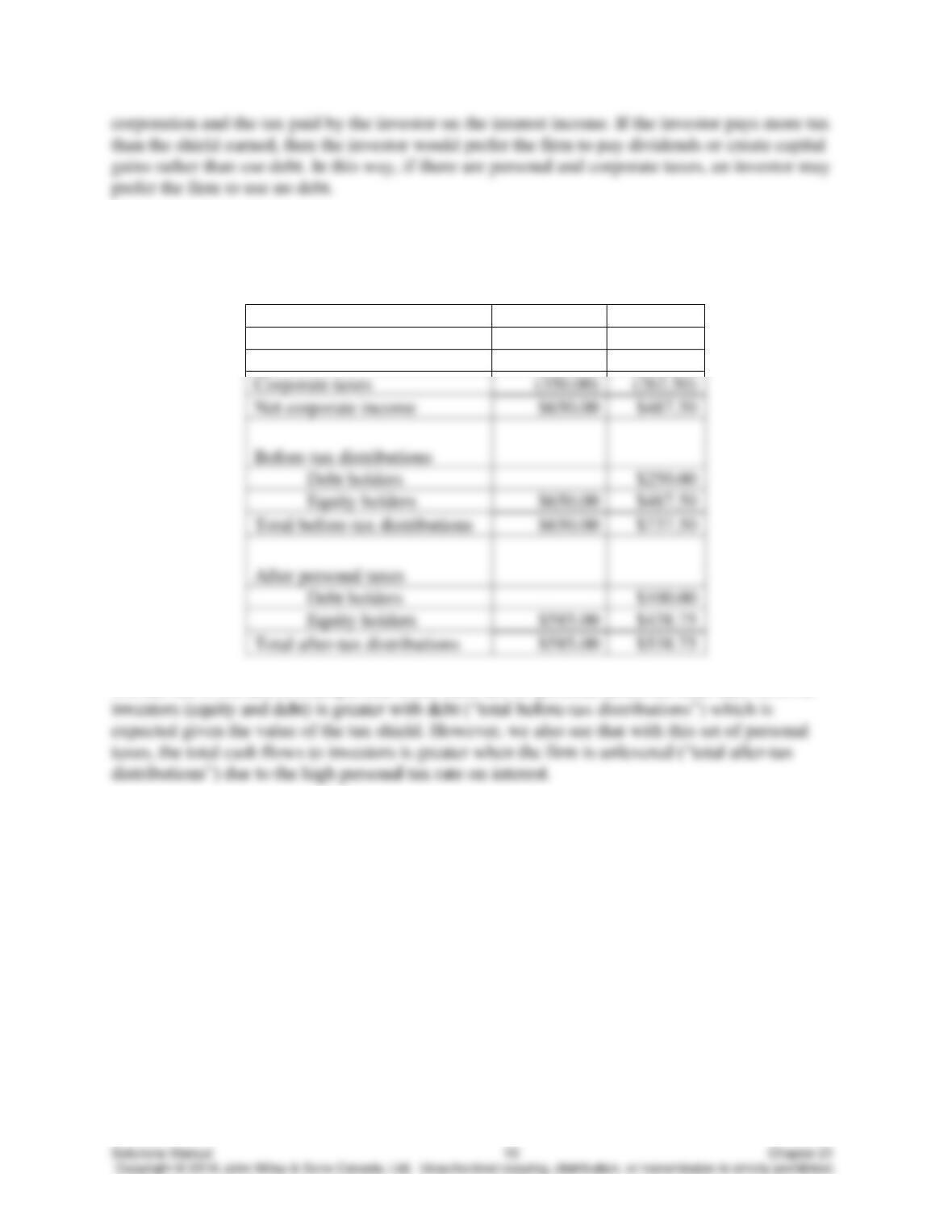
Example: corporate tax = 35%, personal taxes: dividends and capital gains = 10%, interest
income 60%. Compare two firms (both earn $1,000 before interest and taxes, and interest is
$ 250):
Unlevered
Levered
Operating income
$1,000.00
$1,000.00
Interest
(250.00)
Corporate taxes
(262.50)
Net corporate income
Before-tax distributions
Debt holders
Equity holders
Total before-tax distributions
After personal taxes
Debt holders
Equity holders
Total after-tax distributions
We can see in the above example that when there are no personal taxes, the total cash flows to
Challenging
35. Section: 21.3 The Modigliani and Miller (M&M) Irrelevance Theorem
Learning Objective: 21.3
Level of difficulty: Challenging
Solution:
Introduction to Corporate Finance, Fourth Edition Booth, Cleary, Rakita
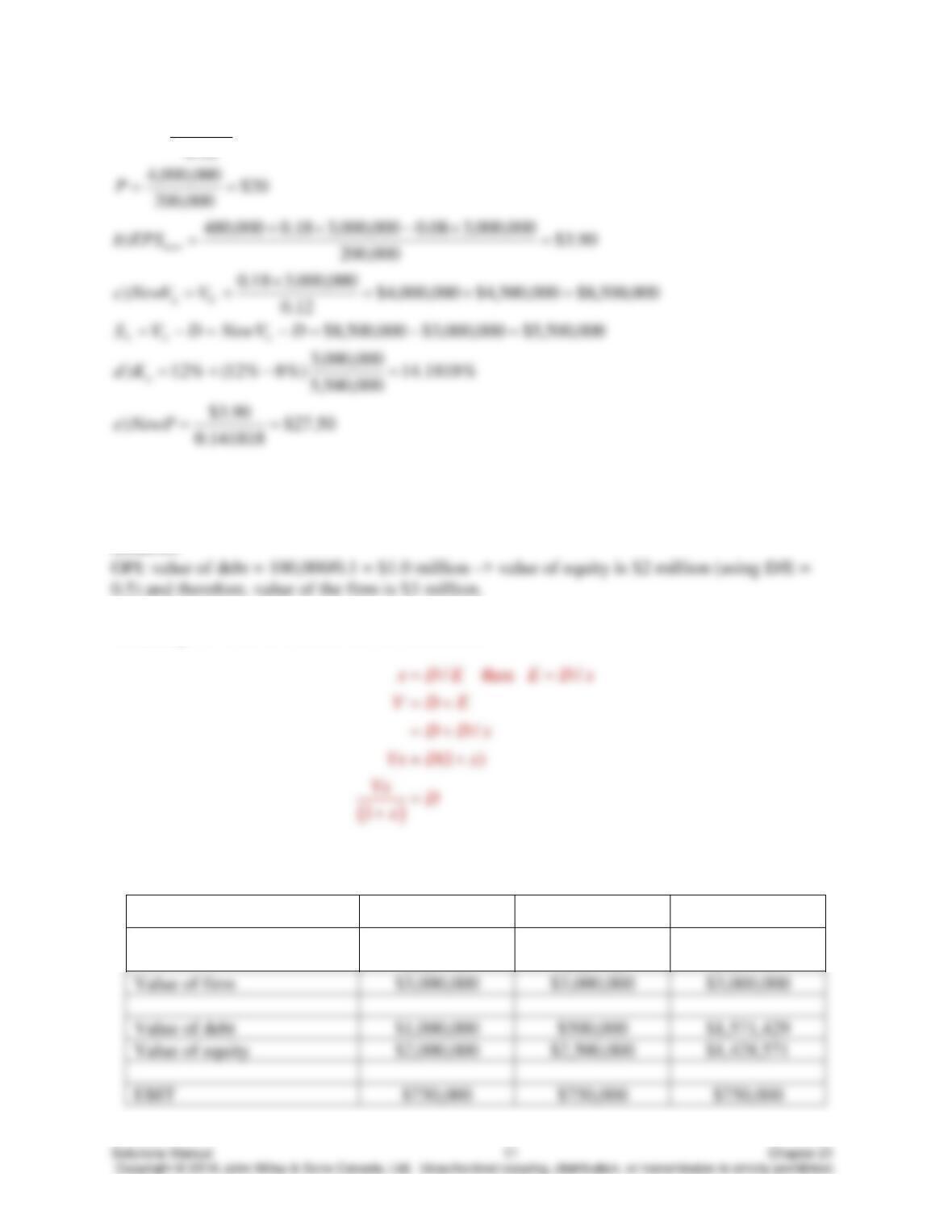
000,000,4$
000,480
)
==
Va
U
36. Section: 21.4 The Impact of Taxes on Capital Structure
Learning Objective: 21.4
Level of difficulty: Challenging
Solution:
Obtaining the value of the debt from the D/E ratio:
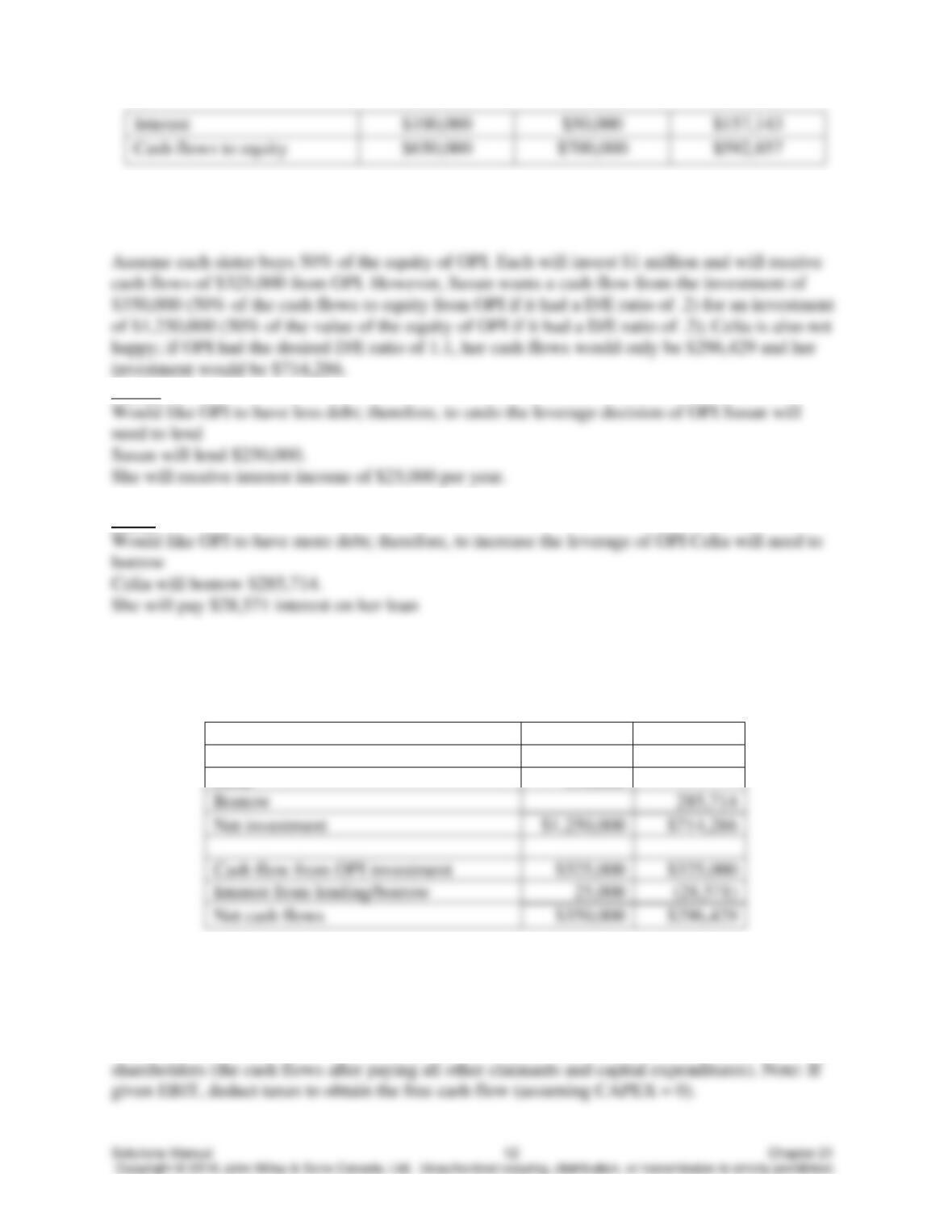
Step 1: Determine what the cash flows from OPI would be if the firm had the desired D/E ratio:
Desired by Susan
Desired by Celia
OPI with
D/E = .5
OPI with
D/E = .2
OPI with
D/E = 1.1
Introduction to Corporate Finance, Fourth Edition Booth, Cleary, Rakita
Step 2: Use the arbitrage approach of the M&M proof to determine how much each sister has to
borrow/lend to end up with the desired cash flows.
Susan:
Celia:
Check that each has the desired cash flows (50% of the cash flows to equity from the desired
OPI) and that each has invested the desired amount (50% of the value of the equity of the desired
OPI).
Susan
Celia
Investment in 50% of equity of OPI
$1,000,000
$1,000,000
Lend
250,000
Borrow
285,714
Net investment
$1,250,000
$714,286
Cash flow from OPI investment
$325,000
$325,000
Interest from lending/borrow
37. Section: 21.4 The Impact of Taxes on Capital Structure
Learning Objective: 21.4
Level of difficulty: Challenging
Solution:
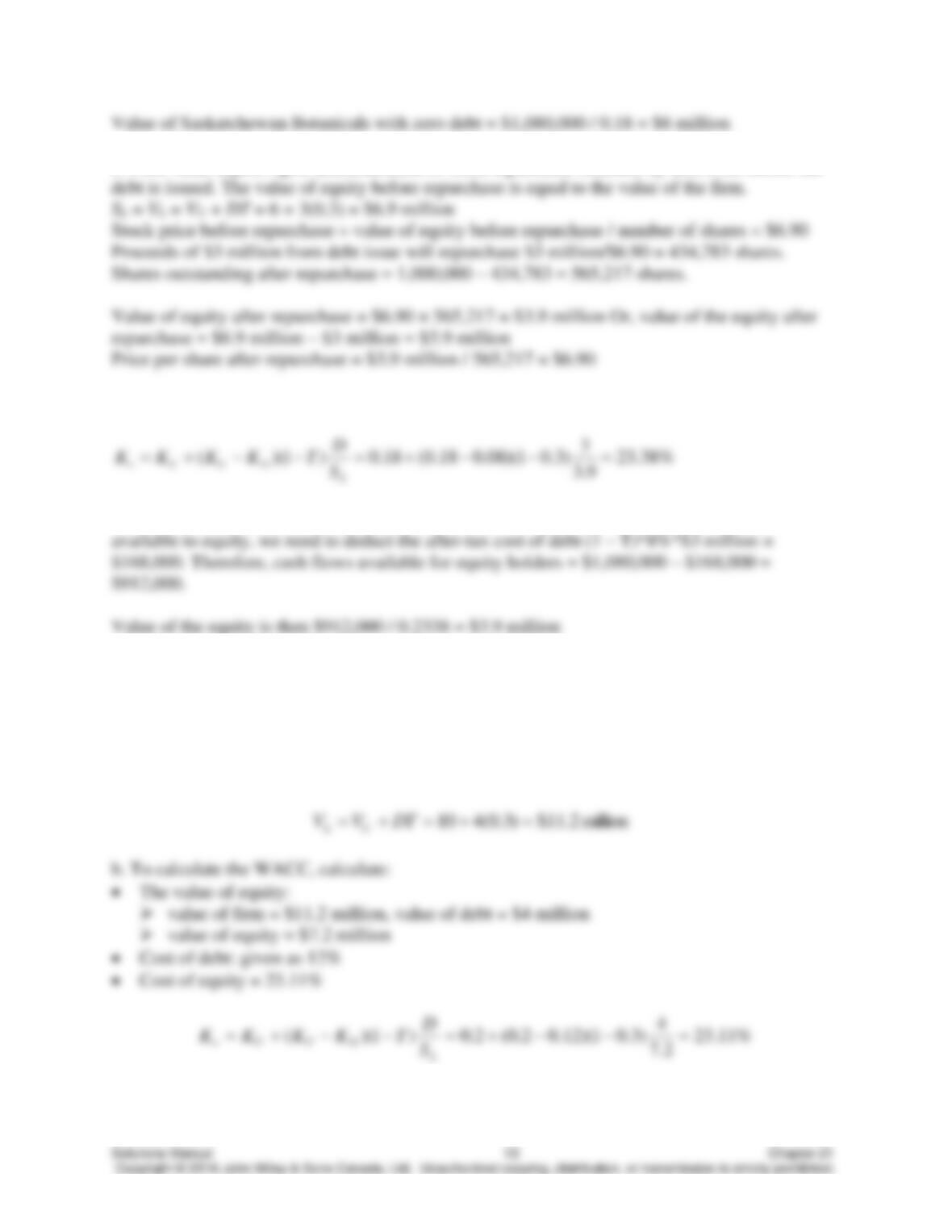
a. To value Saskatchewan Botanicals we need the cash flows that are available to the
Introduction to Corporate Finance, Fourth Edition Booth, Cleary, Rakita
b. Firm value adjusts upon announcement of stock repurchase financed by debt even before the
c.
d. We know from part (a) that EBIT(1 – T) = $1,080,000 per year. To obtain the cash flows
38. Section: 21.4 The Impact of Taxes on Capital Structure
Learning Objective: 21.4
Level of difficulty: Challenging
Solution:
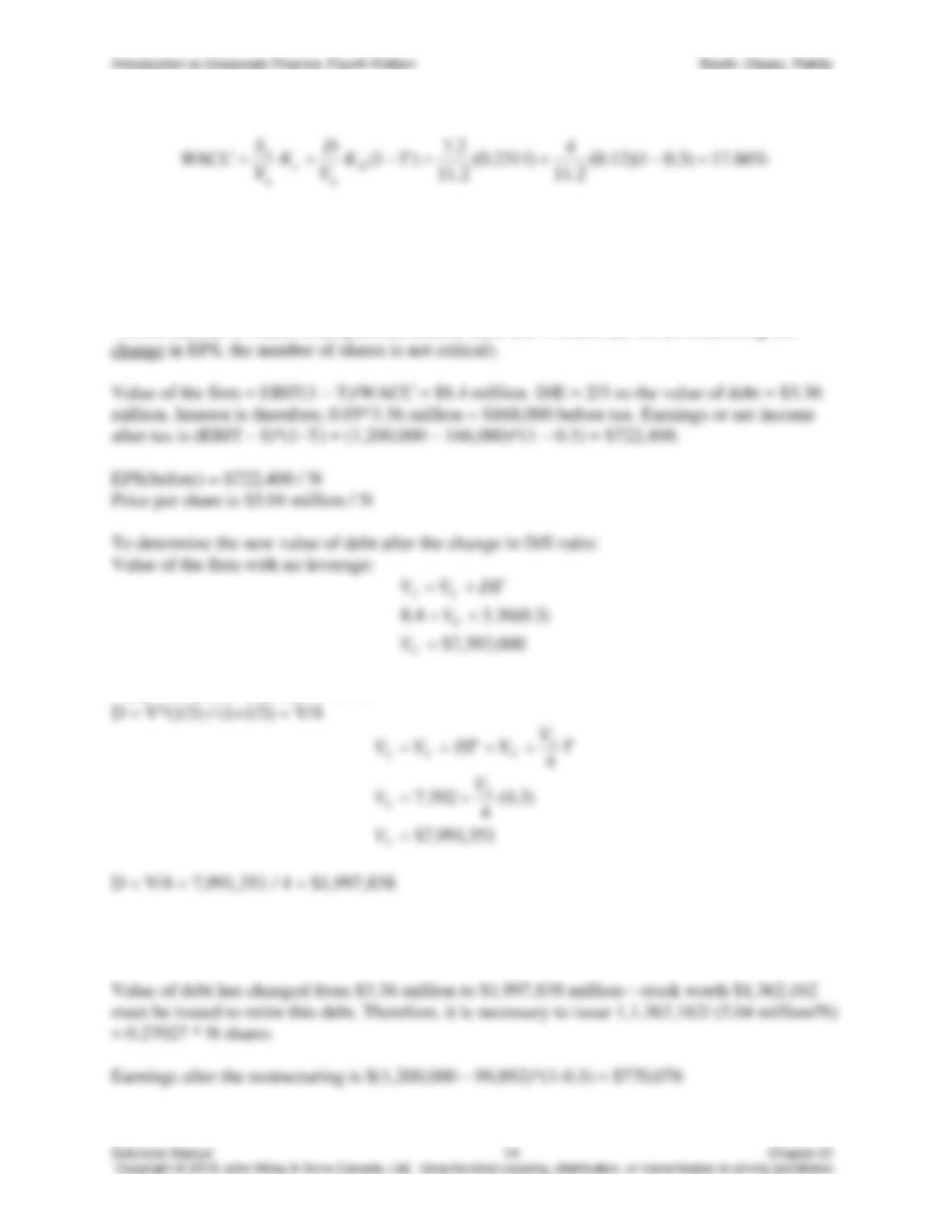
a. Assuming that all cash flows are permanent, then the new value of Athabascan Drilling is
$11.2 million.
The WACC is then:
39. Section: 21.4 The Impact of Taxes on Capital Structure
Learning Objective: 21.4
Level of difficulty: Challenging
Solution:
a.
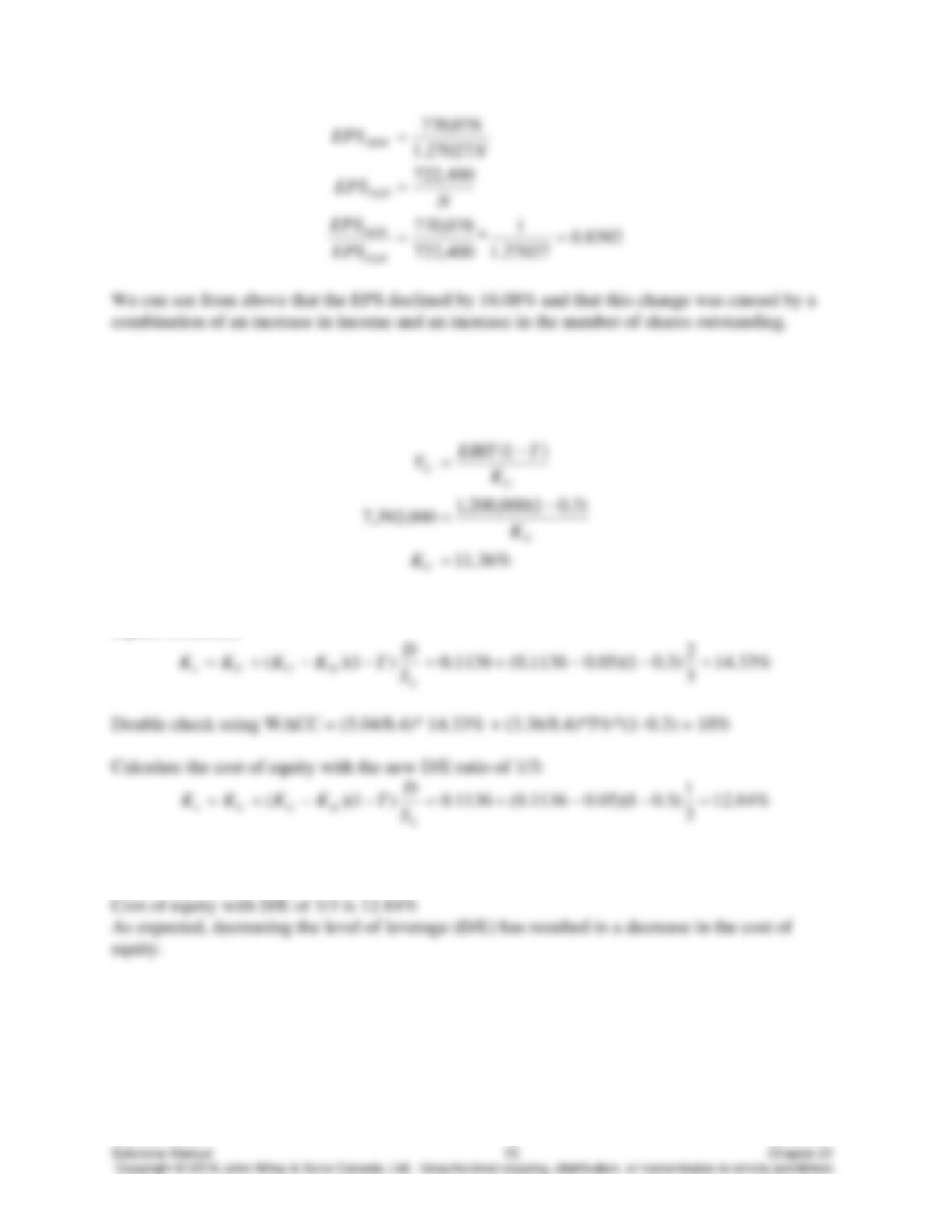
As the number of shares is unspecified assume there are N shares (as we are examining the
Value of the firm with a D/E of 1/3
Value of the debt is $1,997,838 resulting in interest of $99,892 per year. New value of equity is
$5,993,513.
Introduction to Corporate Finance, Fourth Edition Booth, Cleary, Rakita
b.
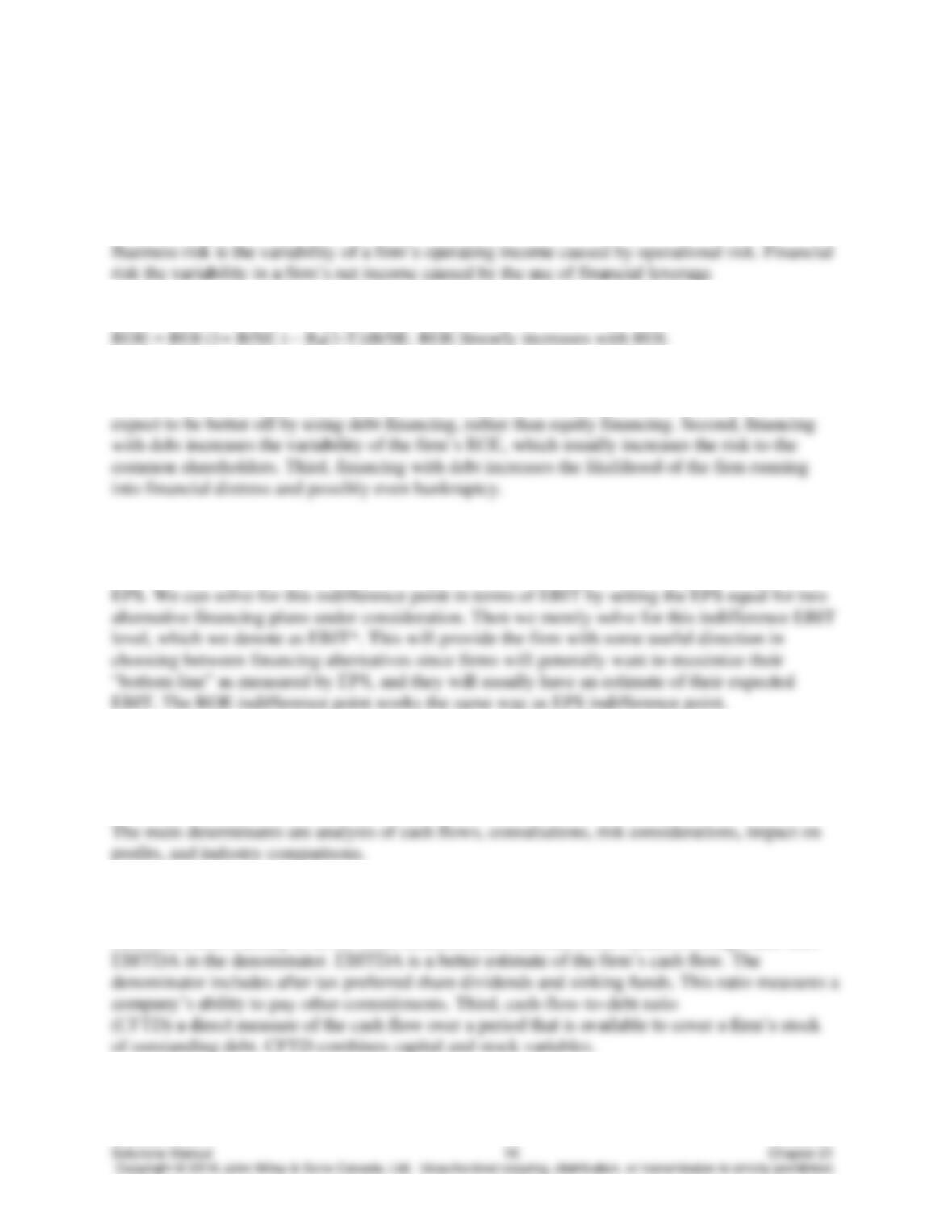
To determine the cost of equity of Straightforward Theatre Company, obtain the cost of
unlevered equity (remember this does not change as the capital structure changes):
Then, using the cost of levered equity formula, obtain the old cost of equity (before the change in
capital structure):
Summary:
Cost of equity with D/E of 2/3 is 14.33%
Introduction to Corporate Finance, Fourth Edition Booth, Cleary, Rakita
Answers to Concept Review Questions
21.1 Financial Leverage
Concept review questions
1. Define business risk and financial risk.
2. How does financial leverage affect the relationship between ROI and ROE?
3. What are the three rules of leverage?
First, for value-maximizing firms, the use of debt increases the expected ROE so shareholders
4. Describe how we determine the ROE and EPS indifference points for a firm based on various
financing alternatives, and explain why this analysis provides the firm with useful information.
EPS indifference point is the EBIT level at which two financing alternatives generate the same
21.2 Determining Capital Structure
Concept review questions
1. What are the main determinants of capital structure?
2. Explain how ratios may be used to assess a company’s ability to assume more debt.
First, interest ratio is EBIT divided by interests. EBIT is not cash flow. Also this ratio cannot
measure a firm’s ability to cover other commitments. Second, fixed burden coverage ratio uses
of outstanding debt. CFTD combines capital and stock variables.
3. What is Altman’s Z score and what does it measure?
Introduction to Corporate Finance, Fourth Edition Booth, Cleary, Rakita
Altman’s Z-score is due to the work of Professor Ed Altman, and is a weighted average of
21.3 The Modigliani and Miller (M&M) Irrelevance Theorem
Concept review questions
1. State the assumptions underlying the M&M irrelevance theory.
M&M’s key assumptions are as follows. (1) There exist two firms in the same “risk class” with
2. Explain the importance of this theory.
Unfortunately, the “M&M results” are only as good as their assumptions, and most of them have
3. What is the basic argument that M&M use to arrive at the irrelevancy result?
M&M proved their proposition by means of an arbitrage argument that there is no such thing as
4. In this ideal M&M world, what will affect firm value?
21.4 The Impact of Taxes on Capital Structure
Concept review questions
1. How do taxes affect the M&M argument?
2. What are the practical difficulties associated with the implications of M&M’s corporate tax
model?
This model contains a crucial flaw, which is that the adjustment is based on the M&M equation,
Introduction to Corporate Finance, Fourth Edition Booth, Cleary, Rakita
21.5 Financial Distress, Bankruptcy, and Agency Costs
Concept review questions
1. Explain the impact of financial distress and agency costs on M&M’s conclusions regarding
capital structure.
The probability of financial distress increases with debts. Financial distress brings both direct
2. Why can the firm’s debt be viewed as the exercise price to the shareholders’ option to
purchase the firm?
If a firm’s value is greater than debt, shareholders can the difference between the firm value and
3. Explain the static trade-off theory.
Static trade-off model states that the firm uses debt to maximize its tax advantages up to the
21.6 Other Factors Affecting Capital Structure
Concept review question
1. Explain how the existence of informational asymmetries and agency problems may lead firms
to follow a pecking order to financing.
Myers’ argument that firms follow a pecking order is based on divulging information. If the
firms use internal cash flow then they do not need anyone’s permission. For example, even the
Introduction to Corporate Finance, Fourth Edition Booth, Cleary, Rakita
21.7 Capital Structure in Practice
Concept review question
1. Explain four of the most important factors influencing capital structure decisions as indicated
in the survey results and how they relate to the conceptual discussion of an optimal capital
structure.
The four most important factors in the Deutsche Bank survey were:
1) Credit rating