560 Instructor’s Manual
A21-14. The Williams Act was designed to stem a wave of hostile takeovers through tender offers.
Target shareholders may have been unable to evaluate the terms of tender offers in the of-
ten short periods of time for which they were open. Sometimes select shareholders were
Q21-15. What are the restrictions faced by corporate insiders during corporate control events?
A21-15. Insider trading laws attempt to prevent informed trading on material nonpublic infor-
mation (inside information), like an upcoming takeover attempt. SEC Rule 10-b-5 out-
Q21-16. How have individual states become more active monitors of takeover activity?
A21-16. Individual states have become more active monitors of takeover activity. Some states
have adopted various antitakeover and anti-bust-up provisions and formed antitrust agen-
Q21-17.To whom is the board of directors accountable, and how should this responsibility affect
how the board of directors treats an acquisition bid?
Solutions to End-of-Chapter Problems
Overview of Corporate Control Activities
P21-1. A firm has four divisions—food, cookware, retail, and credit services—that generate reve-
nues of $1.5 million, $3.8 million, $5.7 million, and $3.1 million, respectively. Compute
the Herfindahl Index (HI) for the firm. The firm is considering the purchase of a rival re-
tailer, which would increase the retail division’s revenues by another $3.2 million. The
firm is also considering selling its credit services division. Assuming these two actions oc-
cur, what will the HI become? What is the HI if the sale of the credit division does not oc-
cur but the rival is acquired?

Chapter 21 Mergers, Acquisitions and Corporate Control
561
A21-1. Sum all of the sales: $1.5 million + $3.8 million + $5.7 million + $3.1 million = $14.1
million
P21-2. HHG Consultants has been asked to analyze Carol & Carroll Co. (C&C), which has one
retail division. C&C is concerned that it is not focused on its core mission of sales despite
only having one division. Each store is divided into departments: casual clothing (CC),
formal clothing (FC), outerwear (OW), shoes (S), and specialty items (SI). C&C’s initial
impression is that all of the departments contribute equally to sales. However, examination
of each department’s actual sales reveals that the breakdown is very different: $5.2 billion
(CC), $2.7 billion (FC), $3.75 billion (OW), $4.5 billion (S), and $1.7 billion (SI). Com-
pute a Herfindahl Index based on the departments having equal sales and based on the ac-
tual sales. Your conclusion concerning the firm’s becoming unfocused will be based on the
actual HI being lower than the equivalent sales HI scenario. What does your analysis find
with regard to the focus of C&C’s retailing division?
P21-3. Firm X has three divisions that generate revenues of $1.3 billion, $2.5 billion, and $5.2
billion. Firm Y is a competitor with three associated divisions that generate $2 billion each.
Using a Herfindahl Index to measure focus, determine if both Firm X and Firm Y share-
holders would see a merger as an action that would increase or rather decrease focus.
A21-3. Firm X sum of sales: $1.3 billion + $2.5 billion + $5.2 billion = $9 billion
562 Instructor’s Manual
P21-4. Shareholders of the firm Up-4-Grabs (U4G) have been offered $36.00 per share in cash for
each of their U4G shares currently selling for $29.53. What is the control premium being
offered in this cash deal? U4G is also considering a stock-swap offer from another firm,
BuyNow, Inc. (BYN). BYN will issue one share for every two shares of U4G. At what
price will BYN shares be equivalent to the control premium available in the cash offer?
When news leaks out about the merger, BYN shares increase to $77.00 and U4G shares in-
crease to $35.24. What control premium does BYN offer now?
P21-5. HBABB Corp. has purchased all of the 10 million shares of BOBCO stock for $43.75 a
share. BOBCO’s net asset value is $350 million. How much goodwill does HBABB need
to consider on its balance sheet? Suppose part of the deal requires HBABB to pay $30 mil-
lion of BOBCO’s debt. Refigure the net asset value (i.e., reduce the debt by $30 million)
and then recalculate the goodwill. One of your accountants tells you that the net asset value
should not be changed and that the $30 million used for BOBCO’s debt should be added to
the purchase price. Refigure the goodwill calculation and determine if there really is a dif-
ference. If there is a difference, which calculation is correct?
A21-5. Goodwill: $43.75*10 million – $350 million = $87.5 million
P21-6. Mega Service Corporation (MSC) is offering to exchange 2.5 shares of its own stock for
each share of target firm Norman Corporation stock as consideration for a proposed mer-
ger. There are 10 million Norman Corp shares outstanding, and its stock price was $60 be-
fore the merger offer. MSC’s pre-offer stock price was $30. What is the control premium
percentage offered? Now suppose that, when the merger is consummated eight months lat-
er, MSC’s stock price drops to $25. At that point, what is the control premium percentage
and total transaction value?
A21-6. The pre-offer value of Norman Corporation is $600 million (10 million shares × $60/share)

Chapter 21 Mergers, Acquisitions and Corporate Control
563
P21-7. Bulldog Industries is offering, as consideration for merger target Blazerco, 1.5 shares of
their stock for each share of Blazerco. There are 1 million shares of Blazerco outstanding,
and its stock price was $50 before the merger offer. Bulldog’s preoffer stock price was
$40. What is the control premium percentage offered? Now suppose that when the merger
is consummated six months later, Bulldog’s stock price drops to $30. At that point, what is
the control premium percentage and total transaction value?
A21-7. The pre-offer value of Blazerco is $50 million (1 million shares × $50/share) and Bulldog
P21-8. You are the director of capital acquisitions for Crimson Software Company. One of the
projects you are considering is the acquisition of Geekware, a private software company
that produces software for finance professors. Dave Vanzandt, the owner of Geekware, is
amenable to the idea of selling his enterprise to Crimson, but he has certain conditions that
must be met before selling. The primary condition set forth is a nonnegotiable, all-cash
purchase price of $20 million. Your project analysis team estimates that the purchase of
Geekware will generate the following marginal cash flow:
Year
Cash Flow
1
$1,000,000
2
3,000,000
3
5,000,000
4
7,500,000
5
7,500,000
Of the $20 million in cash needed for the purchase, $5 million is available from retained
earnings, with a required return of 12%, and the remaining $15 million will come from a
new debt issue yielding 8%. Crimson’s tax rate is 40%. Should you recommend acquiring
Geekware to your CEO?
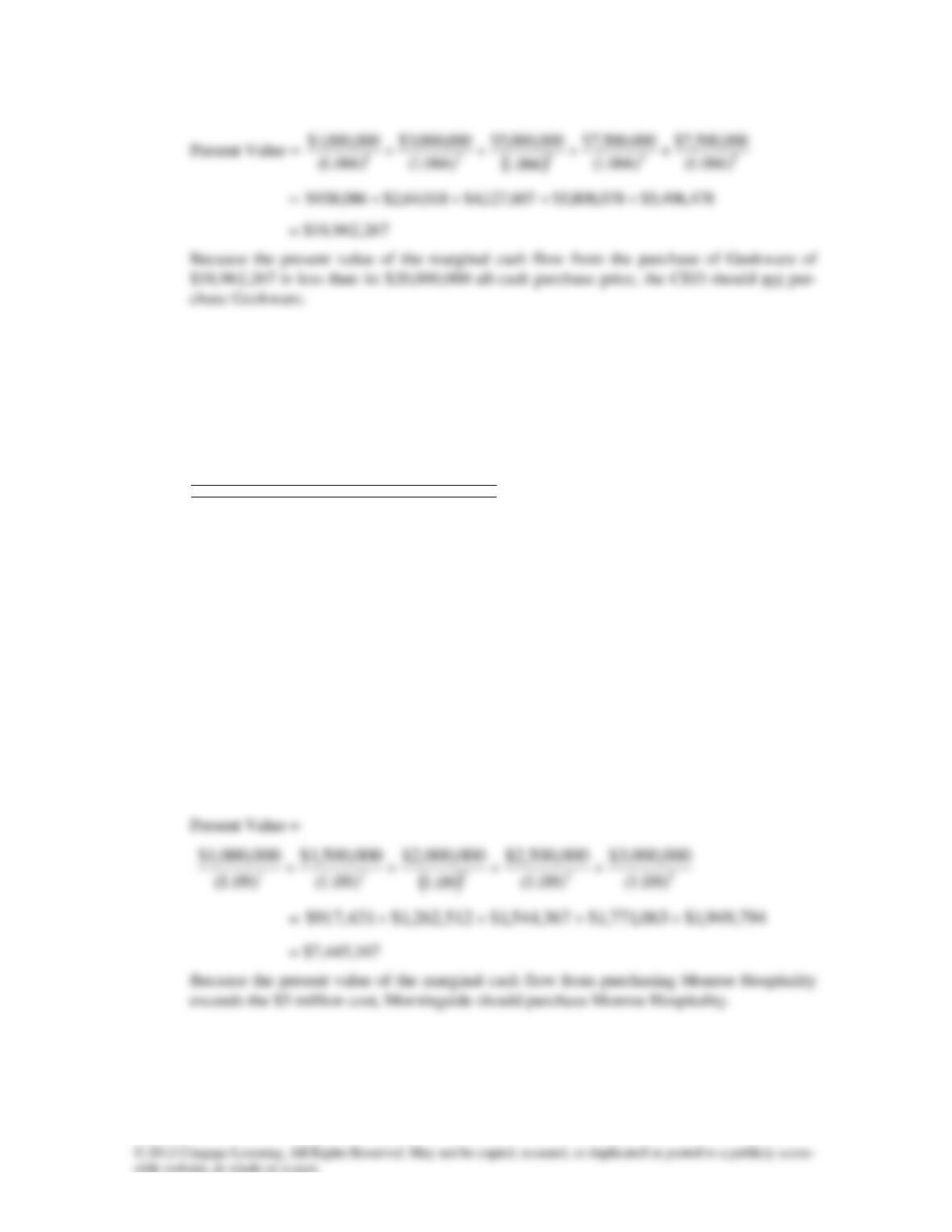
A21-8. First, we calculate the weighted average cost of capital (WACC), which is the required re-
turn on the proposed acquisition.
564 Instructor’s Manual
P21-9. You are the director of capital acquisitions for Morningside Hotel Company. One of the
projects you are deliberating is the acquisition of Monroe Hospitality, a company that owns
and operates a chain of bed-and-breakfast inns. Susan Sharp, Monroe’s owner, is willing to
sell her company to Morningside only if she is offered an all-cash purchase price of $5 mil-
lion. Your project analysis team estimates that the purchase of Monroe Hospitality will
generate the following after-tax marginal cash flow:
Year
Cash Flow
1
$1,000,000
2
1,500,000
3
2,000,000
4
2,500,000
5
3,000,000
If you decide to go ahead with this acquisition, it will be funded with Morningside’s stand-
ard mix of debt and equity at the firm’s weighted average (after-tax) cost of capital of 9%.
Morningside’s tax rate is 30%. Should you recommend acquiring Monroe Hospitality to
your CEO?
A21-9. We use the 9.0% WACC to find the present value of the forecast marginal cash
flow.
P21-10. Firm A plans to acquire Firm B. The acquisition would result in incremental cash flows for
Firm A of $10 million in each of the first five years. Firm A expects to divest Firm B at the
end of the fifth year for $100 million. The β for Firm A is 1.1, which is expected to remain
unchanged after the acquisition. The risk-free rate, Rf, is 7%, and the expected market rate
Chapter 21 Mergers, Acquisitions and Corporate Control
565
of return, Rm, is 15%. Firm A is financed by 80% equity and 20% debt, and this lever-
age will also remain unchanged after the acquisition. Firm A pays interest of 10% on its
debt, which will also remain unchanged after the acquisition.
a. Disregarding taxes, what is the maximum price that Firm A should pay for Firm B?
b. Firm A has a stock price of $30 per share and 10 million shares outstanding. If Firm B
shareholders are to be paid the maximum price determined in part (a) via a new stock
issue, how many new shares will be issued, and what will be the postmerger stock
price?
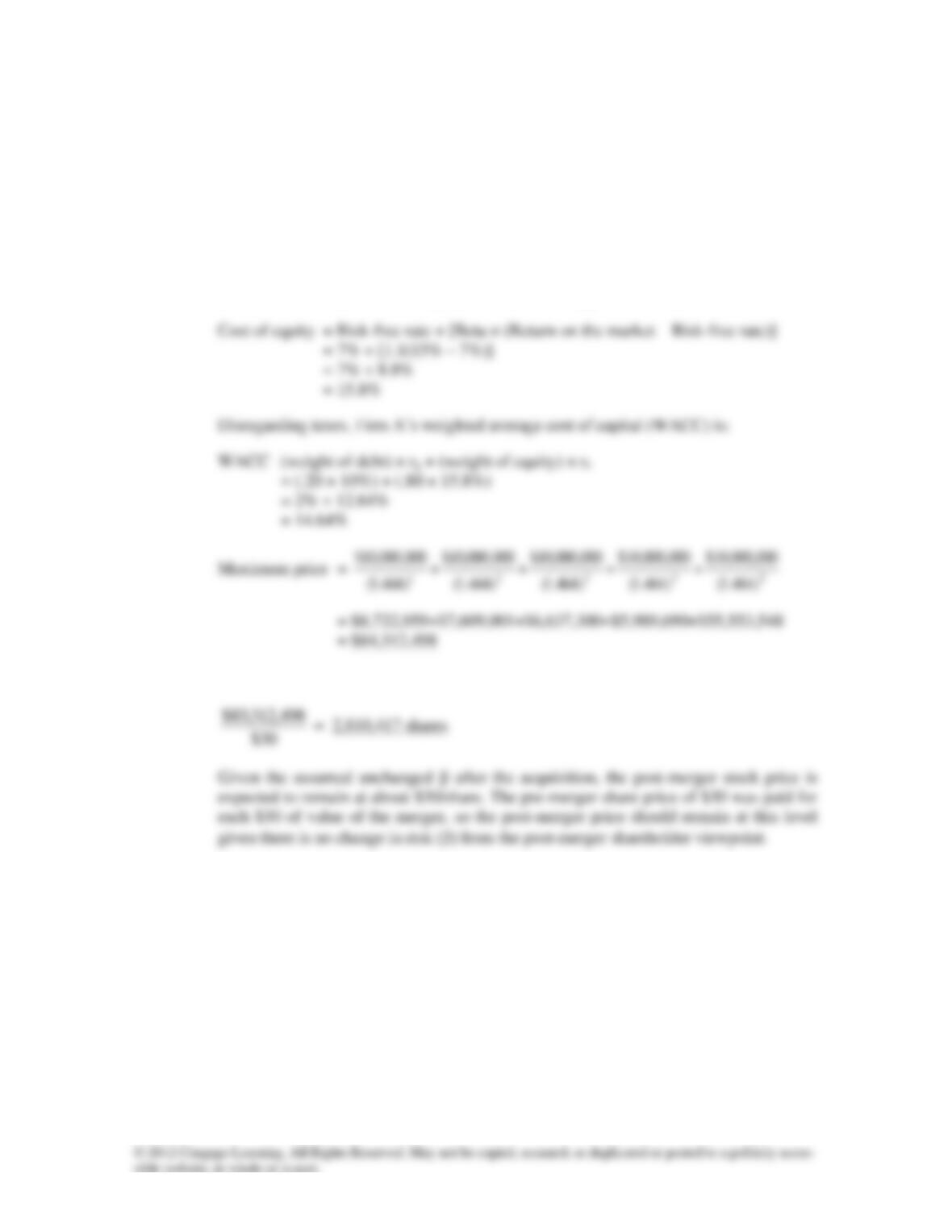
A21-10. a. First calculate the cost of capital that should be applied to this investment.
b. Number of new shares issued at assumed $30/share price:
P21-11. Charger Incorporated and Sparks Electrical Company are competitors in the business of
electrical components distribution. Sparks is the smaller firm and has garnered the attention
of the management of Charger, as Sparks has taken away market share from the larger firm
by increasing its sales force over the past few years. Charger is considering a takeover offer
for Sparks and has asked you to serve on the acquisition valuation team that will turn into
the due diligence team if an offer is made and accepted. Given the following information
and assumptions:
a. Make your recommendation about whether or not the acquisition should be pursued.
b. Assume Sparks has accepted the takeover offer from Charger, and now the new subsid-
iary must be consolidated within Charger’s financial statements. Taking Sparks’s most
recent balance sheet and a restated market value of assets of $295.6 million, calculate
the goodwill that must be booked for this transaction.
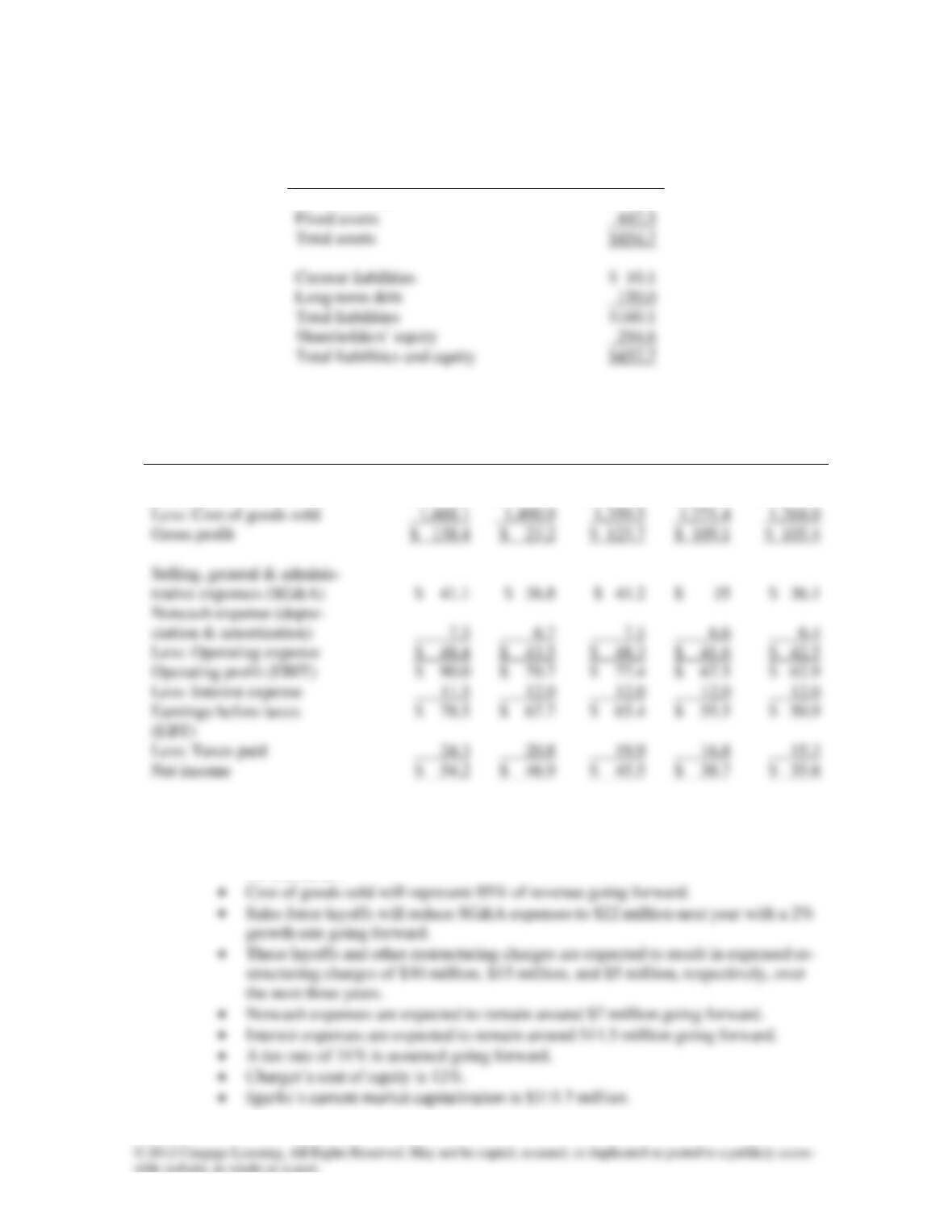
566 Instructor’s Manual
Sparks Electrical Company
Condensed Balance Sheet
Previous Year (2011) ($ in millions)
Current assets
$ 12.2
Fixed assets
Total assets
Current liabilities
Long-term debt
150.0
Total liabilities
Total liabilities and equity
$457.7
Sparks Electrical Company
Condensed Income Statement
Previous Five Years ($ in millions)
2011
2010
2009
2008
2007
Revenues
$1,626.5
$1,614.1
$1,485.2
$1,380.5
$1,373.4
Less: Cost of goods sold
Gross profit
$ 138.4
$ 23.2
$ 109.1
ciation & amortization)
6.7
6.6
Less: Operating expense
Operating profit (EBIT)
$ 79.7
$ 67.5
Less: Interest expense
(EBT)
Less: Taxes paid
Net income
$ 46.9
$ 38.7
Assumptions:
• Sparks would become a wholly owned subsidiary of Charger.
• Revenues will continue to grow at 4.3% for the next five years and will level off at
4% thereafter.
Chapter 21 Mergers, Acquisitions and Corporate Control
567
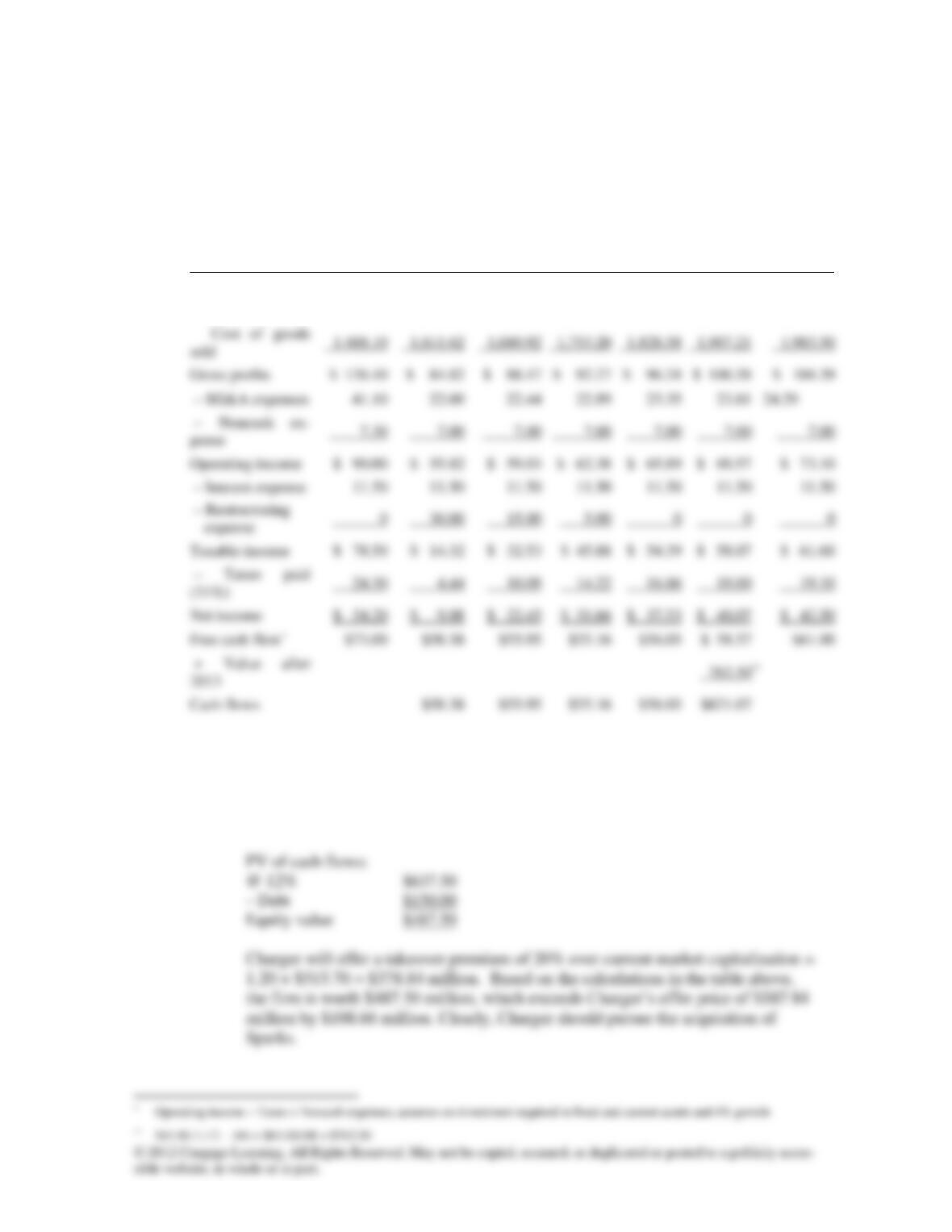
• Charger will offer Sparks a takeover premium of 20% over current market capi-
talization.
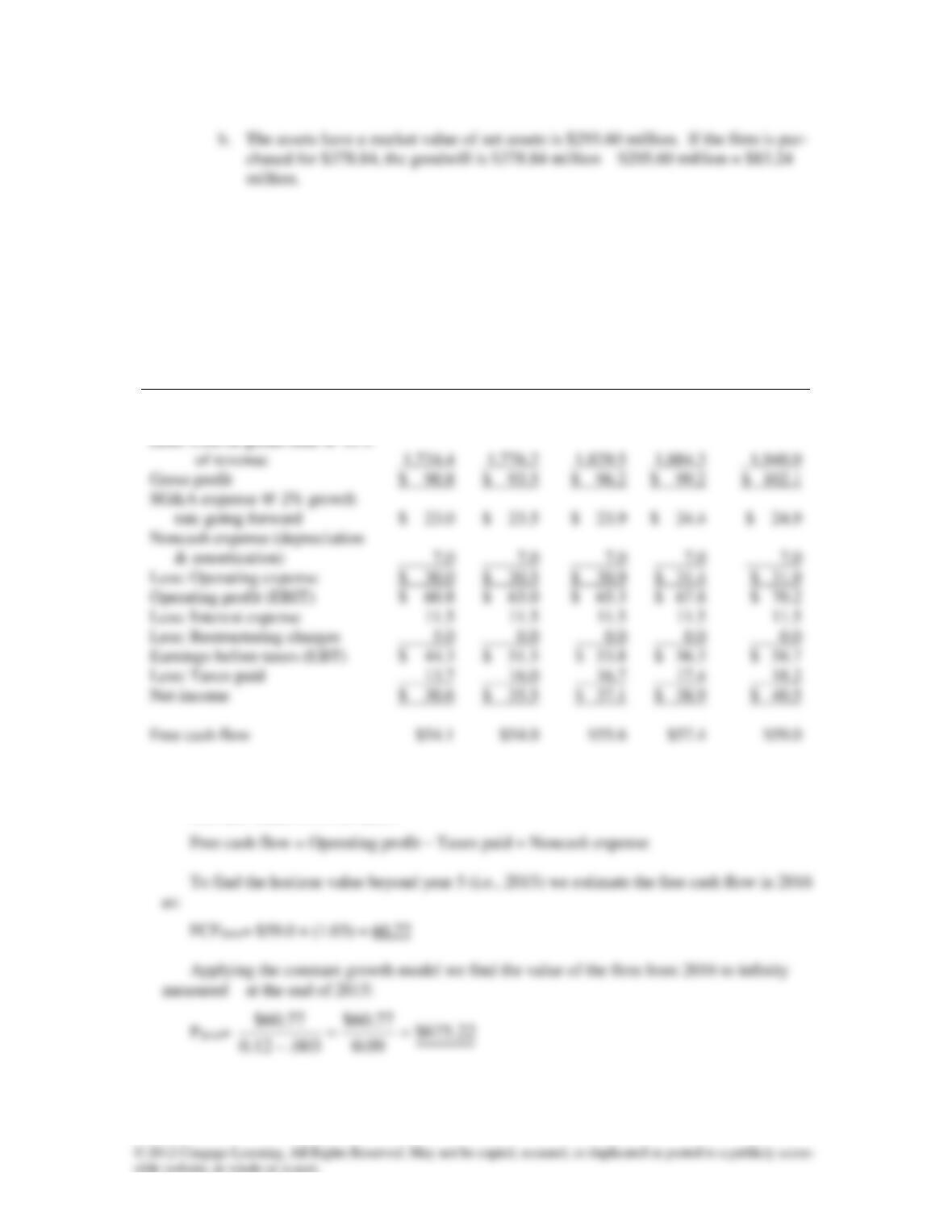
A21-11. a. Assume Charger is an all equity firm and plans on remaining so after the merger
and that the appropriate discount rate is Charger’s 12% cost of equity. The cash flows
and present values are calculated in the following table:
Cash Flow Development ($ in millions)
2011
2012
2013
2014
2015
2016
2017
Revenues
$1,626.50
$1,696.44
$1,769.39
$1,845.47
$1,924.83
$2,007.59
$2,087.90
Operating income
$ 62.38
$ 65.89
$ 69.57
Taxable income
$ 54.39
$ 58.07
Cash flows
* Operating income – Taxes + Noncash expenses; assumes no investment required in fixed and cur-
rent assets and 4% growth
** $61.00 / (.12 – .04) = $61.00/.08 = $762.50
568 Instructor’s Manual
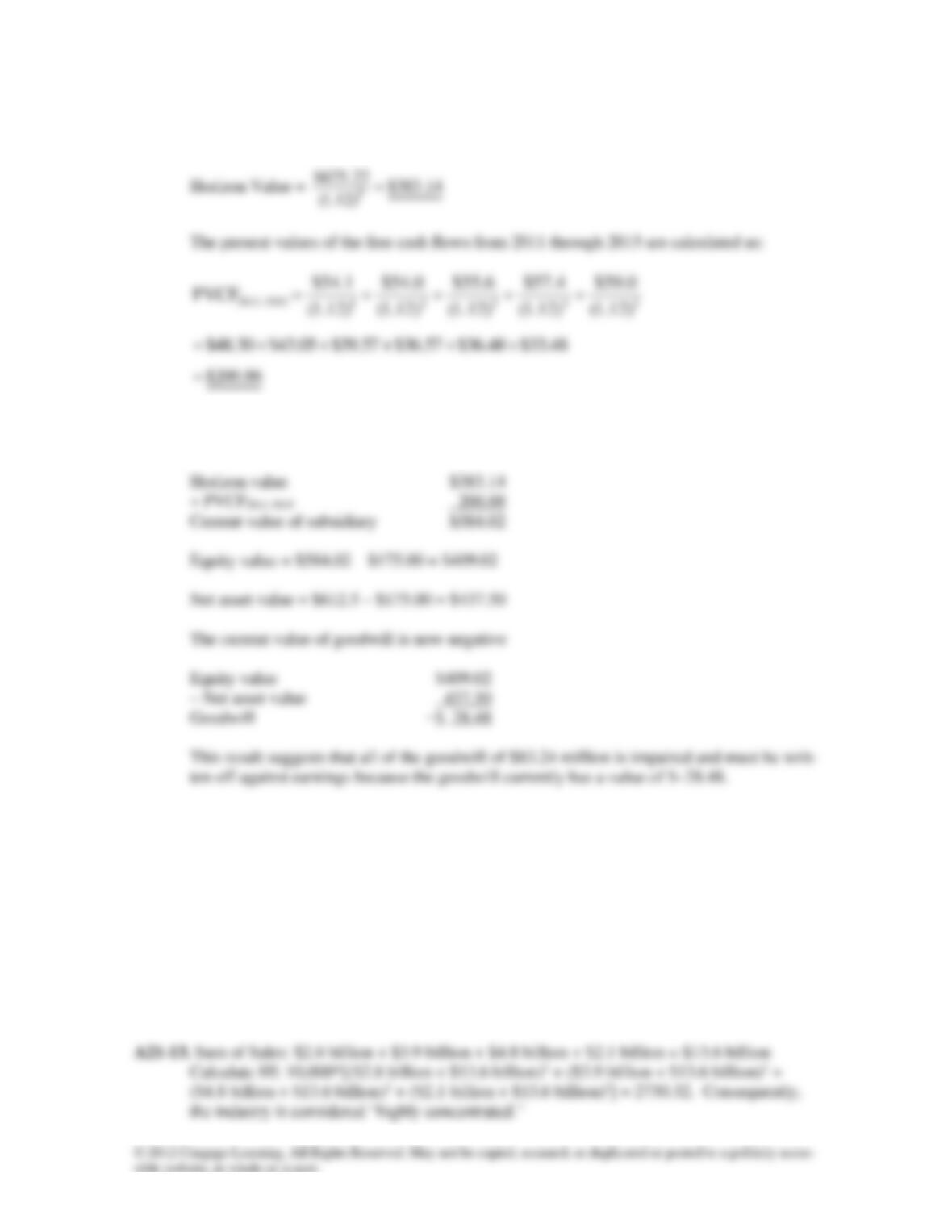
P21-12. Referring to Problem 21-11, assume it is now two years after the acquisition of Sparks, and
you must perform a goodwill impairment test of the subsidiary. Growth expectations have
been lowered to 3% going forward. Using the following five-year projection of cash flows
and a 12% cost of equity, estimate the value of the subsidiary beyond year 5, the current
value of the subsidiary, the current value of goodwill, and any goodwill impairment. Total
assets (excluding intangibles) are now $612.5 million, and total liabilities are $175.0 mil-
lion.
Cash Flow Projections for Next Five Years
2014
2015
2016
2017
2018
Revenues
$1,815.2
$1,869.7
$1,925.7
$1,983.5
$2,043.0
1,724.4
1,776.2
1,884.3
1,940.9
Gross profit
$ 90.8
$ 93.5
$ 99.2
$ 102.1
$ 23.0
$ 23.5
$ 24.4
7.0
7.0
7.0
Less: Operating expense
$ 30.0
$ 30.5
$ 31.4
Operating profit (EBIT)
Less: Interest expense
Earnings before taxes (EBT)
$ 44.3
$ 51.5
$ 56.3
Less: Taxes paid
13.7
16.0
17.4
Net income
Free cash flow
A21-12.These values were calculated by applying the following equation for each year using the
relevant values from the table:
Chapter 21 Mergers, Acquisitions and Corporate Control
569
Discounting back to today (the beginning of 2011) at the 12% rate we get:
The current value of the subsidiary is the sum of the horizon value and the present value of
the cash flows from 2011-2015.
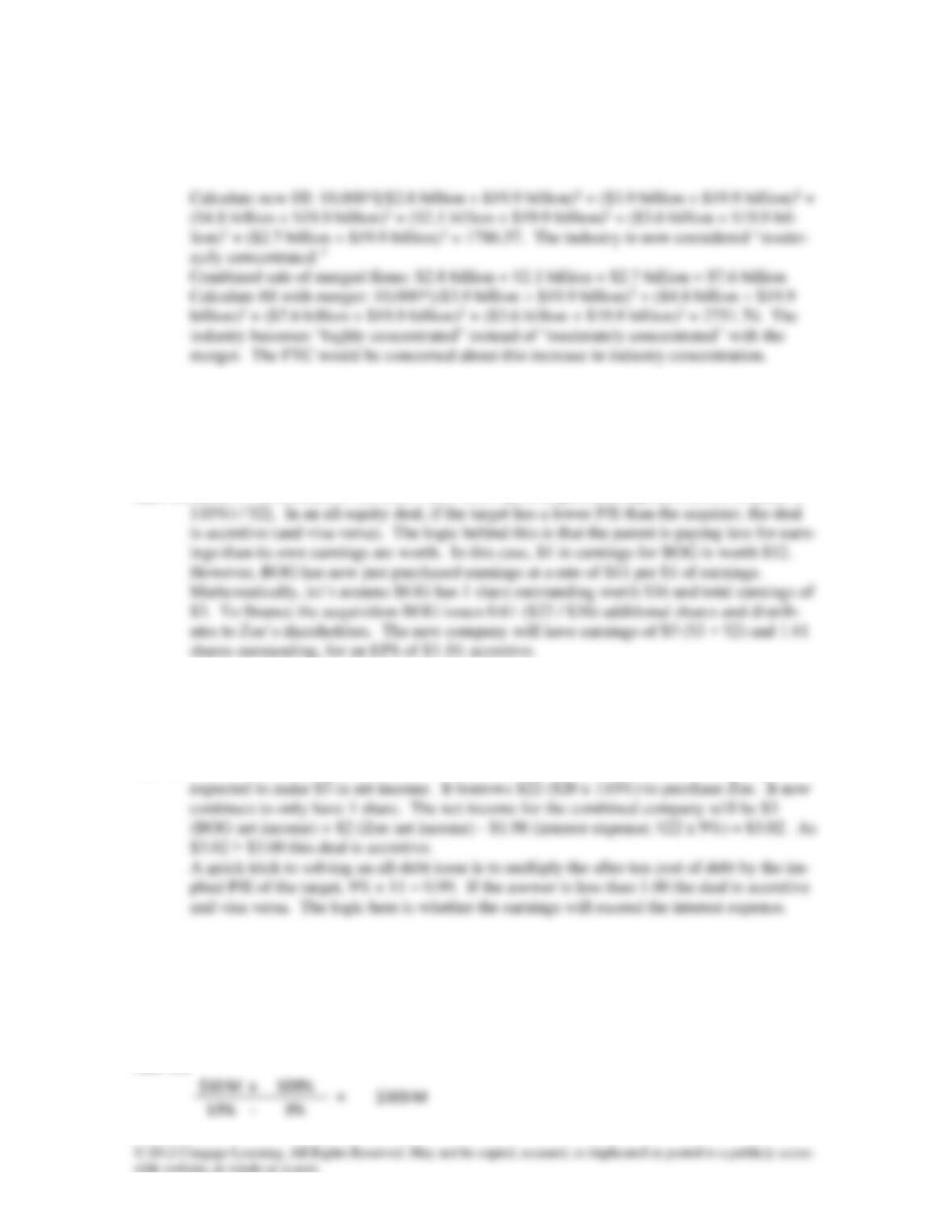
P21-13.
Firms AFD, TYU, CHG, and LAN are competitors within an industry. Their respective
sales figures are $2.8 billion, $3.9 billion, $4.8 billion, and $2.1 billion. What is the Her-
findahl Index (HI) for the industry? Is the industry considered highly concentrated, moder-
ately concentrated, or not concentrated? Assuming that two more firms—QBC ($3.6
billion in sales) and RTY ($2.7 billion in sales)—are added to the industry figures, does the
concentration level of the industry change? (Recompute HI to determine this.) If the three
smallest firms (AFD, LAN, and RTY) merged, would the FTC be concerned? If so, why?
(Note: The HI is measured in units of %2. For example, 50% × 50% = 2,500%2 (or, in dec-
imal form, 0.50 × 0.50 = 0.25). To make the conversion from decimal to percentage form
mathematically, multiply the answer by 10,000; using the same example, this yields 0.50 ×
0.50 × 10,000 = 2,500.)
570 Instructor’s Manual
Sum of sales with two more firms in industry: $13.6 billion + $3.6 billion + $2.7 billion =
$19.9 billion
P21-14.
Bogey Inc. (BOG), with a share price of $36 and EPS of $3, purchases Zoe Corp., with a
pre-acquisition share price of $20 and EPS of $2, for a 10% premium. If the deal is fi-
nanced exclusively with BOG equity and no material synergies are expected, is the deal
accretive or dilutive to BOG shareholders?
A21-14. BOG’s P/E multiple is 12x ($36 / $3). Zoe’s post-acquisition implied P/E is 11x [($20 x
P21-15.Following the previous question, what if BOG instead financed the acquisition entirely
with debt at an after-tax cost of 9%? Would the deal be accretive or dilute to earnings for
BOG shareholders?
A21-15. For this problem, again pretend BOG has 1 share worth $36 and the entire company is
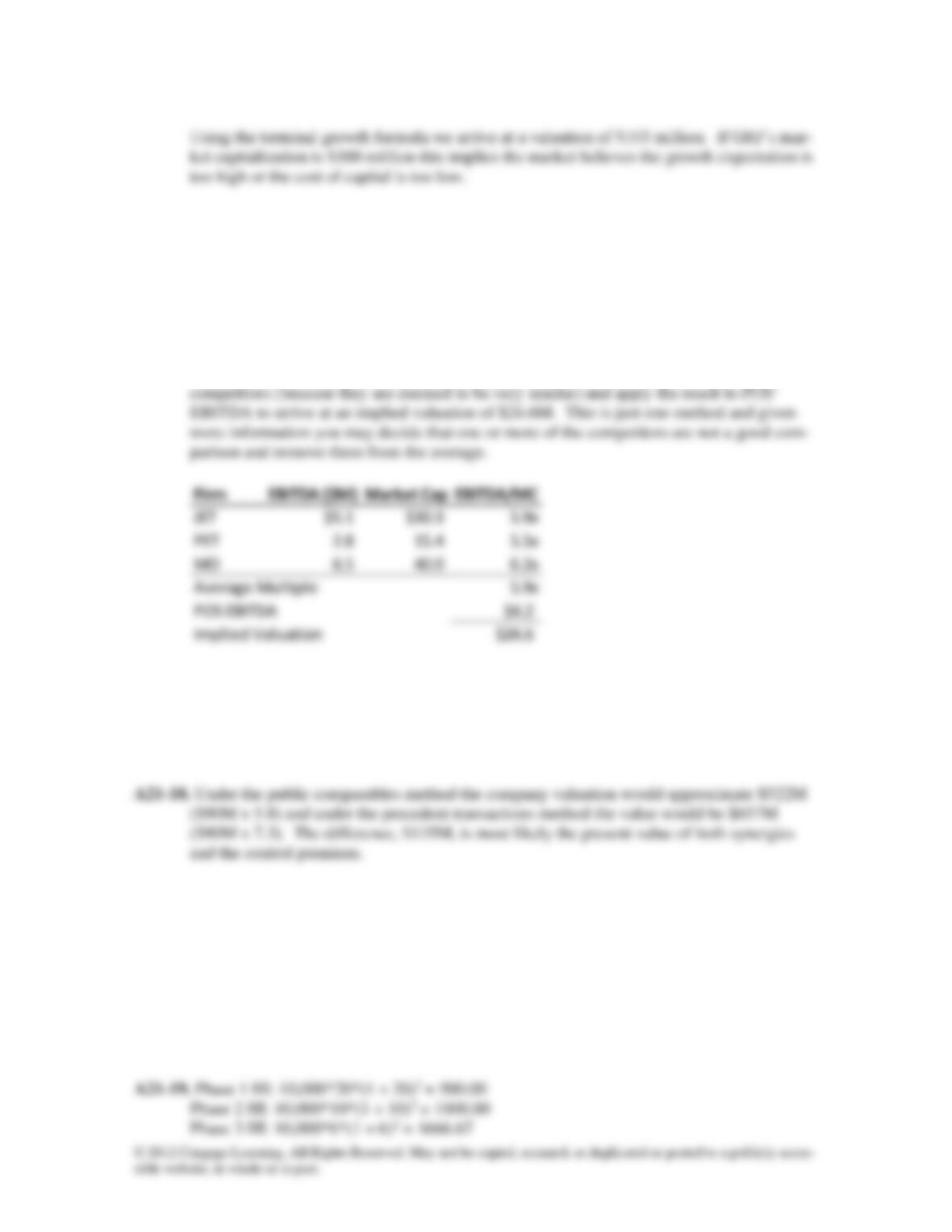
P21-16. GRJ Corp. just reported $10 million in after-tax earnings and management expects to grow
at 3% in perpetuity with a weighted average cost of capital of 13%:
. a. How would you value GRJ using a growing perpetuity formula?
b. If GRJ’s market capitalization is $100 million, what does this say about the market’s
perception of management’s growth and/or cost of capital expectations?
A21-16.
Chapter 21 Mergers, Acquisitions and Corporate Control
571
P21-17.Posada Corp. (POS) expects to earn EBITDA of $4.2 million next year and expects slow
but steady growth thereafter. POS’s three key competitors (nearly identical operations and
growth prospects) are JET (EBITDA of $5.1 million, Market Capitalization of $30.3 mil-
lion), PET (EBITDA of $2.8 million, Market Capitalization of $15.4 million) and MO
(EBITDA of $6.5 million, Market Capitalization of $40 million). What would you estimate
POS’s market valuation to be?
A21-17. As illustrated in the below table, you can average the EBITDA multiples of the three
P21-18. You are assessing a potential acquisition for a client and your analyst informs you that the
historic EBITDA multiple based on Public Comparables is 5.8 and the historic EBITDA
multiple based on Precedent Transactions is 7.3. If the target is expecting EBITDA of $90
million, what are the valuations under each method? Can you rationalize the difference be-
tween the two?
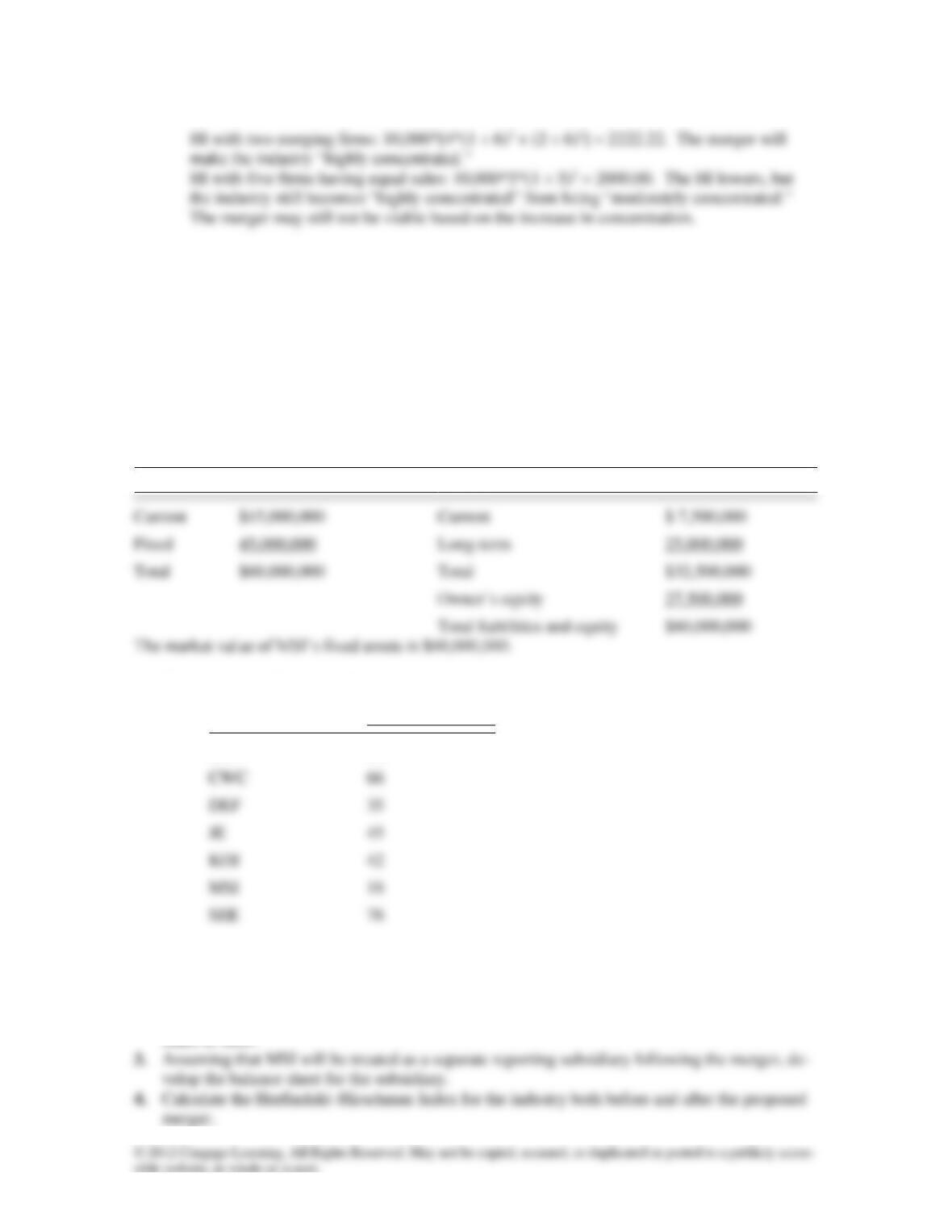
P21-19. A given market was initially segmented evenly among 20 firms (Phase 1). Five years later,
the market was still segmented evenly among competing firms, but there were now only 10
firms (Phase 2). Eventually six firms emerged with equal portions of the market (Phase 3),
but a move toward deregulation of the industry has prompted two of the firms to merge.
Determine the Herfindahl–Hirschman Index for the three phases. Next, determine whether
the merger will cause the industry to be considered highly concentrated. In a preemptive
move (fearing the FTC), the merged firms agree to sell off portions of the market to the
other four firms so that the market will be equally divided among all five firms. How does
this affect the HI, and is the merger viable under these circumstances?
572 Instructor’s Manual
THOMSON ONE Business School Edition: Since P21-20 is based on using a live database, an-
swers will vary from moment to moment. This is a chance for your students to use a version of a
tool that CFAs use every day.
Answer to MiniCase
Mergers, Acquisitions, and Corporate Control
Jackson Enterprises (JE) is offering a 25% takeover premium to Michael Studios, Inc. (MSI) for
the firm’s 2 million outstanding shares, which are currently trading for a pre-offer price of $20 per
share.
The balance sheet for MSI is:
Assets
Liabilities
The sales (in millions) for the industry by company are:
Sales
ABC
$89
CWC
66
Assignment
1. Determine the amount Jackson Enterprises is willing to pay in terms of goodwill.
2. If JE’s shares are currently trading at $62.43, then how many shares should JE offer for every
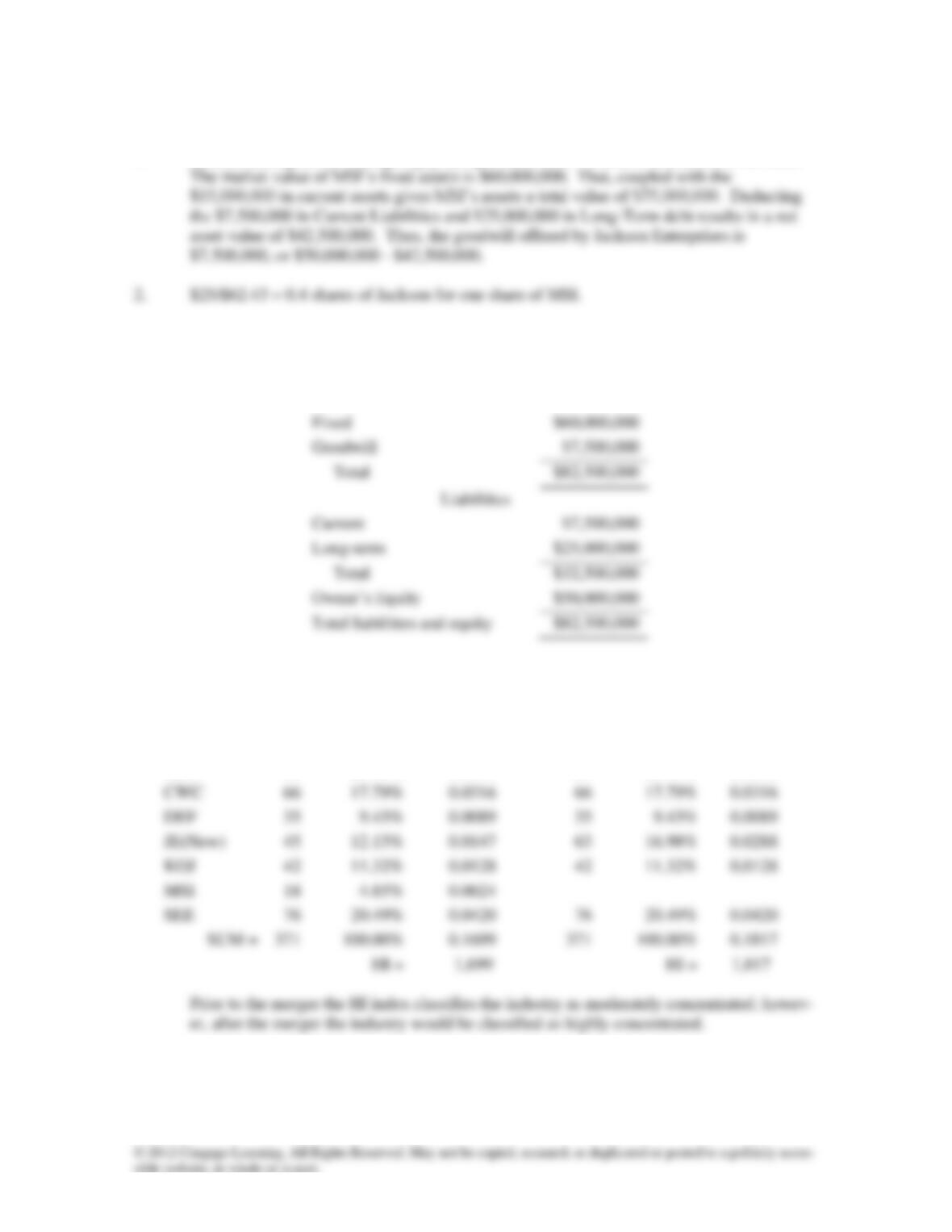
Chapter 21 Mergers, Acquisitions and Corporate Control
573
Answers
1. Jackson Enterprises is willing to pay $25 per share ($20 * 1.25), or $50,000,000 for MSI.
3.
Assets
Current
$15,000,000
Total
$82,500,000
Current
4.
Pre-merger
Post-merger
Sales
Market
Share
Market Share
Squared
Sales
Market
Share
Market
Share
Squared
ABC
89
23.99%
0.0575
89
23.99%
0.0575
66
17.79%
0.0316
66
17.79%
0.0316
KOJ
42
11.32%
0.0128
42
11.32%
0.0128
18
4.85%
0.0024