Mini Case: 21 – 12
VU =
sU
r
)T1(EBIT −
=
$560,000(0.75)
0.14
= $3,000,000 versus $4,000,000.
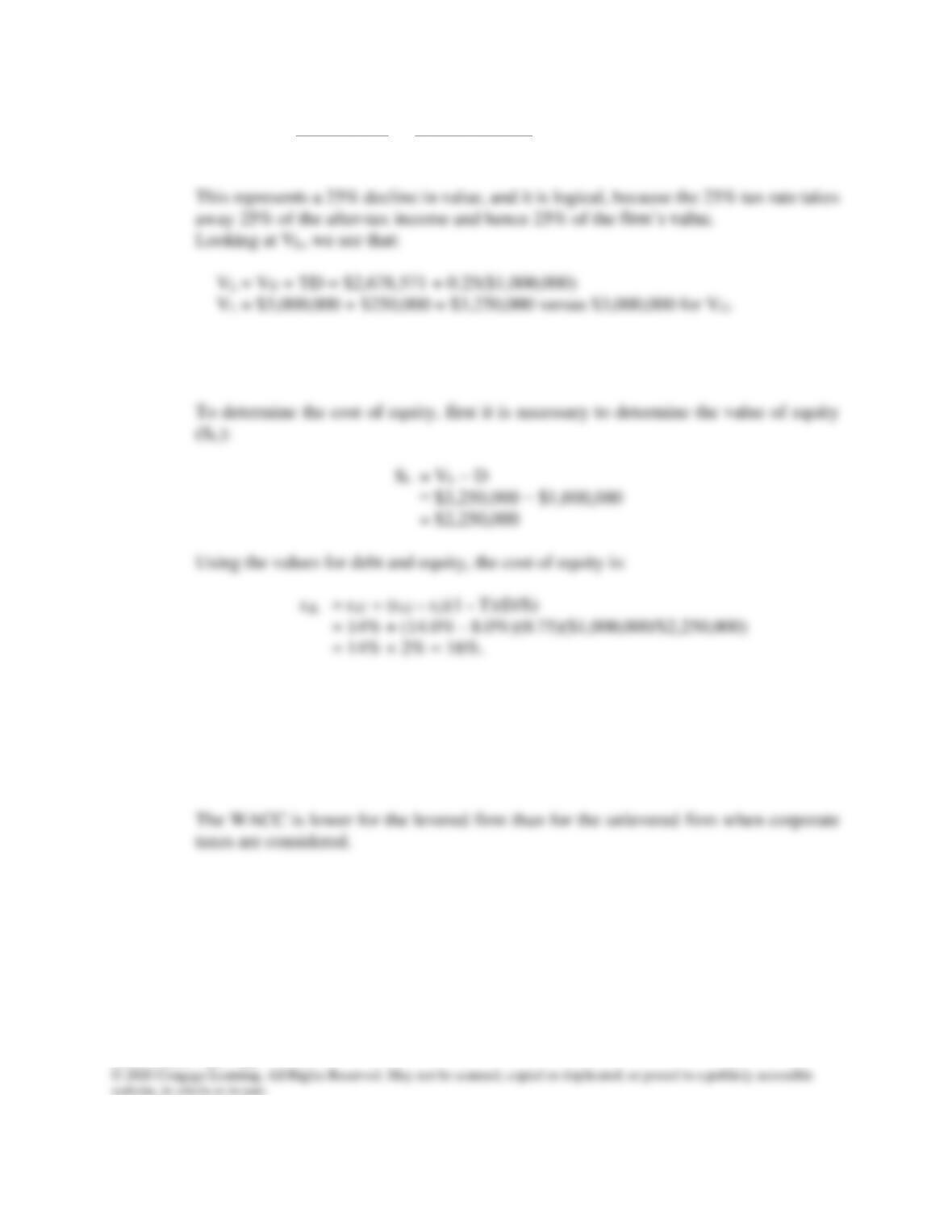
Thus, the use of $1,000,000 of debt financing increases firm value by T(D) = $250,000
over its leverage-free value.
Firm L’s WACC is 11.8 percent:
WACCL = (D/V)rd(1 – T) + (S/V)rs
= ($1,000,000/$3,250,000)(8%)(0.75) + ($2,250,000/$3,250,000)(16%)
= 1.8462% + 11.0769% = 12.9231%.
Mini Case: 21 – 13
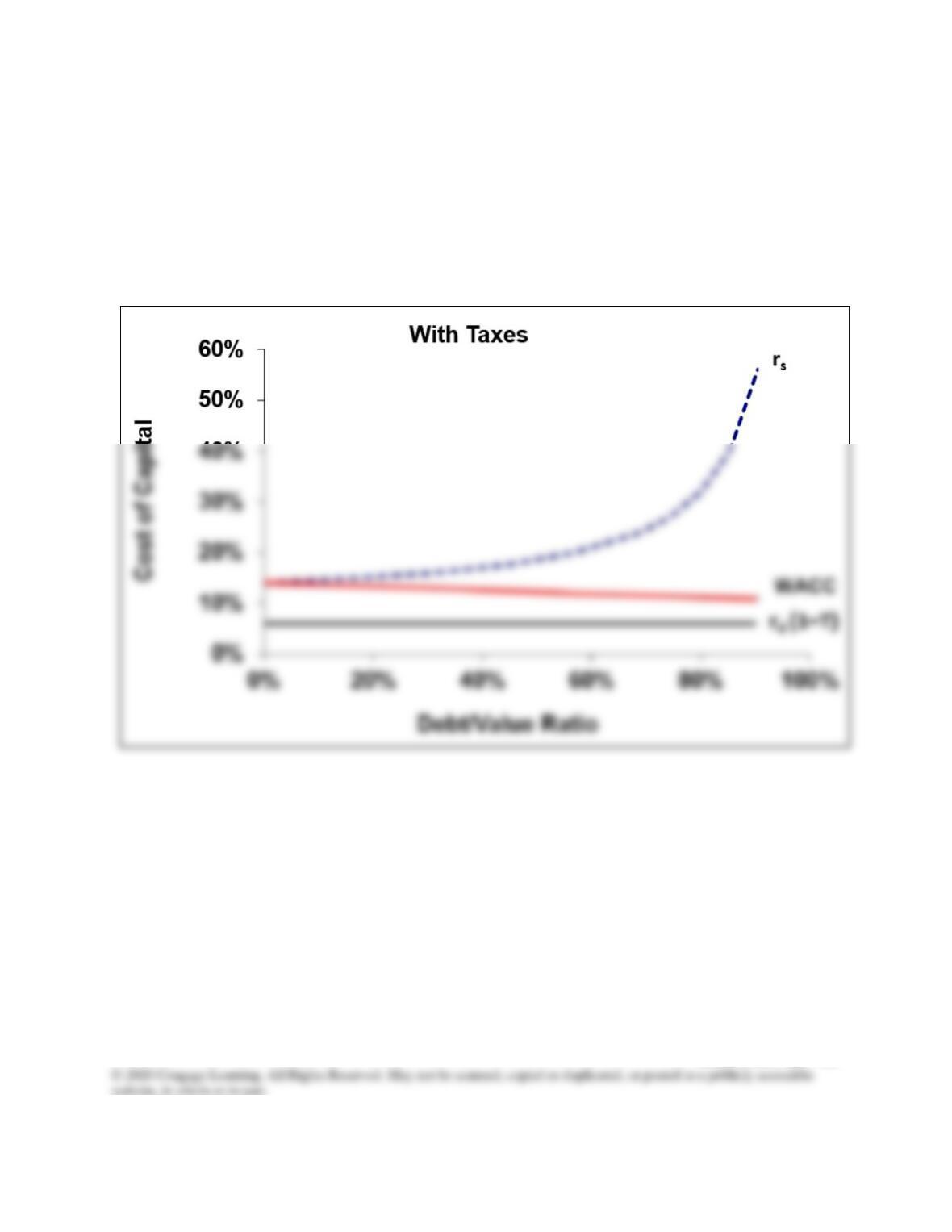
The following figure plots the capital costs at different D/V ratios under the MM
model with corporate taxes. Here the WACC declines continuously as the firm uses
more and more debt, whereas the WACC was constant in the without-tax model. This
result occurs because of the tax deductibility of debt financing (interest payments),
which impacts the graph in two ways: (1) the cost of debt is lowered by (1 – T), and
(2) the cost of equity increases at a slower rate when corporate taxes are considered
because of the (1 – T) term in Proposition II. The combined effect produces the
downward-sloping WACC curve.
Mini Case: 21 – 14
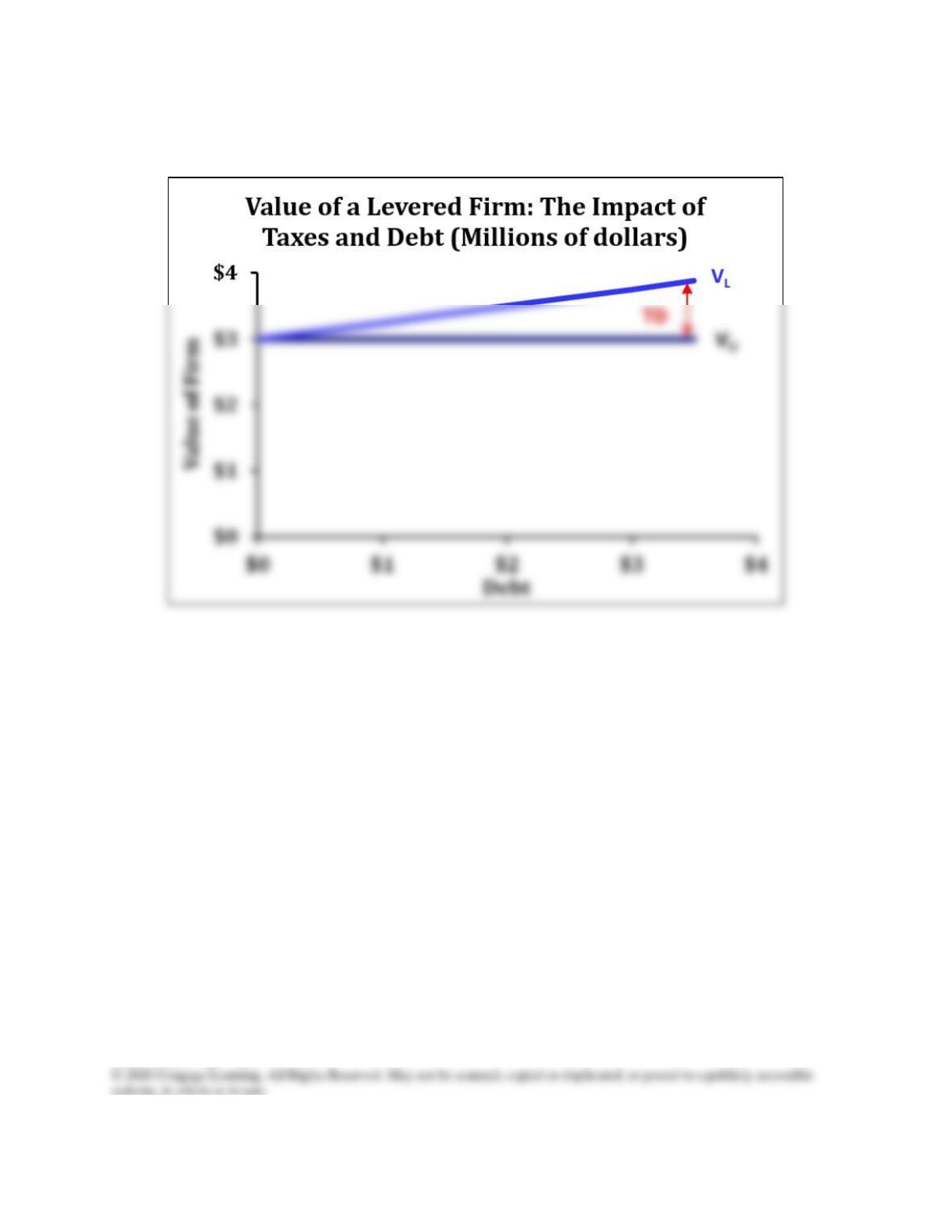
The following figure shows that, when corporate taxes are considered, the firm’s
value increases continuously as more and more debt is used.
d. Suppose that Firms U and L have the same input values as in Part c except for
debt of $980,000. Also, both firms have total net operating capital of $2,000,000
and both firms are expected to grow at a constant rate of 7%. (Assume that the
EBIT in Part c is expected at t = 1.) Use the compressed adjusted present value
(APV) model to estimate the value of U and L. Also estimate the levered cost of
equity and the weighted average cost of capital.
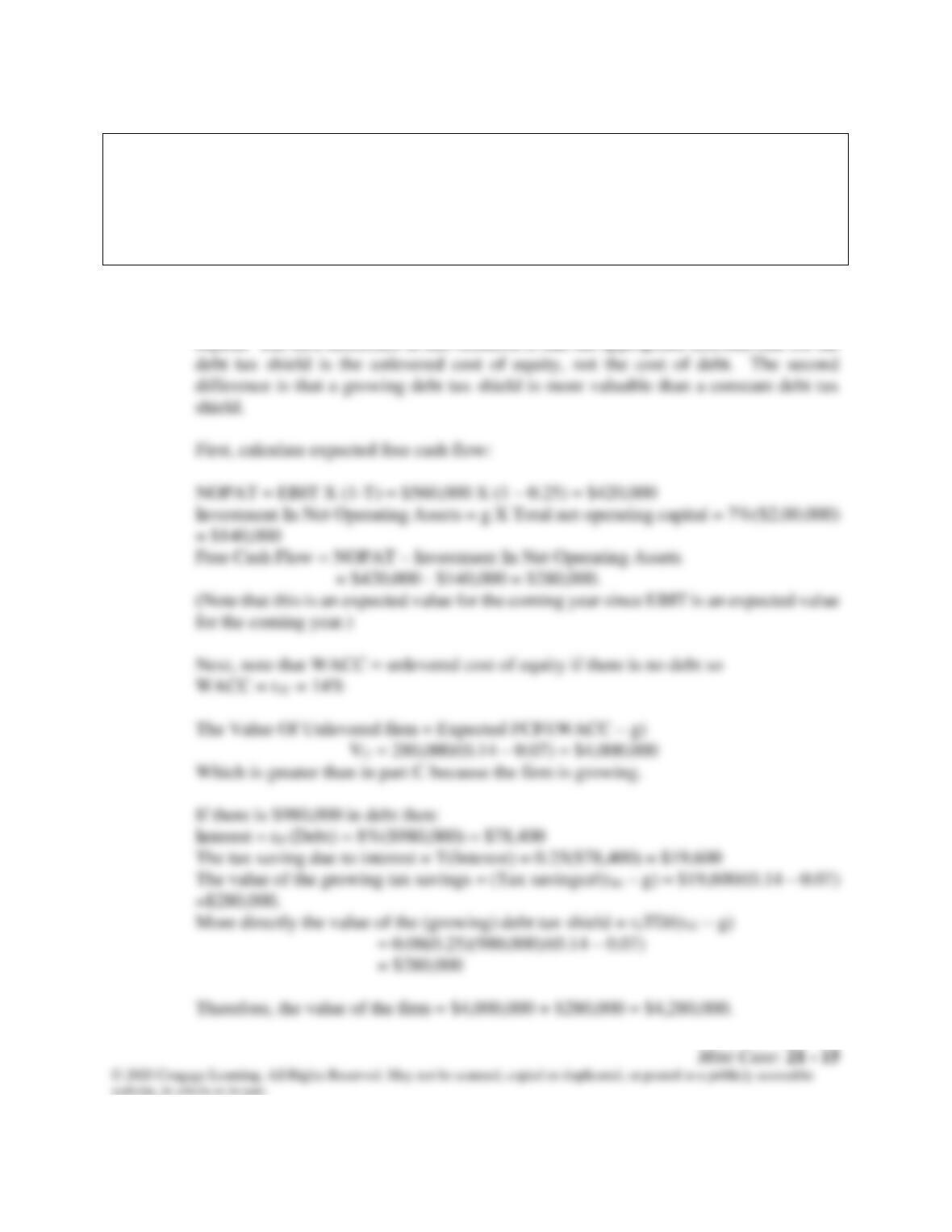
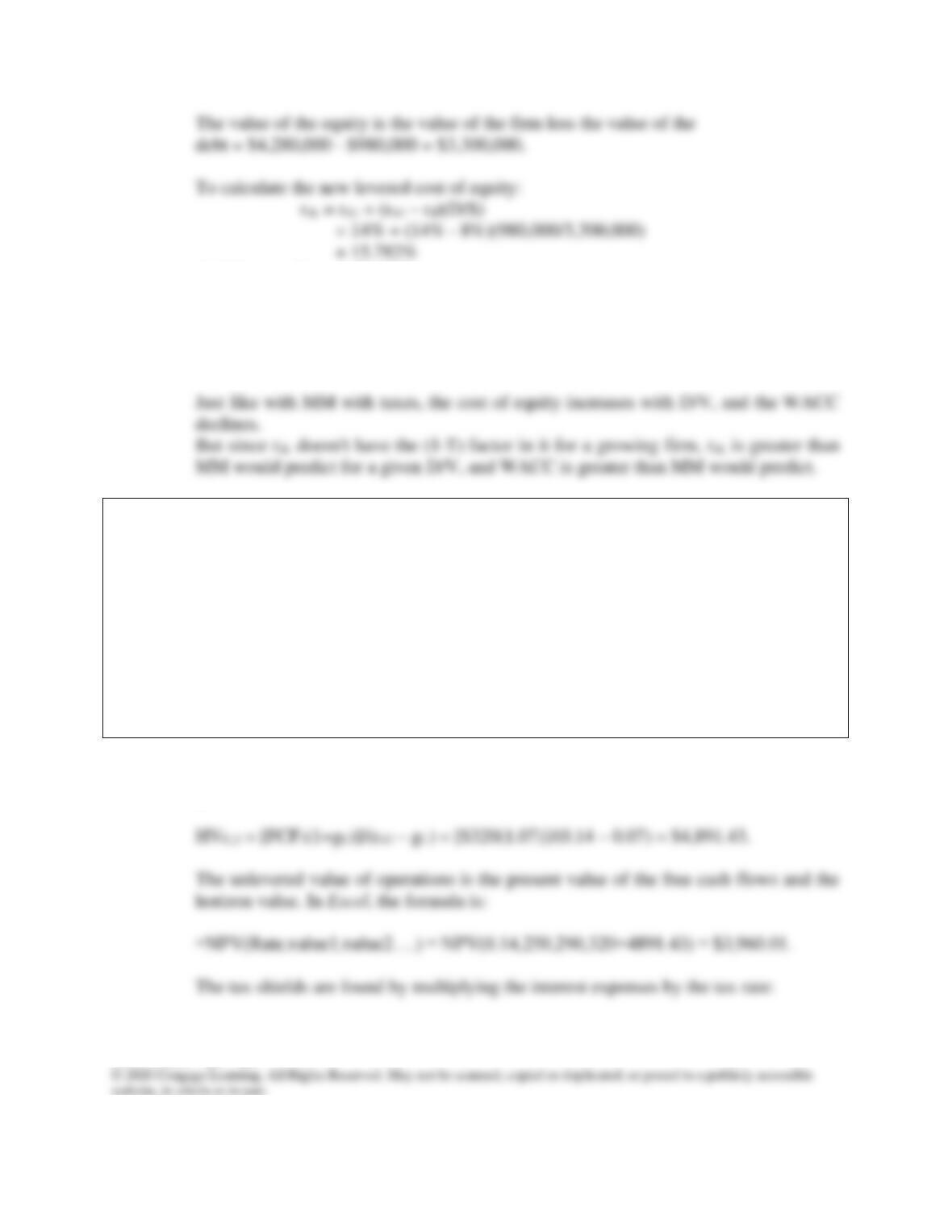
Answer: If a firm is growing, the assumptions that MM made are violated. The extension to the
MM model shows how growth affects the value of the debt tax shield and the cost of
capital. The first difference in this situation is that the appropriate discount rate for the
Mini Case: 21 – 16
And the new levered WACC:
WACCL = (D/V)rd(1 – T) + (S/V)rs
= (980,000/4,280,000)(8%)(1-.25)
+ ($3,300,000/4,280,000)15.782%
= 13.54%.
e. Suppose the expected free cash flow for Year 1 is $250,000 but it is expected to
grow faster than 7% during the next 3 years: FCF2 = $290,000 and FCF3 =
$320,000, after which it will grow at a constant rate of 7%. The expected interest
expense at Year 1 is $128,000, but it is expected to grow over the next couple of
years before the capital structure becomes constant: Interest expense at Year 2
will be $152,000, at Year 3 it will be $192,000 and it will grow at 7% thereafter.
What is the estimated horizon unlevered value of operations (i.e., the value at Year
3 immediately after the FCF at Year 3)? What is the current unlevered value of
operations? What is the horizon value of the tax shield at Year 3? What is the
current value of the tax shield? What is the current total value? The tax rate and
unlevered cost of equity remain at 25% and 14%, respectively.
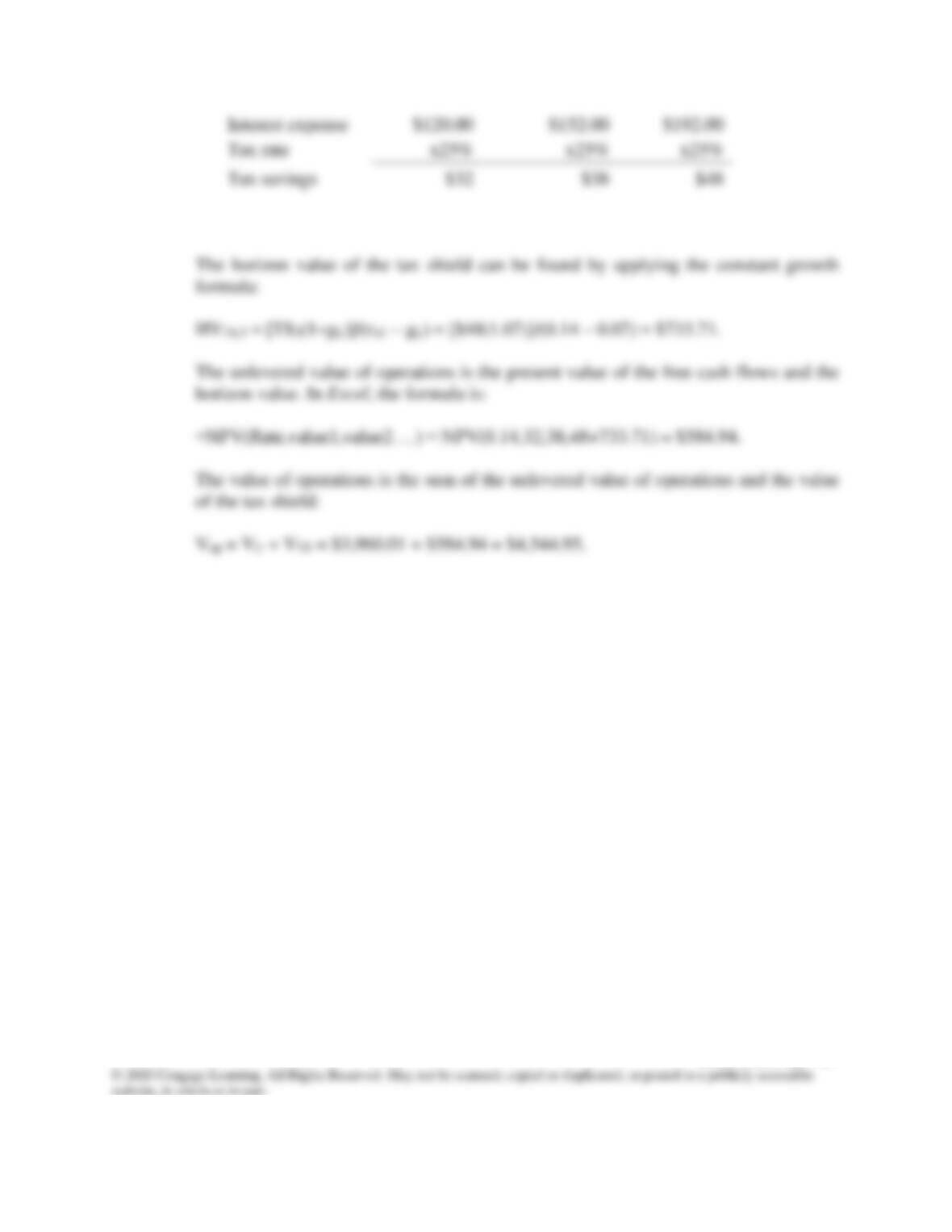
Answer: The unlevered horizon value of operations can be found by applying the constant
growth formula:
Mini Case: 21 – 17
Web Extension 21A
21A-1 Current b = 1.4; rRF = 5%; RPM = 6%; current wd = 30%; T = 25%; rd = 8%,
FCF1 = $2.5 million, FCF2 = $2.9 million, FCF3 = $3.4 million, and FCF4 = 3.57 million;
FCF4 grows at gL = 5% forever.
Mini Case: 21 – 18
a. Determine the Year 4 interest payment and tax shield:
Year 4 interest payment = (Year 3 debt level)(interest rate on debt)
= $30.6(0.085) = $2.601 million.
b. Determine the unlevered value of operations and the value of the tax shield tax shield:
The unlevered horizon value and the unlevered value of operations is the same as in
Problem 2:
Unlevered horizon value = FCF4(1+g)/(rsU–g)
= 3.57(1.05)/(0.1178-0.05)
= $55.29 million
c. Determine the intrinsic value per share:
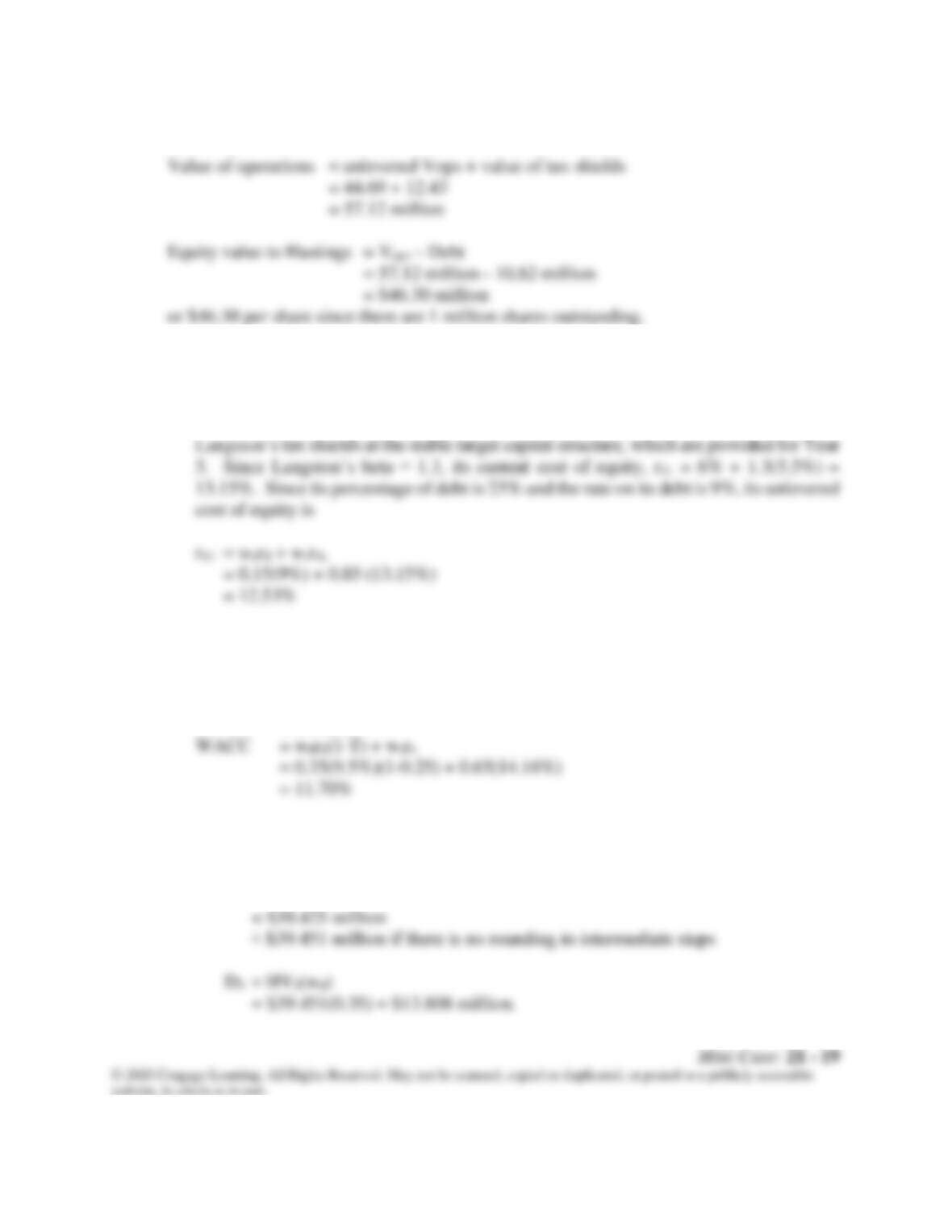
The new value of operations is:
21A-2 a. The appropriate discount rate reflects the risk of the cash flows. Thus, it is Langston’s
unlevered cost of equity that should be used to discount the free cash flows and tax
shields in years 1-5 and at the horizon. The horizon value should be calculated using
b. At the horizon when the new capital structure has been implemented:
rsL = rsU + (rsU –rd)(D/S)
= 12.53% + (12.53% – 9.5%)(0.35/0.65)
= 14.16%
c. At the horizon when the new capital structure has been implemented:
HV5 = FCF5(1+g)/(WACC – g)
= 2.12(1.06)/(0.1170-0.06)
Mini Case: 21 – 20
d.
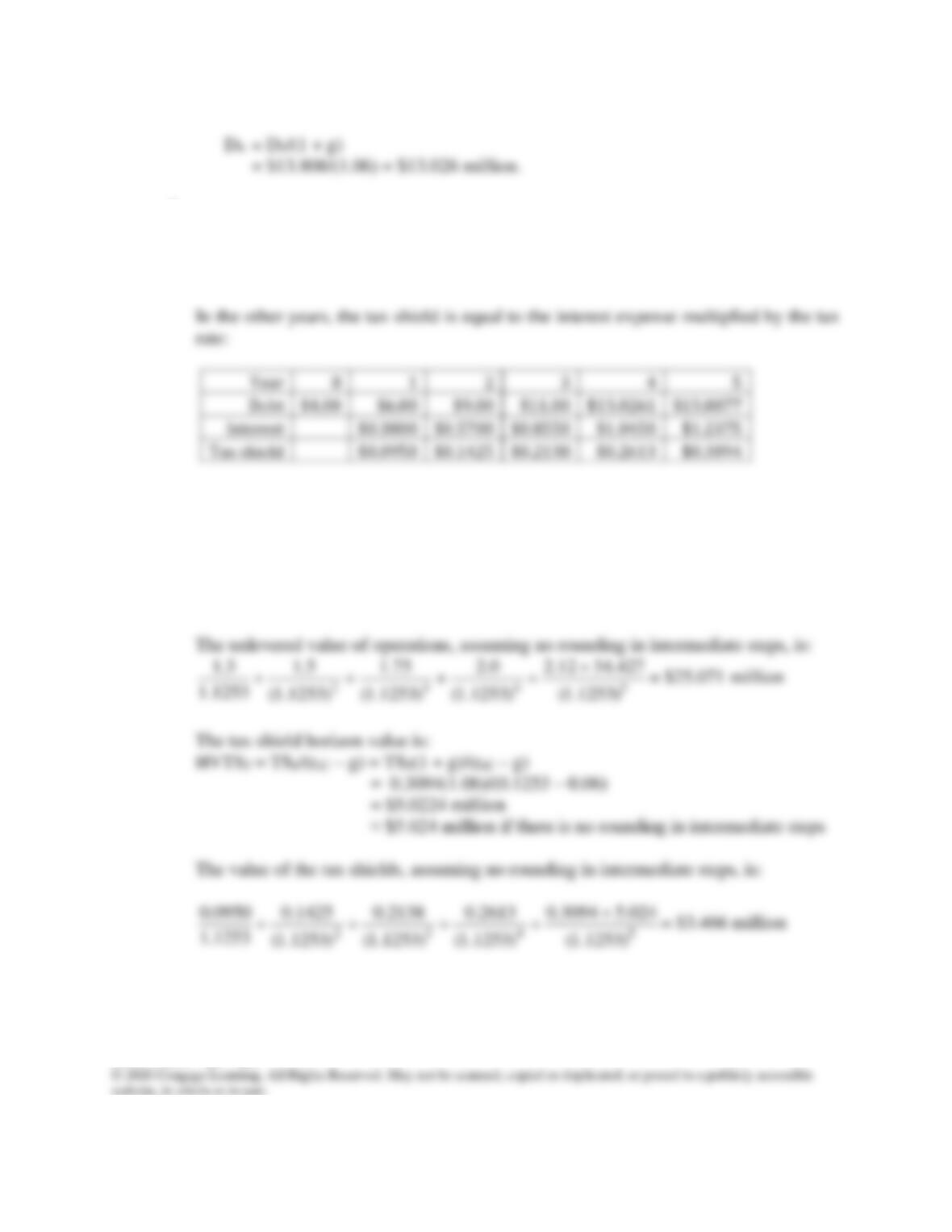
Interest5 = Debt4 (9.5%) = $13.026 (9.5%) = 1.2375
TS5 = Interest5(Tax rate) = 1.2375 (0.25%) = 0.3094 (You must use the post merger
tax rate)
e.
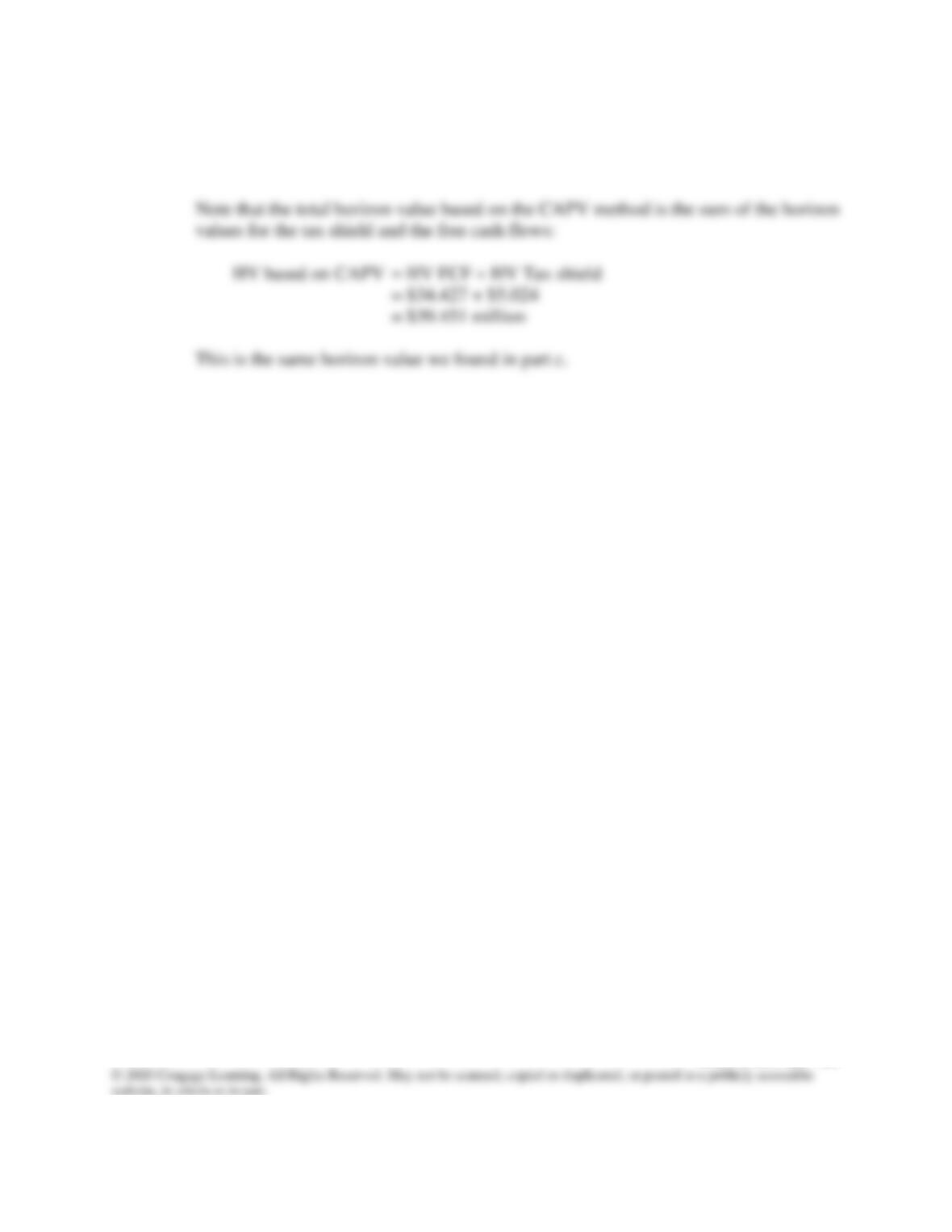
The unlevered horizon value is:
HVUL5 = FCF5(1+g)/(rsU – g)
= 2.12(1.06)/(0.1253-0.06)
= $34.413 million
≈ $34.427 if there is no rounding in intermediate steps
Mini Case: 21 – 21
The value of operations is the sum of the interest tax shields and the unlevered value =
3.466 + 25.071 = $28.537 million.