Answers and Solutions: 21 – 1
Chapter 21
Dynamic Capital Structures and Corporate Valuation
ANSWERS TO END-OF-CHAPTER QUESTIONS
21-1 a. An interest tax shield is the amount of cash flow that is sheltered from taxation due to
the tax deductibility of interest. It is equal to rd(D)(T).
The value of the tax shield is the present value of the future tax savings from the
deductibility of interest payments. The value of the tax shield depends on the rate (rTS)
used to discount future annual tax shields. In the MM model with taxes, rTS = rd.
Because MM assume zero growth, the value of the tax shield is T(D).
If growth is constant, then the value of the tax shield is rdTD(1+gL)/(rTS − gL). where
rd is the interest rate on the debt and rTS is the discount rate for the tax shield.
21-2 The value of a growing tax shield is greater than the value of a constant tax shield. This
means that for a given initial level of debt a growing firm will have more value from
the debt tax shield than a non-growing firm. Thus for a given face value of debt, D, and
unlevered value of equity, U, a growing firm will have a smaller wd, a larger levered
cost of equity, rsL, and a larger WACC. So the MM model will underestimate the value
of the levered firm and its cost of equity and WACC.
Answers and Solutions: 21 – 2
SOLUTIONS TO END-OF-CHAPTER PROBLEMS
21-1 The VU = $500 million With zero taxes, MM show that VL = VU. Therefore, VL = VU =
$500 million
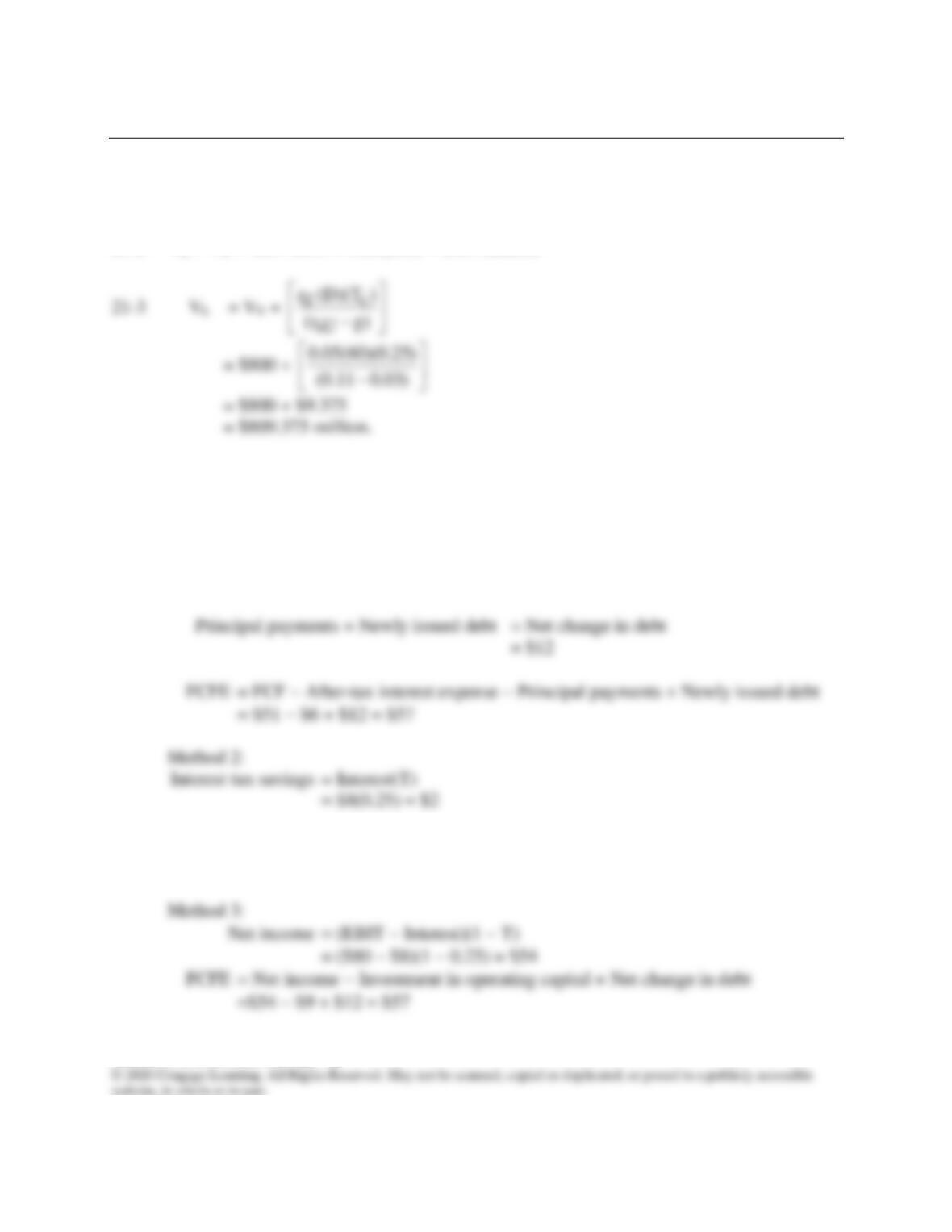
21-2 VL = VU + TD= $800 + 0.25($60) = $815 million.
21-4 Method 1:
FCF = EBIT(1 − T) − Investment in total net operating capital
= $80(1 − 0.25) − $9 = $51
A-T interest expense = Interest(1 − T)
= $8(1 − 0.25) = $6
FCFE = FCF − Interest expense + Interest tax savings + Net change in debt
= $51 − $8 + $2 + $12 = $57
Answers and Solutions: 21 – 3
21-5 VEquity = [FCFE (1 + gL)] / (rSL − gL)
= [$100 (1 + 0.05)] / (0.10 − 0.05) = $2,100
Answers and Solutions: 21 – 4
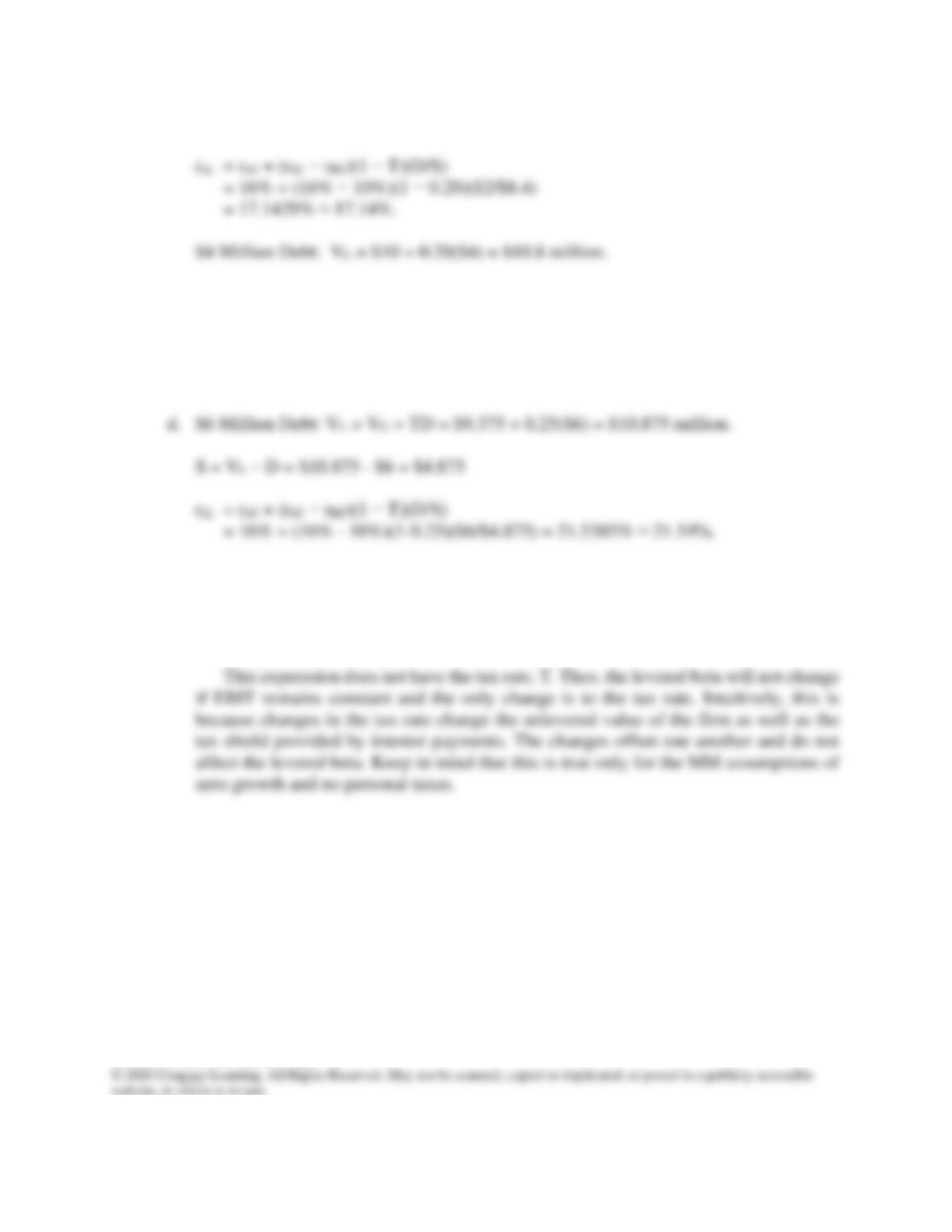
c. $2 Million Debt: VL = VU + TD = $10 + 0.20($2) = $10.4 million.
rsL = 16% + (6%)(0.8)($4/$6.8) = 18.8235% ≈ 18.82%.
$6 Million Debt: VL = $10 + 0.20($6) = $11.2 million.
rsL = 16% + 6% (0.8)($6/$5.2) = 21.5385% ≈ 21.54%.
Note that the levered cost of equity in Part d is the same as in Part c even though
the tax rates differ. It is possible to show that the levered beta can be expressed as:
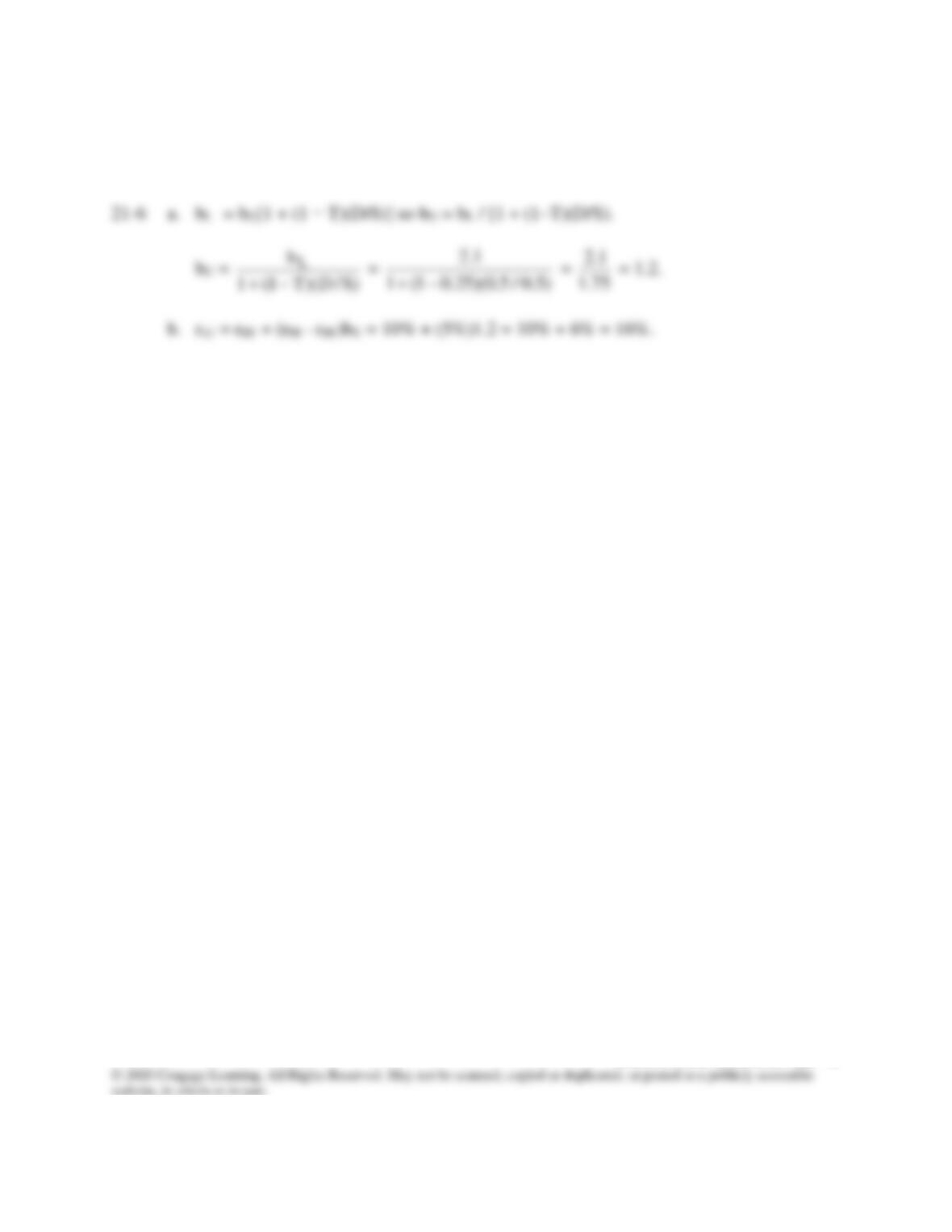
bL =
U
sU
EBIT
bEBIT (r D)
−

Answers and Solutions: 21 – 5
21-7 a. VU =
sU
r
)T1(EBIT −
=
$2(1 0.25)
0.10
−
= $15 million.
c. SL =
sL
d
r
)T1)(DrEBIT( −−
=
[$2 0.05($10)]0.75
0.15
−
= $7.5 million.
VL = SL + D = $7.5 + $10 = $17.5 million.
21-8 a. VU = $500,000/(rsU – g) = $500,000/(0.13 – 0.08) = $10,000,000.
b. VL = $10,000,000
0.07 x 0.25 x 5,000,000
0.13 – 0.08
+
= $10,000,000 + $,750,000 = $11,750,000
0.25)(5/6.25) = 16.60%
Answers and Solutions: 21 – 6
21-9 a. HVU,3 =
07.013.0
)07.1( 40$
−
= $713.33.
g = 7%
HVU,3 =
07.013.0
)07.1( 0.4$
−
= $71.33.
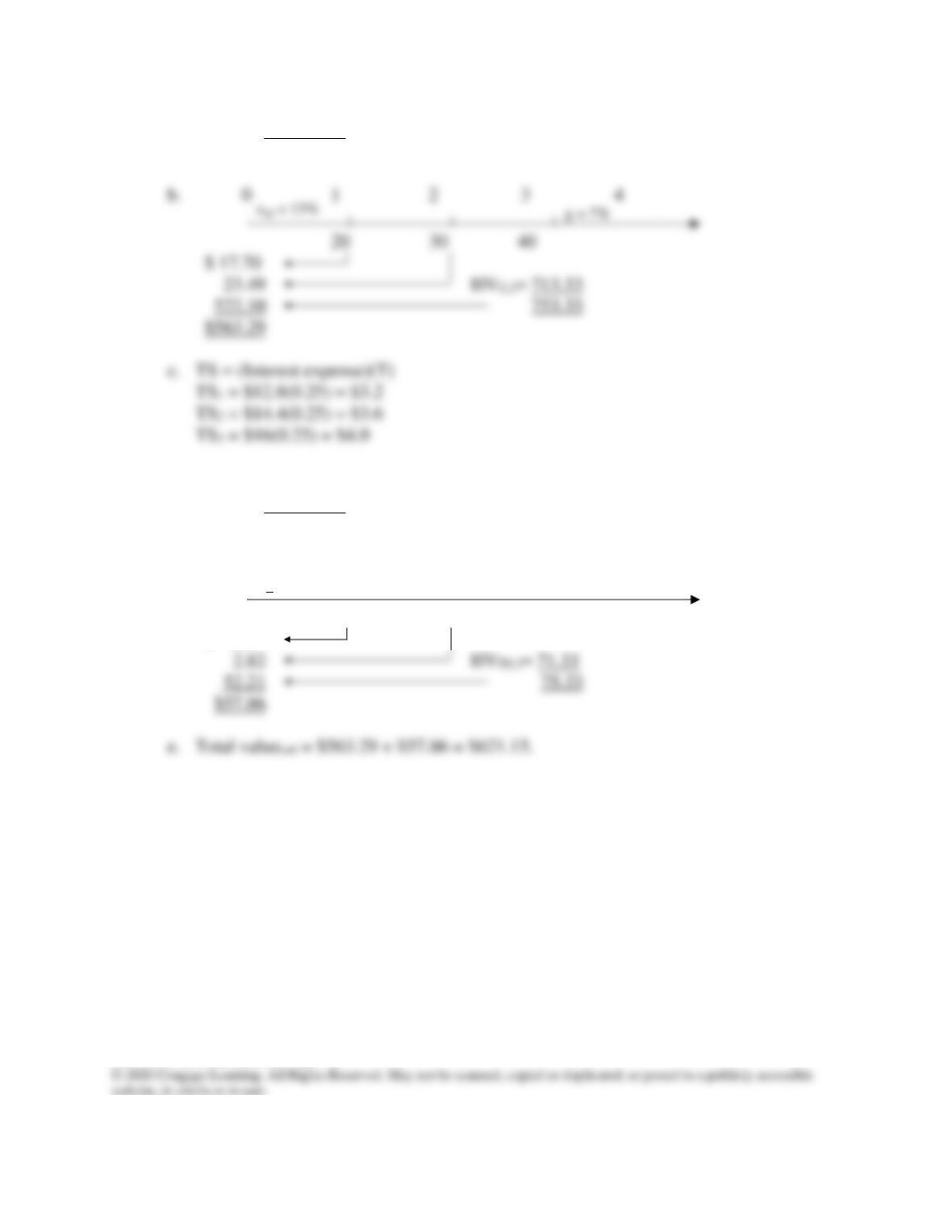
d. 0 1 2 3 4
| | | | |
3.2 3.6 4.0
$ 2.83
rsU = 13%
g = 7%

Answers and Solutions: 21 – 7
SOLUTION TO SPREADSHEET PROBLEM
21-10 The detailed solution for the problem is available in the file Ch21 P10 Build a Model
Solution.xlsx on the textbook’s Web site.

Mini Case: 21 – 8
MINI CASE
David Lyons, CEO of Lyons Solar Technologies, is concerned about his firm’s level of debt
financing. The company uses short-term debt to finance its temporary working capital needs,
but it does not use any permanent (long-term) debt. Other solar technology companies have
debt, and Mr. Lyons wonders why they use debt and what its effects are on stock prices. To
gain some insights into the matter, he poses the following questions to you, his recently hired
assistant:
a. Who were Modigliani and Miller (MM), and what assumptions are embedded in
the MM and Miller models?
Answer: Modigliani and Miller (MM) published their first paper on capital structure (which
assumed zero taxes) in 1958, and they added corporate taxes in their 1963 paper.
Modigliani won the Nobel Prize in economics in part because of this work, and most
Mini Case: 21 – 9
b. Assume that firms U and L are in the same risk class, and that both have EBIT =
$560,000. Firm U uses no debt financing, and its cost of equity is rsU = 14%. Firm
L has $1 million of debt outstanding at a cost of rd = 8%. There are no taxes.
Assume that the MM assumptions hold, and then:
1. Find v, s, rs, and WACC for firms U and L.
Answer: First, we find Vu and VL:
VU =
sU
r
EBIT
=
$560,000
0.14
= $4,000,000.
Mini Case: 21 – 10
b. 2. Graph (a) the relationships between capital costs and leverage as measured by
D/V, and (b) the relationship between value and D.
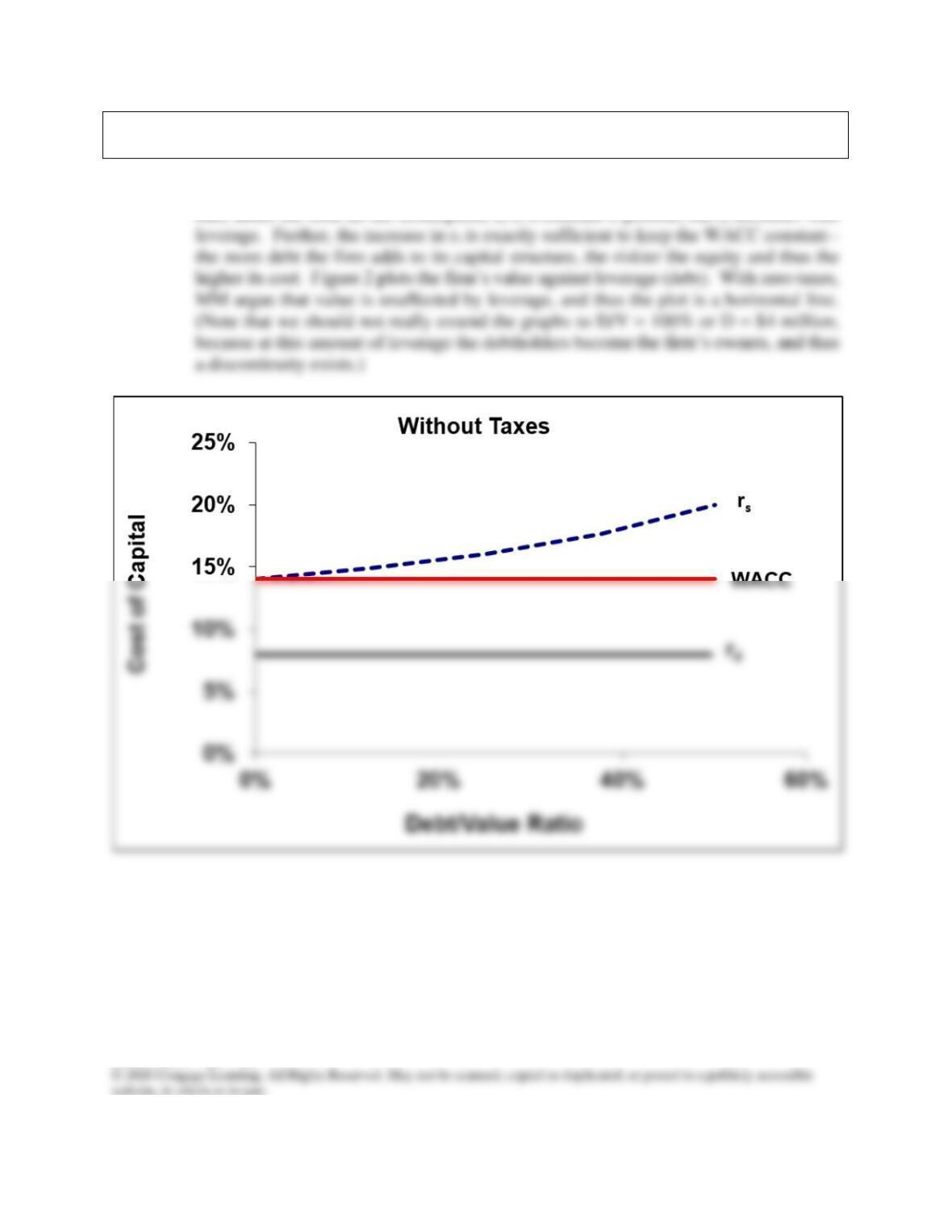
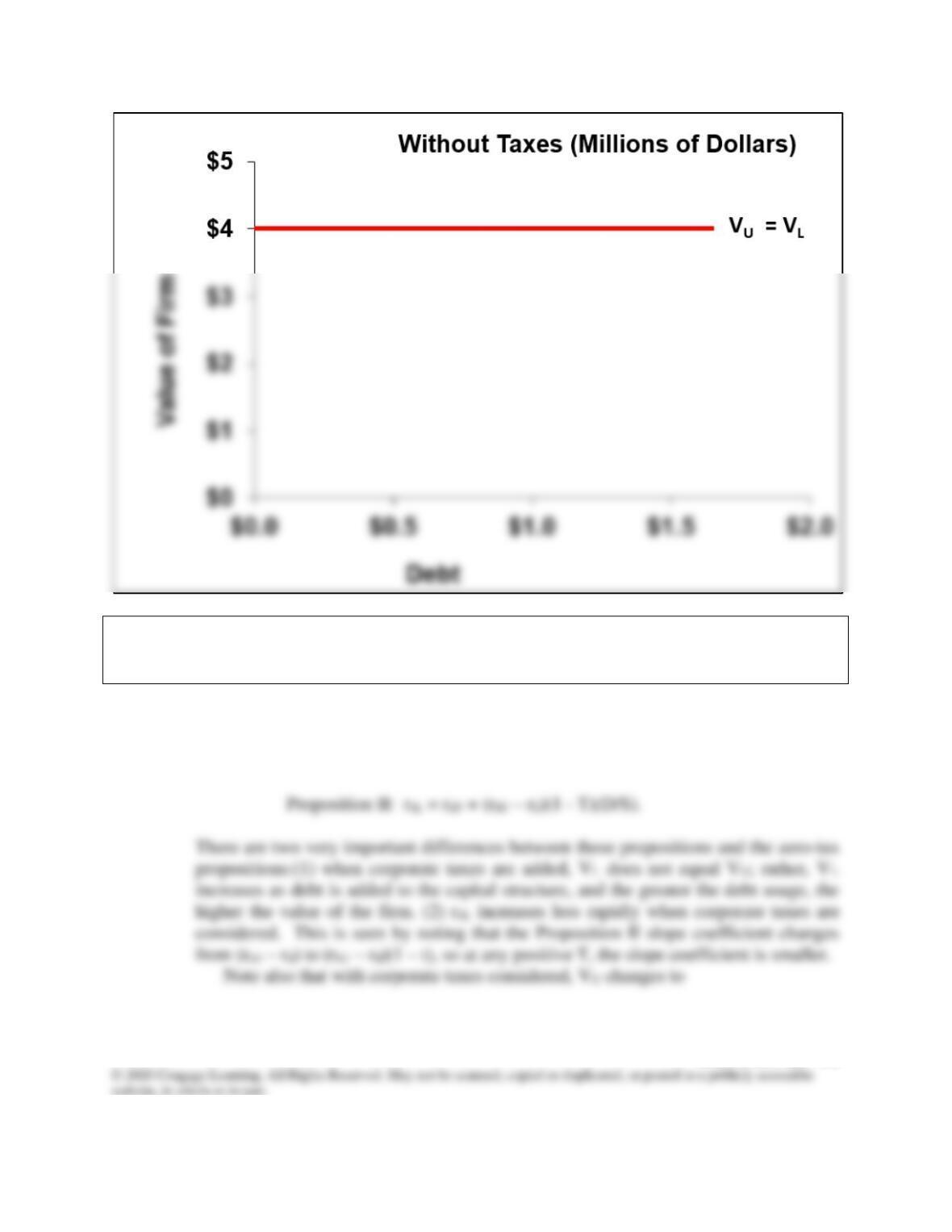
Answer: Figure 1 plots capital costs against leverage as measured by the debt/value ratio. Note
that, under the MM no-tax assumption, rd is a constant 8 percent, but rs increases with
Mini Case: 21 – 11
c. Using the data given in Part b, but now assuming that firms L and U are both
subject to a 25 percent corporate tax rate, repeat the analysis called for in Part
b(1) and b(2) under the MM with-tax model.
Answer: With corporate taxes added, the MM propositions become:
Proposition I: VL = VU + TD.