Chapter 21
Supply Chains and Working Capital Management
ANSWERS TO BEGINNING-OF–CHAPTER QUESTIONS
21-1 The CCC is defined as the number of days between a company’s paying for some product
or service that it sells and the receipt of cash from the sale of the product or service.
Other things held constant, it is better to have a shorter than a longer CCC, because
the lower the CCC, the less the firm’s investment in working capital. With less working
capital, total capital requirement decline, causing the dollar cost of capital to decline.
21-2 A cash budget is a forecast of inflows and outflows of cash, generally on a monthly or
daily basis. The primary purpose of the cash budget is to forecast when loans will be
needed and/or when surplus funds that can be invested will be on hand. A cash budget is
also very useful when negotiating bank loans.
The BOC model provides a detailed example of a monthly cash budget. It shows
21-3 Free trade credit is the credit one gets during the discount period, i.e., credit one
receives while still being able to take discounts. For example, if you buy $100 of goods
under terms of 2/10, net 30, you only have to pay $98 if you pay by the 10th day, so you
21-4 Matching maturities causes the cash flows from an asset to be synchronized with the
cash costs required on the capital used to finance the assets. If the firm were financed
only with debt, and if the debt was amortized, then the matching would be quite close.
However, firms use both debt and equity, and the equity has no stated maturity.
Similarly, assets have varying lives, and those lives cannot always be determined at the
time the asset is being financed.. For example, if a firm spends money on advertising to
Answers and Solutions: 21 – 2
21-5 An aggressive financing policy generally refers to a deliberate mis–matching of asset
and claims maturities. The yield curve is normally upward sloping, so short-term rates
are normally lower than long-term rates. Thus, firms can normally minimize current
interest payments by using primarily short–term debt. However, this can be a big mistake
ANSWERS TO END-OF-CHAPTER QUESTIONS
21-1 a. Working capital is a firm’s investment in short–term assets—cash, marketable
securities, inventory, and accounts receivable. Net working capital is current assets
minus current liabilities. Net operating working capital is operating current assets
minus operating current liabilities.
b. A relaxed WC policy refers to a policy under which relatively large amounts of cash,
policy lies between the relaxed and restricted policies.
c. Permanent current operating assets are the current operating assets needed even at the
low point of the business cycle. For a growing firm in a growing economy,
d. A moderate short–term financing policy matches asset and liability maturities. It is also
referred to as the maturity matching, or “self–liquidating” approach. When a firm
e. The inventory conversion period is the average length of time it takes to convert
materials into finished goods and then to sell them. It is calculated by dividing total
inventory by daily cost of goods sold. The average collection period is the average
length of time required to convert a firm’s receivables into cash. It is calculated by
Answers and Solutions: 21 – 4
f. A cash budget is a schedule showing cash flows (receipts, disbursements, and cash
balances) for a firm over a specified period. The target cash balance is the desired
cash balance that a firm plans to maintain in order to conduct business.
g. Transactions balance (routine) is the cash balance associated with payments and
h. Trade discounts are price reductions that suppliers offer customers for early payment
of bills.
i. Credit policy is nothing more than the firm’s policy on granting and collecting credit.
There are four elements of credit policy, or credit policy variables. These are credit
period, credit standards, collection policy, and discounts.
The credit period is the length of time for which credit is extended. If the credit
period is lengthened, sales will generally increase, as will accounts receivable. This
will increase the financing needs and possibly increase bad debt losses. A shortening
j. An account receivable is created when a good is shipped or a service is performed,
and payment for that good is not made on a cash basis, but on a credit basis.
Days sales outstanding (DSO) is a measure of the average length of time it takes a
Answers and Solutions: 21 – 5
k. Accruals are continually recurring short-term liabilities, especially accrued wages and
accrued taxes. Trade credit is debt arising from credit sales and recorded as an
account receivable by the seller and as an account payable by the buyer.
m. A promissory note is a document specifying the terms and conditions of a loan,
including the amount, interest rate, and repayment schedule. A line of credit is an
arrangement in which a bank agrees to lend up to a specified maximum amount of
funds during a designated period. A revolving credit agreement is a formal, committed
line of credit extended by a bank or other lending institution.
21-2 The two principal reasons for holding cash are for transactions and compensating
21-3 False. Both accounts will record the same transaction amount.
21-4 The four elements in a firm’s credit policy are (1) credit standards, (2) credit period,
Answers and Solutions: 21 – 6
21-5 If an asset’s life and returns can be positively determined, the maturity of the asset can be
matched to the maturity of the liability incurred to finance the asset. This matching will
ensure that funds are borrowed only for the time they are required to finance the asset and
21-6 From the standpoint of the borrower, short-term credit is riskier because short–term
interest rates fluctuate more than long–term rates, and the firm may be unable to repay the
21-7 This statement is false. A firm cannot ordinarily control its accruals since payrolls and
the timing of wage payments are set by economic forces and by industry custom, while
tax payment dates are established by law.
21-8 Yes. If a firm is able to buy on credit at all, if the credit terms include a discount for
21-9 Commercial paper refers to promissory notes of large, strong corporations. These notes
have maturities that generally vary from one day to 9 months, and the return is usually
SOLUTIONS TO END-OF-CHAPTER PROBLEMS
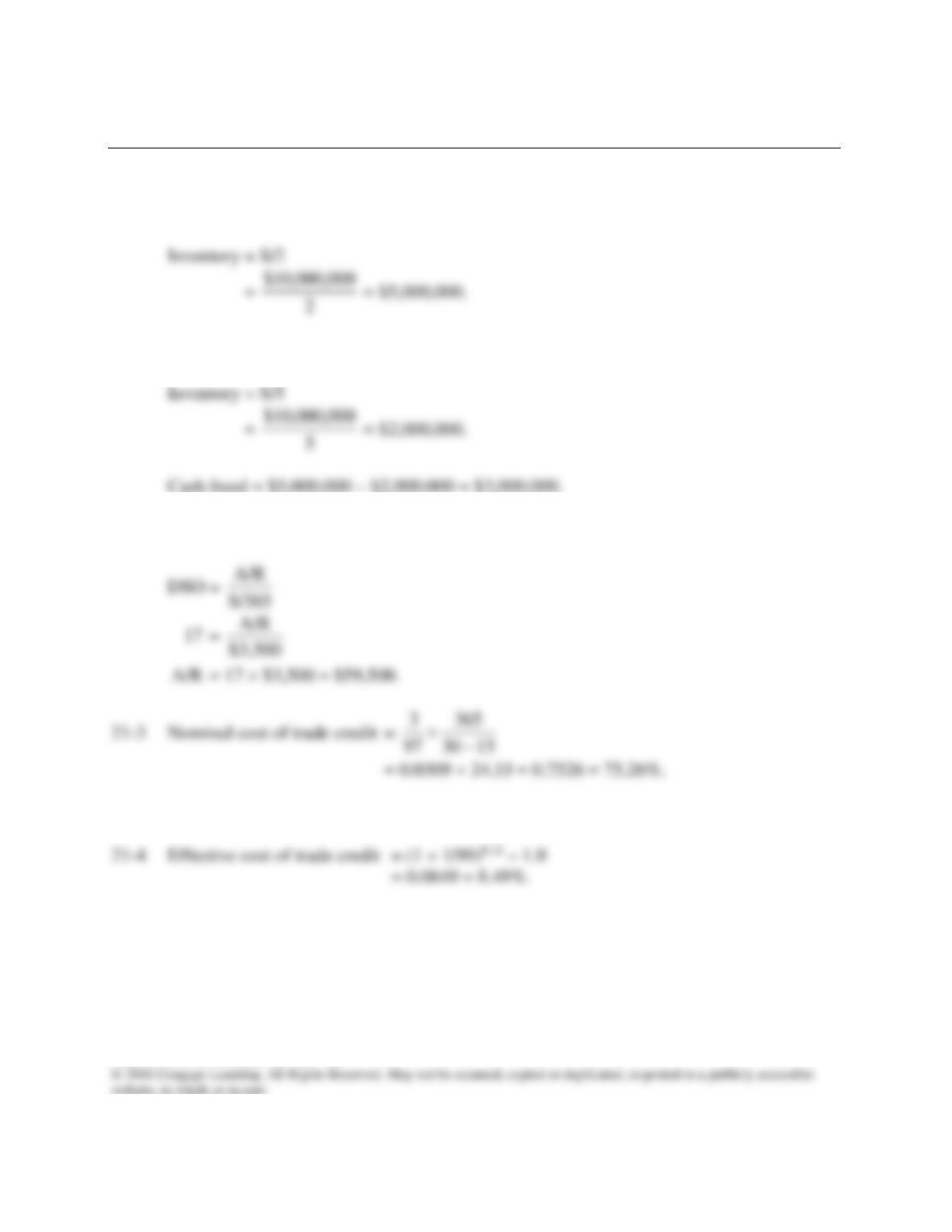
21-1 Sales = $10,000,000; S/I = 2×.
If S/I = 5×, how much cash is freed up?
21-2 DSO = 17; Credit Sales/Day = $3,500; A/R = ?
Effective cost of trade credit = (1.0309)24.33 – 1.0 = 1.0984 = 109.84%.
Answers and Solutions: 21 – 8
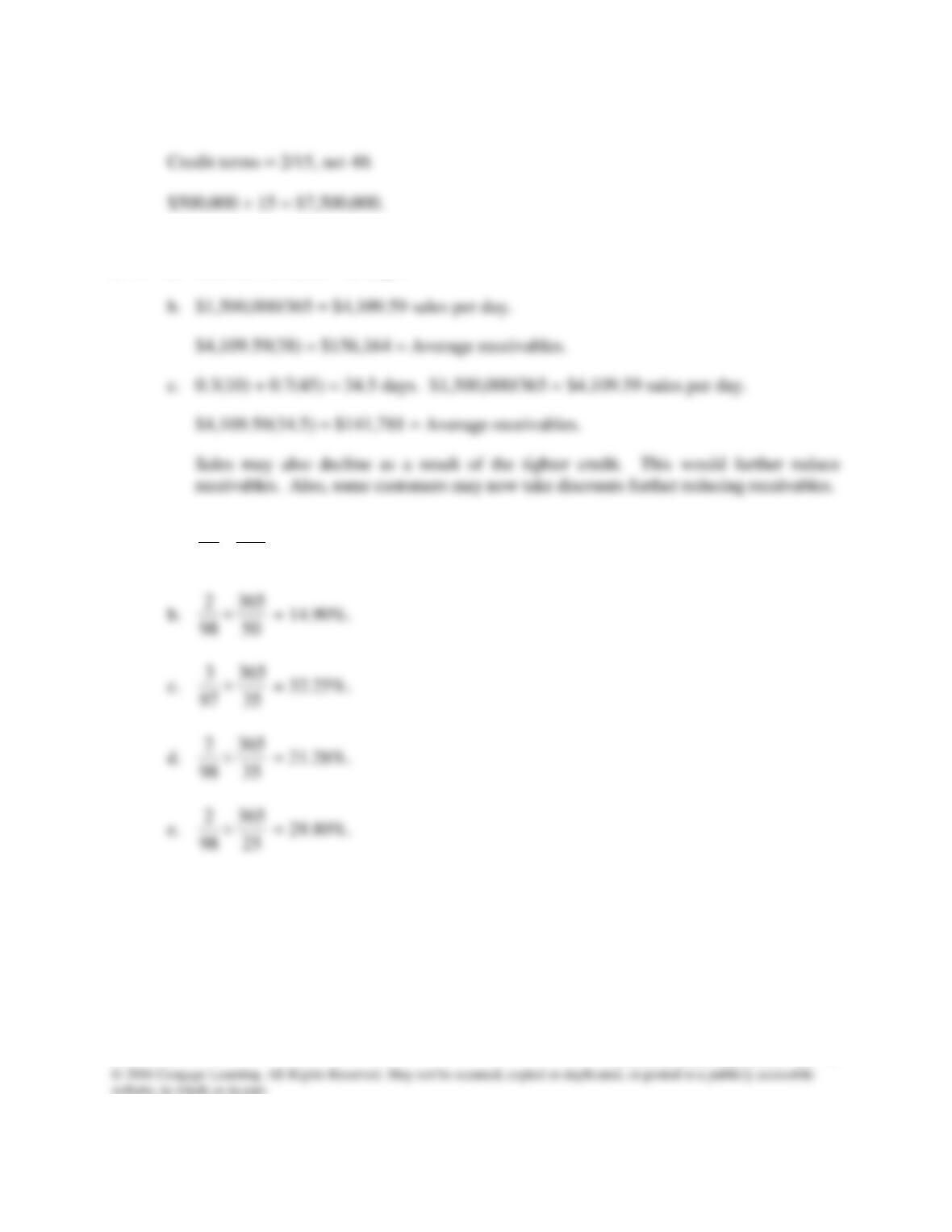
21-5 Net purchase price of inventory = $500,000/day.
21-6 a. 0.3(10) + 0.7(50) = 38 days.
21-7 a.
5
536
99
1×
= 73.74%.
Answers and Solutions: 21 – 9
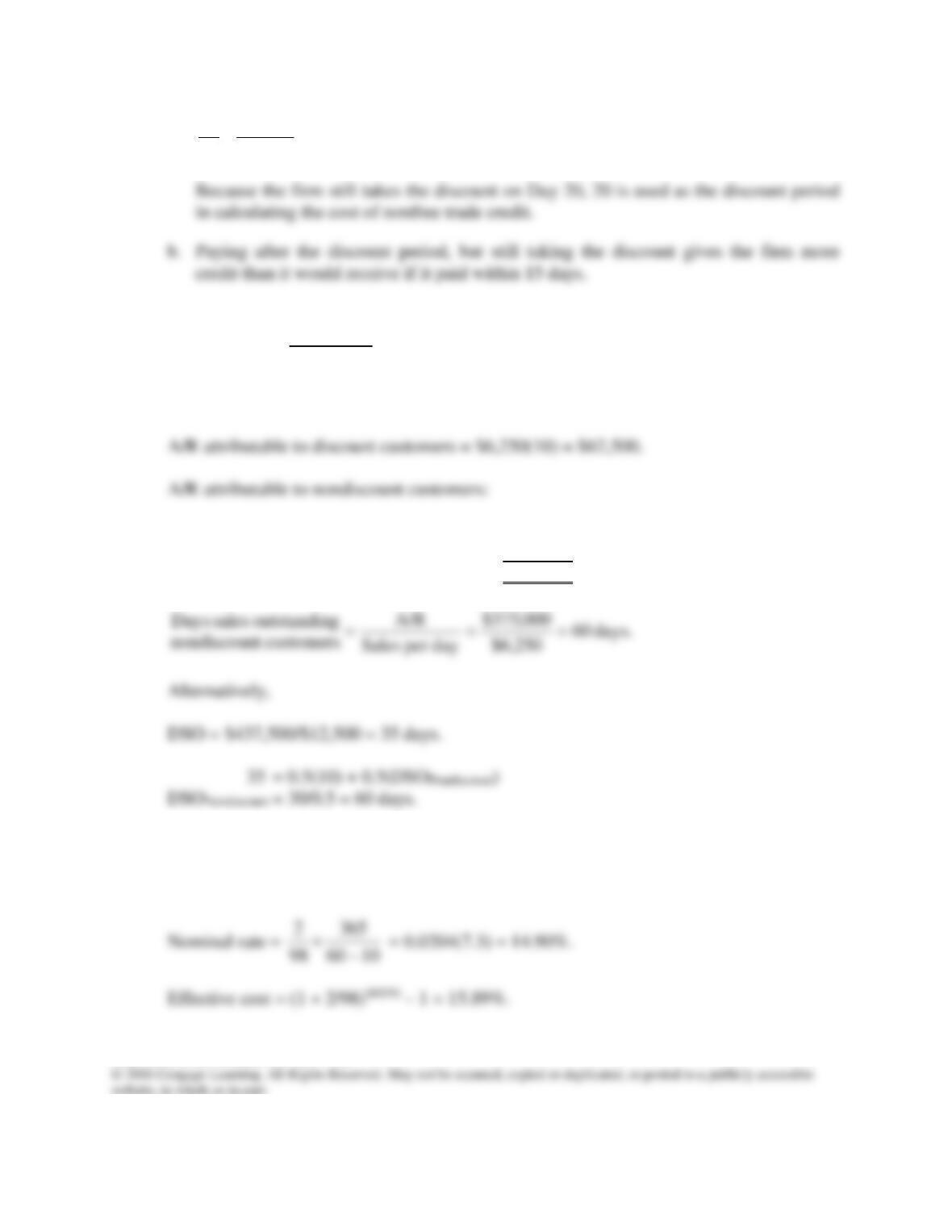
21-8 a.
20 45
536
97
3
−
×
= 45.15%.
21-9 Sales per day =
365
500,562,4$
= $12,500.
Discount sales = 0.5($12,500) = $6,250.
Total A/R $437,500
Discount customers’ A/R 62,500
Nondiscount customers’ A/R $375,000
Thus, although nondiscount customers are supposed to pay within 40 days, they are
actually paying, on average, in 60 days.
Cost of trade credit to nondiscount customers equals the rate of return to the firm:
Answers and Solutions: 21 – 10
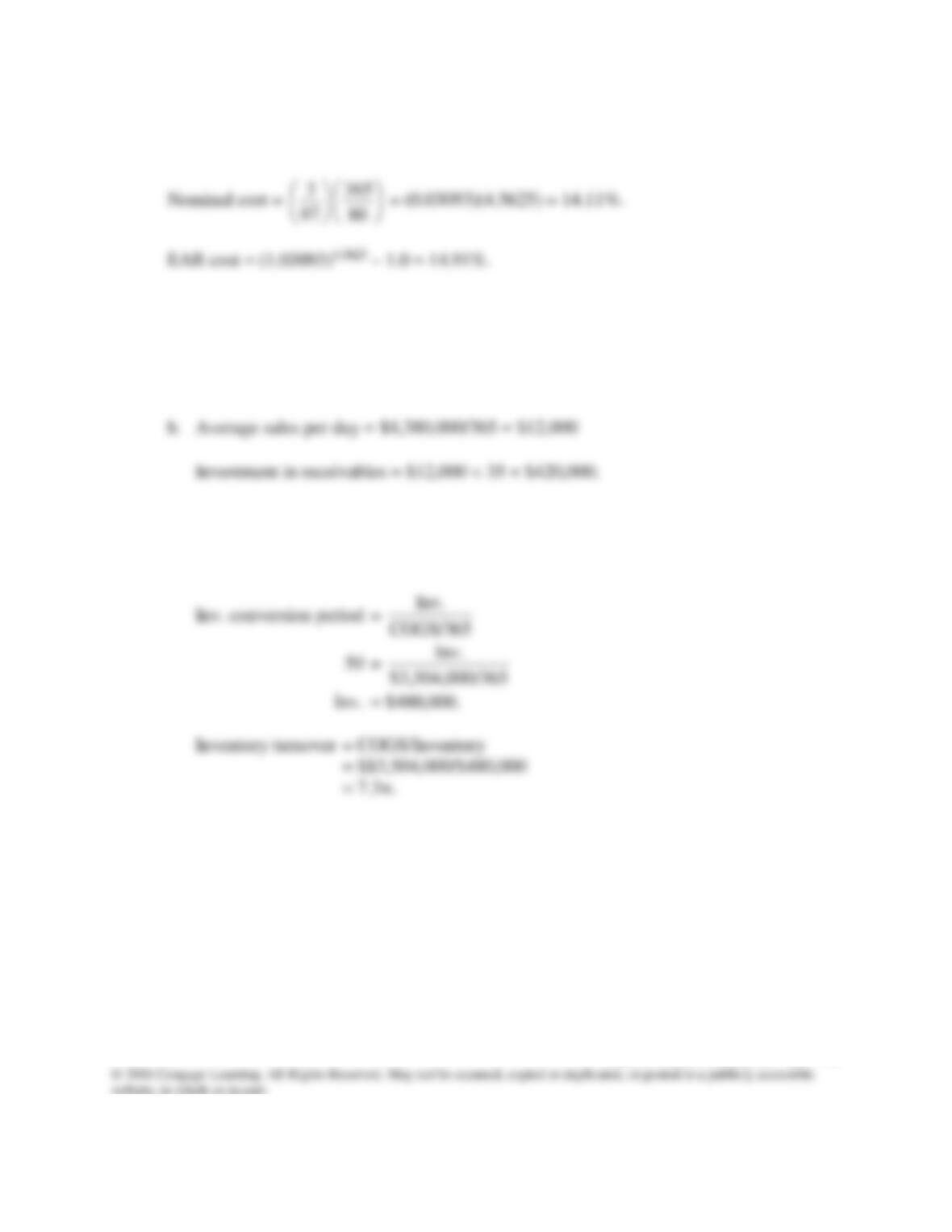
21-10 Accounts payable:
21-11 a.
cycle
conversion
Cash
=
period
deferral
Payables
–
period
collection
Average
+
period
conversion
Inventory
= 50 + 35 – 25 = 60 days.
c. COGS = 0.80 × Sales
= 0.80 × $4,380,000
= $3,504,000.
Answers and Solutions: 21 – 11
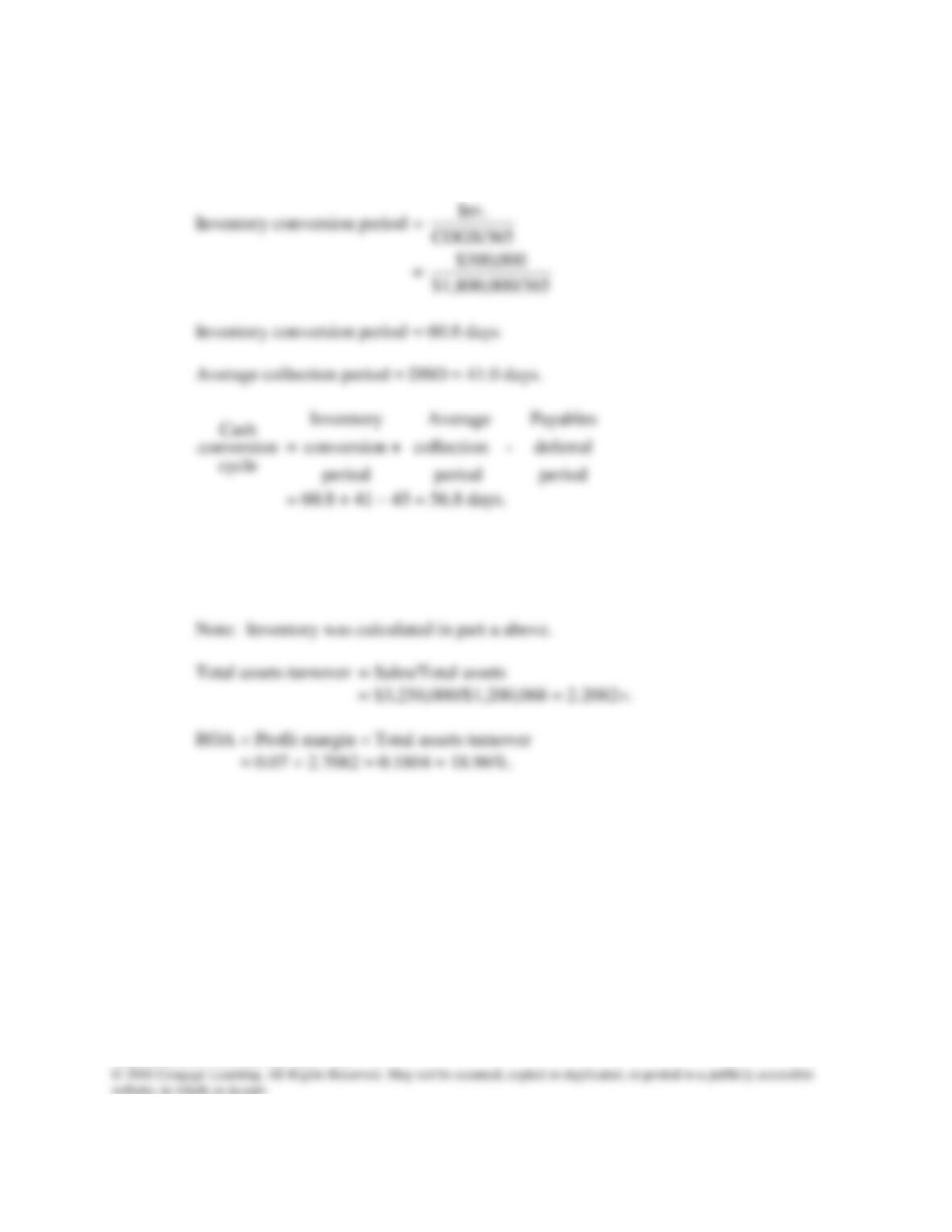
21-12 a. Inventory turnover = COGS/Inventory
6.0= $$1,800,000/Inventory
Inventory = $300,000.
b. Total assets = Inventory + Receivables + Fixed assets
= $300,000 + [($3,250,000/365) × 41] + $535,000
= $300,000 + $365,068 + $535,000 = $1,200,068.
Answers and Solutions: 21 – 12
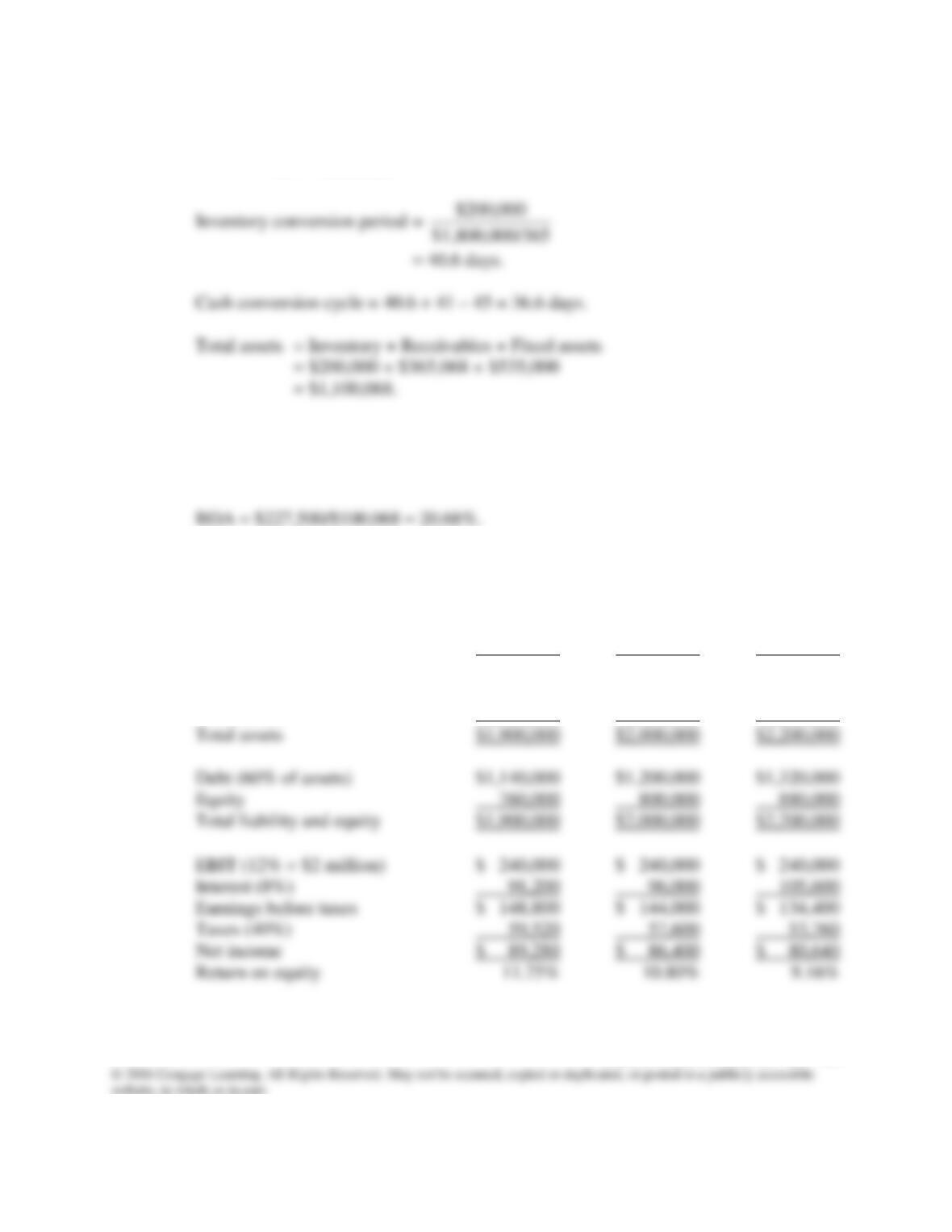
c. Sales/Inv. = 9
$1,800,000/Inv. = 9
Inv. = $200,000
Note: Inventory was calculated from the inventory turnover ratio.
Total assets turnover = $3,250,000/$1,100,068 = 2.95×.
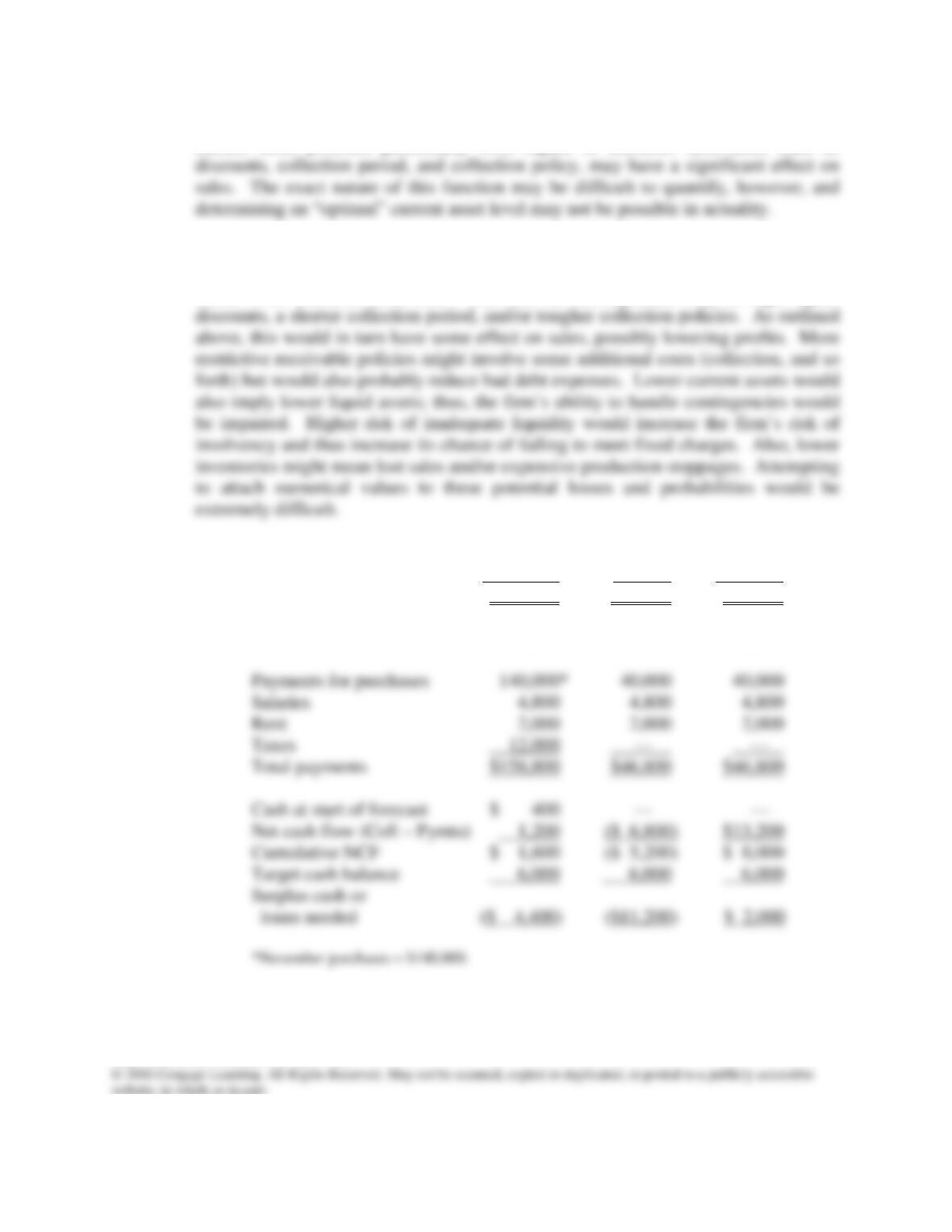
21-13 a.
Current year sales are expected to be $1,600,000x(1.25) = $2,000,000.
Return on equity may be computed as follows:
Tight Moderate Relaxed
Current assets
(% of sales × Sales) $ 900,000 $1,000,000 $1,200,000
Fixed assets 1,000,000 1,000,000 1,000,000
Answers and Solutions: 21 – 13
b. No, this assumption would probably not be valid in a real world situation. A firm’s
current asset policies, particularly with regard to accounts receivable, such as
c. As the answers to Part a indicate, the tighter policy leads to a higher expected return.
However, as the current asset level is decreased, presumably some of this reduction
comes from accounts receivable. This can be accomplished only through higher
21-14 a. I. Collections and Purchases:
December January February
Sales (Collections) $160,000 $40,000 $60,000
Purchases 40,000 40,000 40,000
Answers and Solutions: 21 – 14
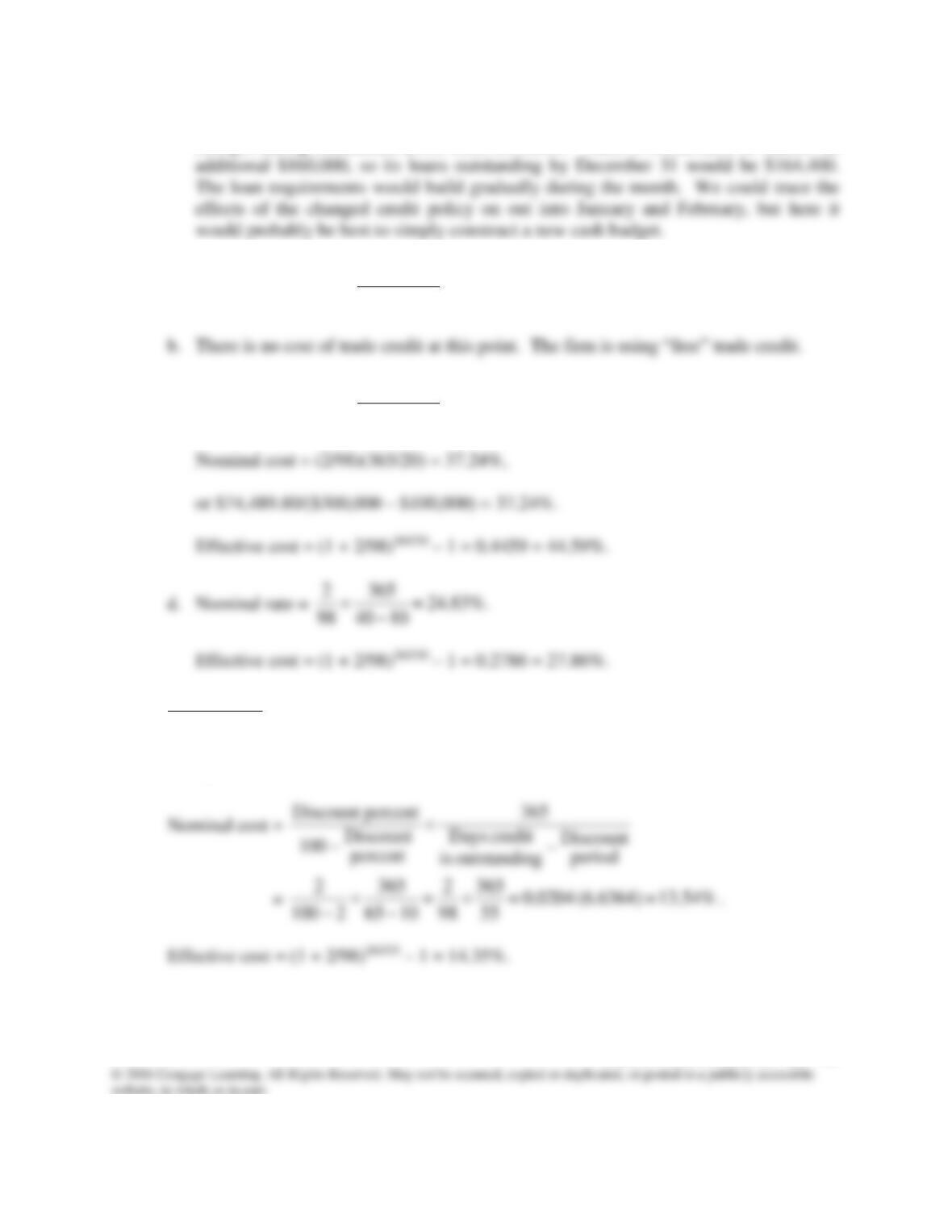
b. If the company began selling on credit on December 1, then it would have zero
receipts during December, down from $160,000. Thus, it would have to borrow an
21-15 a.
payable
accounts Average
=
days 365
000,650,3$
× 10 days = $10,000 × 10 = $100,000.
c.
discount) of(net
payables Average
=
365
000,650,3$
× 30 = $10,000 × 30 = $300,000.
21-16 Trade Credit
Terms: 2/10, net 30. But the firm plans delaying payments 35 additional days, which is
the equivalent of 2/10, net 65.
Answers and Solutions: 21 – 15