531
Chapter 20 Entrepreneurial Finance and Venture Capital
Chapter Overview
Any new firm with great ideas often lacks the money to implement these ideas. The Open-
ing Focus looks at Amazon.com’s emergence as a prototypical “new economy” company from the
perspective of the funds it utilized to fuel its growth. Amazon creatively financed itself with only a
$10,000 cash investment and $15,000 loan from founder Jeff Bezos. The firm received private eq-
Opening Focus Discussion Questions
1. What are some examples of unconventional financing used by Amazon.com in its early days?
Why was it forced to use this kind of financing?
2. What level of return would you expect if you were an early investor in Amazon.com?
This chapter discusses:
20-1. The Challenges of Financing Entrepreneurial Growth Companies
20-2. Venture Capital Financing in the United States
20-4. International Markets for Venture Capital and Private Equity
Technology
1. Smart Ideas Video. Greg Udell of Indiana University talks about the kinds of firms that use
venture capital – those with more intangible and fewer tangible assets that could serve as col-
lateral for lenders.
3. Smart Ideas Video. Steve Kaplan of the University of Chicago looks at how venture capital
investments are structured.
5. Smart Practices Video. David Haeberle, CEO of the Command Equity Group, talks about the
high failure rate among venture capital investments, and their very high risk.
Lecture Guide
Venture capital financing is often more difficult to obtain and more costly than regular fi-
nancing. After the initial public offering, entrepreneurial firms rely heavily on external funding.
532 Instructor’s Manual
20-1 The Challenges of Financing Entrepreneurial Growth Companies
Entrepreneurial firms’ assets are more likely to be intangible, such as patents or intellectual
property rights, by definition assets for which it is harder to obtain external financing. Information
Table 20.1 Sources of Start-up Capital for a Sample of 132 Small Companies
Note that the largest source of financing is personal capital. The entrepreneur must invest a
great deal of his personal capital – expertise and savings into a new venture. An even larger source
20-2 Venture Capital Financing in the United States
Venture capital has been supplied by institutional venture capital funds and angel capitalists,
wealthy investors willing to risk some of their capital on high risk, high reward ventures. Venture
20-2a Types of Venture Capital Funds
Institutional venture capital funds are formal business entities in which full-time professionals
seek out and fund promising ventures, and angel capitalists (or angels) are wealthy individuals who
20-2b Investment Patterns of U.S. Venture Capital Firms
The venture capital industry helps resolve conflicts between investors and venture capital-
Chapter 20 Entrepreneurial Finance and Venture Capital 533
20-2c Industrial and Geographic Distribution of Investment Capital
California, which has a reputation as a technology incubator, has received more than its
proportional share of venture capital.
• Student Involvement: Ask students what role local and state governments need to play in
order to attract new ventures. Why do new ventures tend to cluster in a particular area?
20-2d Venture Capital Investments by Stage of Firm Development
Note how little venture money goes to brand new start up companies. Even though venture
20-2e The Economic Effect of U.S. Venture Capital Investment
The U.S. market and U.S. investors have served as providers of venture funds. The fact
20-3 The Organization and Operations of U.S. Venture Capital Firms
20-3a Organization and Funding of Venture Capital Limited Partnerships
Venture capitalists also help protect their investments through staged financing. Rather
than give the firm all the money it needs, additional money is provided only after significant mile-
20-3b How Venture Capitalists Structure Their Investments
Venture capitalists protect themselves through covenants that help ensure that the original
providers of capital are not diluted through future equity issues and through maintaining access to
exiting the firm through an initial public offering. Venture capitalists allocate risk, return and own-
534 Instructor’s Manual
20-3c Why Venture Capitalists Use Convertible Securities
20-3d The Pricing of Venture Capital Investments
Like any investment, return is related to risk. A venture is riskiest at its start up, and ven-
20-3eThe Profitability of Venture Capital Investments
This section details returns from the various venture financing and venture fund types.
Figure 20.1 Returns to Venture Capital Investing versus Public Markets
20-3f Exit Strategies Employed by Venture Capitalists
20-4 International Markets for Venture Capital and Private Equity
20-4a European Venture Capital and Private-Equity Fund-Raising and Investment
Venture capital financing has grown dramatically in Europe in the past decade. European
20-4b Venture Capital outside U.S. and Western Europe
While the U.S. is the biggest play in the VC funding market, with Europe second, other
countries are increasing their venture funding. India is the most promising private-equity market in
Chapter 20 Entrepreneurial Finance and Venture Capital 535
Entrepreneurial Finance and Venture Capital Summary
Venture capital financing as increased both in dollar amount and investor base. What once
was the province of just a few wealthy investors is now open to smaller investors through venture
capital funds. What was once almost solely a U.S. market has spread to other countries and conti-
nents.
Ch. 20 Resource Article
“How Long Can VCs Keep the Curtains Closed?” Business Week, October 21, 2002. This article
Enrichment Exercise
The Economic Review, from the Federal Reserve Bank of Atlanta, Fourth Quarter 2002, has a spe-
Answers to Concept Review Questions
1. Entrepreneurial finance differs from “ordinary” finance in that entrepreneurial growth compa-
nies often invest in very high-risk, high-return projects. The most valuable assets on many
2. Firms usually finance intangible assets with equity rather than with debt because lenders are
more reluctant to provide debt capital to a firm with intangible assets. Lenders can repossess
3. An angel capitalist is a wealthy investor who funds risky venture enterprises. While angel in-
vestors provide large amounts of capital to new firms, the angel industry is not as structured as
4. Private limited partnerships have the advantages of being easy to form, providing limited liabil-
ity to investors, and providing investors with smaller amounts of capital to invest in diversified
536 Instructor’s Manual
5. Staged financing is less risky to the venture capitalists. They invest a small amount, see if the
firm uses it well, see if the business appears to be successful, and then they can invest more in
6. Venture capital deals can be very profitable, however, there is a high failure rate. In efficient
capital markets investors are appropriately rewarded for risk – higher risk-taking means higher
7. European governments and stock exchanges would like to promote a vibrant entrepreneurial
sector because of the potential high profits and job creation potential that could be associated
8. Banks provide more European venture capital financing than in the United States. European
VC funds are generally organized as investment companies, acting more like U.S. mutual funds
9. Though venture capital markets in China and India are not large, there is evidence that they
Solutions to Self-Test Problems
ST20-1. You are seeking $1.5 million from a venture capitalist to finance the launch of your
online financial search engine. You and the VC agree that your venture is currently
worth $3 million, and when the company goes public in an IPO in five years, it is ex-
pected to have a market capitalization of $20 million. Given the company’s stage of de-
velopment, the VC requires a 50% return on investment. What fraction of the firm will
the VC receive in exchange for its $1.5 million investment in your company?
A: Expected market value in 5 years = $20 million
Fraction equity received = $11,390,625 $20,000,000 = 56.95%.
Chapter 20 Entrepreneurial Finance and Venture Capital 537
ST20-2. An entrepreneur seeks $12 million from a VC fund. The entrepreneur and fund managers
agree that the entrepreneur’s venture is currently worth $30 million and that the company
is likely to be ready to go public in four years. At that time, the company is expected to
have net income of $6 million and comparable firms are expected to be selling at a
price/earnings ratio of 25. Given the company’s stage of development, the venture capital
fund managers require a 40% compound annual return on their investment. What fraction
of the firm will the fund receive in exchange for its $12 million investment?
ST20-3. Suppose that 6 out of 10 investments made by a VC fund are a total loss, meaning that
the return on each of them is −100%. Of the remaining investments, three break even
(earning a 0% return) and one pays off spectacularly by earning a 650% return. What is
the realized return on the VC fund’s overall portfolio?
A: This solution assumes that each of the 10 investments is for equal dollar amounts.
Therefore, each investment gets a portfolio weight of 10%.
Answers to End-of-Chapter Questions
Q20-1. List and describe the key financial differences between entrepreneurial growth compa-
nies and large publicly traded firms.
A20-1. Entrepreneurial firms differ from large companies in a number of ways. Entrepreneurial
companies have volatile cash flows, and in fact may have negative cash flows at their in-
Q20-2. How does the financing of entrepreneurial growth companies differ from that of most
firms in mature industries? Under what circumstances can EGCs obtain debt financing
from banks or other financial institutions?
A20-2. Entrepreneurial firm financing differs from large company financing in that entrepreneurial
538 Instructor’s Manual
Q20-3. What is an angel capitalist? How do the financing techniques used by angels differ from
those employed by professional venture capitalists?
A20-3. An angel capitalist is a wealthy investor who funds risky ventures. Angel investors are
Q20-4. Distinguish between the four basic types of venture capital funds. Which type has
emerged as the dominant organizational form? Why?
A20-4. Venture capital funding is provided by small business investment companies. These are
federally chartered corporations established through the Small Business Administration
Q20-5. What are some of the common characteristics of those entrepreneurial growth companies
that are able to attract venture capital investment? In which industries and states is the
majority of venture capital invested?
A20-5. Entrepreneurial ventures tend to be high-growth, high-tech companies. Venture capital-
ists look for industries where they have some competitive advantage and where their
Q20-6. What is meant by early-stage and later-stage venture capital investment? What propor-
tions of venture capital have been allocated between the two in recent years? Which
stage requires a higher expected return? Why?
A20-6. Early stage financing accounted for about fourteen percent of venture capital financing at
the beginning of 2007. Seed capital, the very earliest stages of venture capital financing
Chapter 20 Entrepreneurial Finance and Venture Capital 539
Q20-7. What are the responsibilities and typical payoff for a general partner in a venture capital
limited partnership?
A20-7. The general partner is responsible for seeking out investment opportunities, negotiating
the terms under which investments will be made, monitoring the performance of the ven-
Q20-8. Define staged financing. Why is this an efficient risk-minimizing mechanism for venture
capitalists?
A20-8. Staged financing minimizes risk for the venture capital investors. In staged financing,
the investors provide only a small percentage of the financing needed at first, just enough
Q20-9. List and briefly describe some of the more popular covenants included in venture capital
investment contracts. What is their general purpose?
A20-9. Many VC contracts specify maximum acceptable leverage and dividend payout ratios,
require the firm to carry insurance, restrict the firm’s ability to acquire other firms or sell
Q20-10. What is the most popular form of financing (or security type) required by venture capital-
ists in return for their investment? Why is this form of financing optimal for both the en-
trepreneur and the venture capitalist?
A20-10. The most popular financing type is convertible preferred stock. Venture capitalists like
convertible securities for a number of reasons. Convertible securities give them an own-
540 Instructor’s Manual
Q20-11. List the major differences between venture capital financing in the United States and
Western Europe. What major changes have been occurring recently in the European ven-
ture capital industry?
A20-11. Banks provide more European venture capital financing than in the U.S. European VC
funds are generally organized as investment companies, acting more like U.S. mutual
Q20-12. Why is a vibrant IPO market considered vital to the success of a nation’s venture capital
industry? What impact did the near collapse of Germany’s Neuer Markt have on the Eu-
ropean venture capital industry?
A20-12. European governments and stock exchanges would like to promote a vibrant entrepre-
neurial sector because of the potential high profits accruing from this sector. European
Q20-13. Describe the recent levels of venture capital activity in Canada, Israel, China, India and
India. What is the outlook for each of them?
A20-13. The venture capital industry in Canada is different from other advanced countries. Ca-
nadian government policies led to a venture capital system that relied heavily on labor
Solutions to End-of-Chapter Problems
P20-1. Access the National Venture Capital Association Web site at http://www.nvca.org, and
update Figure 20.1, using the most recent data available from this web site and its links.
What general trend do you see in the returns to venture capital investing versus returns in
the public markets?

Chapter 20 Entrepreneurial Finance and Venture Capital 541
P20-2. An entrepreneur seeks $4 million from a venture capitalist. They agree that the entrepre-
neur’s venture is currently worth $12 million and that, when the company goes public in an
IPO three years hence, it will have an expected market capitalization of $70 million. Given
the company’s stage of development, the VC requires a 40% return on investment. What
fraction of the firm will the VC receive in exchange for its $4 million investment?
A20-2. Expected market value in 3 years = $70 million
Required return on investment = 40%
P20-3. An entrepreneur seeks $10 million from a VC fund. The entrepreneur and fund managers
agree that the entrepreneur’s venture is currently worth $25 million and that the company
is likely to be ready to go public in five years. At that time, the company is expected to
have net income of $7.5 million, and comparable firms are expected to be selling at a
price/earnings ratio of 30. Given the company’s stage of development, the venture capital
fund managers require a 50% compound annual return on their investment. What fraction
of the firm will the fund receive in exchange for its $10 million investment?
A20-3. Value of firm = Net income P/E multiple = 7.5 30 = $225 million
P20-4. The venture capital fund Techno Fund II made a $4 million investment in Optical Fibers
Corporation five years ago and, in return, received 1 million shares representing 20% of
Optical Fibers’ equity. Optical Fibers is now planning an initial public offering in which it
will sell 1 million newly created shares for $50 per share. Techno has chosen to exercise its
demand registration rights and will sell its shares—alongside the newly created shares—in
Optical Fibers’ IPO. The investment banks underwriting Optical Fibers’ IPO will charge a
7% underwriting spread, so both the firm and Techno Fund II will receive 93% of the $50
per-share offer price. Assuming the IPO is successful, calculate the compound annual re-
turn that Techno will have earned on its investment.
A20-4. Amount received by Optical Fibers IPO = .93 $50 = $46.50
Value of offering = $46.50 1,000,000 new shares = $46,500,000
Return = 63.3%.
542 Instructor’s Manual
P20-5. High-Tech Fund III made a $3 million investment in Internet Printing Company (IPC) six
years ago and received 2 million shares of series A convertible preferred stock. Each of
these shares is convertible into two shares of IPC common stock. Three years later, High-
Tech III participated in a second round of financing for IPC and received 3 million shares
of series B convertible preferred stock in exchange for a $15 million investment. Each se-
ries B share is convertible into one share of IPC common stock. Internet Printing Company
is now planning an IPO, but it must convert all its outstanding convertible preferred shares
into common stock before the offering. After conversion, IPC will have 20 million com-
mon shares outstanding and will create another 2 million common shares for sale in the
IPO. The underwriter handling IPC’s initial offering expects to sell these new shares for
$45 each but has prohibited existing shareholders from selling any of their stock in the
IPO. The underwriter will keep 7% of the offer as an underwriting discount. Assume that
the IPO is successful and that IPC shares sell for $60 each immediately after the offering.
a. Calculate the total number of IPC common shares that High-Tech III will own after the
IPO. What fraction of IPC’s total outstanding common stock does this represent?
b. Using the post-issue market price for IPC shares, calculate the (unrealized) compound
annual return that High-Tech III earned on its original and subsequent investments in
IPC stock.
c. Now assume that the second-round IPC financing had been made under much less fa-
vorable conditions and that High-Tech III paid only $1 million instead of $15 million
for the 3 million series B shares. Assuming that all the other features of IPC’s initial
offering described above hold true, calculate the (unrealized) compound annual return
High-Tech III earned on this second investment in IPC stock.
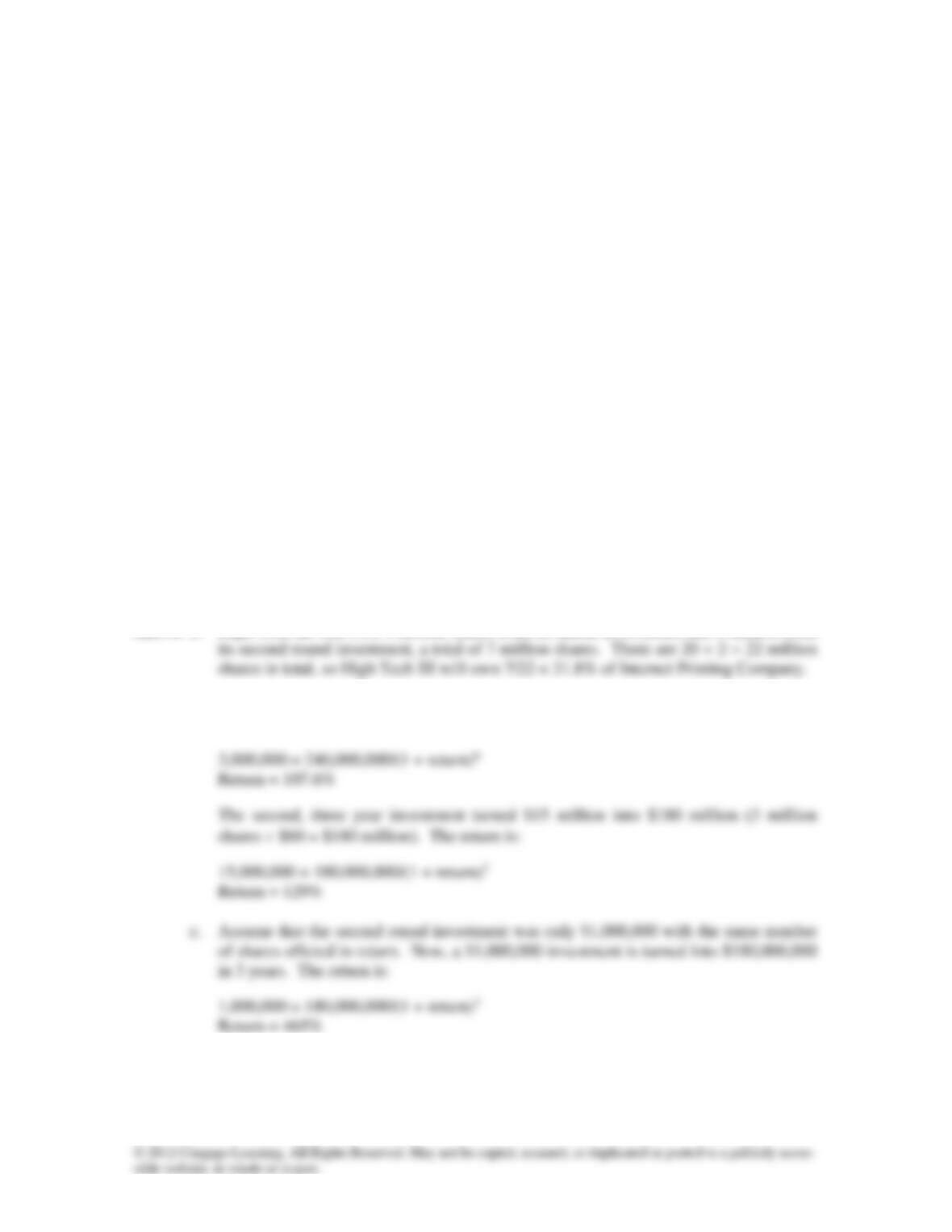
A20-5. a. High Tech III will own 4 million shares from its initial investment, and 3 million from
b. The first, six-year investment turned $3 million into $240 million (4 million shares x
$60 = $240 million). The return is:
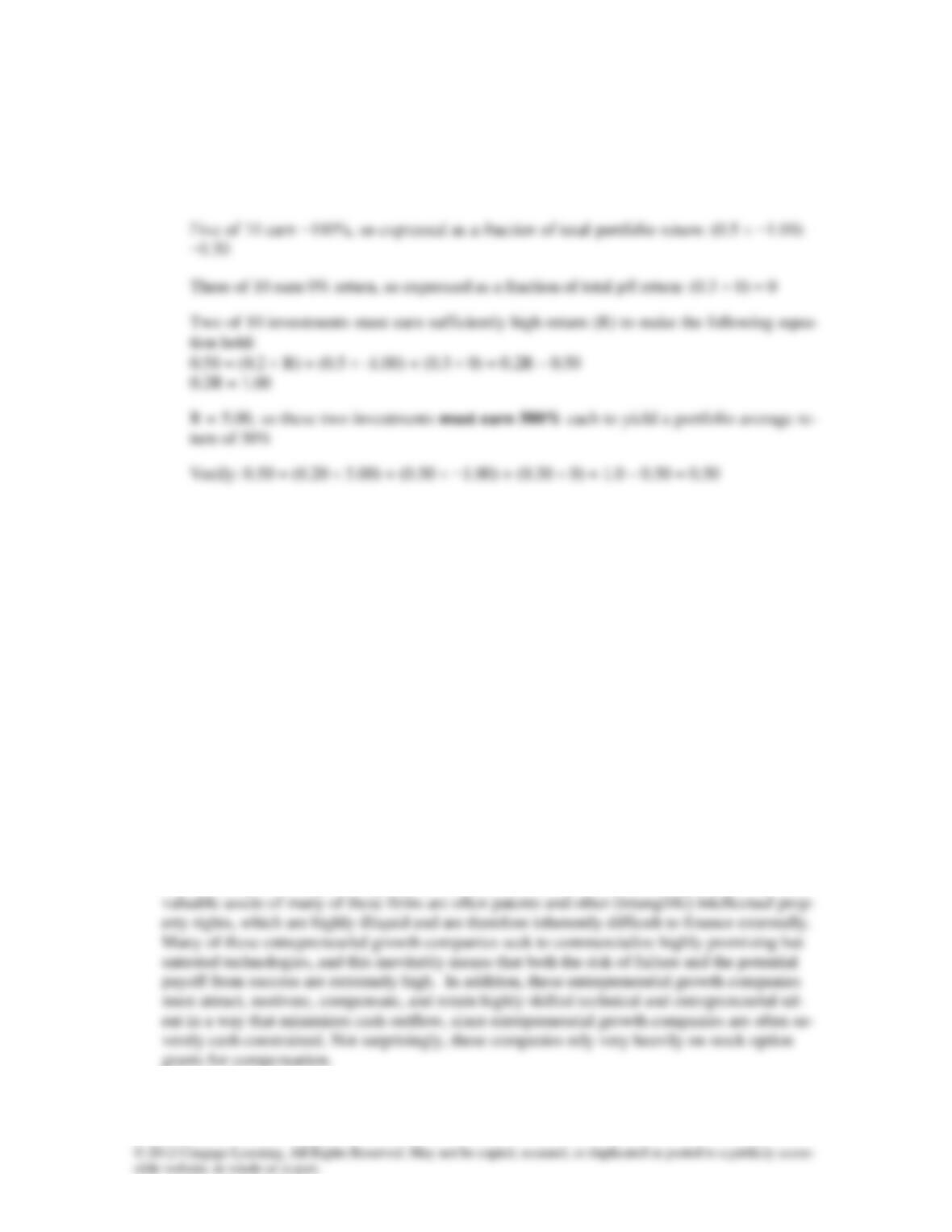
P20-6. Suppose that five out of ten investments made by a VC fund are a total loss, meaning that
the return on each of them is −100%. Of the ten investments, three break even, earning a 0
percent return. If the VC fund’s expected return equals 50%, what rate of return must it
earn on the two most successful deals to achieve a portfolio return equal to expectations?
Chapter 20 Entrepreneurial Finance and Venture Capital 543
A20-6. This solution assumes that each of the 10 investments is for equal dollar amounts. There-
fore, each investment gets a portfolio weight of 10%.
Answer to MiniCase
Entrepreneurial Finance and Venture Capital
Through your financial services firm, Vestin Capital, Incorporated, you have raised a pool of mon-
ey from clients. You intend to invest it in new business opportunities. To prepare for this endeavor,
you decide to answer the following questions.
Assignment
1. What are some of the challenges of financing entrepreneurial growth companies?
2. What are the different types of venture capital funds?
3. What are some choices for organizing a venture capital firm?
4. In what ways should a venture capital firm structure its investments?
5. Should venture capital firms use convertible securities?
6. What are some of the exit strategies that may be available to a venture capital firm?
Answers
1. There are many challenges that are inherent with financing entrepreneurial growth companies.
These types of companies grow very rapidly and usually consume more cash than they gener-
ate because growth requires ongoing investments in fixed assets and working capital. The most
2. There are four categories of institutional venture capital funds; (a) small business investment
companies (SBICs), (b) financial venture capital funds, (c) corporate venture capital funds, and
544 Instructor’s Manual
(d) venture capital limited partnerships. Small business investment companies (SBICs) are
3. Most of the top venture capital firms are organized as general partnerships, which begin the
venture financing process by creating a distinct limited partnership fund. Although some ven-
ture funds are created by public offerings of limited partnership interests (which can then be
4. Although one should be wary of describing anything as unique as a venture capital investment
contract as “standard,” most agreements between VCs and entrepreneurs share certain charac-
and (5) the overall state of the market. Venture capitalists will use staged financing to mini-
mize their risk exposure. Staged financing is not only a very efficient way to minimize risk for
the venture capitalist, but it also gives the venture fund an extremely valuable option to deny or
delay additional funding. The accompanying cancellation option places the maximum feasible
amount of financial risk on the entrepreneur, but in return allows the entrepreneur to obtain
5. In fact, venture capitalists almost always receive some type of convertible security instead, ei-
ther convertible debt or, more frequently, convertible preferred stock. There are several rea-
sons for this preference. First, it allows venture capitalists to exercise effective voting control
over a portfolio company without having to purchase a majority of that firm’s common stock,
6. The exit strategies available to a venture capital firm include; (1) an initial public offering