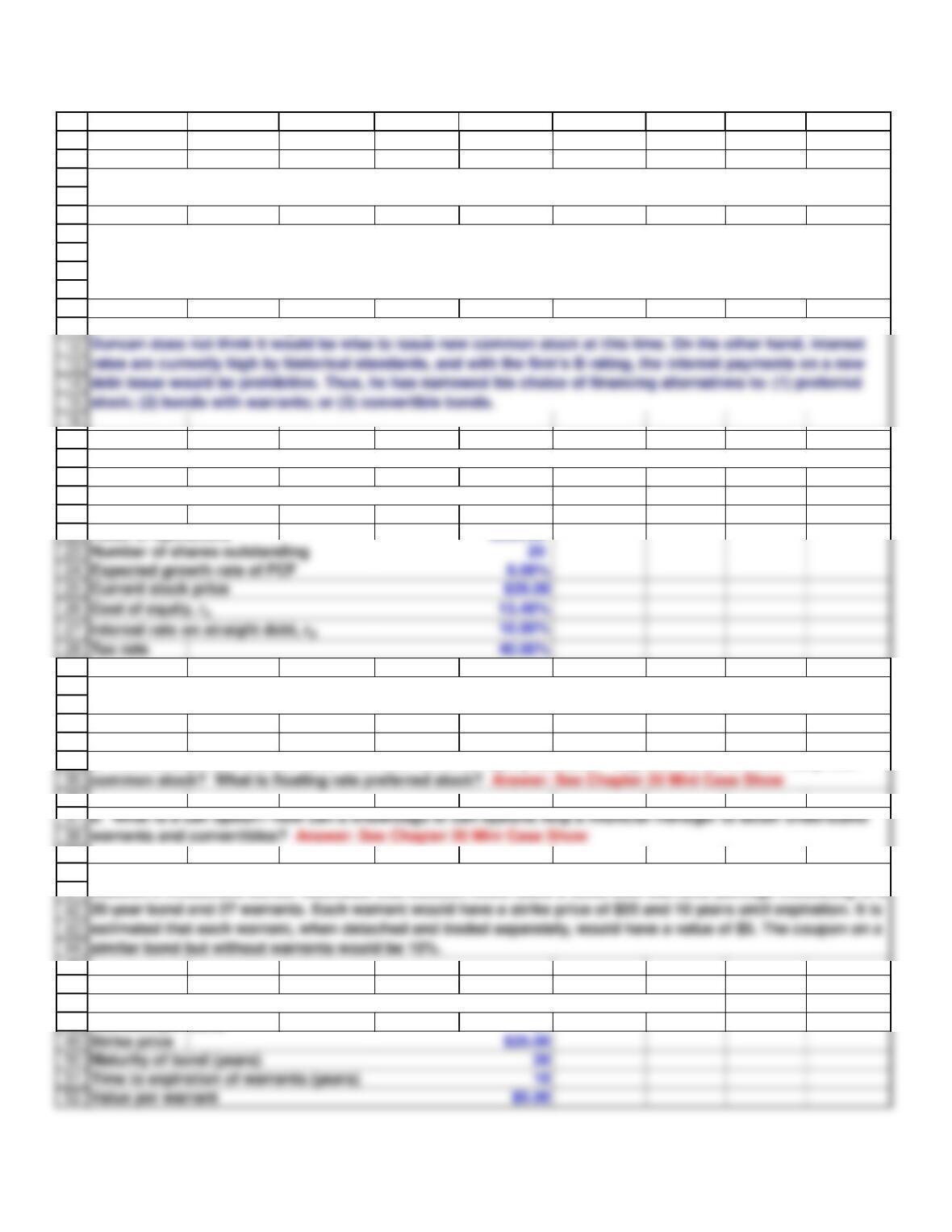
Number of shares outstanding 20
Expected growth rate of FCF 8.00%
Current stock price $20.00
Tax rate 40.00%
b. What is a call option? How can a knowledge of call options help a financial manager to better understand
estimated that each warrant, when detached and traded separately, would have a value of $5. The coupon on a
Strike price $25.00
Maturity of bond (years) 20
Time to expiration of warrants (years) 10
Value per warrant $5.00
1
2
3
4
5
6
7
8
9
10
11
17
18
19
20
21
22
29
30
31
32
33
34
36
39
40
45
46
47
48
A B C D E F G H I
1/6/2015
Inputs (Note: All values are in millions, except per share data.)
Value of operations $500.00
Data for Bonds with Warrants (Note: All values are in millions, except per share data.)
Warrants per bond 27
Chapter 20. Mini Case for Hybrid Financing: Preferred Stock, Warrants, and Convertibles
c. Mr. Duncan has decided to eliminate preferred stock as one of the alternatives and focus on the others.
EduSoft’s investment banker estimates that EduSoft could issue a bond-with-warrants package consisting of a
Because he expects earnings to continue rising sharply and looks for the stock price to follow suit, Mr.
Paul Duncan, financial manager of EduSoft Inc., is facing a dilemma. The firm was founded 5 years ago to
provide educational software for the rapidly expanding primary and secondary school markets. Although
EduSoft has done well, the firm’s founder believes an industry shakeout is imminent. To survive, EduSoft must
grab market share now, and this will require a large infusion of new capital.
a. How does preferred stock differ from both common equity and debt? Is preferred stock more risky than
As Duncan’s assistant, you have been asked to help in the decision process by answering the following
questions:
The following data apply to all three alternatives:
stock; (2) bonds with warrants; or (3) convertible bonds.
55
56
57
58
59
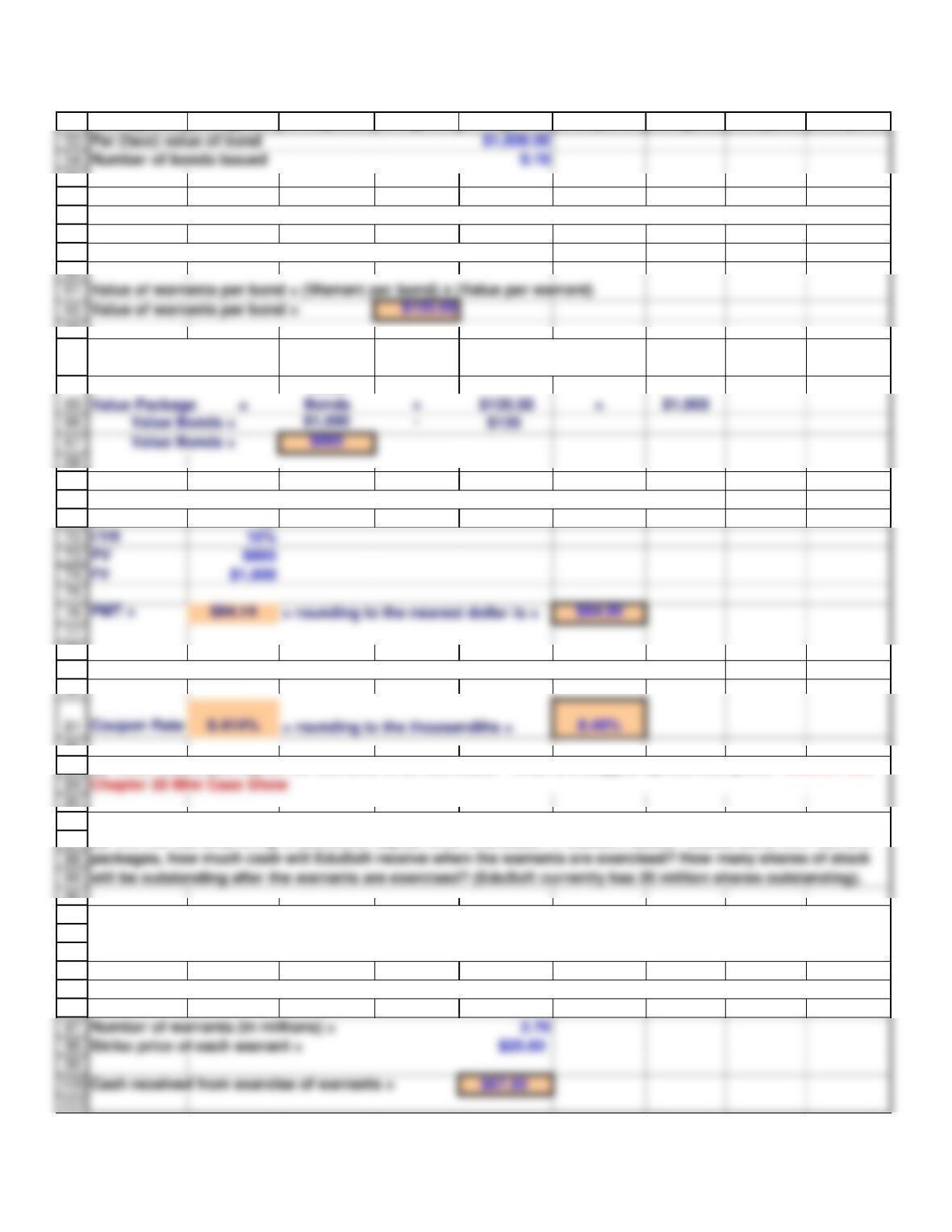
Bonds +$135.00 = $1,000
63
64
69
70
71
78
79
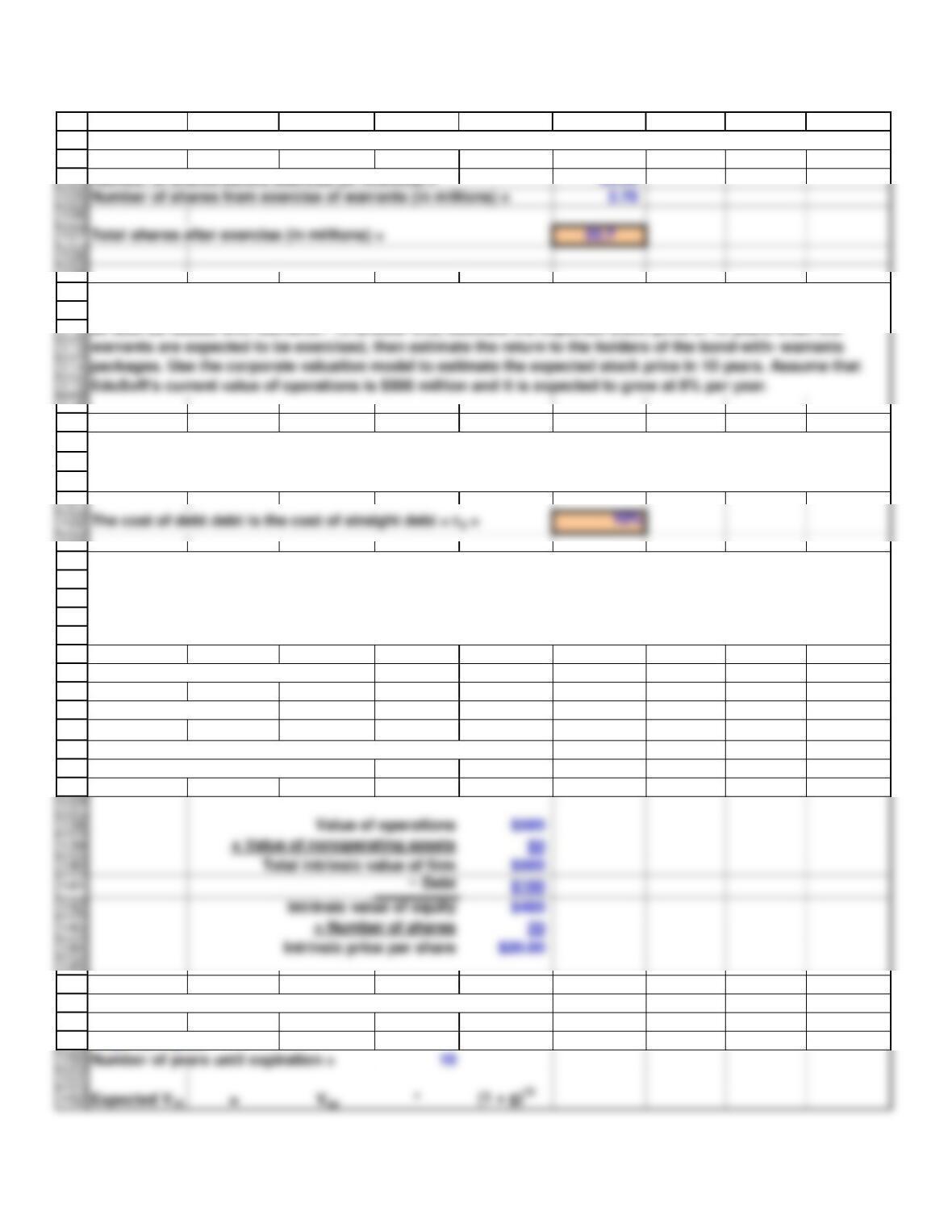
packages, how much cash will EduSoft receive when the warrants are exercised? How many shares of stock
will be outstanding after the warrants are exercised? (EduSoft currently has 20 million shares outstanding).
82
83
85
86
87
90
91
92
93
94
95
96
A B C D E F G H I
First, find the value of the embedded straight bond.
Value Package =
Value
Bonds +Value warrants = $1,000
Value
N20
(3) Will the warrants bring in additional capital when exercised? If EduSoft issues 100,000 bond-with-warrant
How much cash will the firm receive when the warrants are exercised?
(2) When would you expect the warrants to be exercised? What is a stepped-up-exercise price? Answer: See
When exercised, each warrant will bring in an amount equal to the strike price, $25; this is equity capital.
Warant-holders will receive one share of common stock per warrant. The strike price is typically set some 20%
to 30% above the current stock price when the warrants are issued.
(1) What coupon rate should be set on the bond with warrants if the total package is to sell for $1,000?
Use the required payment to determine the required coupon rate.
Find the payment such that the bond with warrant is issued at par.
102
103
104
109
110
111
116
117
118
119
120
Number of years until expiration = 10
123
124
125
126
127
128
129
130
131
132
133
134
135
136
145
146
147
148
149
A B C D E F G H I
Number of shares before exercise (in millions) = 20.00
Current valuation analysis
Required inputs:
Initial Vop $500
Initial value of debt = Number of bonds x Iissue price $100
Number of shares outstanding 20
Valuation analysis in 10 years when warrants expire
Required inputs:
(4) Because the presence of warrants causes a lower coupon rate on the accompanying debt issue, shouldn’t
all debt be issued with warrants? To answer this, estimate the expected stock price in 10 years when the
How many shares of stock will there be after the warrants are exercised?
Begin by estimating the required return on the debt, rd, and the required return on the warrants, rw. To find the
overall cost of capital for the convertible bond, rc, comine the cost of straight debt with the cost of the warrant,
weighting them by the percentages they comprise of the bond-with-warrants package.
To find the cost of warrants, we will find the expected profit of the warrant holders and the expected return. If
the warrants are very likely to be in the money at expiration, then we can approximate the expected profit by
first estimating the expected stock price at expiration. We begin by performing a current valuation analysis
and then we repeat the analysis assuming 10 years have passed and the value of operations has grown at it
expected growth rate.
Number of shares from exercise of warrants (in millions) = 2.70
163
164
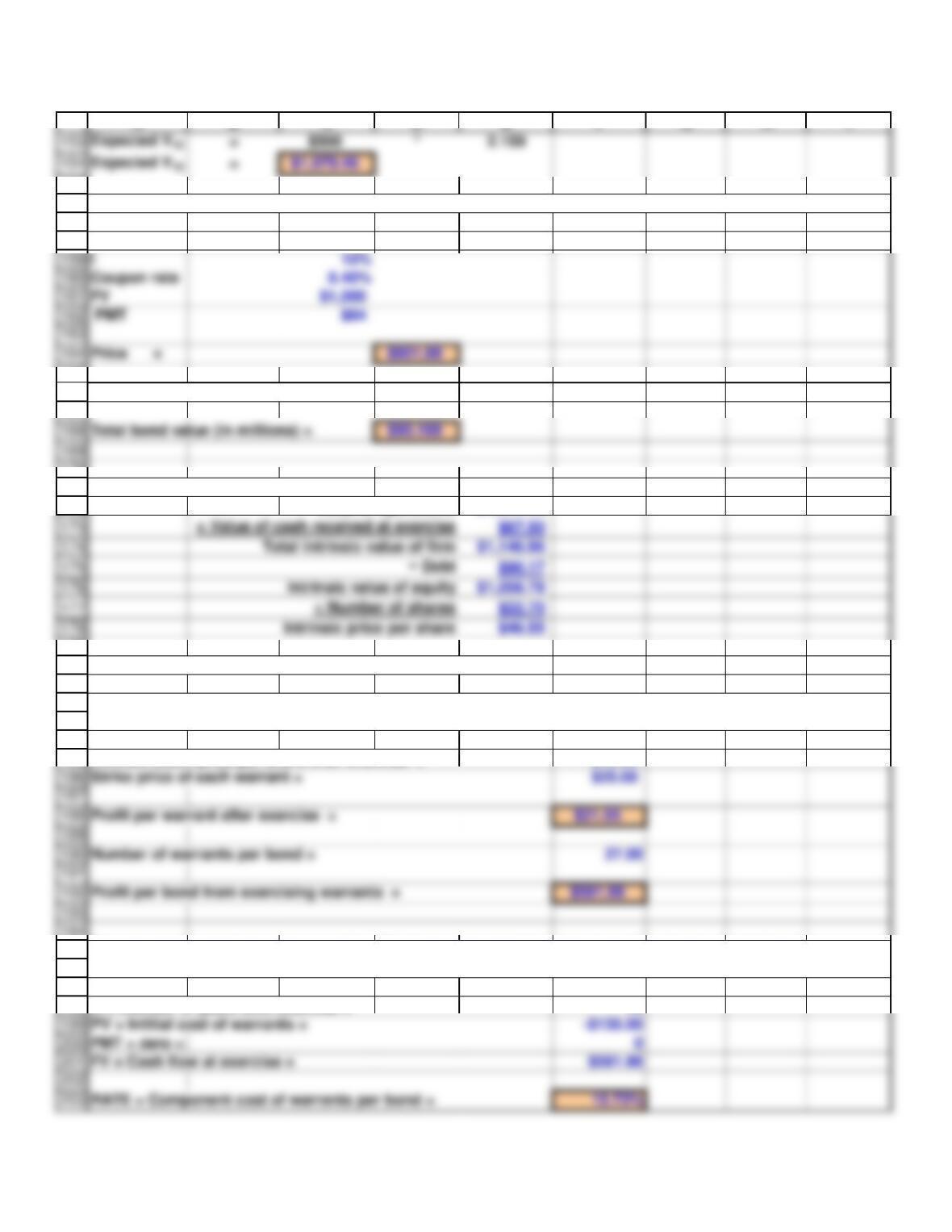
Coupon rate 8.40%
PMT $84
155
156
157
158
165
166
167
168
187
188
191
192
Strike price of each warrant = $25.00
Number of warrants per bond = 27.00
170
171
172
179
180
181
182
183
184
185
202
203
PV = Intitial cost of warrants = -$135.00
PMT = zero = 0
FV = Cash flow at exercise = $581.98
194
195
196
197
198
A B C D E F G H I
N10
Number of bonds (in millions) 0.10
Intrinsic stock price in at expiration
Value of operations $1,079.46
Estimating the expected return to the warrant-holders
Intrinsic stock price per share after exercise = $46.55
N = Number of years until exercise = 10
How much will the bonds be worth in 10 years? (There will be 10 years remaining to maturity.)
The per warrant profit to the warrant-holder is equal to the stock price minus the strike price. The total profit
per bond is equal to the total number warrants per bond multiplied by the profit per warrant.
The component cost per warrant is the IRR of an investment in warrants at time 0 and a cash flow from
exercising.
204
205
206
207
208
209
210
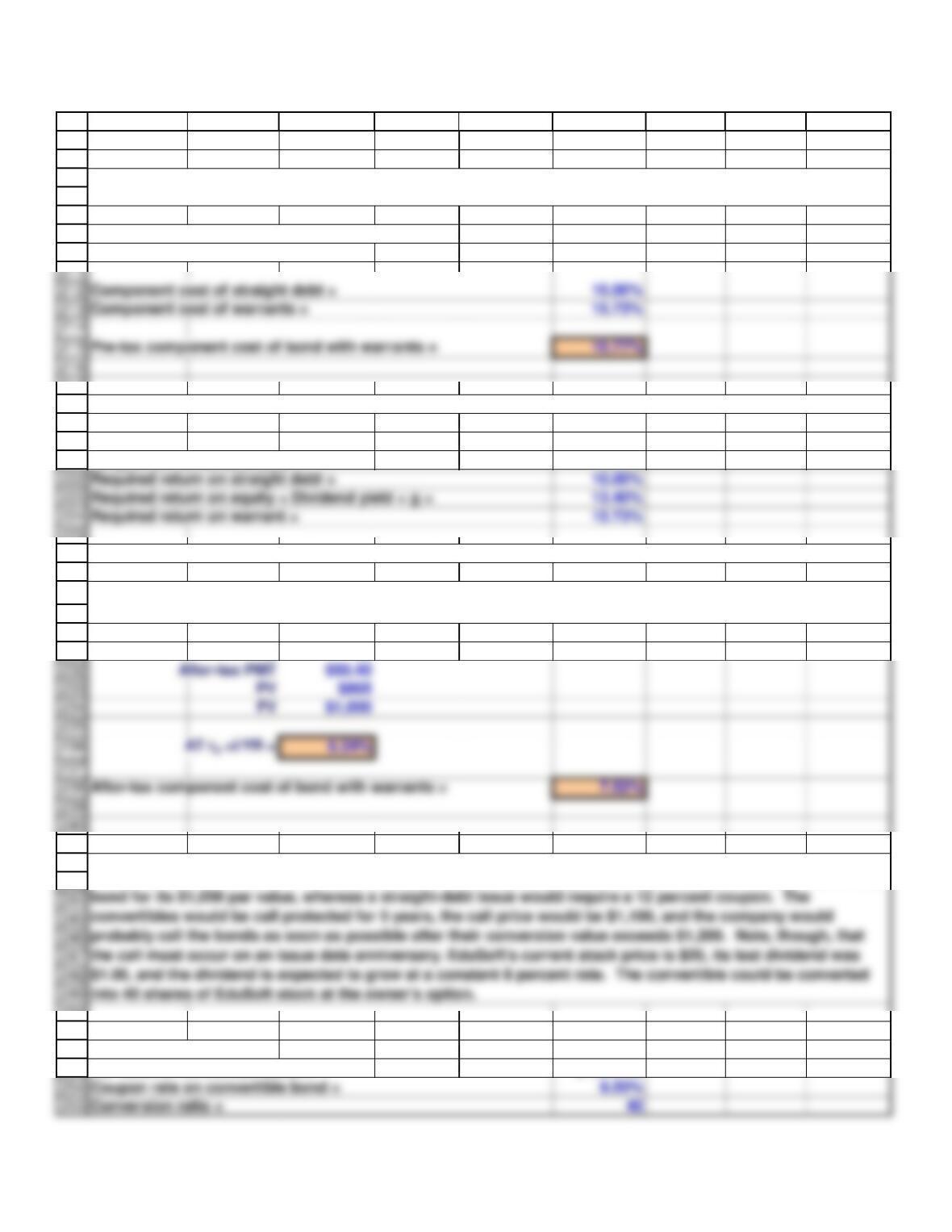
Required return on straight debt = 10.00%
Required return on equity = Dividend yield + g = 13.40%
Required return on warrant = 15.73%
217
218
219
220
221
225
226
227
228
229
230
231
into 40 shares of EduSoft stock at the owner’s option.
241
242
243
250
251
252
253
A B C D E F G H I
% straight bond in bond with warrants = 86.50%
% warrants in bond with warrants = 13.50%
Coupon on convertible debt = 8.40%
N20
Required inputs:
Par value of convertible bond = $1,000.00
(5) How would you expect the cost of the bond with warrants to compare with the cost of straight debt? With
(6) If the corporate tax rate is 40%, what is the after-tax cost of the bond with warrants?
Because the bond portion of the package was issued at a discount (its value was only $865, not $1,000), its
after-tax cost of debt is not equal to rd(1-T). You must find the rate of return given the after-tax coupon.
The pre-tax component cost of the bond with warrants is the weighted average of the pre-tax component costs
of the straight bond and the warrants.
d. As an alternative to the bond with warrants, Mr. Duncan is considering convertible bonds. The firm’s
investment bankers estimate that EduSoft could sell a 20-year, 8.5 percent annual coupon, callable convertible
Component cost of straight debt = 10.00%
Component cost of warrants = 15.73%
256
257
258
259
260
264
265
266
267
268
1$864.00
2$933.12
1$864.00 $711.02 $864.00
2$933.12 $697.12 $933.12
276
277
278
279
280
281
282
283
294
295
296
297
298
299
300
301
302
303
A B C D E F G H I
Maturity (in years) of convertible bond = 20
Inputs:
N = 20
I/YR = 10%
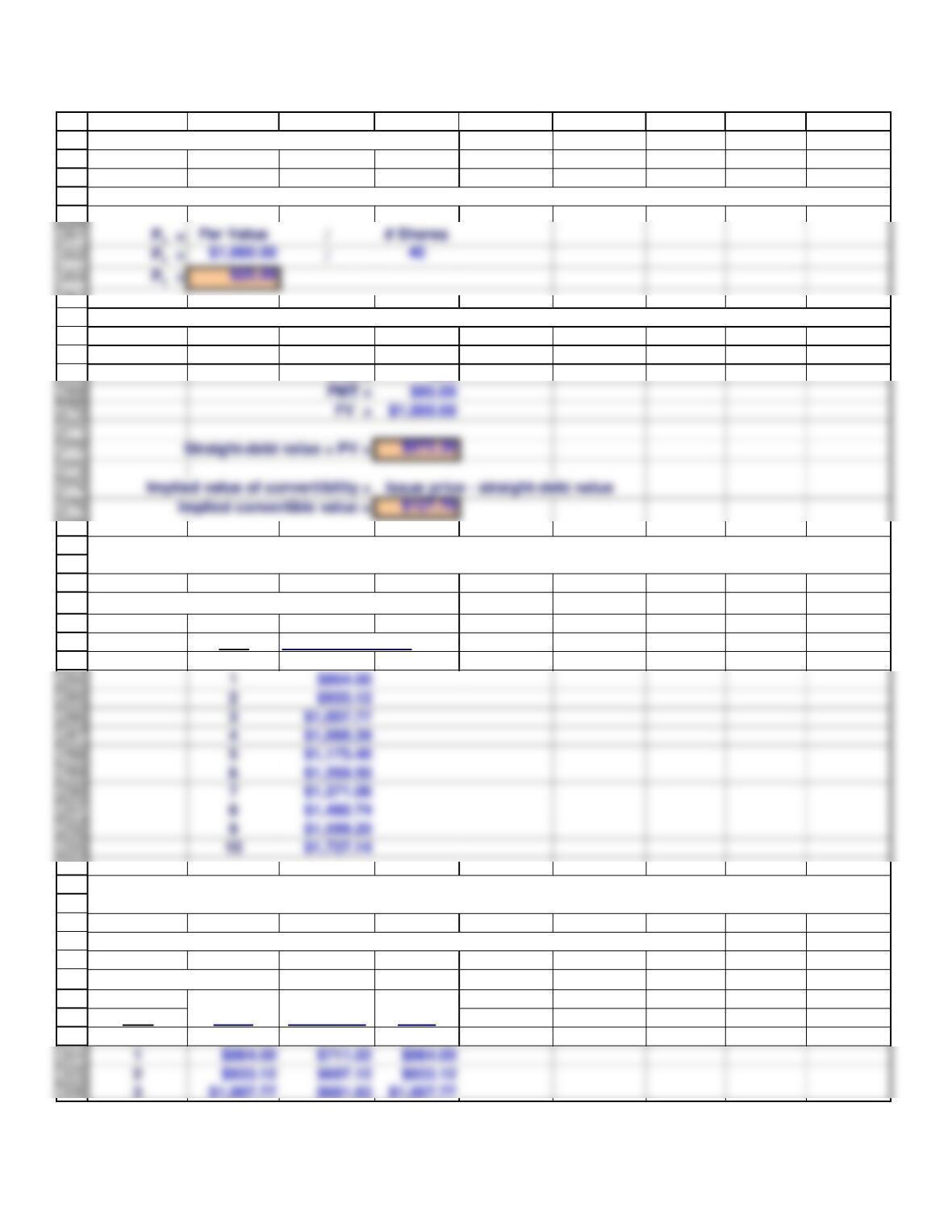
Conversion value = CVt = CR(P0)(1 + g)t.
t Conversion value
0$800.00
The floor value is the higher of the straight debt value and the conversion value.
Straight-debt value =
t
0$800.00 $723.65 $800.00
Conversion
Value
Straight-
Debt Value
Floor
value
(2) What is the convertible’s straight-debt value? What is the implied value of the convertibility feature?
(1) What conversion price is built into the bond?
(3) What is the formula for the bond‘s expected conversion value in any year? What is its conversion value at
Year 0? At Year 10?
(4) What is meant by the “floor value” of a convertible? What is the convertible’s expected floor value at Year
0? At Year 10?
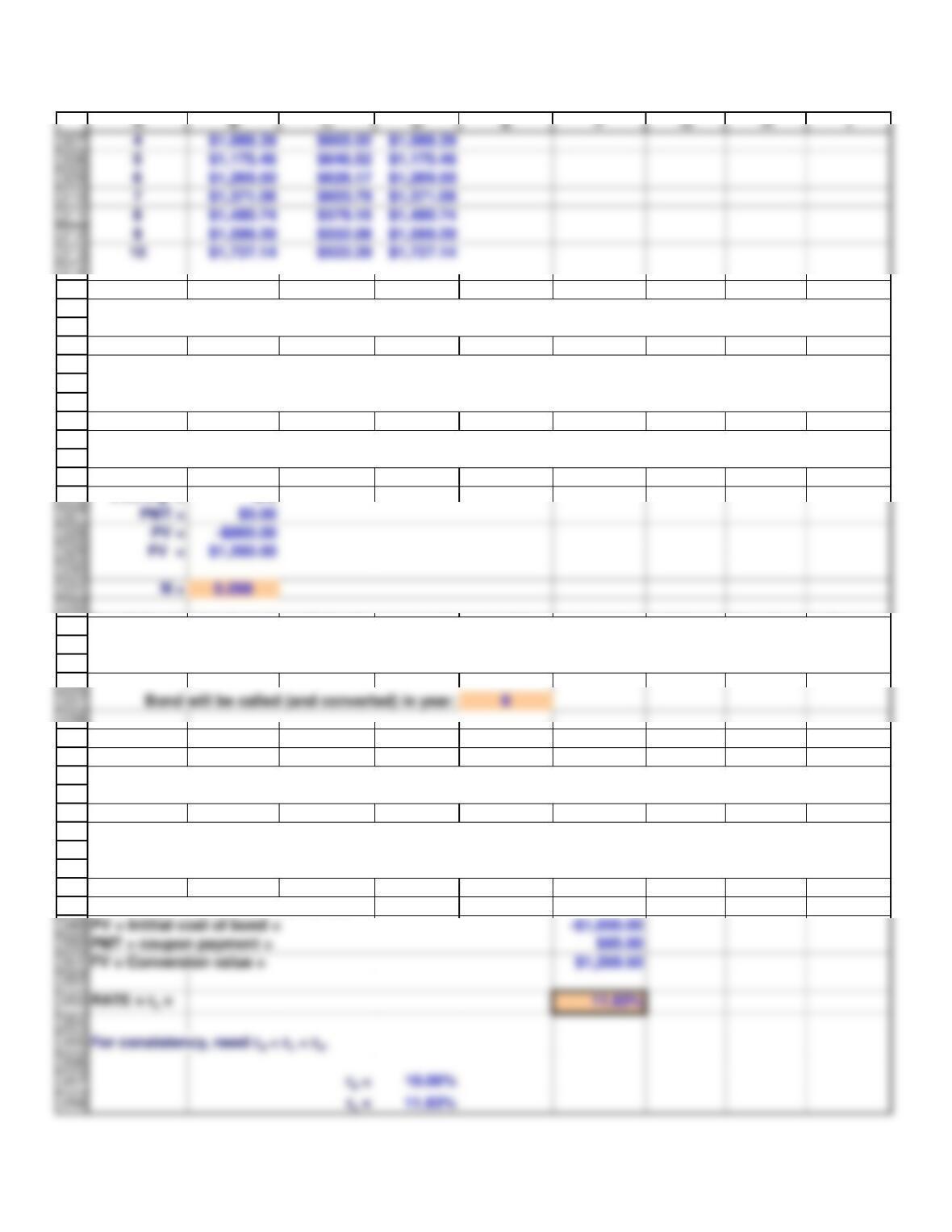
PV = Intitial cost of bond = -$1,000.00
PMT = coupon payment = $85.00
FV = Conversion value = $1,269.50
314
315
316
317
318
319
320
321
322
323
324
325
326
333
334
335
338
339
340
341
342
343
344
345
346
347
348
I/YR = g = 8%
N = Number of years until conversion = 6
Recall that the bond can be called only on an anniversary date, so we must round the number of years that we
just found up to the next integer. Also, we must verify that the year is at least as great as the number of years
the bond is protected from calls.
The bondholder will receive the coupon each year until conversion (including the year of the conversion). At
conversion, the bondholder will also receive the conversion value. We can find the return using the RATE
function.
(5) Assume that EduSoft intends to force conversion by calling the bond as soon as possible after its
conversion value exceeds 20 percent above its par value, or 1.2($1,000) = $1,200. When is the issue expected
to be called? (Hint: Recall that the call must be made on an anniversary date of the issue.)
A convertible will generally sell above its floor value prior to maturity because convertibility constitutes a call
option that has value.
Notice that the conversion value grows at the same rate as the stock. So the first step is to find the number of
years until the initial conversion value grows to the value at which it will be called.
(6) What is the expected return on the convertible to EduSoft? Does this cost appear to be consistent with the
convertible bond’s risk?
360
361
362
363
364
365
366
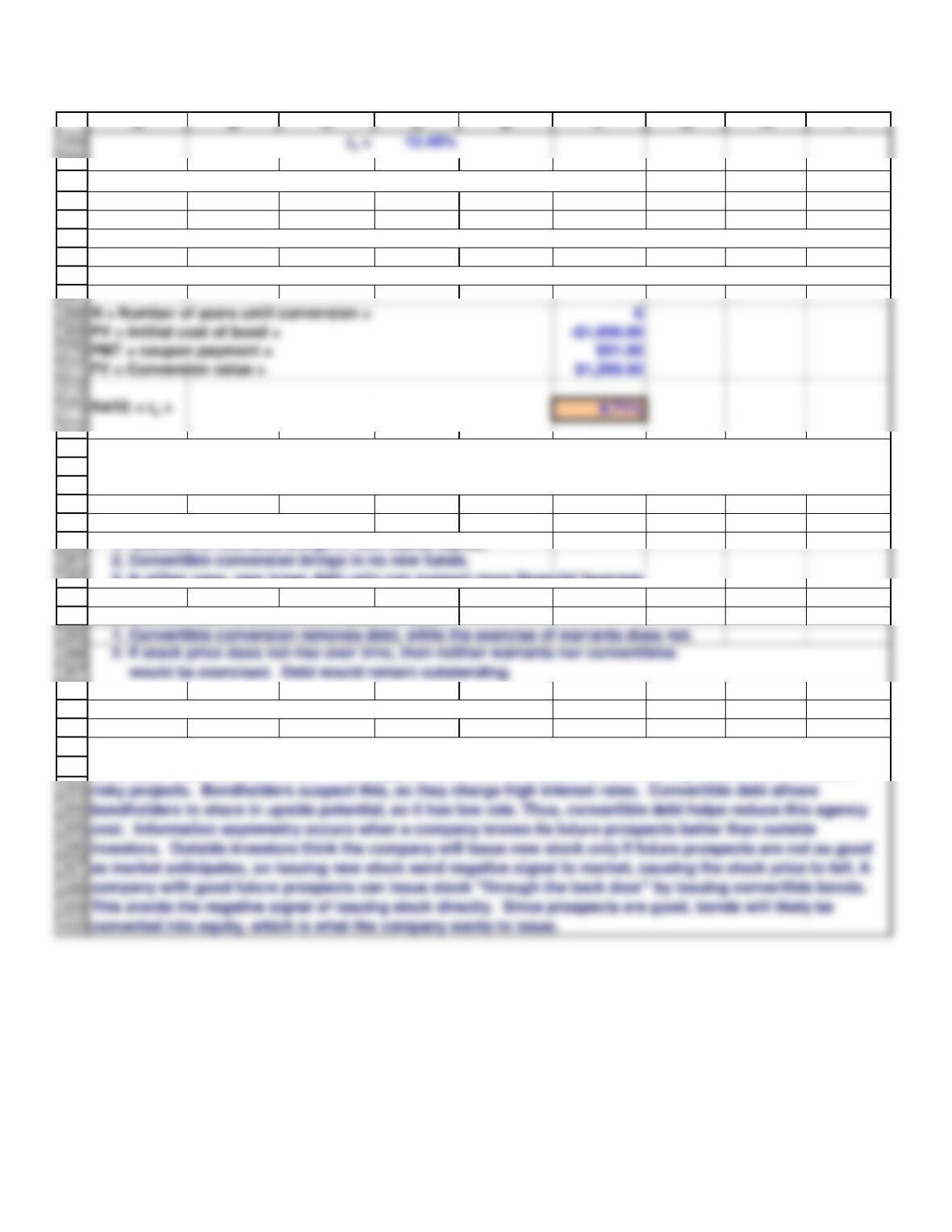
1. Convertible conversion removes debt, while the exercise of warrants does not.
2. Convertible conversion brings in no new funds.
converted into equity, which is what the company wants to issue.
374
375
376
377
378
379
380
382
383
384
388
389
390
391
392
Since rc is between rd and rs, the costs are consistent with the risks.
1. Exercise of warrants brings in new equity capital.
3. In either case, new lower debt ratio can support more financial leverage.
Does the firm want to commit to 20 years of debt?
f. How do convertible bonds help reduce agency costs?
e. Mr. Duncan believes that the costs of both the bond with warrants and the convertible bond are close
enough to one another to call them even, and also consistent with the risks involved. Thus, he will make his
decision based on other factors. What are some of the factors which he should consider?
Agency costs can arise due to conflicts between shareholders and bondholders, in the form of asset
substitution (or bait-and-switch. This happens when the firm issues low cost straight debt, then invests in
(7) What is the after-tax cost of the convertible bond?
Use the after-tax coupon payment, then find the rate of return.
The firm’s future needs for equity capital:
N = Number of years until conversion = 6
PV = Intitial cost of bond = -$1,000.00
PMT = coupon payment = $51.00
FV = Conversion value = $1,269.50