
Answers and Solutions: 20 – 14
SOLUTION TO SPREADSHEET PROBLEM
20-8 The detailed solution for the spreadsheet problem, Ch20 P08 Build a Model
Solution.xlsx, is available on the textbook’s web site.

Mini Case: 20 – 15
MINI CASE
Paul Duncan, financial manager of Edusoft Inc., is facing a dilemma. The firm was founded
five years ago to provide educational software for the rapidly expanding primary and
secondary school markets. Although Edusoft has done well, the firm’s founder believes that
an industry shakeout is imminent. To survive, Edusoft must grab market share now, and
this will require a large infusion of new capital.
Because he expects earnings to continue rising sharply and looks for the stock price to
follow suit, Mr. Duncan does not think it would be wise to issue new common stock at this
time. On the other hand, interest rates are currently high by historical standards, and with
the firm’s B rating, the interest payments on a new debt issue would be prohibitive. Thus, he
has narrowed his choice of financing alternatives to: (1) preferred stock; (2) bonds with
warrants; or (3) convertible bonds.
As Duncan’s assistant, you have been asked to help in the decision process by answering
the following questions:
a. How does preferred stock differ from both common equity and debt? Is preferred
stock more risky than common stock? What is floating rate preferred stock?
Answer: Preferred stock is a hybrid—it contains some features that are similar to debt and some
features that are similar to common equity. Like debt, preferred payments to investors
are contractually fixed, but like common equity, preferred dividends can be omitted
Mini Case: 20 – 16
b. What is a call option? How can knowledge of call options help a financial manager
to better understand warrants and convertibles?
Answer: A call option is a contract which gives the holder the right, but not the obligation, to
c. Mr. Duncan has decided to eliminate preferred stock as one of the alternatives
and focus on the others. EduSoft’s investment banker estimates that EduSoft
could issue a bond-with-warrants package consisting of a 20-year bond and 27
warrants. Each warrant would have a strike price of $25 and 10 years until
expiration. It is estimated that each warrant, when detached and traded
separately, would have a value of $5. The coupon on a similar bond but without
warrants would be 10%.
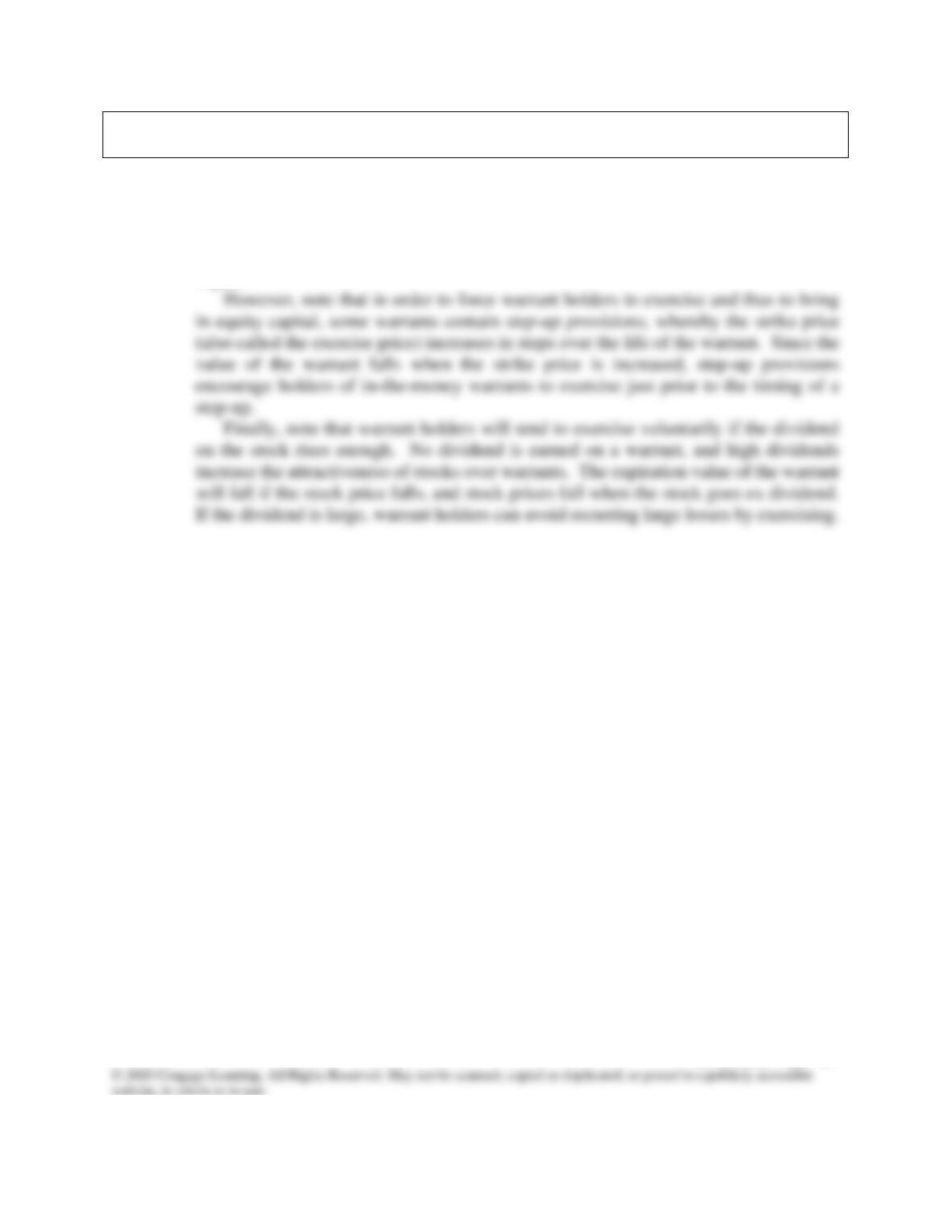
1. What coupon rate should be set on the bond with warrants if the total package is
to sell for $1,000?
Answer: If the entire package is to sell for $1,000, then
Mini Case: 20 – 17
c. 2. When would you expect the warrants to be exercised? What is a stepped-up–
exercise price?
Answer: Generally, a warrant will sell in the open market at a premium above its expiration
value, which is the value of the warrant if exercised. Thus, prior to expiration, an
investor who wanted cash would sell his or her warrants in the marketplace rather than
exercise them. Therefore, warrants tend not to be exercised until just before they
expire.

Mini Case: 20 – 18
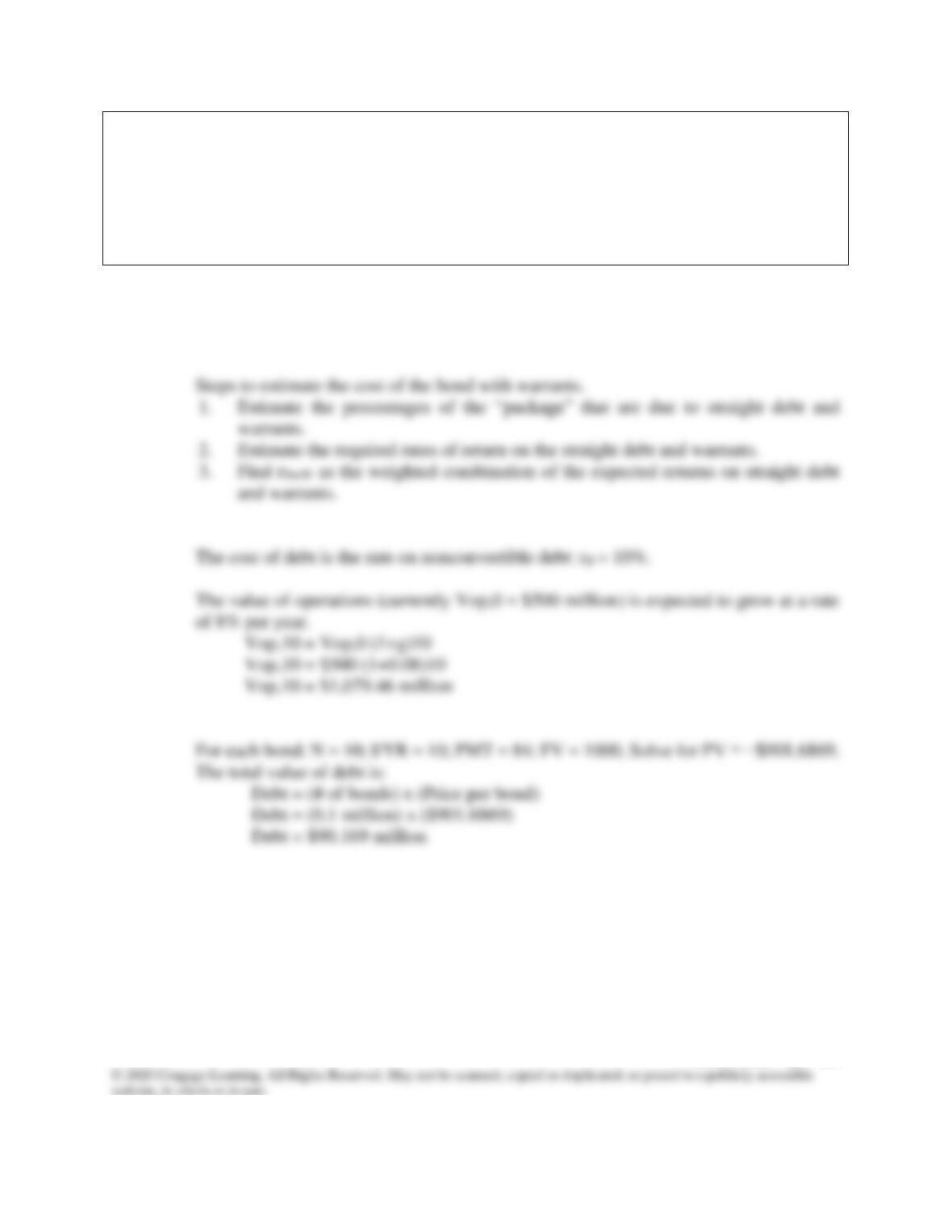
c. 3. Will the warrants bring in additional capital when exercised? If EduSoft issues
100,000 bond-with-warrant packages, how much cash will EduSoft receive when
the warrants are exercised? How many shares of stock will be outstanding after
the warrants are exercised? (EduSoft currently has 20 million shares
outstanding).
Answer: When exercised, each warrant will bring in an amount equal to the strike price, which
in this case means $25 of equity capital, and holders will receive one share of common
stock per warrant. Note that the strike price is typically set at 10% to 30% above the
Mini Case: 20 – 19
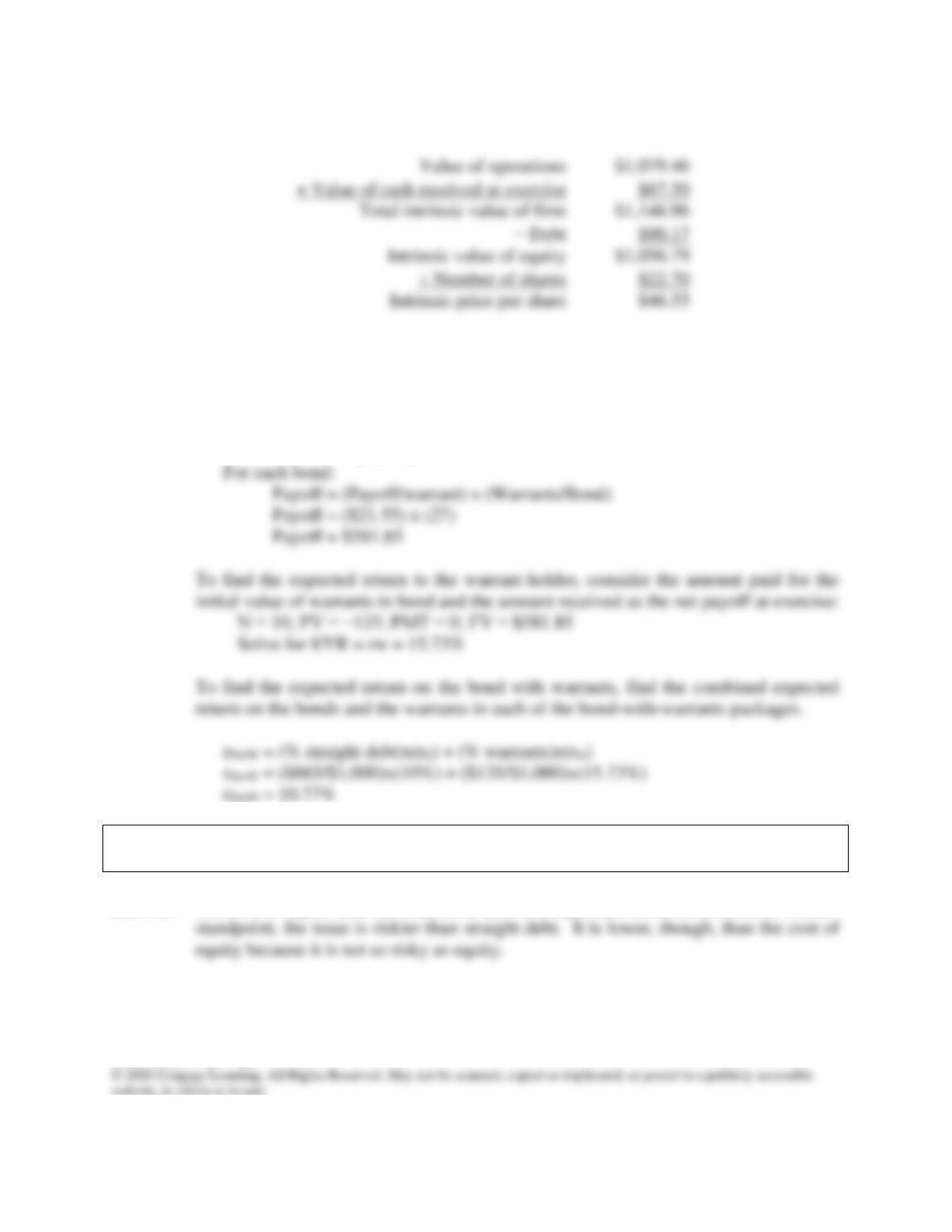
c. 4. Because the presence of warrants causes a lower coupon rate on the accompanying
debt issue, shouldn’t all debt be issued with warrants? To answer this, estimate
the expected stock price in 10 years when the warrants are expected to be
exercised, then estimate the return to the holders of the bond-with- warrants
packages. Use the corporate valuation model to estimate the expected stock price
in 10 years. Assume that EduSoft’s current value of operations is $500 million and
it is expected to grow at 8% per year.
Answer: Even though the 8.4 percent coupon rate on the bond is below the 10 percent coupon
on straight bonds, the overall cost of a bond-with-warrants issue is generally higher
than that of a straight-debt issue.
Mini Case: 20 – 20
Use these and previous data to find the intrinsic stock price:
Find the payoff to the warrant-holder at the time of exercise:
For each warrant:
+$46.55 for value of each share
−$25.00 paid to exercise warrant
+21.55 net payoff per warrant
c. 5. How would you expect the cost of the bond with warrants to compare with the
cost of straight debt? With the cost of common stock (which is 13.4%)?
Answer: This cost is higher than the 10 percent cost of straight debt because, from the investors’

Mini Case: 20 – 21
c. 6. If the corporate tax rate is 25%, what is the after-tax cost of the bond with
warrants?
Answer: Because the bond portion of the package was issued at a discount (its value was only
$865, not $1,000), its after-tax cost of debt is not equal to rd(1-T). You must find the
rate of return given the after-tax coupon.
d. As an alternative to the bond with warrants, Mr. Duncan is considering convertible
bonds. The firm’s investment bankers estimate that Edusoft could sell a 20-year, 8.5
percent annual coupon, callable convertible bond for its $1,000 par value, whereas a
straight-debt issue would require a 10 percent coupon. The convertibles would be
call protected for 5 years, the call price would be $1,100, and the company would
probably call the bonds as soon as possible after their conversion value exceeds
$1,200. Note, though, that the call must occur on an issue date anniversary. Edusoft’s
current stock price is $20, its last dividend was $1.00, and the dividend is expected to
grow at a constant 8 percent rate. The convertible could be converted into 40 shares
of Edusoft stock at the owner’s option.
1. What conversion price is built into the bond?
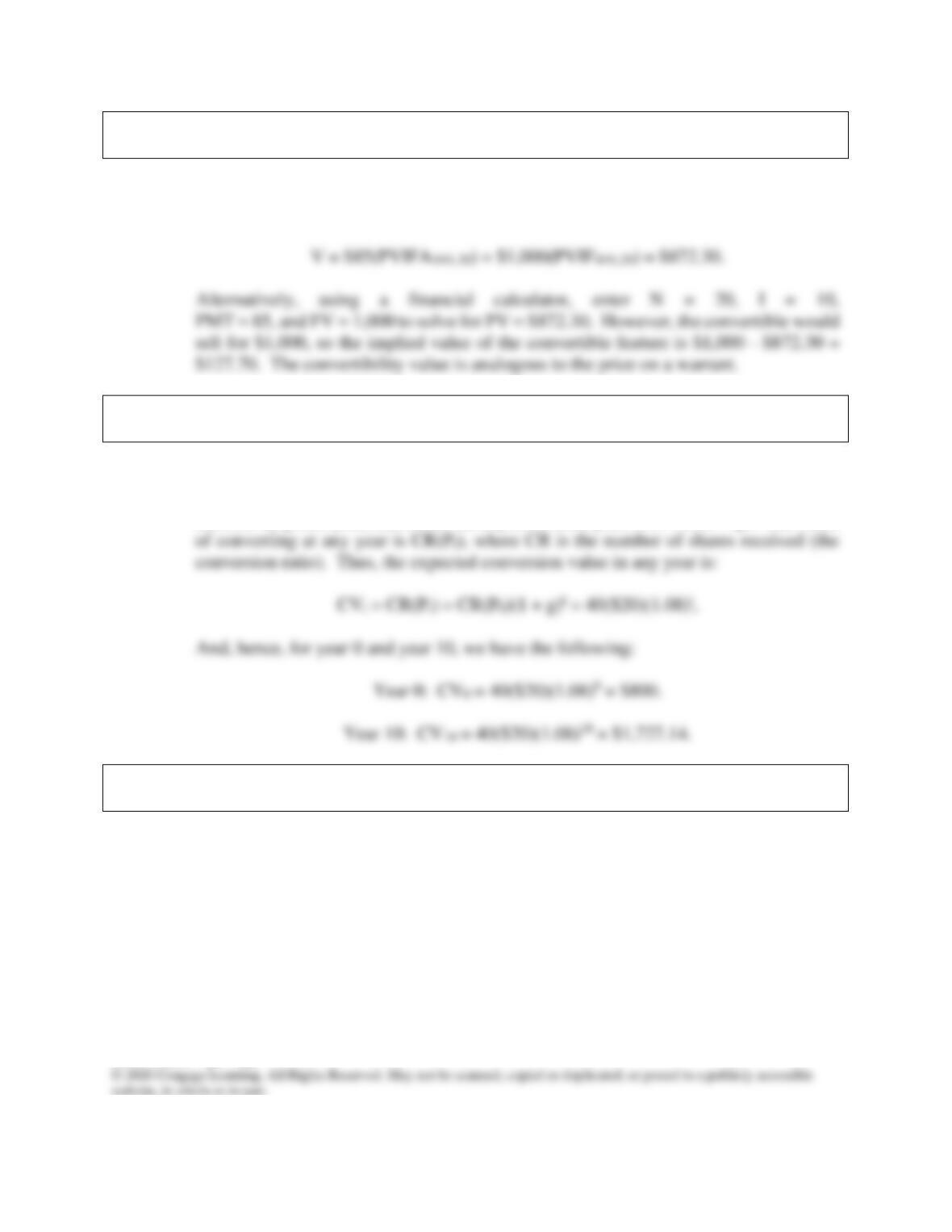
Answer: Conversion Price = PC =
received Shares #
Par value
=
40
000,1$
= $25.
Mini Case: 20 – 22
d. 2. What is the convertible’s straight-debt value? What is the implied value of the
convertibility feature?
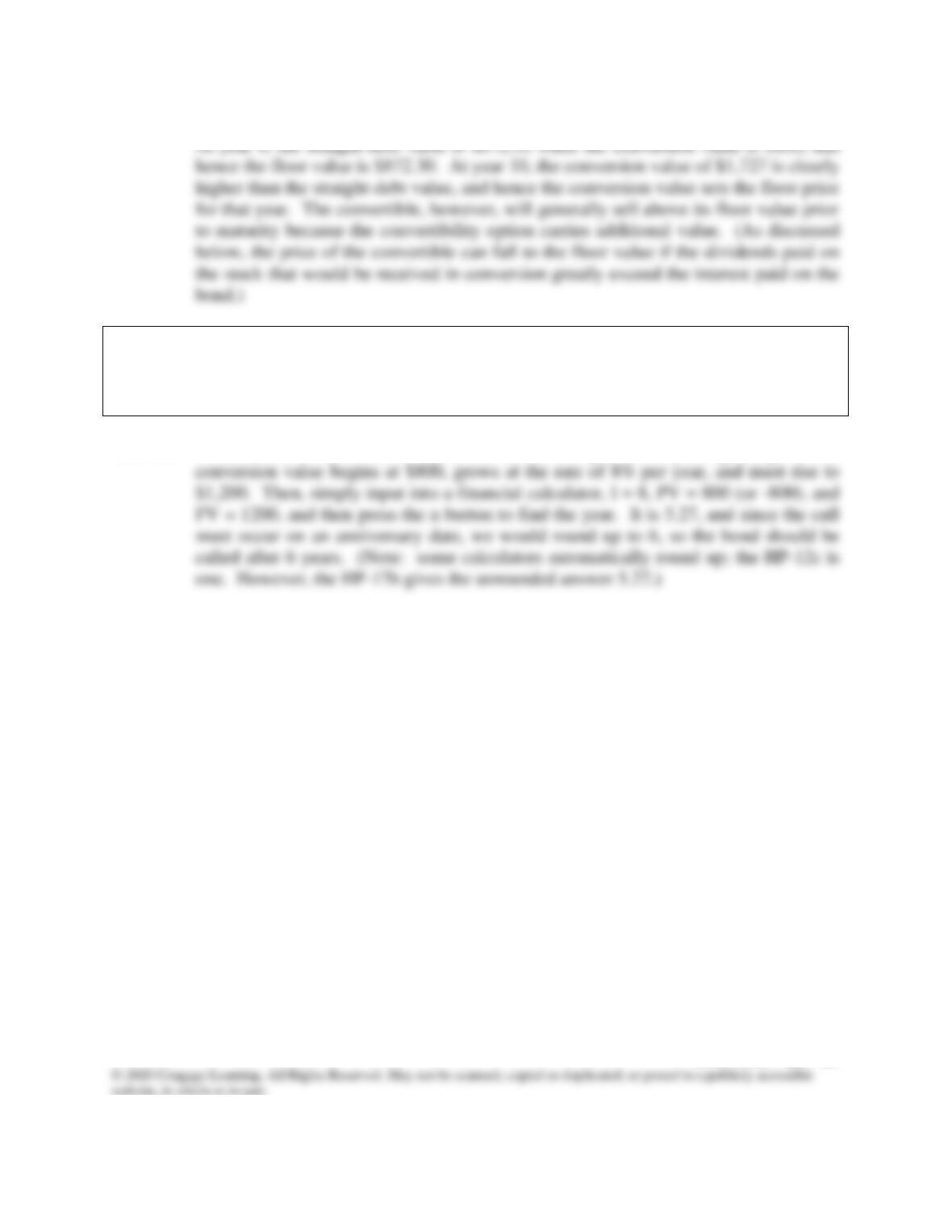
Answer: Since the required rate of return on a 20-year straight bond is 10 percent, the value of
an 8.5 percent annual coupon bond is $872.30:
d. 3. What is the formula for the bond’s expected conversion value in any year? What
is its conversion value at year 0? At year 10?
Answer: The conversion value in any year is simply the value of the stock one would receive
upon converting. Since Edusoft is a constant growth stock, its price is expected to
increase by g each year, and hence the expected stock price is Pt = P0(1 + g)t. The value
d. 4. What is meant by the “floor value” of a convertible? What is the convertible’s
expected floor value at year 0? At year 10?
Mini Case: 20 – 23
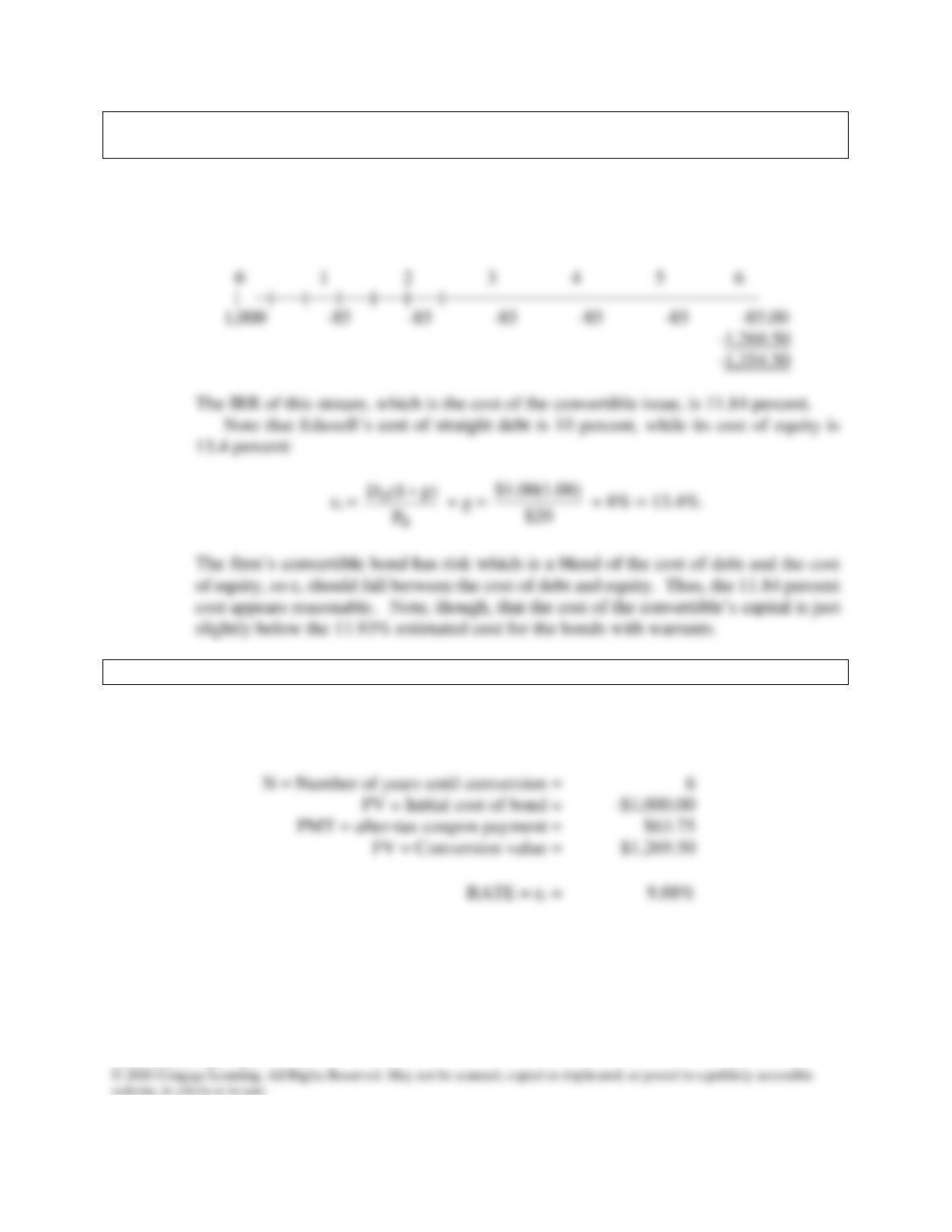
Answer: The floor value is simply the higher of the straight-debt value and the conversion value.
d. 5. Assume that Edusoft intends to force conversion by calling the bond as soon as
possible after its conversion value exceeds 20 percent above its par value, or
1.2($1,000) = $1,200. When is the issue expected to be called? (Hint: recall that
the call must be made on an anniversary date of the issue.)
Answer: The easiest way to find the year conversion is expected is by recognizing that the
Mini Case: 20 – 24
d. 6. What is the expected cost of capital for the convertible to Edusoft? Does this cost
appear to be consistent with the riskiness of the issue?
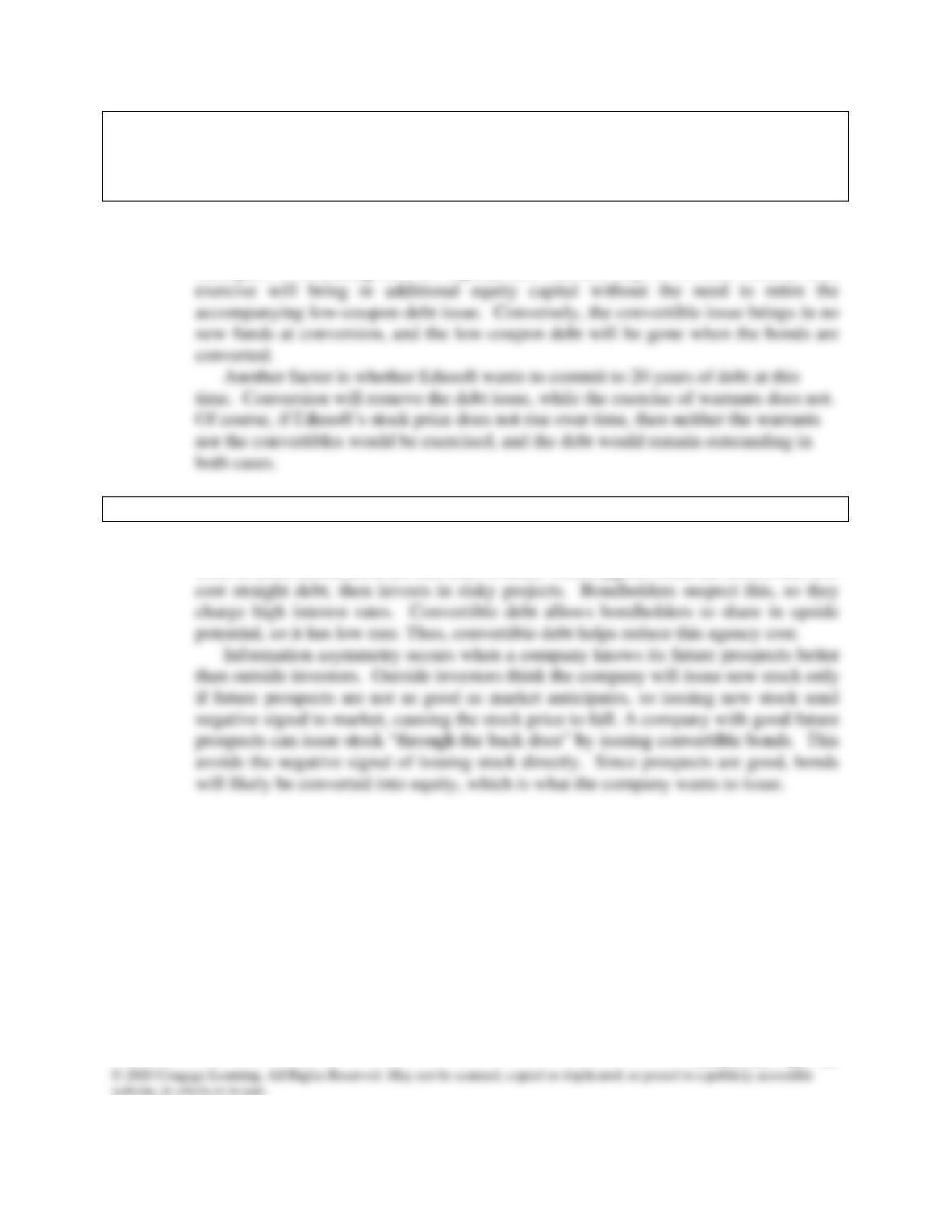
Answer: The firm would receive $1,000 now, would make coupon payments of $85 for 6 years,
and then would issue stock worth 40($20)(1.08)6 = $1,269.50. Thus, the cash flow
stream would look like this:
d. 7. What is the after-tax cost of the convertible bond?
Answer: Use the after-tax coupon payment, then find the rate of return. The after-tax coupon
payment is $63.5: 8.5%($1,000)(1 – 0.25) =
Mini Case: 20 – 25
e. Mr. Duncan believes that the costs of both the bond with warrants and the
convertible bond are close enough to one another to call them even, and also
consistent with the risks involved. Thus, he will make his decision based on other
factors. What are some of the factors which he should consider?
Answer: One factor that should be considered is the firm’s future needs for capital. If Edusoft
anticipates a continuing need for capital, then warrants may be favored, because their
f. How do convertible bonds help reduce agency costs?
Answer: Agency costs can arise due to conflicts between shareholders and bondholders, in the
form of asset substitution (or bait-and-switch.) This happens when the firm issues low