Chapter 20
Hybrid Financing: Preferred Stock, Warrants, and
Convertibles
ANSWERS TO END-OF-CHAPTER QUESTIONS
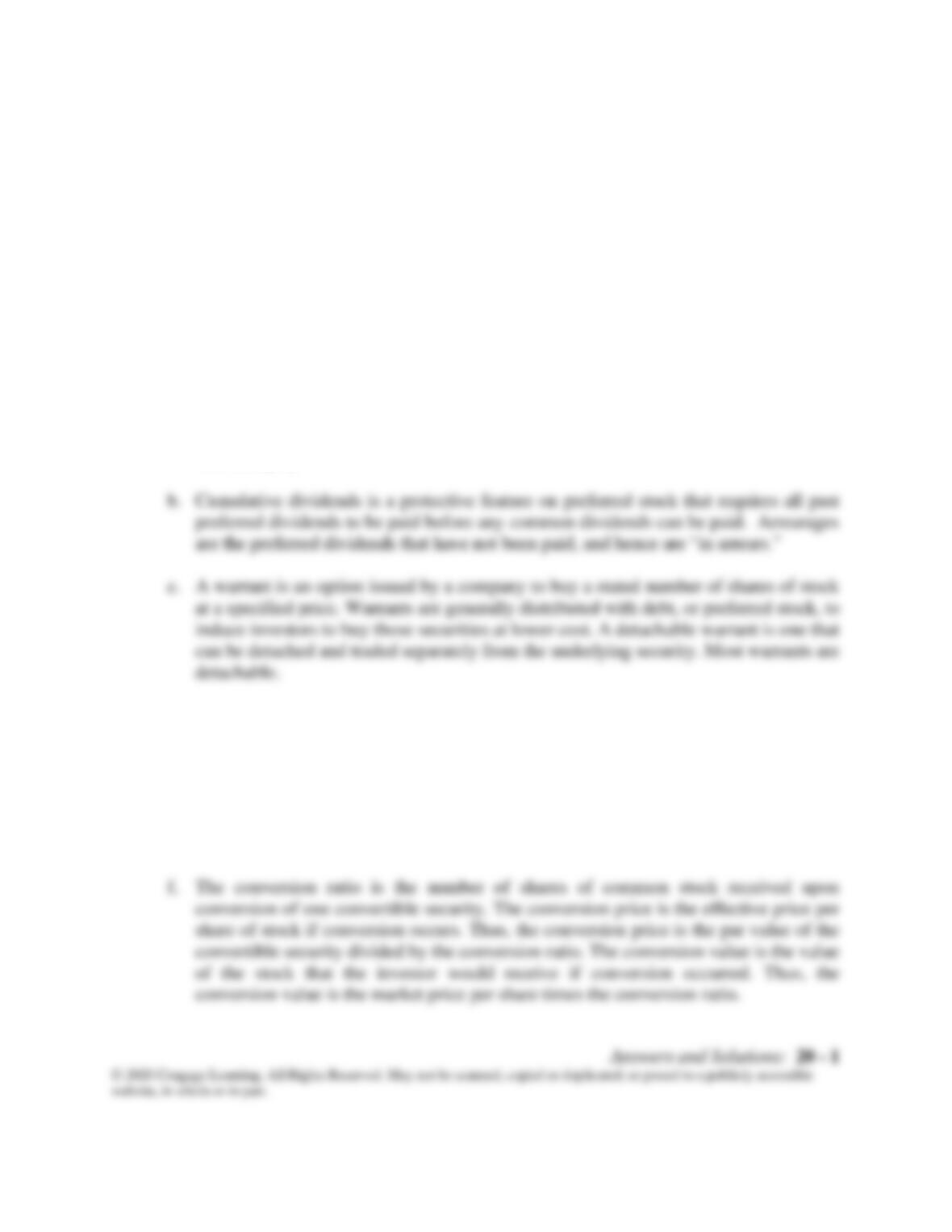
20-1 a. Preferred stock is a hybrid security, having characteristics of both debt and equity. It
is similar to equity in that it (1) is called “stock” and is included in the equity section
of a firm’s balance sheet, (2) has no maturity date, and (3) has payments which are
considered dividends—thus, they are not legally required and are not tax deductible.
However, it is also similar to debt in that it (1) sets a fixed rate for dividends, (2) affords
its holders no voting rights, and (3) has priority over common shareholders in the event
of bankruptcy.
d. A stepped-up price is a provision in a warrant that increases the striking price over time.
This provision is included to prod owners into exercising their warrants.
e. Convertible securities are bonds or preferred stocks that can be exchanged for
(converted into) common stock, under specific terms, at the option of the holder. Unlike
the exercise of warrants, conversion of a convertible security does not provide addi–
tional capital to the issuer.
Answers and Solutions: 20 – 2
g. A “sweetener” is a feature that makes a security more attractive to some investors,
thereby inducing them to accept a lower current yield. Convertible features and
warrants are examples of sweeteners.
20-2 Preferred stock is best thought of as being somewhere between debt (bonds) and equity
(common stock). Like debt, preferred stock imposes a fixed charge on the firm, affords its
20-3 The trend in stock prices subsequent to an issue influences whether or not a convertible
issue will be converted, but conversion itself typically does not provide a firm with
20-4 Either warrants or convertibles could be used by a firm that expects to need additional
financing in the future—warrants, because when they are exercised, additional funds will
be brought into the firm directly; convertibles, because when they are converted, the equity
base is expanded and debt can be sold more easily. However, a firm that does not have
additional funds requirements would not want to use warrants.
20-5 a. The value of a warrant depends primarily on the expected growth of the underlying
stock’s price. This growth, in turn, depends in a major way on the plowback of earnings;
the higher the dividend payout, the lower the retention (or plowback) rate; hence, the
slower the growth rate. Thus, warrant values will be higher, other things held constant,
the smaller the firm’s dividend payout ratio. This effect is more pronounced for long–
term than for short-term warrants.
20-6 The statement is made often. It is not really true, as a convertible’s issue price reflects the
underlying stock’s present price. Further, when the bond or preferred stock is converted,
the holder receives shares valued at the then-existing price, but effectively pays less than
the market price for those shares.
20-7 The convertible bond has an expected return which consists of an interest yield (10 percent)
plus an expected capital gain. We know the expected capital gain must be at least 4 percent,
because the total expected return on the convertible must be at least equal to that on the

SOLUTIONS TO END-OF-CHAPTER PROBLEMS
20-1 Bonds with warrants: $1,000 par value 15-year 5% coupon bonds with annual payments,
trading for $1,000.
Straight debt: $1,000 par value 15-year bonds with 7% annual coupon, also trading for
$1,000. Value of warrants = ?
20-2 Convertible Bond’s Par value = $1,000; Conversion price, Pc = $50;
CR = ?
CR =
c
P
Par value
=
50$
000,1$
= 20 shares.
20-3 a. Exercise value = MAX[Current price – Strike price, 0].
Current Strike Exercise
Price Price Value
$ 20 $25 Max[-$5,0] = 0
Answers and Solutions: 20 – 5
b. VPackage = $1,000 =
warrantsthe
of Value
bond theof Value
debtStraight +
= VB + 50($3)
20-4 a. A 10 percent premium results in a conversion price of $42(1.10) = $46.20, while a 30
percent premium leads to a conversion price of $42(1.30) = $54.60. Investment bankers
often use the rule of thumb that the premium over the present price should be in the
20-5 a. The premium of the conversion price over the stock price was 14.1 percent: $62.75/$55
– 1.0 = 0.141 = 14.1%.
b. The before-tax interest savings is calculated as follows:
Answers and Solutions: 20 – 6
d. If interest rates had not changed, then the value of the straight bond fifteen years after
issue would have been $699.25, calculated as follows: N = 25, I/YR = 8.75, PV = ?,
PMT = 57.5, FV = 1000. Solving, PV = -699.25.
e. The value of straight bond would have increased from $669.11 at the time of issue to
$699.25 fifteen years later, as calculated above, due to the fact that the bonds are closer
to maturity (because a bond’s value approaches its par value as it gets closer to
maturity). However, the value of the conversion feature would have fallen sharply, for
two reasons. First, the stock price fell from $55 to $32.75, and a decrease in stock price
hurts the value of an option. Second, the time until maturity for the conversion fell
from 40 years to 25 years, and a reduction in the remaining time to exercise an option
hurts its value. Therefore, the bonds probably would have fallen below the $1,000
issue price.
Answers and Solutions: 20 – 7
20-6 a. Balance Sheet
Alternative 1
LOC $0
Other current liabilities $150,000
Long-term debt —
Common stock, par $1 162,500
Paid-in capital 437,500
Retained earnings 50,000
Total assets $800,000 Total claims $800,000
Notes:
Answers and Solutions: 20 – 8
Alternative 2
LOC $0
Other current liabilities $150,000
Long-term debt —
Common stock, par $1 150,000
Paid-in capital 450,000
Retained earnings 50,000
Total assets $ 800,000 Total claims $ 800,000
Notes:
The number of bonds that were issued is equal to the total proceeds ($500,000)
divided by the par value ($1,000): $500,000/$1,000 = 500. Number of new shares of
common is equal to the number of bonds (500) multiplied by the conversion ratio
(100): 500(100) = 50,000. New additional common stock par value is equal to the
Alternative 3
LOC $0
Other current liabilities $150,000
Notes:
Total asset are equal to the previous total assets plus the additional new assets. The
additional new assets are equal to the previous total debt proceeds ($500,000) plus the
proceeds from exercising the warrants ($500,000) minus the amount used to pay off
the LOC: $500,000 + $500,000 – $250,000 = $750,000. The new total assets are equal
to the old TA ($550,000) plus the new assets ($750,000), which is $1,300,000.
is the number of warrants (50,000) multiplied by the strike price per warrant:
50,000($10) = $500,000. New additional common stock par value is equal to the
number of new shares multiplied by the $1 par value: 50,000($1) = $50,000.
Resulting common stock at par is sum of previous common stock at par and new
additional common stock at par: $100,000 + $50,000 = $150,000. Additional paid in
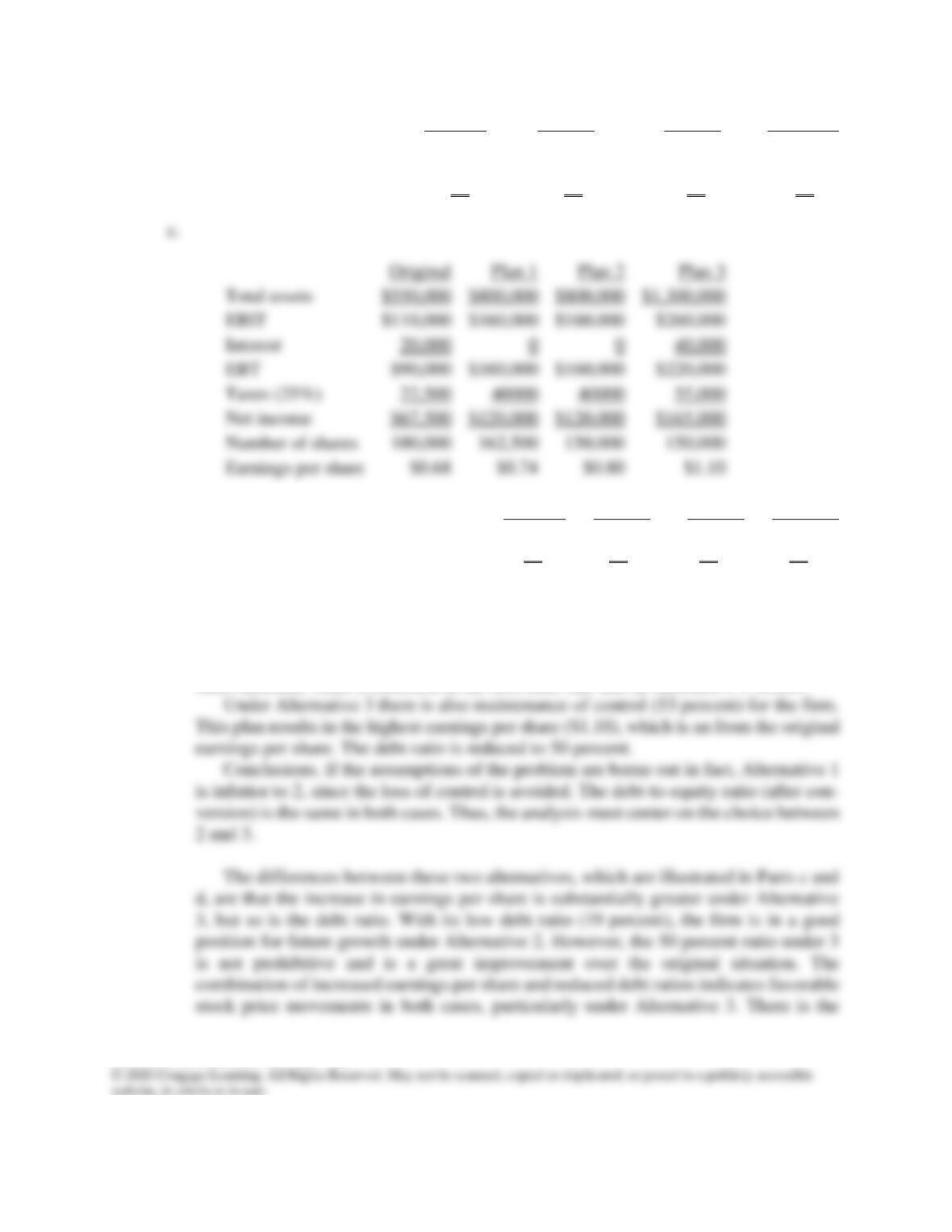
Answers and Solutions: 20 – 10
b. Original Plan 1 Plan 2 Plan 3
Number of shares 80,000 80,000 80,000 80,000
Total shares 100,000 162,500 150,000 150,000
Percent ownership 80% 49% 53% 53%
d. Original Plan 1 Plan 2 Plan 3
Total liabilities $400,000 $150,000 $150,000 $ 650,000
TL/TA 73% 19% 19% 50%
e. Alternative 1 results in loss of control (to 49 percent) for the firm. Under it, he loses
his majority of shares outstanding. Indicated earnings per share increase, and the debt
ratio is reduced considerably (by 54 percentage points).
Alternative 2 results in maintaining control (53 percent) for the firm. Earnings per
share increase, while a reduction in the debt ratio like that in Alternative 1 occurs.
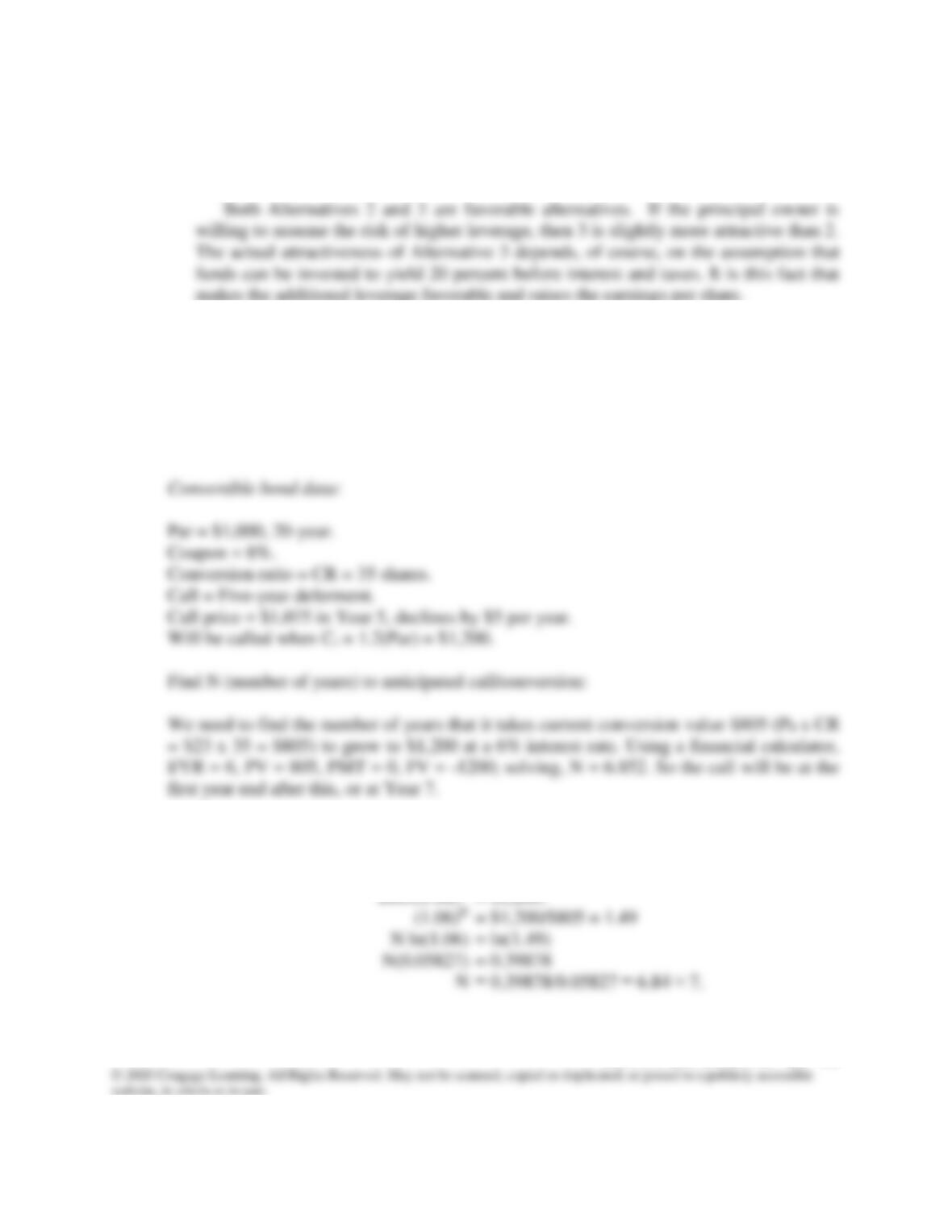
Answers and Solutions: 20 – 11
remote chance that the firm could lose its commercial bank financing under 3, since it
was the bank which initiated the permanent financing suggestion. The additional funds,
especially under 3, may enable the firm to become more current on its trade credit.
Also, the bonds will no doubt be subordinated debentures.
20-7 a.
Stock data and stock required return:
rd = 9%.
P0 = $23.
Dividend yield = 7%.g = 6%.
rs = Dividend yield + g = 7% + 6% = 13%.
We could also calculate this as:
(CR)(P0)(1 + g)N = $1,200
($23)(35)(1 + 0.06)N = $1,200
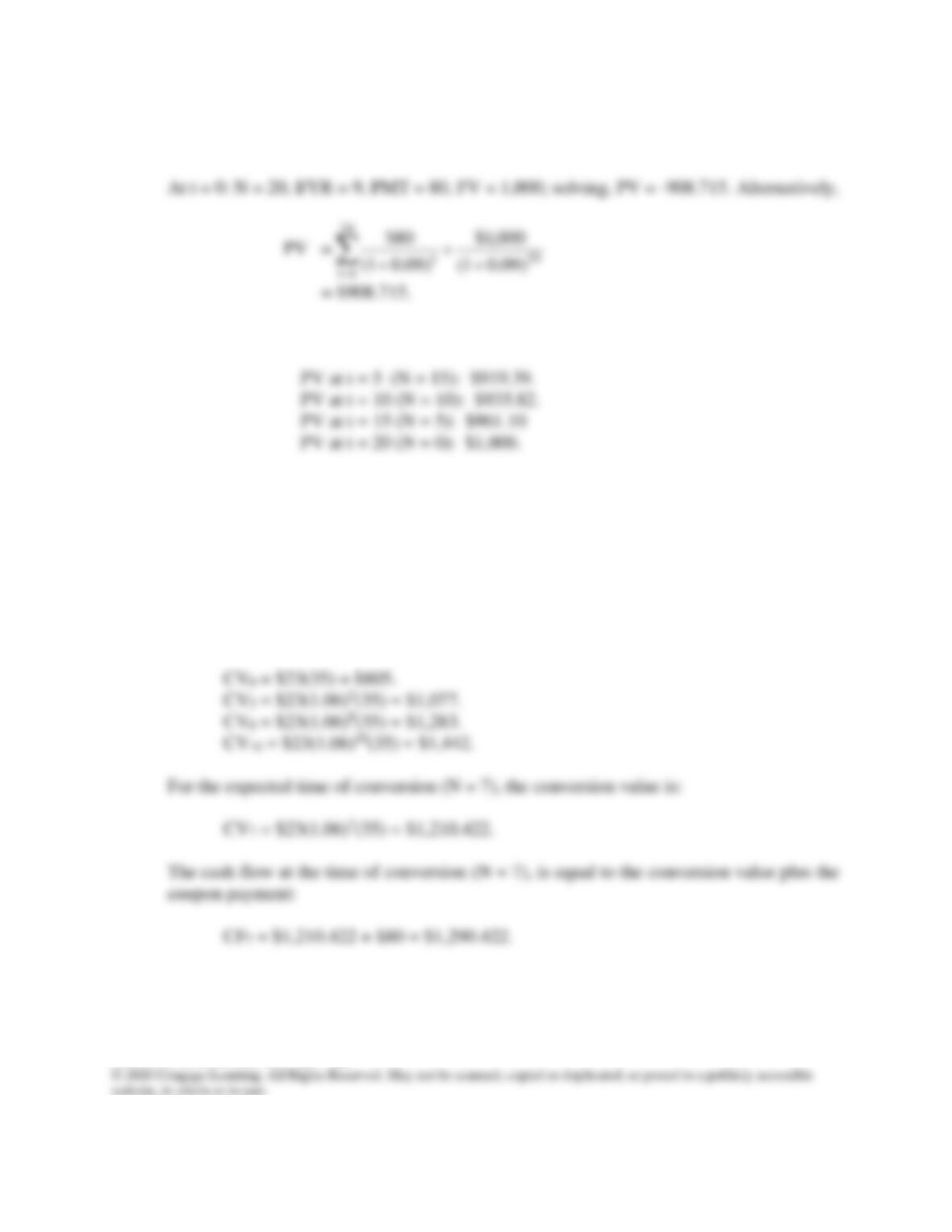
Answers and Solutions: 20 – 12
Straight-debt value of the convertible at t = 0:
(Assumes annual payment of coupon)
Repeating, we can find the straight bond value for different values of N:
Conversion value:
The stock price should grow at the 6%. The conversion value at Year t is equal to the
expected stock price multiplied by the conversion ratio:
CVt = P0(1.06)N(35).
Repeating for different values of N:

Answers and Solutions: 20 – 13
b. $1,000 =
=+
+
+
7
1t cc )r1(
42.210,1$
)r1(
80$
.