4
Chapter 2
Introduction to Financial Statement
Analysis
2-1. What four financial statements can be found in a firm’s 10-K filing? What checks are there on
the accuracy of these statements?
2-2. Who reads financial statements? List at least three different categories of people. For each
category, provide an example of the type of information they might be interested in and discuss
why.
Users of financial statements include present and potential investors, financial analysts, and other
interested outside parties (such as lenders, suppliers and other trade creditors, and customers).
Financial managers within the firm also use the financial statements when making financial decisions.
2-3. Find the most recent financial statements for Starbucks’ corporation (SBUX) using the following
sources:
a. From the company’s Web site www.starbucks.com (Hint: Search for “investor relations.”)
b. From the SEC Web site www.sec.gov. (Hint: Search for company filings in the EDGAR
database.)
c. From the Yahoo! Finance Web site http://finance.yahoo.com.
d. From at least one other source. (Hint: Enter “SBUX 10K” at www.google.com.)
2-4. Consider the following potential events that might have taken place at Global Conglomerate on
December 30, 2015. For each one, indicate which line items in Global’s balance sheet would be
affected and by how much. Also indicate the change to Global’s book value of equity. (In all
cases, ignore any tax consequences for simplicity.)
a. Global used $20 million of its available cash to repay $20 million of its long-term debt.
b. A warehouse fire destroyed $5 million worth of uninsured inventory.
c. Global used $5 million in cash and $5 million in new long-term debt to purchase a $10
million building.
d. A large customer owing $3 million for products it already received declared bankruptcy,
leaving no possibility that Global would ever receive payment.
e. Global’s engineers discover a new manufacturing process that will cut the cost of its flagship
product by over 50%.
f. A key competitor announces a radical new pricing policy that will drastically undercut
Global’s prices.
2-5. What was the change in Global Conglomerate’s book value of equity from 2014 to 2015
according to Table 2.1? Does this imply that the market price of Global’s shares increased in
2015? Explain.
2-6. Use EDGAR to find Qualcomm’s 10-K filing for 2015. From the balance sheet, answer the
following questions:
a. How much did Qualcomm have in cash and short-term investments?
b. What were Qualcomm’s total accounts receivable?
c. What were Qualcomm’s total assets?
d. What were Qualcomm’s total liabilities? How much of this was long-term debt?
e. What was the book value of Qualcomm’s equity?
2-7. Find online the annual 10-K report for Costco Wholesale Corporation (COST) for fiscal year
2015 (filed in October 2015). Answer the following questions from their balance sheet:
a. How much cash did Costco have at the end of the fiscal year?
b. What were Costco’s total assets?
c. What were Costco’s total liabilities? How much debt did Costco have?
d. What was the book value of Costco’s equity?
2-8. In early 2012, General Electric (GE) had a book value of equity of $116 billion, 10.6 billion
shares outstanding, and a market price of $17 per share. GE also had cash of $84 billion, and
total debt of $410 billion. Three years later, in early 2015, GE had a book value of equity of $128
billion, 10.0 billion shares outstanding with a market price of $25 per share, cash of $85 billion,
and total debt of $302 billion. Over this period, what was the change in GE’s:
a. market capitalization?
b. market-to-book ratio?
c. enterprise value?
a. 2012 Market Capitalization: 10.6 billion shares $17/share = $180.2. 2015 Market Capitalization:
2-9. In early-2015, Abercrombie & Fitch (ANF) had a book equity of $1390 million, a price per share
of $25.52, and 69.35 million shares outstanding. At the same time, The Gap (GPS) had a book
equity of $2983 million, a share price of $41.19, and 421 million shares outstanding.
a. What is the market-to-book ratio of each of these clothing retailers?
b. What conclusions can you draw by comparing the two ratios?
2-10. See Table 2.5 showing financial statement data and stock price data for Mydeco Corp.
a. What is Mydeco’s market capitalization at the end of each year?
b. What is Mydeco’s market–to-book ratio at the end of each year?
c. What is Mydeco’s enterprise value at the end of each year?
2012–2016 Financial Statement Data and Stock Price Data for Mydeco Corp.
MydecoCorp.2012-2016 (Alldataasoffiscalyearend;$inmillions)
IncomeStatement 2012 2013 2014 2015 2016
Revenue 404.3 363.8 424.6 510.7 604.1
CostofGoodsSold (188.3) (173.8) (206.2) (246.8) (293.4)
EBIT 61.4 37.5 41.9 57.0 72.8
InterestIncome(Expense) (33.7) (32.9) (32.2) (37.4) (39.4)
BalanceSheet 2012 2013 2014 2015 2016
Assets
Cash 48.8 68.9 86.3 77.5 85.0
AccountsReceivable 88.6 69.8 69.8 76.9 86.1
Inventory 33.7 30.9 28.4 31.7 35.3
TotalCurrentAssets 171.1 169.6 184.5 186.1 206.4
&Stockholders’Equity
778.1 774.6 855.2 893.4 915.1
StatementofCashFlows 2012 2013 2014 2015 2016
NetIncome 18.0 3.0 6.3 12.7 21.7
Depreciation&Amortization 27.3 27.0 34.3 38.4 38.6
ChangeinCash 18.1 20.1 17.4 (8.8) 7.5
8 Berk/DeMarzo, Corporate Finance, Fourth Edition
a.
b.
c.
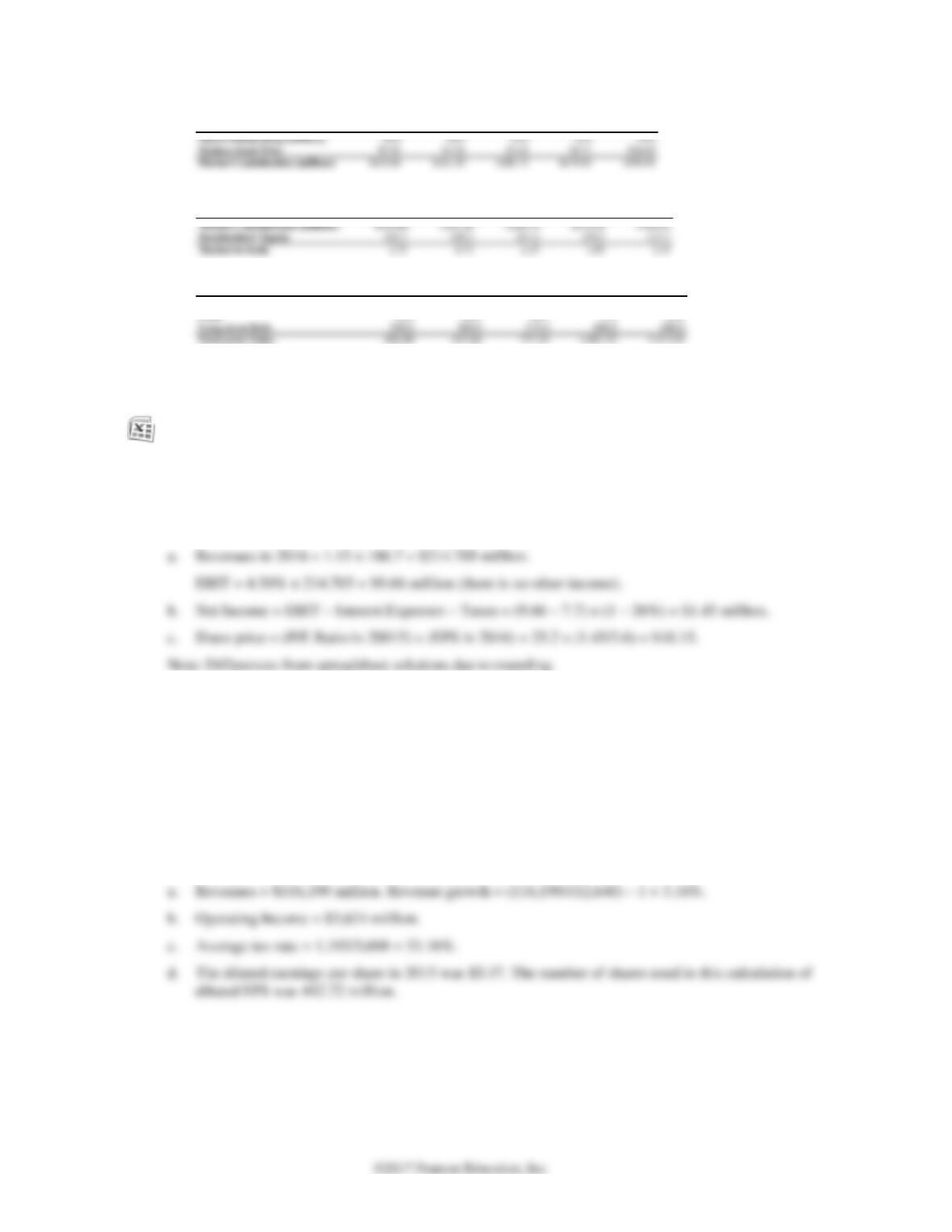
2-11. Suppose that in 2016, Global launches an aggressive marketing campaign that boosts sales by
15%. However, their operating margin falls from 5.57% to 4.50%. Suppose that they have no
other income, interest expenses are unchanged, and taxes are the same percentage of pretax
income as in 2015.
a. What is Global’s EBIT in 2016?
b. What is Global’s net income in 2016?
c. If Global’s P/E ratio and number of shares outstanding remains unchanged, what is Global’s
share price in 2016?
2-12. Find online the annual 10-K report for Costco Wholesale Corporation (COST) for fiscal year
2015 (filed in October 2015). Answer the following questions from their income statement:
a. What were Costco‘s revenues for fiscal year 2015? By what percentage did revenues grow
from the prior year?
b. What was Costco‘s operating income for the fiscal year?
c. What was Costco‘s average tax rate for the year?
d. What were Costco‘s diluted earnings per share in fiscal year 2015? What number of shares
is this EPS based on?
Year 2012 2013 2014 2015 2016
Year 2012 2013 2014 2015 2016
Year 2012 2013 2014 2015 2016
Market Capitalization (millions) $435.60 $181.50 $288.75 $479.05 $598.95
2-13. See Table 2.5 showing financial statement data and stock price data for Mydeco Corp.
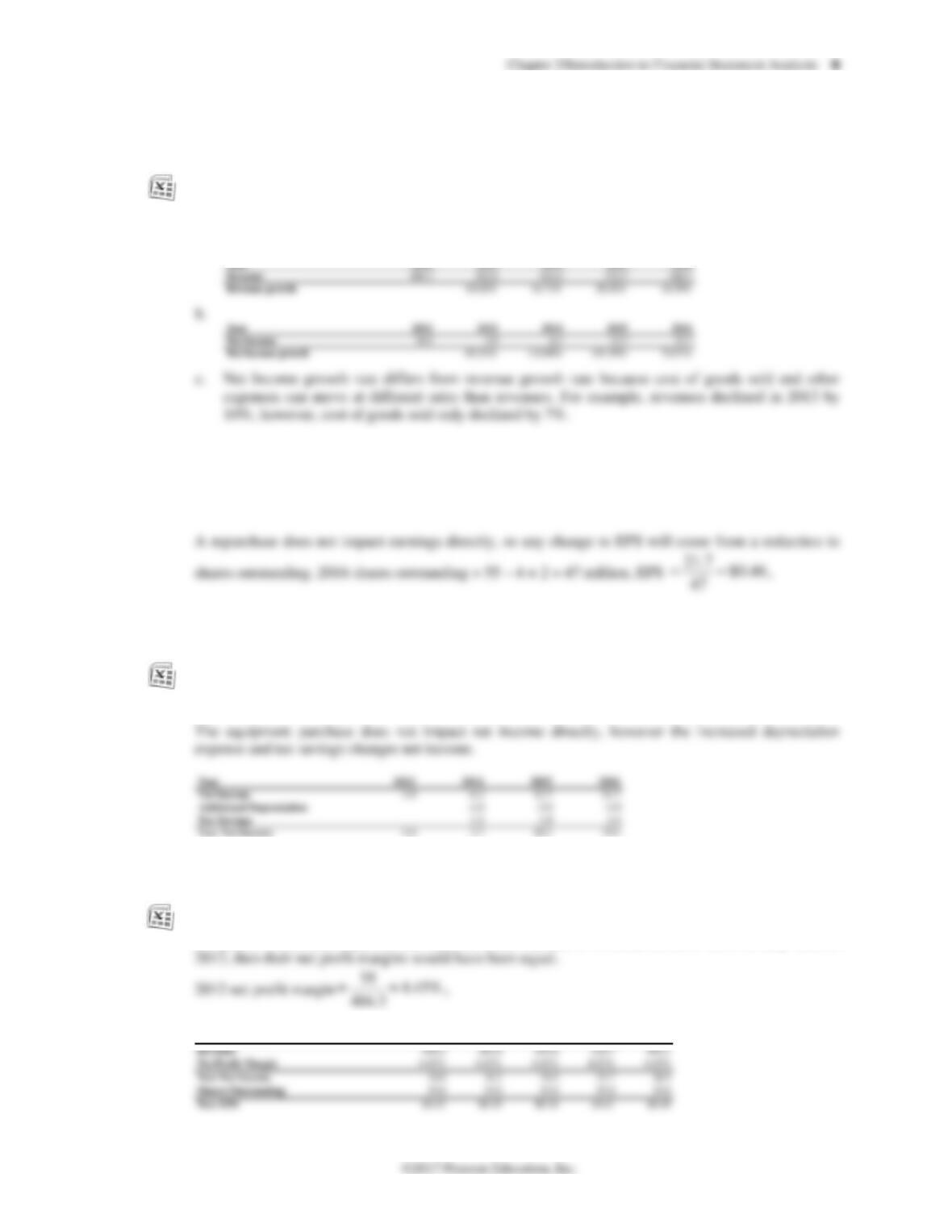
a. By what percentage did Mydeco’s revenues grow each year from 2013 to 2016?
b. By what percentage did net income grow each year?
c. Why might the growth rates of revenues and net income differ?
a.
2-14. See Table 2.5 showing financial statement data and stock price data for Mydeco Corp. Suppose
Mydeco repurchases 2 million shares each year from 2013 to 2016. What would its earnings per
share be in 2016? (Assume Mydeco pays for the shares using its available cash and that Mydeco
earns no interest on its cash balances.)
2-15. See Table 2.5 showing financial statement data and stock price data for Mydeco Corp. Suppose
Mydeco had purchased additional equipment for $12 million at the end of 2013, and this
equipment was depreciated by $4 million per year in 2014, 2015, and 2016. Given Mydeco’s tax
rate of 35%, what impact would this additional purchase have had on Mydeco’s net income in
years 2013–2016?
2-16. See Table 2.5 showing financial statement data and stock price data for Mydeco Corp. Suppose
Mydeco’s costs and expenses had been the same fraction of revenues in 2013–2016 as they were
in 2012. What would Mydeco’s EPS have been each year in this case?
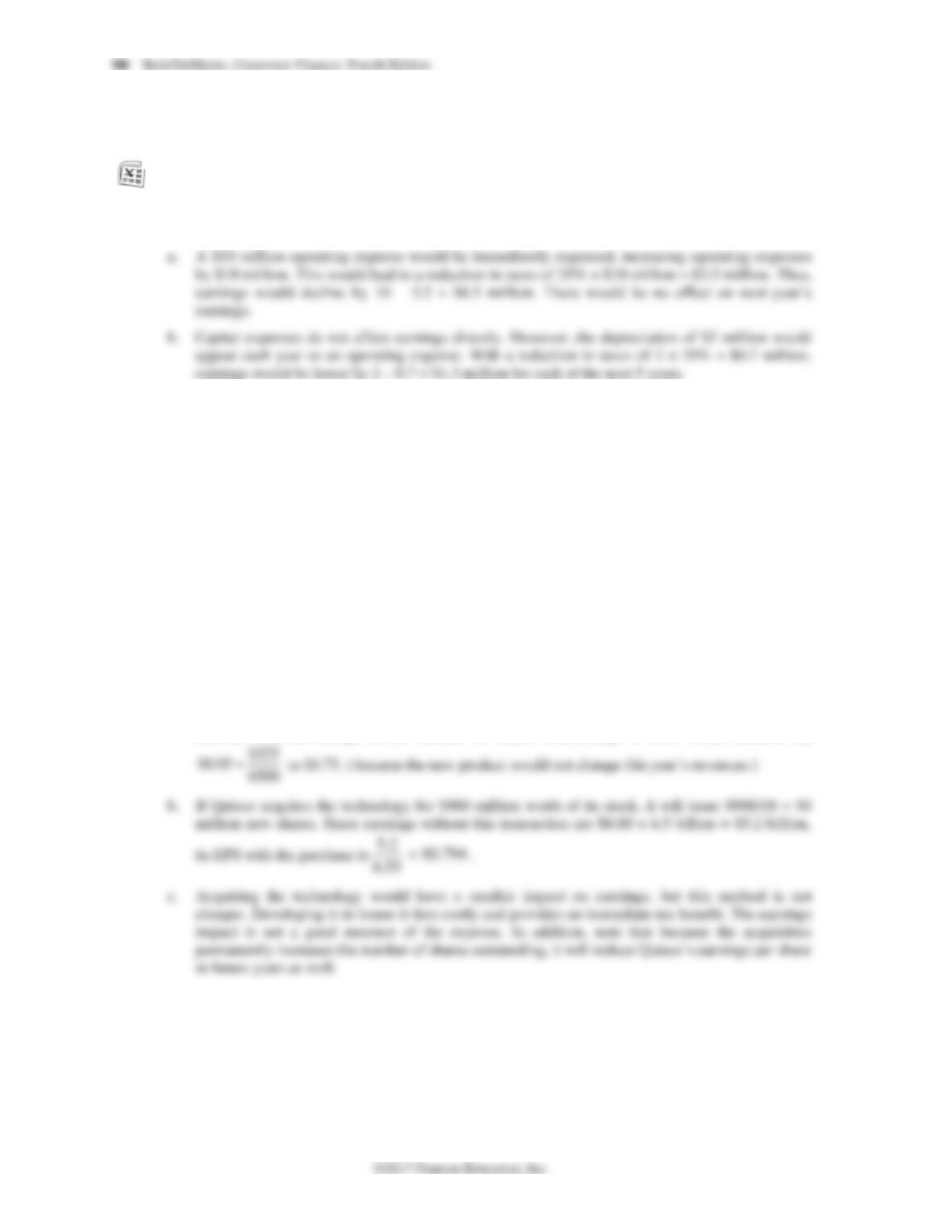
If Mydeco’s costs and expenses had been the same fraction of revenues in 2013–2016 as they were in
Year 2012 2013 2014 2015 2016
Year 2012 2013 2014 2015 2016
2-17. Suppose a firm’s tax rate is 35%.
a. What effect would a $10 million operating expense have on this year’s earnings? What effect
would it have on next year’s earnings?
b. What effect would a $10 million capital expense have on this year’s earnings if the capital is
depreciated at a rate of $2 million per year for five years? What effect would it have on next
year’s earnings?
2-18. Quisco Systems has 6.5 billion shares outstanding and a share price of $18. Quisco is considering
developing a new networking product in house at a cost of $500 million. Alternatively, Quisco
can acquire a firm that already has the technology for $900 million worth (at the current price)
of Quisco stock. Suppose that absent the expense of the new technology, Quisco will have EPS of
$0.80.
a. Suppose Quisco develops the product in house. What impact would the development cost
have on Quisco’s EPS? Assume all costs are incurred this year and are treated as an R&D
expense, Quisco’s tax rate is 35%, and the number of shares outstanding is unchanged.
b. Suppose Quisco does not develop the product in house but instead acquires the technology.
What effect would the acquisition have on Quisco’s EPS this year? (Note that acquisition
expenses do not appear directly on the income statement. Assume the firm was acquired at
the start of the year and has no revenues or expenses of its own, so that the only effect on
EPS is due to the change in the number of shares outstanding.)
c. Which method of acquiring the technology has a smaller impact on earnings? Is this method
cheaper? Explain.
a. If Quisco develops the product in-house, its earnings would fall by $500 × (1 – 35%) = $325
million. With no change to the number of shares outstanding, its EPS would decrease by
2-19. Find online the annual 10-K report for Costco Wholesale Corporation (COST) for fiscal year
2015 (filed in October 2015). Answer the following questions from their cash flow statement:
a. How much cash did Costco generate from operating activities in fiscal year 2015?
b. What was Costco depreciation and amortization expense?
c. How much cash was invested in new property and equipment (net of any sales)?
Chapter 2/Introduction to Financial Statement Analysis 11
d. How much did Costco raise from the sale of shares of its stock (net of any purchases)?
2-20. See Table 2.5 showing financial statement data and stock price data for Mydeco Corp.
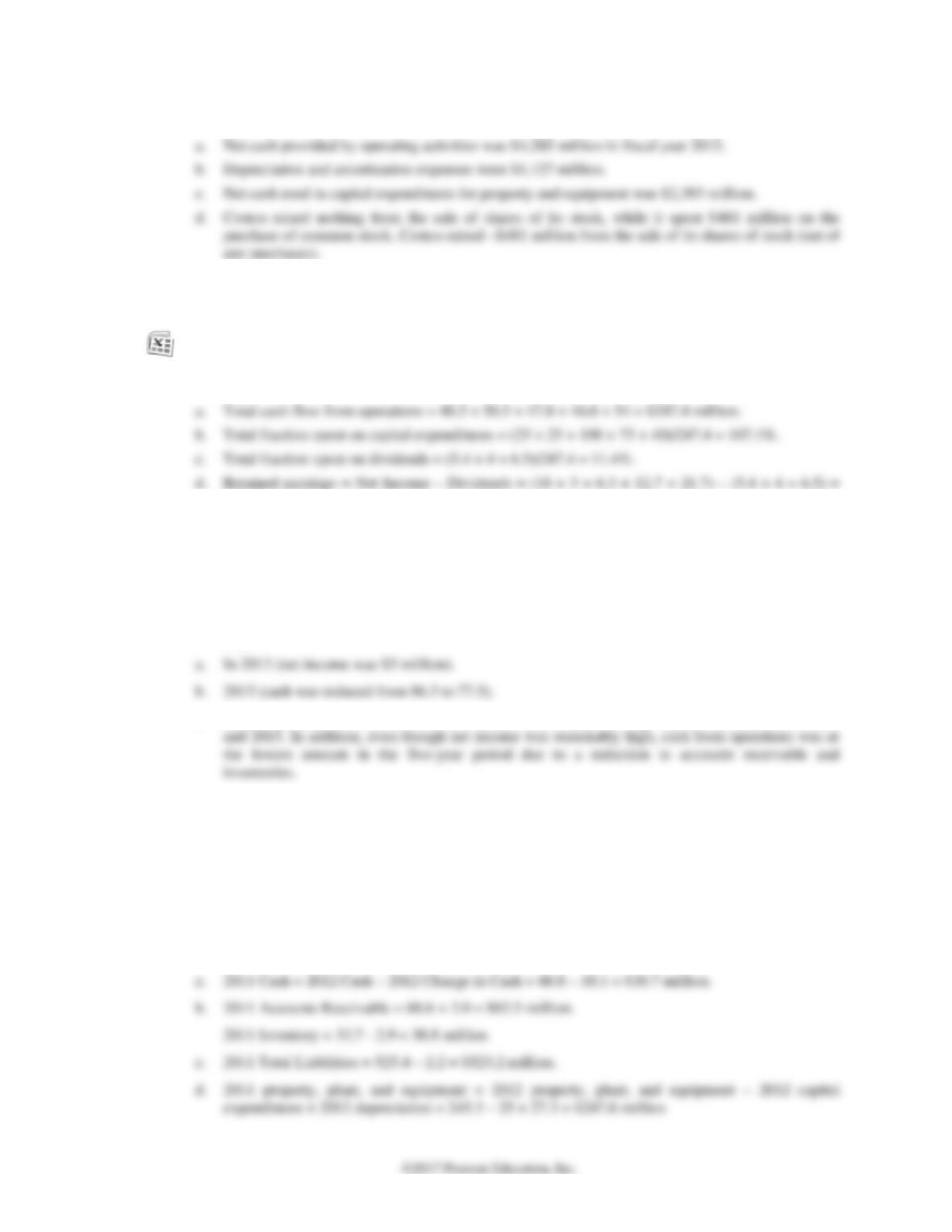
a. From 2012 to 2016, what was the total cash flow from operations that Mydeco generated?
b. What fraction of the total in (a) was spent on capital expenditures?
c. What fraction of the total in (a) was spent paying dividends to shareholders?
d. What was Mydeco’s total retained earnings for this period?
$33.6 million.
2-21. See Table 2.5 showing financial statement data and stock price data for Mydeco Corp.
a. In what year was Mydeco’s net income the lowest?
b. In what year did Mydeco need to reduce its cash reserves?
c. Why did Mydeco need to reduce its cash reserves in a year when net income was reasonably
high?
c. Mydeco needed to reduce cash (it also issued debt) to pay for large capital expenditures in 2014
2-22. See Table 2.5 showing financial statement data and stock price data for Mydeco Corp. Use the
data from the balance sheet and cash flow statement in 2012 to determine the following:
a. How much cash did Mydeco have at the end of 2011?
b. What were Mydeco’s accounts receivable and inventory at the end of 2011?
c. What were Mydeco’s total liabilities at the end of 2011?
d. Assuming goodwill and intangibles were equal in 2011 and 2012, what was Mydeco’s net
property, plant, and equipment at the end of 2011?
2-23. Can a firm with positive net income run out of cash? Explain.
2-24. Suppose your firm receives a $5 million order on the last day of the year. You fill the order with
$2 million worth of inventory. The customer picks up the entire order the same day and pays $1
million upfront in cash; you also issue a bill for the customer to pay the remaining balance of $4
million in 30 days. Suppose your firm’s tax rate is 0% (i.e., ignore taxes). Determine the
consequences of this transaction for each of the following:
a. Revenues
b. Earnings
c. Receivables
d. Inventory
e. Cash
2-25. Nokela Industries purchases a $40 million cyclo–converter. The cyclo-converter will be
depreciated by $10 million per year over four years, starting this year. Suppose Nokela’s tax rate
is 40%.
a. What impact will the cost of the purchase have on earnings for each of the next four years?
b. What impact will the cost of the purchase have on the firm’s cash flow for the next four
years?
2-26. See Table 2.5 showing financial statement data and stock price data for Mydeco Corp.
a. What were Mydeco’s retained earnings each year?
b. Using the data from 2012, what was Mydeco’s total stockholders’ equity in 2011?
a. Retained earnings = Net Income – Dividends Paid
Year 2012 2013 2014 2015 2016
2-27. Find online the annual 10-K report for Costco Wholesale Corporation (COST) for fiscal year
2015 (filed in October 2015). Answer the following questions from the notes to their financial
statements:
a. How many stores did Costco open outside of the U.S. in 2015?
b. What property does Costco lease? What are the minimum lease payments due in 2016?
c. What was Costco’s worldwide member renewal rate for 2015? What proportion of Costco
cardholders had Gold Star memberships in 2015?
d. What fraction of Costco’s 2015 sales came from gas stations, pharmacy, food court, and
optical? What fraction came from apparel and small appliances?
2-28. See Table 2.5 showing financial statement data and stock price data for Mydeco Corp.
a. What were Mydeco’s gross margins each year?
b. Comparing Mydeco’s gross margin, EBIT margin, and net profit margin in 2012 and 2016,
which margins improved?
a.
b. None of the margins improved from 2012 to 2016
2-29. For fiscal year end 2015, Walmart Stores, Inc. (WMT) had revenue of $485.65 billion, gross
profit of $120.57 billion, and net income of $16.36 billion. Costco Wholesale Corporation (COST)
had revenue of $116.20 billion, gross profit of $15.13 billion, and net income of $2.38 billion.
a. Compare the gross margins for Walmart and Costco.
b. Compare the net profit margins for Walmart and Costco.
c. Which firm was more profitable in 2015?
Year 2012 2013 2014 2015 2016
Year 2012 2016
Revenue 404.3 604.1
2-30. At the end of 2015, Apple had cash and short-term investments of $41.60 billion, accounts
receivable of $35.89 billion, current assets of $89.38 billion, and current liabilities of $80.61
billion.
a. What was Apple’s current ratio?
b. What was Apple’s quick ratio?
c. What is Apple’s cash ratio?
d. At the end of 2015, HPQ had a cash ratio of 0.35, a quick ratio of 0.73 and a current ratio of
1.15. What can you say about the asset liquidity of Apple relative to HPQ?
2-31. See Table 2.5 showing financial statement data and stock price data for Mydeco Corp.
a. How did Mydeco’s accounts receivable days change over this period?
b. How did Mydeco’s inventory days change over this period?
c. Based on your analysis, has Mydeco improved its management of its working capital during
this time period?
a. 2012 accounts receivable days .
2-32 See Table 2.5 showing financial statement data and stock price data for Mydeco Corp.
a. Compare accounts payable days in 2012 and 2016.
b. Did this change in accounts payable days improve or worsen Mydeco’s cash position in
2016?
a. 2012 accounts payable days .
=88.6
404.3/ 365 =80.0
=18.7
188.3/ 365 =36.2
2-33. See Table 2.5 showing financial statement data and stock price data for Mydeco Corp.
a. By how much did Mydeco increase its debt from 2012 to 2016?
b. What was Mydeco’s EBITDA/Interest coverage ratio in 2012 and 2016? Did its coverage
ratio ever fall below 2?
c. Overall, did Mydeco’s ability to meet its interest payments improve or decline over this
period?
2-34. See Table 2.5 showing financial statement data and stock price data for Mydeco Corp.
a. How did Mydeco’s book debt–equity ratio change from 2012 to 2016?
b. How did Mydeco’s market debt-equity ratio change from 2012 to 2016?
c. Compute Mydeco’s debt–to-enterprise value ratio to assess how the fraction of its business
that is debt financed has changed over the period.
2-35. Use the data in Problem 8 to determine the change, from 2012 to 2015, in GE’s
a. book debt-equity ratio?
b. market debt-equity ratio?
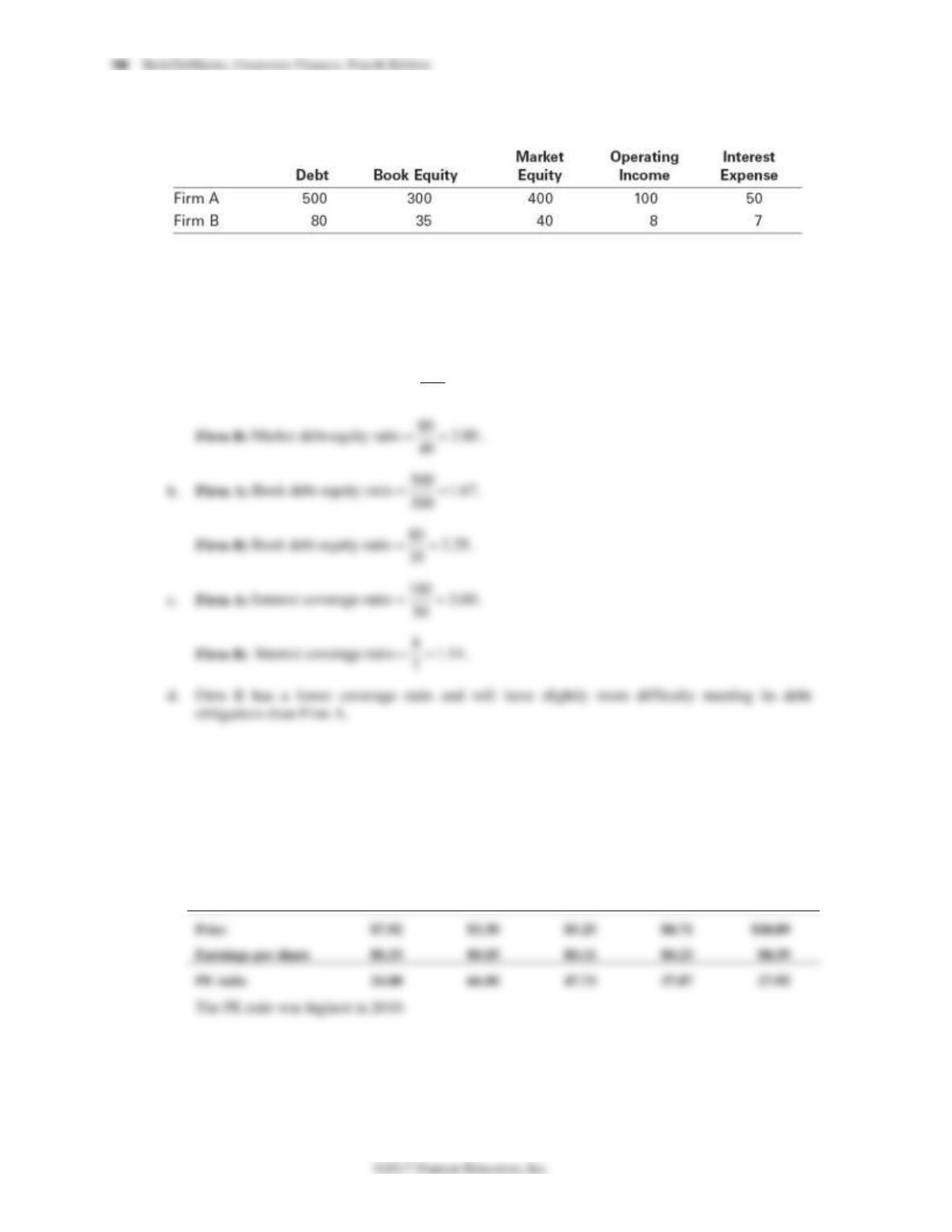
2-36. You are analyzing the leverage of two firms and you note the following (all values in millions of
dollars):
a. What is the market debt-to-equity ratio of each firm?
b. What is the book debt-to-equity ratio of each firm?
c. What is the interest coverage ratio of each firm?
d. Which firm may have more difficulty meeting its debt obligations? Explain.
a. Firm A: .
2-37. See Table 2.5 showing financial statement data and stock price data for Mydeco Corp.
a. Compute Mydeco’s PE ratio each year from 2012 to 2016. In which year was it the highest?
b. What was Mydeco’s Enterprise Value to EBITDA ratio each year? In which year was it the
highest?
c. What might explain the differing time pattern of the two valuation ratios?
a.
Year
2012
2013
2014
2015
2016
Price
Earnings per share
500
Market debt-equity ratio 1.25
400
==
Chapter 2/Introduction to Financial Statement Analysis 17
b.
2-38. In early-2015, United Airlines (UAL) had a market capitalization of $24.8 billion, debt of $12.8
billion, and cash of $5.5 billion. United also had annual revenues of $38.9 billion. Southwest
Airlines (LUV) had a market capitalization of $28.8 billion, debt of $2.7 billion, cash of $2.9
billion, and annual revenues of $18.6 billion.
a. Compare the market capitalization–to-revenue ratio (also called the price–to-sales ratio) for
United Airlines and Southwest Airlines.
b. Compare the enterprise value–to-revenue ratio for United Airlines and Southwest Airlines.
c. Which of these comparisons is more meaningful? Explain.
a. Market capitalization-to-revenue ratio:
b. Enterprise value-to-revenue ratio:
2-39. See Table 2.5 showing financial statement data and stock price data for Mydeco Corp.
a. Compute Mydeco’s ROE each year from 2012 to 2016.
b. Compute Mydeco’s ROA each year from 2012 to 2016.
c. Which return is more volatile? Why?
a.
b.
Year 2012 2013 2014 2015 2016
Enterprise value 886.80 612.60 777.45 1,001.55 1,113.95
Year 2012 2013 2014 2015 2016
Net Income 18.0 3.0 6.3 12.7 21.7
Year 2012 2013 2014 2015 2016
18 Berk/DeMarzo, Corporate Finance, Fourth Edition
2-40. See Table 2.5 showing financial statement data and stock price data for Mydeco Corp. Was
Mydeco able to improve its ROIC in 2016 relative to what it was in 2012?
2-41. For fiscal year 2015, Costco Wholesale Corporation had a net profit margin of 2.05%, asset
turnover of 3.48, and a book equity multiplier of 3.15.
a. Use this data to compute Costco’s ROE using the DuPont Identity.
b. If Costco‘s managers wanted to increase its ROE by one percentage point, how much higher
would their asset turnover need to be?
c. If Costco‘s net profit margin fell by one percentage point, by how much would their asset
turnover need to increase to maintain their ROE?
2-42. For fiscal year 2015, Walmart Stores Inc. (WMT) had total revenues of $484.65 billion, net
income of $16.36 billion, total assets of $203.49 billion, and total shareholder’s equity of $81.39
billion.
a. Calculate Wal-Mart’s ROE directly, and using the DuPont Identity.
b. Comparing with the data for Costco in problem 41, use the DuPont Identity to understand
the difference between the two firms’ ROEs.
2-43. Consider a retailing firm with a net profit margin of 3.5%, a total asset turnover of 1.8, total
assets of $44 million, and a book value of equity of $18 million.
a. What is the firm’s current ROE?
=61.4´(1–0.35)
Chapter 2/Introduction to Financial Statement Analysis 19
b. If the firm increased its net profit margin to 4%, what would be its ROE?
c. If, in addition, the firm increased its revenues by 20% (while maintaining this higher profit
margin and without changing its assets or liabilities), what would be its ROE?
2-44. Find online the annual 10-K report for Costco Wholesale Corporation (COST) for fiscal year
2015 (filed in October 2015).
a. Which auditing firm certified these financial statements?
b. Which officers of Costco’s certified the financial statements?
2-45. WorldCom reclassified $3.85 billion of operating expenses as capital expenditures. Explain the
effect this reclassification would have on WorldCom’s cash flows. (Hint: Consider taxes.)
WorldCom’s actions were illegal and clearly designed to deceive investors. But if a firm could
legitimately choose how to classify an expense for tax purposes, which choice is truly better for
the firm’s investors?