Answers and Solutions: 2 – 1
Chapter 2
Financial Statements, Cash Flows, and Taxes
ANSWERS TO END-OF-CHAPTER QUESTIONS
2-1 a. The annual report is a report issued annually by a corporation to its stockholders. It
contains basic financial statements, as well as management’s opinion of the past year’s
operations and the firm’s future prospects. A firm’s balance sheet is a statement of the
firm’s financial position at a specific point in time. It specifically lists the firm’s assets
on the left-hand side of the balance sheet, while the right-hand side shows its liabilities
and equity, or the claims against these assets. An income statement is a statement
summarizing the firm’s revenues and expenses over an accounting period. Net sales
are shown at the top of each statement, after which various costs, including income
taxes, are subtracted to obtain the net income available to common stockholders. The
bottom of the statement reports earnings and dividends per share.
c. The statement of stockholders’ equity shows how much of the firm’s earnings were
retained in the business rather than paid out in dividends. It also shows the resulting
balance of the retained earnings account and the stockholders’ equity account. Note
that retained earnings represents a claim against assets, not assets per se. Firms retain
earnings primarily to expand the business, not to accumulate cash in a bank account.
The statement of cash flows reports the impact of a firm’s operating, investing, and
financing activities on cash flows over an accounting period.
Answers and Solutions: 2 – 2
f. Accounting profit is a firm’s net income as reported on its income statement. Net cash
flow, as opposed to accounting net income, is the sum of net income plus non-cash
adjustments. NOPAT, net operating profit after taxes, is the amount of profit a
company would generate if it had no debt and no financial assets. Free cash flow is the
cash flow actually available for distribution to investors after the company has made
all investments in fixed assets and working capital necessary to sustain ongoing
operations. Return on invested capital is equal to NOPAT divided by total net operating
capital. It shows the rate of return that is generated by assets.
h. A progressive tax means the higher one’s income, the larger the percentage paid in
taxes. Taxable income is defined as gross income less a set of exemptions and
deductions which are spelled out in the instructions to the tax forms individuals must
file. Marginal tax rate is defined as the tax rate on the last unit of income. Average tax
rate is calculated by taking the total amount of tax paid divided by taxable income.
Answers and Solutions: 2 – 3
j. Improper accumulation is the retention of earnings by a business for the purpose of
enabling stockholders to avoid personal income taxes on dividends. An S corporation
is a small corporation which, under Subchapter S of the Internal Revenue Code, elects
to be taxed as a proprietorship or a partnership yet retains limited liability and other
benefits of the corporate form of organization.
2-2 The four financial statements contained in most annual reports are the balance sheet,
income statement, statement of stockholders’ equity, and statement of cash flows.
2-5 Operating capital is the amount of interest bearing debt, preferred stock, and common
equity used to acquire the company’s net operating assets. Without this capital a firm
cannot exist, as there is no source of funds with which to finance operations.
2-7 Free cash flow is the cash flow actually available for distribution to investors after the
company has made all the investments in fixed assets and working capital necessary to
sustain ongoing operations. It is the most important measure of cash flows because it
shows the exact amount available to all investors.
2-8 If the business were organized as a partnership or a proprietorship, its income could be
passed to the owners without being subject to taxation at the business level. Also, if you
expected to have losses for a few years while the company was getting started, if you were
Answers and Solutions: 2 – 4
SOLUTIONS TO END–OF-CHAPTER PROBLEMS
2-1 Corporate yield = 7.68%; T = 25%
AT yield = (Pre-tax yield)(1 – T)
= 7.68%(0.75) = 5.76%.
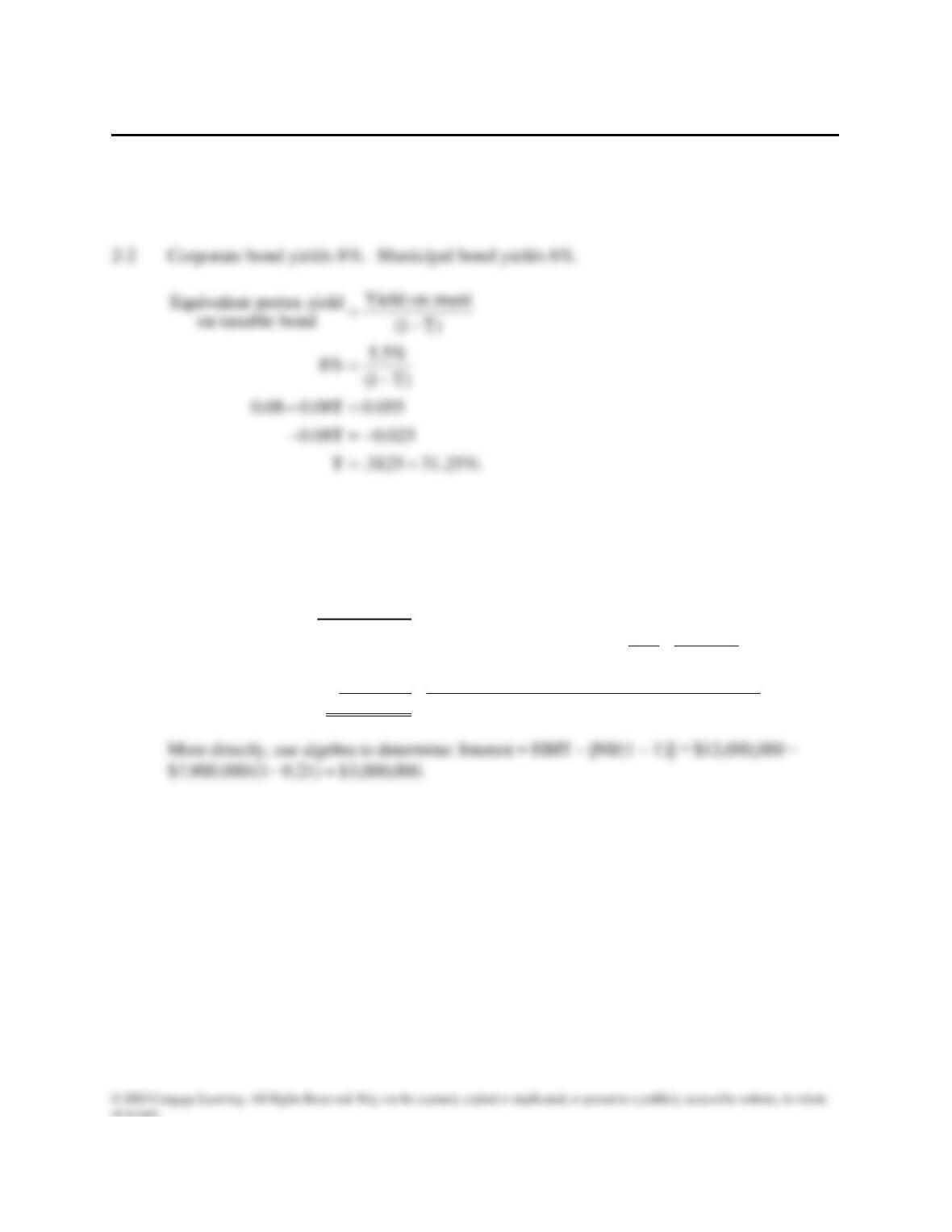
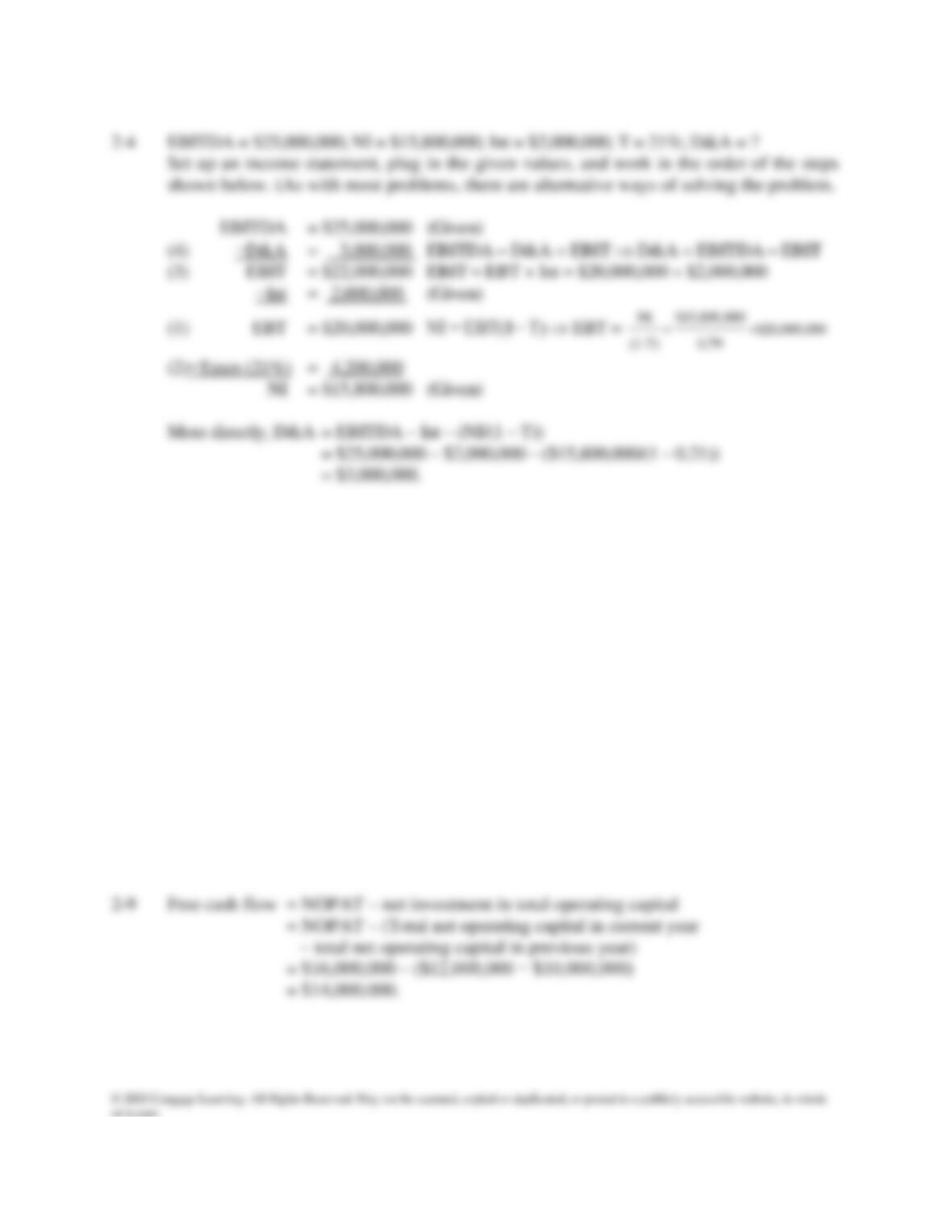
2-3 NI = $7,900,000; EBIT = $13,000,000; T = 21%; Interest = ?
Set up an income statement, plug in the given values, and work in the order of the steps
shown below. (As with most problems, there are alternative ways of solving the problem.
EBIT = $13,000,000 (Given)
(3) −Interest = 3,000,000 = EBIT – EBT = $13,000,000 – $10,000,000 = $3,000,000.
(1) EBT = $10,000,000 NI = EBT(1− T) EBT =
NI $7,900,000
= =$10,000,000
(1-T) 0.79
(2) −Taxes (21%) = 2,100,000 = EBT(T) = $10,000,000)(0.21) = $2,100,000.
NI = $7,900,000 (Given)
Answers and Solutions: 2 – 5
2-5 NI = $3,100,000; DEP = $500,000; AMORT = 0; NCF = ?
NCF = NI + DEP and AMORT = $3,100,000 + $500,000 = $3,600,000.
2-6 NI = $70,000,000; R/EY/E = $900,000,000; R/EB/Y = $855,000,000; Dividends = ?
R/EB/Y + NI – Div = R/EY/E
$855,000,000 + $70,000,000 – Div = $900,000,000
$925,000,000 – Div = $900,000,000
$25,000,000 = Div.
2-7 NOPAT = EBIT(1 – T) = $4,000,000(1 – 0.25) =$3,000,000.
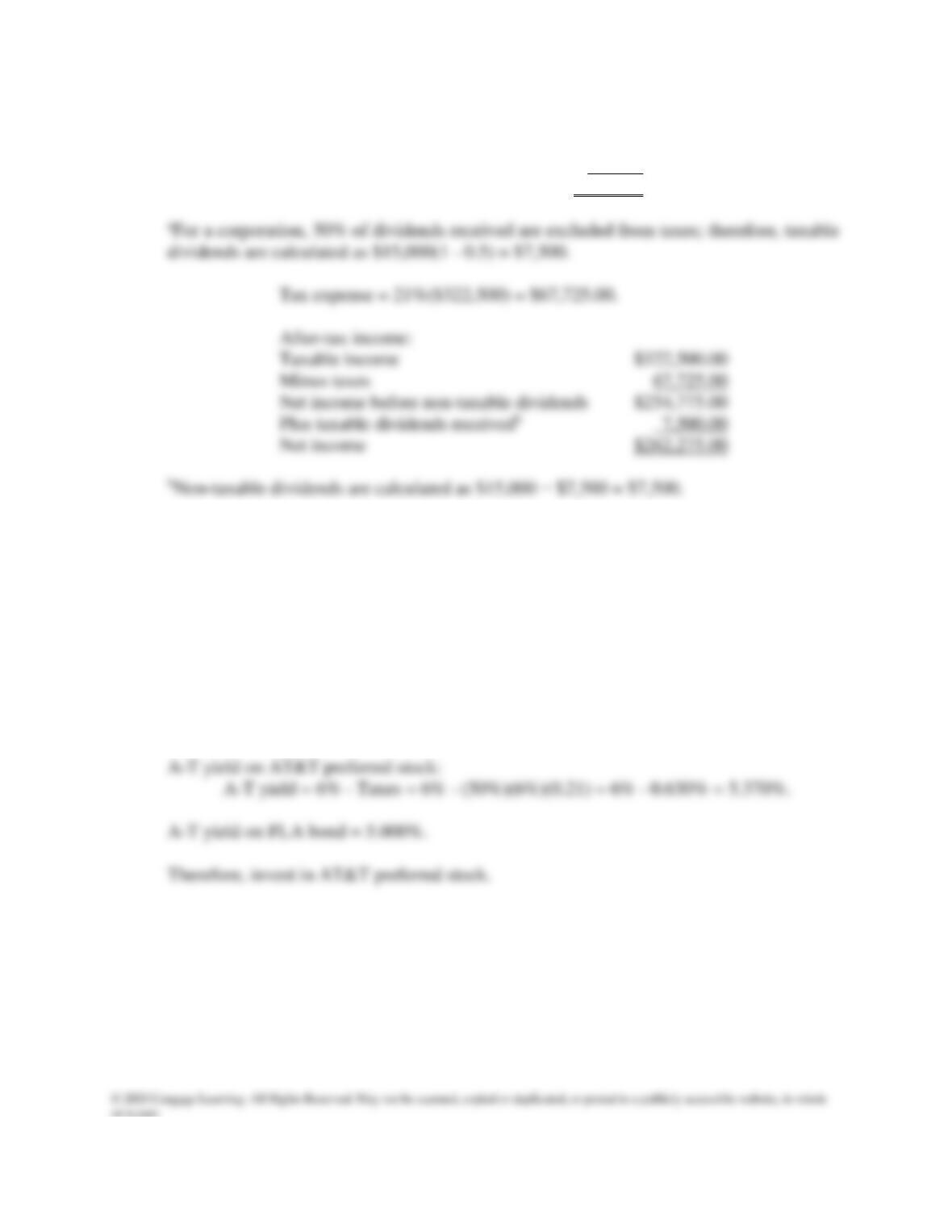
2-8 Total net operating capital = Net fixed assets + net operating working capital
= Net fixed assets + (Operating CA – Operating CL)
= $15,000,000 + ($10,000,000 – $3,000,000)
= $22,000,000.
Answers and Solutions: 2 – 6
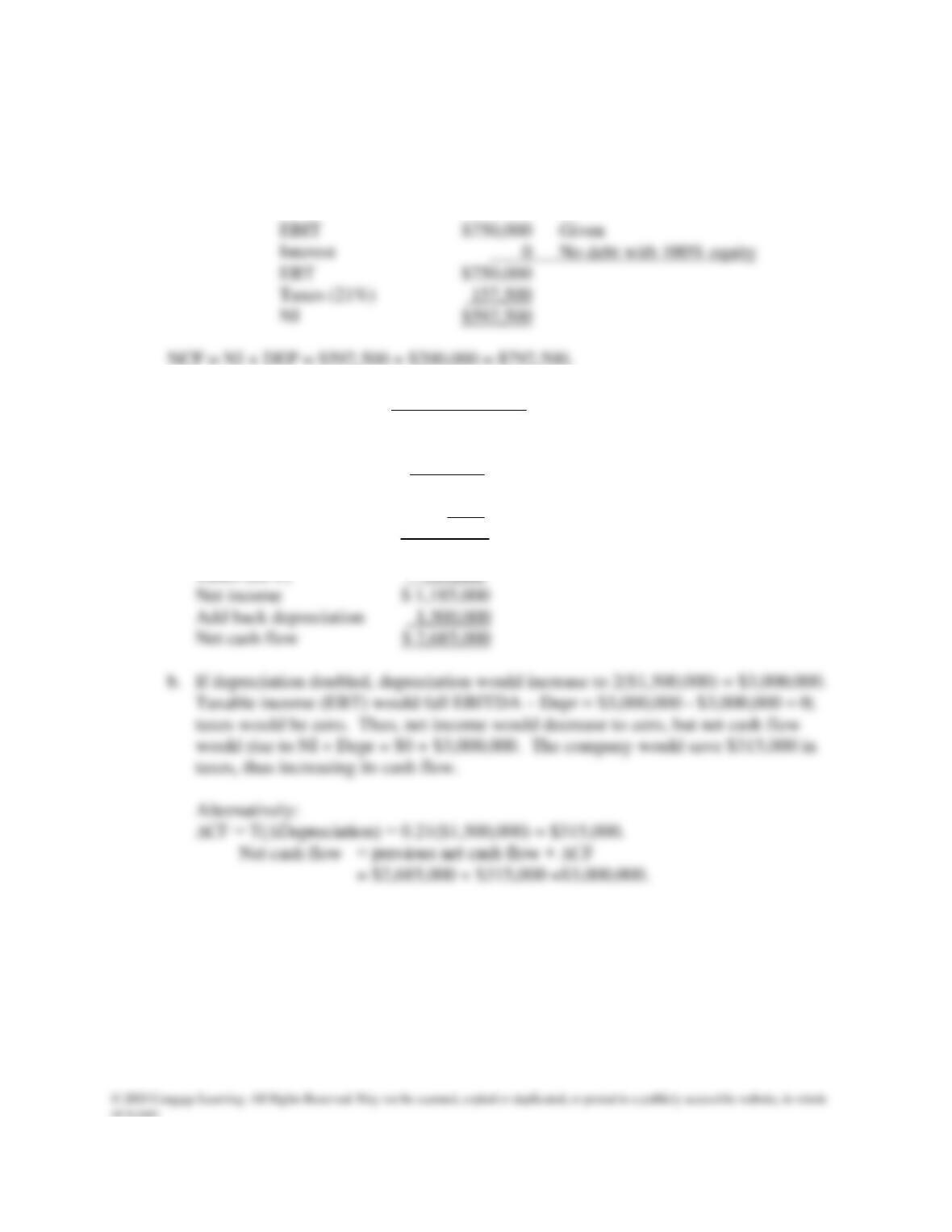
2-10 Pre-tax operating earnings $365,000
Less Interest deduction 50,000
Plus: Taxable dividends receiveda 7,500
Taxable income $322,500
2-11 a. Tax = $50,000,000)(0.21) = $10,500,000.
b. Tax = $1,000,000(0.21) = $210,000.
c. Tax = ($1,000,000)(1 − 0.50)(0.21) = $105,000.
2-12 A-T yield on AT&T bond = 6.6% – Taxes = 6.6% – 6.6%(0.21) = 5.214%.
Check: Invest $10,000 @ 6.6% = $660 interest.
Pay 21% tax, so A-T income = $660(1 – T) = $660(0.79) = $521.4.
A-T rate of return = $521.40/$10,000 = 5.214%.
Answers and Solutions: 2 – 7
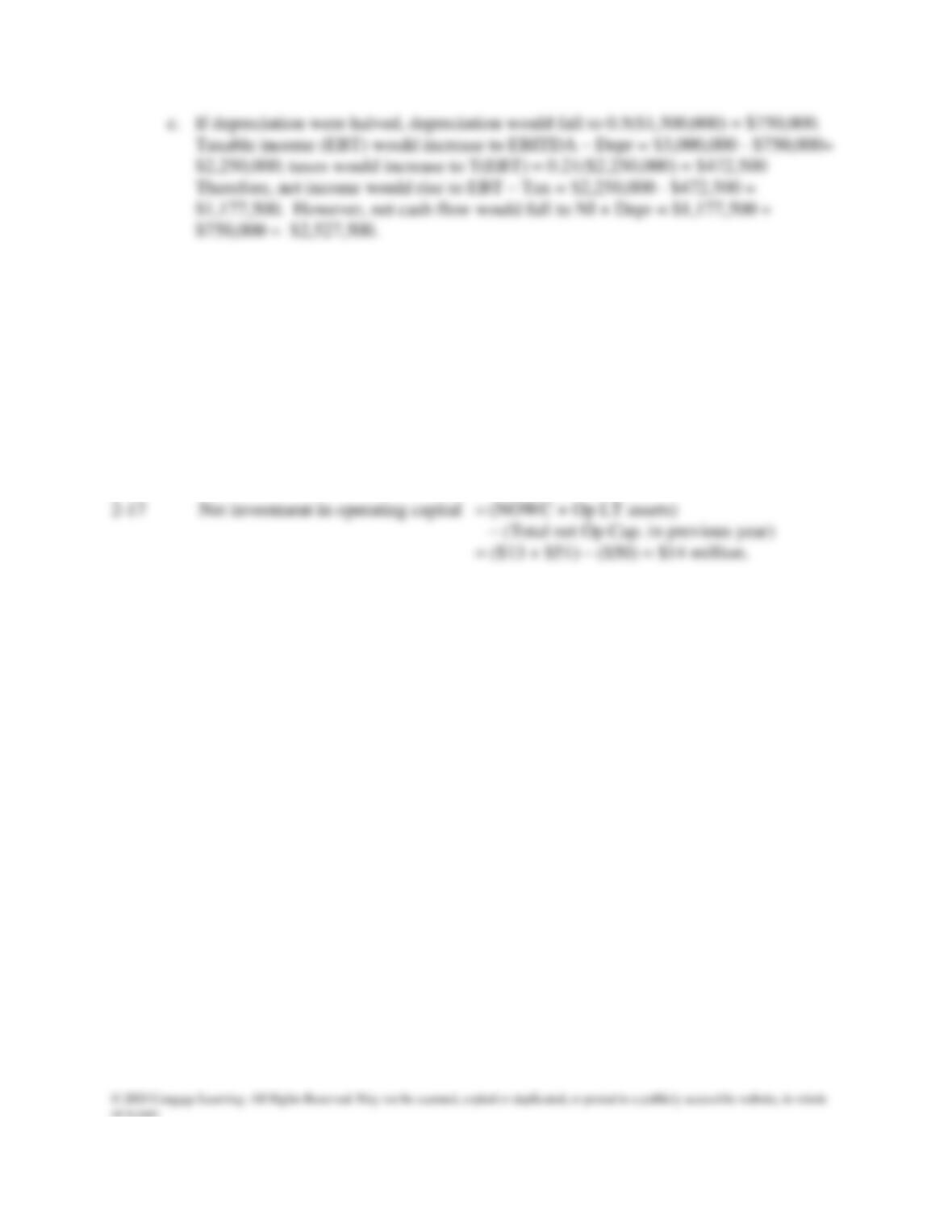
2-13 EBIT = $750,000; DEP = $200,000; 100% Equity; T = 21%
Set up an income statement, plug in the given values, and work in the order of the steps
shown below. (As with most problems, there are alternative ways of solving the problem.
2-14 a. Income Statement
Sales revenues $12,000,000 Given
Costs except
depreciation 9,000,000 = 75%($12,000,000)
EBITDA 3,000,000
Interest 0
Depreciation 1,500,000 Given
EBT $ 1,500,000 = Sales – (cost except depr) – depr.
Answers and Solutions: 2 – 8
d. You should prefer to have higher depreciation charges and higher cash flows. Net
cash flows are the funds that are available to the owners to withdraw from the firm
and, therefore, cash flows should be more important to them than net income.
2-15 NOPAT = EBIT(1 – T) = $80,000(1 – 0.25) =$60,000.
2-16 NOWC = Operating CA – Operating CL
= (Cash + AR + INV) – (AP + Accruals)
= ($90 + $1,200 + $900) – ($600 + $200)
= $1,390 million.
Answers and Solutions: 2 – 9
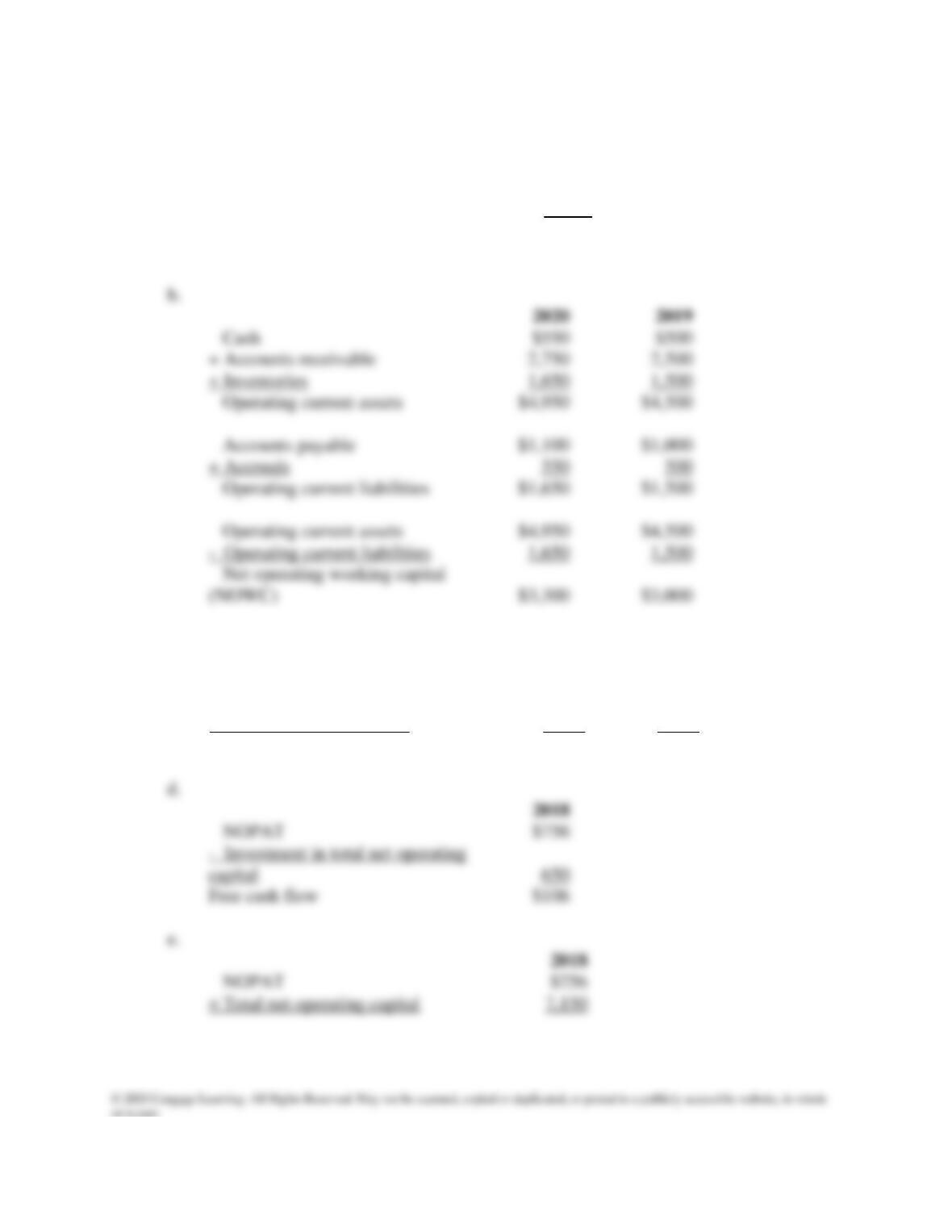
2-18 a.
2020
EBIT
$1,008
x (1-Tax rate)
75.0%
Net operating profit after taxes
(NOPAT)
$756
Cash
+ Accounts receivable
Operating current assets
$4,500
Accounts payable
$1,000
+ Accruals
Operating current liabilities
$1,500
Operating current assets
$4,500
– Operating current liabilities
Net operating working capital
(NOWC)
$3,000
c.
2018
2017
Net operating working capital
(NOWC)
$3,300
$3,000
+ Net plant and equipment
3,850
3,500
Total net operating capital
$7,150
$6,500
NOPAT
– Investment in total net operating
capital
650
Free cash flow
NOPAT
÷ Total net operating capital
Answers and Solutions: 2 – 10
Return on invested capital
(ROIC)
10.57%
f.
Uses of FCF
2018
After-tax interest payment =
$90
Reduction (increase) in debt =
-$284
Payment of dividends =
$202
Repurchase (Issue) stock =
$88
Purchase (Sale) of short-term
investments =
$10
Total uses of FCF =
$106
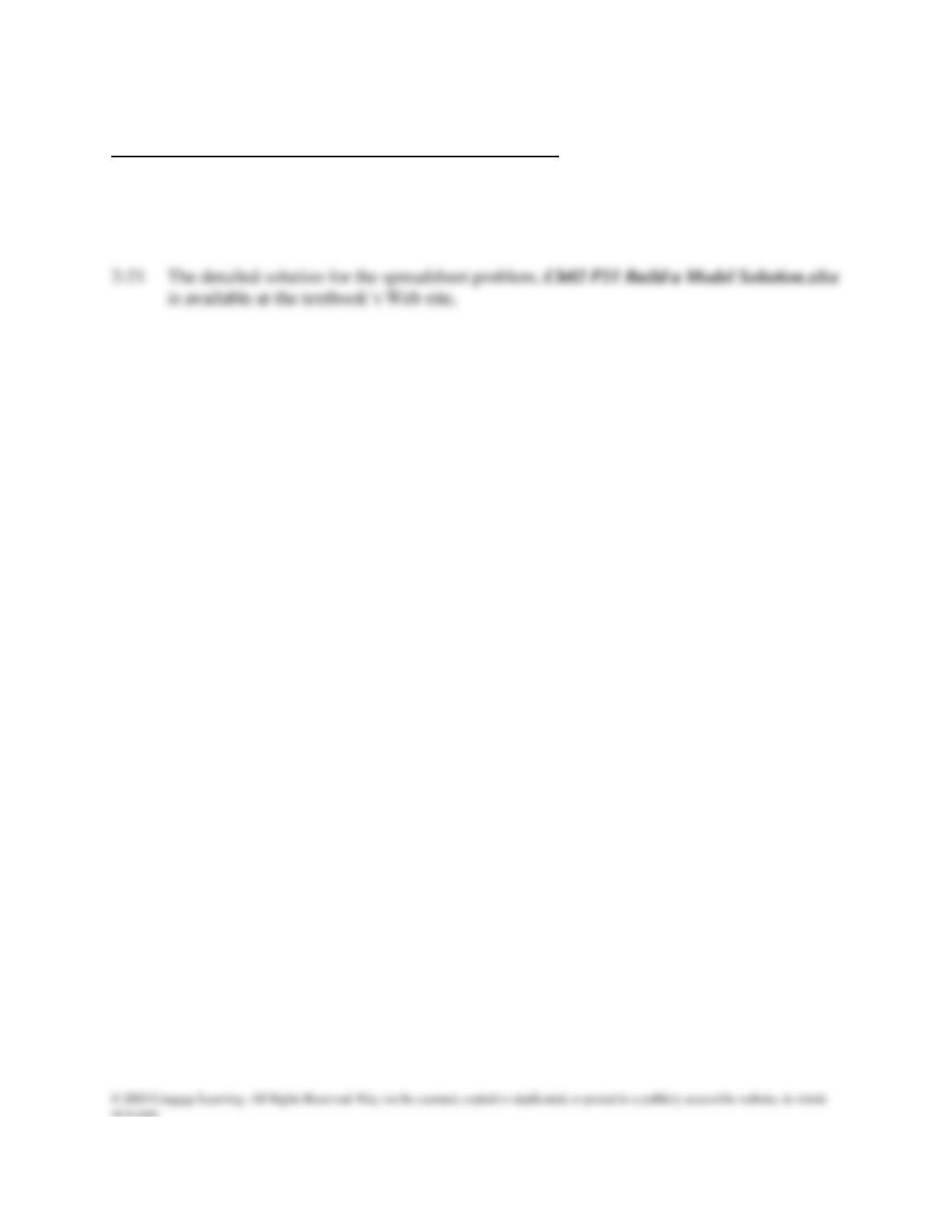
2-19 a. Last year:
Taxable income = Pre-tax earnings
– MIN(Pre-tax earnings, Remaining cumulative past losses)
= $100,000 – MIN($100,000,$500,000)
= $0.
Remaining loss = MAX(Beginning cumulative loss – Pre-tax earnings,0)
= MAX($500,000 – $100,000,0) = $400,000.
Answers and Solutions: 2 – 11
SOLUTION TO SPREADSHEET PROBLEM
2-20 The detailed solution for the spreadsheet problem, Ch02 P20 Build a Model Solution.xlsx
is available at the textbook’s Web site.