10. In a widely anticipated move, on August 30, 1990, the Bank of Japan raised the discount rate
(the rate it charges on loans to financial institutions) from 5.25% to 6% to reduce inflationary
pressures in Japan. Many currency traders had expected the Japanese central bank to raise its
rate by more than 0.75%. What was the likely consequence of this interest rate rise on the
yen:dollar exchange rate?
ANSWER. The key to this answer is to focus on the operative term “widely anticipated” and recognize that
11. In the late 1980s, the Bank of Japan bought billions of dollars in the foreign exchange market
to prop up the dollar’s value against the yen. What were the likely consequences of this foreign
exchange market intervention for the Japanese economy?
ANSWER. Without domestic sterilization, the increased purchase of dollars for yen led to a jump in the
12. Countries with high inflation need to keep devaluing their currencies to maintain
competitiveness. But countries that try to maintain their competitiveness by devaluing their
currencies only end up with even higher inflation. Discuss.
ANSWER. Devaluation improves competitiveness to the extent that it does not cause higher inflation. If
13. The Russian government is trying to figure out how to stabilize the value of its currency. What
advice would you offer to it?
ANSWER. The value of the ruble depends on the available supply of rubles relative to the demand for
14. “Unsterilized interventions are just open market operations conducted through the foreign
exchange market rather than through the U.S. government securities market.” Comment on
this statement.
15. As 1992 began, the Russian government and the central bank tightened credit in an attempt to
slow the growth in the supply of rubles. However, the moves weren’t popular with the
country’s giant state-run industrial enterprises, which are still dependent on official subsidies
and cheap credit. In July 1992, the Russian Parliament appointed Viktor Gerashchenko head
of the central bank. One of his first acts was to say that he didn’t think the time was right to
make the ruble convertible. Then he said that he would continue to extend credits to bankrupt
and inefficient state enterprises.
15.a. How independent is the Russian central bank likely to be? What political pressures is it facing?
ANSWER. The Russian central bank is unlikely to be very independent since the Russian Parliament can
15.b. What is the likely effect of Mr. Gerashchenko’s statements on inflationary expectations in
Russia?
15.c. How do you think the ruble:dollar exchange rate was affected by these statements?
15.d. In 1995, the Russian Central Bank signed an agreement with the International Monetary
Fund not to issue cheap credits to state enterprises. How should the ruble react if the central
bank sticks to its agreement with the IMF?
16. In January 1991, President Mikhail Gorbachev banned all 50-ruble and 100-ruble bills, while
permitting Soviet citizens to change only 1,000 rubles in these large bills into smaller
denominations. In addition, savings-bank accounts were frozen for six months. The object of
these measures was to strip the country’s powerful black marketeers of their operating capital,
driving as many as possible out of business, and to reduce inflation, which has been running at
about 80% a year. The official Russian news agency Tass reported that the government had
“clearly decided that the confiscation version of monetary reform was the most efficient and
least expensive version at its disposal.”
16.a. Were these measures likely to achieve President Gorbachev’s objectives?
ANSWER. These measures might drive some black marketeers out of business, but they cannot reduce
16.b. How do you think the ruble’s exchange rate responded to President Gorbachev’s initiative?
Explain.
17. On October 29, 1995, the Mexican government announced a new economic plan that called for
the government to boost the economy by cutting taxes and spending. The plan also included an
agreement among business, labor, and government representatives to limit wage and price
increases. How do you think the peso responded to this announcement? What about the
Mexican stock market? Explain.
18. Under the Convertibility Act, Argentina’s central bank is allowed to count dollar-denominated
bonds issued by the Argentine government as part of its “foreign” reserve assets. What
potential problem do you see with this rule?
ANSWER. The central bank’s ability to count dollar-denominated bonds issued by the Argentine
19. After the Mexican devaluation, investors questioning Argentina’s ability to maintain currency
convertibility began pulling their money out of Argentina. In response, the Argentine
government took extraordinary steps to maintain its exchange rate at $1 per peso.
19.a. What were the likely consequences of this capital flight for Argentina’s peso money supply?
For Argentine peso interest rates? For economic growth?
ANSWER. Since Argentina maintains a currency board, it cannot sterilize the effects of currency inflows
or outflows. An outflow of capital, therefore, must lead to a decline in the quantity of pesos in circulation.
19.b. Why was the Argentine government so reluctant to devalue the peso?
ANSWER. Argentina saw what happened in Mexico a month before, where peso devaluation led to higher
19.c As U.S. interest rates rise, what is likely to happen to Argentine rates? Why?
20. One recommended approach to strengthen the dollar against the yen is for the U.S. Treasury
to issue about $70 billion a year (the Japanese share of the U.S. trade deficit) in yen–
denominated bonds. How might this move help the dollar?
21. In 1993, President Carlos Salinas de Gortari proposed a bill that would formally grant the
Bank of Mexico, Mexico’s central bank, autonomy vis-à-vis the central government. As an
investor, how would you view such a proposal? What other changes might help to amplify the
signals sent by this proposal?
ANSWER. Investors, who value price stability, would view such a bill as strongly positive. Such a law
22. The People’s Bank of China, China’s central bank, is run by bureaucrats whose prime
objective seems to be funding loss-making state-owned firms. What is your prediction about
the inflation outlook for China and the value of its currency, the yuan? Explain.
23. In August 1994, Alan Blinder, recently appointed as vice chairman of the Federal Reserve
Board, gave a talk in which he argued that the Fed should be willing to tolerate somewhat
higher inflation to spur economic growth and job creation. The dollar fell almost immediately.
Explain the link between Dr. Blinder’s views and the value of the dollar.
ANSWER. The view that the Fed should try to stimulate economic growth at the risk of somewhat more
inflation is precisely the attitude that got the U.S. in so much trouble in the late 1960s and 1970s. By
24. Describe the chief differences between a currency board and a central bank with a nominal
exchange rate target.
ANSWER. First, the central bank controls the money supply by setting the nominal exchange rate target
and then adjusting the money supply to achieve that target. Under a currency board system, there is no
25. In 1994, China sought to boost its foreign exchange reserves and stabilize the yuan (which was
under pressure to appreciate) by mandating that Chinese enterprises sell all their foreign
exchange to the country’s commercial banks. The People’s Bank of China, in turn, was forced
to buy surplus foreign exchange with yuan.
25.a. What are the likely consequences of this policy for China’s rate of inflation? Explain.
25.b. What alternatives are open to China to achieve its attempt to simultaneously hold down the
value of the yuan and curb inflation?
ANSWER. In reality, there are no alternatives for China. After creating the additional yuan through the
26. In the midst of the Asian financial crisis, Malaysia’s Prime Minister Mahathir Mohamad
accused an international cabal of Jewish financiers of deliberately provoking the crisis to
wreck Malaysia’s economy. “Jews are not happy to see Muslims prosper,” he said. Following
his remarks, Malaysia’s financial markets and its currency, the ringgit, plunged to record
lows. Explain.
ANSWER. Financial markets are not the United Nations or the Third World organization of nonaligned
27. In the 1995 election for the French presidency, the Socialist candidate, Lionel Jospin, vowed to
halt all privatizations, raise taxes on business, spend heavily on job creation, and cut the work
week without a matching pay cut. At the time Mr. Jospin made this vow, he was running neck–
and-neck with the conservative Prime Minister Jacques Chirac, who espoused free-market
policies. In a surprise ending to the 1997 French parliamentary elections, the Socialist party
won and Mr. Jospin became Prime Minister. Given that Mr. Jospin still espoused the same
policies as before, what was the likely reaction of the French franc to his election?
SUGGESTED SOLUTIONS TO CHAPTER 2 PROBLEMS
1. On August 1, 2006, Zimbabwe changed the value of the Zim dollar from Z$101/U.S.$ to
Z$250/U.S.$.
1.a. What was the original U.S. dollar value of the Zim dollar? What is the new U.S. dollar value
of the Zim dollar?
1.b. By what percent has the Zim dollar devalued (revalued) relative to the U.S. dollar?
1.c. By what percent has the U.S. dollar appreciated (depreciated) relative to the Zim dollar?
2. In 2002, one dollar bought ¥125. In 2006, it bought about ¥115.
2.a. What was the dollar value of the yen in 2005? What was the yen’s dollar value in 2006?
2.b. By what percent has the yen risen in value between 2002 and 2006?
2.c. By what percent has the dollar fallen in value between 2002 and 2006?
3. On February 1, the euro is worth $1.2966. By May 1, it has moved to $1.3634.
3.a. By how much has the euro appreciated or depreciated against the dollar over this 3-month
period?
3.b. By how much has the dollar appreciated or depreciated against the euro over this period?
4.a. By what percent did the won devalue?
4.b. Following the initial devaluation what further percentage devaluation would be necessary for
the won to equal its black market value?
5. On March 29, 2007, the Indian rupee (Rs) was worth $0.023270. The next day, it was worth
5.a. By how much has the rupee devalued against the dollar?
5.b. By how much has the dollar appreciated against the rupee?
6. On June 14, 2001, Domingo Cavallo, Argentina’s treasury secretary announced a new exchange
rate policy designed to stimulate Argentina’s slumping economy. Under the new policy,
exporters and importers would be able to convert between dollars and pesos at an exchange
rate that was an average of the dollar and the euro exchange rates, that is, P1 = $0.50 + €0.50.
At that time, the euro was trading at $0.85.
6.a. How many pesos would an exporter receive for one dollar under the new system?
6.b. How many dollars would an importer receive for one peso under the new system?
ADDITIONAL CHAPTER 2 PROBLEMS AND SOLUTIONS
1. In the second half of 1997, the Indonesian rupiah devalued by 84% against the U.S. dollar. By
how much has the dollar appreciated against the rupiah?
2. During 1997, the U.S. dollar appreciated by 104% against the South Korean won. By how much
did the won depreciate against the U.S. dollar during the year?
3. On January 1, 1975, the Mexican peso/U.S.$ exchange rate was Ps 12.5 = $1. By 1985, the
exchange rate stood at Ps 208.9 = $1.
3.a. By how much has the Mexican peso appreciated or depreciated against the dollar over this
10-year period?
3.b. By how much has the dollar appreciated or depreciated against the peso over this period?
4. Suppose the Russian ruble devalues by 75% against the dollar. What is the percentage
appreciation of the dollar against the ruble?
5. Suppose the dollar appreciates by 500% against the Russian ruble. How much has the ruble
devalued against the dollar?
6. In 1993, the Brazilian cruzeiro lost 95% of its dollar value. What happened to the cruzeiro
value of the dollar during 1993?
7. Between 1988 and 1991, the price of a room at the Milan Hilton rose from Lit 346,400 to Lit
475,000. Concurrently, the exchange rate went from Lit 1,302 = $1 in 1988 to Lit 1,075 = $1 in
1991.
7.a. By how much has the dollar cost of a room at the Milan Hilton changed over this three-year
period?
7.b. What has happened to the lira’s dollar value during this period?
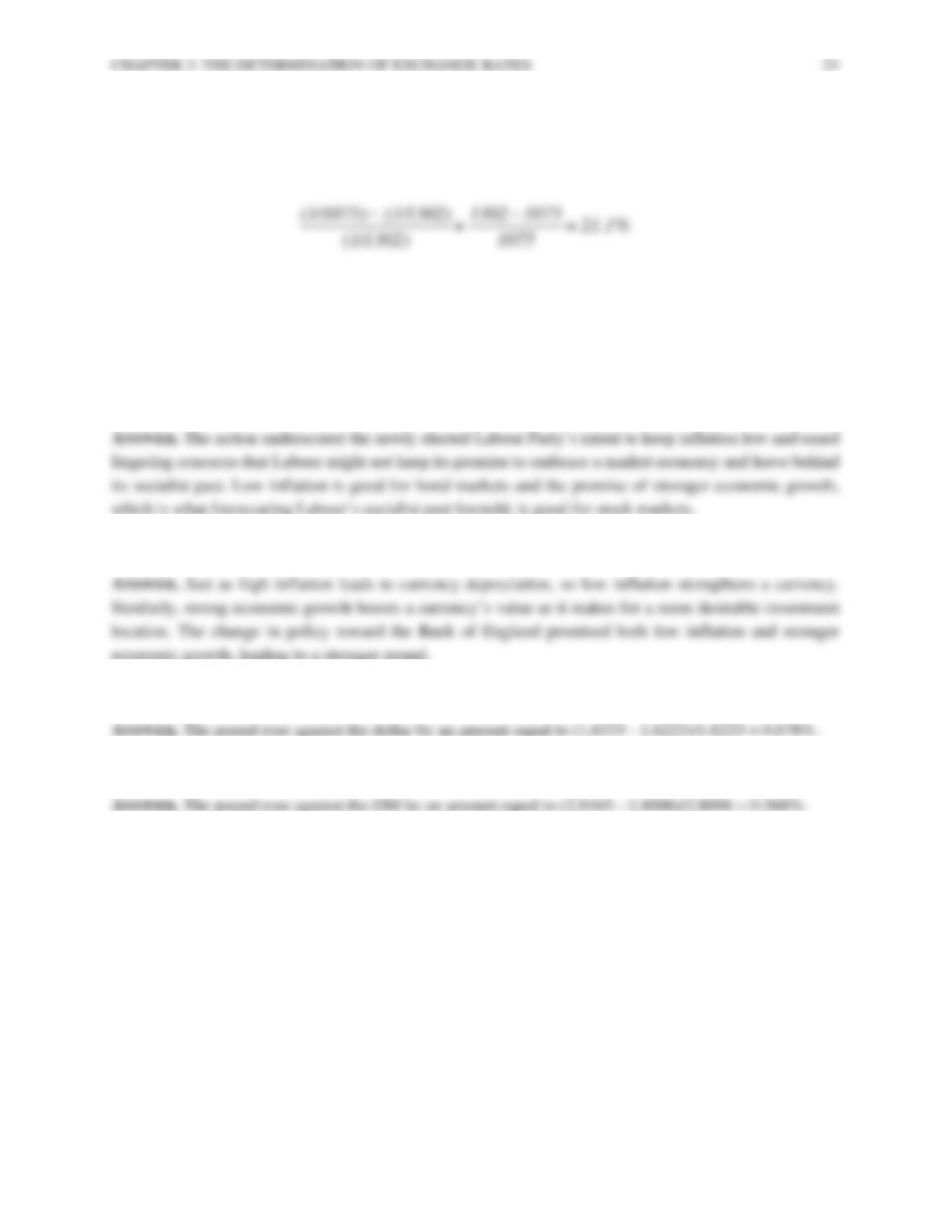
ANSWER. According to Equation 2.1, the lira’s dollar value has appreciated by
8. On the day that the Chancellor of the Exchequer announced independence for the Bank of
England along with a boost in the base lending rate of one-quarter of a percentage point, the
British stock market rose 1.4%, and British gilts rose about 2.1%. The pound rose to $1.6333
from $1.6223 and to DM2.8165 from DM2.8006.
8.a. Why did the British stock and bond markets jump on the news?
8.b. Why did the British pound appreciate on the news?
8.c. What was the pound’s percentage appreciation against the U.S. dollar?
8.d. What was the pound’s percentage appreciation against the DM?