Chapter 2 CFIN6
Chapter 2 Solutions
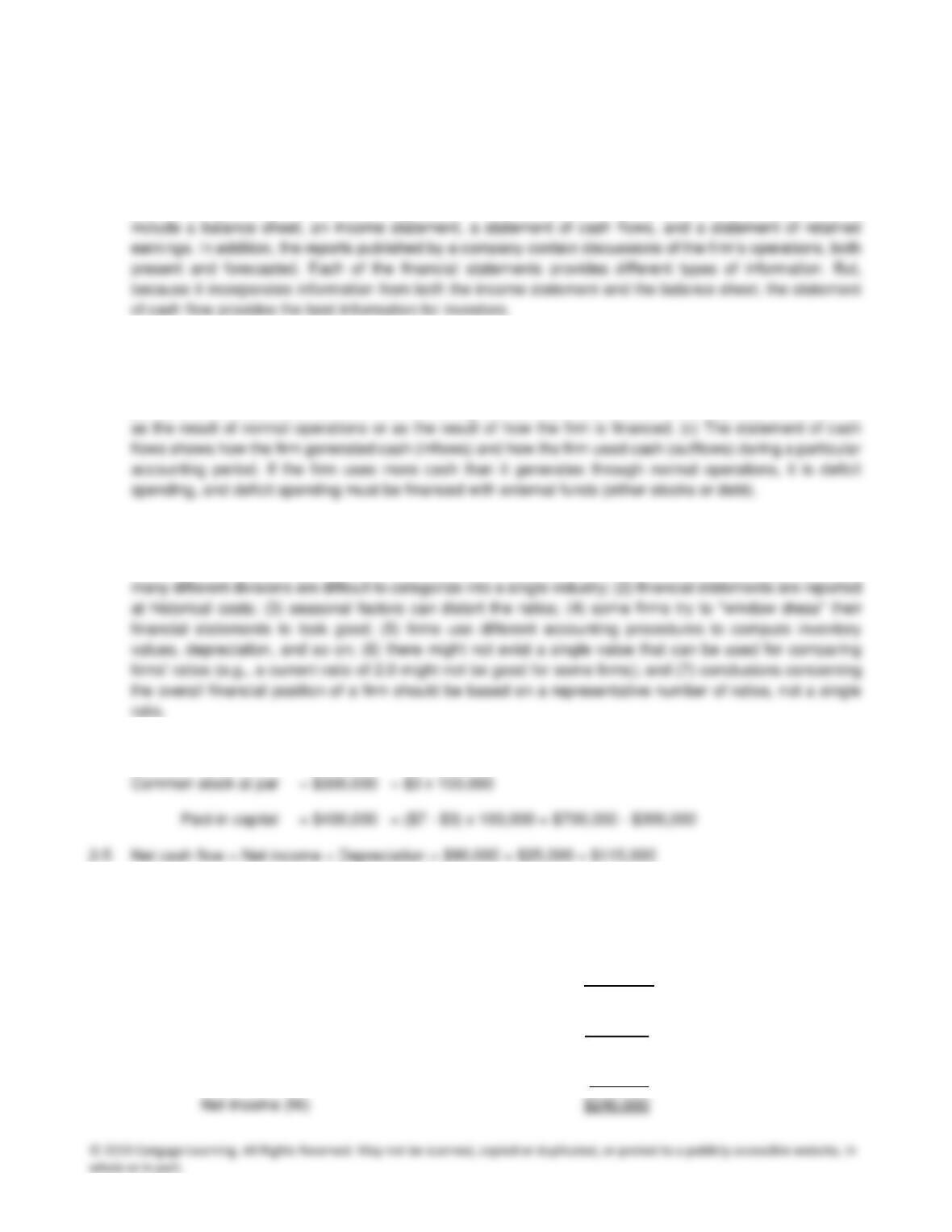
2-1 Publically-traded companies are required to provide adequate financial information to their shareholders.
Information generally is provided through financial reports that a company periodically produces, which
2-2 (a) The balance sheet shows, at a particular point in time, the amount the firm has invested in assets and
how much of those investments are financed with loans (liabilities) and how much are financed with equity
(stock). (b) The income statement shows the revenues (sales) that the firm generated during a particular
period and the expenses that were incurred during that same period, whether those expense were incurred
2-3 The most important aspect of ratio analysis is the judgment used when interpreting the results to reach
conclusions concerning a firm’s current financial position and the direction in which the firm is headed in the
future. The analyst should be aware of, and include in the interpretation, the fact that: (1) large firms with
2-4 Shares issued = 100,000 Price per share = $7 Par value per share = $3
2-6 The income statement for HighTech Wireless with the information that is given in the problem:
Sales ?
Operating expenses, excluding depreciation $(500,000)
Depreciation (100,000)
EBIT ?
Interest 0 (HighTech has no debt)
Earnings before taxes (EBT) ?
Taxes (40%) ?
Chapter 2 CFIN6
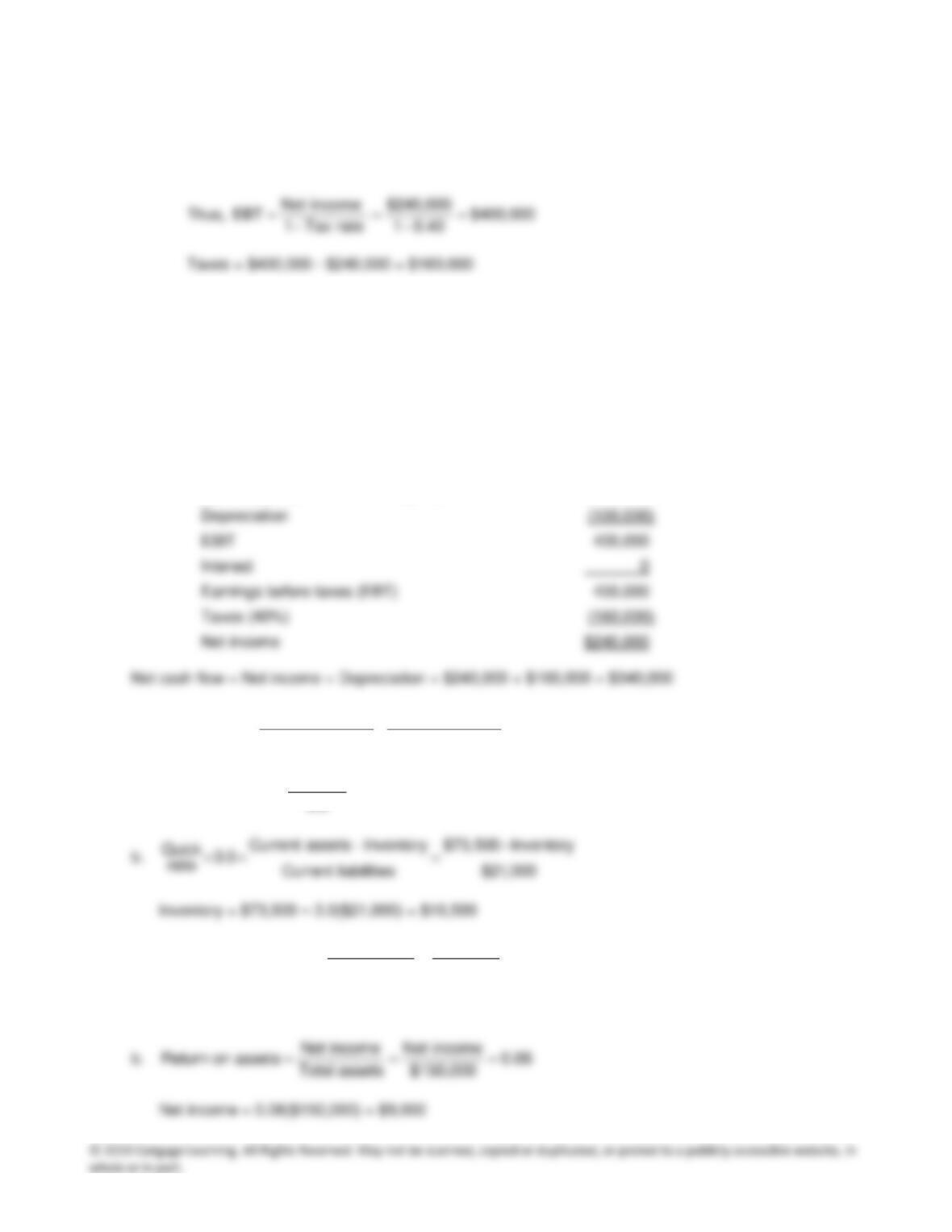
Starting with net income and working up the income statement to solve for sales, we have the
following computations:
1. NI = EBT(1 – 0.4)
2. EBIT = EBT + Interest = $400,000 + 0 = $400,000
3. Sales = EBIT + Operating expenses, excluding depreciation + Depreciation
= $400,000 + $500,000 + $100,000 = $1,000,000
To show that this is the correct result, let’s start with sales equal to $1,000,000 and compute the
net income:
Sales $1,000,000
Operating expenses, excluding depreciation (500,000)
2-7 a.
Current assets $73,500
Current 3.5
ratio Current liabilities Current liabilities
= = =
$73,500
Current liabilities = =$21,000
2-8 a.
Sales Sales
Total assets turnover 2.0
Total assets $150,000
= = =
Sales = 2.0($150,000) = $300,000
Chapter 2 CFIN6
Net income $9,000
Net profit margin 0.03 3.0%
Sales $300,000
= = = =
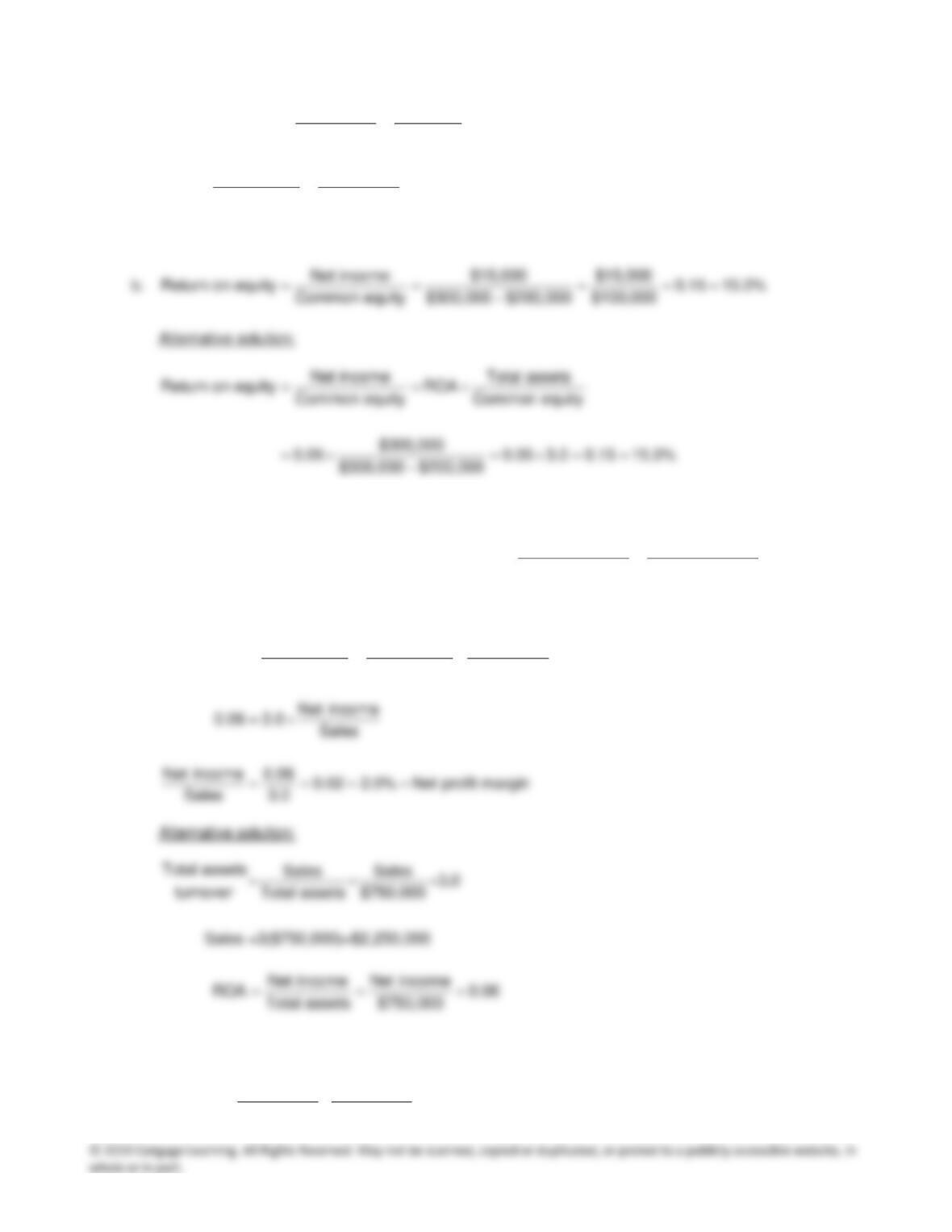
2-9 a.
Net income Net income
ROA 0.05
Total assets $300,000
= = =
Net income = 0.05($300,000) = $15,000
2-10 a. Debt ratio = 40%
==
Common equity Common equity
Proportion of firm = 1 – 0.40 = 0.6 = 60%
financed with common stock Total assets $750,000
Common equity = $750,000(0.6) = $450,000
b.
=
Net income Sales Net income
ROA= Total assets Total assets Sales
Net income 0.06($750,000) $45,000
==
Net profit Net income $45,000
= = =0.02=2.0%
margin Sales $2,250,000
Chapter 2 CFIN6
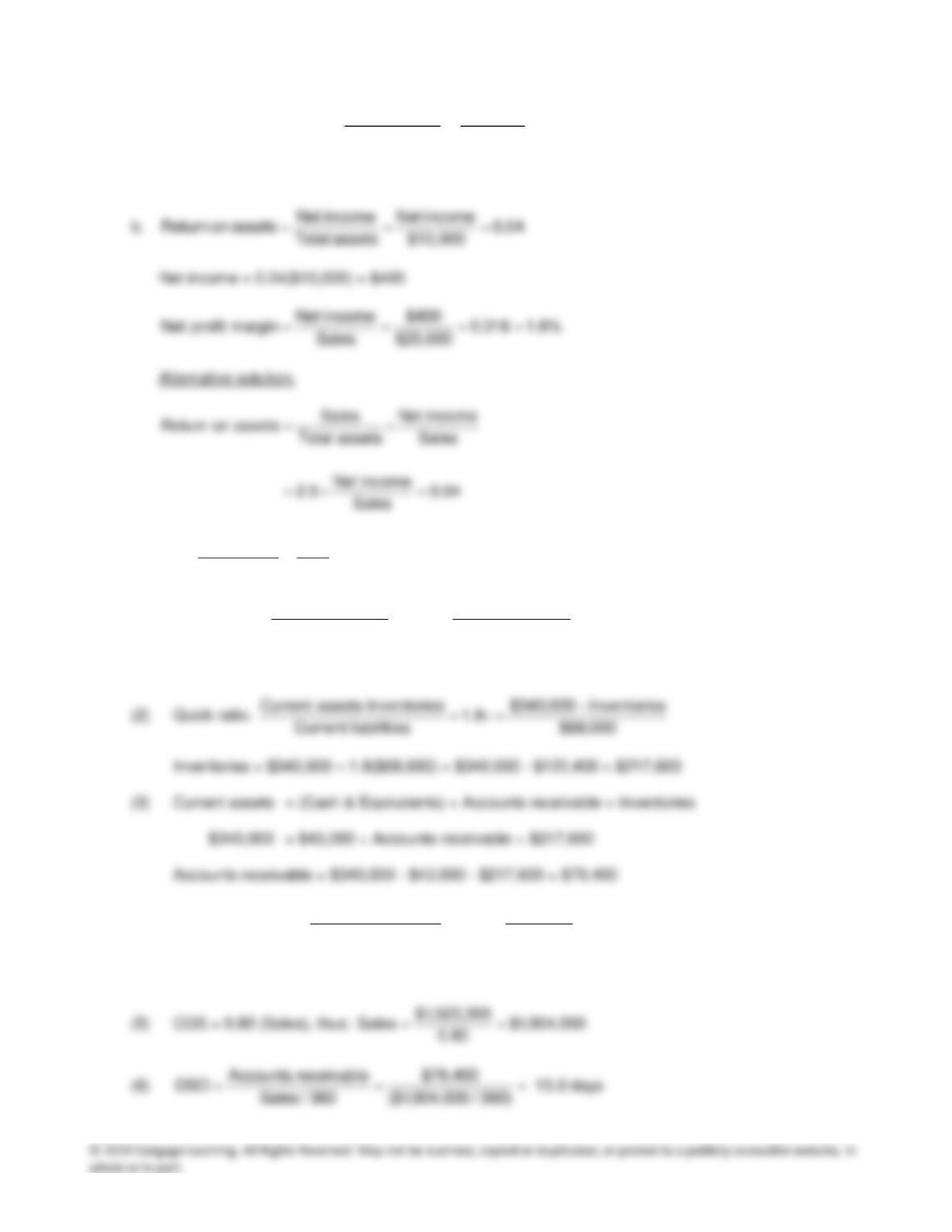
2-11 a.
Sales Sales
Total assets turnover 2.5
Total assets $10,000
= = =
Sales = 2.5($10,000) = $25,000
Net income 0.04 0.016 1.6% Net profit margin
Sales 2.5
= = = =
2-12 (1) Current ratio:
Current assets $340,000
5.0
Current liabilities Current liabilities
= =
Current liabilities = $340,000/5.0 = $68,000
(4) Inventory turnover:
Cost of goods sold CGS
7.0
Inventory $217,600
= =
CGS = 7($217,600) = $1,523,200
Chapter 2 CFIN6
2-13 a. TIE = EBIT/INT, so find EBIT and INT
Interest = $200,000 x 0.06 = $12,000
Net income = $540,000 x 0.04 = $21,600
Net income = Taxable income(1 – T)
b. For TIE to equal 6.0, EBIT = 6.0($12,000) = $72,000
When EBIT = $72,000, Net income = ($72,000 – $12,000)(1 – 0.40) = $36,000
Because NI = 0.04(Sales), Sales = $36,000/0.04 = $900,000
2-14 We are given: Common equity = $35,000,000 Common shares outstanding = 7,000,000
Market price per share = $8 Net income = $14,000,000
2-15 We are given: ROE = 15% TA turnover = Sales/Total assets = 2.0x
Debt Ratio = 60%
a. From DuPont equation: ROE = ROA x Equity multiplier
0.15 = ROA x (Total assets/Common equity)
Chapter 2 CFIN6
1
0.15 ROA 1 Debt ratio
=
−
ROA = 0.15/2.5 = 0.06 = 6.0%
b. ROA = (Net profit margin) x (Total assets turnover)
0.06 = Net profit margin x 2.0
Net profit margin = 0.06/2.0 = 0.03 = 3.0%
Alternative solution:
TA turnover = Sales/Total assets = 2.0x, thus Sales = 2.0(Total assets)
2-16 We are given: ROA = 8% Total assets = $440,000
Debt Ratio = 20%
a.
Net income
ROA Total assets
=
Net income
0.08 $440,000
=
Net income = 0.08($440,000) = $35,200
2-17 We are given: ROA = 4% Current assets = $260,000
Net income = $140,000 Long-term debt = $1,755,000
% assets financed with equity = 35%
Chapter 2 CFIN6
(1)
Net income $140,000
ROA 0.04
Total assets Total assets
===
; Total assets = $140,000/0.04 = $3,500,000
(2) Total liabilities = (Total assets) x (Debt ratio) = $3,500,000(1 – 0.35) = $2,275,000
2-18 We are given: ROA = 3% ROE = 5% Total assets = $100,000
a.
Net income Net income
ROA 0.03
Total assets $100,000
= = =
; Net income = $100,000(0.03) = $3,000
2-19 We are given: % assets financed with equity = 60% Current ratio = 5.0
Total assets turnover = 4.0 Current assets = $150,000
Sales = $1,800,000
(1)
Current assets $150,000
Current ratio 5.0
Current liabilities Current liabilities
===
Current liabilities = $150,000/5 = $30,000
2-20 We are given: P/E ratio = 15.0 Price per share = $30
Fixed assets turnover = 8.0 Current ratio = 5.0
Current liabilities = $300,000 Net profit margin = 0.04
Chapter 2 CFIN6
(2)
Net income $120,000
Net profit margin 0.04
Sales Sales
= = =
; Sales = $120,000/0.04 = $3,000,000
(3)
Fixed assets Sales $3,000,000 8.0
turnover Net fixed assets Fixed assets
= = =
; Fixed assets = $3,000,000/8 = $375,000