
Chapter
Using Financial
Statements and Budgets
Chapter 2
How Will This Affect Me?
A recent survey shows that more than half of adult Americans could not cover 6 months of living expenses or
the cost of medical emergencies. And younger millennials between the ages of 18 and 24 are the least
prepared*. These are scary findings … and this chapter shows what you can do to avoid being part
of these alarming statistics.
LEARNING GOALS
LG1 Understand the relationship between financial plans and statements.
The statement above “it’s hard to get where you need to go if you don’t know where you are” is very true.
There are three basic financial statements: Balance Sheet, Income Statement, and Budget. The balance sheet
Note the “Financial Road Sign” that discusses the 50/30/20 rule.
• 50 percent of income goes to living expenses and necessities (needs), which include rent, utilities, groceries,
insurance, and transportation.
• 30 percent of income goes to flexible spending (wants), which includes everything you want but don’t need to
buy. Examples are spending money on eating out, movies, and travel.
LG2 Prepare a personal balance sheet.
The Balance Sheet computes the net worth [assets less liabilities] as of a given date. By comparing the current
balance sheet with the previous one from a year ago, you can see if you are moving toward your goal, or not.
While liquid assets and investments may look the same, their purpose is very different. The liquid assets are
available to spend or pay off debt, while the investments are for the long term. Recall that here we are
Exhibit 2.2 gives the student hope that in the future they will have a net worth.
LG3 Generate a personal income and expense statement.
While the balance sheet reports financial position as of a given day, the income statement covers a stated period,
typically a month or year. The Financial Planning Exercises Number 4 should lead the students to consider
what income is. The exercise asks the question is income gross pay or net pay. If you take the position that it is
LG4 Develop a good record-keeping system and use ratios to evaluate personal financial statements.
Without records, you are flying blind. It’s like the person who says they can spend money as long as they have
a check in their checkbook. Records give you a way to prepare financial reports which allow you to evaluate
LG5 Construct a cash budget and use it to monitor and control spending.
The income statement reports the cash surplus or deficit for the period. But is the surplus of $2,000 good or not.
You need something to compare it to. Frequently you compare to the previous period. While that is better than
no comparison, comparing to your planned surplus is better. Your planned surplus is the bottom line of your
LG6 Apply time value of money concepts to put a monetary value on financial goals.
Financial plans are concerned with what future amounts you will need to be able to provide for your desired
lifestyle at that time. Since the time is in the future, typically you need to apply the concept called the time
LG7 Understand the relationship between inflation and nominal interest rates and calculate the real
interest rate.
The interest rate used in time value of money computations matters. The appropriate rate is the inflation
adjusted rate. In the example in the text, the nominal rate of 8% becomes an inflation rate of 4.85% if you
Link to Solutions to Financial Planning Exercises
Financial Facts or Fantasies?
These may be used as “teasers” to get the students on the right page with you. Also, they may be used as
quizzes after you covered the material or as “pre–test questions” to get their attention.
• Because financial statements are used to record actual results, they’re really not that important in personal
financial planning.
Fantasy: Personal financial statements let you know where you stand financially. As such, they not only help
you set up realistic financial plans and strategies but also provide a system for monitoring the amount of
progress you’re making toward the financial goals you’ve set.
• Only the principal portion of a loan should be recorded on the liability side of a balance sheet.
Fact: The principal portion of a loan represents the unpaid balance and is the amount of money you owe. In
contrast, interest is a charge that will be levied over time for the use of the money.
• Generating a cash surplus is desirable, because it adds to your net worth.
Financial Facts or Fantasies?
These may be used as a quiz or as a pre-test to get the students interested.
1. True False Whereas the balance sheet summarizes your financial condition at a given point in time, the
income and expense statement report on your financial performance over time.
2. True False Because financial statements are used to record actual results, they’re really not that important in
personal financial planning.
Answers: 1. True 2. False 3. False 4. True 5. True 6. False
YOU CAN DO IT NOW
The “Do It Now” cases may be assigned to the students as short cases or problems. They will help make the
topic more real or relevant to the students. In most cases, it will only take about ten minutes to do, that is, until
the student starts looking around at the web site. But they will learn by doing so.
Track Your Expenses
It’s easy for spending to become so automatic that we’re not aware we’re doing it. So where does your money
Save Automatically
We all know we should save regularly. One way to create a savings “habit” is to literally make it automatic.

Financial Impact of Personal Choices
Read and think about the choices being made. Do you agree or not? Ask the students to discuss the choices
being made.
No Budget, No Plan: Mason Bought a Boat!
Mason is 28 and has a good job as a sales rep. He’s always found budgeting boring and has been intending to
start a financial plan for years.
Applying Personal Finance
What’s Your Condition?
Financial statements reflect your financial condition. They help you measure where you are now. Then,
as time passes and you prepare your financial statements periodically, you can use them to track your
progress toward financial goals. Good financial statements are also a must when you apply for a loan.
This project will help you to evaluate your current financial condition.
1. Have you included all your assets at fair market value (not historical cost) on your balance sheet?
2. Have you included all your debt balances as liabilities on your balance sheet? (Don’t take your
monthly payment amounts multiplied by the number of payments you have left—this total includes
future interest.)
3. Have you included all items of income on your income and expense statement? (Remember, your
but not on both. For example, the $350 car payment you made this month is an expense on your
income and expense statement. The remaining $15,000 balance on your car loan is a liability on
your balance sheet, while the fair market value of your car at $17,500 is an asset.
Solutions to Financial Planning Exercises
1. Preparing Financial Statements: Axel Gibson is preparing his balance sheet and income and
expense statement for the year ending June 30, 2020. He is having difficulty classifying six items
and asks for your help. Which, if any, of the following transactions are assets, liabilities, income, or
expense items?
a. Axel rents a house for $1,350 a month.
The monthly rent is a monthly expense. The payment will reduce an asset, Cash.
b. On June 21, 2020, Axel bought diamond earrings for his wife and charged them using his
MasterCard. The earrings cost $900, but he hasn’t yet received the bill.
The purchase will result in a new asset, personal property for $900. Since he purchased using a credit
c. Axel borrowed $3,500 from his parents last fall, but so far, he has made no payments to them.
Since no loan payments were made during the period, a corresponding expense would not appear.
d. Axel makes monthly payments of $225 on an installment loan; about half of it is interest, and the
balance is repayment of principal. He has 20 payments left, totaling $4,500.
The income and expense statement will show an expense: payment of loan $225 per month times 12
e. Axel paid $3,800 in taxes during the year and is due a tax refund of $650, which he hasn’t yet
received.
The payment of taxes is an expense recorded as paid, typically monthly or when paycheck is received.
f. Axel invested $2,300 in some common stock.
The cash asset goes down and the investment asset goes up. The investment will appear on the balance
sheet.
2. Projecting Financial Statements: Put yourself 10 years into the future. Construct a fairly detailed
and realistic balance sheet and income and expense statement reflecting what you would like to
achieve by that time.
While everyone’s financial statements will differ based on their own expectation of the future, each
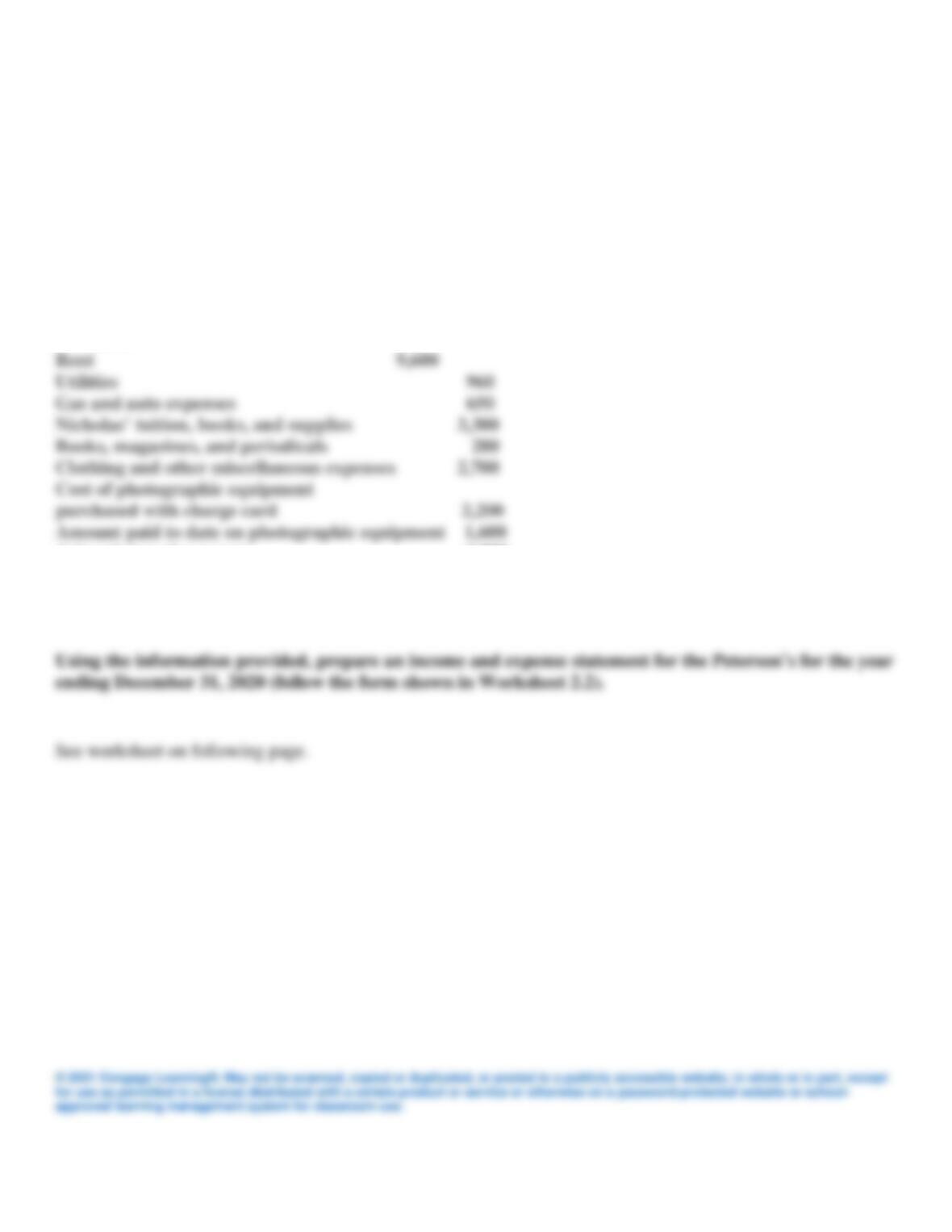
3. Preparing Personal Balance Sheet: Use Worksheet 2.1. Sadie Richardson’s banker has asked her to
submit a personal balance sheet as of June 30, 2020, in support of an application for a $6,000 home
improvement loan. She comes to you for help in preparing it. So far, she has made the following list of
her assets and liabilities as of June 30, 2020:
Cash on hand $ 70
Balance in checking account 180
Balance in money market deposit account with
Southwest Savings 650
Installment loan balances:
Auto loans 3,000
Furniture loan 500 3,500
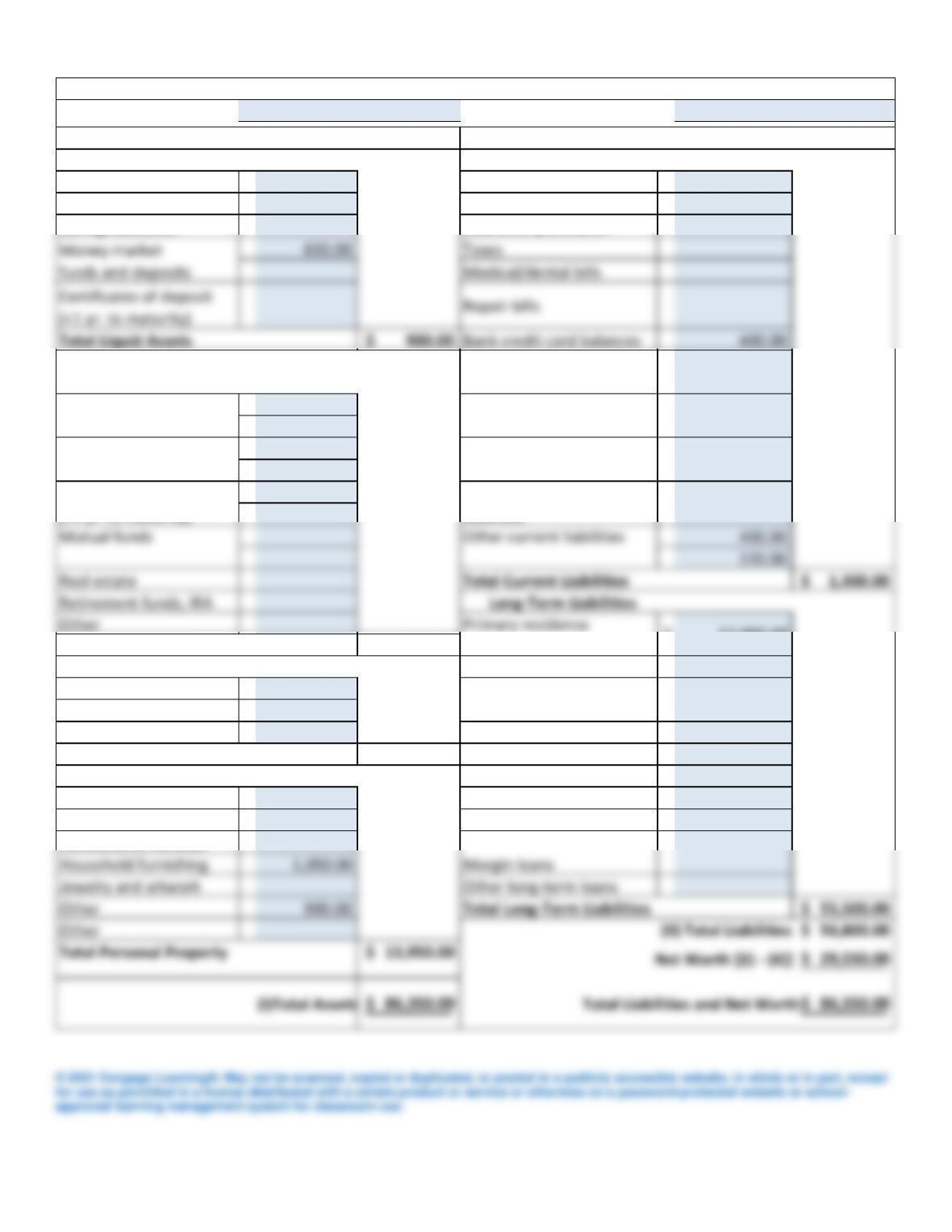
From the data given, prepare Sadie Richardson’s balance sheet, dated June 30, 2020 (follow the balance
sheet form shown in Worksheet 2.1). Then evaluate her balance sheet relative to the following factors: (a)
solvency, (b) liquidity, and (c) equity in her dominant asset.
See following page for Worksheet 2.1 for Sadie Richardson.
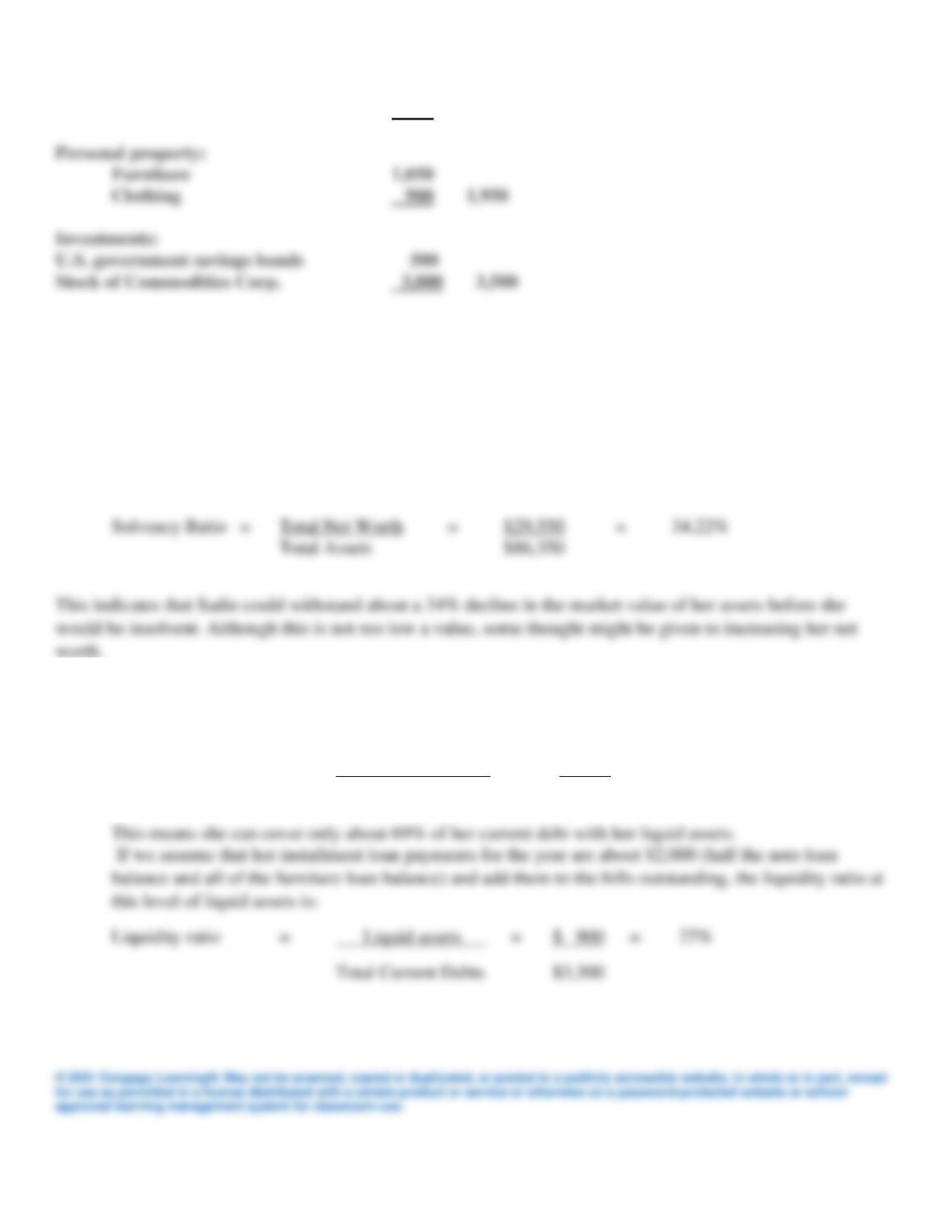
3-a. Solvency Ratio: This term refers to having a positive net worth. The calculation for her solvency ratio is
as follows:
3-b. Liquidity Ratio: A simple analysis of Sadie’s balance sheet reveals that she’s not very liquid. In comparing
current liquid assets ($900) with current bills outstanding ($1,300), it is obvious that she cannot cover
her bills and is, in fact, $400 short (i.e., $1,300 current debt – $900 current assets). Her liquidity ratio is:
Liquidity ratio = Liquid Assets = $ 900 = 69.21%
Total Current Debts $1,300

This indicates that if she lost income, she could cover only about 27% of her existing one-year debt
obligations with her liquid assets—and this does not include her mortgage payment! This is clearly not a
favorable liquidity position.
Recreational vehicles
Household furnishing
1,050.00
Margin loans
Worksheet 2.1, Exercise 3, chapter 2
Name(s)
Date
Liquid Assets
Current Liabilities
Cash on hand
$
70.00
Utilities
$
90.00
In checking
180.00
Rent
Savings accounts
Insurance premiums
650.00
Taxes
Medical/dental bills
Certificates of deposit
Repair bills
Bank credit card balances
400.00
Money market
funds and deposits
Investments
Dept. store credit card
balances
190.00
Stocks
$
3,000.00
Bonds
500.00
Mutual funds
Other current liabilities
400.00
220.00
Real estate
1,300.00
$
Retirement funds, IRA
balances
(>1 yr. to maturity)
3,500.00
$
Real Property
Second home mortgage
Primary residence
$
68,000.00
Second home
Other
Auto loans
3,000.00
68,000.00
$
Appliance/furniture loans
500.00
Personal Property
Home improvement loans
Auto(s): 2015 Honda Civic
$
12,000.00
Single-payment loans
Auto(s):
Education loans
Total Investments
Total Real Property
Gas and other credit card
balances
Bank line of credit
$
52,000.00
Real estate investment
mortgage
Travel and entertainment
card balances
mortgage
BALANCE SHEET
ASSETS
LIABILITIES
Certificates of deposit
June 30, 2020
Sadie Richardson
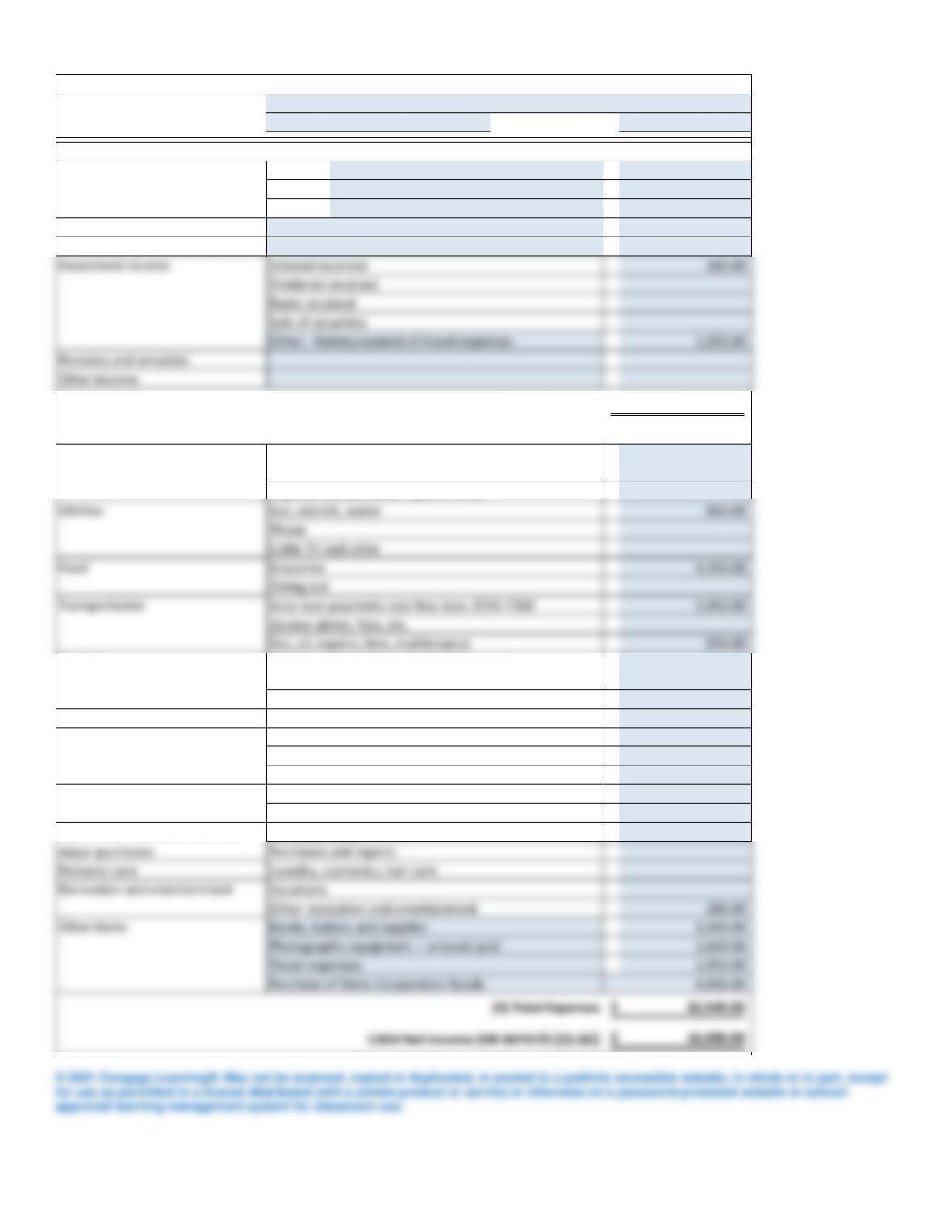
4. Preparing Income and Expense Statement: Use Worksheet 2.2. Ariana and Nicholas Peterson are
about to construct their income and expense statement for the year ending December 31, 2020. They have
put together the following income and expense information for 2020:
Ariana’s salary $47,000
Reimbursement for travel expenses 1,950
Interest on:
Savings account 110
Bonds of Delta Corporation 70
Groceries 4,150
Ariana’s travel expenses 1,950
Purchase of a used car (cost) 9,750
Outstanding loan balance on car 7,300
Purchase of bonds in Delta Corporation 4,900
Worksheet 2.2 Exercise 4, Chapter 2
Name(s)
For the [month or year] Ended December 31, 2020
Income
Name: $ 47,000.00
Name:
Name:
Self-employment income
Bonuses and commissions
Interest received
Dividends received
Rents received
Expenses
Repairs, maintenance, improvements
Utilities
Gas, electric, water
Cable TV and other
Groceries
Dining out
Transportation
Auto loan payments cost less loan, 9750-7300
License plates, fees, etc.
Gas, oil, repairs, tires, maintenance
Clothing 2,700.00
major purchases
Purchases and repairs
Other recreation and entertainment
Travel expenses
Laundry, cosmetics, hair care
Vacations
INCOME AND EXPENSE STATEMENT
Ariana and Nicholas Peterson
Year
Wages and salaries
Ariana Peterson
(I) Total Income
Housing
Rent/mortgage payment
(include insurance and taxes, if applicable)
Medical
Health, major medical, disability insurance
(payroll deductions or not provided by employer)
Doctor, dentist, hospital, medicines
Clothes, shoes, and accessories
Insurance
Homeowner’s (if not covered by mortgage payment)
Life (not provided by employer) &/or Long-term Care
Auto
Taxes
Income and social security
Property (if not included in mortgage)
Appliances, furniture, and other
Loan payments
49,130.00$
$
9,600.00
5. Preparing Cash Budget: Landon and Naomi Gray are preparing their cash budget. Help the Grays
reconcile the following differences, giving reasons to support your answers.
a. Their only source of income is Landon’s salary, which amounts to $5,000 a month before taxes.
Landon wants to show the $5,000 as their monthly income, whereas Naomi argues that his take-
home pay of $3,917 is the correct value to show.
Like many questions it depends. If the taxes and other payroll deductions are considered out of their
b. Naomi wants to make a provision for fun money, an idea that Landon cannot understand.
He asks, “Why do we need fun money when everything is provided for in the budget?”
By having an allowance for “fun money,” the Grays have specifically set aside a certain portion of their
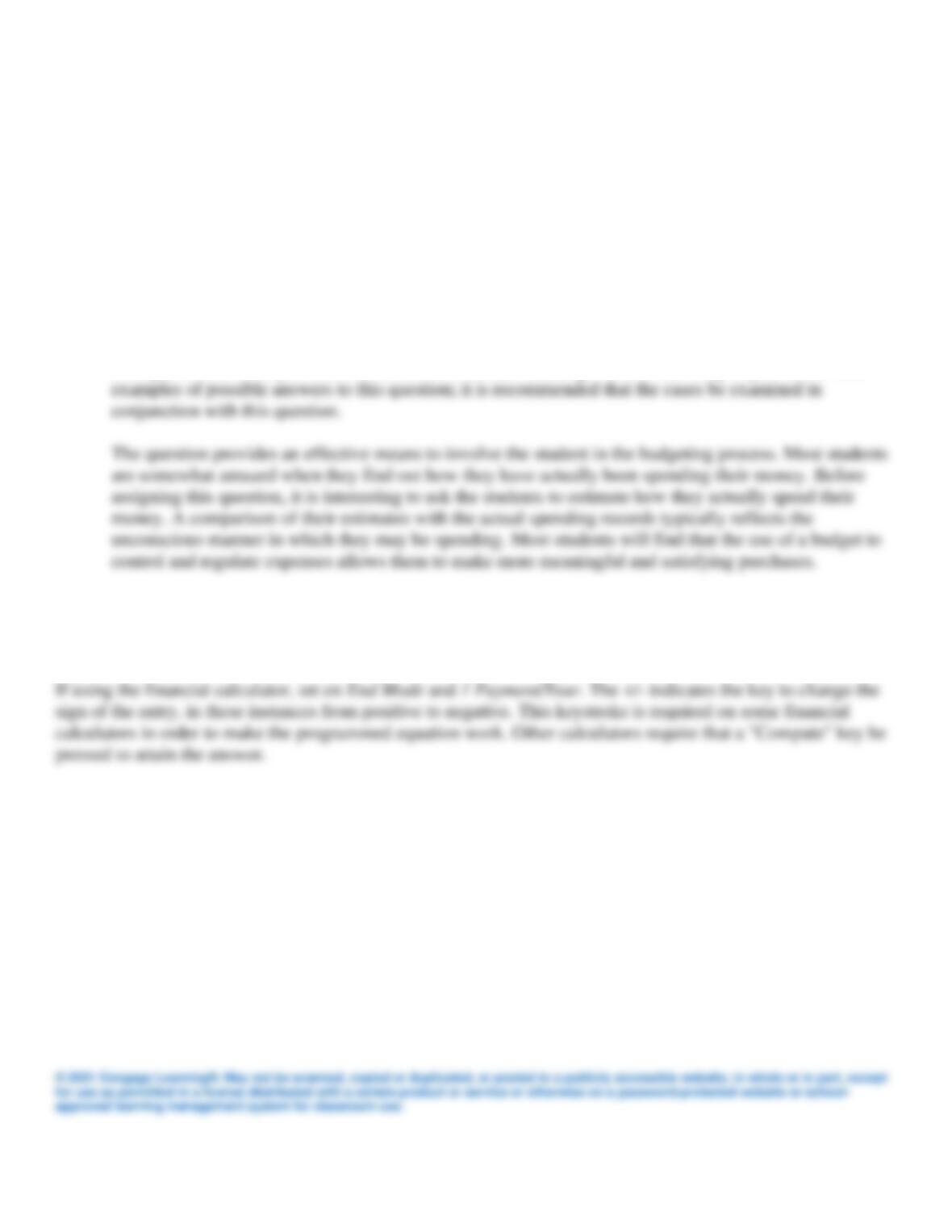
6. Identifying Missing Budget Items: Here is a portion of Joshua Sanders’s budget record for a recent
month. Fill in the blanks in columns 5 and 6.
Note, here the answers are included in bold. They may be deleted if you wish to use in classroom.
Item
(1)
Amount
Budgeted
(2)
Amount
Spent
(3)
Beginning
Balance
(4)
Monthly
Surplus
(Deficit)
(5)
Cumulative
Surplus
(Deficit)
(6)
Rent
$550
$575
$50
-$25
$25
Utilities
150
145
Food
510
475
Auto
7. Personal Cash Budget Use Worksheet 2.3. Prepare a record of your income and expenses for the last 30
days; then prepare a personal cash budget for the next three months. (Use the format in Worksheet 2.3
but fill out only three months and the Total column.) Use the cash budget to control and regulate your
expenses during the next month. Discuss the impact of the budget on your spending behavior, as well as
any differences between your expected and actual spending patterns.
This question requires a personal response that will differ for each student. Therefore, a specific
example has not been provided. However, the Critical Thinking Cases in this chapter provide several
PLEASE NOTE: Exercises 8 through 10 deal with time value of money, and solutions using Excel, the tables,
and the financial calculator will be presented. The factors are taken from the tables as follows: future value–
Appendix A; future value annuity–Appendix B; present value–Appendix C; present value annuity–Appendix D.
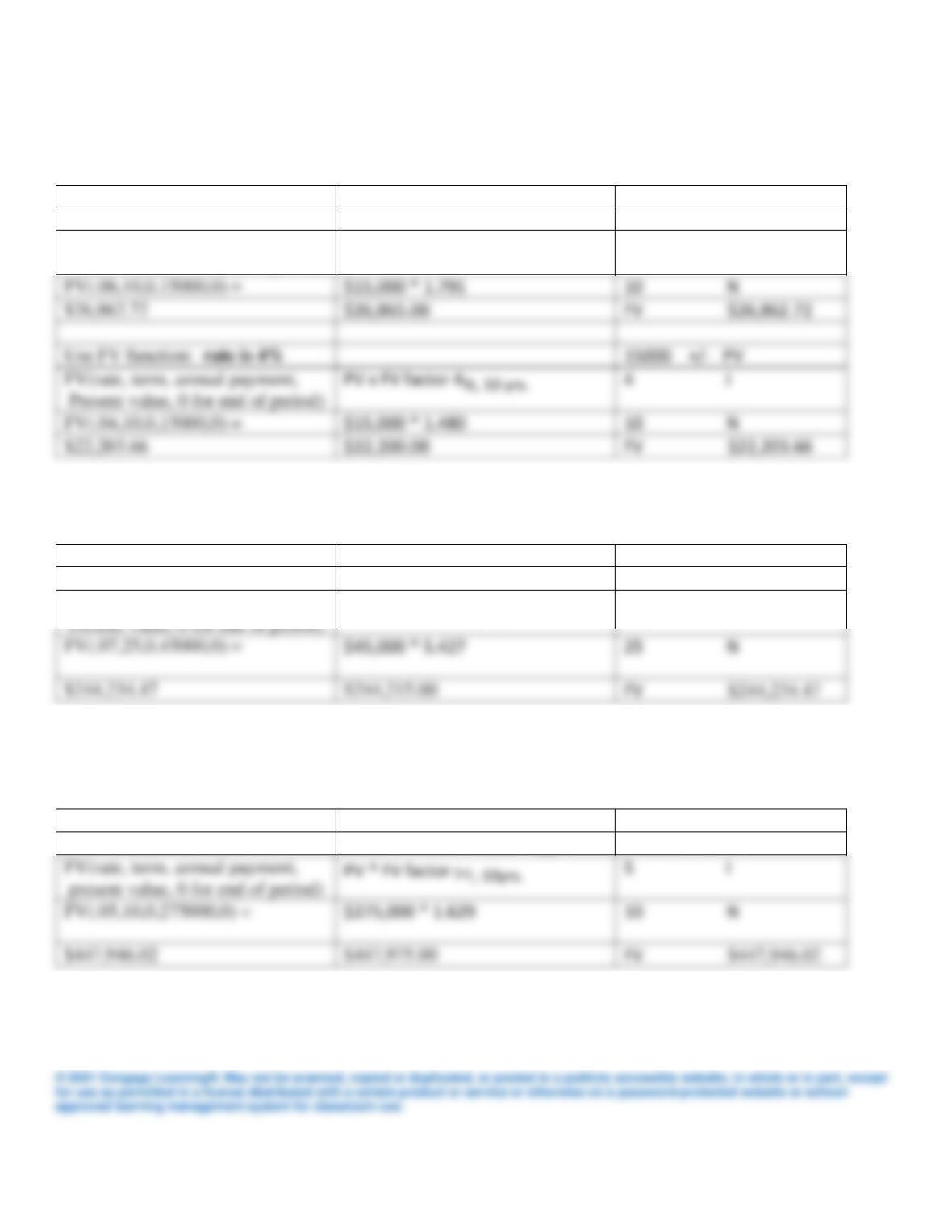
8. Calculating present and future values: Use future or present value techniques to solve the following
problems.
a. Starting with $15,000, how much will you have in 10 years if you can earn 6 percent on your
money? If you can earn only 4 percent?
EXCEL
TABLE
CALCULATOR
Use FV function: rate is 6%
Table of Future Values, App A
15000 +/- PV
FV(rate, term, annual payment,
Present value, 0 for end of period)
PV * FV factor 6%, 10 yrs.
6 I
FV(.06,10,0,15000,0) =
$26,862.72
Use FV function: rate is 4%
FV(.04,10,0,15000,0) =
$22,203.66
b. If you inherited $45,000 today and invested all of it in a security that paid a 7 percent rate of
return, how much would you have in 25 years?
EXCEL
TABLE
CALCULATOR
Use FV function: rate is 7%
Table of Future Values, App A
45000 +/- PV
FV(rate, term, annual payment,
Present value, 0 for end of period)
FV(.07,25,0,45000,0) =
25 N
$244,234.47
$244,215.00
PV * FV factor 7%, 25yrs.
7 I
c. If the average new home costs $275,000 today, how much will it cost in 10 years if the price
increases by 5 percent each year?
EXCEL
TABLE
CALCULATOR
Use FV function: rate is 5%
Table of Future Values, App A
275000 +/- PV
FV(rate, term, annual payment,
present value, 0 for end of period)
5 I
FV(.05,10,0,275000,0) =
10 N
$447,946.02
$447,975.00
d. You think that in 15 years, it will cost $212,000 to provide your child with a 4-year college
education. Will you have enough if you take $70,000 today and invest it for the next 15 years at 5
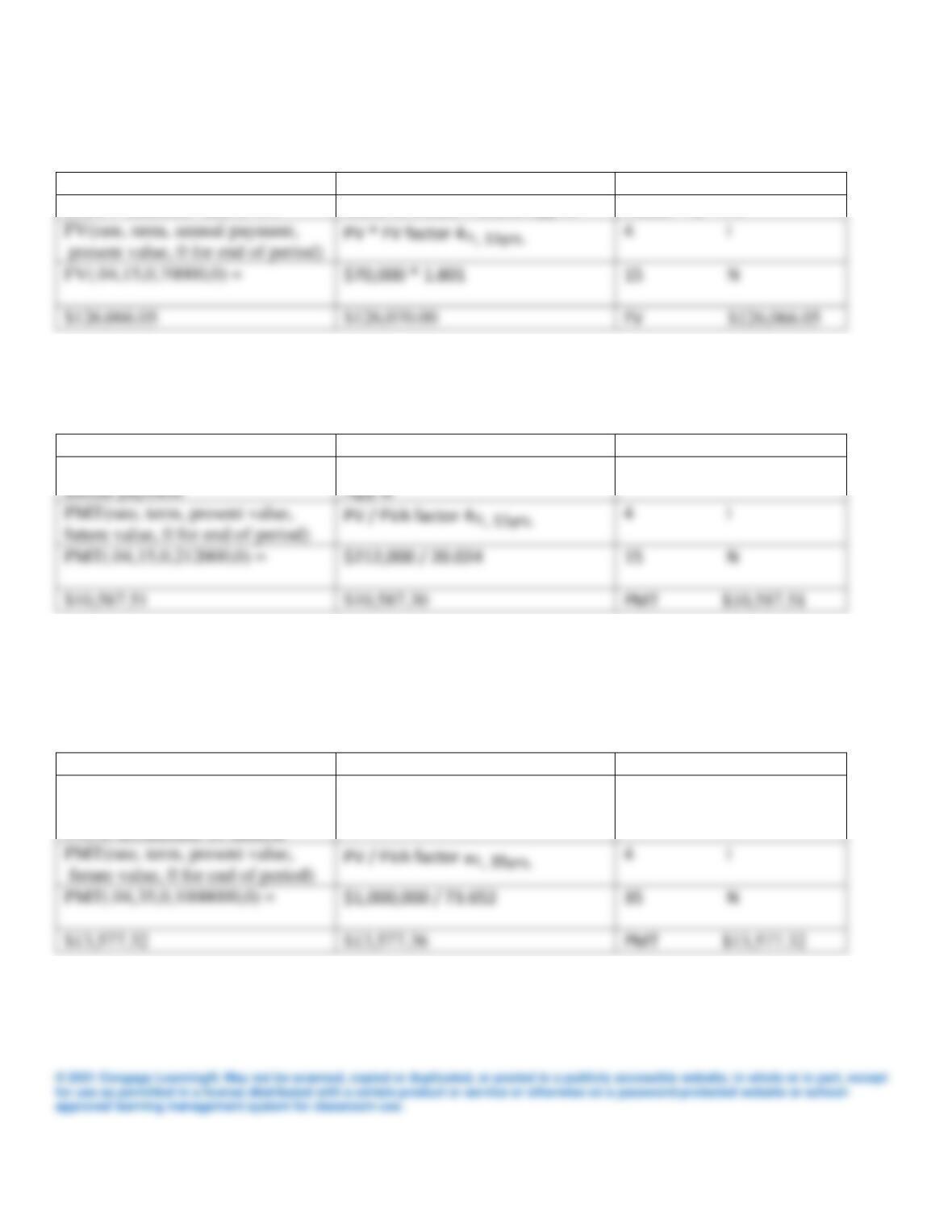
percent? If you start from scratch, how much will you have to save each year to have $212,000 if
you can earn 4 percent rate of return on your investments?
No, you will have $126.066, which is less than your $212,000 goal.
EXCEL
TABLE
CALCULATOR
Use FV function: rate is 4%
Table of Future Values, App A
FV(.04,15,0,70000,0) =
$126,066.05
$126,070.00
You will need to deposit $10,587.51 at the end of each year for 15 years in order to reach the $212,000
goal. I am assuming a 4% rate of return on investments.
EXCEL
TABLE
CALCULATOR
Use PMT function to determine
PMT(rate, term, present value,
$10,587.51
$10,587.30
Table of Future Values Annuity,
212000 +/- FV
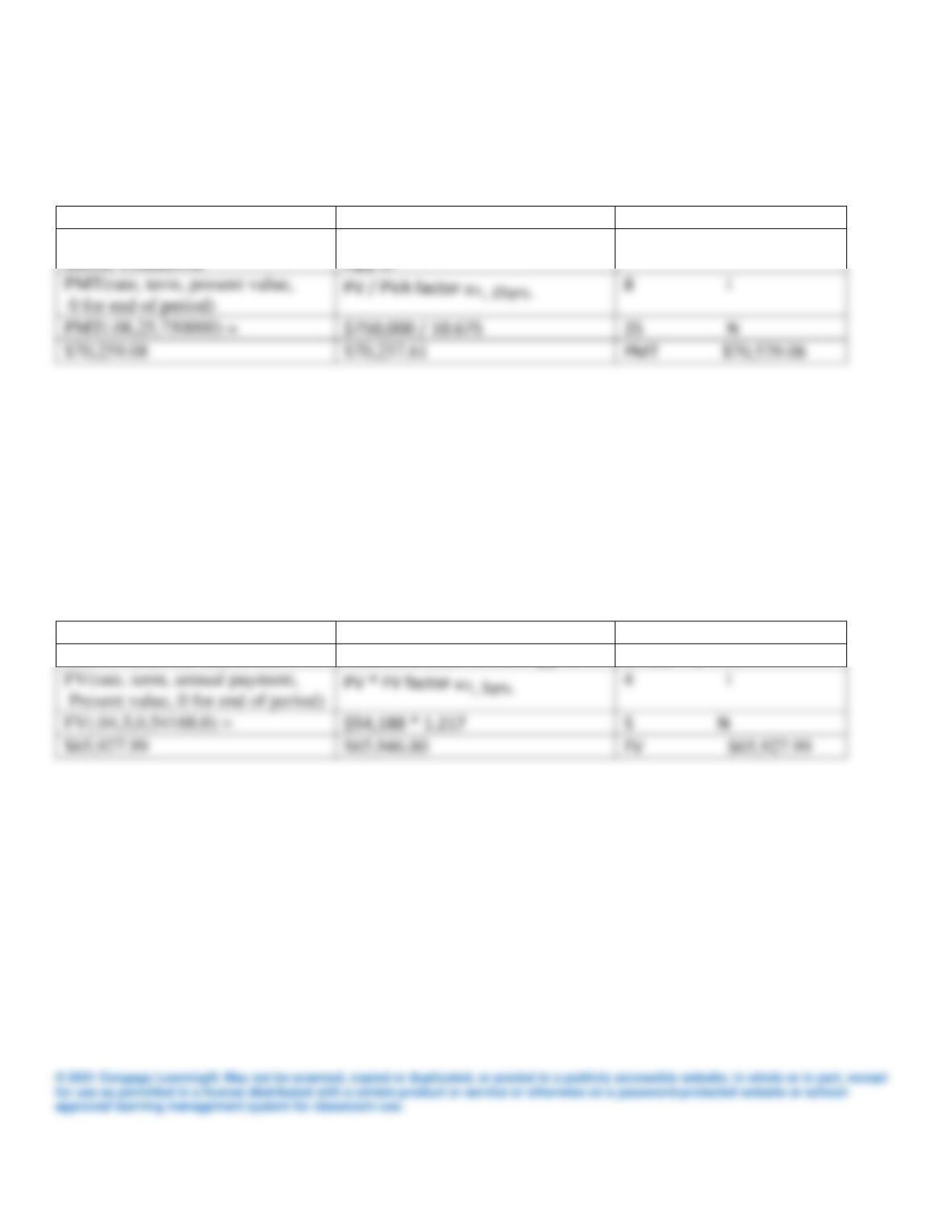
e. If you can earn 4 percent, how much will you have to save each year if you want to retire in 35
years with $1 million?
You will need to invest $13,577.32 at the end of each year at a rate of 4% for the next 35 years in order
to retire with $1 million.
EXCEL
TABLE
CALCULATOR
Use PMT function to determine
annual saving amount with rate of
PMT(rate, term, present value,
$13,577.32
$13,577.36
Table of Future Values Annuity,
App B
1000000 +/- FV
f. You plan to have $750,000 in savings and investments when you retire at age 60. Assuming that
you earn an average of 8 percent on this portfolio, what is the maximum annual withdrawal you
can make over a 25-year period of retirement?
You will be able to withdraw $70,259.08 at the end of each year for 25 years if you retire with $750,000
invested at 8%. If you live beyond 85, you have a problem.
EXCEL
TABLE
CALCULATOR
Use PMT function to determine
PMT(rate, term, present value,
$70,259.08
$70,257.61
Table of Present Values Annuity,
750000 +/– PV
9. Evaluating a Saving Goal: Over the past several years, Natalie Howard has been able to save
regularly. As a result, she has $54,188 in savings and investments today. She wants to establish her own
business in 5 years and feels she will need $100,000 to do so.
a. If she can earn 4 percent on her money, how much will her $54,188 in savings/investments
be worth in five years? Will Natalie have the $100,000 she needs? If not, how much more money
will she need?
If Natalie can earn 4% on her money, $54,188 will be worth about $65,928 in 5 years:
EXCEL
TABLE
CALCULATOR
Use FV function: rate is 4%
Table of Future Values, App A
54188 +/– PV
FV(rate, term, annual payment,
FV(.04,5,0,54188,0) =
$65,927.99
$65,946.80
No, she will fall short by about $34,072.
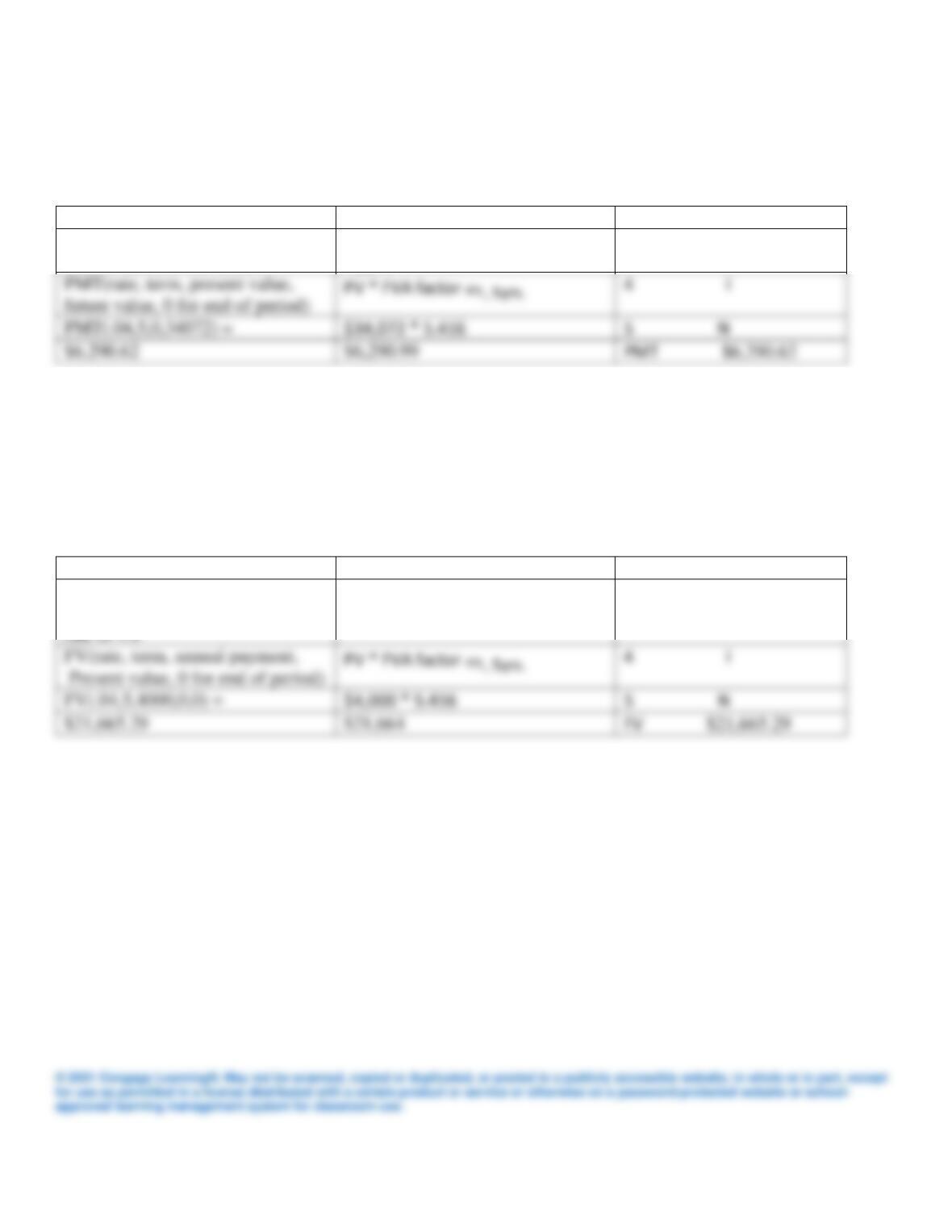
b. Given your answer to part a, how much will Natalie have to save each year over the next five years
to accumulate the additional money? Assume that she can earn interest at a rate of 4 percent.
Assuming Natalie adds a payment to her savings at the end of each year for the next five years so that
the fifth payment comes at the end of the time period, she would have to save $6,290.32 per year. This
calculation is as follows:
EXCEL
TABLE
CALCULATOR
Use PMT function to determine
annual addition she needs
Table of Future Values Annuity,
App B
34072 +/– FV
PMT(rate, term, present value,
future value, 0 for end of period)
c. If Natalie can afford to save only $4,000 a year, then given your answer to part a, will she have the
$100,000 she needs to start her own business in five years?
If Natalie saves only $4,000 per year, she would have an additional $21,665 for a total of $87,593
($65,928 + $21,665) and will fall $12,407 short of her $100,000 goal.
EXCEL
TABLE
CALCULATOR
Use FV function to determine FV
an annuity of $4,000 per year with
rate of 4%
FV(rate, term, annual payment,
Present value, 0 for end of period)
Table of Future Values Annuity,
App B
4000 +/- PMT
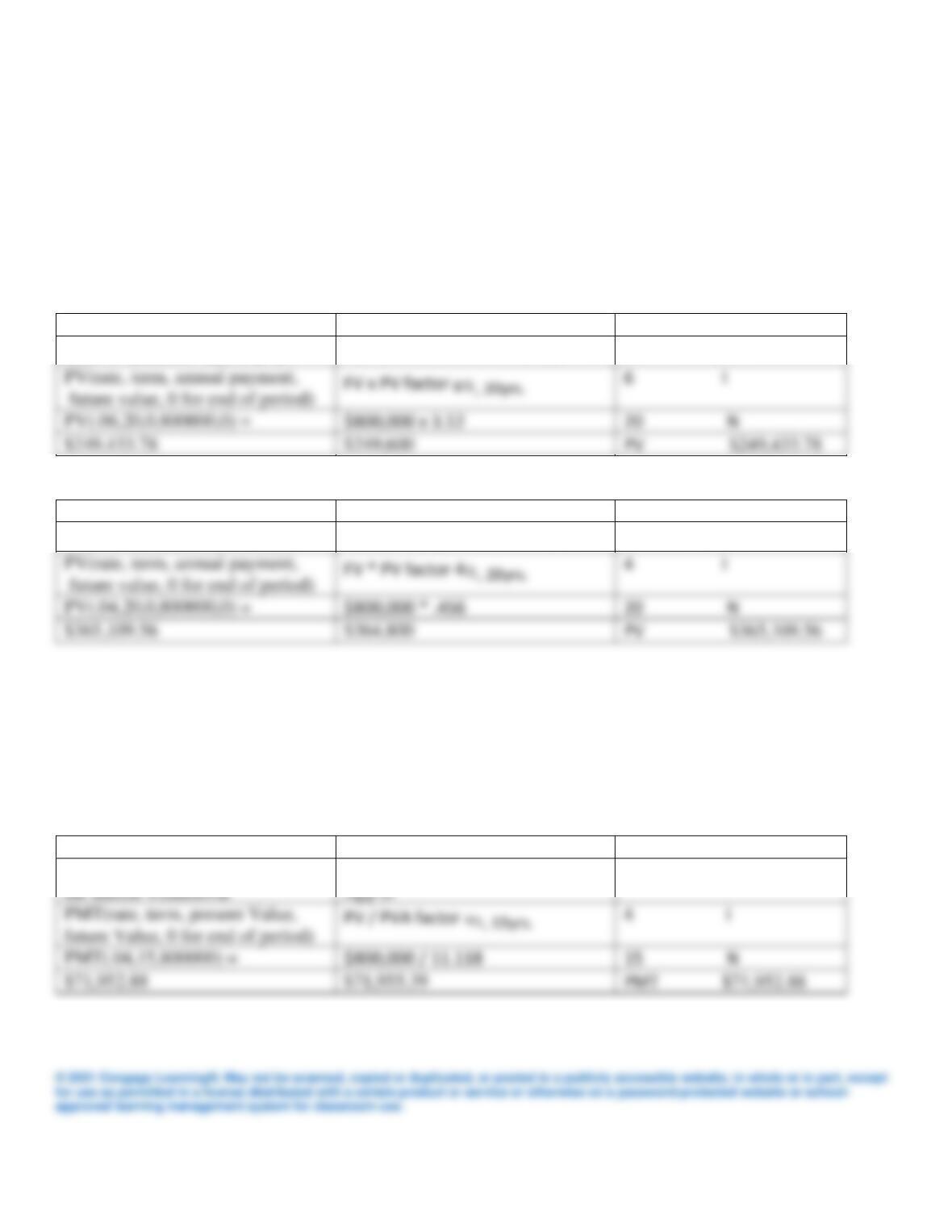
10. Funding a Retirement Goal: Connor Ward wishes to have $800,000 in a retirement fund 20 years
from now. He can create the retirement fund by making a single lump-sum deposit today.
a. If he can earn 6 percent on his investments, how much must Connor deposit today to create the
retirement fund? If he can earn only 4 percent on his investments? Compare and discuss the
results of your calculations.
If Connor can earn 6%, he will have to invest $249,433.78 now to have $800,000 in 20 years. If he can
only earn 4%, he will have to invest $365,109.56 now to have $800,000 in 20 years. The extra 2% rate
makes a $115,675.78 difference in the amount he has to invest.
EXCEL
TABLE
CALCULATOR
Use PV function: rate is 6%
Table of Present Values, App C
800000 +/- FV
EXCEL
TABLE
CALCULATOR
Use PV function: rate is 4%
Table of Present Values, App C
800000 +/- FV
PV(rate, term, annual payment,
b. If, upon retirement in 20 years, Connor plans to invest the $800,000 in a fund that earns 4 percent,
what is the maximum annual withdrawal he can make over the following 15 years?
Connor can withdraw $71,952.88 at the end of every year for 15 years.
EXCEL
TABLE
CALCULATOR
Use PMT function to determine
Table of Present Values Annuity,
800000 +/– PV