Chapter 2
Financial Statements, Cash Flows, and Taxes
ANSWERS TO END-OF-CHAPTER QUESTIONS
2-1 a. The annual report is a report issued annually by a corporation to its stockholders. It
contains basic financial statements, as well as management’s opinion of the past year’s
operations and the firm’s future prospects. A firm’s balance sheet is a statement of the
firm’s financial position at a specific point in time. It specifically lists the firm’s assets
on the left-hand side of the balance sheet, while the right-hand side shows its liabilities
c. The statement of stockholders’ equity shows how much of the firm’s earnings were
retained in the business rather than paid out in dividends. It also shows the resulting
balance of the retained earnings account and the stockholders’ equity account. Note
that retained earnings represents a claim against assets, not assets per se. Firms retain
earnings primarily to expand the business, not to accumulate cash in a bank account.
Answers and Solutions: 2 – 2
e. Operating current assets are the current assets used to support operations, such as cash,
accounts receivable, and inventory. It does not include short-term investments.
Operating current liabilities are the current liabilities that are a natural consequence of
the firm’s operations, such as accounts payable and accruals. It does not include notes
payable or any other short-term debt that charges interest. Net operating working
capital is operating current assets minus operating current liabilities. Total net
operating capital is sum of net operating working capital and operating long-term
capital. It shows the rate of return that is generated by assets.
g. Market value added is the difference between the market value of the firm (i.e., the sum
of the market value of common equity, the market value of debt, and the market value
of preferred stock) and the book value of the firm’s common equity, debt, and preferred
stock. If the book values of debt and preferred stock are equal to their market values,
its purchase price. Ordinary corporate operating losses can be carried backward for 2
years forward for indefinitely and used to offset future taxable income.
j. Improper accumulation is the retention of earnings by a business for the purpose of
enabling stockholders to avoid personal income taxes on dividends. An S corporation
2-2 The four financial statements contained in most annual reports are the balance sheet,
income statement, statement of stockholders’ equity, and statement of cash flows.
2-3 No, because the $20 million of retained earnings doesn’t mean the company has $20
million in cash. The retained earnings figure represents cumulative amount of net income
2-5 Operating capital is the amount of interest bearing debt, preferred stock, and common
equity used to acquire the company’s net operating assets. Without this capital a firm
cannot exist, as there is no source of funds with which to finance operations.
2-6 NOPAT is the amount of net income a company would generate if it had no debt and held
no financial assets. NOPAT is a better measure of the performance of a company’s
2-7 Free cash flow is the cash flow actually available for distribution to investors after the
2-8 If the business were organized as a partnership or a proprietorship, its income could be
passed to the owners without being subject to taxation at the business level. Also, if you
expected to have losses for a few years while the company was getting started, if you were
Answers and Solutions: 2 – 4
SOLUTIONS TO END–OF-CHAPTER PROBLEMS
2-2 Corporate bond yields 8%. Municipal bond yields 6%.
Yield on muni
Equivalent pretax yield
on taxable bond (1 T)
=
−
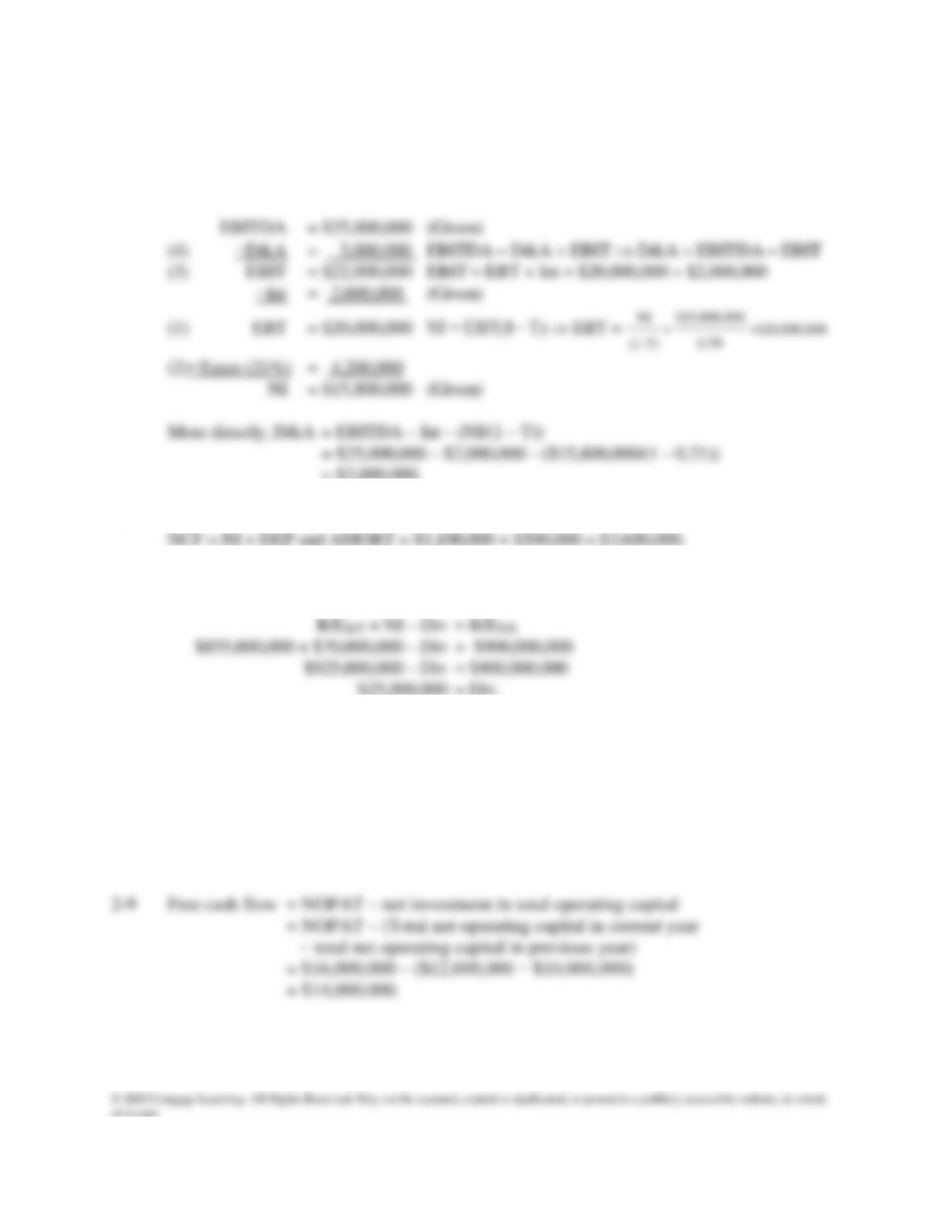
2-3 NI = $7,900,000; EBIT = $13,000,000; T = 21%; Interest = ?
Set up an income statement, plug in the given values, and work in the order of the steps
shown below. (As with most problems, there are alternative ways of solving the problem.
Answers and Solutions: 2 – 5
2-4 EBITDA = $25,000,000; NI = $15,800,000; Int = $2,000,000; T = 21%; D&A = ?
Set up an income statement, plug in the given values, and work in the order of the steps
shown below. (As with most problems, there are alternative ways of solving the problem.
= $3,000,000.
2-5 NI = $3,100,000; DEP = $500,000; AMORT = 0; NCF = ?
2-6 NI = $70,000,000; R/EY/E = $900,000,000; R/EB/Y = $855,000,000; Dividends = ?
2-7 NOPAT = EBIT(1 – T) = $4,000,000(1 – 0.25) =$3,000,000.
2-8 Total net operating capital = Net fixed assets + net operating working capital
= Net fixed assets + (Operating CA – Operating CL)
= $15,000,000 + ($10,000,000 – $3,000,000)
= $22,000,000.
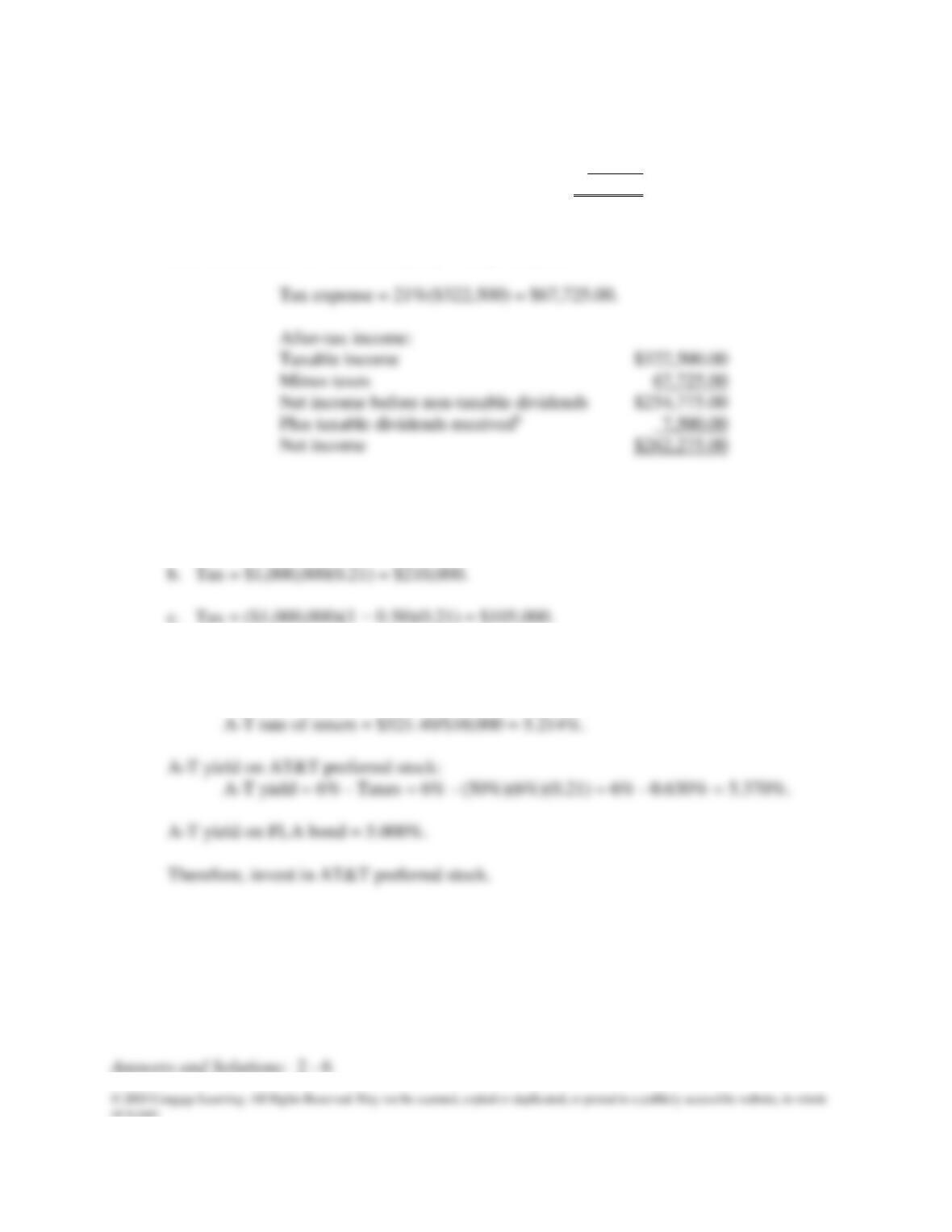
2-10 Pre-tax operating earnings $365,000
Less Interest deduction 50,000
Plus: Taxable dividends receiveda 7,500
Taxable income $322,500
aFor a corporation, 50% of dividends received are excluded from taxes; therefore, taxable
dividends are calculated as $15,000(1 – 0.5) = $7,500.
bNon-taxable dividends are calculated as $15,000 − $7,500 = $7,500.
2-11 a. Tax = $50,000,000)(0.21) = $10,500,000.
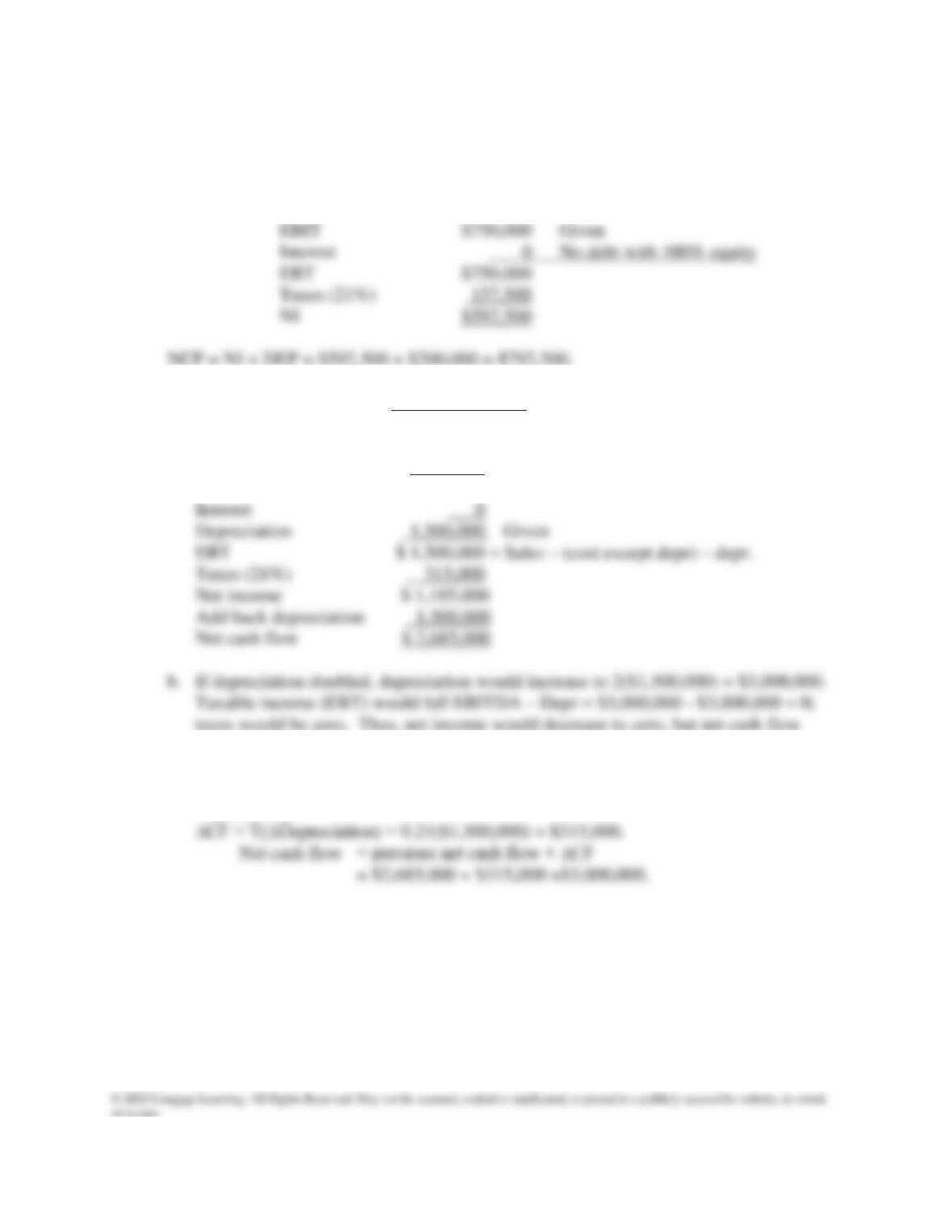
2-12 A-T yield on AT&T bond = 6.6% – Taxes = 6.6% – 6.6%(0.21) = 5.214%.
Check: Invest $10,000 @ 6.6% = $660 interest.
Pay 21% tax, so A-T income = $660(1 – T) = $660(0.79) = $521.4.
Answers and Solutions: 2 – 7
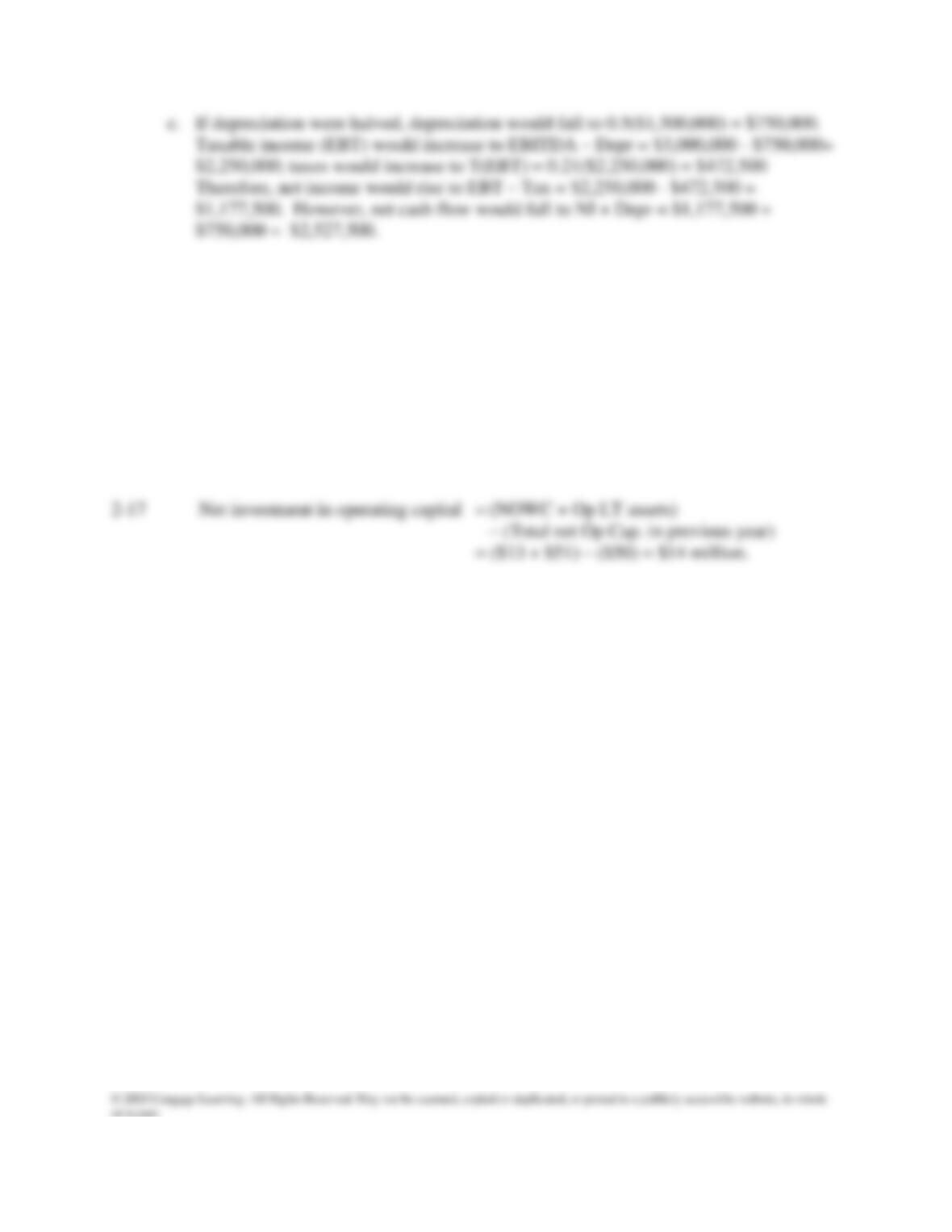
2-13 EBIT = $750,000; DEP = $200,000; 100% Equity; T = 21%
Set up an income statement, plug in the given values, and work in the order of the steps
shown below. (As with most problems, there are alternative ways of solving the problem.
2-14 a. Income Statement
Sales revenues $12,000,000 Given
Costs except
depreciation 9,000,000 = 75%($12,000,000)
EBITDA 3,000,000
would rise to NI + Depr = $0 + $3,000,000. The company would save $315,000 in
taxes, thus increasing its cash flow.
Alternatively:
Answers and Solutions: 2 – 8
d. You should prefer to have higher depreciation charges and higher cash flows. Net
cash flows are the funds that are available to the owners to withdraw from the firm
and, therefore, cash flows should be more important to them than net income.
2-15 NOPAT = EBIT(1 – T) = $80,000(1 – 0.25) =$60,000.
2-16 NOWC = Operating CA – Operating CL
= (Cash + AR + INV) – (AP + Accruals)
= ($90 + $1,200 + $900) – ($600 + $200)
= $1,390 million.
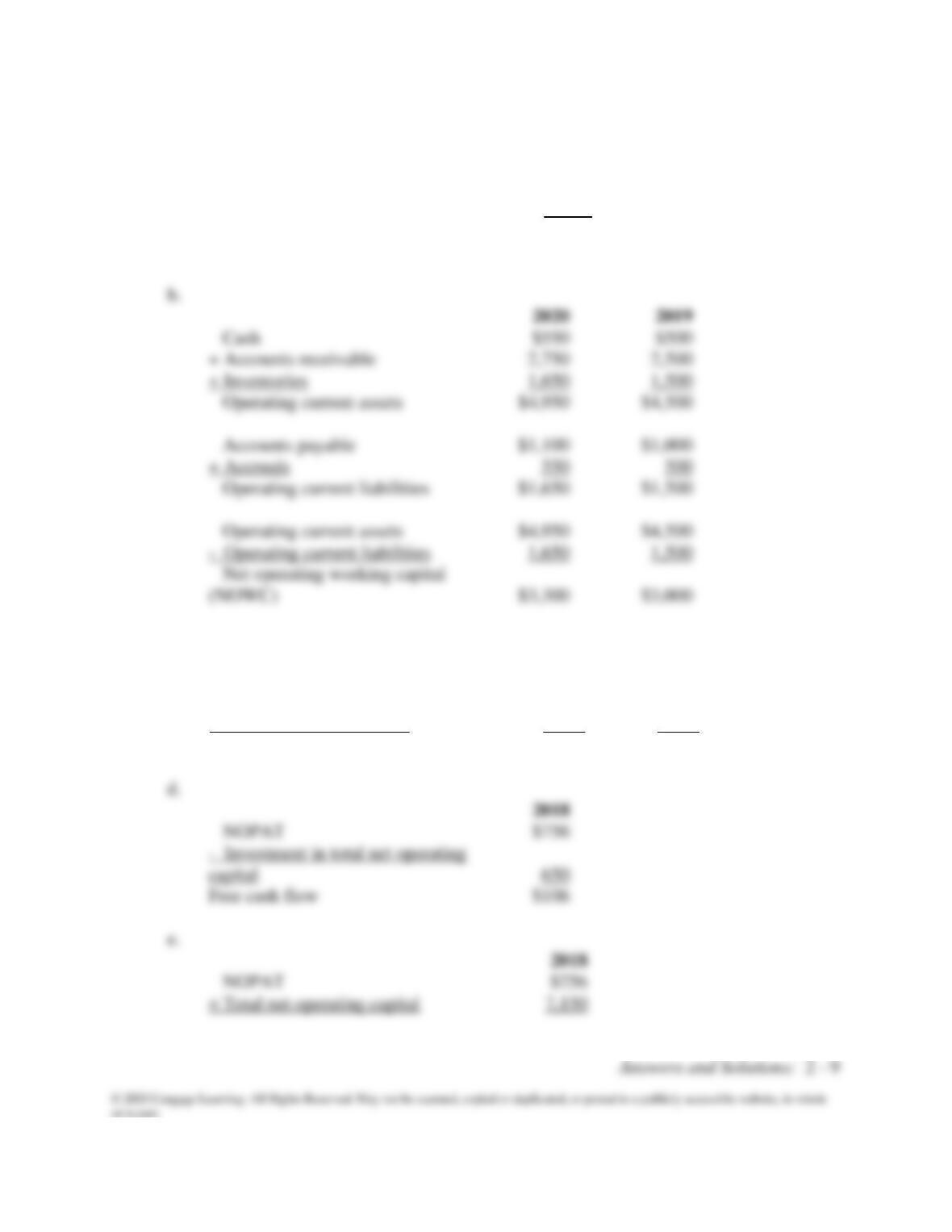
2-18 a.
2020
EBIT
$1,008
x (1-Tax rate)
75.0%
Net operating profit after taxes
(NOPAT)
$756
Cash
+ Accounts receivable
Operating current assets
$4,500
Accounts payable
$1,000
+ Accruals
Operating current liabilities
$1,500
Operating current assets
$4,500
– Operating current liabilities
Net operating working capital
(NOWC)
$3,000
c.
2018
2017
Net operating working capital
(NOWC)
$3,300
$3,000
+ Net plant and equipment
3,850
3,500
Total net operating capital
$7,150
$6,500
NOPAT
– Investment in total net operating
capital
650
Free cash flow
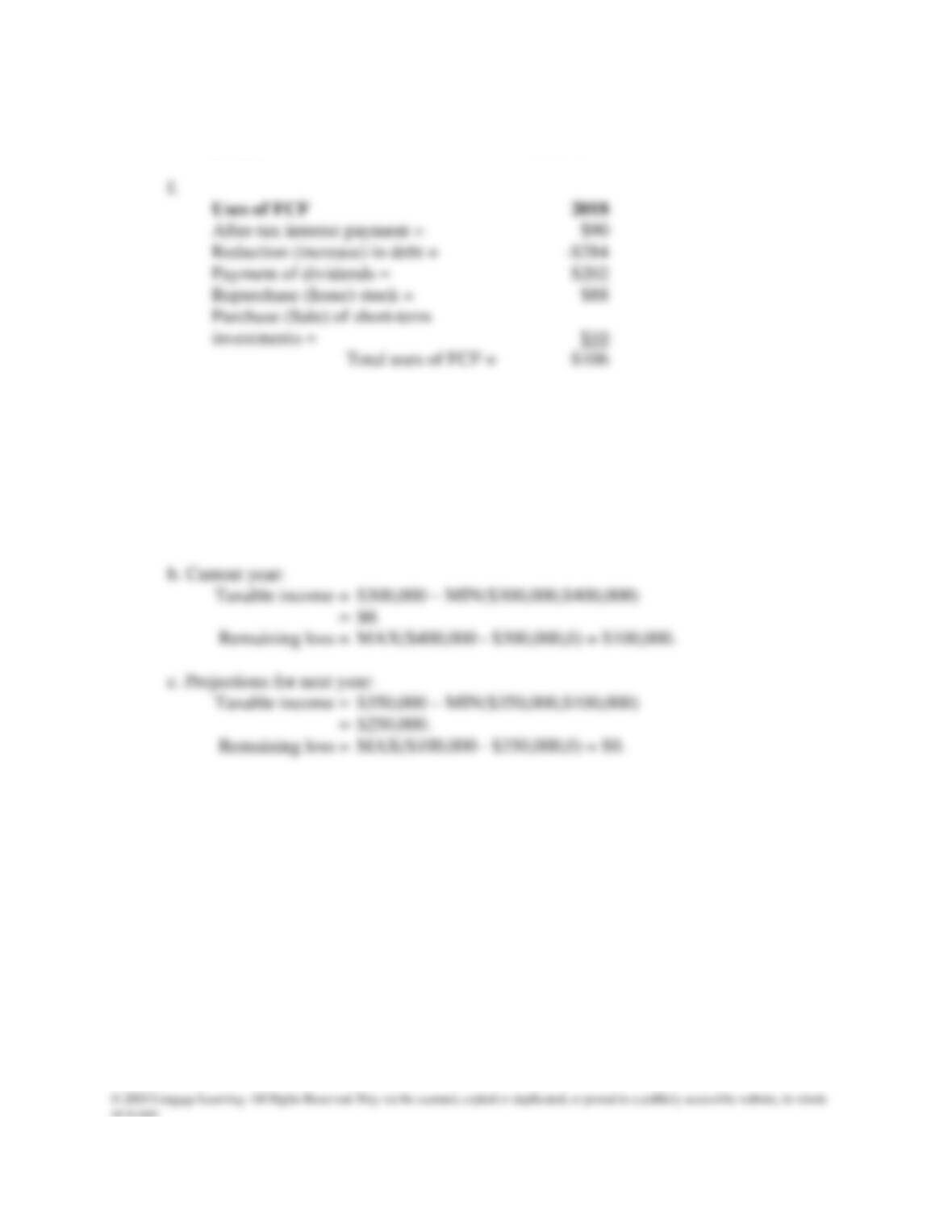
NOPAT
÷ Total net operating capital
Answers and Solutions: 2 – 10
Return on invested capital
(ROIC)
10.57%
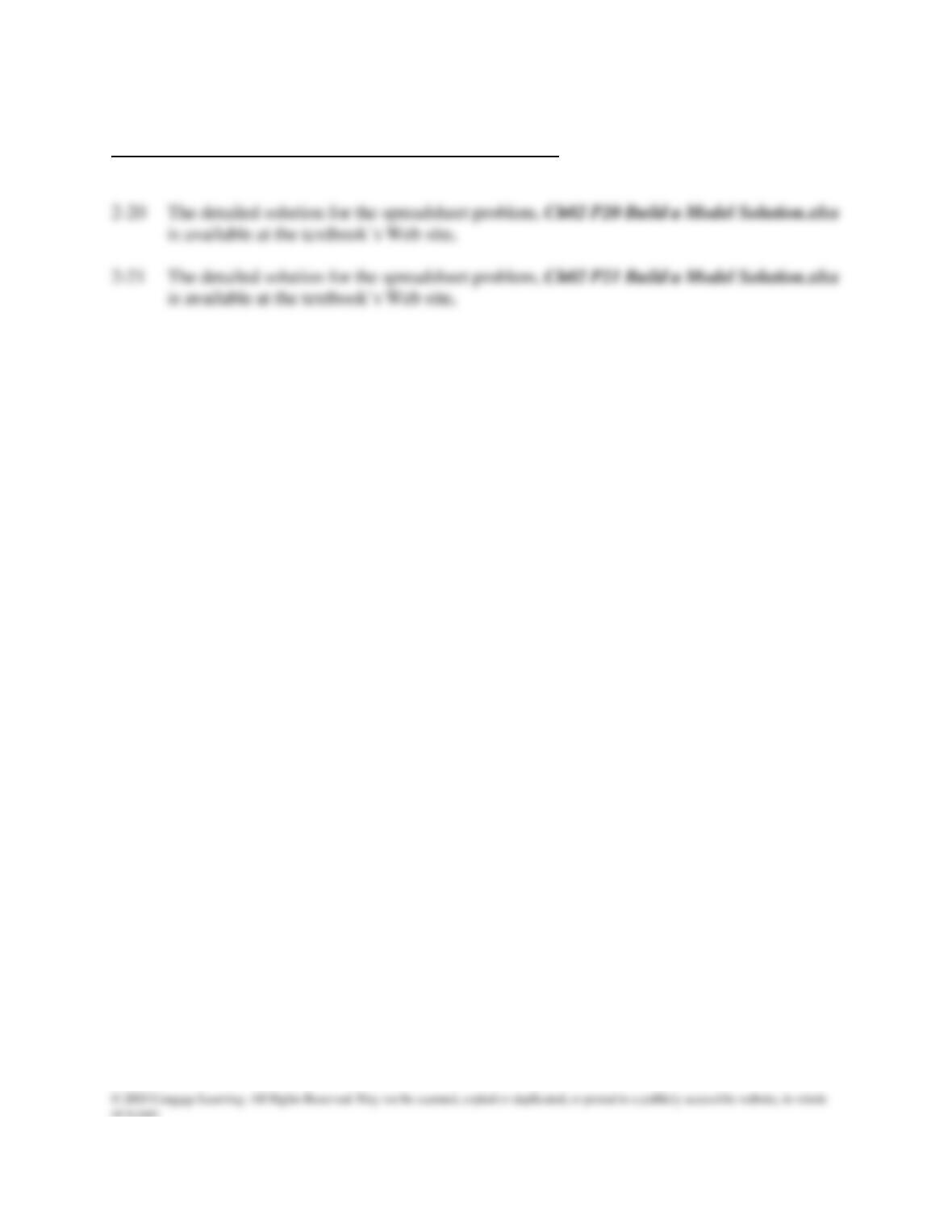
2-19 a. Last year:
Taxable income = Pre-tax earnings
– MIN(Pre-tax earnings, Remaining cumulative past losses)
= $100,000 – MIN($100,000,$500,000)
= $0.
Remaining loss = MAX(Beginning cumulative loss – Pre-tax earnings,0)
= MAX($500,000 – $100,000,0) = $400,000.
Answers and Solutions: 2 – 11
SOLUTION TO SPREADSHEET PROBLEM