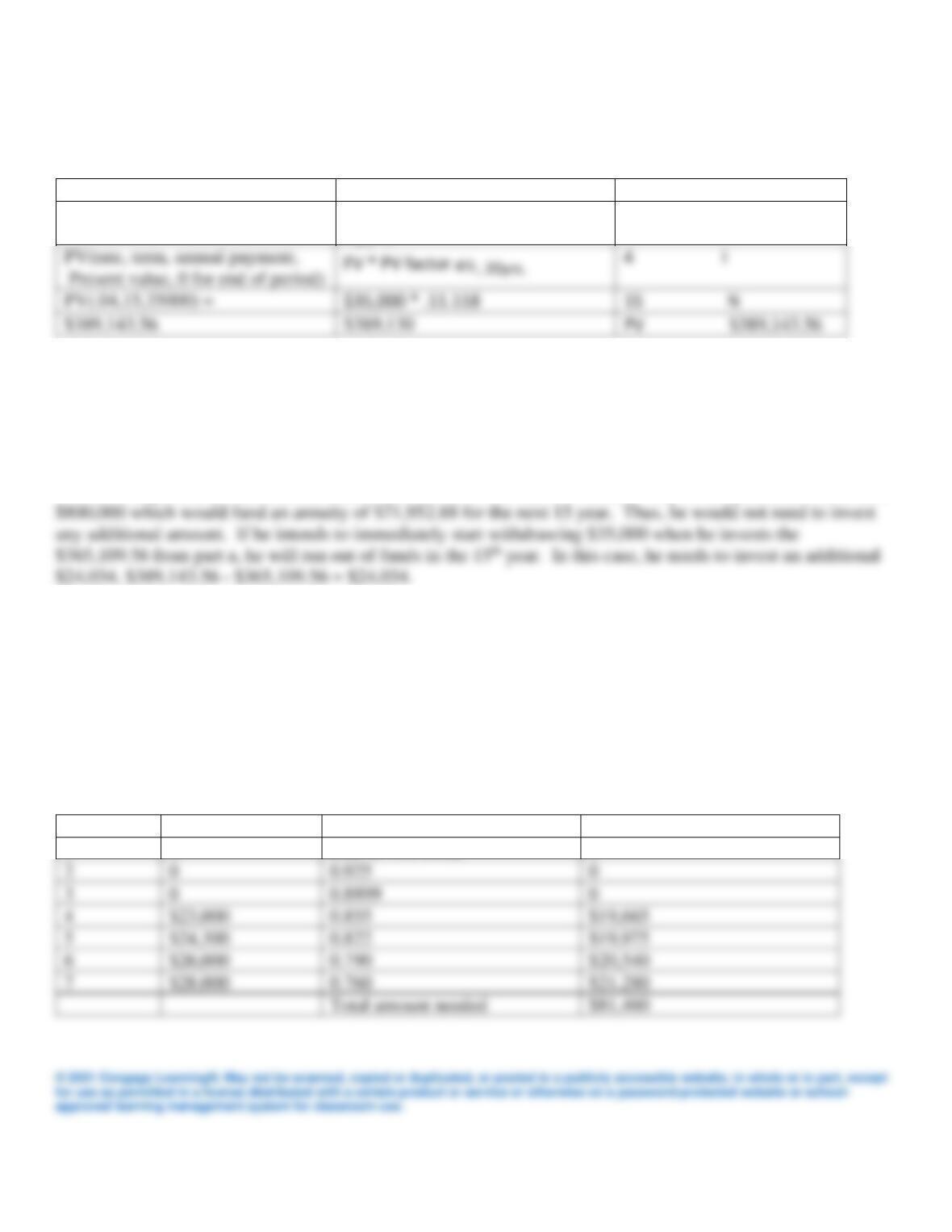
c. How much would Connor need to have on deposit at retirement to annually withdraw $35,000
over the 15 years if the retirement fund earns 4 percent?
The present value of $35,000 for 15 years at 4% is 389,143.56. That is the amount he must deposit in order to
withdraw $35,000 per year for 15 years.
EXCEL
TABLE
CALCULATOR
Use PV function: rate is 4%
Table of Present Values Annuity,
App D
35000 +/– PMT
PV(rate, term, annual payment,
Present value, 0 for end of period)
d. To achieve his annual withdrawal goal of $35,000 calculated in part c, how much more than the
amount calculated in part a must Connor deposit today in an investment earning
4 percent annual interest?
If Connor deposited $365,109.56 as determined in Part a. and did not withdraw any for 20 years, he would have
11. Funding a College Goal: Jeremiah Wood wants to set up a fund to pay for his daughter’s education.
In order to pay her expenses, he will need $23,000 in four years, $24,300 in five years, $26,000 in six
years, and $28,000 in seven years. If he can put money into a fund that pays 4 percent interest, what
lump-sum payment must Jeremiah place in the fund today to meet his college funding goals?
Jeremiah needs $81,459.60 today to fund college. See Computations below.
Year
Amount needed
Present Value factor, Table C
Present Value
1
0
Rate is 4%, 0.962
0
2
0
0.925
0
3
0
0.8899
0
4
$23,000
0.855
$19,665
5
$24,300
0.822
$19,975
6
$26,000
0.790
$20,540
7
$28,000
0.760
$21,280
Total amount needed
$81,460
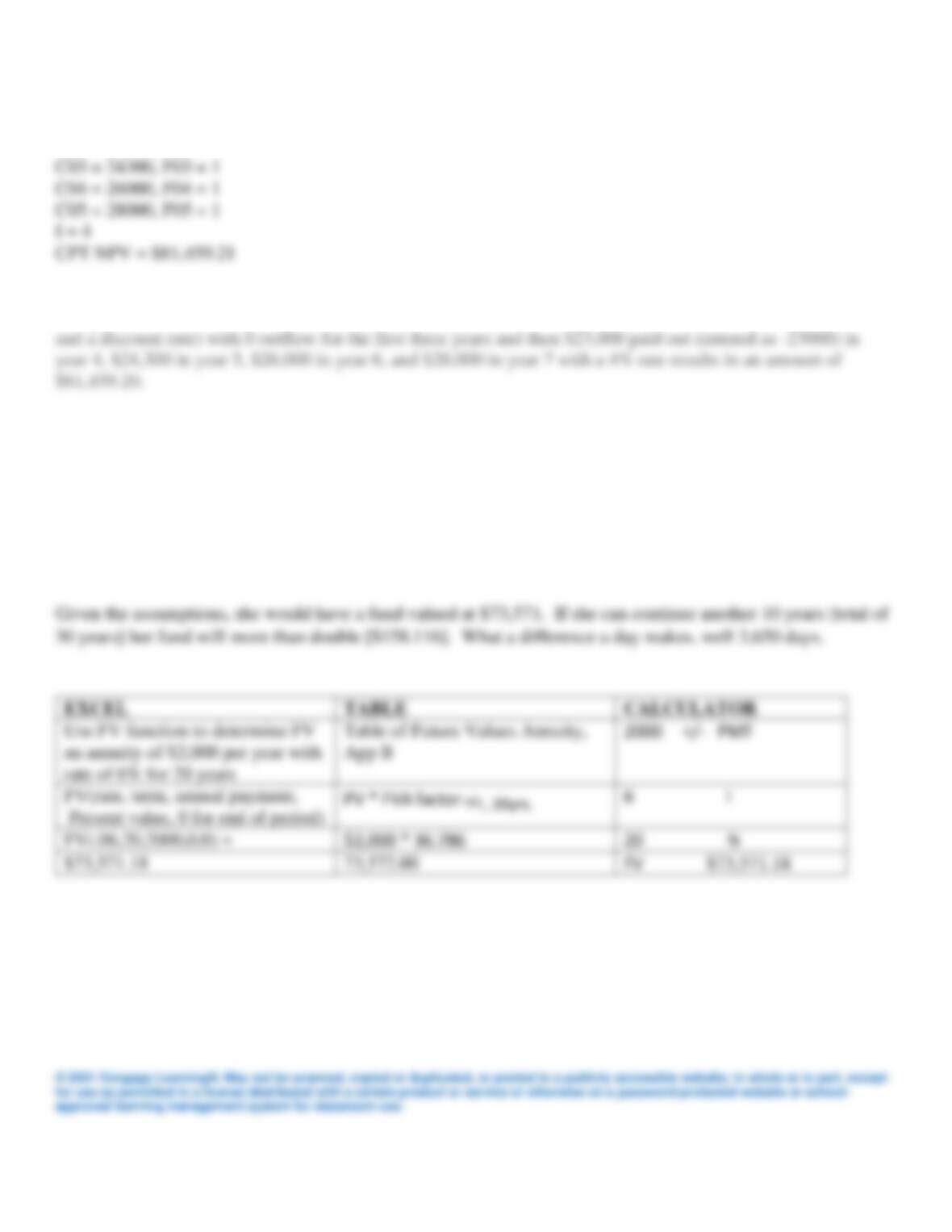
Using a financial calculator, specifically a TI BAII+
CFO = 0
C01 = 0, F01 = 3
C02 = 23000, F02 = 1
With Excel:
Using the NPV function (Returns the net present value of an investment based on a series of periodic cash flows
12. Calculating Expected Future Value of Investments: Lucy Price has always been interested in stocks.
She has decided to invest $2,000 once every year into an equity mutual fund that is expected to produce a
return of 6 percent a year for the foreseeable future. Lucy is really curious how much money she can
reasonably expect her investment to be worth in 20 years. What would you tell her?
It should be noted that you are calculating this amount using an expected rate of return. Should the return be
higher any given years, the value will be more. Should the return be lower any given years, the value will be
less.
13. Inflation and interest rates. Lillian Coleman is 21 years old and has just graduated from college. In
considering the retirement investing options available at her new job, she is thinking about the long-term
effects of inflation. Help her by answering the following related questions:
a. Explain the effect of long-term inflation on meeting retirement financial planning goals.
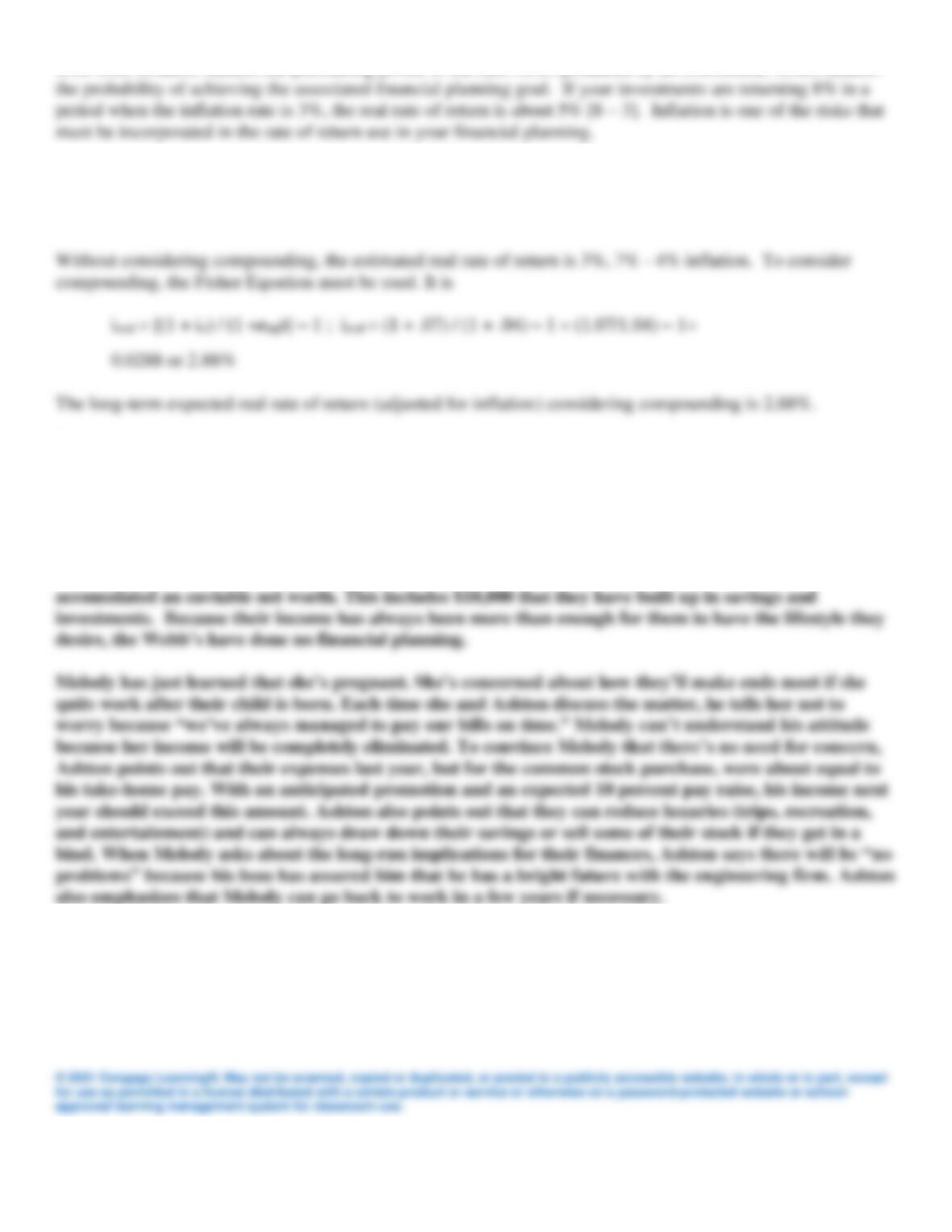
b. If long-term inflation is expected to average 4 percent per year and you expect a long-term
investment return of 7 percent per year, what is Lillian’s long-term expected real rate of return
(adjusted for inflation)? Be sure to consider the important impact of compounding.
Solutions to Critical Thinking Cases
2.1 The Webb’s Version of Financial Planning
Ashton and Melody Webb are a married couple in their mid-20s. Ashton has a good start as an electrical
engineer and Melody works as a sales representative. Since their marriage four years ago, Ashton and
Melody have been living comfortably. Their income has exceeded their expenses, and they have
Despite Ashton’s arguments, Melody feels that they should carefully examine their financial condition in
order to do some serious planning. She has gathered the following financial information for the year
ending December 31, 2020
Salaries Take-home Pay Gross Salary
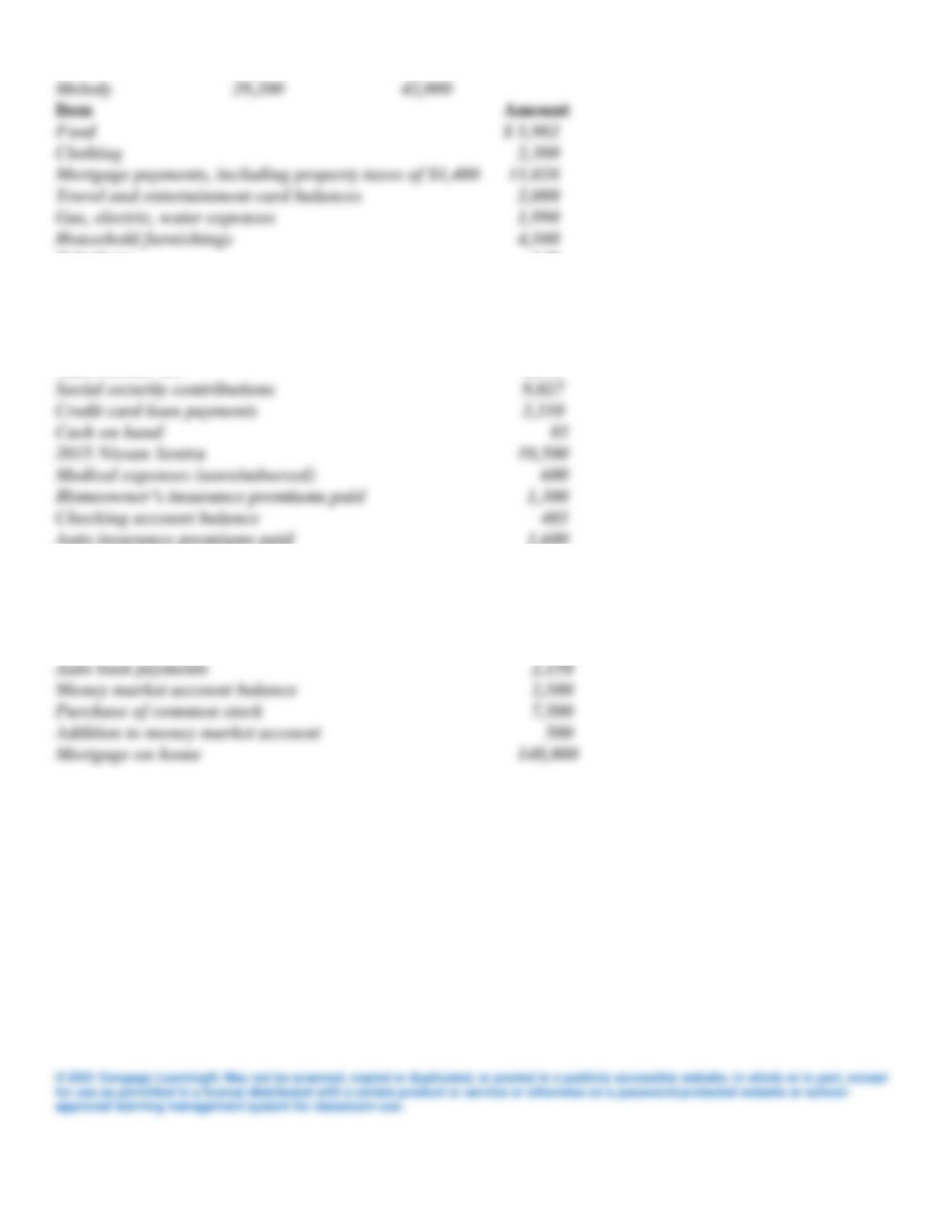
Ashton $52,500 $76,000
Telephone 640
Auto loan balance 4,650
Common stock investments 7,500
Bank credit card balances 675
Federal income taxes 22,472
Auto insurance premiums paid 1,600
Transportation 2,800
Cable television 680
Estimated value of home 185,000
Trip to Europe 5,000
Recreation and entertainment 4,000
Critical Thinking Questions
1. Using this information and Worksheets 2.1 and 2.2, construct the Webb’s balance sheet and
income and expense statement for the year ending December 31, 2020.
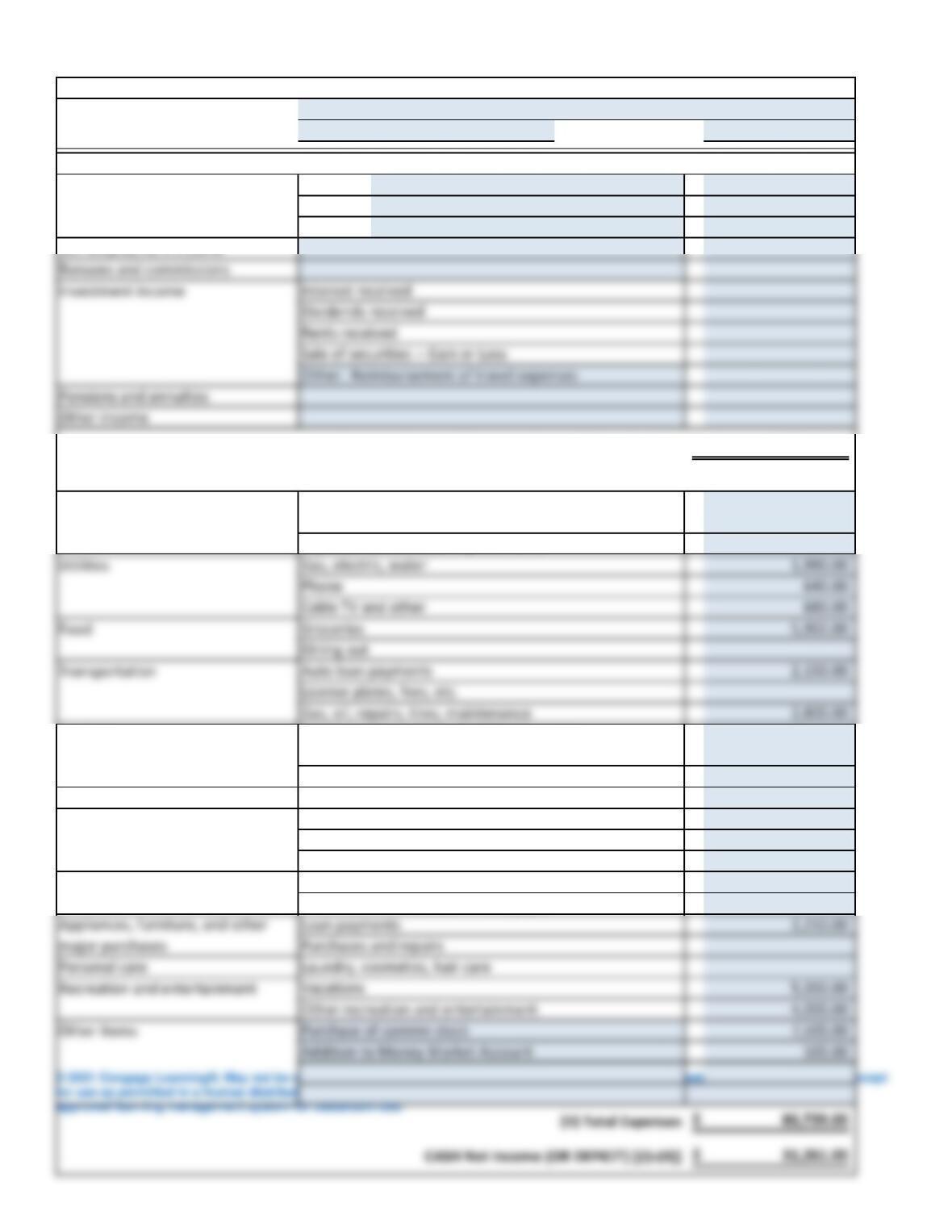
Critical thinking Prob 2-1 Worksheet 2.2 Income Statement
Name(s)
For the [month or year] Ended December 31, 2020
Income
Name: $ 76,000.00
Name: 42,000.00
Name:
Self-employment income
Bonuses and commissions
Pensions and annuities
Other income
Interest received
Dividends received
Rents received
Expenses
1,990.00
5,902.00
2,150.00
2,800.00
Gas, electric, water
Phone
Cable TV and other
Food
Groceries
Dining out
Auto loan payments
License plates, fees, etc.
Gas, oil, repairs, tires, maintenance
Clothing 2,300.00
1,300.00
1,600.00
36,539.00
INCOME AND EXPENSE STATEMENT
Ashton and Melody Webb
year
Wages and salaries
Ashton Webb
Melody Webb
(I) Total Income
Repairs, maintenance, improvements
Housing
Rent/mortgage payment
(include insurance and taxes, if applicable)
Medical
Health, major medical, disability insurance
(payroll deductions or not provided by employer)
600.00
Doctor, dentist, hospital, medicines
Clothes, shoes, and accessories
Insurance
Homeowner’s (if not covered by mortgage payment)
Life (not provided by employer) &/or Long-term Care
Auto
Taxes
Income and social security
Property (if not included in mortgage)
118,000.00$
$
11,028.00
Appliances, furniture, and other
major purchases
Loan payments
Purchases and repairs
Other recreation and entertainment
Addition to Money Market Account
Vacations
Jewelry and artwork Other long-term loans
Total Long-Term Liabilities
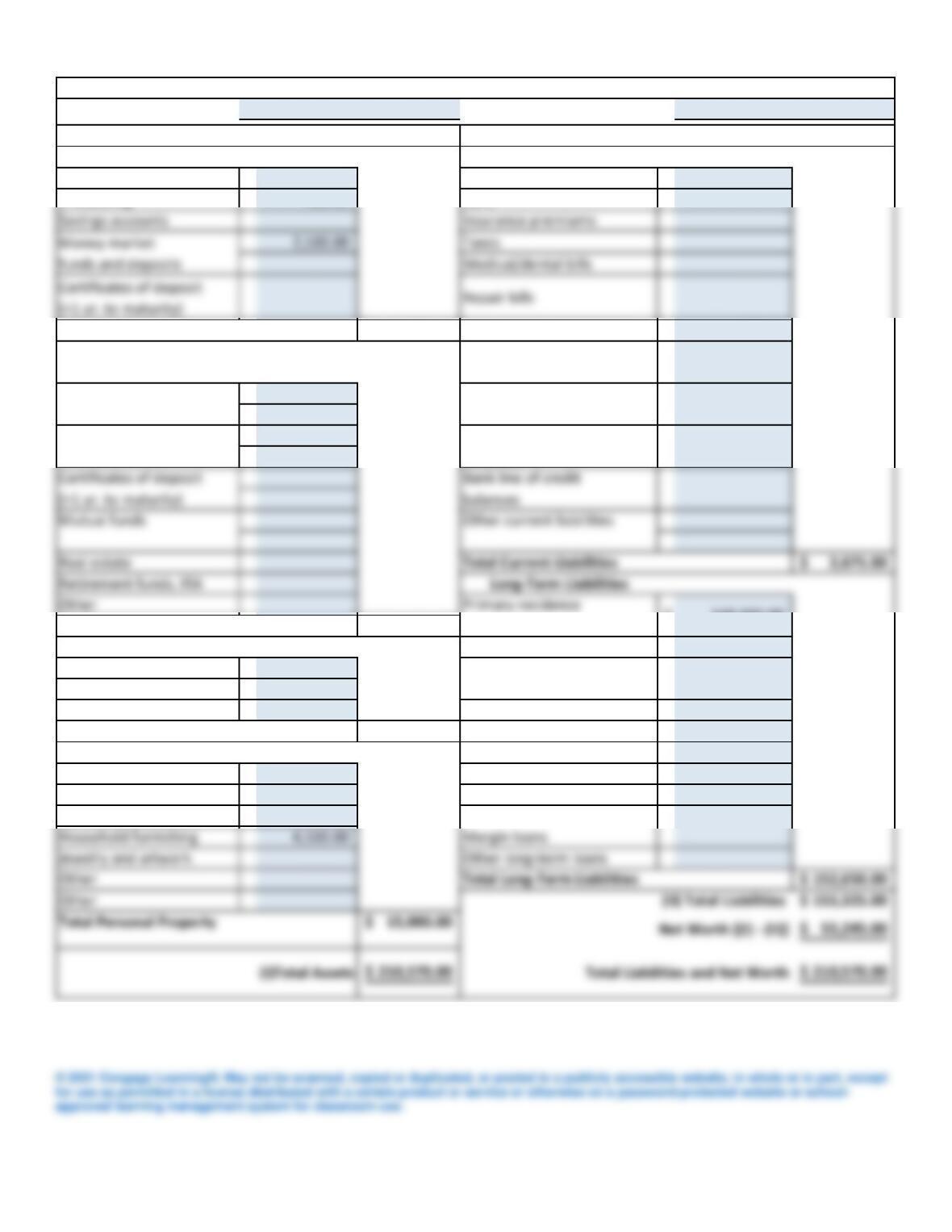
Critical Thinking 2-1 Part 1
Name(s) Date
Liquid Assets Current Liabilities
Cash on hand $ 85.00 Utilities $
In checking 485.00 Rent
Savings accounts Insurance premiums
Money market
funds and deposits
3,070.00$ Bank credit card balances 675.00
Investments
Dept. store credit card
balances
Stocks $ 7,500.00
Bonds
Mutual funds Other current liabilities
Total Current Liabilities
Primary residence
7,500.00$
Real Property Second home mortgage
Primary residence $ 185,000.00
Second home
Other Auto loans 4,650.00
185,000.00$ Appliance/furniture loans
Personal Property Home improvement loans
Auto(s): 2015 Nissan Sentra
$ 10,500.00 Single-payment loans
Auto(s): Education loans
Recreational vehicles
BALANCE SHEET
ASSETS
LIABILITIES
December 31, 2020
Ashton and Melody Webb
Total Liquid Assets
2,000.00
Gas and other credit card
balances
$
148,000.00
Real estate investment
mortgage
Travel and entertainment
card balances
mortgage
Total Investments
Total Real Property
2. Comment on the Webb’s financial condition regarding (a) solvency, (b) liquidity, (c) savings,
and (d) ability to pay debts promptly. If the Webbs continue to manage their finances as
described, what do you expect the long-run consequences to be? Discuss.
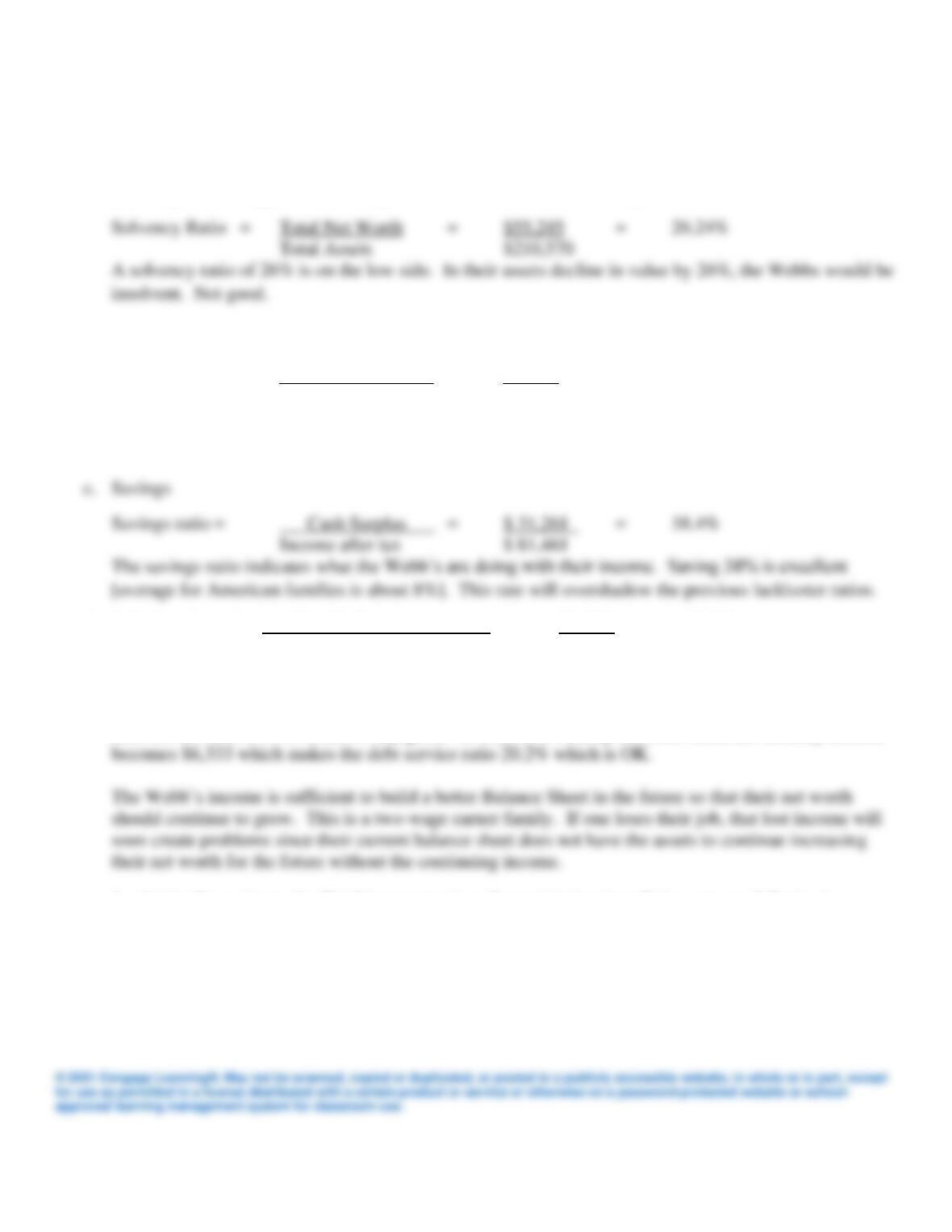
a. Solvency Ratio: This ratio shows the degree of exposure to insolvency or how much “cushion” you
have as protection against insolvency. The calculation for her solvency ratio is as follows:
b. Liquidity Ratio:
Liquidity ratio = Liquid Assets = $ 3,070 = 1.15
Total Current Debts $ 2,675
The liquidity ratio indicates the Webb’s ability to pay current debts. A ratio of greater than 1 is
acceptable, but higher would be better.
d. Debt Service ratio = Monthly loan payments = $1,282 = 13.0%
Monthly Gross Income $9,833
The annual loan payments are the home mortgage of $11,028, the auto loan payment of $2,150 plus the
unspecified loan payments of $2,210 for a total of $15,388 for the year or $1,282 for the month. The
debt service ratio is 13% which is very good. Of course, if Melody does not work, the monthly income
3. Critically evaluate the Webb’s approach to financial planning. Point out any fallacies in
Ashton’s observations, and be sure to mention (a) implications for the long term, as well as (b)
the potential impact of inflation in general and specifically on their net worth. What
procedures should they use to get their financial house in order? Be sure to discuss the role
that long- and short-term financial plans and budgets might play.
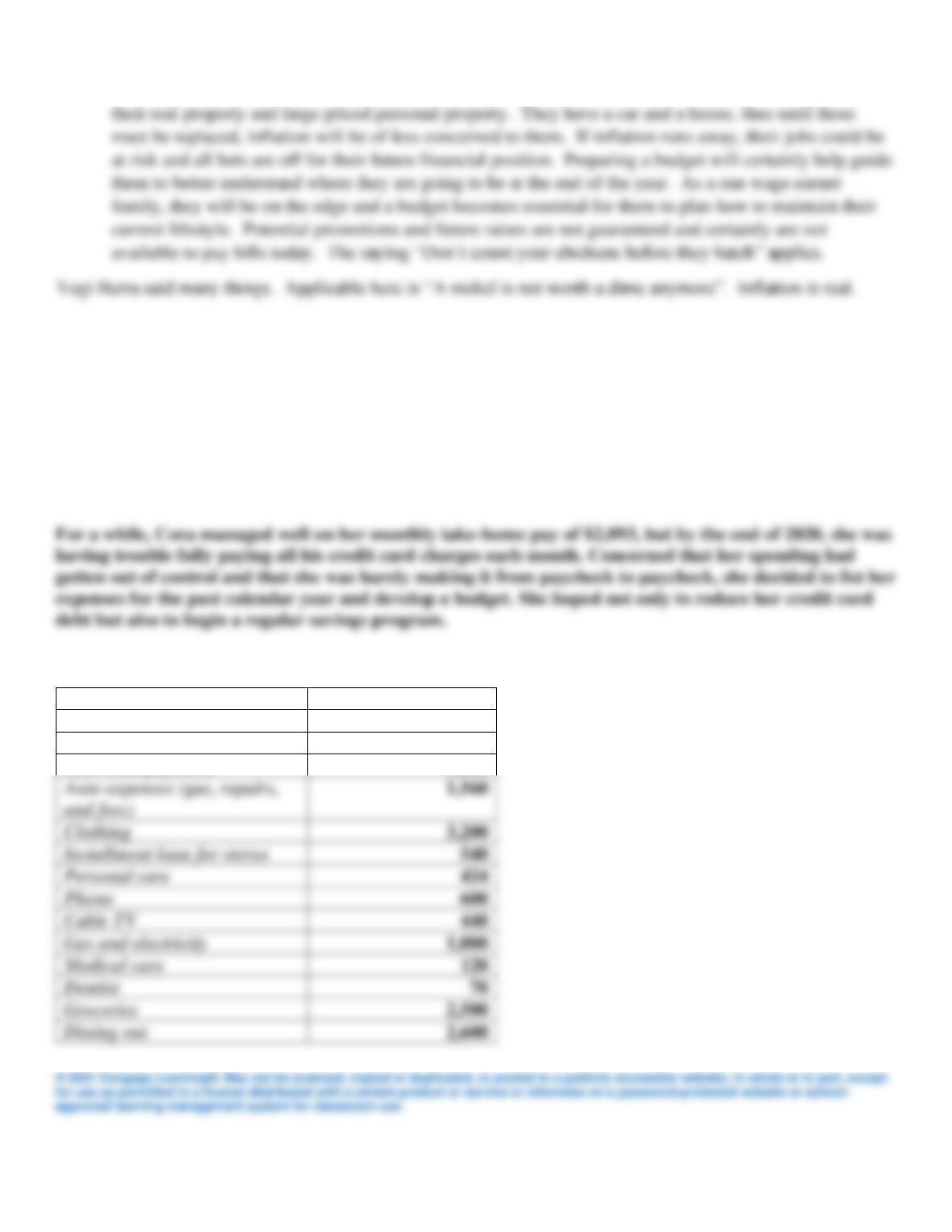
At this point, the key to their future is maintaining the two-income family. Long term if both incomes
continue, the Webbs will build their net worth. While inflation is a constant threat, the impact will be on
2.2 Cora Hamilton Learns to Budget
Cora Hamilton recently graduated from college and moved to Charlotte to take a job as a market
research analyst. She was pleased to be financially independent and was sure that, with her $45,000
salary, she could cover her living expenses and have plenty of money left over to furnish her studio
apartment and enjoy the wide variety of social and recreational activities available in Charlotte. She
opened several department-store charge accounts and obtained a bank credit card.
Cora prepared the following summary of expenses for 2020:
Item
Annual Expenditure
Rent
$12,000
Auto insurance
1,855
3,840
and fees)
3,200
Installment loan for stereo
Personal care
1,080
2,500
2,600
After reviewing her 2020 expenses, Cora made the following assumptions about her expenses for 2020:
1. All expenses will remain at the same levels, with these exceptions:
a. Auto insurance, auto expenses, gas and electricity, and groceries will increase 5 percent.
2. All expenses will be budgeted in equal monthly installments except for the vacation and these items:
a. Auto insurance is paid in two installments due in June and December.
3. She will eliminate her bank credit card balance by making extra monthly payments of $75 during each
of the first six months.
4. Regarding her income, Cora has just received a small raise, so her take-home pay will be $3,200 per
month.
Critical Thinking Question
1. a. Prepare a preliminary cash budget for Cora for the year ending December 31, 2020,
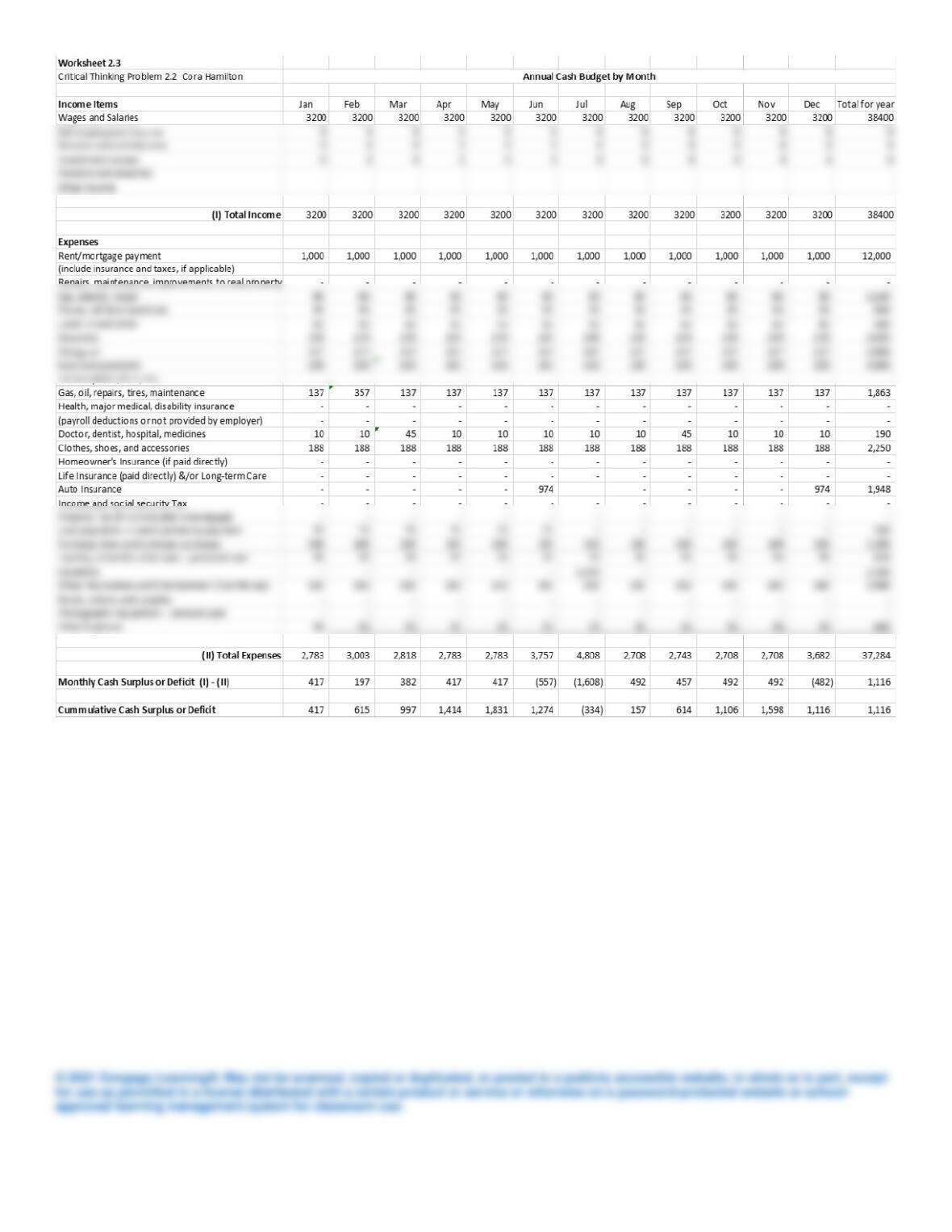
1a. See worksheet below albeit small print.
1.b. The worksheet reports that for the year her total take-home income is $38,400 and total expenses are
$37,284 for a budgeted excess of receipts over disbursements of $1,116. On a monthly basis, her expenses
exceed her income in June [auto insurance due], July [Utah vacation] and December [second auto insurance
cover some of the July expenses and pay the balance over next four months.
2. Note some of the 2021 expenses are increased for 2020. In the solution this increase is computed by the
worksheet. For example, auto expenses for 2020 are $1,560 but are increased by 5% for 2021, that is, for 2021
the monthly expenses will be 1.05*(1,560/12) or $137 rounded.
3. Analyze the budget and advise Cora on her financial situation. Suggest some long-term, intermediate,
and short-term financial goals for Cora, and discuss some steps she can take to reach them.
Cora is close to not being able to cover her budgeted expenses. It would be a good exercise for the class to
discuss what could be reduced. Most likely the dining out, vacation, and recreation expenses will be suggested.
Test Yourself Questions
2-1 What are the two types of personal financial statements? What is a budget, and how does it differ
from personal financial statements? What role do these reports play in a financial plan?
Personal financial statements provide important information needed in the personal financial planning
process. The balance sheet describes your financial condition [that is what assets and liabilities you
2-2 Describe the balance sheet, its components, and how you would use it in personal financial planning.
Differentiate between investments and real and personal property.
The balance sheet summarizes your financial position by showing your assets (what you own listed at
fair market value), your liabilities (what you owe), and your net worth (the difference between assets
2-3 What is the balance sheet equation? Explain when a family may be viewed as technically insolvent.
The balance sheet equation is:
Net Worth = Total Assets – Total Liabilities
2-4 Explain two ways in which net worth could increase (or decrease) from one period to the next.
There are basically two ways to achieve an increase in net worth. First, one could prepare a budget for
the pending period to specifically provide for an increase in net worth by acquiring more assets and/or
paying down debts. Then you take steps to attain this budget. If you accomplished this by planning and
opposite strategies/occurrences.) Of course, there is also the old fashion way, you inherit wealth.
2-5 What is an income and expense statement? What role does it serve in personal financial planning?
The income and expense statement capture the actual result of financial activities. If income exceeds
2-6 Explain what cash basis means in this statement: “An income and expense statement
should be prepared on a cash basis.” How and where are credit purchases shown when statements are
prepared on a cash basis?
The cash basis only records income that is received in cash or expenses that are paid in cash during the
period. It does not include as income any amount that you are due [receivables] or an expense that you
2-7 Distinguish between fixed and variable expenses and give examples of each.
Fixed expenses are contractual, predetermined expenses that are made each period, such as rent,
2-8 Is it possible to have a cash deficit on an income and expense statement? If so, how?
Yes, a cash deficit appears on a cash basis income and expense statement whenever the period’s
2-9 How can accurate records and control procedures be used to ensure the effectiveness of the personal
financial planning process?
Before you can set realistic goals, develop your financial plans, or effectively manage
2-10 Describe some of the areas or items you would consider when evaluating your balance sheet and
income and expense statement. Cite several ratios that could help in this effort.
Ratios are used to relate items from the financial statements. These ratios provide useful information for
Current Ratio: Current Assets divided by Current Liabilities, useful for short term credit decisions
Solvency ratio: Total net worth divided by total assets; measures the degree of exposure to insolvency
2-11 Describe the cash budget and its three parts. How does a budget deficit differ from a budget
surplus?
A cash budget is a summary of estimated cash income and cash expenses for a specific time period,
typically a year. The three parts of the cash budget include: the income section where all expected
2-12 The Garcia family has prepared their annual cash budget for 2021. They have divided it into 12
monthly budgets. Although only 1 monthly budget balances, they have managed to balance the overall
budget for the year. What remedies are available to the Garcia family for meeting the monthly budget
deficits?
Monthly deficits may be handled by shifting expenses to a later month or income to an earlier month. If
2-13 Why is it important to analyze budget variances and their implied surpluses or deficits at the end of
each month?
By examining end-of-month budget balances, and the associated surpluses or deficits for all accounts, a
2-14 Why is it important to use time value of money concepts in setting personal financial goals?
A dollar today and a dollar in the future may enable you to purchase different amounts of goods and
2-15 What is compounding? Explain the rule of 72.
Interest is earned over a given period of time. When interest is compounded, this given period of time is
broken into segments, such as months. Interest is then calculated one segment at a time, with the interest
2-16 When might you use future value? Present value? Give specific examples.
Future value calculations show how much an amount will grow over a given time period. Future value is
2-17 Explain how inflation affects the purchasing poser of money over time. What is the Fisher equation
and how does it relate nominal and real interest rates to the expected rate of inflation?
Inflation is changes in the purchasing power of money. It is expressed as a percentage. Thus, if a loaf
of bread costs $3.00 on January 1 of year and the inflation rate is 3%, that same bread will cost $3.09
one year later. If you are saving $3.00 in a bank account that pays 1%, at the end of the year you will
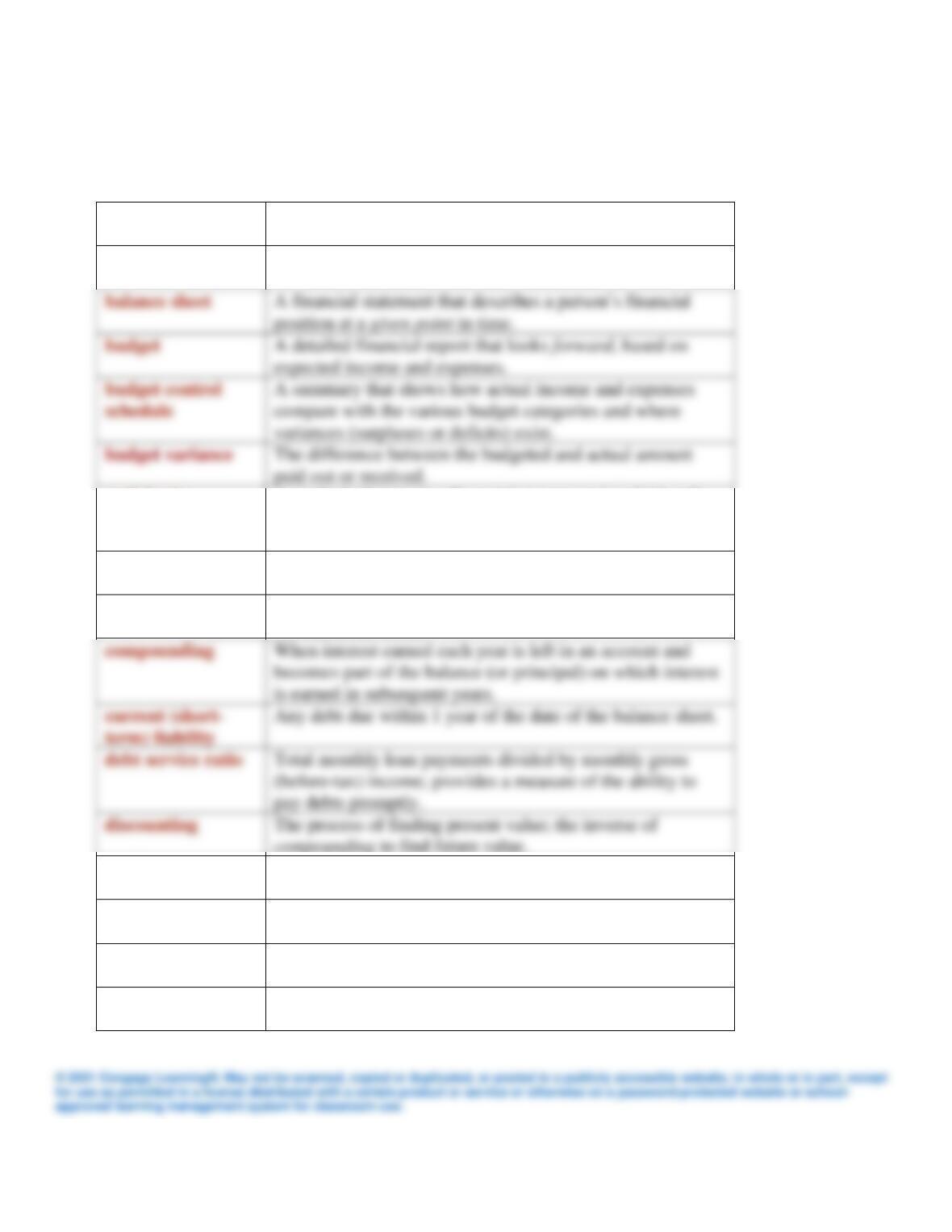
Again, the inflation adjusted interest rate computed by the Fisher equation considers the compounding effect of
interest and is a more accurate rate. For many applications simply subjecting the expected inflation rate from
the nominal rate of interest will give an acceptable inflation adjusted interest rate.
Key Terms
annuity
A fixed sum of money that occurs annually.
assets
Items that one owns.
balance sheet
budget
A detailed financial report that looks forward, based on
expected income and expenses.
budget control
schedule
A summary that shows how actual income and expenses
compare with the various budget categories and where
variances (surpluses or deficits) exist.
The difference between the budgeted and actual amount
paid out or received.
cash basis
A method of preparing financial statements in which only
transactions involving actual cash receipts or actual cash
outlays are recorded.
cash deficit
An excess amount of expenses over income, resulting in
insufficient funds as well as in decreased net worth.
cash surplus
An excess amount of income over expenses that results in
increased net worth.
compounding
When interest earned each year is left in an account and
becomes part of the balance (or principal) on which interest
is earned in subsequent years.
current (short-
term) liability
Any debt due within 1 year of the date of the balance sheet.
debt service ratio
Total monthly loan payments divided by monthly gross
(before-tax) income; provides a measure of the ability to
pay debts promptly.
discounting
The process of finding present value; the inverse of
compounding to find future value.
equity
The actual ownership interest in a specific asset or group of
assets.
expenses
Money spent on living costs and to pay taxes, purchase
assets, or repay debt.
fair market value
The actual value of an asset, or the price for which it can
reasonably be expected to sell in the open market.
financial plans
Describe financial goals and provide the action plans to
their achievement.
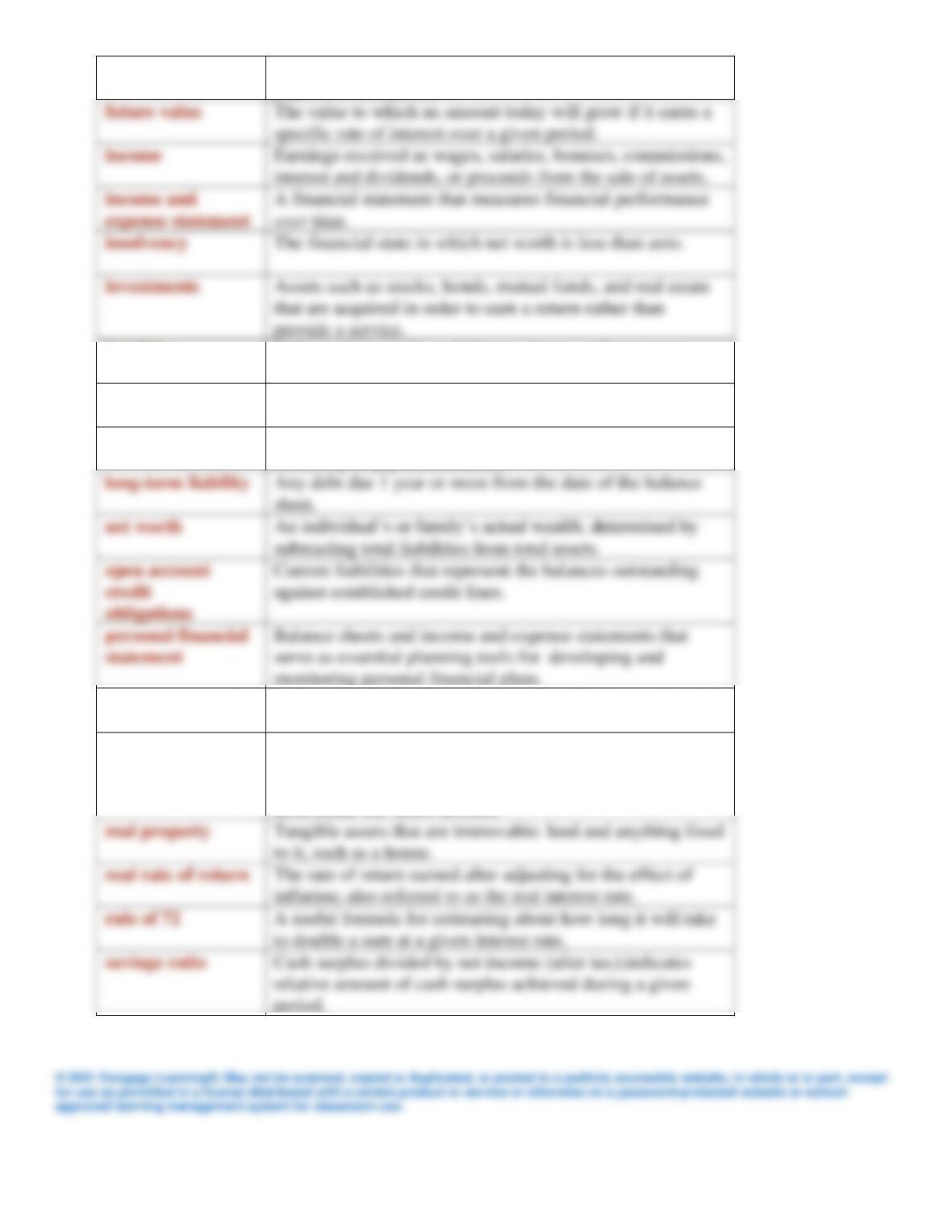
fixed expenses
Contractual, predetermined expenses involving equal
payments each period.
income
Earnings received as wages, salaries, bonuses, commissions,
interest and dividends, or proceeds from the sale of assets.
income and
expense statement
A financial statement that measures financial performance
insolvency
The financial state in which net worth is less than zero.
investments
that are acquired in order to earn a return rather than
provide a service.
liabilities
Debts such as credit card charges, loans, and mortgages.
liquid assets
Assets that are held in the form of cash or that can readily
be converted to cash with little or no loss in value.
liquidity ratio
the ability to pay current debts.
long-term liability
Any debt due 1 year or more from the date of the balance
sheet.
net worth
subtracting total liabilities from total assets.
open account
Total liquid assets divided by total current debts; measures
personal property
Tangible assets that are movable and used in everyday life.
present value
The value today of an amount to be received in the future;
it’s the amount that would have to be invested today at a
given interest rate over a specified time period to
accumulate the future amount.
real property
Tangible assets that are immovable: land and anything fixed
to it, such as a house.
real rate of return
The rate of return earned after adjusting for the effect of
inflation; also referred to as the real interest rate.
rule of 72
A useful formula for estimating about how long it will take
to double a sum at a given interest rate.
savings ratio
relative amount of cash surplus achieved during a given
period.

solvency ratio
Total net worth divided by total assets; measures the degree
of exposure to insolvency.
variable expenses
Expenses involving payment amounts that change from one
time period to the next.
.
Chapter Outline
Learning Goals
I. Mapping Out Your Financial Future
A. The Role of Financial Statements in Financial Planning
B. Assessing Your Financial Situation, Plans, and Goals
*Test Yourself*
II. The Balance Sheet: How Much Are You Worth Today?
A. Assets: The Things You Own
III. The Income and Expense Statement: What We Earn and Where It Goes
A. Income: Cash In
IV. Using Your Personal Financial Statements
A. Keeping Good Records
B. Managing Your Financial Records
C. Tracking Financial Progress: Ratio Analysis
V. Cash In and Cash Out: Preparing and Using Budgets
A. The Budgeting Process
B. Forecasting Income
VI. The Time Value of Money: Putting a Dollar Value on Financial Goals
A. Solving Time Value of Monday Problems Using Different Approaches: Formulas, Financial
Calculators, Spreadsheets, and Timelines
B. Future Value
4.
VII. Inflation and Interest Rates
*Test Yourself*
Summary
Financial Planning Exercises
Key Financial Relationships