Computron’s Income Statement (Millions of Dollars)
Net sales 5,500$ 6,000$
Cost of goods sold (Excluding depr. & amort.) 4,300 4,800
Other operating expenses 350 420
Total operating costs 4,940$ 5,540$
Earnings before interest and taxes (EBIT) 560$ 460$
Less interest 68 108
Pre-tax earnings 492$ 352$
Taxes (25%) 123 88
Net Income 369$ 264$
1
2
3
4
5
6
7
8
9
26
27
28
29
30
31
32
33
34
35
36
37
38
55
56
57
58
59
60
61
62
63
64
65
66
67
A B C D E F G H
11/20/2018
Situation
Liabilities and equity
Accounts payable 300$ 400$
Notes payable 50 250
Accruals 200 240
Total current liabilities 550$ 890$
Long-term bonds 800 1,100
Total liabilities 1,350$ 1,990$
Common stock 1,000 1,000
Retained earnings 1,730 1,910
Total equity 2,730$ 2,910$
Total liabilities and equity 4,080$ 4,900$
Other Data 2018 2019
Stock price $50.00 $30.00
Shares outstanding (millions) 100 100
Common dividends (millions) $90 $84
Tax rate 25% 25%
Weighted average cost of capital (WACC) 10.00% 10.00%
Computron’s Statement of Cash Flows (Millions of Dollars)
2019
Operating Activities
Net Income before preferred dividends 264$
Chapter 2 Mini Case
Jenny Cochran, a graduate of The University of Tennessee with 4 years of experience as an equities analyst, was recently brought
in as assistant to the chairman of the board of Computron Industries, a manufacturer of computer components.
Computron’s Balance Sheets (Millions of Dollars)
Assets
Cash and equivalents 60$ 50$
Short-term investments 100 10
Accounts receivable 400 520
Gross fixed assets 3,900$ 4,820$
Less: Accumulated depreciation 1,000 1,320
Net fixed assets 2,900$ 3,500$
Total assets 4,080$ 4,900$
= $1,390 −$640
= $750
= $1,080 −$500
= $580
91
103
104
105
106
107
108
109
110
111
112
113
114
115
116
117
118
119
120
121
Net Operating Profit After Taxes
2019 NOPAT = EBIT x ( 1 – T )
= $460 x75%
= $345
2018 NOPAT = EBIT x ( 1 – T )
= $560 x75%
= $420
Net Operating Working Capital
NOPAT is the amount of profit Computron would generate if it had no debt and held no financial assets.
Those current assets used in operations are called operating current assets, and the current liabilities that result from
operations are called operating current liabilities. Net operating working capital is equal to operating current assets minus
operating current liabilities.
Depreciation and amortization 320
Change in accounts receivable (120)
Change in inventories (200)
Change in accounts payable 100
Change in accruals 40
Net cash provided by operating activities 404$
Investing activities
Cash used to acquire fixed assets (920)$
Change in short-term investments 90
Net cash provided by investing activities (830)$
Financing Activities
Change in notes payable 200$
Change in long-term debt 300
Payment of cash dividends (84)
Net cash provided by financing activities 416$
Cash and securities at beginning of the year 60
= $345.0 $4,250
= 8.1%
2018 ROIC = NOPAT ÷ Operating Capital
= $420.0 $3,480
= 12.1%
Operating Profitability
= $345.0 $6,000
= 5.8%
= $420.0 $6,000
= 7.0%
Capital Utilization
= $4,250.0 $6,000
= 70.8%
The operating profitability (OP) ratio shows how many dollars of operating profit are generated by each dollar of sales.
The capital utilization (CR) ratio shows how many dollars of operating assets are needed to generated a dollar of sales.
130
131
132
133
134
135
136
137
138
139
140
141
142
143
144
145
146
160
161
162
163
164
165
166
167
168
A B C D E F G H
Total Net Operating Capital (TNOC)
TNOC = NOWC + net operating long-term assets
2019 TNOC = NOWC + Fixed assets
= $750 +$3,500
= $4,250
2018 TNOC = NOWC + Fixed assets
= $580 +$2,900
= $3,480
e. What is Computron’s free cash flow (FCF)? What are Computron’s “net uses” of its FCF?
Free Cash Flow
Return on Invested Capital
2019 ROIC = NOPAT ÷ Operating Capital
f. Calculate Computron’s return on invested capital (ROIC). Computron has a 10% cost of capital (WACC). What caused the
decline in the ROIC? Was it due to operating profitability or capital utilization? Do you think Computron’s growth added value?
The Return on Invested Capital tells us the amount of NOPAT per dollar of operating capital.
Computron’s Free Cash Flow calculation is the cash flow actually availabe for distribution to investors after the company has
= $345.0 −$770
= -$425
Uses of FCF 2019
After-tax interest payment = $81
Reduction (increase) in debt = -$500
Payment of dividends = $84
Repurchase (Issue) stock = $0
Purchase (Sale) of short-term investments = -$90
Total uses of FCF = -$425
Market Value Added
Taxable dividends= $5 million
199
200
201
202
203
204
205
206
215
216
217
218
219
220
235
236
237
238
239
240
241
242
243
244
254
255
256
257
258
259
260
g. What is Computron’s EVA? The cost of capital was 10% in both years.
Economic Value Added
2019 EVA = NOPAT −Operating Capital x WACC
h. What happened to Computron’s market value added (MVA)?
Year-end common stock price $50.00 $30.00
Year-end shares outstanding (in millions) 100 100
Operating income = $87 million
Interest income received = $8 million
k. The Tax Cut and Jobs Act was signed into law in 2017. Briefly describe its key provisions related to personal taxation. Answer:
See Mini Case Show.
j. Assume that a corporation has $87 million of taxable income from operations. It also received interest income of $8 million
and dividend income of $10 million. The federal tax rate is 21% and the dividend exclusion rate is 50%. What is the company’s
federal tax liability?
l. Assume that you are in the 25% marginal tax bracket and that you have $20,000 to invest. You have narrowed your
investment choices down to municipal bonds yielding 7% or equally risky corporate bonds with a yield of 10%. Which one
should you choose and why? At what marginal tax rate would you be indifferent?
i. The Tax Cut and Jobs Act was signed into law in 2017. Briefly describe its key provisions related to corporate tax taxation.
Answer: See Mini Case Show.
Economic Value Added represents Computron’s residual income that remains after the cost of all capital, including equity
capital, has been deducted.
Operating profitability declined and the capital utlization worsened, each contributing to the big decrease in ROIC.
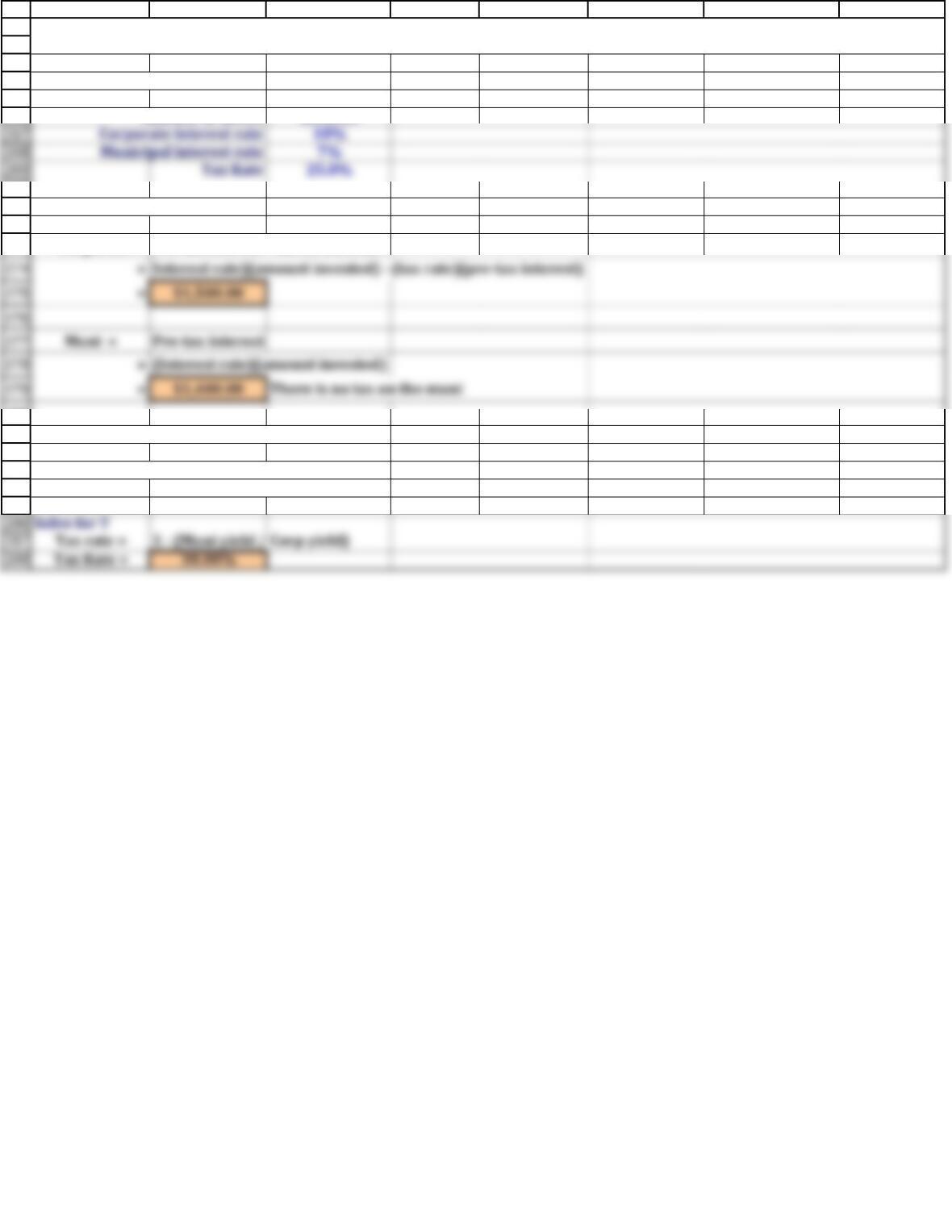
Solve for T
261
262
263
264
265
266
270
271
272
273
280
281
282
283
284
285
A B C D E F G H
Taxable vs. Tax Exempt bonds
Amount to invest $20,000
After-tax interest
Corporate = Pre-tax interest – tax on interest
Tax rate at which you would be indifferent
After-tax yield on muni versus corp bond
Muni Yield = Corp Yield *(1-Tax rate)
l. Assume that you are in the 25% marginal tax bracket and that you have $20,000 to invest. You have narrowed your
investment choices down to municipal bonds yielding 7% or equally risky corporate bonds with a yield of 10%. Which one
should you choose and why? At what marginal tax rate would you be indifferent?