Chapter 2
Determination of Interest Rates
Outline
Loanable Funds Theory
Household Demand for Loanable Funds
Business Demand for Loanable Funds
Government Demand for Loanable Funds
Factors That Affect Interest Rates
Impact of Economic Growth on Interest Rates
Impact of Inflation on Interest Rates
Impact of Foreign Flows of Funds on Interest Rates
Forecasting Interest Rates
Chapter 2: Determination of Interest Rates ❖ 2
Key Concepts
1. Explain the Loanable Funds Theory by deriving demand and supply schedules for loanable funds.
2. Explain the Fisher Effect and tie it in with Loanable Funds Theory by explaining how inflation affects
the demand and supply schedules for loanable funds.
POINT/COUNTER-POINT:
Does a Large Fiscal Budget Deficit Result in Higher Interest Rates?
POINT: No. In some years (such as 2008), the fiscal budget deficit was large and interest rates were very
low.
COUNTER-POINT: Yes. When the federal government borrows large amounts of funds, it can crowd out
other potential borrowers, and the interest rates are bid up by the deficit units.
Questions
1. Interest Rate Movements. Explain why interest rates changed as they did over the past year.
ANSWER: This exercise should force students to consider how the factors that influence interest
2. Interest Elasticity. Explain what is meant by interest elasticity. Would you expect federal
government demand for loanable funds to be more or less interest-elastic than household demand for
loanable funds? Why?
ANSWER: Interest elasticity of supply represents a change in the quantity of loanable funds supplied
Chapter 2: Determination of Interest Rates ❖ 3
3. Impact of Government Spending. If the federal government planned to expand the space program,
how might this change affect interest rates?
ANSWER: An expanded space program would (a) force the federal government to increase its budget
deficit, (b) possibly force any firms involved in facilitating the program to borrow more funds.
4. Impact of a Recession. Explain why interest rates tend to decrease during recessionary periods.
Review historical interest rates to determine how they react to recessionary periods. Explain this
reaction.
ANSWER: During a recession, firms and consumers reduce their amount of borrowing. The demand
5. Impact of the Economy. Explain how the expected interest rate in one year depends on your
expectation of economic growth and inflation.
ANSWER: The interest rate in the future should increase if economic growth and inflation are
6. Impact of the Money Supply. Would increasing the money supply growth place upward or
downward pressure on interest rates?
ANSWER: If one believes that higher money supply growth will not cause inflationary expectations,
7. Impact of Exchange Rates on Interest Rates. Assume that if the U.S. dollar strengthens, it can
place downward pressure on U.S. inflation. Based on this information, how might expectations of a
strong dollar affect the demand for loanable funds in the United States and U.S. interest rates? Is there
any reason to think that expectations of a strong dollar could also affect the supply of loanable funds?
Explain.
ANSWER: As a strong U.S. dollar dampens U.S. inflation, it can reduce the demand for loanable
8. Nominal versus Real Interest Rate. What is the difference between the nominal interest rate and
real interest rate? What is the logic behind the implied positive relationship between expected
inflation and nominal interest rates?
Chapter 2: Determination of Interest Rates ❖ 4
ANSWER: The nominal interest rate is the quoted interest rate, while the real interest rate is defined
require a nominal return that exceeds the inflation rate.
9. Real Interest Rate. Estimate the real interest rate over the last year. If financial market participants
overestimate inflation in a particular period, will real interest rates be relatively high or low? Explain.
ANSWER: This exercise forces students to measure last year’s nominal interest rate and inflation
rate.
10. Forecasting Interest Rates. Why do forecasts of interest rates made by experts differ?
ANSWER: Various factors may influence interest rates, and changes in these factors will affect
Advanced Questions
11. Impact of Stock Market Crises. During periods when investors suddenly become fearful that stocks
are overvalued, they dump their stocks, and the stock market experiences a major decline. During
these periods, interest rates also tend to decline. Use the loanable funds framework discussed in this
chapter to explain how a massive selloff of stocks leads to lower interest rates.
ANSWER: When investors shift funds out of stocks, they move it into money market securities,
12. Impact of Expected Inflation. How might expectations of higher prices in the U.S. affect the
demand for loanable funds, the supply of loanable funds, and interest rates in the U.S.? Offer a logical
explanation of why such an impact on interest rates in the U.S. might spread to other countries.
ANSWER: The expectations of higher prices will cause concern about the possible increase in
Chapter 2: Determination of Interest Rates ❖ 5
13. Global Interaction of Interest Rates. Why might you expect the interest rate movements of various
industrialized countries to be more highly correlated in recent years than they were in earlier years?
ANSWER: Interest rates among countries are expected to be more highly correlated in recent years
14. Impact of War. War tends to cause significant reactions in financial markets. Why might a
war in the Middle East place upward pressure on U.S. interest rates? Why might some investors
expect a war like this to place downward pressure on U.S. interest rates?
ANSWER: A war places upward pressure on U.S. interest rates because it may (1) increase
inflationary expectations in the United States if oil prices increase abruptly, and (2) increase the
expected U.S. budget deficit as government expenditures were necessary to boost military support.
15. Impact of September 11. Offer an argument for why the terrorist attack on the United States on
September 11, 2001 could have placed downward pressure on U.S. interest rates. Offer an argument
for why those attacks could have placed upward pressure on U.S. interest rates.
ANSWER: The terrorist attack could cause a reduction in spending related to travel (airlines, hotels),
16. Impact of Government Spending. Jayhawk Forecasting Services analyzed several factors that could
affect interest rates in the future. Most factors were expected to place downward pressure on interest
rates. Jayhawk also expected that although the annual budget deficit was to be cut by 40 percent from
the previous year, the deficit would still be very large. Because Jayhawk believed that the deficit’s
impact would more than offset the effects of other factors, it forecast interest rates to increase by 2
percent. Comment on Jayhawk’s logic.
ANSWER: A reduction in the deficit should free up some funds that had been used to support the
Chapter 2: Determination of Interest Rates ❖ 6
17. Decomposing Interest Rate Movements. The interest rate on a one-year loan can be decomposed
into a one-year risk-free (free from default risk) component and a risk premium that reflects the
potential for default on the loan in that year. A change in economic conditions can affect the risk-free
rate and the risk premium. The risk-free rate is usually affected by changing economic conditions to a
greater degree than the risk premium. Explain how a weaker economy will likely affect the risk-free
component, the risk premium, and the overall cost of a one-year loan obtained by (a) the Treasury,
and (b) a corporation. Will the change in the cost of borrowing be more pronounced for the Treasury
or for the corporation? Why?
ANSWER: The weaker economy will likely reduce the risk-free component and will increase the risk
premium. The overall cost of borrowing is reduced for a loan to the Treasury and a loan to a
18. Forecasting Interest Rates Based on Prevailing Conditions. Consider the prevailing conditions for
inflation (including oil prices), the economy, the budget deficit, and the Fed’s monetary policy that
could affect interest rates. Based on these conditions, do you think interest rates will likely increase or
decrease during this semester? Offer some logic to support your answer. Which factor do you think
will have the greatest impact on interest rates?
ANSWER: This question is open-ended. It requires students to apply the concepts that were presented
19. Impact of Economic Crises on Interest Rates. When economic crises in countries are due to a weak
economy, local interest rates tend to be very low. However, if the crisis is caused by an unusually
high rate of inflation, the interest rate tends to be very high. Explain why.
ANSWER: A weak economy causes a reduction in the demand for loanable funds, because
20. U.S. Interest Rates During the Credit Crisis. During the credit crisis, U.S. interest rates were
extremely low, which enabled businesses to borrow at a low cost. Holding other factors constant, this
should have resulted in a higher number of feasible projects, which should have encouraged
businesses to borrow more money and expand. Yet, many businesses that had access to loanable
funds were unwilling to borrow during the credit crisis. What other factor changed during this period
that more than offset the potentially favorable effect of the low interest rates on project feasibility,
therefore discouraging businesses from expanding?
ANSWER: Businesses recognized that the cash flows to be generated from their projects would be
Chapter 2: Determination of Interest Rates ❖ 7
21. Political Influence on Interest Rates. Offer an argument for why a political regime that favors a
large government will cause interest rates to be higher. Offer at least one example of why a political
regime that favors a large government will cause interest rates to be lower [Hint: Recognize that the
government intervention in the economy can influence other factors that affect interest rates.]
ANSWER: A political regime that favors a large government will have more government
expenditures. Assuming that taxes are not affected, the fiscal budget deficit will be larger. As the
22. Impact of Stock Market Uncertainty. Consider a period in which stock prices are very high,
such that investors begin to think that stocks are overvalued and their valuations are very uncertain. If
investors decide to move their money into much safer investments, how do you think this would
affect general interest rate levels? In your answer, use the loanable funds framework by explaining
how the supply or demand for loanable funds would be affected by the investor actions, and how this
would affect general interest rate levels. In your answer, use the loanable funds framework to
explain how the supply of or demand for loanable funds would be affected by the investor
actions, and how this force would affect interest rates.
ANSWER: If investors sell their stocks, they receive cash and may deposit their cash in banks. This
22. Impact of the European Economy. Use the loanable funds framework to explain how European
economic conditions might affect U.S. interest rates.
ANSWER: Weak European conditions could weaken U.S. economic conditions, because the
economies are integrated through international trade and investment. If the European economy causes
CRITICAL THINKING QUESTION
Forecasting Interest Rates Given your knowledge of how interest rates are influenced by
various factors reflecting the demand for funds and the supply of funds available in the credit
markets, write a short essay to explain how and why interest rates will change over the next three
months.
Chapter 2: Determination of Interest Rates ❖ 8
ANSWER
There is no perfect answer, but the exercise forces students to consider how factors that affect U.S.
Interpreting Financial News
Interpret the following comments made by Wall Street analysts and portfolio managers.
a. “The flight of funds from bank deposits to U.S. stocks will pressure interest rates.”
As the supply of loanable funds declines (due to bank deposit withdrawals), there will be upward
pressure on interest rates.
As the federal government spends more than it taxes, it borrows the difference; the greater the
amount borrowed, the higher the pressure on U.S. interest rates.
Managing in Financial Markets
As the treasurer of a manufacturing company, your task is to forecast the direction of interest rates. Your
company plans to borrow funds and it may use the forecast of interest rates to determine whether it should
obtain a loan with a fixed interest rate or a floating interest rate. The following information can be
considered when assessing the future direction of interest rates:
Economic growth has been high over the last two years, but you expect that it will be stagnant
over the next year.
Chapter 2: Determination of Interest Rates ❖ 9
a. Given the preceding information, assess how the demand for and the supply of loanable funds
would be affected (if at all), and predict the future direction of interest rates.
The demand for loanable funds should decline in response to: (1) stagnant economic growth
(because a relatively low level of borrowing will be needed), and (2) a major cut in government
b. Your company can obtain a one-year loan at a fixed-rate of 8 percent or a floating-rate loan that is
currently at 8 percent but its interest rate would be revised every month in accordance with
general interest rate movements. Which type of loan is more appropriate based on the information
provided?
c. Assume that Canadian interest rates have abruptly risen just as you have completed your forecast
of future U.S. interest rates. Consequently, Canadian interest rates are now 2 percentage points
above U.S. interest rates. How might this specific situation place pressure on U.S. interest rates?
Considering this situation along with the other information provided, would you change your
forecast of the future direction of U.S. interest rates?
This situation could encourage U.S. individuals and firms to withdraw their savings from U.S.
Problems
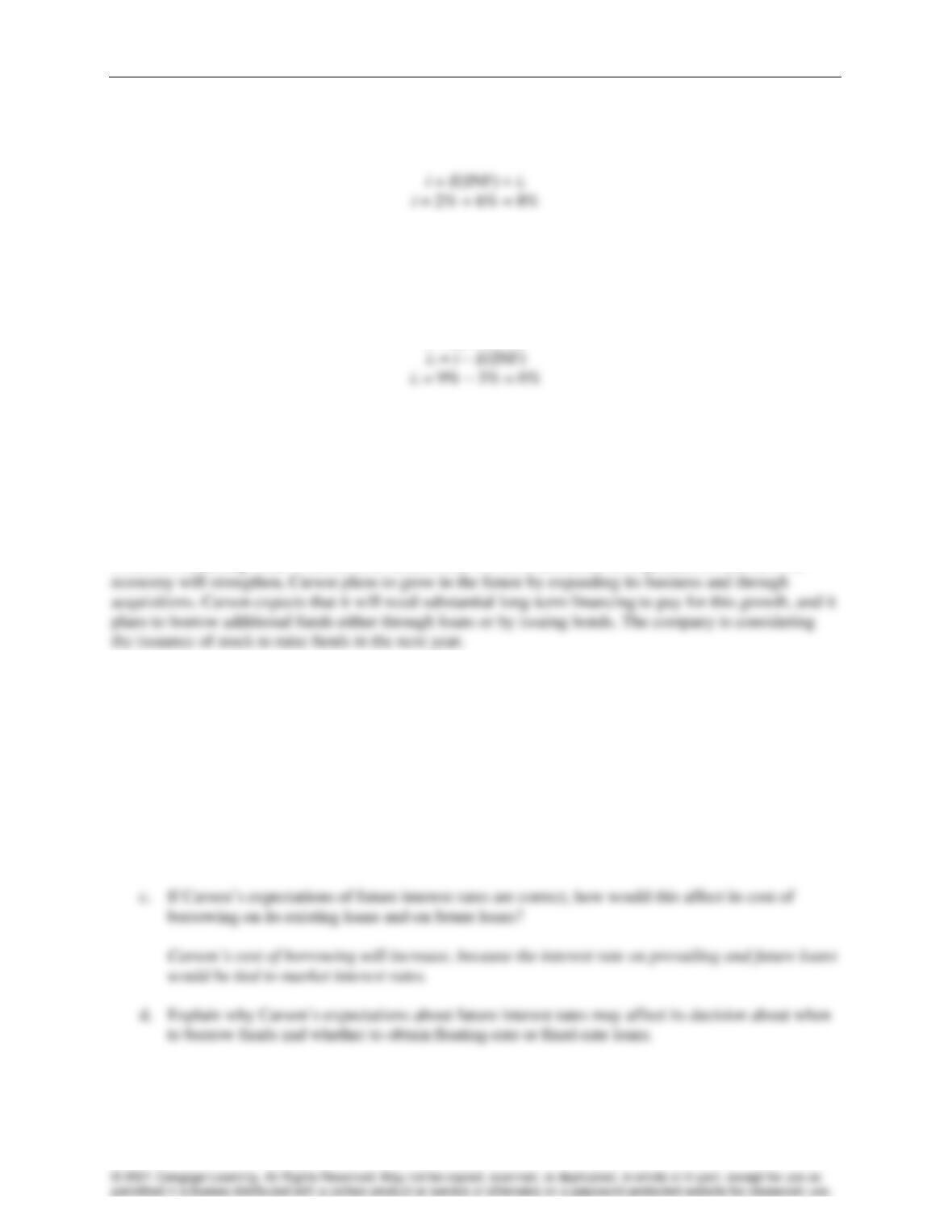
1. Nominal Rate of Interest. Suppose the real interest rate is 6 percent and the expected inflation is 2
percent. What would you expect the nominal rate of interest to be?
Chapter 2: Determination of Interest Rates ❖ 10
ANSWER:
2. Real Interest Rate. Suppose that Treasury bills are currently paying 9 percent and the expected
inflation is 3 percent. What is the real interest rate?
ANSWER:
i = E(INF) + ir
Flow of Funds Exercise
How the Flow of Funds Affects Interest Rates
Recall that Carson Company has obtained substantial loans from finance companies and commercial
banks. The interest rate on the loans is tied to market interest rates and is adjusted every six months. Thus,
its cost of obtaining funds is sensitive to interest rate movements. Given its expectations that the U.S.
a. Explain why Carson should be very interested in future interest rate movements.
The future interest rate movements affect Carson’s cost of obtaining funds, and therefore may
affect the value of its stock.
b. Given Carson’s expectations, do you think that the company anticipates that interest rates will
increase or decrease in the future? Explain.
Carson expects the U.S. economy to strengthen, and therefore should expect that interest rates
will increase (assuming other things held constant).
Chapter 2: Determination of Interest Rates ❖ 11