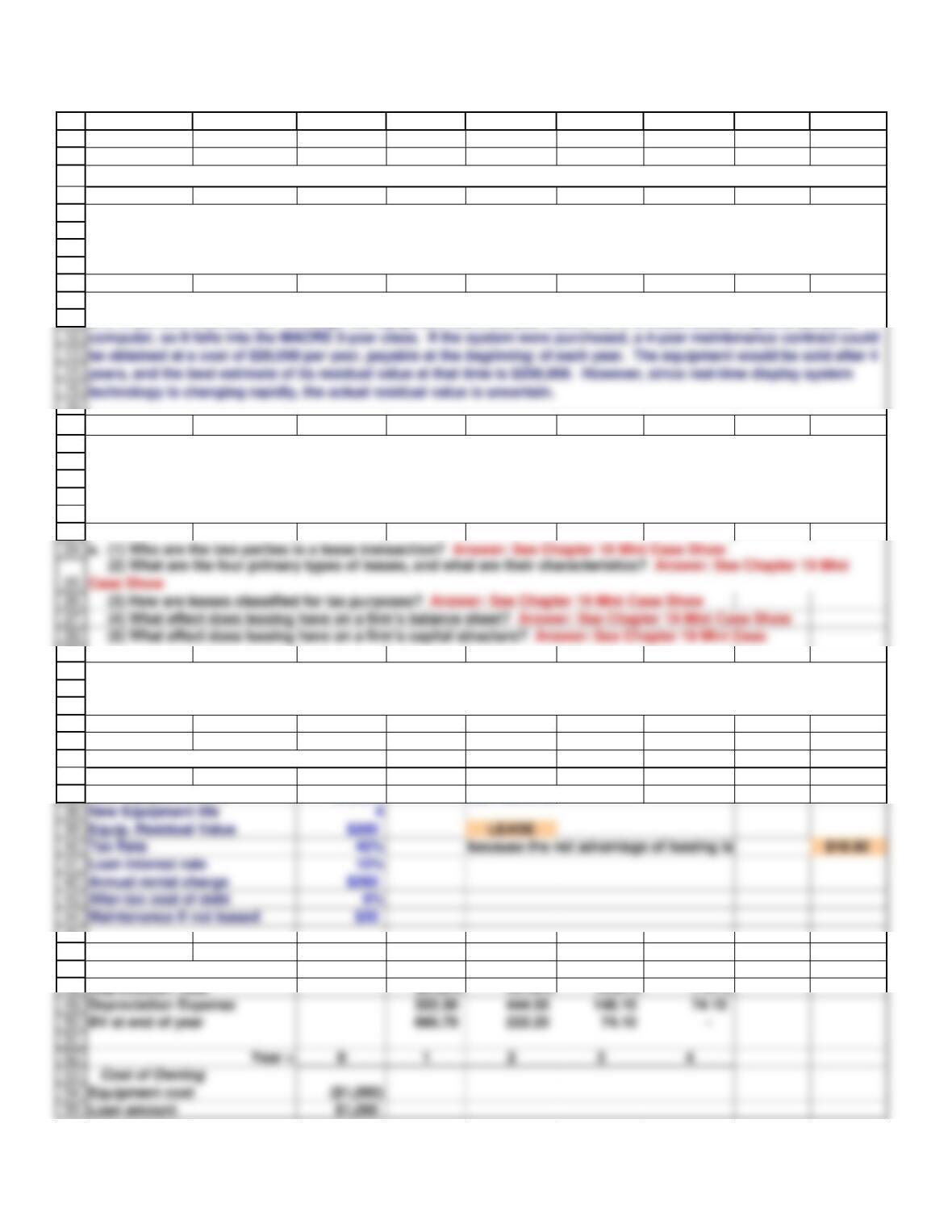
New Equipment life 4
Equip. Residual Value $200 LEASE
Tax Rate 40%
because the net advantage of leasing is
Loan interest rate 10%
Annual rental charge $260
After-tax cost of debt 6%
Maintenance if not leased $20
Depreciation Expense 333.30 444.50 148.10 74.10
BV at end of year 666.70 222.20 74.10 –
Equipment cost ($1,000)
Loan amount $1,000
1
2
3
4
5
6
7
8
9
10
11
16
17
18
19
20
21
22
23
29
30
31
32
33
34
35
36
37
45
46
47
48
A B C D E F G H I
1/5/2015
Input Data
(all dollar figures in thousands)
New Equipment cost $1,000 KEY OUTPUT
NPV LEASE ANALYSIS
Depreciation Rate 33.33% 44.45% 14.81% 7.41%
Chapter 19. Mini Case for Lease Financing
Lewis Securities Inc. has decided to acquire a new market data and quotation system for its Richmond home office.
The system receives current market prices and other information from several on-line data services, then either
displays the information on a screen or stores it for later retrieval by the firm’s brokers. The system also permits
customers to call up current quotes on terminals in the lobby.
The equipment costs $1,000,000, and, if it were purchased, Lewis could obtain a term loan for the full purchase price
at a 10 percent interest rate. Although the equipment has a six-year useful life, it is classified as a special-purpose
As an alternative to the borrow-and-buy plan, the equipment manufacturer informed Lewis that Consolidated Leasing
would be willing to write a 4-year guideline lease on the equipment, including maintenance, for payments of $260,000
at the beginning of each year. Lewis’s marginal federal-plus-state tax rate is 40 percent. You have been asked to
analyze the lease-versus-purchase decision, and in the process to answer the following questions:
b. (1) What is the present value cost of owning the equipment? (Hint: Set up a time line which shows the net cash
flows over the period t = 0 to t = 4, and then find the PV of these net cash flows, or the PV cost of owning.)
56
57
58
68
69
70
71
74
75
76
77
78
Cost of Owning
Equipment cost ($1,000)
risk. If the residual value were included as an outflow (a negative CF) in the cost of leasing cash flows, the increased
83
84
85
86
87
88
92
93
94
95
96
97
98
99
100
101
102
A B C D E F G H I
Interest expense ($100) ($100) ($100) ($100)
Tax savings from interest 40 40 40 40
Principal repayment ($1,000)
c. What is Lewis’s present value cost of leasing the equipment? (Hint: Again, construct a time line.)
Year = 0 1 2 3 4
Cost of Leasing
Cost Comparison
The discount rate applied to the residual value inflow (a positive CF) should be increased to account for the increased
e. Now assume that the equipment’s residual value could be as low as $0 or as high as $400,000, but that $200,000 is
the expected value. Since the residual value is riskier than the other cash flows in the analysis, this differential risk
should be incorporated into the analysis. Describe how this could be accomplished. (No calculations are necessary,
but explain how you would modify the analysis if calculations were required.) What effect would increased
uncertainty about the residual value have on Lewis’s lease-versus-purchase decision?
(2) Explain the rationale for the discount rate you used to find the
Leasing is similar to debt financing in that the cash flows have relatively low risk because most are fixed by contract.
d. What is the net advantage to leasing (NAL)? Does your analysis indicate that Lewis should buy or lease the
equipment? Explain.
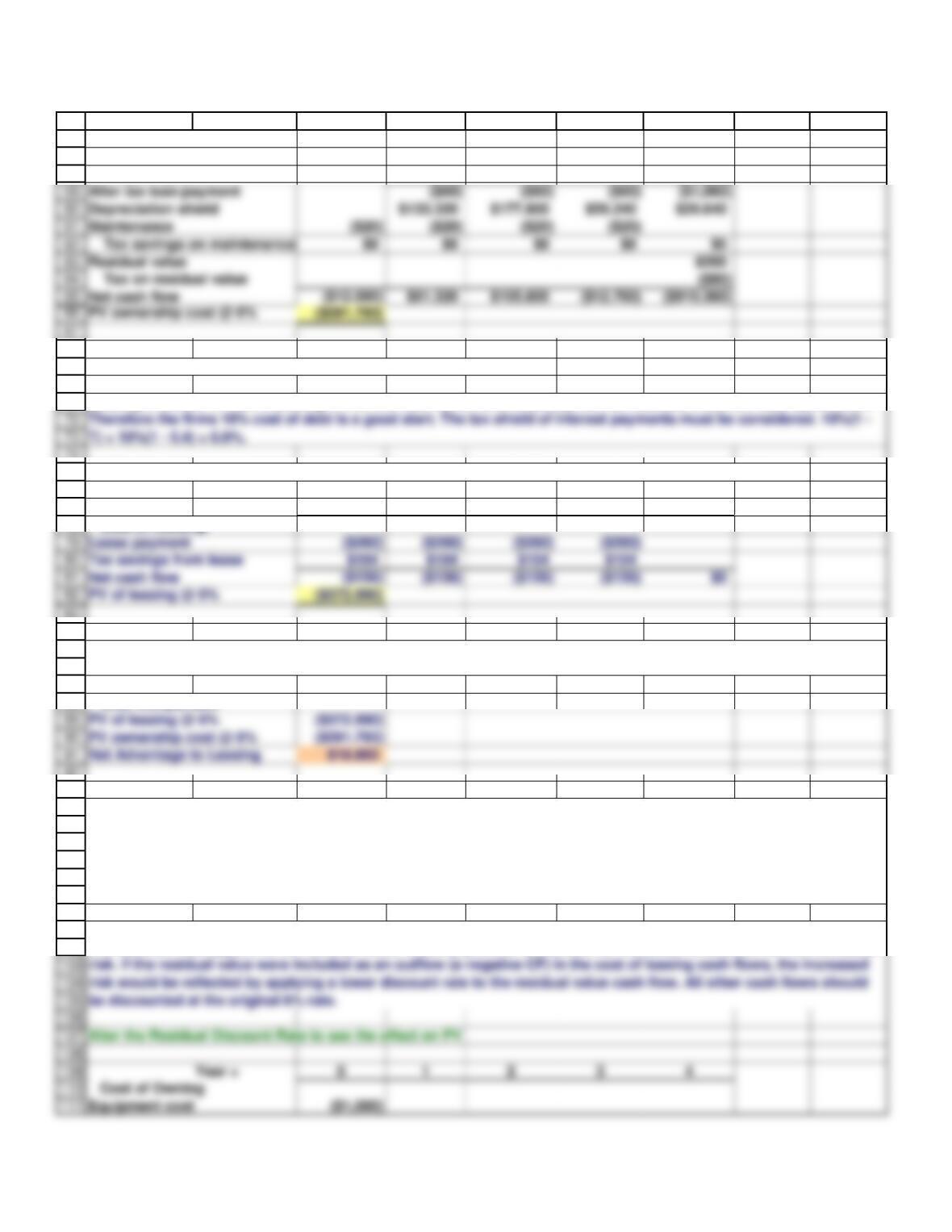
After tax loan payment ($60) ($60) ($60) ($1,060)
Depreciation shield $133.320 $177.800 $59.240 $29.640
Tax savings on maintenance
Residual value $200
Tax on residual value ($80)
Net cash flow ($12.000) $61.320 $105.800 ($12.760) ($910.360)
112
113
114
115
To the lessor, writing the lease is an investment. Therefore, the lessor must compare the return on the lease
investment with the return available on alternative investments of similar risk.
Lessor’s tax rate = 40%
Lessor’s pre-tax interest rate = 10%
126
127
128
129
130
131
135
136
137
138
139
140
141
142
143
144
145
163
164
165
166
A B C D E F G H I
Loan amount $1,000
Interest expense ($100) ($100) ($100) ($100)
Tax savings from interest $40 $40 $40 $40
Principal repayment ($1,000)
NPV LEASOR’S ANALYSIS
Lease payment = $280
f. The lessee compares the cost of owning the equipment with the cost of leasing it. Now put yourself in the lessor’s
shoes. In a few sentences, how should you analyze the decision to write or not write the lease?
g. (1) Assume that the lease payments were actually $280,000 per year, that Consolidated Leasing is also in the 40
percent tax bracket, and that it also forecasts a $200,000 residual value. Also, to furnish the maintenance support,
Consolidated would have to purchase a maintenance contract from the manufacturer at the same $20,000 annual cost,
again paid in advance. Consolidated Leasing can obtain an expected 10 percent pre-tax return on investments of
similar risk. What would Consolidated‘s NPV and IRR of leasing be under these conditions?
(2) What do you think the lessor’s NPV would be if the lease payments were set at $260,000 per year? (Hint: The
lessor’s cash flows would be a “mirror image” of the lessee’s cash flows.)
The lessor owns the equipment when the lease expires. Therefore, residual value risk is passed from the lessee to the
lessor. The increased residual value risk makes the lease more attractive to the lessee.
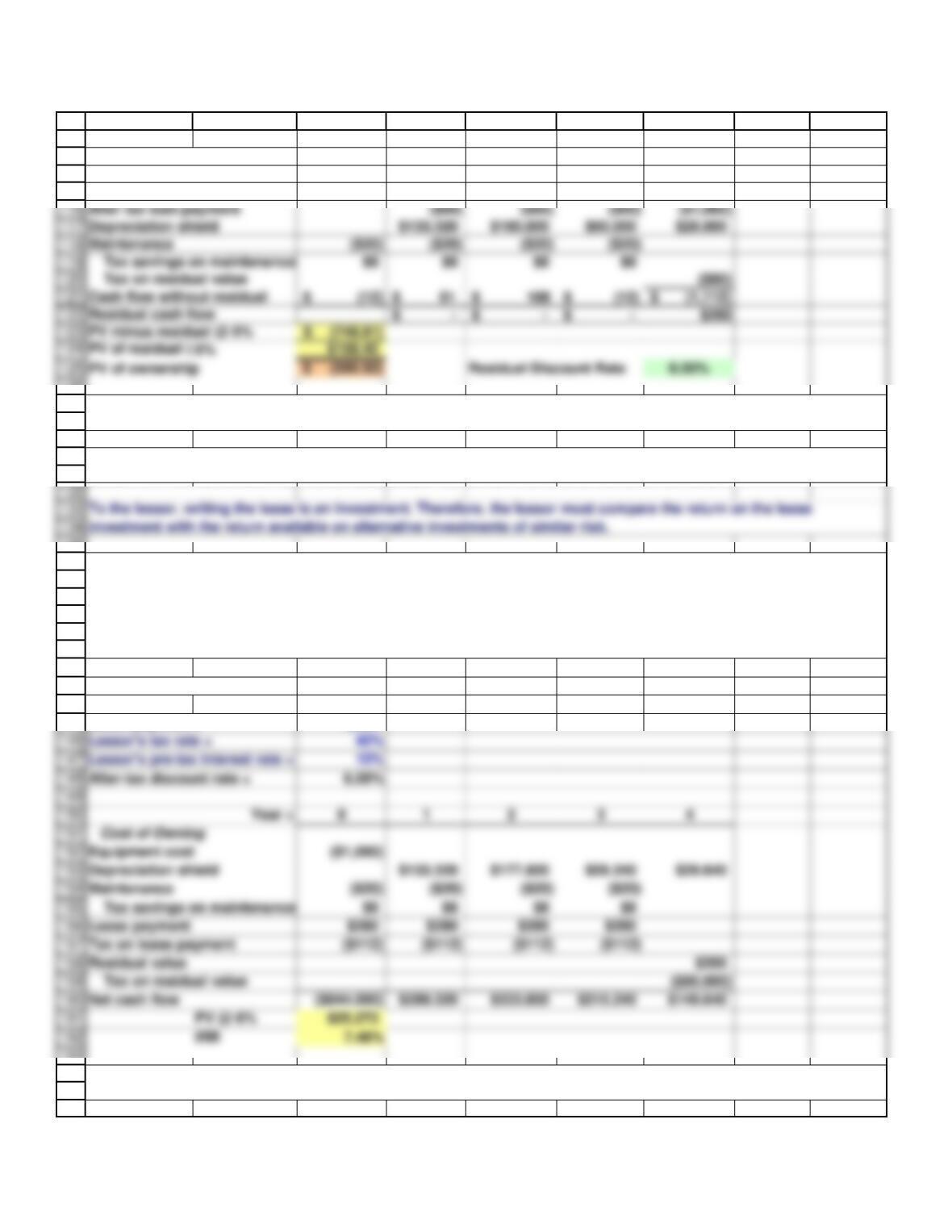
After tax loan payment ($60) ($60) ($60) ($1,060)
Depreciation shield $133.320 $180.000 $60.000 $28.000
Tax savings on maintenance
Tax on residual value ($80)
Cash flow without residual $ (12) $ 61 $ 108 $ (12) $ (1,112)
Residual cash flow $ – $ – $ – $200
PV minus residual @ 6% (748.91)$
171
172
173
174
175
176
177
178
A B C D E F G H I
h. Lewis’s management has been considering moving to a new downtown location, and they are concerned that these
plans may come to fruition prior to the expiration of the lease. If the move occurs, Lewis would buy or lease an
entirely new set of equipment, and hence management would like to include a cancellation clause in the lease
contract. What impact would such a clause have on the riskiness of the lease from Lewis’s standpoint? From the
lessor’s standpoint? If you were the lessor, would you insist on changing any of the lease terms if a cancellation
clause were added? Should the cancellation clause contain any restrictive covenants and/or penalties of the type
contained in bond indentures or provisions similar to call premiums?