Answers and Solutions: 19 – 1
Chapter 19
Lease Financing
ANSWERS TO END-OF-CHAPTER QUESTIONS
19-1 a. The lessee is the party leasing the property. The party receiving the payments from the
lease (that is, the owner of the property) is the lessor.
b. An operating lease, sometimes called a service lease, provides for both financing and
maintenance. Generally, the operating lease contract is written for a period
considerably shorter than the expected life of the leased equipment and it contains a
c. Off-balance sheet financing refers to the fact that for many years neither leased assets
nor the liabilities under lease contracts appeared on the lessees’ balance sheets. To
correct this problem, the Financial Accounting Standards Board issued FASB
d. FASB Statement 13 is the Financial Accounting Standards Board statement (November
1976) that spells out in detail the conditions under which a lease must be capitalized,
and the specific procedures to follow. ASU 2016-02 is the FASB update that states that
virtually all leases longer than a year, including operating leases, must be capitalized.
Answers and Solutions: 19 – 2
f. The residual value is the market value of the leased property at the expiration of the
lease. The estimate of the residual value is one of the key elements in lease analysis.
g. The lessee’s analysis involves determining whether leasing an asset is less costly than
buying the asset. The lessee will compare the present value cost of leasing the asset
with the present value cost of purchasing the asset (assuming the funds to purchase the
h. The net advantage to leasing (NAL) gives the dollar value of the lease to the lessee. It
is, in a sense, the NPV of leasing versus owning.
19-2 An operating lease is usually cancelable and includes maintenance. Operating leases are,
frequently, for a period significantly shorter than the economic life of the asset, so the
19-3 You would expect to find that lessees, in general, are in relatively low income-tax brackets,
while lessors tend to be in high tax brackets. The reason for this is that owning tends to
19-4 A cancellation clause would reduce the risk to the lessee since the firm would be allowed
to terminate the lease at any point. Since the lease is less risky than a standard financial
lease, and less risky than straight debt, which cannot usually be prepaid without a
prepayment charge, the discount rate on the cost of leasing might be adjusted to reflect
lower risk. (Note that this requires increasing the discount rate since cash outflows are
Answers and Solutions: 19 – 3
Answers and Solutions: 19 – 4
SOLUTIONS TO END–OF-CHAPTER PROBLEMS
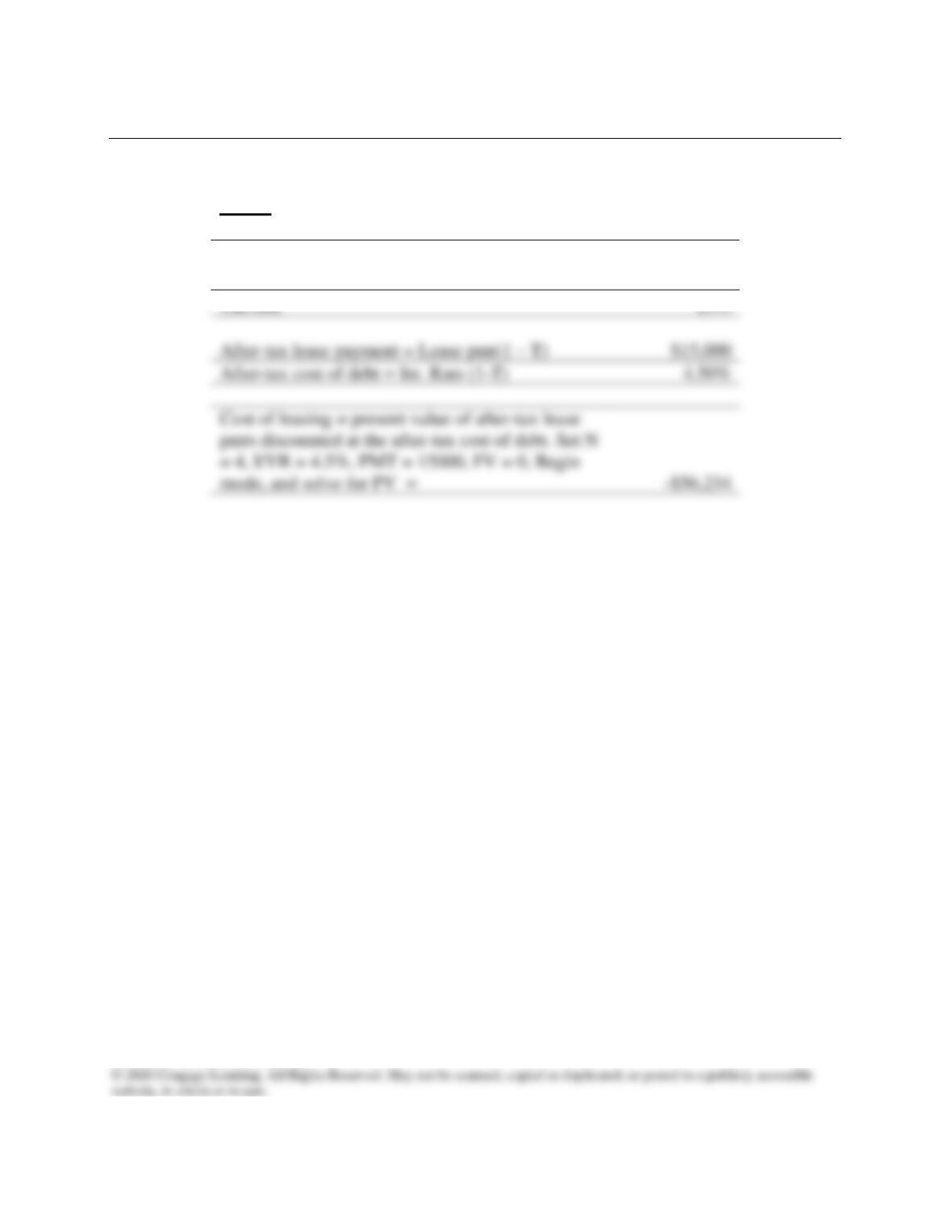
19-1
Inputs
Annual lease payment
$20,000
Lease term
4
Interest rate =
6%
Tax rate
After-tax lease payment = Lease pmt(1 – T)
$15,000
After-tax cost of debt = Int. Rate (1-T)
mode, and solve for PV =
Answers and Solutions: 19 – 5
19-2
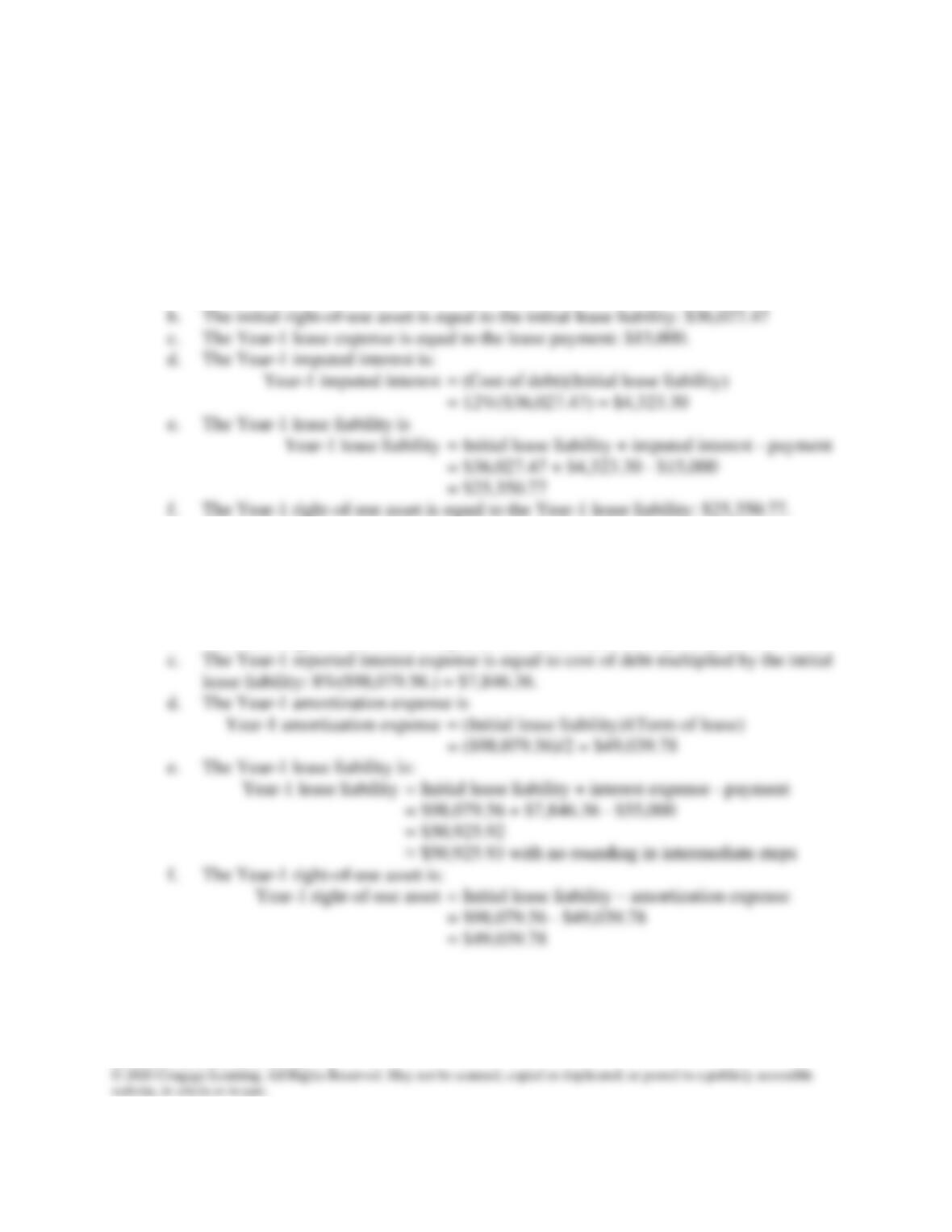
19-2 Purchase price = $200,000
Tax rate = 25%
Cost of debt = 9%
Depreciation rates
Year 0
Year 1
Year 2
Year 3
Year 4
0.3333
0.4445
0.1481
0.0741
Intermediate calculations
Depreciation expense =
Depr. Rate (Purchase
price)
$66,660
$88,900
$29,620
$14,820
Depreciation tax shield =
Depr.(Tax rate)
$16,665
$22,225
$7,405
$3,705
PV of after-tax loan pmts =
purchase price
After-tax cost of debt =
(Cost of debt)(1-T)
Answers and Solutions: 19 – 6
19-3 The initial lease liability is the present value of the lease payments discounted at the cost
of debt. Set N = 14, I/YR = 9%%, PMT = $3,653, FV = 0, and solve for PV = $28,442.81
NAL for finance lease = Purchase price − Initial lease liability
=$30,000 −$28,442.8 = $1,557.2
19-4
a. The initial lease liability is equal to the present value of the lease payments when
discounted at the cost of debt. Set N = 3, I/YR = 12, PMT = 15000, FV = 0, and
solve for PV = $36,027.47
19-5
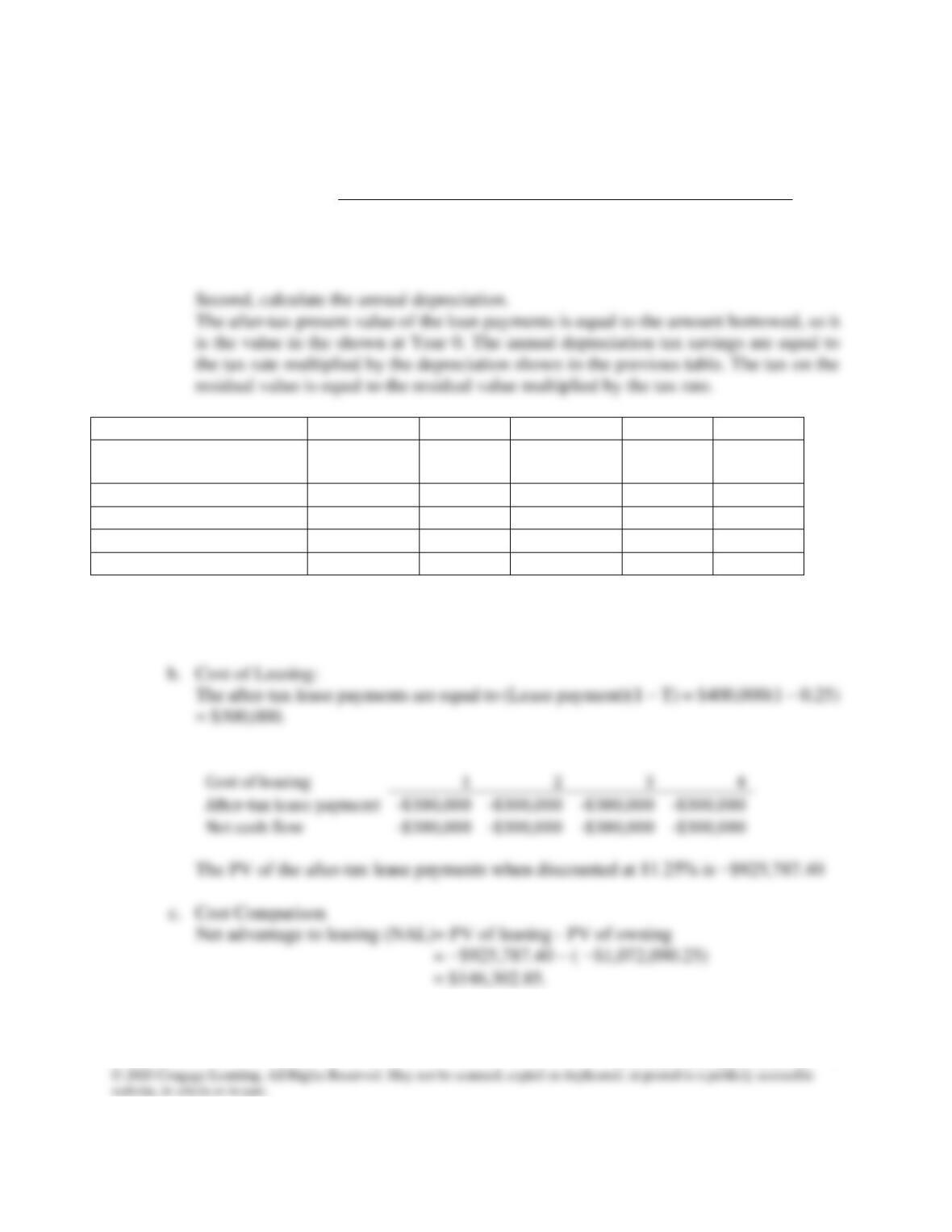
a. The initial lease liability is equal to the present value of the lease payments when
discounted at the cost of debt. Set N = 2, I/YR = 8, PMT = 55000, FV = 0, and solve
for PV = $98,079.56.
b. The initial right-of-use asset is equal to the initial lease liability: $98,079.56.
Answers and Solutions: 19 – 7
19-6
a. Cost of Owning:
First, calculate the annual depreciation.
0
1
2
3
4
Depreciation Schedule
33.33%
44.45%
14.81%
7.41%
Depreciation
$499,950
$666,750
$222,150
$111,150
Book Value
$1,500,000
$1,000,050
$333,300
$111,150
$0
Cost of Owning
0
1
2
3
4
After tax loan payments =
purchase price =
-$1,500,000
Depreciation Tax savings
$124,988
$166,688
$55,538
$27,788
Residual Value
$250,000
Tax on residual value
-$62,500
Net cash flow
-$1,500,000
$124,988
$166,688
$55,538
$215,288
Cost of leasing
After-tax lease payment
-$300,000
-$300,000
-$300,000
-$300,000
Net cash flow
-$300,000
-$300,000
-$300,000
-$300,000
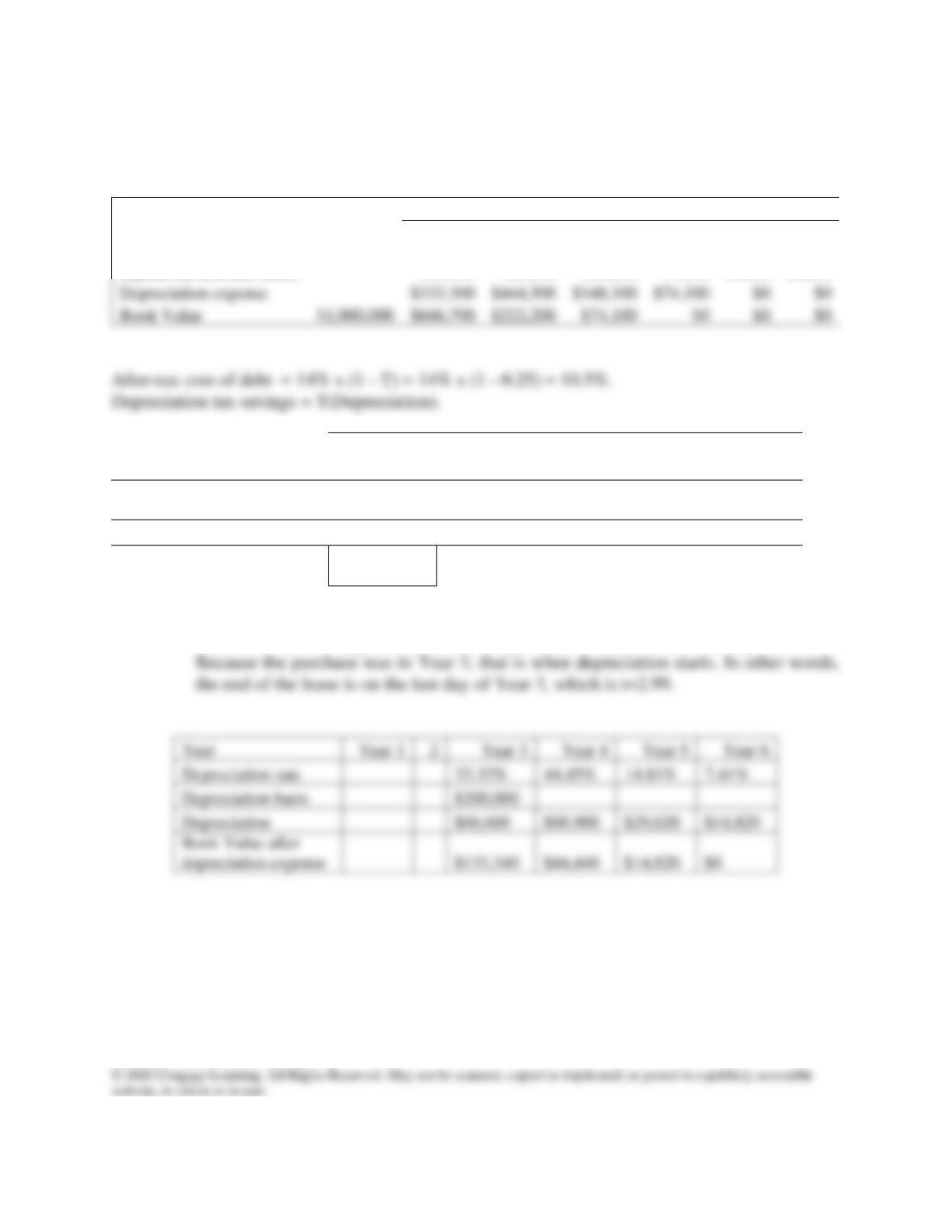
The after-tax cost of debt is rd(1 – T) = 15%(1 – 0.25) = 11.25%.
The NPV of the after-tax cash flows when discounted at 11.25% is −$1,072,090.25.
Answers and Solutions: 19 – 8
19-7
a.
First, calculate the annual depreciation.
Year:
1
2
3
4
5
6
Depreciation rate for
purchase at Year 0 (rates
depend on MACRS class)
33.33%
44.45%
14.81%
7.41%
0.00%
0.00%
Depreciation expense
$333,300
$444,500
$148,100
$74,100
Book Value
$1,000,000
$666,700
$222,200
$74,100
$0
0
1
2
3
4
5
6
Purchase price
-$1,000,000
Tax savings due to
depreciation
$83,325
$111,125
$37,025
$18,525
$0
$0
Net cash flow of owning
-$1,000,000
$83,325
$111,125
$37,025
$18,525
$0
$0
PV of owning @ after-tax
cost of debt
-$793,716.27
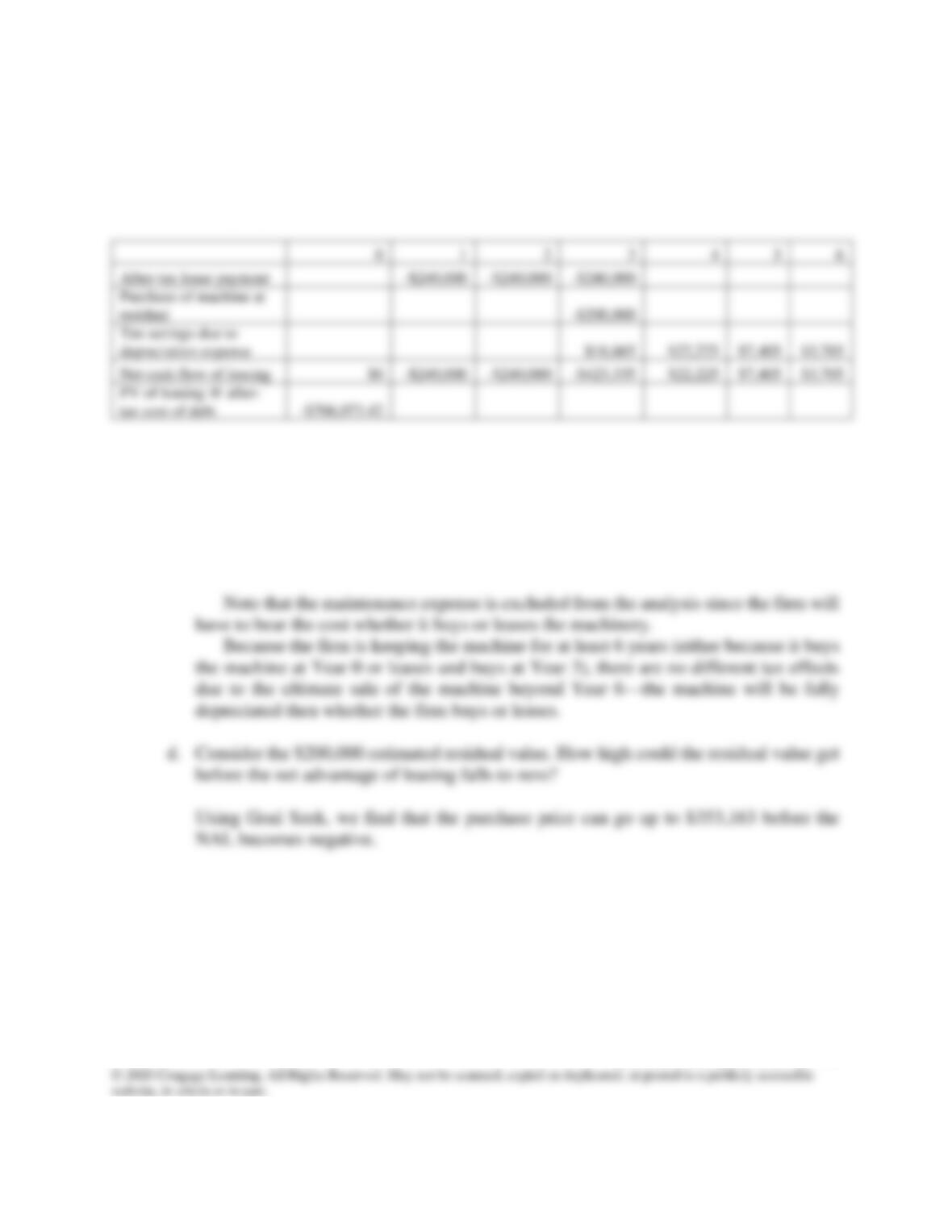
b. First, calculate the depreciation after the purchase is made on the last day of Year 3.
Answers and Solutions: 19 – 9
Now calculate the cost of owning.
The after-tax lease payment is equal to (Lease payment)(1 – T) = $320,000(1 – 0.25) =
$240,000.
The tax saving dues to depreciation are equal to the depreciation expense multiplied by
the tax rate.
c. Net advantage to leasing = PV of leasing – PV of owning
= −$706,073.42 − (−$793,716.27 ) = $87,642.85.
Because the NAL is positive, the company should choose the lease.
Note that the maintenance expense is excluded from the analysis since the firm will

Answers and Solutions: 19 – 10
SOLUTION TO SPREADSHEET PROBLEM
19-8 The detailed solution for the spreadsheet problem, Ch19 P08 Build a Model
Solution.xlsx, is available on the textbook’s web site.

Mini Case: 19 – 11
MINI CASE
Lewis Securities Inc. has decided to acquire a new market data and quotation system for its
Richmond home office. The system receives current market prices and other information
from several on-line data services, then either displays the information on a screen or stores
it for later retrieval by the firm’s brokers. The system also permits customers to call up
current quotes on terminals in the lobby.
The equipment costs $1,000,000, and, if it were purchased, Lewis could obtain a term
loan for the full purchase price at a 10 percent interest rate. Although the equipment has a
six-year useful life, it is classified as a special-purpose computer, so it falls into the MACRS
3-year class. If the system were purchased, a 4-year maintenance contract could be obtained
at a cost of $20,000 per year, payable at the beginning of each year. The equipment would be
sold after 4 years, and the best estimate of its residual value at that time is $200,000.
However, since real-time display system technology is changing rapidly, the actual residual
value is uncertain.
As an alternative to the borrow-and-buy plan, the equipment manufacturer informed
Lewis that Consolidated Leasing would be willing to write a 4-year guideline lease on the
equipment, including maintenance, for payments of $260,000 at the beginning of each year.
Lewis’s marginal federal-plus-state tax rate is 40 percent. You have been asked to analyze
the lease-versus-purchase decision, and in the process to answer the following questions:
a. 1. Who are the two parties to a lease transaction?
Mini Case: 19 – 12
a. 2. What are the four primary types of leases, and what are their characteristics?
Answer: The four primary types of leases are operating, finance, sale and leaseback, and
combination. An operating lease, sometimes called a service lease, provides for both
a. 3. How are leases classified for tax purposes?
Answer: A tax-oriented lease (also called a guideline lease) is a lease that meets all of the IRS
a. 4. What effect does leasing have on a firm’s balance sheet?
Answer: Virtually all leases longer than a year must be capitalized, which means that the present
a. 5. What effect does leasing have on a firm’s capital structure?
Answer: Leasing is a substitute for debt financing, so leasing increases a firm’s financial
Mini Case: 19 – 13
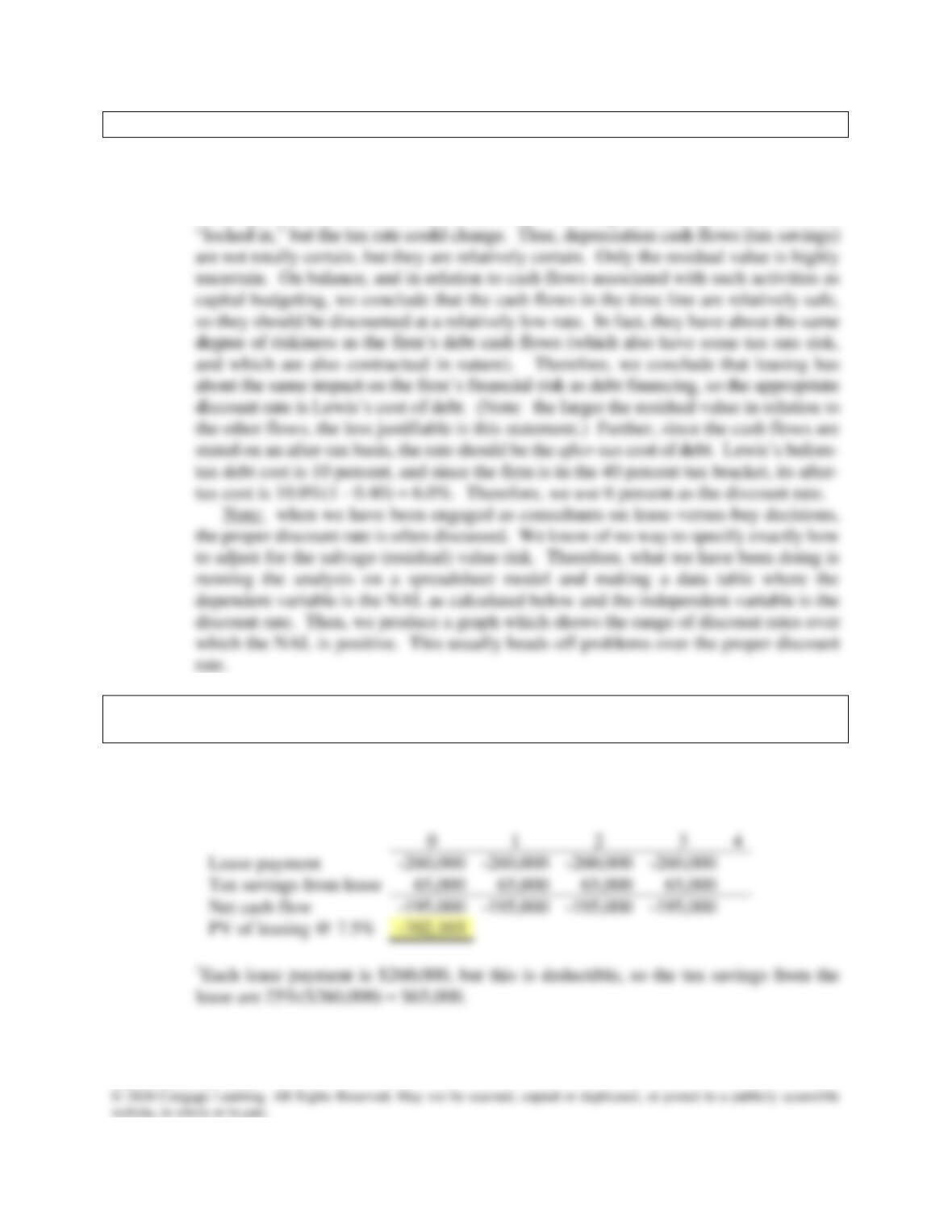
b. 1. What is the present value of owning the equipment? (Hint: set up a time line
which shows the net cash flows over the period t = 0 to t = 4, and then find the PV
of these net cash flows, or the PV cost of owning.)
Answer: To develop the cost of owning, we begin by constructing the depreciation schedule:
depreciable basis = $1,000,000.
MACRS Depreciation End-Of-Year
Year Rate Expense Book Value
1 0.3333 $ 333,300 $666,700
Mini Case: 19 – 14
b. 2. Explain the rationale for the discount rate you used to find the PV.
Answer: The proper discount rate depends on (1) the riskiness of the cash flow stream and (2)
the general level of interest rates. The loan payments and the maintenance costs are
fixed by contract, hence are not at all risky. The depreciation deductions are also
c. What is Lewis’s present value of leasing the equipment? (Hint: again, construct
a time line.)
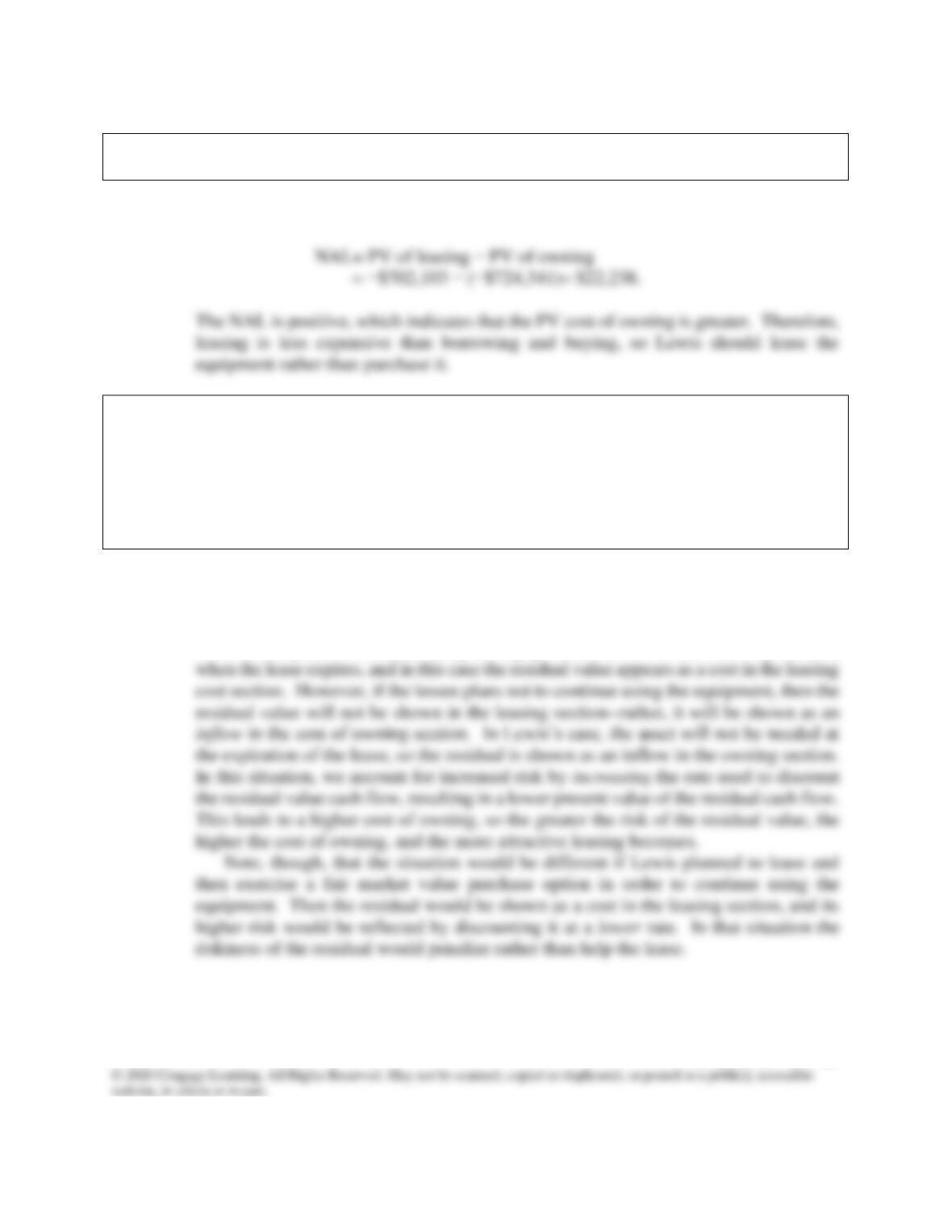
Answer: If Lewis leased the equipment, its only cash flows would be the after-tax lease
payments:
Mini Case: 19 – 15
d. What is the net advantage to leasing (NAL)? Does your analysis indicate that
Lewis should buy or lease the equipment? Explain.
Answer: The net advantage to leasing (NAL) is $18,751:
e. Now assume that the equipment’s residual value could be as low as $0 or as high
as $400,000, but that $200,000 is the expected value. Since the residual value is
riskier than the other cash flows in the analysis, this differential risk should be
incorporated into the analysis. Describe how this could be accomplished. (No
calculations are necessary, but explain how you would modify the analysis if
calculations were required.) What effect would increased uncertainty about the
residual value have on Lewis’s lease-versus-purchase decision?
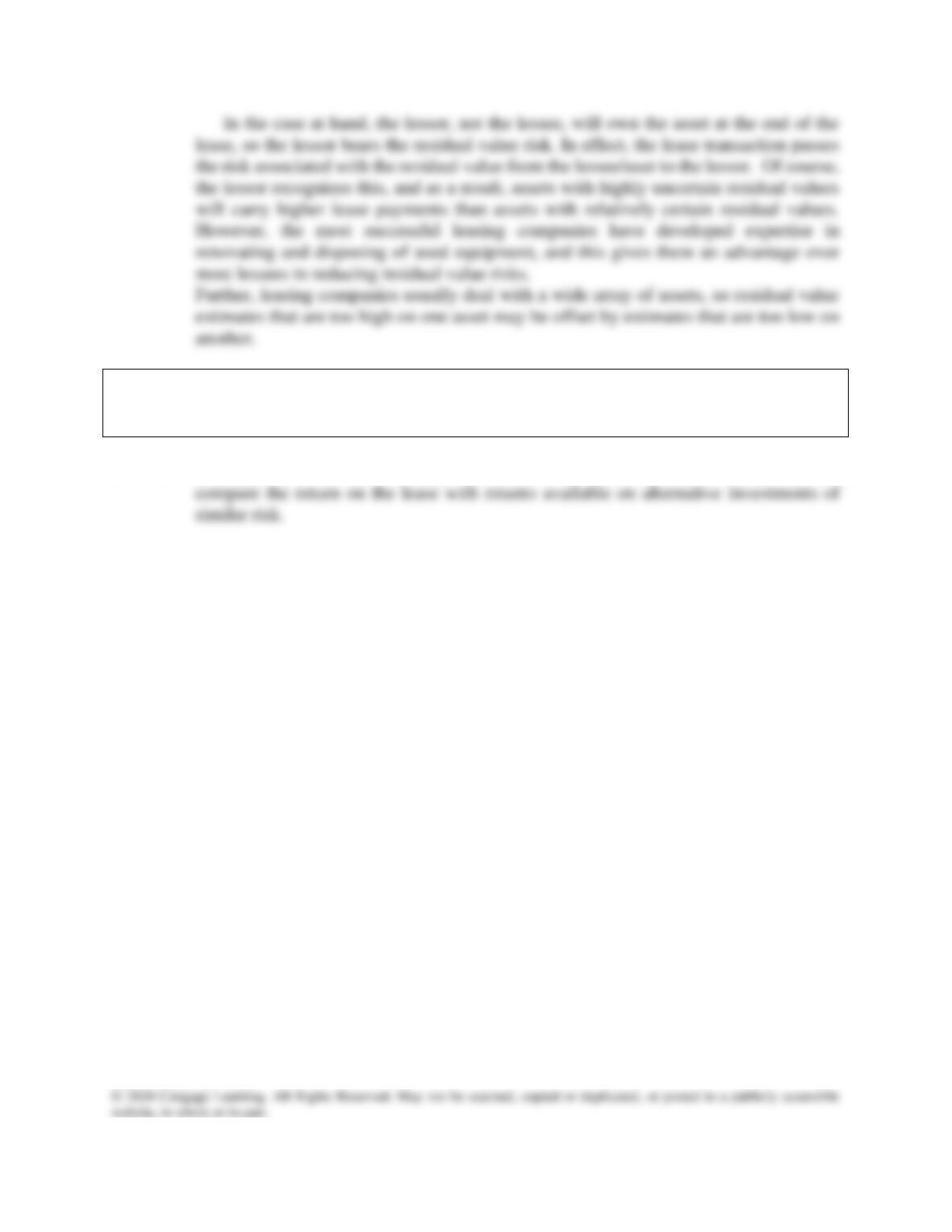
Answer: First, note that the residual value in a lease analysis will be shown either in the “cost of
owning section” or in the “cost of leasing” section, depending on whether or not the
company plans to continue using the leased asset at the expiration of the basic lease.
If the lessee plans to continue using the equipment, then it will have to be purchased
Mini Case: 19 – 16
f. The lessee compares the present value of owning the equipment with the present
value of leasing it. Now put yourself in the lessor’s shoes. In a few sentences, how
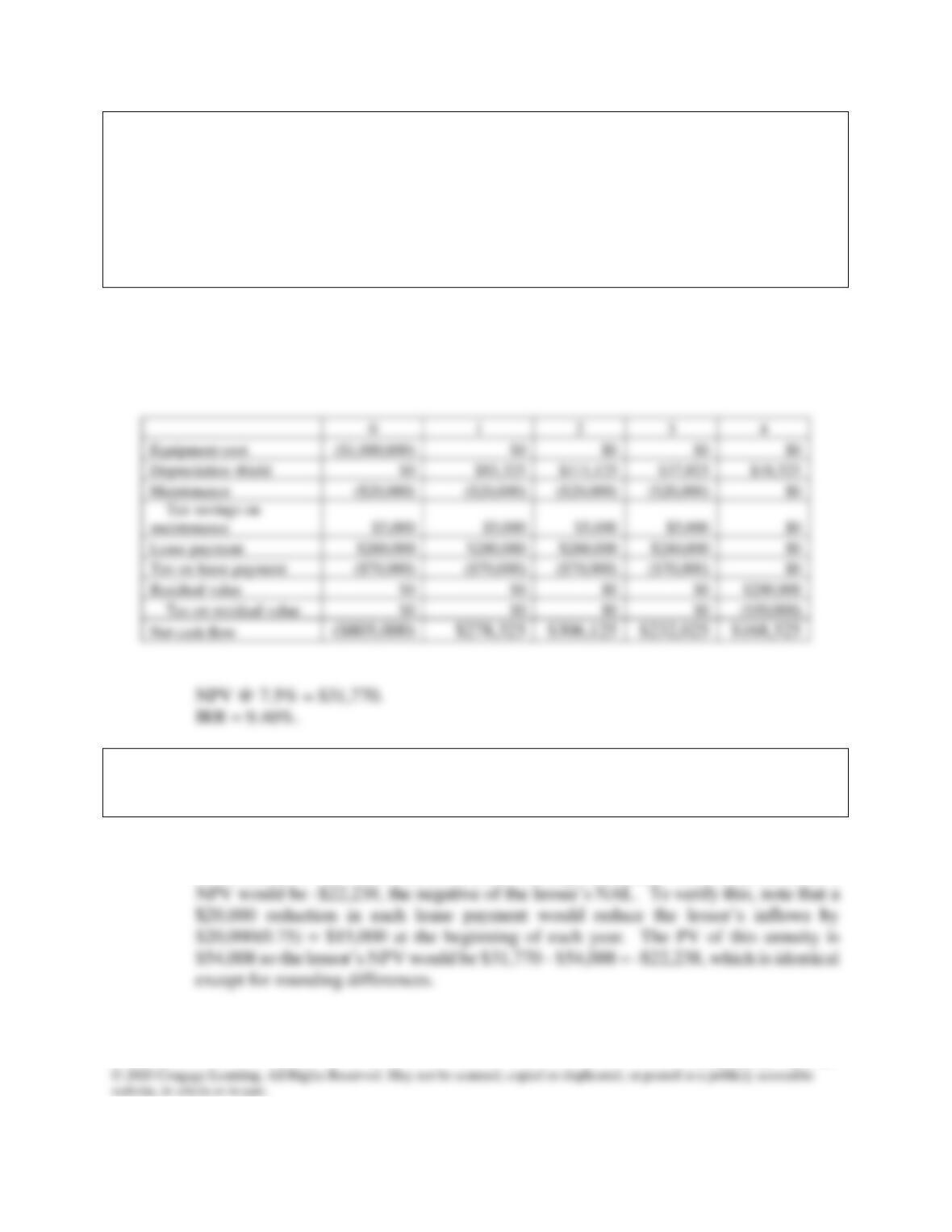
should you analyze the decision to write or not write the lease?
Answer: The lessor should view “writing” the lease as an investment, so the lessor should
Mini Case: 19 – 17
g. 1. Assume that the lease payments were actually $280,000 per year, that
Consolidated Leasing is also in the 25 percent tax bracket, and that it also
forecasts a $200,000 residual value. Also, to furnish the maintenance support,
Consolidated would have to purchase a maintenance contract from the
manufacturer at the same $20,000 annual cost, again paid in advance.
Consolidated Leasing can obtain an expected 10 percent pre-tax return on
investments of similar risk. What would Consolidated’s NPV and IRR of leasing
be under these conditions?
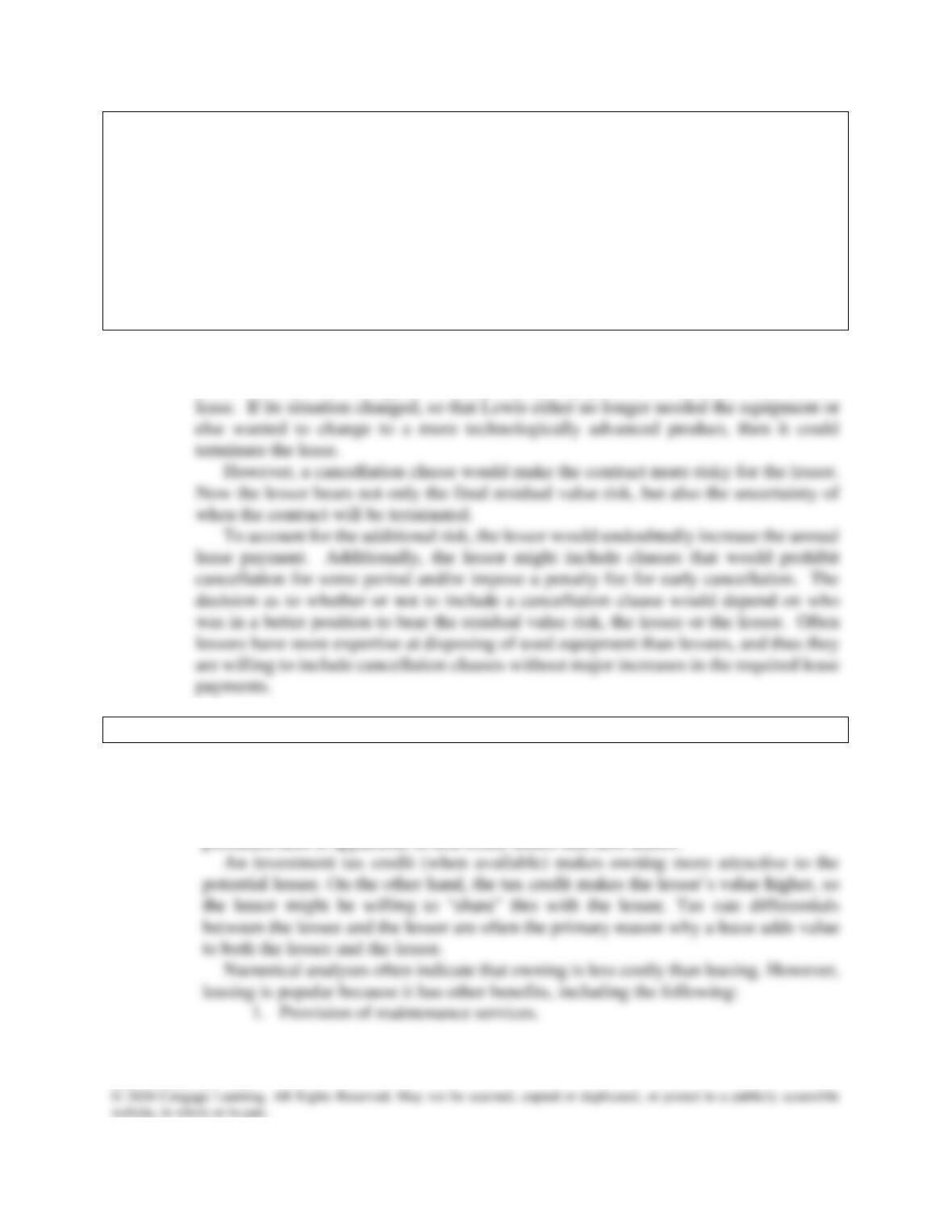
Answer: The lessor must invest $1,000,000 to buy the equipment, but then it expects to receive
tax benefits and lease payments over the life of the lease. Note that the depreciation
expenses calculated earlier also apply to the lessor, so we have this cash flow stream:
g. 2. What do you think the lessor’s NPV would be if the lease payment were set at
$260,000 per year? (Hint: the lessor’s cash flows would be a “mirror image” of
the lessee’s cash flows.)
Answer: With lease payments of $260,000, the lessor’s cash flows would be the “mirror image”
of the lessee’s NAL—the same dollars, but with signs reversed. Therefore, the lessor’s
Mini Case: 19 – 18
h. Lewis’s management has been considering moving to a new downtown location,
and they are concerned that these plans may come to fruition prior to the
expiration of the lease. If the move occurs, Lewis would buy or lease an entirely
new set of equipment, and hence management would like to include a cancellation
clause in the lease contract. What impact would such a clause have on the riskiness
of the lease from Lewis’s standpoint? From the lessor’s standpoint? If you were
the lessor, would you insist on changing any of the lease terms if a cancellation
clause were added? Should the cancellation clause contain any restrictive
covenants and/or penalties of the type contained in bond indentures or provisions
similar to call premiums?
Answer: A cancellation clause would lower the risk of the lease to Lewis, the lessee, because
then it would not be obligated to make the lease payments for the entire term of the
h. What are some other issues in lease analysis?
Answer: Higher residual values make leasing less attractive to the lessee. Lease financing
often is more available or a “better” deal than debt financing. The lease analysis
presented here is applicable to real estate leases and auto leases.
Mini Case: 19 – 19