Chapter 19
Bank Management
Outline
Bank Goals, Strategy, and Governance
Aligning Managerial Compensation with Bank Goals
Bank Strategy
Managing Liquidity
Managing Interest Rate Risk
Methods Used to Assess Interest Rate Risk
Managing Credit Risk
Managing Market Risk
Measuring Market Risk
Methods Used to Reduce Market Risk
Integrated Bank Management
Application
Managing Risk of International Operations
Exchange Rate Risk
Settlement Risk
Chapter 19: Bank Management ❖ 2
Key Concepts
2. Describe liquidity risk and explain how banks manage it.
4. Describe credit risk and explain how banks manage it.
POINT/COUNTER-POINT:
Can Bank Failures be Avoided?
POINT: No. Banks are in the business of providing credit. When economic conditions deteriorate, there
will be loan defaults and some banks will not be able to survive.
WHO IS CORRECT? Use the Internet to learn more about this issue and then formulate your own
opinion.
ANSWER: Many arguments are possible. A bank may be able to avoid a large amount of loan defaults by
Questions
1. Integrating Asset and Liability Management. What is accomplished when a bank integrates its
liability management with its asset management?
ANSWER: Integrating asset and liability decisions can improve performance. For example, the
rate-sensitive assets, such as floating-rate loans. This strategy reduces interest rate risk.
2. Liquidity. Given the liquidity advantage of holding Treasury bills, why do banks hold only a
relatively small portion of their assets as T-bills?
ANSWER: Treasury bill yields are sometimes lower than a bank’s cost of obtaining funds. Thus,

Chapter 19: Bank Management ❖ 3
3. Illiquidity. How do banks resolve illiquidity problems?
ANSWER: Banks can resolve illiquidity by selling some assets to obtain funds or borrowing funds in
4. Managing Interest Rate Risk. If a bank expects interest rates to decrease over time, how might it
alter the rate sensitivity of its assets and liabilities?
5. Rate Sensitivity. List some rate-sensitive assets and some rate-insensitive assets of banks.
6. Managing Interest Rate Risk. If a bank is very uncertain about future interest rates, how might it
insulate its future performance from future interest rate movements?
7. Net Interest Margin. What is the formula for the net interest margin? Explain why it is closely
monitored by banks.
ANSWER: The net interest margin is closely monitored by banks because it usually is the primary
8. Managing Interest Rate Risk. Assume that a bank expects to attract most of its funds through short-
term CDs and would prefer to use most of its funds to provide long-term loans. How could it follow
this strategy and still reduce interest rate risk?
9. Bank Exposure to Interest Rate Movements. According to this chapter, have banks been able to
insulate themselves against interest rate movements? Explain.
ANSWER: Banks can attempt to minimize their exposure to interest rate risk because they have the
10. Gap Management. What is a bank’s gap, and what does it attempt to determine? Interpret a negative
gap. What are some limitations of measuring a bank’s gap?

Chapter 19: Bank Management ❖ 4
ANSWER: A bank gap is measured to determine its exposure to interest rate risk. A negative gap
11. Duration. How do banks use duration analysis?
ANSWER: Banks measure duration of assets and liabilities so that they can determine whether their
12. Measuring Interest Rate Risk. Why do loans that can be prepaid on a moment’s notice complicate
the bank’s assessment of interest rate risk?
ANSWER: A fixed-rate loan may be perceived as rate insensitive. Yet, if it is prepaid, the funds are
13. Bank Management Dilemma. Can a bank simultaneously maximize return and minimize credit risk?
If not, what can it do instead?
ANSWER: Banks cannot maximize return unless they incur some credit risk, so they must balance
14. Bank Exposure to Economic Conditions. As economic conditions change, how do banks adjust
their asset portfolio?
15. Bank Loan Diversification. What are the two ways in which a bank should diversify its loans? Why?
Is international diversification of loans a viable strategy for dealing with credit risk? Defend your
answer.
ANSWER: Banks should diversify across geographic regions and industries, to reduce exposure to
specific events.
16. Commercial Borrowing. Do all commercial borrowers receive the same interest rate on loans?
ANSWER: Interest rates on loans at a given point in time are dependent on the degree of risk of the
Chapter 19: Bank Management ❖ 5
17. Bank Dividend Policy. Why might a bank retain some excess earnings rather than distribute those
funds as dividends?
18. Managing Interest Rate Risk. If a bank has more rate-sensitive liabilities than rate-sensitive assets,
what will happen to its net interest margin during a period of rising interest rates? During a period of
declining interest rates?
19. Floating-Rate Loans. Does the use of floating-rate loans eliminate interest rate risk? Explain.
ANSWER: The use of floating-rate loans may reduce interest rate risk, but not eliminate it, because
20. Managing Exchange Rate Risk. Explain how banks become exposed to exchange rate risk.
ANSWER: When banks accept deposits in one currency and provide loans in a different currency,
Advanced Questions
21. Bank Exposure to Interest Rate Risk. Oregon Bank has branches overseas that concentrate in short-
term deposits in dollars and floating-rate loans in British pounds. Because it maintains rate-sensitive
assets and liabilities of equal amounts, the bank believes it has essentially eliminated its interest rate
risk. Do you agree? Explain.
22. Managing Interest Rate Risk. Dakota Bank has a branch overseas with the following balance sheet
characteristics: 50 percent of the liabilities are rate sensitive and denominated in Swiss francs; the
remaining 50 percent of liabilities are rate insensitive and are denominated in dollars. With regard to
assets, 50 percent are rate-sensitive and are denominated in dollars; the remaining 50 percent of assets
are rate-insensitive and are denominated in Swiss francs.
a. Is the performance of this branch susceptible to interest rate movements? Explain.
ANSWER: Dakota Bank is susceptible to interest rate movements. If Swiss interest rates rise, the

Chapter 19: Bank Management ❖ 6
b. Assume that Dakota Bank plans to replace its short-term deposits denominated in U.S. dollars
with short-term deposits denominated in Swiss francs, because Swiss interest rates are currently
lower than U.S. interest rates. The asset composition would not change. This strategy is intended
to widen the spread between the rate earned on assets and the rate paid on liabilities. Offer your
insight into how this strategy could backfire.
ANSWER: The strategy could backfire if the Swiss franc appreciates against the dollar over time,
c. One consultant has suggested to Dakota Bank that it could avoid exchange rate risk by making
loans in whatever currencies it receives as deposits. In this way, it will not have to exchange one
currency for another. Offer your insight on whether there are any disadvantages to this strategy.
ANSWER: One disadvantage is that the bank may not be able to satisfy some potential borrowers
CRITICAL THINKING QUESTION
Managing Bank Capital Some bank managers argue that U.S. bank’s access to capital is restricted
because the capital requirements imposed by U.S. regulators are too high. Write a short essay that can
offer logical insight into why high capital requirements may restrict a bank’s access to capital. Also,
describe why high capital requirements for all banks in the U.S. might actually allow the banks easier
access to capital. Which of the arguments do you believe?
ANSWER
If capital requirements are high, the bank’s degree of financial leverage is more limited, and banks may
Interpreting Financial News
Interpret the following statements made by Wall Street analysts and portfolio managers.
a. “The bank’s biggest mistake was that it did not recognize that its forecast of a strong local real
estate market and declining interest rates could be wrong.”

Chapter 19: Bank Management ❖ 7
b. “Banks still need some degree of interest rate risk to be profitable.”
c. “The bank used interest rate swaps so that its spread is no longer exposed to interest rate
movements. However, its loan volume and therefore its profits are still exposed to interest rate
movements.”
Managing in Financial Markets
As a manager of Stetson Bank, you are responsible for hedging Stetson’s interest rate risk. Stetson has
forecasted its cost of funds as follows:
Year Cost of Funds
1 6%
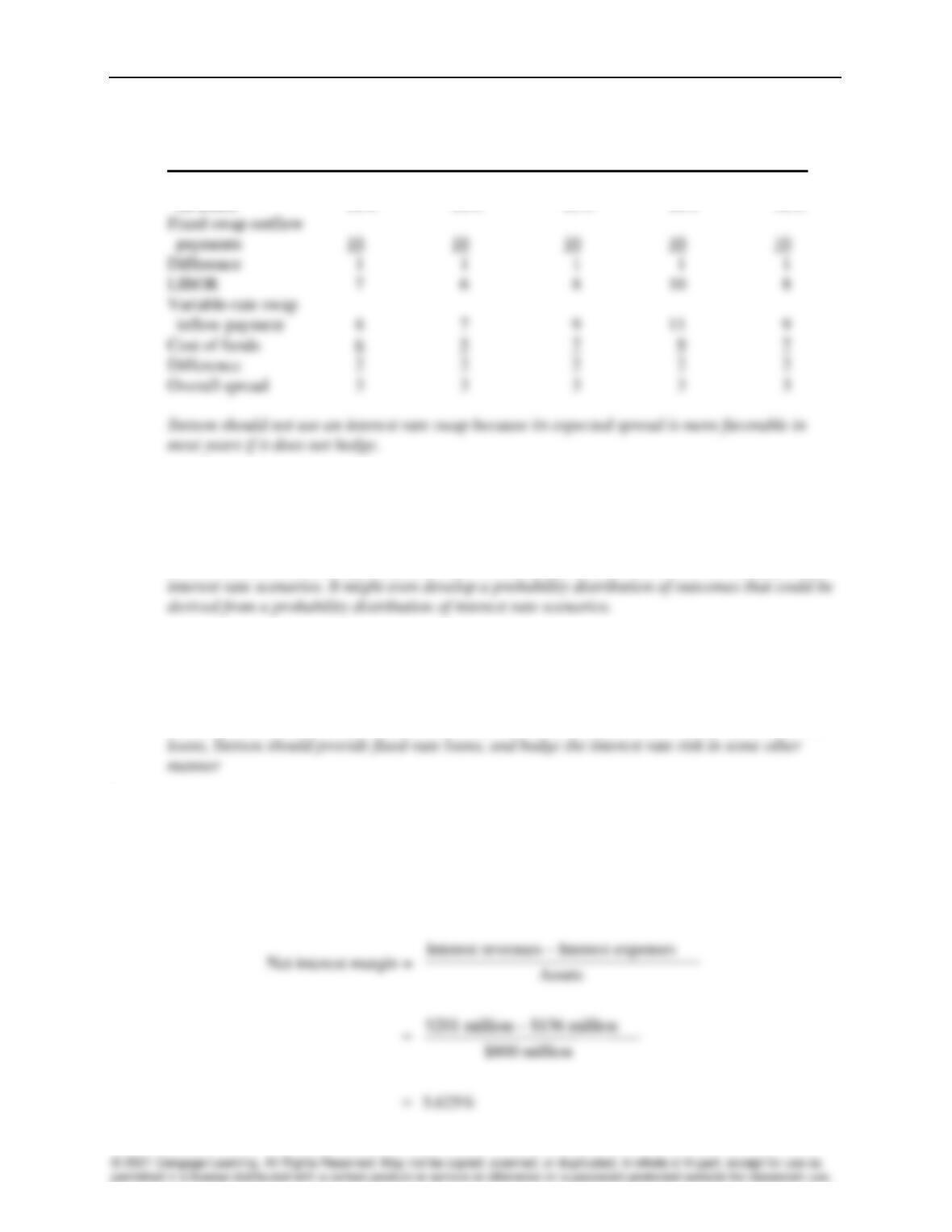
a. Determine the spread that Stetson would earn each year if it uses an interest rate swap to hedge all
of its interest rate risk. Would you recommend that Stetson use an interest rate swap?
Chapter 19: Bank Management ❖ 8
Stetson’s overall spread is derived as follows:
Year 1 Year 2 Year 3 Year 4 Year 5
Average rate earned
b. Although Stetson has forecasted its cost of funds, it recognizes that its forecasts may be
inaccurate. Offer a method that Stetson can use to assess the potential results from using an
interest rate swap while accounting for the uncertainty surrounding future interest rates.
Stetson could use sensitivity analysis to determine its performance based on a variety of possible
c. Stetson is exposed to interest rate risk because it uses some of its funds to make fixed-rate loans,
as some borrowers prefer fixed rates. An alternative method of hedging interest rate risk is to use
adjustable-rate loans. Would you recommend that Stetson use only adjustable-rate loans to hedge
its interest rate risk? Explain.
No. Stetson needs to accommodate the needs of its borrowers. If the borrowers prefer fixed-rate
.
Problems
1. Net Interest Margin. Suppose a bank earns $201 million in interest revenue but pays $156 million in
interest expense. It also has $800 million in earning assets. What is its net interest margin?
ANSWER:

Chapter 19: Bank Management ❖ 9
2. Calculating Return on Assets. If a bank earns $169 million net profit after tax and has $17 billion
invested in assets, what is its return on assets?
ANSWER:
ROA
=
Net profit after taxes
Total assets
3. Calculating Return on Equity. If a bank earns $75 million net profits after tax and has $7.5 billion
invested in assets and $600 million equity investment, what is its return on equity?
4. Managing Risk. Use the balance sheet for San Diego Bank in Exhibit A (below and next page) and
the industry norms in Exhibit B (page following Exhibit A) to answer the following questions:
a. Estimate the gap and determine how San Diego Bank would be affected by an increase in interest
rates over time.
ANSWER:
Gap = Rate-sensitive assets – Rate-sensitive liabilities
b. Assess San Diego Bank’s credit risk. Does it appear high or low relative to the industry? Would
San Diego Bank perform better or worse than other banks during a recession?
ANSWER: The bank has a greater proportion of commercial and consumer loans than the industry
c. For any type of bank risk that appears to be higher than the industry, explain how the bank’s
balance sheet could be restructured to reduce this risk.

Chapter 19: Bank Management ❖ 10
ANSWER: The bank could reduce its interest rate risk by using floating-rate loans and by trying to
Exhibit A: Balance Sheet for San Diego Bank
(in Millions of Dollars)
Assets Liabilities and Capital
Required
reserves
$800
Demand deposits
$800
loans
Floating-rate
None
Fixed-rate
$7,000
MMDAs
$6,000
Total
$7,000
Consumer loans
$5,000
Short-term
$9,000
From 1 to 5 years years
None
Mortgages
Total
$9,000
Floating-rate
None
Fixed-rate
$2,000
Federal funds
$500
Total
$2,000
Long-term bonds
$400
Treasury
securities
Short-term
None
Capital
$800
Long-term
$1,000
Total
$1,000
High-rated
None
Moderate-rated
$2,000
Total
$2,000
municipal
securities

Chapter 19: Bank Management ❖ 11
High-rated
None
Moderate-rated
$1,700
Total
$1,700
$500
TOTAL ASSETS
$20,000
AND CAPITAL
$20,000

Chapter 19: Bank Management ❖ 12
Exhibit B: Industry Norms in Percentage Terms
Assets Liabilities and Capital
Required reserves
4%
Demand deposits
17%
Floating-rate
20%
Fixed-rate
11%
MMDAs
20%
Total
31%
Consumer loans
20%
Short-term
35%
From 1 to 5 years
10%
Mortgages
Total
45%
Floating-rate
7%
Fixed-rate
3%
Long-term bonds
2%
Total
10%
Capital
6%
Treasury securities
Short-term
7%
Long-term
8%
Total
15%
Long-term corporate
securities
High-rated
3%
Moderate-rated
2%
Total
Long-term municipal
securities
High-rated
3%
Moderate-rated
2%
Total
5%
Fixed assets
5%
TOTAL LIABILITIES

Chapter 19: Bank Management ❖ 13
5. Measuring Risk. Montana Bank wants to determine the sensitivity of its stock returns to interest rate
movements, based on the following information:
Quarter
Return on Montana Stock
Return on Market
Interest Rate
1
2%
3%
6.0%
2
2
2
7.5
3
–1
–2
9.0
4
0
–1
8.2
5
2
1
7.3
6
–3
–4
8.1
7
1
5
7.4
8
0
1
9.1
9
–2
0
8.2
10
1
–1
7.1
11
3
3
6.4
12
6
4
5.5
Use a regression model in which Montana’s stock return is a function of the stock market return and
the interest rate. Determine the relationship between the interest rate and Montana’s stock return by
assessing the regression coefficient applied to the interest rate. Is the sign of the coefficient positive or
negative? What does it suggest about the bank’s exposure to interest rate risk? Should Montana Bank
be concerned about rising or declining interest rate movements in the future?
ANSWER: The coefficient for the market variable is 0.38, while the coefficient for the interest rate
variable is –1.15. The t-statistics for the coefficients suggest significance at the 0.10 level for the
Flow of Funds Exercise
Managing Credit Risk
Recall that Carson Company relies heavily on commercial banks for loans. When the company was first
established with equity funding from its owners, Carson could easily obtain debt financing, because the
Chapter 19: Bank Management ❖ 14
a. Explain the difference in the willingness of banks to provide loans to Carson Company. Why do
banks sometimes differ in their conclusions when they are assessing the same information about a
firm that wants to borrow funds?
First, some banks may be more optimistic about economic conditions than other banks, and
b. Consider the flow of funds for a publicly traded bank that is a key lender to Carson Company.
This bank received equity funding from shareholders, which it uses to establish its business. It
channels bank deposit funds, which are insured by the FDIC, to provide loans to Carson
Company and other firms. The depositors have no idea how the bank uses their funds. Yet, the
FDIC does not prevent the bank from making risky loans. So, who is monitoring the bank? Do
you think the bank is taking more risk than its shareholders desire? How does the FDIC
discourage the bank from taking too much risk? Why might the bank ignore the FDIC’s efforts to
discourage excessive risk taking?
The bank is monitored by its shareholders. It is probably taking the risk that is desired by its
shareholders. Yet, the FDIC may need to intervene if the bank experiences financial problems.