3
4
5
6
7
8
9
10
11
12
13
14
15
16
17
18
19
20
21
22
23
24
25
26
27
28
29
30
31
32
33
34
35
36
37
38
39
40
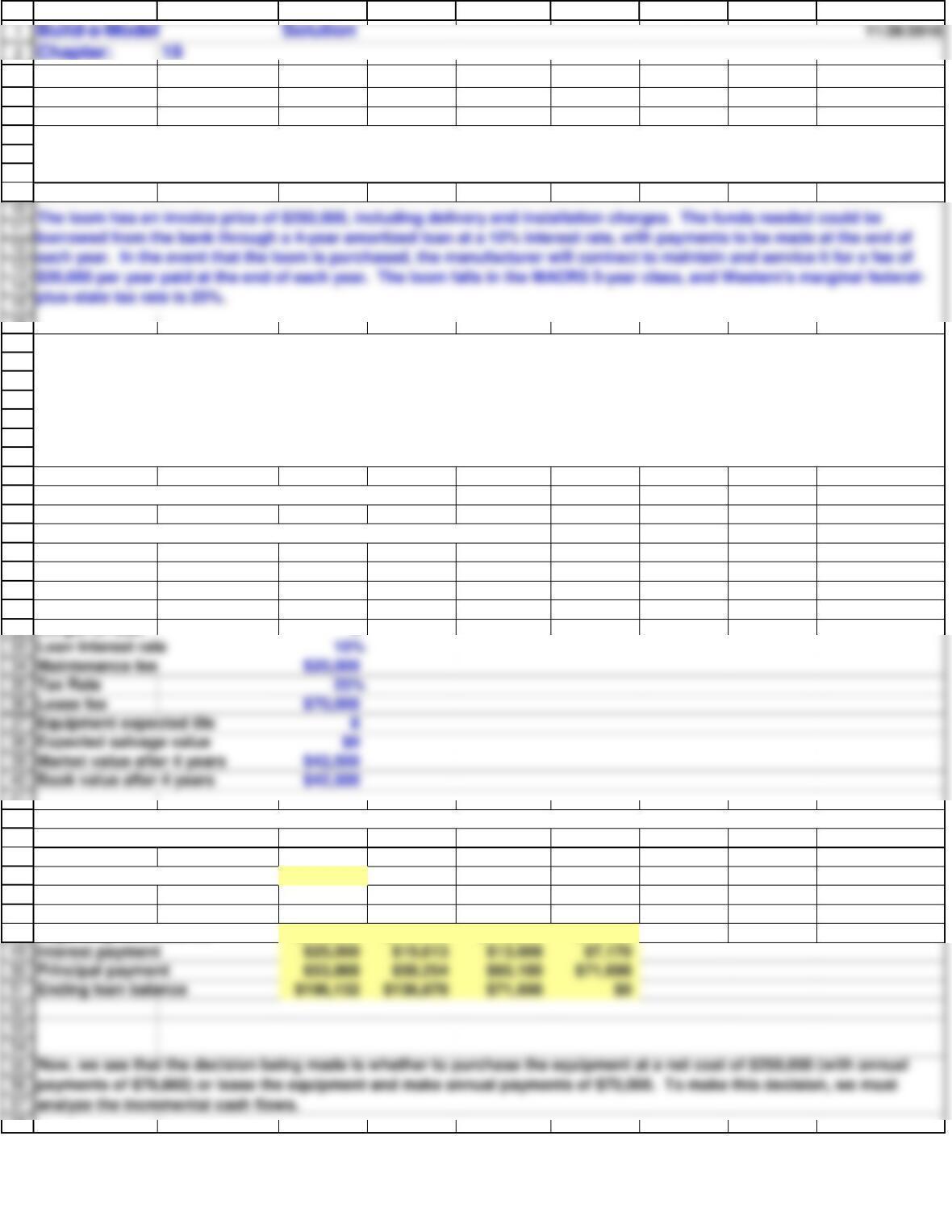
Loan Interest rate 10%
Maintenance fee $20,000
Tax Rate 25%
Lease fee $70,000
Equipment expected life 8
Expected salvage value $0
Market value after 4 years $42,500
Book value after 4 years $42,500
41
42
43
44
45
46
47
48
49
50
51
52
53
54
55
56
57
Interest payment $25,000 $19,613 $13,688 $7,170
Principal payment $53,868 $59,254 $65,180 $71,698
Ending loan balance $196,132 $136,878 $71,698 $0
analyze the incremental cash flows.
58
A B C D E F G H I
Problem: 8
a. Should the loom be leased or purchased?
First, we want to lay out all of the input data in the problem.
INPUT DATA
Invoice Price $250,000
Length of loan 4
First, we can determine the annual loan payment that must be made on the new equipment. We will do so using the
function wizard for PMT.
Annual loan payment = $78,868
Year 1 2 3 4
Beginning loan balance $250,000 $196,132 $136,878 $71,698
As part of its overall plant modernization and cost reduction program, Western Fabrics’ management has decided to install
a new automated weaving loom. In the capital budgeting analysis of this equipment, the IRR of the project was found to
be 20% versus the project’s required return of 12%.
Gardial Automation Inc., maker of the loom, has offered to lease the loom to Westen for $70,000 upon delivery and
installation (at t=0) plus 4 additional annual lease payments of $70,000 to be made at the ends of Years 1 through 4. (Note
that there are 5 lease payments in total.) The lease agreement includes maintenance and servicing. Actually, the loom has
an expected life of eight years, at which time its expected salvage value is zero; however, after 4 years, its market value is
expected to equal its book value of $42,500. Tanner-Woods plans to build and entirely new plant in 4 years, so it has no
interest in either leasing or owning the proposed loom for more than that period.
59
60
61
62
63
64
65
69
70
71
72
73
74
75
76
77
78
79
80
81
82
83
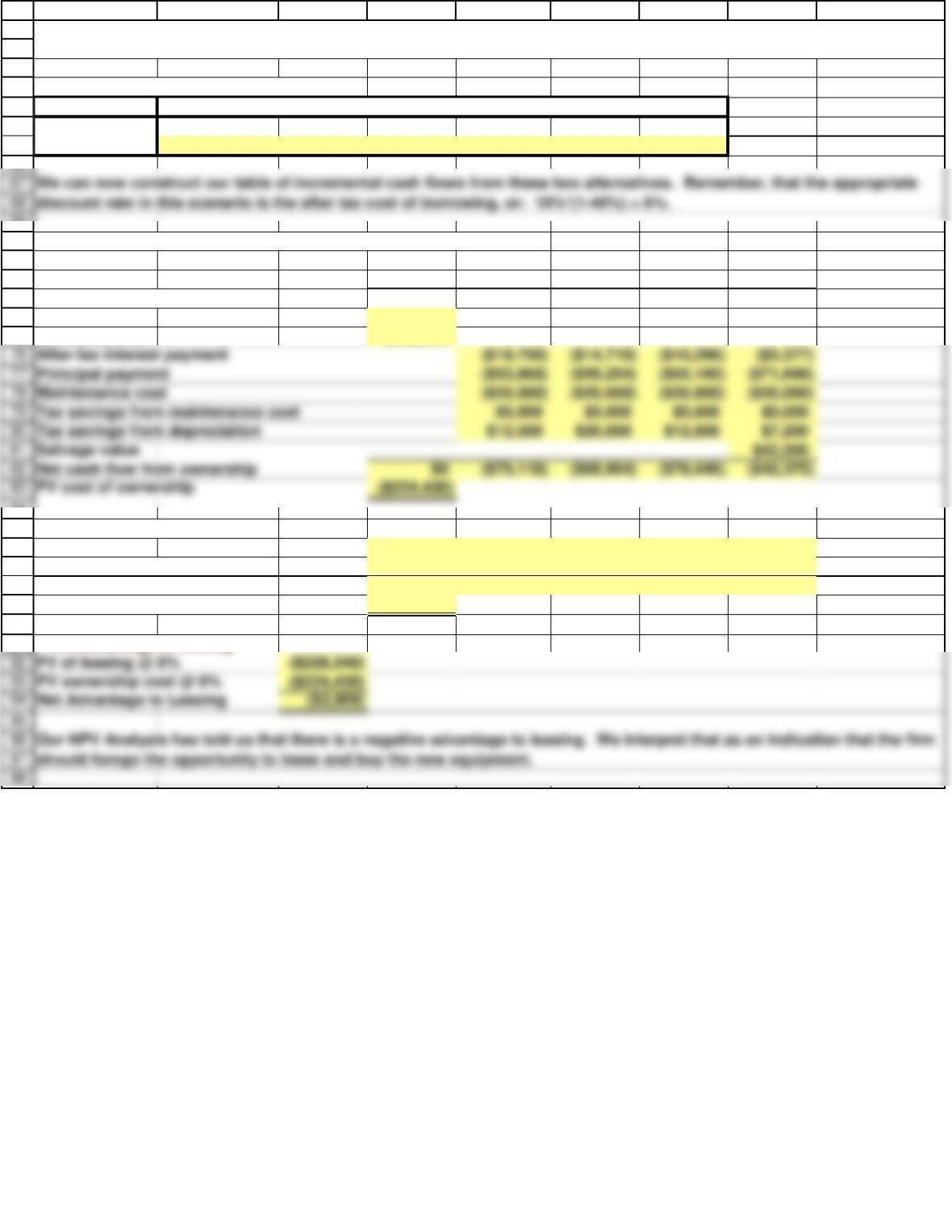
After-tax interest payment ($18,750) ($14,710) ($10,266) ($5,377)
Principal payment ($53,868) ($59,254) ($65,180) ($71,698)
Maintenance cost ($20,000) ($20,000) ($20,000) ($20,000)
Tax savings from maintenance cost $5,000 $5,000 $5,000 $5,000
Tax savings from depreciation $12,500 $20,000 $12,000 $7,200
Salvage value $42,500
Net cash flow from ownership $0 ($75,118) ($68,964) ($78,446) ($42,375)
PV cost of ownership ($224,430)
84
85
86
87
88
89
90
91
92
93
94
96
97
98
PV of leasing @ 6% ($228,340)
PV ownership cost @ 6% ($224,430)
Net Advantage to Leasing ($3,909)
A B C D E F G H I
MACRS 5-year Depreciation Schedule
Year 1 2 3 4 5 6
Depr. Rate 20.00% 32.00% 19.20% 11.52% 11.52% 5.76%
Depr. Exp. $50,000 $80,000 $48,000 $28,800 $28,800 $14,400
NPV LEASE ANALYSIS OF INCREMENTAL CASH FLOWS
Year = 0 1 2 3 4
Present value of ownership
Purchase cost ($250,000)
Loan proceeds $250,000
Present value of leasing
Lease payment ($70,000) ($70,000) ($70,000) ($70,000) ($70,000)
Tax savings from lease payment $17,500 $17,500 $17,500 $17,500 $17,500
Net cash flow from leasing ($52,500) ($52,500) ($52,500) ($52,500) ($52,500)
PV cost of leasing ($228,340)
Net advantage of leasing
Before proceeding with our NPV analysis we must determine the schedule of depreciation charges for this new equipment.
66
67
68
99
100
101
102
103
104
105
106
107
108
119
120
121
122
123
124
125
126
127
128
129
130
131
132
133
134
135
136
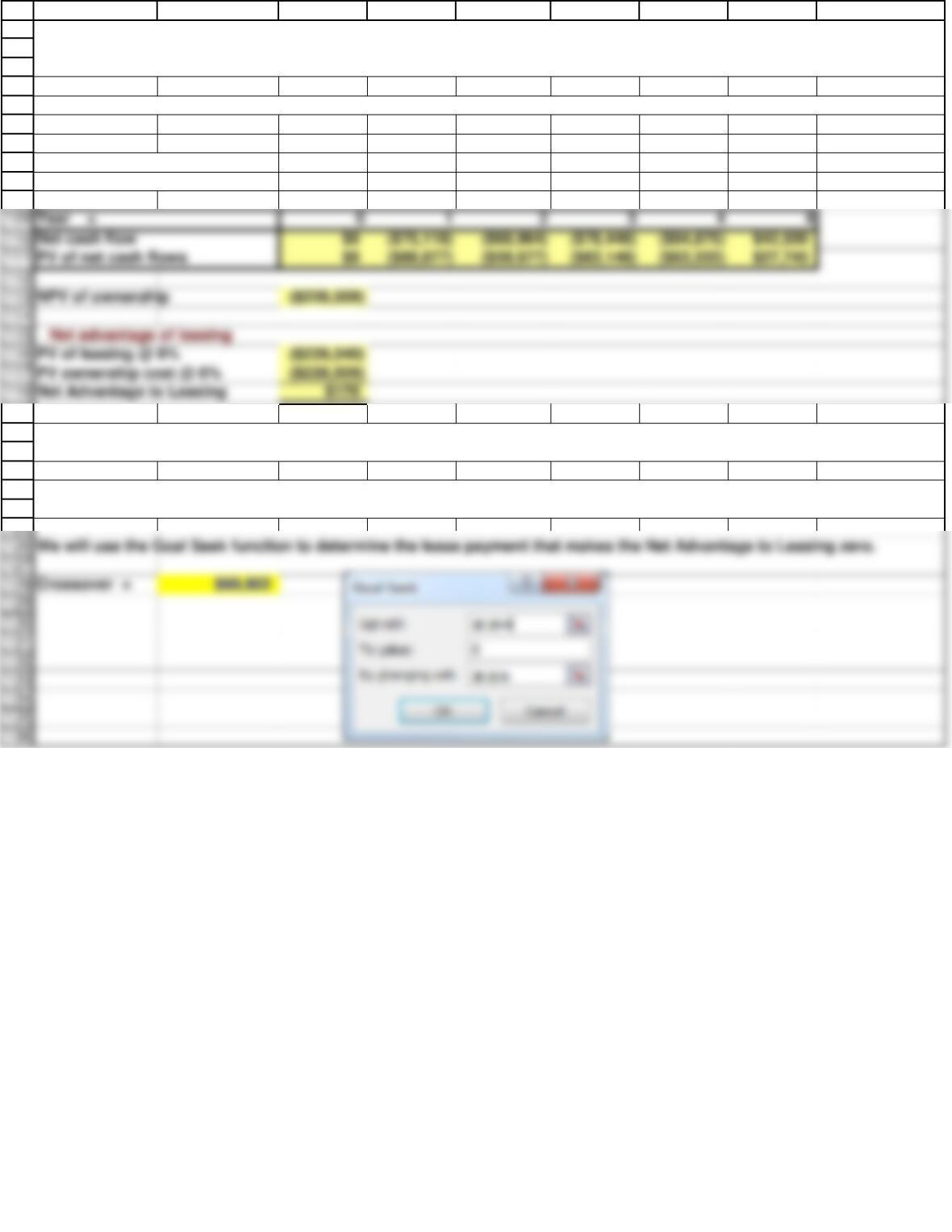
We will use the Goal Seek function to determine the lease payment that makes the Net Advantage to Leasing zero.
Crossover = $68,802
A B C D E F G H I
All cash flows would remain unchanged except that of the salvage value. Our new array of cash flows would resemble the
following:
Standard discount rate 10%
Salvage value rate 15%
Under this new assumption of using a greater discount factor for the salvage value, we find that the firm should lease, and
not buy, the equipment.
c. Assuming that the after-tax cost of debt should be used to discount all anticipated cash flows, at what lease payment
would the firm be indifferent to either leasing or buying?
b. The salvage value is clearly the most uncertain cash flow in the analysis. Assume that the appropriate salvage value
pre-tax discount rate is 15 percent. What would be the effect of a salvage value risk adjustment on the decision?
109
110
111
112
113
114
115
116
117
118
Net cash flow $0 ($75,118) ($68,964) ($78,446) ($84,875) $42,500
NPV of ownership ($228,509)
PV of leasing @ 6% ($228,340)
PV ownership cost @ 6% ($228,509)