Chapter 19
Lease Financing
ANSWERS TO BEGINNING-OF–CHAPTER QUESTIONS
19-1 An operating lease is one that typically requires the lessor to service the equipment, that
has a lease term that is much shorter than the life of the equipment, and that can be cancelled
Before 1973, when FASB 13 was passed, firms could lease on a long-term, non-
cancelable basis, and thus create a long–term liability, yet not show either the leased asset
or the liability on its balance sheet. After FASB 13, most financial or capital leases had to
be shown on the balance sheet, with the leased asset appearing as an asset and the PV of
the future lease payments appearing as a liability. This is called “capitalizing the lease,”
and its purpose was to cause balance sheets to better reflect companies’ actual financial
positions. A lease must be capitalized if any one of the following conditions holds:
• The lease terms effectively transfer ownership of the property from the lessor to the
lessee.
Answers and Solutions: 19 – 1
19-2 A synthetic lease involves the creation of a special purpose entity (SPE) that (1) gets a loan,
often for something like 97% of the cost of the asset which is to be leased plus equity from
some source equal to 3% of the cost, (2) then uses those funds to purchase an asset required
by the SPE’s sponsoring corporation, and (3) then the SPE leases the asset to the
The primary purpose of synthetic loans was to get around FASB 13 and allow
companies to keep debt off their balance sheets. Many of them were sham transactions.
The sponsoring corporation really had an obligation to pay off the SPE’s loan, and that
obligation should have been shown on the firm’s balance sheet.
Enron, Tyco, and many other companies used synthetic leases. These companies often
19-3 Lease analysis involves having the lessee find the NAL and the lessor find the NPV. Under
this analysis, the lessee takes the lease payments as tax deductions and the lessor treats
them as income. Moreover, the lessor depreciates the asset for tax purposes. However,
Answers and Solutions: 19 – 2
• The lease term must not exceed 80% of the asset’s expected life. This limits the number
of years of the lease’s life. For example, if the asset has a 10–year life, the maximum
term for the lease is 8 years.
• The leased asset’s residual value at the end of the lease term must be at least 20% of
the asset’s initial value. For example, if the asset had a cost of $100,000, then its
19-4 The tab labeled “Balance Sheet” in the BOC model shows the situation for two companies
that differ only with respect to whether or not they lease. In the debate leading up to FASB
13 in 1973, some argued that investors were mislead by non-capitalized leases. Others
argued that the leasing information, some of which was reported in footnotes to the
financial statements, was sufficient to enable investors to ascertain the effects of leasing.
Those who thought investors were being mislead prevailed, and FASB 13 was passed.
Firms generally choose between (1) leasing and (2) borrowing the money and then
Answers and Solutions: 19 – 3
However, once clever (but devious) accountants figured out how to use synthetic leases
to hide debt, the situation changed. Some companies used synthetic leases to fool lenders
and equity analysts, and as a result the perceived risk was less than it would be had the debt
19-5 NAL stands for Net Advantage to Leasing. It is calculated as follows: (1) Identify the
cash flows associated with leasing the asset and the cash flows associated with borrowing
19-6 BOC model can be used to answer this question. It shows (1) that leasing is a zero sum
game if the key inputs used in the lease analysis (purchase price of asset, maintenance cost,
cost of debt, tax rate, and residual value) are the same for the lessee and lessor. However,
leasing companies often have advantages that are reflected in differences between the
lessee and lessor inputs, and those differences lead to situations where leasing creates
1 Using absolute values results in a positive NAL when leasing is desirable and a negative NAL when leasing is not
desirable. It is easy to get confused, because the cash flows are primarily costs, which are negative. Using absolute
values puts things in a proper context.
Answers and Solutions: 19 – 4
The model is also used to find the minimum lease payment that would be acceptable to
the lessor and the maximum payment that the lessee can afford to pay. The difference
between those two amounts represents a “bargaining range” within which the actual lease
Answers and Solutions: 19 – 5
ANSWERS TO END-OF-CHAPTER QUESTIONS
19-1 a. The lessee is the party leasing the property. The party receiving the payments from the
lease (that is, the owner of the property) is the lessor.
b. An operating lease, sometimes called a service lease, provides for both financing and
maintenance. Generally, the operating lease contract is written for a period
considerably shorter than the expected life of the leased equipment, and contains a
cancellation clause. A financial lease does not provide for maintenance service, is not
cancelable, and is fully amortized; that is, the lease covers the entire expected life of
c. Off–balance sheet financing refers to the fact that for many years neither leased assets
nor the liabilities under lease contracts appeared on the lessees’ balance sheets. To
d. FASB Statement 13 is the Financial Accounting Standards Board statement (November
1976) that spells out in detail the conditions under which a lease must be capitalized,
and the specific procedures to follow.
Answers and Solutions: 19 – 6
f. The residual value is the market value of the leased property at the expiration of the
lease. The estimate of the residual value is one of the key elements in lease analysis.
g. The lessee’s analysis involves determining whether leasing an asset is less costly than
buying the asset. The lessee will compare the present value cost of leasing the asset
with the present value cost of purchasing the asset (assuming the funds to purchase the
h. The net advantage to leasing (NAL) gives the dollar value of the lease to the lessee. It
is, in a sense, the NPV of leasing versus owning.
i. The alternative minimum tax (AMT), which is figured at about 20 percent of the profits
19-2 An operating lease is usually cancelable and includes maintenance. Operating leases are,
frequently, for a period significantly shorter than the economic life of the asset, so the
Answers and Solutions: 19 – 7
19-3 You would expect to find that lessees, in general, are in relatively low income-tax brackets,
while lessors tend to be in high tax brackets. The reason for this is that owning tends to
19-4 The banks, when they initially went into leasing, were paying relatively high tax rates.
However, since municipal bonds are tax-exempt, their heavy investments in municipals
19-5 a. Pros:
• The use of the leased premises or equipment is actually an exclusive right, and the
payment for the premises is a liability that often must be met. Therefore, leases
should be treated as both assets and liabilities.
Answers and Solutions: 19 – 8
b. Cons:
• Because the firm does not actually own the leased property, the legal aspect can be
cited as an argument against capitalization.
19-6 Lease payments, like depreciation, are deductible for tax purposes. If a 20–year asset were
depreciated over a 20–year life, depreciation charges would be 1/20 per year (more if
19-7 In fact, Congress did this in 1981. Depreciable lives were shorter than before; corporate
tax rates were essentially unchanged (they were lowered very slightly on income below
$50,000); and the investment tax credit had been improved a bit by the easing of recapture
19-8 A cancellation clause would reduce the risk to the lessee since the firm would be allowed
to terminate the lease at any point. Since the lease is less risky than a standard financial
lease, and less risky than straight debt, which cannot usually be prepaid without a
SOLUTIONS TO END-OF-CHAPTER PROBLEMS
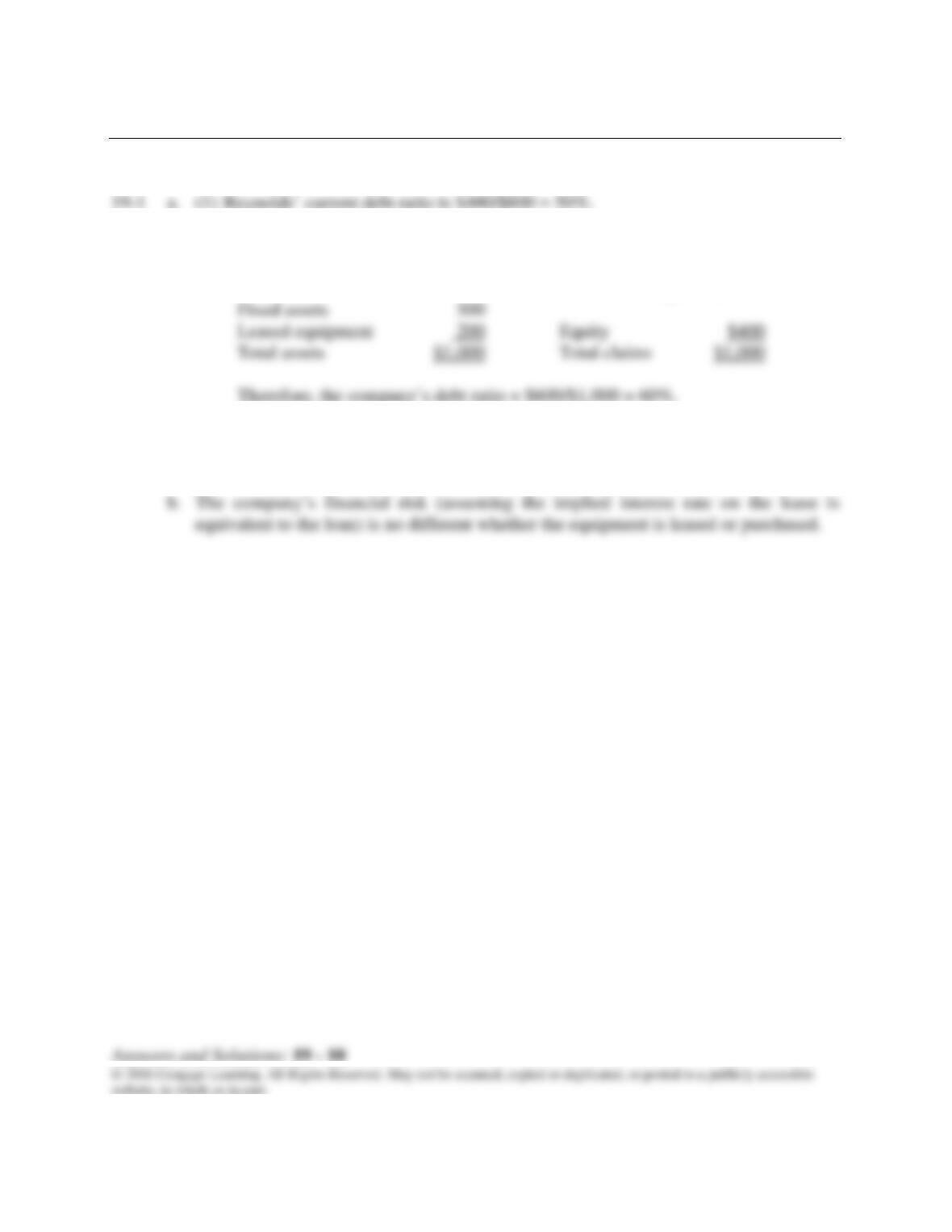
(2) If the company purchased the equipment its balance sheet would look like:
Current assets $300 Debt (including lease) $600
(3) If the company leases the asset and does not capitalize the lease, its debt ratio =
$400/$800 = 50%.
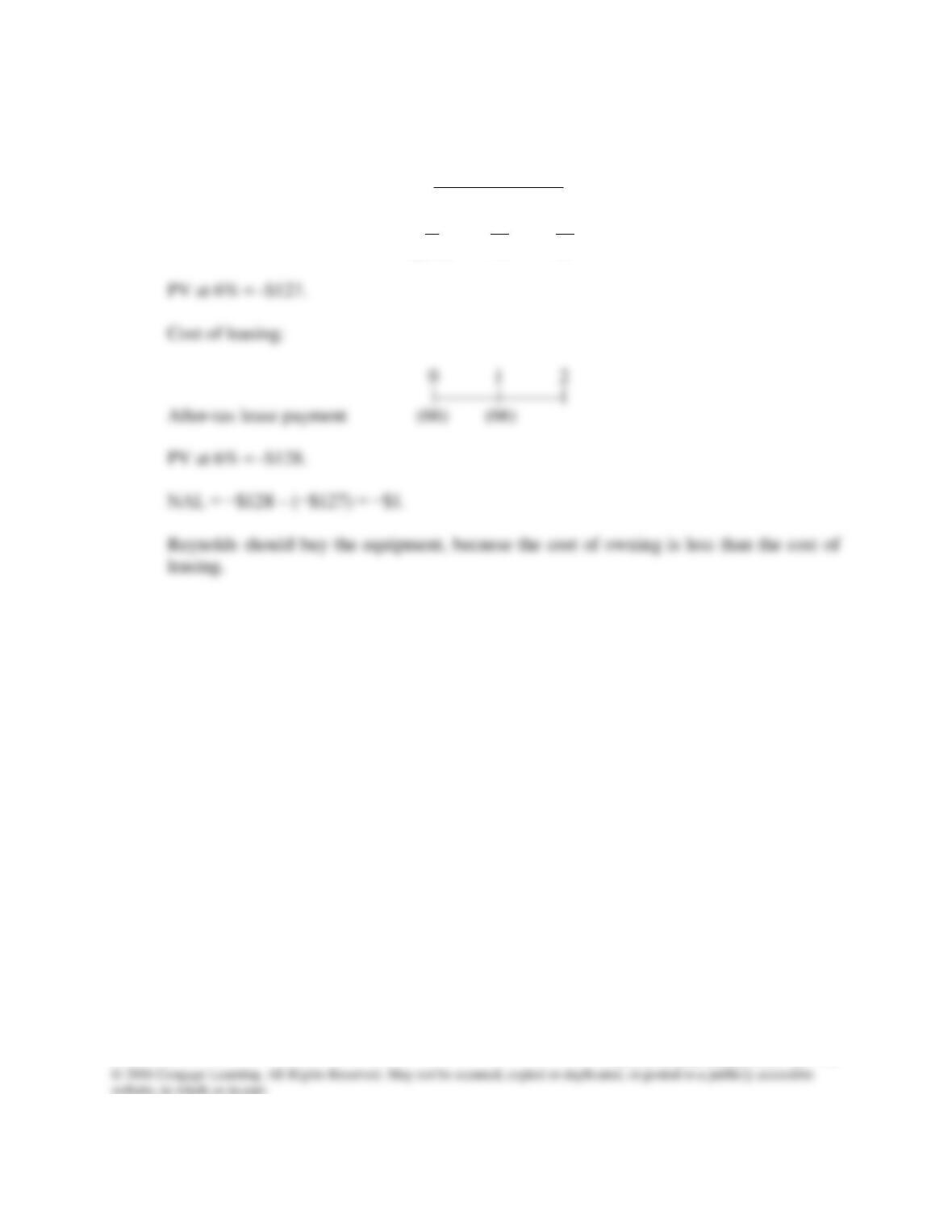
19-2 Cost of owning:
0 1 2
| | |
Cost (200)
Depreciation shield 40 40
(200) 40 40
Answers and Solutions: 19 – 11
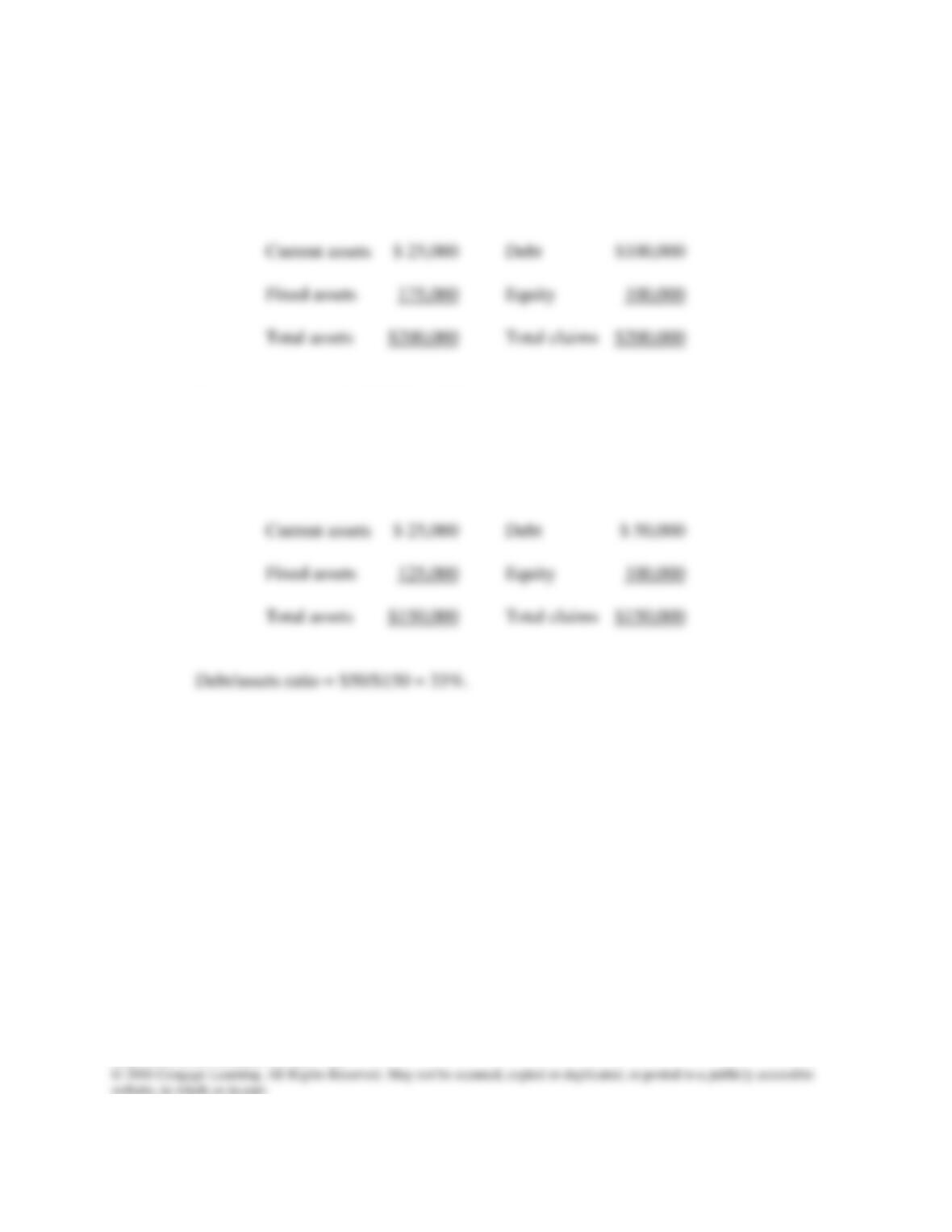
19-3 a. Balance sheets before lease is capitalized:
Energen
Balance Sheet (Owns new assets)
(Thousands of Dollars)
Debt/assets ratio = $100/$200 = 50%.
Hastings Corporation
Balance Sheet (Leases as operating lease)
(Thousands of Dollars)
Answers and Solutions: 19 – 12
b. Balance sheet after lease is capitalized:
Hastings Corporation
Balance Sheet (Capitalizes lease)
(Thousands of Dollars)
19-4
I. Cost of Owning:
0
1
2
3
4
After–tax loan paymentsa
($135,000)
($135,000)
($135,000)
($1,635,000)
Depr. tax savingsb
$199,980
$266,700
$88,860
$44,460
($1,440,540)
PV of owning at 9% = −$885,679.47
II. Cost of Leasing:
0
1
2
3
4
Answers and Solutions: 19 – 13