
Introduction to Corporate Finance, Fourth Edition Booth, Cleary, Rakita
Chapter 18: Debt Instruments
Multiple Choice Questions
1. Section: 18.1 What Is Debt?
Learning Objective: 18.1
Level of difficulty: Intermediate
2. Section: 18.1 What Is Debt?
Learning Objective: 18.1
Level of difficulty: Basic
3. Section: 18.2 Short-Term Debt and the Money Market
Learning Objective: 18.2
Level of difficulty: Intermediate
4. Section: 18.2 Short-Term Debt and the Money Market
Learning Objective: 18.2
Level of difficulty: Intermediate
5. Section: 18.2 Short-Term Debt and the Money Market
Learning Objective: 18.2
Level of difficulty: Intermediate
6. Section: 18.2 Short-Term Debt and the Money Market
Learning Objective: 18.2
Level of difficulty: Intermediate
7. Section: 18.2 Short-Term Debt and the Money Market
Learning Objective: 18.2
Level of difficulty: Intermediate

Introduction to Corporate Finance, Fourth Edition Booth, Cleary, Rakita
8. Section: 18.3 Bank Financing
Learning Objective: 18.3
Level of difficulty: Intermediate
9. Section: 18.3 Bank Financing
Learning Objective: 18.3
Level of difficulty: Intermediate
10. Section: 18.3 Bank Financing
Learning Objective: 18.3
Level of difficulty: Intermediate
11. Section: 18.5 Bond Ratings
Learning Objective: 18.5
Level of difficulty: Basic
Practice Problems
Basic
12. Section: 18.1 What Is Debt?
Learning Objective: 18.1
Level of difficulty: Basic
Solution:
Interest is compensation for the use or retention of money owed to another.
13. Section: 18.2 Short-Term Debt and the Money Market
Learning Objective: 18.2
Level of difficulty: Basic
Solution:
14. Section: 18.2 Short-Term Debt and the Money Market
Learning Objective: 18.2
Level of difficulty: Basic
Solution:
15. Section: 18.2 Short-Term Debt and the Money Market
Introduction to Corporate Finance, Fourth Edition Booth, Cleary, Rakita
Learning Objective: 18.2
Level of difficulty: Basic
Solution:
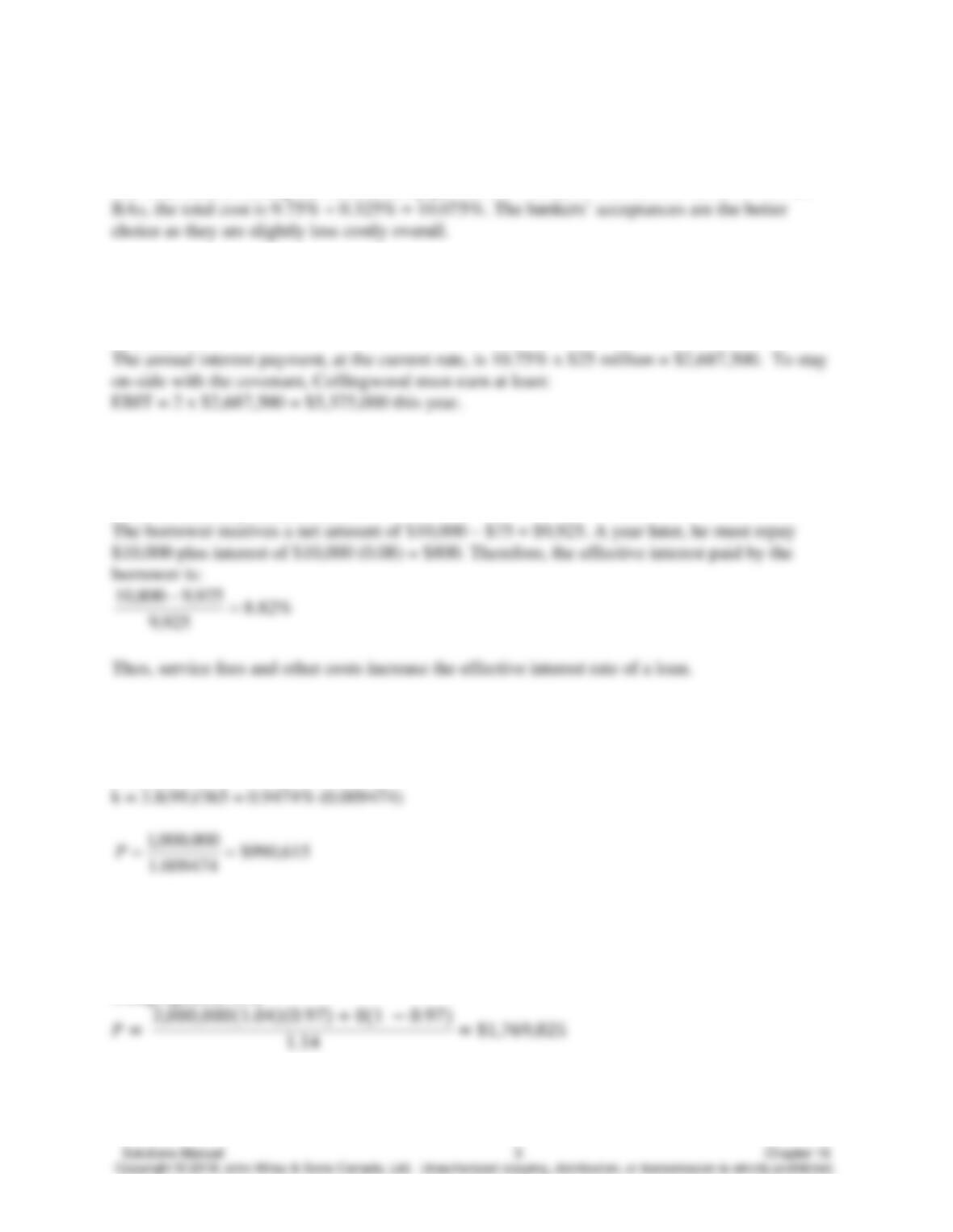
The total cost of issuing the commercial paper is 10% + 0.125% + 0.125% = 10.25%. For the
16. Section: 18.3 Bank Financing
Learning Objective: 18.3
Level of difficulty: Basic
Solution:
Intermediate
17. Section: 18.2 Short-Term Debt and the Money Market
Learning Objective: 18.2
Level of difficulty: Intermediate
18. Section: 18.2 Short-Term Debt and the Money Market
Learning Objective: 18.2
Level of difficulty: Intermediate
Solution:
19. Section: 18.2 Short-Term Debt and the Money Market
Learning Objective: 18.2
Level of difficulty: Intermediate
Solution:
Using equation 18.2
20. Section: 18.2 Short-Term Debt and the Money Market
Learning Objective: 18.2

Introduction to Corporate Finance, Fourth Edition Booth, Cleary, Rakita
Level of difficulty: Intermediate
21. Section: 18.2 Short-Term Debt and the Money Market
Learning Objective: 18.1, 18.2
Level of difficulty: Intermediate
Solution:
No Debt
$125,000 loan at 6%
Net Income
EBIT
$143,500
$143,500
22. Section: 18.2 Short-Term Debt and the Money Market
Learning Objective: 18.2
Level of difficulty: Intermediate
Solution:
23. Section: 18.3 Bank Financing
Learning Objective: 18.3
Level of difficulty: Intermediate
Solution:
24. Section: 18.4 Long-Term Debt and the Money Market
Learning Objective: 18.4
Level of difficulty: Intermediate
Introduction to Corporate Finance, Fourth Edition Booth, Cleary, Rakita
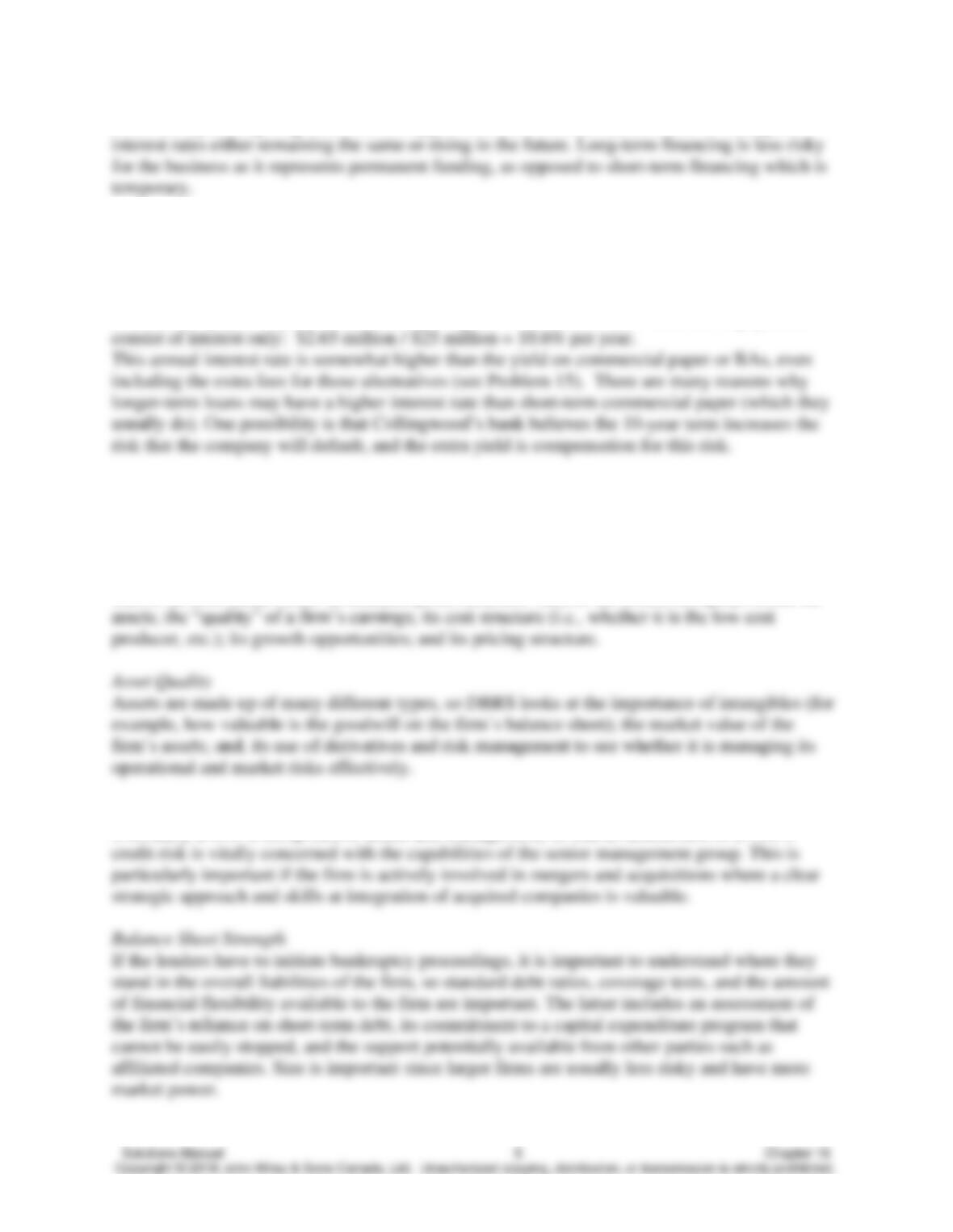
Solution: By issuing long-term debt (as opposed to short-term debt), the issuer is betting on
25. Section: 18.2 Long-Term Debt and the Money Market
Learning Objective: 18.4
Level of difficulty: Intermediate
Solution:
The “bullet” payment pays off the entire principal amount of the loan so the annual payments
26. Section: 18.5 Bond Ratings
Learning Objective: 18.5
Level of difficulty: Intermediate
Solution:
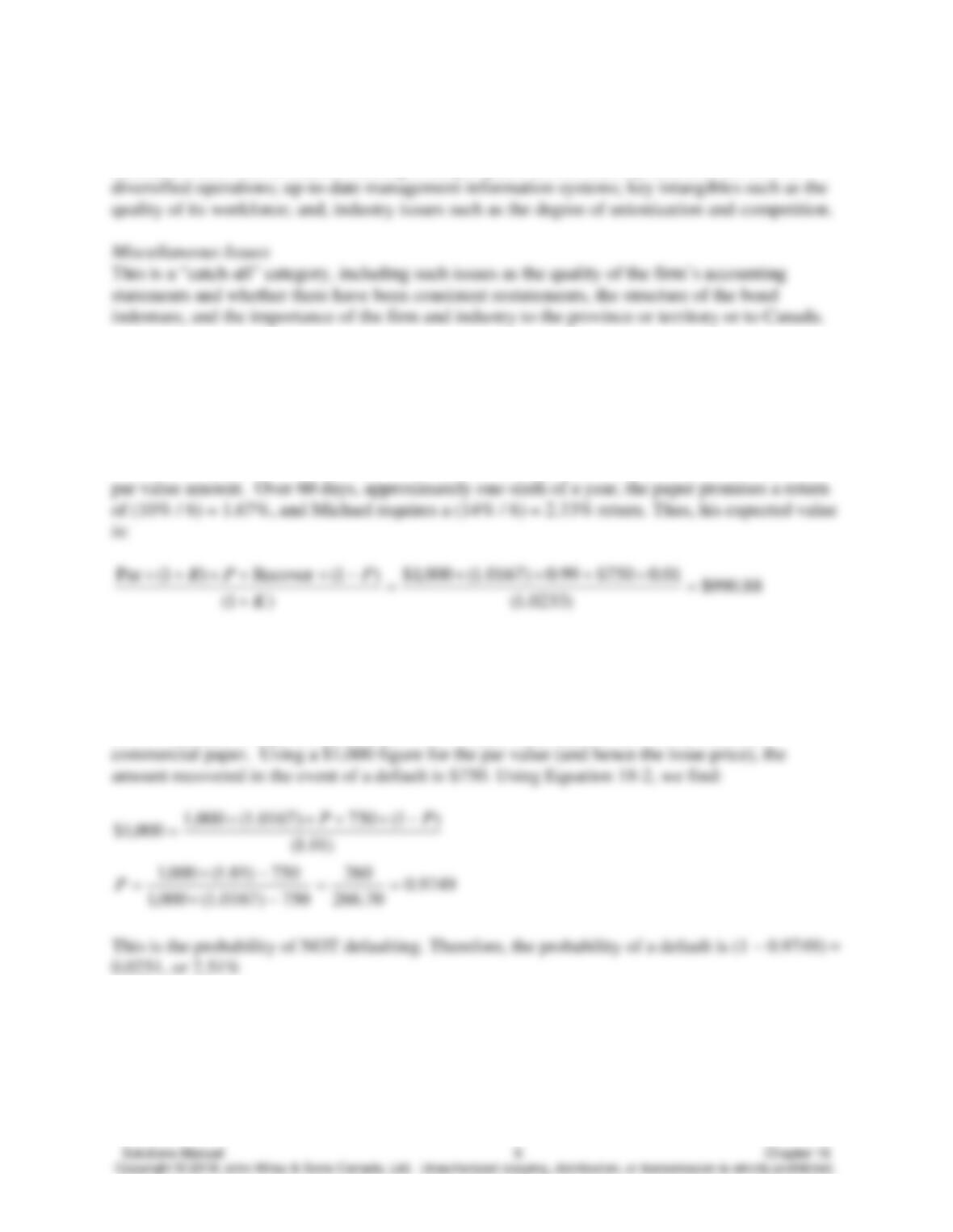
Core Profitability
This is an assessment based on standard profit measures such as the return on equity; return on
Strategy and Management Strength
Ultimately a firm is comprised of assets and management, so that an assessment of a firm’s
Introduction to Corporate Finance, Fourth Edition Booth, Cleary, Rakita
Business Strength
Standard issues such as market share; growth prospects for the industry; a defensible base of
Challenging
27. Section: 18.2 Short-Term Debt and the Money Market
Learning Objective: 18.2
Level of difficulty: Challenging
Solution:
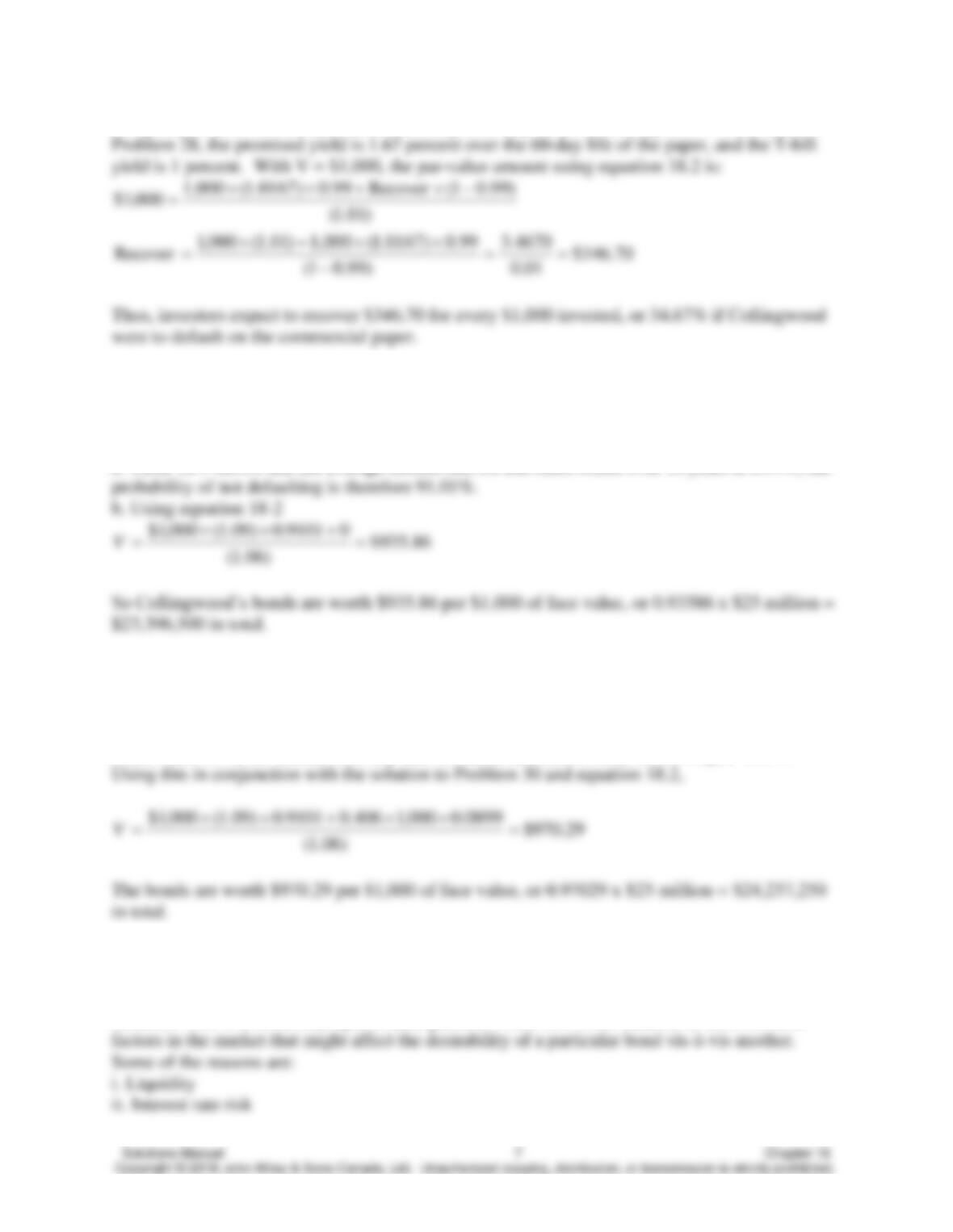
Michael will pay only his “expected value” for the Collingwood commercial paper, not the full
28. Section: 18.2 Short-Term Debt and the Money Market
Learning Objective: 18.2
Level of difficulty: Challenging
Solution:
At 10% per year, the promised return is 1.67% (approximately) for the 60-day life of the
29. Section: 18.2 Short-Term Debt and the Money Market
Learning Objective: 18.2
Level of difficulty: Challenging
Solution:
Introduction to Corporate Finance, Fourth Edition Booth, Cleary, Rakita
A 1 percent chance of default means that the probability of not defaulting is, P = 99%. As in
30. Section: 18.5 Bond Ratings
Learning Objective: 18.5
Level of difficulty: Challenging
Solution:
a. Table 18-5 shows that the average default rate for BB-rated bonds over 10 years is 8.99%; the
31. Section: 18.5 Bond Ratings
Learning Objective: 18.5
Level of difficulty: Challenging
Solution:
From Table 18-6, the default recovery rate on senior unsecured bonds has averaged 40.6%.
32. Section: 18.5 Bond Ratings
Learning Objective: 18.5
Level of difficulty: Challenging
Solution: This is a somewhat open-ended question which will force students to think of other

Introduction to Corporate Finance, Fourth Edition Booth, Cleary, Rakita
Introduction to Corporate Finance, Fourth Edition Booth, Cleary, Rakita
Answers to Concept Review Questions
18.1 What Is Debt?
Concept review questions
1. Distinguish debt from equity.
2. Explain how to estimate the after-tax cost of debt.
3. What three characteristics does the CRA look for to determine whether interest payments are
tax deductible?
The three characteristics are the following:
18.2 Short-Term Debt and the Money Market
Concept review questions
1. Explain how interest is received on most money market instruments.
There are three major money market instruments: T-bills, commercial papers, and Banker’s
acceptances. T-bills are sold at discounts. CRA regards the increase from the purchase price to
2. Contrast treasury bills, commercial paper, and BAs in terms of who issues them, their basic
structure and default risk, and the yields they provide.
They differ in the following ways. First, who issues them? T-bills are issued by the government,
3. Define yield spreads and explain how they arise.
Yield spreads are the difference between yield of a corporate debt security and the T-bill. The
18.3 Banking Financing
Concept review questions
1. Briefly describe operating LCs, revolving LCs, and term loans.
Bank Financing includes line of credit (LCs) and term loans. LCs fall into two types: operating
LCs and revolving LCs. Operating LCs lending facilities that are made available by the bank for
the firm’s operating purposes and that generally cannot be used to back up a CP program; these
2. Why do banks typically impose debt covenants on their borrowing customers?
3. Why is it reasonable to assume that most firms will have a banking relationship?
For large-amount financing, CPs require the line-of-credit backups from a bank, and BAs require
18.4 Long-Term Financing Debt and the Money Market
Concept review questions
1. Define mortgage bonds, secured debentures, unsecured debentures, and subordinated debt.
Mortgage bonds are similar to residential mortgage arrangements, in which the lender has
2. Discuss the rationale for including debt covenants in a public issue.
Unlike a bank who can monitor the operation and financing of a firm, the investors in a public
3. Briefly describe the negative pledge and cross-default clauses.

Introduction to Corporate Finance, Fourth Edition Booth, Cleary, Rakita
Negative pledge is a clause that stipulates that a borrower may not create higher-priority debt
18.5 Bond Ratings
Concept review questions
1. Differentiate investment-grade debt from junk debt.
2. Briefly describe the main factors DBRS considers in determining its debt ratings.
In determining its rating, DBRS looks at six basic factors: core profitability, asset quality,
3. Briefly summarize the evidence regarding how well debt ratings work.
DBRS tracked the default probability after 5, 10, 20 years after the original rating. The most