Chapter 18
Initial Public Offerings, Investment Banking, and Financial
Restructuring
ANSWERS TO BEGINNING-OF–CHAPTER QUESTIONS
18-1 Reasons for going public include the following. Note that, generally, several of these
reasons will be important at the time of the IPO.
• To raise additional capital. Original investors may be tapped out, or they may not want
to put additional funds into the business for diversification reasons. Thus, the company
needs to bring in outside funds, and an IPO is the most efficient way of doing so.
• Founding stockholders want liquidity, which a public market would provide.
Some downsides to public ownership include: Costs, disclosure requirements, harder
to engage in self-dealings that benefit the controlling stockholders.
Also, analysts do not follow very small stocks where trading volume is necessarily
small. Therefore, if a firm is so small that an active market for its stock cannot be
Answers and Solutions: 18 – 1
Finally, it is interesting to note that some very large companies with tens of thousands
of employees like Publix, CM2Hill, and Cargill have been able to get most of the
advantages listed above without actually going public. These companies have developed
internal markets that work as follows: (1) The company hires an investment banking firm
to operate the plan, which is set up much like a mutual fund, with each participating
18-2 In the late 1990s it was common for IPO stocks to rise far above the offering price on the
first day of trading. This situation indicated that companies were fileaving money on the
table,” i.e., that they could have gotten more for the shares they sold than they actually
received. This under-pricing was rationalized on several grounds, including (1) that it
reduced risk to the underwriter and thus lowered costs to the issuer, (2) that it helped
enhance the reputation of the underwriter, which benefited the issuer, and (3) that it helped
insure a successful offering and thus made follow-on offerings easier to complete. In
Answers and Solutions: 18 – 2
Example of IPO Pricing
An example of how an IPO would be priced is shown in the BOC model. The valuation
is, of course, a critical issue. Theoretically, the proper pricing basis is the DCF model as
discussed in Chapters 8 and 9. Data on publicly–owned companies that are comparable to
the company that is going public would be obtained and used to develop a discount rate,
which would then applied to the company’s projected cash flows. Although the DCF
Given the total valuation, the bankers would need to find a price per share. Bankers
generally like to offer new stock at about $15 per share, though a higher price may be used
for IPOs of large, established companies like Kraft, which came out at $31 per share.
Assuming the target price is $15, then the company will divide the total value by $15 to
determine the total number of shares, so in our example the company should have
18-3 An SEO purchase would be considered less risky than an IPO purchase because with an
SEO there are already shares publicly traded and so there is an existing market price for
the shares. With an IPO there is no history of trade prices and so there is much more
Answers and Solutions: 18 – 3
18-4 The bond refunding decision is, in essence, a capital budgeting decision. A bond will be
called if interest rates decline after the bond was issued by an amount sufficient to cause
the annual interest saving from getting rid of the old–high interest bond and replacing it
with a new low-interest bond to offset the costs associated with the refunding, mainly a
ANSWERS TO END-OF-CHAPTER QUESTIONS
18-1 a. A closely held corporation goes public when it sells stock to the general public. Going
public increases the liquidity of the stock, establishes a market value, facilitates raising
new equity, and allows the original owners to diversify. However, going public
c. A venture capitalist is the manager of a venture capital fund. The fund raises most of
its capital from institutional investors and invests in start–up companies in exchange for
equity. The venture capitalist gets a seat on the companies’ boards of directors. Before
an IPO, the senior management team and the investment banker make presentations to
Answers and Solutions: 18 – 5
d. The Securities and Exchange Commission (SEC) is a government agency which
regulates the sales of new securities and the operations of securities exchanges. The
SEC, along with other government agencies and self-regulation, helps ensure stable
markets, sound brokerage firms, and the absence of stock manipulation. Registration
of securities is required of companies by the SEC before the securities can be offered
e. A prospectus summarizes information about a new security issue and the issuing
company. A fired herring,” or preliminary prospectus, may be distributed to potential
f. The National Association of Securities Dealers (NASD) is an industry group primarily
concerned with the operation of the over-the-counter (OTC) market.
g. A best efforts arrangement versus an underwritten sale refers to two methods of selling
new stock issues. In a best efforts sale, the investment banker is only committed to
Answers and Solutions: 18 – 6
h. Refunding occurs when a company issues debt at current low rates and uses the
proceeds to repurchase one of its existing high coupon rate debt issues. Often these are
callable issues, which means the company can purchase the debt at a lower–than–market
price. Project financings are arrangements used to finance mainly large capital projects
such as energy explorations, oil tankers, refineries, utility power plants, and so on.
18-2 No. The role of the investment banker is more important if the stock demand curve has a
18-3 No. The real value of a security is determined by the equilibrium forces of an efficient
18-4 a. Going public would tend to make attracting capital easier and to decrease flotation
costs.
b. The increasing institutionalization of the fibuy side” of the stock and bond markets
should increase a firm’s ability to attract capital and should reduce flotation costs.
18-5 Investment bankers must investigate the firms whose securities they sell, simply because,
if an issue is overvalued and suffers marked price declines after the issue, the banker will
SOLUTIONS TO END-OF-CHAPTER PROBLEMS
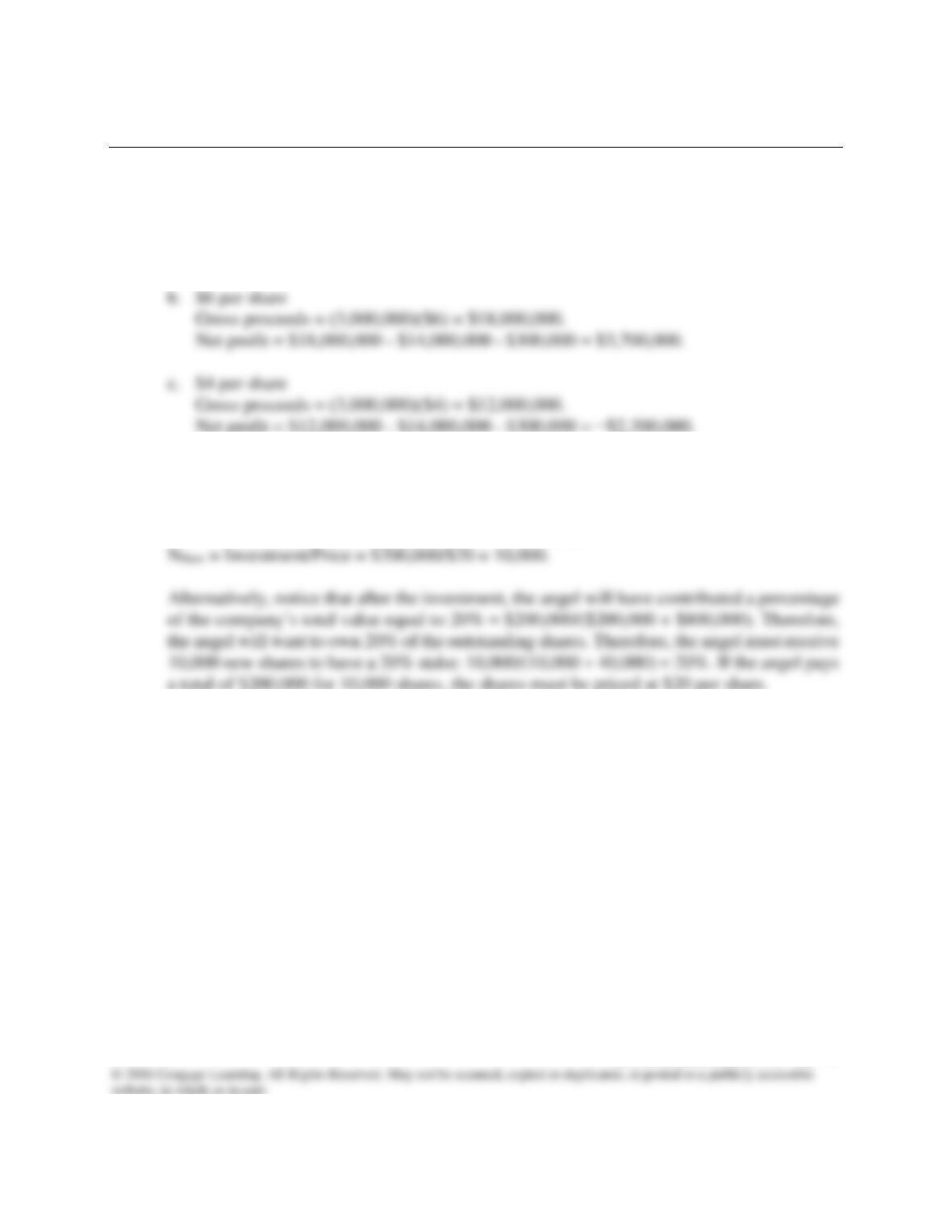
18-1 a. $5 per share
Gross proceeds = (3,000,000)($5) = $15,000,000.
Net profit = $15,000,000 – $14,000,000 – $300,000 = $700,000.
18-2 Net proceeds per share = $22(1 – 0.05) = $20.90.
Number of shares to be sold = ($20,000,000 + $150,000)/$20.90 = 964,115 shares.
18-3 POffer = VPre–issue/(F nNew + nExisting) = $800,000/( 0(nNew) + 40,000) = $20.
18-4 a.
Answers and Solutions: 18 – 9
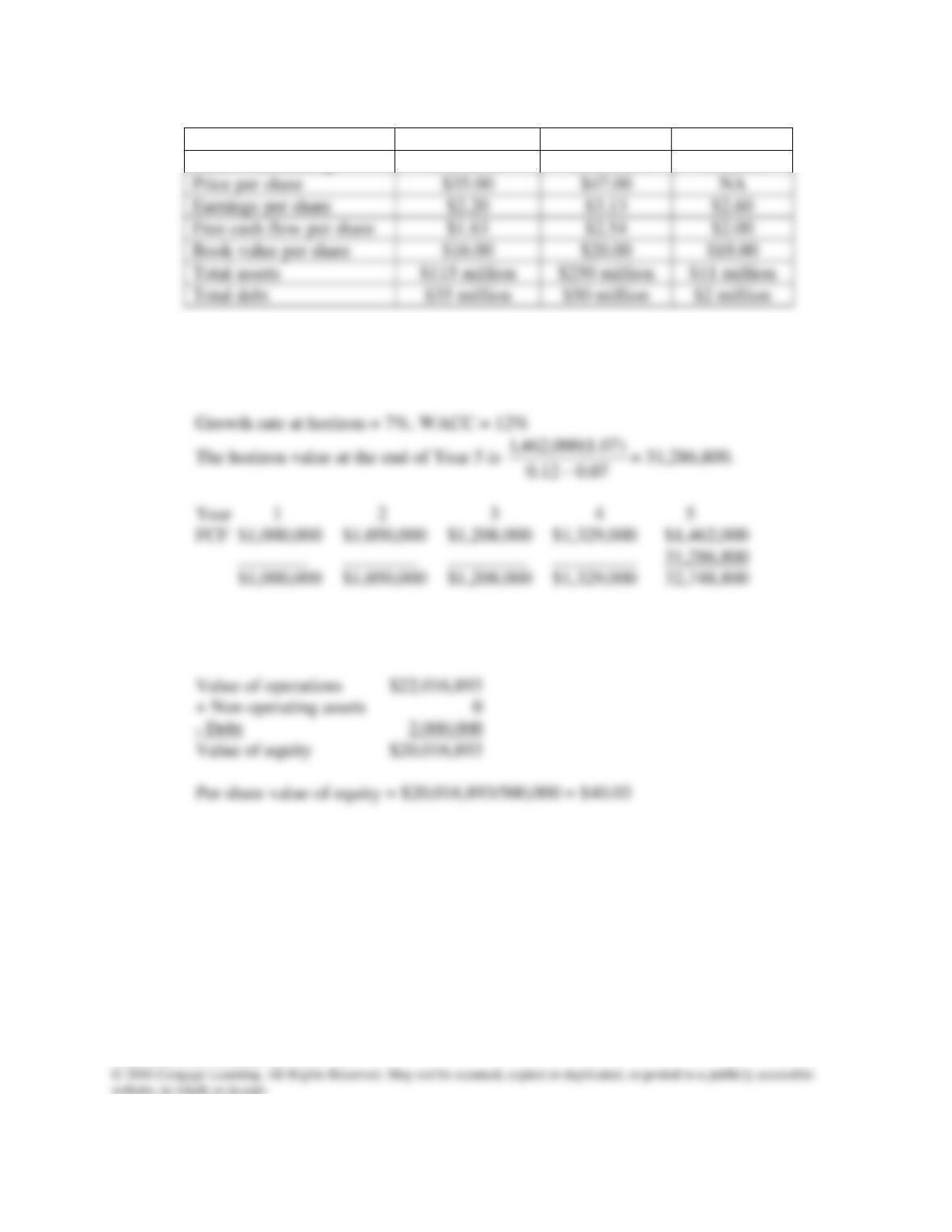
Year 1 2 3 4 5
FCF $1,000,000 $1,050,000 $1,208,000 $1,329,000 $1,462,000
The present value of the horizon value (at Year 5) and the free cash flows in Years 1
through 5 is $22,545,783 and this is the value of operations for the company.
Company Data
Abercrombe
Gunter
B&C
Shares outstanding
5 million
10 million
500,000
Answers and Solutions: 18 – 10
Price per share
$47.00
Earnings per share
Free cash flow per share
Book value per share
$20.00
Total assets
Total debt
b.
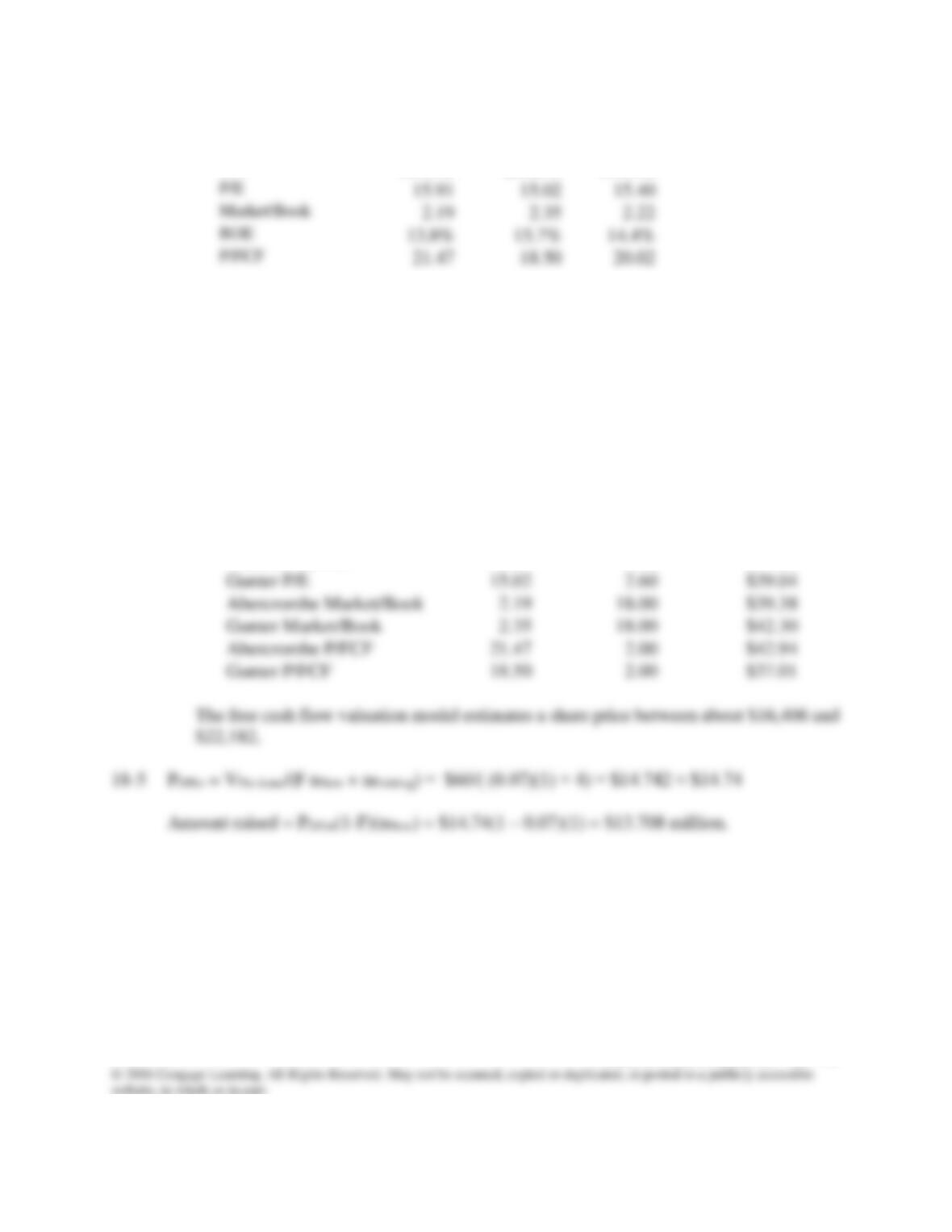
Abercrombe
Gunter
B&C
D/A
30.43%
20.00%
18.18%
Notes:
Market/Book = market price per share divided by book value of equity per share.
ROE can be calculated from per–share information as earnings per share divided by
book value per share.
c. The implied prices are obtained by multiplying B&C’s measure (earnings per share, or
book value per share or FCF per share) by the corresponding ratio (also called a
fimultiple”) for each of the two comparison companies:
Ratio
B&C measure
Implied B&G
price per share
Abercrombe P/E
15.91
2.60
$41.36
Gunter P/E
15.02
2.60
$39.04
Gunter Market/Book
$42.30
Abercrombe P/FCF
21.47
2.00
$42.94
Gunter P/FCF
18.50
2.00
$37.01
Answers and Solutions: 18 – 11
ROE
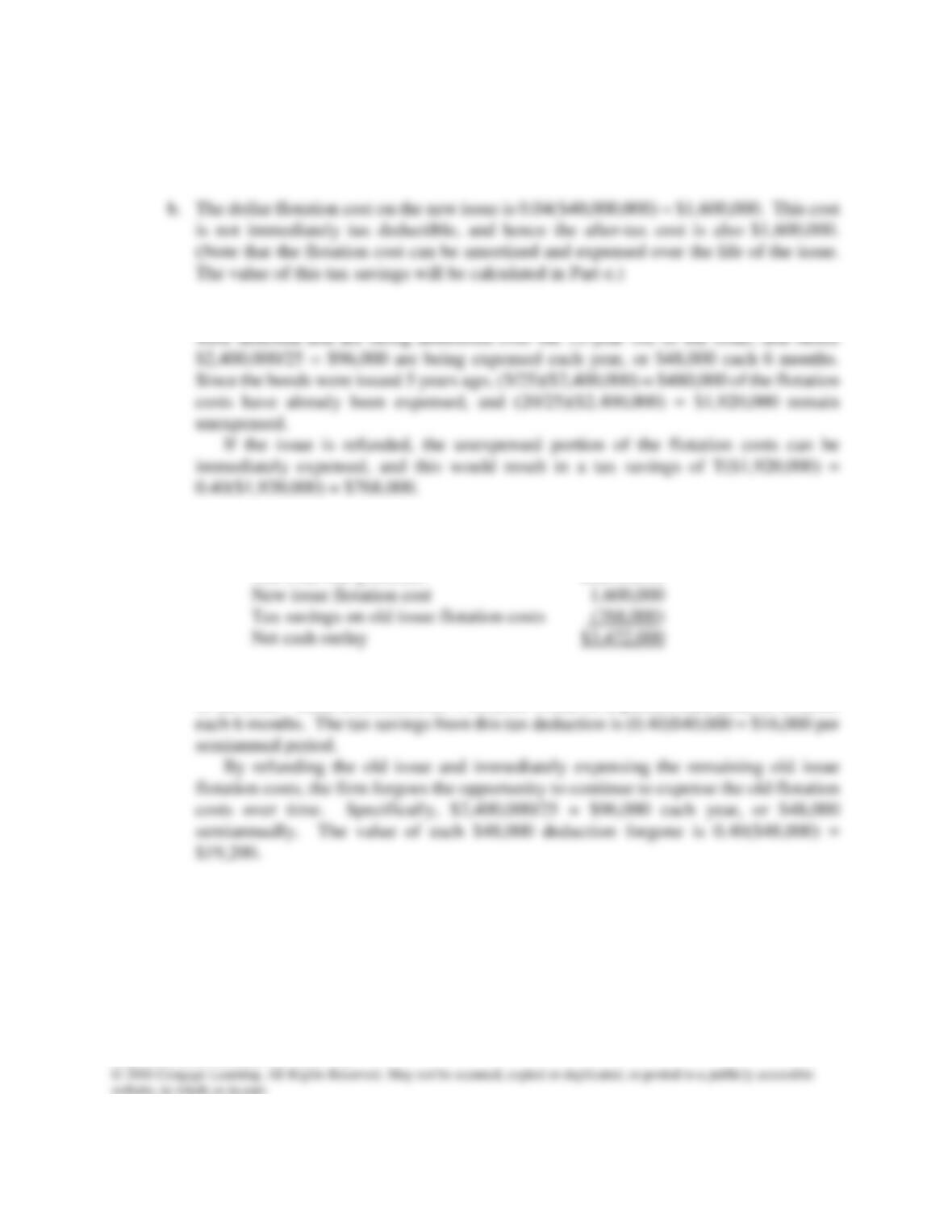
18-6 a. Since the call premium is 11 percent, the total premium is 0.11($40,000,000) =
$4,400,000. However, this is a tax deductible expense, so the relevant after-tax cost is
$4,400,000(1 – T) = $4,400,000(0.60) = $2,640,000.
c. The flotation costs on the old issue were 0.06($40,000,000) = $2,400,000. These costs
d. The net after-tax cash outlay is $3,472,000, as shown below:
Old issue call premium $2,640,000
e. The new issue flotation costs of $1,600,000 would be amortized over the 20-year life
of the issue. Thus, $1,600,000/20 = $80,000 would be expensed each year, or $40,000
Answers and Solutions: 18 – 12