Answers and Solutions: 18 – 1
Chapter 18
Public and Private Financing: Initial Offerings, Seasoned
Offerings, and Investment Banks
ANSWERS TO END-OF-CHAPTER QUESTIONS
18-1 a. A closely held corporation goes public when it sells stock to the general public. Going
public increases the liquidity of the stock, establishes a market value, facilitates raising
new equity, and allows the original owners to diversify. However, going public
increases business costs, requires disclosure of operating data, and reduces the control
of the original owners. The new issue market is the market for stock of companies that
go public, and the issue is called an initial public offering (IPO).
c. A venture capitalist is the manager of a venture capital fund. The fund raises most of
its capital from institutional investors and invests in start-up companies in exchange for
equity. The venture capitalist gets a seat on the companies’ boards of directors. Before
d. The Securities and Exchange Commission (SEC) is a government agency which
regulates the sales of new securities and the operations of securities exchanges. The
SEC, along with other government agencies and self-regulation, helps ensure stable
markets, sound brokerage firms, and the absence of stock manipulation. Registration
e. A prospectus summarizes information about a new security issue and the issuing
company. A fired herring,” or preliminary prospectus, may be distributed to potential
buyers prior to approval of the registration statement by the SEC. After the registration
has become effective, the securities, accompanied by the prospectus, may be offered
for sale.
Answers and Solutions: 18 – 3
g. Project financings are arrangements used to finance mainly large capital projects such
as energy explorations, oil tankers, refineries, utility power plants, and so on. Usually,
one or more firms (sponsors) will provide the equity capital required by the project,
18-2 An IPO Increases liquidity and allows founders to harvest their wealth, permits founders
to diversify their wealth, establishes a value for the firm (which is helpful for tax purposes
if the owner dies and is helpful when selling the company to another company), increases
visibility, increases credibility, and often opens potential markets.
18-3 No. The real value of a security is determined by the equilibrium forces of an efficient
18-4 a. Going public would tend to make attracting capital easier and to decrease flotation
costs.
b. The increasing institutionalization of the fibuy side” of the stock and bond markets
should increase a firm’s ability to attract capital and should reduce flotation costs.
c. Financial conglomerates can offer a variety of financial services and types of

18-5 Investment bankers must investigate the firms whose securities they sell, simply because,
if an issue is overvalued and suffers marked price declines after the issue, the banker will
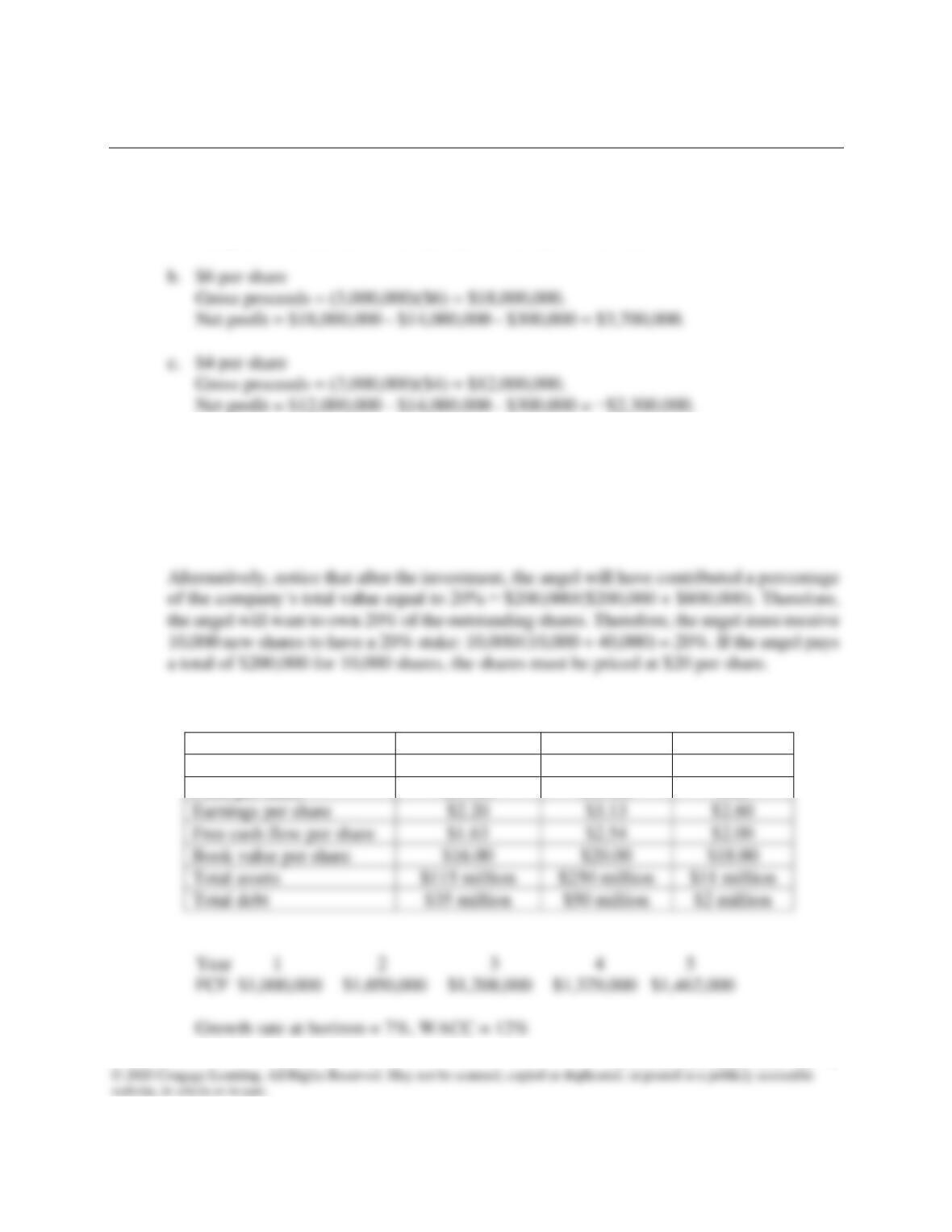
Earnings per share
$2.60
Free cash flow per share
$2.00
Book value per share
$16.00
$20.00
Total assets
Total debt
$35 million
Answers and Solutions: 18 – 5
SOLUTIONS TO END–OF-CHAPTER PROBLEMS
18-1 a. $5 per share
Gross proceeds = (3,000,000)($5) = $15,000,000.
Net profit = $15,000,000 – $14,000,000 – $300,000 = $700,000.
18-2 Net proceeds per share = $22(1 – 0.05) = $20.90.
Number of shares to be sold = ($20,000,000 + $150,000)/$20.90 = 964,115 shares.
18-3 POffer = VPre-issue/(F nNew + nExisting) = $800,000/( 0(nNew) + 40,000) = $20.
NNew = Investment/Price = $200,000/$20 = 10,000.
18-4 a.
Company Data
Abercrombe
Gunter
B&C
Shares outstanding
5 million
10 million
500,000
Price per share
$35.00
$47.00
NA
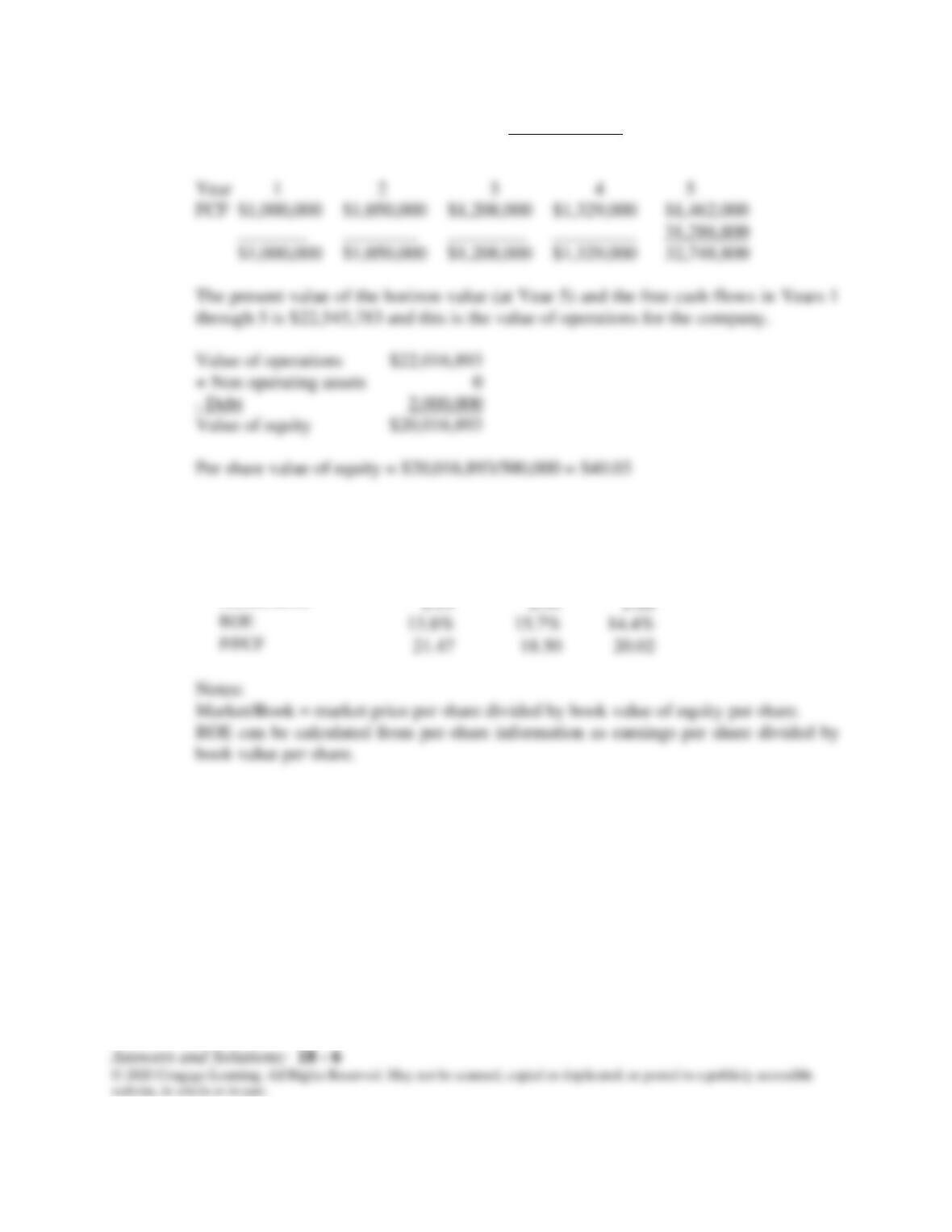
The horizon value at the end of Year 5 is
07.012.0
)07.1(000,462,1
−
= 31,286,800.
b.
Abercrombe
Gunter
B&C
D/A
30.43%
20.00%
18.18%
P/E
15.91
15.02
15.40
Market/Book
21.47
18.50
20.02
Answers and Solutions: 18 – 7
c. The implied prices are obtained by multiplying B&C’s measure (earnings per share, or
book value per share or FCF per share) by the corresponding ratio (also called a
fimultiple”) for each of the two comparison companies:
Ratio
B&C measure
Implied B&G
price per share
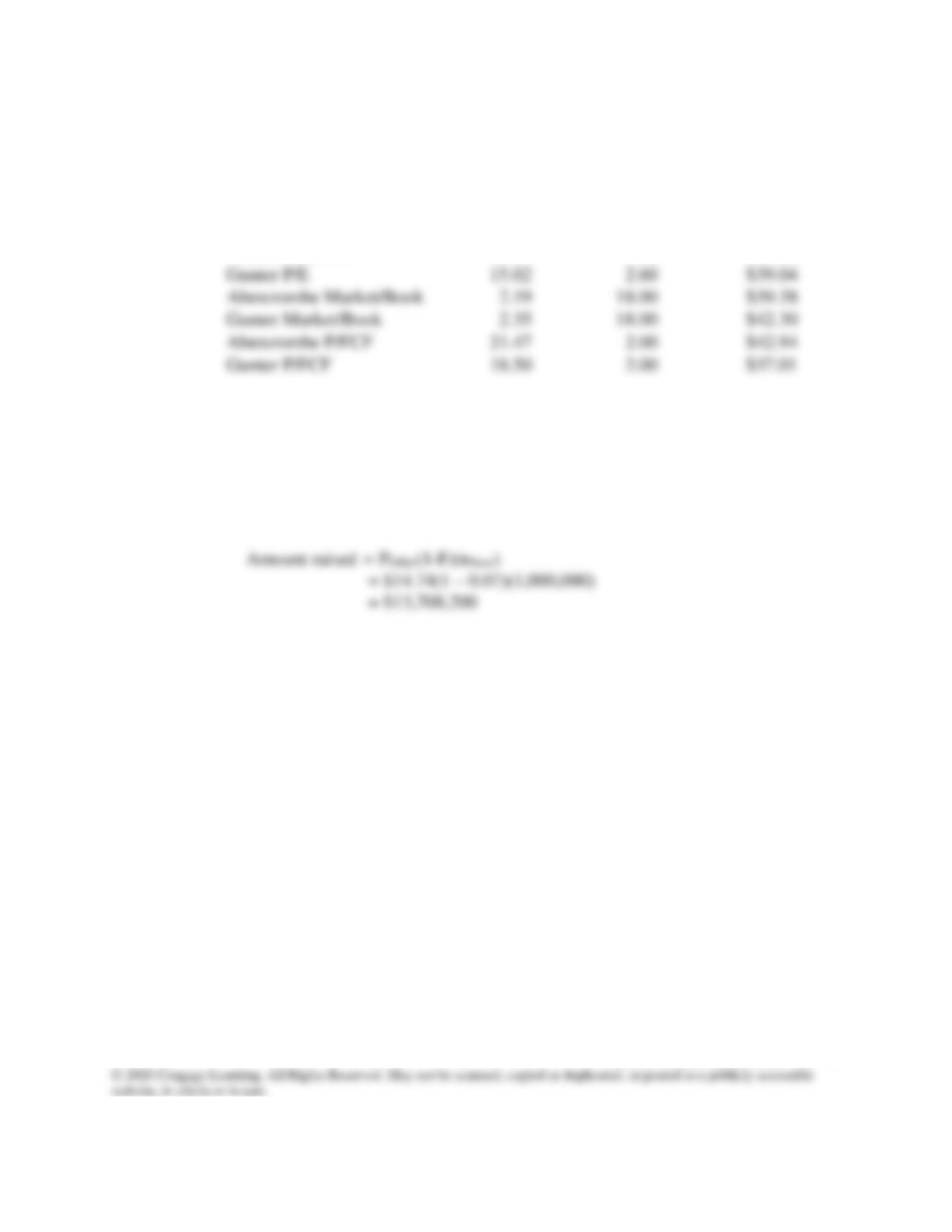
Abercrombe P/E
15.91
2.60
$41.36
Gunter P/E
15.02
2.60
$39.04
Gunter Market/Book
$42.30
Abercrombe P/FCF
21.47
2.00
$42.94
Gunter P/FCF
18.50
2.00
$37.01
The free cash flow valuation model estimates a share price between about $16,406 and
$22,182.
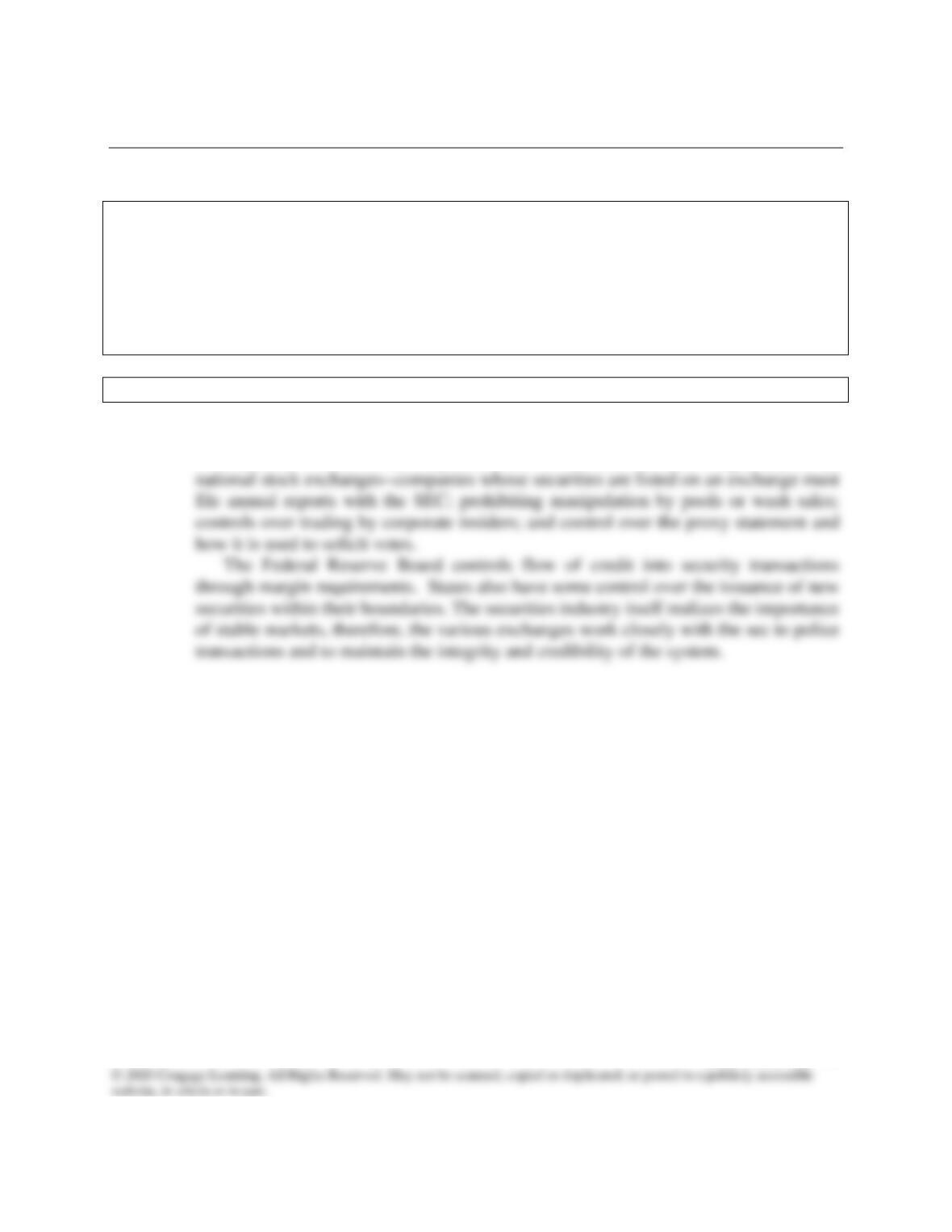
18-5 POffer = VPre-issue/(F nNew + nExisting)
= $60,000,000/( (0.07)(1,000,000) + 4,000,000)
= $14.742 ≈ $14.74

Answers and Solutions: 18 – 8
SOLUTION TO SPREADSHEET PROBLEM
18-6 The detailed solution for the spreadsheet problem, Solution for Ch18 P06 Build a
Model.xlsx, is available on the textbook’s Web site.
Mini Case: 18 – 9
MINI CASE
Randy’s, a family-owned restaurant chain operating in Alabama, has grown to the point that
expansion throughout the entire Southeast is feasible. The proposed expansion would require
the firm to raise about $18.3 million in new capital. Because Randy’s currently has a debt
ratio of 50% and because family members already have all their personal wealth invested in
the company, the family would like to sell common stock to the public to raise the $18.3
million. However, the family wants to retain voting control. You have been asked to brief
family members on the issues involved by answering the following questions.
a. What agencies regulate securities markets?
Answer: The main agency that regulates the securities market is the Securities And Exchange
Commission. Some of the responsibilities of the SEC include: regulation of all
Mini Case: 18 – 10
b. How are start-up firms usually financed?
Answer: The first financing comes from the founders. The first external financing comes from
c. Differentiate between a private placement and a public offering.
Answer: In a private placement stock is sold directly to one or a small group of investors rather
than being distributed to the public at large. A private placement has the advantage of
d. Why would a company consider going public? What are some advantages and
disadvantages?
Answer: A firm is said to be figoing public” when it sells stock to the public for the first time.
A company’s first stock offering to the public is called an fiinitial public offering
Mini Case: 18 – 11
e. What are the steps of an initial public offering?
Answer: Select an investment banker, file the S-1 registration document with the SEC, choose a
f. What criteria are important in choosing an investment banker?
Answer: (1) reputation and experience in the industry. (2) existing mix of institutional and retail
reputation of the analyst who will cover the stock.
Mini Case: 18 – 12
g. Would companies going public use a negotiated deal or a competitive bid?
Answer: The firm would almost certainly use a negotiated deal. The competitive bid process
for setting investment bankers’ fees is feasible only for large, well-established firms on
h. Would the sale be on an underwritten or best efforts basis?
Answer: Most stock offerings are done on an underwritten basis, but the price is not set until the

Mini Case: 18 – 13
i. The estimated pre-IPO value of equity in the company is about 63 million and
there are 4 million shares of existing shares of stock held by family members. The
investment bank will charge a 7% spread, which is the difference between the
price the new investor pays and the proceeds to the company. To net $18.3 million,
what is the value of stock that must be sold? What is the total post-IPO value of
equity? What percentage of this equity will the new investors require? How many
shares will the new investors require? What is the estimated offer price per share?
Answer: To net $18.6 million, the company must issue $18.6/(1 – 0.07) = $20.
The value of equity after the IPO is equal to the value before plus the net proceeds:
Mini Case: 18 – 14
j. What is a roadshow? What is bookbuilding?
Answer: The senior management team, the investment banker, and the lawyer make
presentations to potential institutional investors. They usually visit ten to twenty cities,
k. Describe the typical first-day returns of an IPO and the long-term returns to IPO
investors.
Answer: First-day returns average 14.1%, with many stocks having much higher returns. The
l. What are the direct and indirect costs of an IPO?
Answer: The underwriter usually charges a 7% fee, based on the offer price. In addition, there
are direct costs to lawyers, accountants, printers, etc. That can easily total $400,000.
m. What are equity carve-outs?
Answer: Equity carve-outs are a special type of IPO in which a public company creates a new
Mini Case: 18 – 15
n. Describe some ways other than an IPO that companies use to raise funds from the
capital markets.
Answer: In seasoned equity offers, publicly traded companies issue additional stock. Companies
o. What are some other investment banking activities? How did these increase
investment banks’ risk?
Answer: The repeal of Glass-Stegall in 1999 blurred lines between traditional investment banks
and other financial institutions.
p. What is meant by going private? What are some advantages and disadvantages?
Answer: Going private is the reverse of going public. Typically, the managers of a firm team
up with a small group of outside investors, who furnish most of the equity capital, and
Mini Case: 18 – 16
q. What is project financing.
Answer: 1. Project financings are arrangements used to finance mainly large capital projects
such as energy explorations, oil tankers, refineries, utility power plants, and so on.