492
Chapter 18 International Financial Management
Chapter Overview
What is the financial impact that firm’s experience when they create products and services
in one country and sell in another? The opening scenario discusses the change in the policies sur-
rounding the trading of the Chinese Yuan. This would allow more movement in the yuan than every
Opening Focus Discussion Questions:
1. Who is helped and hurt by a falling domestic currency rate? Think of the position of manufac-
turers who sell their goods abroad. What about domestic manufacturers who import materials
needed for production from abroad? What about consumers at home and abroad? What about
tourists at home and abroad?
2. How could McDonald’s reduce its currency risk?
This chapter looks at:
18-1. Exchange Rate Fundamentals
18-2. Parity Conditions of International Finance
Technology
1. Smart Concepts provide a step-by-step explanation of interest rate parity.
2. Smart Practices Video. Dick Acton, vice president and treasurer of Ford Motor Co., looks at
3. Smart Ideas Video. Ike Mathur of the University of Southern Illinois at Carbondale, looks at
international capital budgeting projects and the advantages of being a first mover.
5. Smart Solutions provide step-by-step solution to Problem 18-8, illustrating arbitrage profits
because of differences in exchange rate.
6. Smart Excel provides a step-by-step solution to Problem 18-9, illustrating the law of one
price.
Lecture Guide
This chapter is important in corporate finance because just about every company has some in-
ternational dealings. A company may obtain some of its revenues abroad, or it may have produc-
tion facilities abroad. Even a company that has all of its production and sales in the U.S. may be
Chapter 18 International Financial Management 493
18-1 Exchange Rate Fundamentals
18-1a Fixed versus Floating Exchange Rates
Most countries have floating foreign exchange rates, in which the domestic currency value
moves up (appreciates) or moves down (depreciates) relative to other countries’ currencies. Some
18-1b Exchange Rate Quotes
This section illustrates exchange rate quote terminology. Currencies can be quoted as units of
foreign currency per dollar or dollars per unit of foreign currency.
Figure 18-1 Exchange Rate Quotes: New York Closing Snapshot for Thursday
Currencies trade at discounts or premiums, relative to another currency. This reflects whether
currencies are expected to depreciate or appreciate in the future.
Figure 18.2 Triangular Arbitrage
18-1c The Foreign Exchange Market
The foreign exchange market is not a physical presence market but a global telecommuni-
18-2 The Parity Conditions in International Finance
18-2a Forward-Spot Parity
Exchange rates can have a big impact on corporations. What causes changes in exchange
rates? Since spot rates apply to current foreign exchange transactions, and forward rates to those in
494 Instructor’s Manual
Table 18.1 Inflation and Exchange Rate Movements, 2000-2010
18-2b Purchasing Power Parity
Purchasing power parity states that price levels should be equal across the world. In other
words, an equivalent amount of currency should buy the same bundle of goods and services in eve-
ry country. The theory assumes trade will equalize the price of any goods in all countries; if this
Figure 18-3 Arbitrage and the Law of One Price
18-2c Interest Rate Parity
Interest rate parity states that the currency of a country with a lower interest rate should be at a
18-2d Real Interest Rate Parity: The Fisher Effect
The Fisher Effect states that nominal interest rates are made up of two components – a real re-
18-3 Managing Financial and Political Risk
18-3a Transaction Risk
These sections provide a numerical example of how a firm’s profits could be hurt (or helped)
by currency fluctuations. Many firms will choose to hedge some or all of this risk. Boeing is in
the business of manufacturing and selling airplanes, not speculating in exchange rate changes.
Chapter 18 International Financial Management 495
18-3b Translation and Economic Risk
Firms with assets and liabilities denominated in foreign currencies face translation risk when
18-3c Political Risk
Many countries have regulations concerning foreign investment in that country. For example,
18-3d EMU and the Rise of Regional Trading Blocks
More countries are finding strength in numbers and banding together in a trading block, like
18-4 Long-Term Investment Decisions
18-4a Capital Budgeting
While an international company evaluates capital budgeting projects as usual – by developing a
set of relevant cash flows and discounting those cash flows at an appropriate required rate of return
– international projects present additional difficulties for the firm’s analysis. Note that a company
496 Instructor’s Manual
18-4b Cost of Capital
It is appropriate to take international considerations into account when computing discount rates.
Note that the foreign market is probably not perfectly positively correlated with the U.S. market.
This means there may be advantages to diversifying with international investments.
International Financial Management summary
Truly everyone needs to be concerned with international financial management. It is difficult to
Ch. 18 Resource Articles
“Europe’s Tender Equity Culture,” Wall Street Journal, September 18, 2002. This article notes
that as stock prices decline, Europe is retreating form a market-focused model. Privatization pro-
jects are on old, and efficiency-driven consolidation has faltered.
“A Capital Idea,” Wall Street Journal, October 14, 2002. The European Union hopes to make its
financial markets more efficient. This looks at recent rules passed to help European markets be-
come better able to challenge U.S. markets
“European Debt Woes, Fed’s Dour Outlook A Toxic Brew for the Market,” Forbes, September 22,
2011. This article discusses the global ramifications of the debt problems in Europe and how it is
affecting investing in the U.S. and other countries.
Answers to Concept Review Questions
1. A rise in the euro makes French wine more expensive to U.S. consumers, but it would make
U.S. semiconductor imports cheaper for the German firm.
3. If someone says, “The exchange rate between dollars and pounds increased today,” you cannot
4. The spot rate is the exchange rate for an immediate trade, and the forward rate is the exchange
5. Forward spot parity establishes a kind of breakeven point at which traders are indifferent be-
tween locking in a forward exchange rate or waiting to transact at the spot rate on a later date.
Chapter 18 International Financial Management 497
6. If parity relationships are violated, then it may be possible for traders to make a profit. For ex-
ample, if PPP is violated because the same good sells at different prices in a common currency
7. IRP says that the price (or return) on a risk-free investment should be the same in a common
8. The investor who notices that interest rates are much lower in Japan than in the United States
and borrows in Japan and invests the proceeds in the United States is exposed to currency risk.
9. Transactions exposure refers to the risk that the value of a specific transaction will change as
10. A firm that owes money in a foreign currency could enter a forward contract to buy that cur-
rency in the future. That transaction locks in a price of foreign currency so the firm knows ex-
11. At one level, the euro simplifies the transactions exposure for a U.S. firm exporting to Europe-
an countries, because there is only one foreign currency to worry about rather than a dozen
12. Discounting the cash flows of a foreign investment using the foreign cost of capital, then con-
verting that to the home currency at the spot rate, yields the same NPV as converting the pro-
ject’s cash flows to domestic currency at the forward rate and then discounting them at the
498 Instructor’s Manual
13. It is not surprising to find that the risk premium on the world market portfolio is lower than the
Solutions to Self-Test Problems
ST18-1. Use Figure 18.1 to determine whether the British pound trades at a forward discount or a
forward premium relative to the Japanese yen. Use the 6-month forward rate in your cal-
culations.
A: To calculate the spot and forward exchange rates between pounds and yen, we must take
ST18-2. Suppose the spot exchange rate equals ¥100/$ and the six-month forward rate equals
¥101/$. An investor can purchase a T-bill in the U.S. that matures in six months and
earns an annual rate of return of 3%. What would be the annual return on a similar Japa-
nese investment?
A: In order for the Interest Rate Parity to hold, we get:
Answers to End-of-Chapter Questions
Q18-1. Define a multinational corporation (MNC). What additional factors must be considered by
the manager of an MNC that a manager of a purely domestic firm is not forced to face?
A18-1. An MNC is a large corporation that does business in many different countries. Managers of
Q18-2. Who are the major players in foreign currency markets, and what are their motivations for
trading?
Chapter 18 International Financial Management 499
Q18-3. Suppose that an exchange rate is quoted in terms of euros per pound. In what direction
would this rate move if the euro appreciated against the pound?
Q18-4. Explain how triangular arbitrage ensures that currency values are essentially the same in
different markets around the world at any given moment.
A18-4. If exchange rate quotes in different markets are not consistent with each other, the traders
Q18-5. In what sense is it a misnomer to refer to a currency as weak or strong? Who benefits and
who loses if the yen appreciates against the pound?
A18-5. Currency movements benefit some and harm others. If the yen appreciates against the
Q18-6. What does a spot exchange rate have in common with a forward rate, and how are they
different?
A18-6. Both are simply prices of one currency in terms of another, but the spot rate applies to im-
Q18-7. What does it mean to say that a currency trades at a forward premium?
Q18-8. Explain how the law of one price establishes a relationship between changes in currency
values and inflation rates.
A18-8. The law of one price says that similar goods should sell at the same price in a common cur-
rency no matter where you buy it. Therefore, if prices in one country are rising faster than
Q18-9. Why does purchasing power parity appear to hold in the long run but not in the short run?
A18-9. In the long run traders can exploit deviation from the law of one price by purchasing goods
500 Instructor’s Manual
Q18-10. In terms of risk, is a U.S. investor indifferent about whether to buy a U.S. government
bond or a U.K. government bond? Why or why not?
A18-10. The U.K. bond is riskier for the U.S. investor due to currency risk. However, if the U.S.
Q18-11. If the euro trades at a forward premium against the yen, explain why interest rates in Ja-
pan would have to be higher than they are in Europe.
A18-11. If the euro trades at a forward premium, then a European investor who sends money to
Q18-12. Suppose that the U.S. Federal Reserve suddenly decides to raise interest rates. Trace out
the potential impact that this action might have on (1) interest rates abroad, (2) the spot
value of the dollar, and (3) the forward value of the dollar.
A18-12. Investors sell foreign assets and buy US assets. This lowers the US interest rate and rais-
Q18-13. Interest rates on risk-free bonds in the United States are about 2%, whereas interest rates
on Swiss government bonds are 6%. Can we conclude that investors around the world
will flock to buy Swiss bonds? Why or why not?
A18-13. The Swiss rate is not necessarily a better deal. You have to look at the forward dis-
Q18-14. A Japanese investor decides to purchase shares in a company that trades on the London
Stock Exchange. The investor’s plan is to hold these shares for one year, selling them
and converting the proceeds to yen at year’s end. During the year, the pound appreciates
against the yen. Does this enhance or diminish the investor’s return on the stock?
A18-14. It enhances the Japanese investor’s return.
Q18-15. Suppose that the dollar trades at a forward discount relative to the yen. A U.S. firm must
pay a Japanese supplier ¥10 million in three months. A manager in the U.S. firm reasons
A18-15. Not entering the forward hedge exposes to the firm to risk which it may or may not want
to accept. Just because the dollar buys fewer yen on the forward market than it does on
Chapter 18 International Financial Management 501
Solutions to End-of-Chapter Problems
Exchange Rate Fundamentals
P18-1. One month ago, the Mexican peso (Ps)–U.S. dollar exchange rate was Ps9.0395/$
($0.1106/Ps). This month, the exchange rate is Ps9.4805/$ ($0.1055/Ps). State which cur-
A18-1. The dollar appreciates because it buys more pesos today than it did a month ago. The per-
A18-2. If we divide $1.0062/C$ by $1.6104/£, we obtain £0.6248/C$.
P18-3. On Thursday the exchange rate between the Canadian dollar and Japanese yen was
C$0.0098/¥, and on Friday the exchange rate was C$0.0099/¥. Which currency appreciat-
ed and which currency depreciated?
A18-3. The yen appreciated while the Canadian dollar depreciated
A18-4. Answers to this question will change over time.
P18-5. Recently a financial newspaper reported the following spot and forward rates for the Japa-
nese yen (¥)
A18-5. The dollar trades at a discount and the yen trades at a premium. The annualized premium
on the yen given the one-month forward contract is (0.007568 − 0.007556)/0.007556 x 12
502 Instructor’s Manual
P18-6. Using the data presented in Figure 18.1, specify whether the U.S. dollar trades at a forward
premium or discount relative to the Canadian dollar, the Japanese yen, and the Swiss franc.
Use the three-month forward rates to determine the answer.
A18-6. The dollar buys fewer units of Japanese yen and the Swiss franc on the three-month for-
P18-7. Using the data presented in Figure 18.1, determine the forward premium or discount on the
Canadian dollar relative to the British pound, the Japanese yen, and the Swiss franc. Use
the six-month forward rates to determine the answer, and express your answer as an annual
rate.
A18-7. First we need spot and forward exchange rates between these currencies. We will quote
exchange rates in terms of foreign currency per Canadian dollar. We can calculate spot
rates as follows:
(£0.6214/$) / (C$0.9958/$) = £0.6240/C$
P18-8. You are quoted the following series of exchange rates for the U.S. dollar ($), the Canadian
dollar (C$), and the British pound (£):
$0.6000/C$ C$1.6667/$
$1.2500/£ £0.8000/$
C$2.5000/£ £0.4000/C$
Assuming that you have $1 million in cash, how can you take advantage of this series of
exchange rates? Show the series of trades that would yield an arbitrage profit, and calculate
how much profit you would make.
A18-8. Taking the ratio of the first two exchange rates we have ($0.6000/C$) / ($1.2500/£) =
Chapter 18 International Financial Management 503
The Parity Conditions in International Finance
P18-9. The current spot exchange rate is ¥109.43/$. A particular commodity sells for $5,000 in the
United States and ¥600,000 in Japan.
a. Does the law of one price hold? If not, explain how to profit through arbitrage.
b. If it costs ¥60,000 to transport the commodity from the United States to Japan, is there
still an arbitrage opportunity? At what exchange rate (in yen per dollar) would buying
the commodity in the United States and shipping it to sell in Japan become profitable?
c. Given shipping costs of ¥60,000, at what exchange rate would it be profitable to buy
the commodity in Japan and ship it to the United States to sell? Comment on the gen-
eral lesson from parts (a)−(c).
d. Taking the commodity prices in the United States and Japan as given, at what ex-
change rate (in terms of yen per dollar) would the law of one price hold ignoring ship-
ping costs?
b. The shipping costs would wipe out the arbitrage profits. However, shipping from the
U.S. would be profitable if the exchange rate satisfied this equation: $5,000 (X) <
P18-10. If the expected rate of inflation in the United States is 1%, the one-year risk-free interest
rate is 2%, and the one-year risk-free rate in Britain is 4%, what is the expected inflation
rate in Britain?
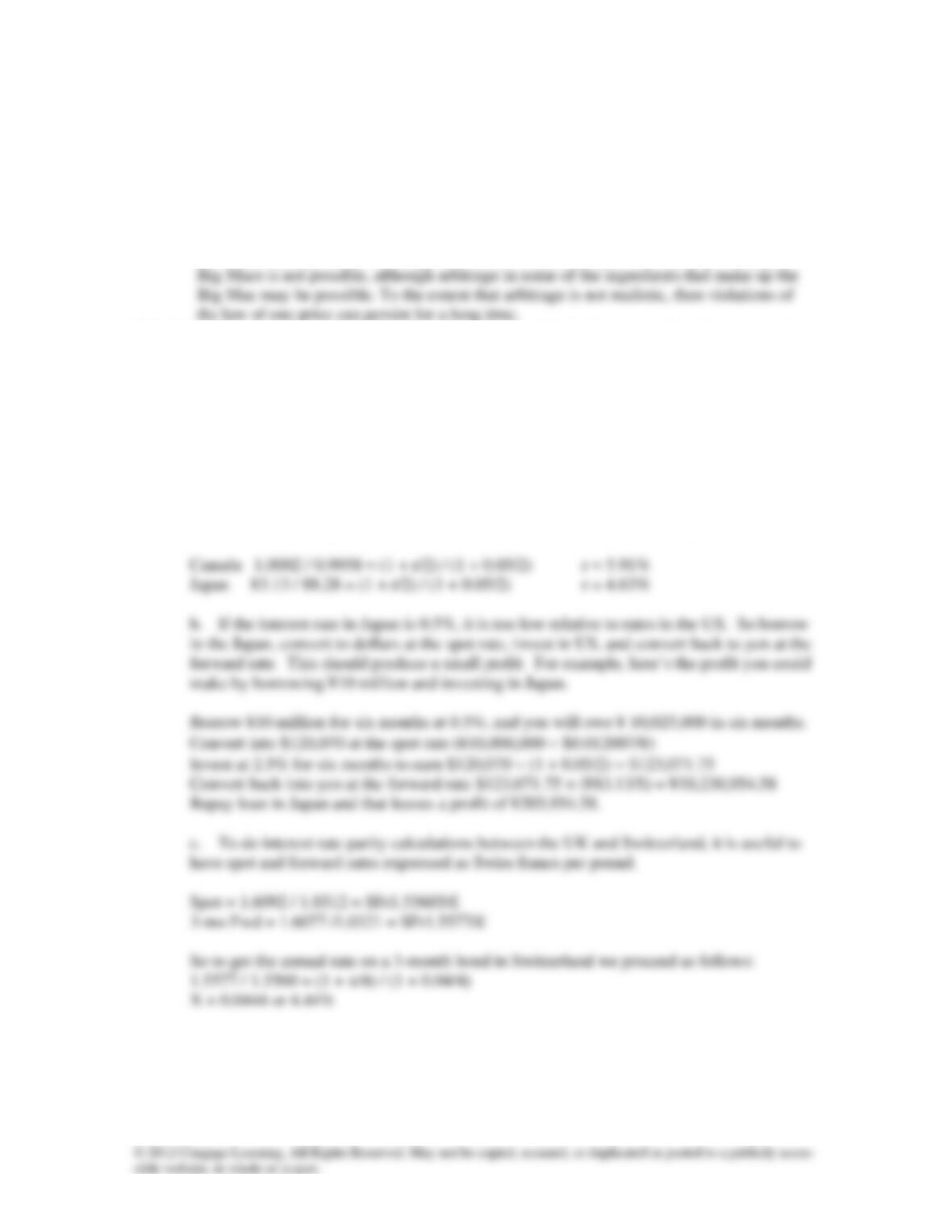
A18-10. Using the real interest rate parity equation:
504 Instructor’s Manual
P18-11. Go to http://www.economist.com. Under Economics, Markets & Data, find the link for
the “Big Mac index.” After exploring this part of the site, explain why the Big Mac index
might foreshadow changes in exchange rates. What features of the Big Mac would sug-
gest that Big Macs may not satisfy the law of one price?
A18-11. The details will change over time, but the basic idea is that in countries where Big Macs
are relatively expensive, exchange rates should depreciate. Of course doing arbitrage in
P18-12. Assume that the annual interest rate on a six-month U.S. Treasury bill is 5%, and use the
data presented in Figure 18.1 to answer the following:
a. Calculate the annual interest rate on six-month bills in Canada and Japan.
b. Suppose that the annual interest rate on a six-month bill in Japan is 0.5%. Illustrate
how to exploit this via covered interest arbitrage.
c. Suppose that the annual interest rate on a three-month U.K. government bond is 4%.
What is the annual interest rate on a three-month government bond in Switzerland?
d. Suppose that the actual Swiss interest rate is 0.5%. Illustrate how to conduct covered
interest arbitrage to exploit this situation.
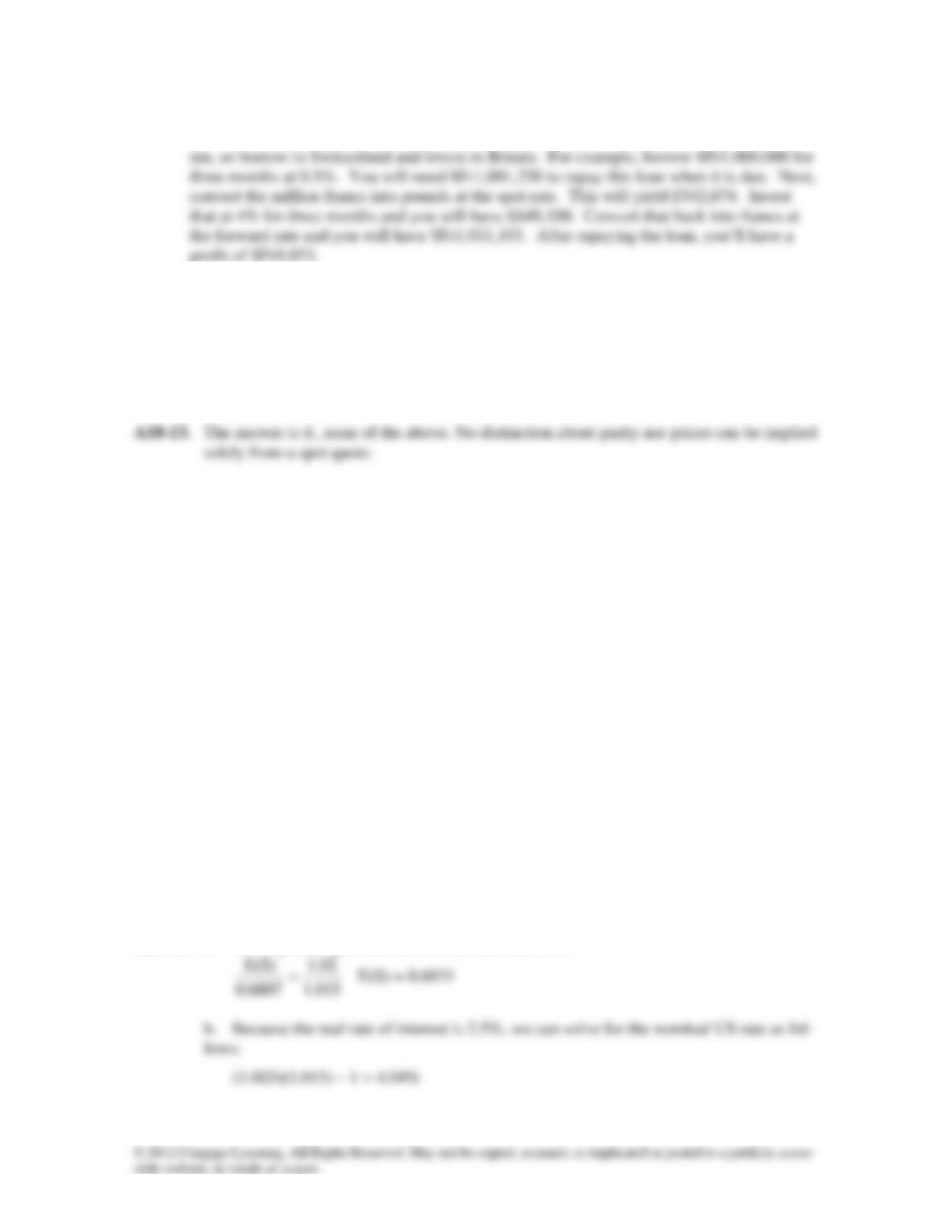
A18-12. a. Use interest rate parity to calculate the risk-free rates in Canada in Japan as follows:
Chapter 18 International Financial Management 505
d. If the actual rate in Switzerland is 0.5%, that rate is too low relative to the rate in Brit-
P18-13. Shortly after it was introduced, the euro traded just below parity with the dollar, meaning
that one dollar purchased more than one euro. This implies
a. that U.S. inflation was lower than European inflation
b. that U.S. interest rates were lower than European rates
c. that the law of one price does not hold
d. none of the above
P18-14. Assume that the following information is known about the current spot exchange rate
between the U.S. dollar and the British pound (£), inflation rates in Britain and the Unit-
ed States, and the real rate of interest—which is assumed to be the same in both coun-
tries:
Current spot rate, S = $1.4500/£ (£0.6897/$)
U.S. inflation rate, iUS = 1.5% per year (0.015)
British inflation rate, iUK = 2.0% per year (0.020)
Real rate of interest, R = 2.5% per year (0.025)
Based on this data, use the parity conditions of international finance to compute the fol-
lowing:
a. Expected spot rate next year
b. U.S. risk-free rate (on a 1-year bond)
c. British risk-free rate (on a 1-year bond)
d. One-year forward rate
Finally, show how you can make an arbitrage profit if you are offered the chance to sell
or buy pounds forward (for delivery one year from now) at the current spot rate of
$1.4500/£ (£0.6897/$). Assuming that you can borrow $1 million or £689,700 at the risk-
free interest rate, what would your profit be on this arbitrage transaction?
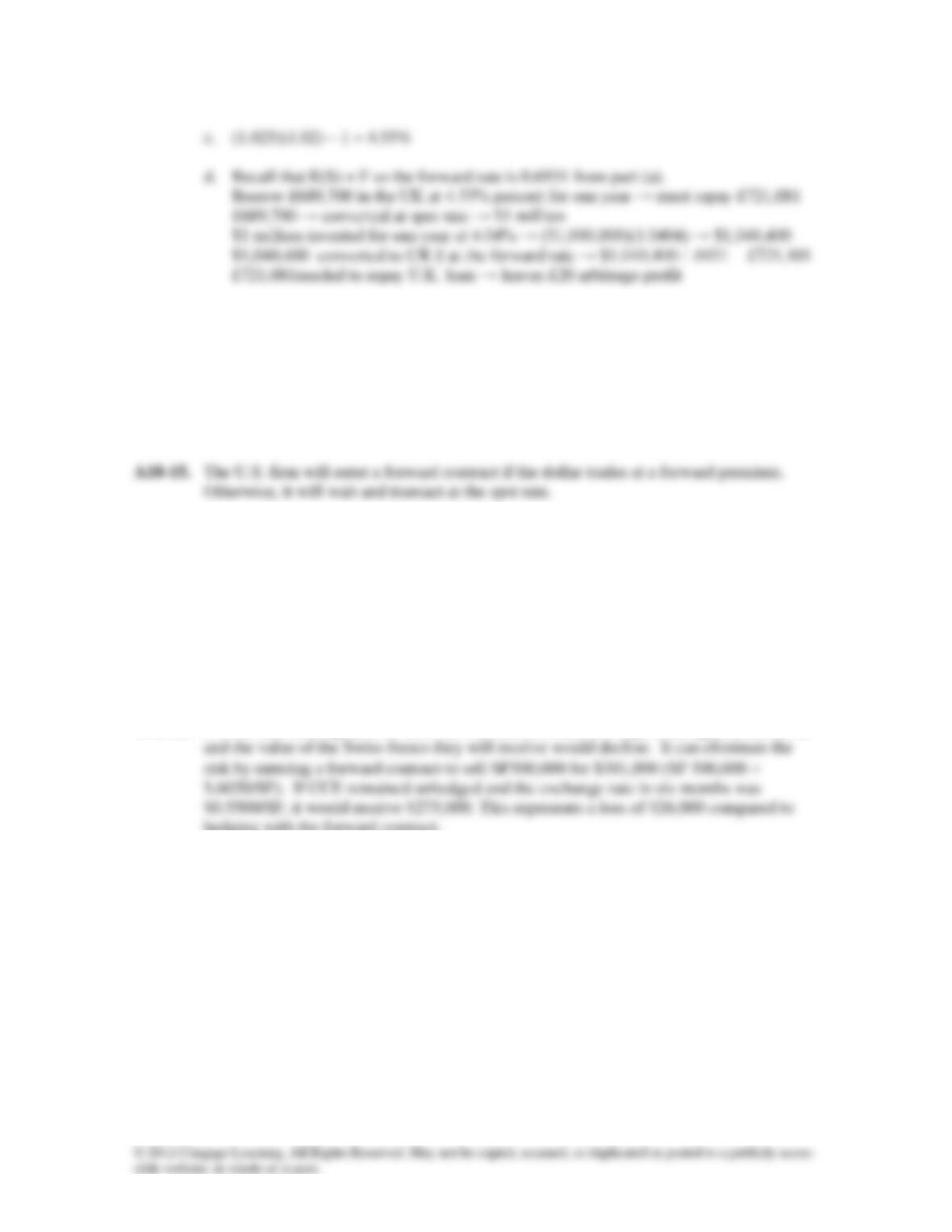
A18-14. a. The expected spot rate can be obtained from PPP:
506 Instructor’s Manual
Managing Financial and Political Risk
P18-15. Suppose that the spot exchange rate follows a random walk, which means that the best
forecast of the spot rate at some future date is simply its current value. Now suppose that
a U.S. firm owes €1 million to a Spanish supplier. If the U.S. firm wants to minimize the
expected dollar cost of paying its Spanish supplier (without regard to currency risk), de-
scribe the circumstances under which the firm will or will not enter into a forward con-
tract to hedge its exposure.
P18-16. Classic City Exporters (CCE) recently sold a large shipment of sporting equipment to a
Swiss company—the goods will be sold in Zurich. The sale was denominated in Swiss
francs (SF) and was worth SF500,000. Delivery of the sporting goods and payment by
the Swiss buyer are due to occur in six months. The current spot exchange rate is
$0.6002/SF (SF1.6661/$), and the six-month forward rate is $0.6020/SF (SF1.6611/$).
What risk would CCE run if it remained unhedged, and how could it hedge that risk with
a forward contract? Assuming that the actual exchange rate in six months is $0.5500/SF
(SF1.8182/$), compute the profit or loss—and state which it is—CCE would experience
if it had chosen to remain unhedged.
A18-16. If it remains unhedged, CCE runs the risk that the franc will depreciate against the dollar
hedging with the forward contract.
P18-17. A British firm will receive $1 million from a U.S. customer in three months. The firm is
considering two strategies to eliminate its foreign exchange exposure. The first strategy
is to pledge the $1 million as collateral for a three-month loan from a U.S. bank at 4 per-
cent interest. The U.K. firm will then convert the proceeds of the loan to pounds at the
spot rate. When the loan is due, the firm will pay the $1 million balance due by handing
its U.S. receivable over to the bank. This strategy allows the U.K. firm to “monetize” its
receivable immediately. The spot exchange rate is 0.6550 pounds per dollar.
The second strategy is to enter a forward contract at an exchange rate of 0.6450
pounds per dollar. This ensures that the U.K. firm will receive £645,000 in three months.
If the firm wanted to monetize this payment immediately, it could take out a three-month
loan from a U.K. bank at 8 percent, pledging the proceeds of the forward contract as col-
lateral.
Which of these strategies should the firm follow?
Chapter 18 International Financial Management 507
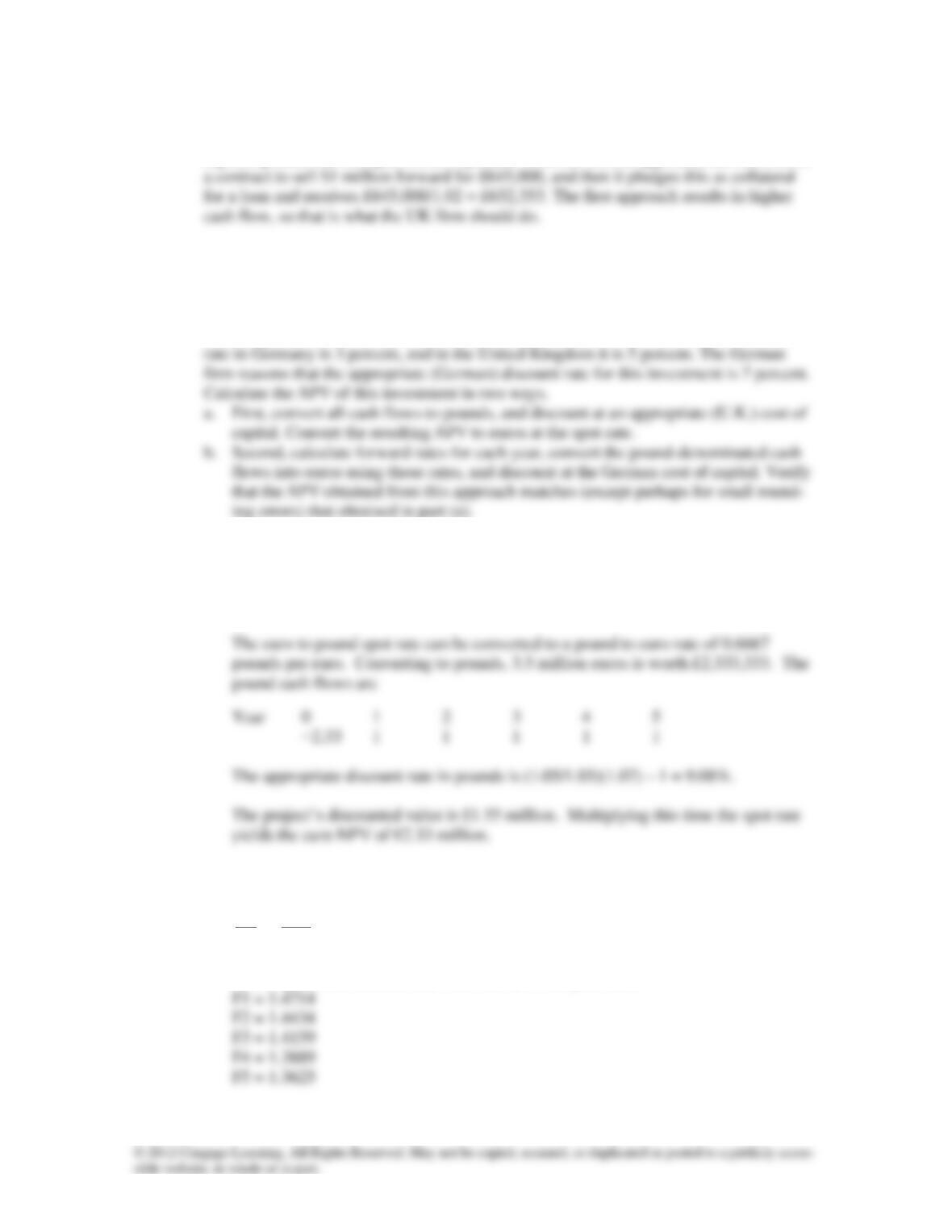
A18-17. With the first approach, the UK firm can borrow $1,000,000/1.01 = $990,099. Convert-
ing into pounds the firm gets 648,515 pounds. With the second approach, the firm enters
Long-Term Investment Decisions
P18-18. A German company manufactures a specialized piece of manufacturing equipment and
leases it to a U.K. enterprise. The lease calls for five end-of-year payments of £1 million.
The German firm spent €3.5 million to produce the equipment, which is expected to have
no salvage value after five years. The current spot rate is €1.5/£. The risk-free interest
A18-18. a. Project cash flows:
Year 0 1 2 3 4 5
€3.5 £1 £1 £1 £1 £1
b. The forward rate (in euros per pound) in year “t” is given by the following formula:
t
)
05.1
03.1
(
5.1
F=
This implies that forward rates over the next five years are:
508 Instructor’s Manual
Multiplying these forward rates times the 1 million pound cash flow in each of the
next five years results in a series of euro denominated cash flows, which we can dis-
count at the euro interest rate of 7%. The resulting NPV is 2.32million euros.
THOMSON ONE Business School Edition: Because P18-19 and P18-20 are based on using a
live data base, answers will vary from moment to moment. This is a chance for your students to
use a version of a tool that CFAs use every day.
Answer to MiniCase
International Financial Management
Five years after completing your college degree you accept an exciting new job with the multina-
tional firm Rangsit Trading Incorporated. This new position will involve a great deal of travel,
along with some other challenging responsibilities. Part of your job function is to set company pol-
icy to manage exchange rate risk. As such, you decide that you need to become fluent in the fol-
lowing topics.
Assignment
1. First, you decide to review basic exchange rate terminology.
a. Describe fixed and floating exchange rate systems. What are some problems with these
systems?
2. Next, you review the following parity relationships.
a. Describe forward-spot parity.
3. Finally, you review the following risks that are relevant to multinational firms.
a. Describe transactions risk and how this risk can be alleviated.
b. Describe translation and economic risks and how these risks can be alleviated.
c. Describe political risk and how this risk can be alleviated.
Answers
1. a. A fixed-rate system, governments fix (or peg) their currency’s value, usually in terms of
another currency such as the U.S. dollar. Once a government pegs the currency at a partic-
b. A managed floating rate system is a hybrid in which a nation’s government loosely “fixes”
the value of the national currency in relation to that of another currency, but does not ex-
Chapter 18 International Financial Management 509
2. a. If the spot rate governs foreign exchange transactions in the present and the forward rate
equals the price of trading currencies at some point in the future, intuition suggests that the
b. Purchasing power parity can be described using the law of one price as its basis. The law
of one price states that identical goods trading in different markets should sell at the same
price. As an extension, purchasing power parity says that if the law of one price holds at all
times, then differences in expected inflation between two countries are associated with ex-
d. If nominal rates of return on risk-free investments are equalized around the world, after
adjusting for currency translation, perhaps real rates of return are also equalized. Real in-
terest rate parity means that investors should earn the same real rate of return on risk-free
investments no matter the country in which they choose to invest.
e. If our four parity relationships are combined we have the relationship as presented in equa-
tion 18.7. The first equality simply restates the forward-spot parity relationship. The sec-
ond equality is the expression for interest rate parity, and the third and fourth equalities
3. a. Transactions risk is that exposure to exchange rate risk faced by a firm that is vulnerable to
an adverse change in the value of any of its cash flows as a result of exchange rate move-
b. Translation and economic risks relate to those additional complexities involved with oper-
ating internati0nally if they have affiliates or subsidiaries on the ground in a foreign coun-
510 Instructor’s Manual
posure. In other words, foreign exchange rate fluctuations affect individual accounts in the
financial statements. A more important risk element concerns economic exposure, which is
c. Political risk refers to actions taken by a government that have a negative impact on the
value of foreign companies operating in that country. Macro political risk means that all