
CHAPTER 17
PROFESSIONAL PORTFOLIO MANAGEMENT, ALTERNATIVE
ASSETS, AND INDUSTRY ETHICS
Answers to Questions
1. Private management and advisory firms typically develop a personal relationship with
their clients, getting to know the specific investment objectives and constraints of each.
The collection of assets held can then be tailored to the special needs of the client.
Conversely, a mutual fund (investment company) offers a general solution to an
2. Based upon Exhibit 17.2, there has been a rapid increase in the number of large asset
management firms. Much of this asset growth can be explained by the strong
3. After the initial public sale of shares in the investment company the open-end fund will
continue to sell new shares to the public at the NAV with or without a sales charge and

4. A load fund charges a fee for the sale of shares (front end load) and/or redeeming shares
5. You definitely should care about how well a mutual fund is diversified. One of the major
advantages of a mutual fund is instant diversification, so it truly is important. Given the
6. As an investor, it is the net return that is important because these are the returns that you
derive. The net return for a fund is the return after all research and management costs.
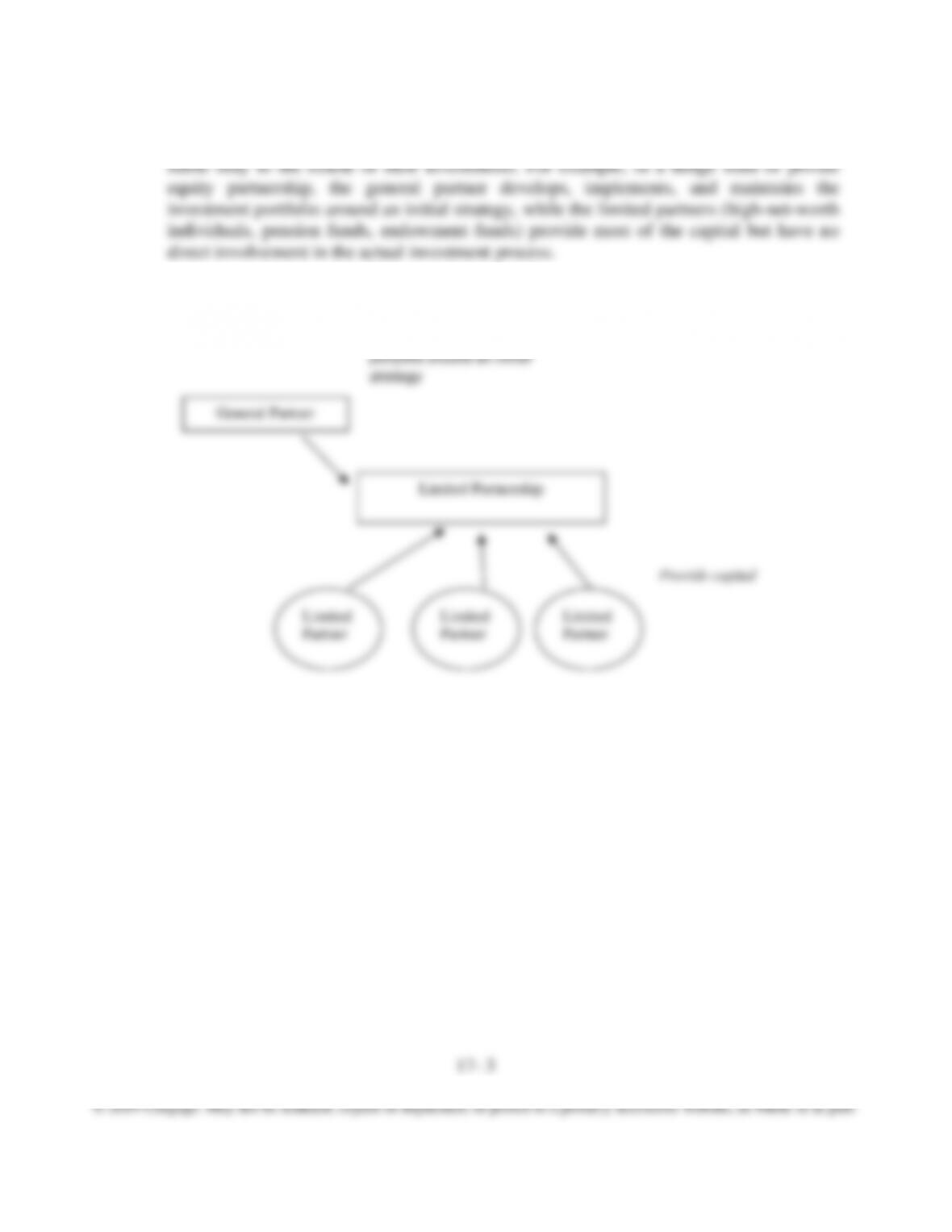
7. In a limited partnership, one or more general partners are responsible for running the
organization and assuming its legal obligations, while the remaining limited partners are
8.
Develops, implements, and
maintains the investment

17-
4
A.1. The alpha from the long-short strategy can be transported to other asset classes by
A.2. The three major quantifiable sources of risk are:
i) Market risk
ii) Credit risk
A.3. Risk-based leverage uses a measure of market risk (such as VAR) relative to a
measure of the resources available to absorb risk (such as cash or equity).
B. The hedge fund investment strategies best characterized by each of the three strategy
components reviewed by Marco are:
1. Quantitative strategy
3. Quantitative strategy
Supplemental information (not required)
1. The first component—describing a quantitative strategy—involves purchasing stocks
2. The second component—describing an arbitrage/relative value strategy—involves
3. The third component—describing a quantitative strategy—involves using neural
networks to detect patterns in historical data; computer-generated analyses of past
trading patterns are used to determine future trading strategies.
C.
Marco’s five
Correct or
If incorrect, give one Reason why the
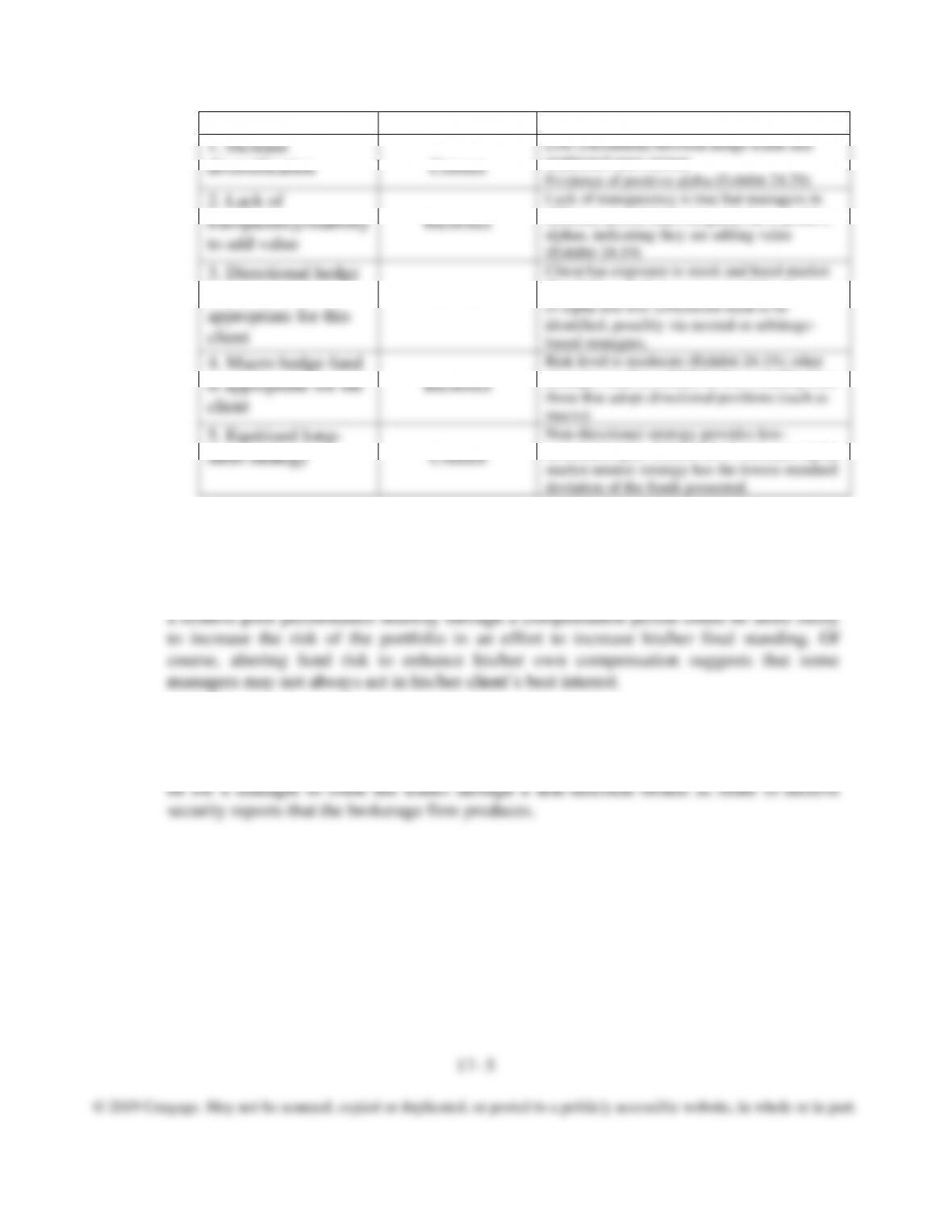
Low correlations between hedge funds and
traditional asset classes
alphas, indicating they are adding value
identified, possibly via neutral or arbitrage–
9. Managers are often compensated with a base salary and a bonus that depends on the
performance of their portfolios relative to those of their peers. Therefore, a manager with
10. Soft dollars are generated when a manager commits the investor to paying a brokerage
commission that is higher than the simple cost of executing a stock trade in exchange for
the manager receiving additional bundled services from the broker. One example would
Conclusions
Incorrect?
Conclusion is incorrect
2. Lack of
transparency/inability
Incorrect
Lack of transparency is true but managers in
different mutual fund categories have positive
fund is more
Incorrect
“beta” through their current portfolio. Sources
of alpha and low correlation need to be
is appropriate for the
Incorrect
strategies tend to exhibit far less volatility than
those that adopt directional positions (such as
5. Equitized long-
short strategy
Correct
Non-directional strategy provides low-
correlated alpha. Exhibit 24.19 indicates equity
17-
6
CHAPTER 17
Answers to Problems
1.
6,250
$8.00
$50,000
shares ofnumber Initial ==
2. Load fund = ($1,000 – $80) x 1.15 = $1,058.00
Represents a 5.80 percent growth
3. Period NAV Premium/Discount Market Price Annual Return
0 $10.00 0.0 $10.00
3(a). Using the above data, the arithmetic average return per year is 3.65%. On an annual
compounded (geometric average) basis, the average annual return is 3.42%.
3(b). (12.30 / 10.00) (1/4) – 1 = 5.31%
3(c). Ignoring commission, shares were purchased for $10.69 and sold at 10.08 and thus
a return of -5.7%.
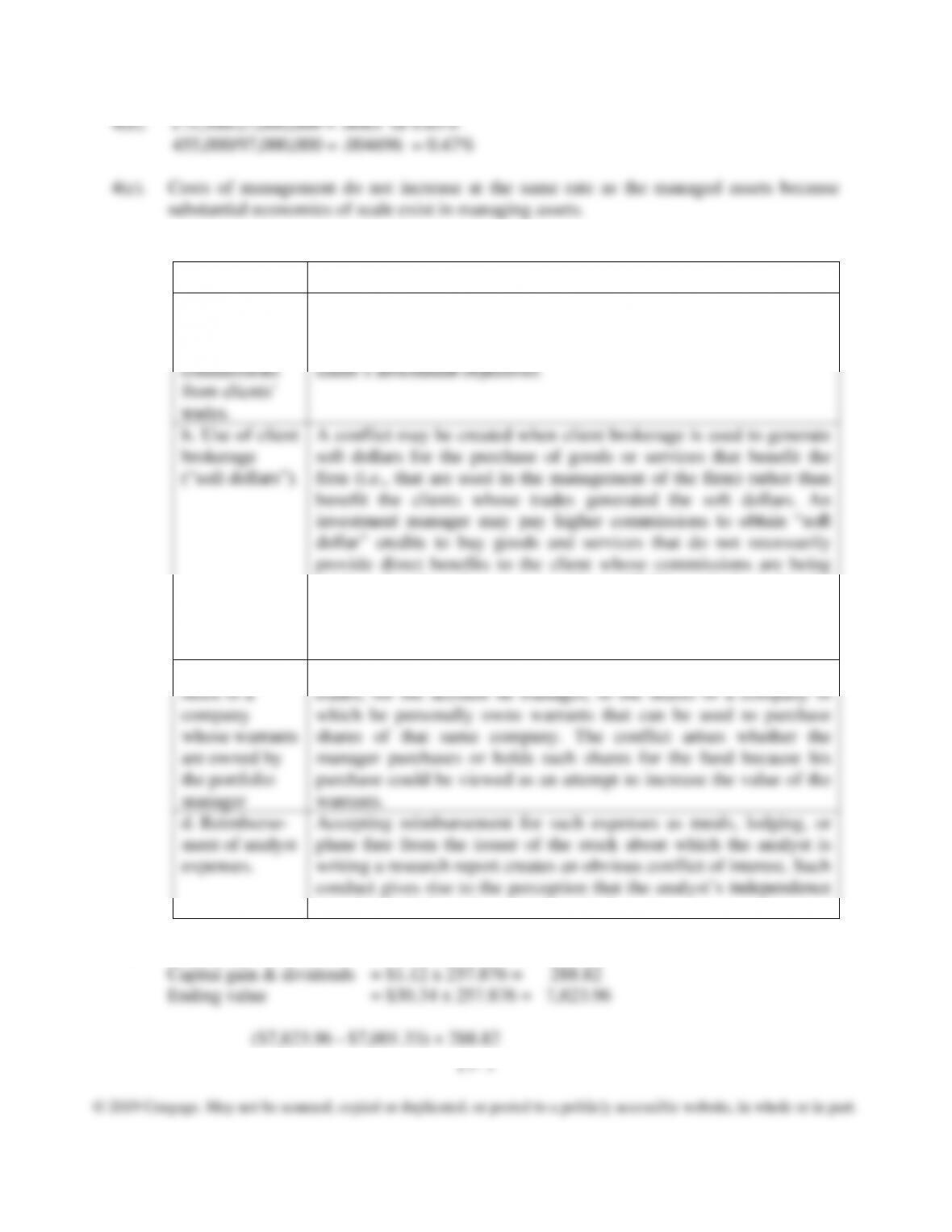
5.
Conduct
Potential Conflict
a.
Compensation
based on
commissions
from clients’
trades.
A fee structure of this type can cause a conflict because the portfolio
manager has an incentive to turn over investments in client accounts
to increase fees. A high volume of trading may be in conflict with a
client’s investment objectives.
b. Use of client
brokerage
(“soft dollars”).
A conflict may be created when client brokerage is used to generate
soft dollars for the purchase of goods or services that benefit the
firm (i.e., that are used in the management of the firm) rather than
benefit the clients whose trades generated the soft dollars. An
investment manager may pay higher commissions to obtain “soft
dollar” credits to buy goods and services that do not necessarily
provide direct benefits to the client whose commissions are being
used; such actions, however, must be justifiable on the basis that the
goods and services aid the manager in its investment decision–
making process. Absent such justification, the manager is putting its
own interest ahead of the client’s interest.
c. Purchase of
stock in a
company
whose warrants
are owned by
the portfolio
manager
There is a potential conflict of interest when a portfolio manager
trades, for the account he manages, in the shares of a company in
which he personally owns warrants that can be used to purchase
shares of that same company. The conflict arises whether the
manager purchases or holds such shares for the fund because his
purchase could be viewed as an attempt to increase the value of the
warrants.
d. Reimburse-
ment of analyst
expenses.
Accepting reimbursement for such expenses as meals, lodging, or
plane fare from the issuer of the stock about which the analyst is
writing a research report creates an obvious conflict of interest. Such
conduct gives rise to the perception that the analyst’s independence
and objectivity have been compromised.
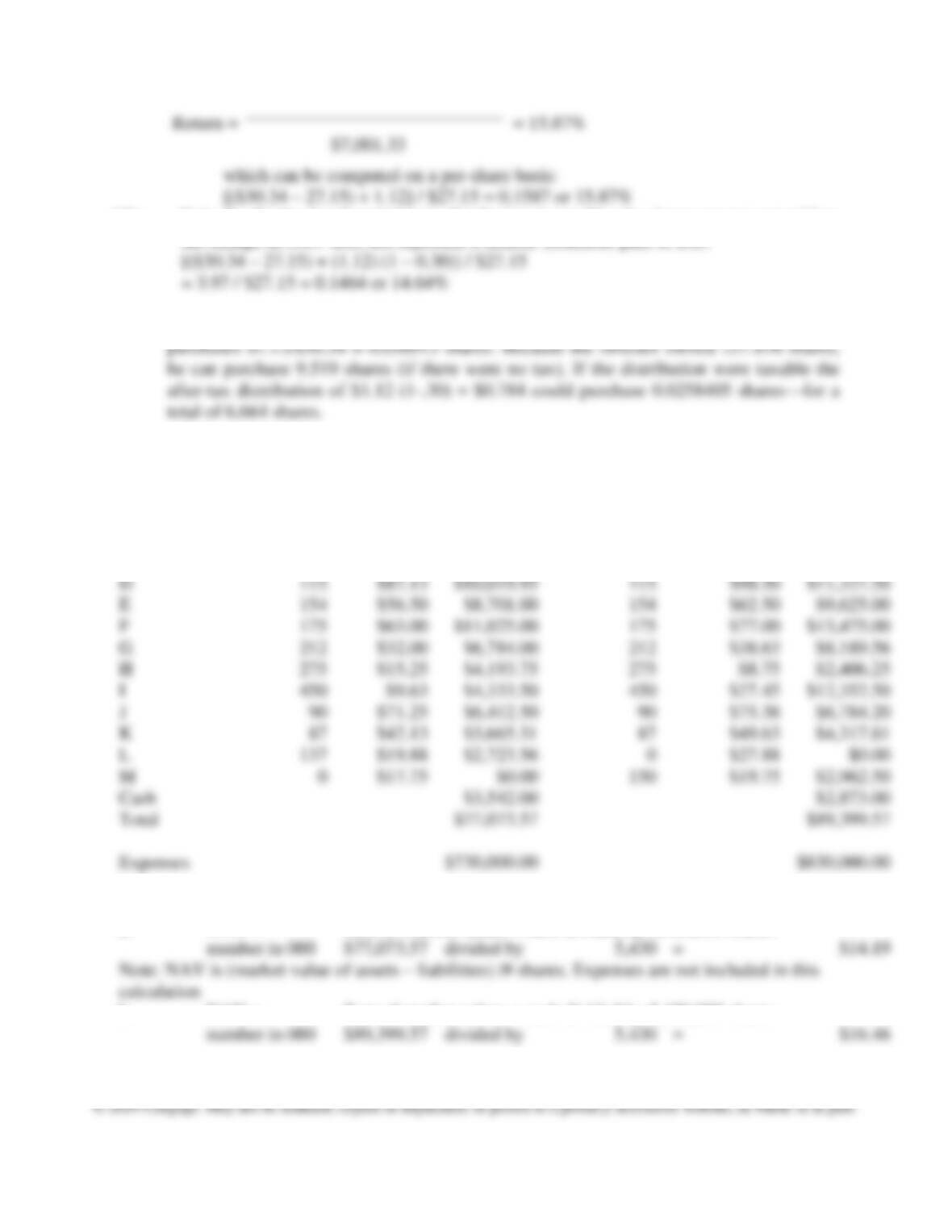
6(a). Beginning value = $27.15 x 257.876 = $7,001.33
17-
8
6(b). Only the dividend and capital gain distribution is taxable; the shares are not yet sold so
the change in NAV does not represent a taxable (realized) gain or loss:
6(c). The investor received a distribution of $1.12 per share which, at the year-end NAV,
7.
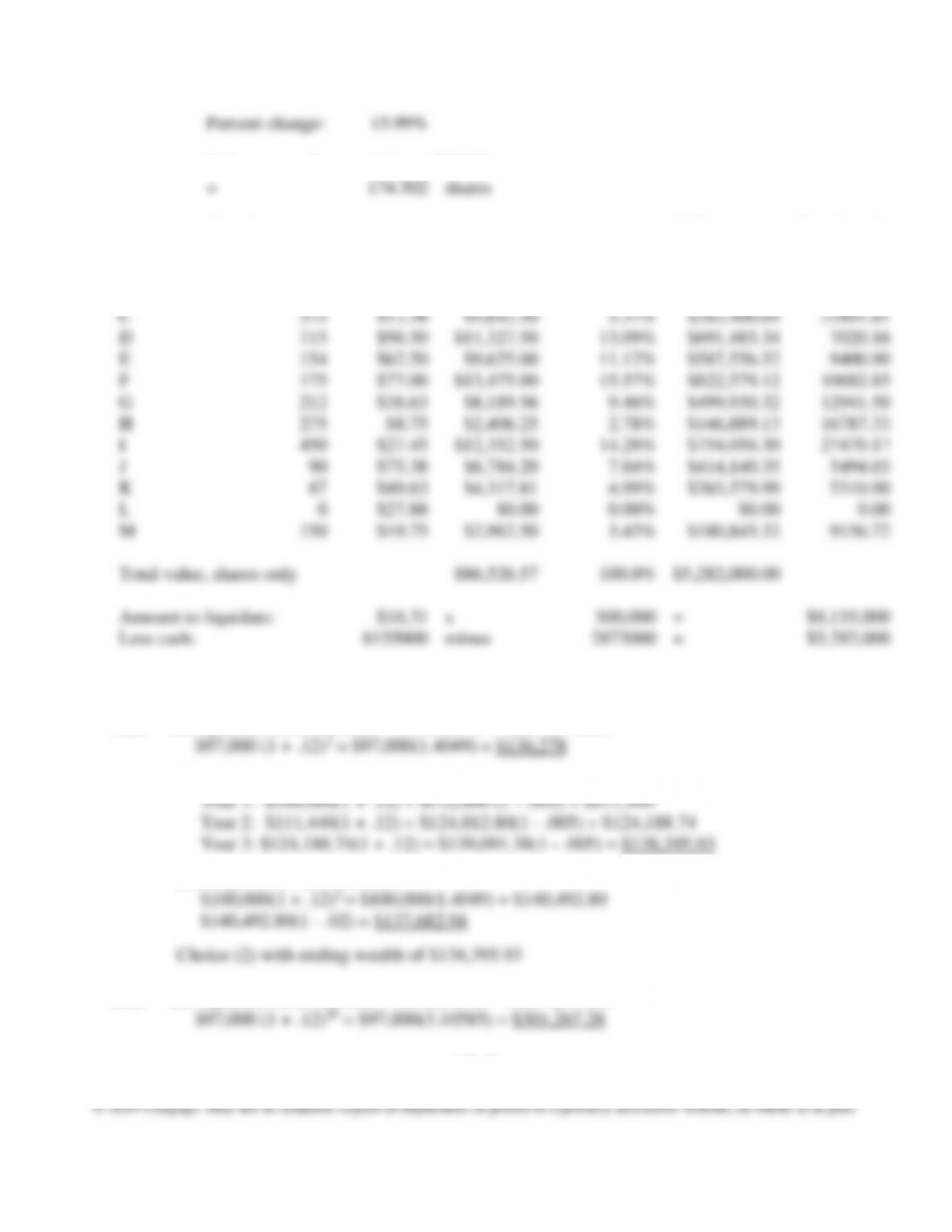
Year 1
Year 2
Stock
Shares (000)
price
MV (000)
Shares (000)
price
MV (000)
A
100
$45.25
$4,525.00
100
$48.75
$4,875.00
B
225
$25.38
$5,710.50
225
$24.75
$5,568.75
C
375
$14.50
$5,437.50
375
$12.38
$4,642.50
D
115
$87.13
$10,019.95
115
$98.50
$11,327.50
E
154
$56.50
$8,701.00
154
$62.50
$9,625.00
F
175
$63.00
$11,025.00
175
$77.00
$13,475.00
G
212
$32.00
$6,784.00
212
$38.63
$8,189.56
H
275
$15.25
$4,193.75
275
$8.75
$2,406.25
I
450
$9.63
$4,333.50
450
$27.45
$12,352.50
J
90
$71.25
$6,412.50
90
$75.38
$6,784.20
K
87
$42.13
$3,665.31
87
$49.63
$4,317.81
L
137
$19.88
$2,723.56
0
$27.88
$0.00
M
0
$17.75
$0.00
150
$19.75
$2,962.50
Cash
$3,542.00
$2,873.00
Total
$77,073.57
$89,399.57
Expenses
$730,000.00
$830,000.00
a.
NAV =
Sum of market values + cash divided by 5,430,000 shares
number in 000
$77,073.57
divided by
5,430
=
$14.19
Note: NAV is (market value of assets – liabilities) /# shares. Expenses are not included in this
calculation
b.
NAV =
Sum of market values + cash divided by 5,430,000 shares
number in 000
$89,399.57
divided by
5,430
=
$16.46
17-
9
Percent change:
15.99%
c.
# shares = cash account / year 2 NAV
=
174.502
shares
d.
Year 2
Dollars to
Number of
Shares (000)
price
MV (000)
% holding
be sold
shares sold
A
100
$48.75
$4,875.00
5.63%
$297,593.56
6104.48
B
225
$24.75
$5,568.75
6.44%
$339,943.41
13735.09
C
375
$12.38
$4,642.50
5.37%
$283,400.64
22891.81
D
115
$98.50
$11,327.50
13.09%
$691,485.34
7020.16
E
154
$62.50
$9,625.00
11.12%
$587,556.52
9400.90
F
175
$77.00
$13,475.00
15.57%
$822,579.12
10682.85
G
212
$38.63
$8,189.56
9.46%
$499,930.32
12941.50
H
275
$8.75
$2,406.25
2.78%
$146,889.13
16787.33
I
450
$27.45
$12,352.50
14.28%
$754,056.30
27470.17
J
90
$75.38
$6,784.20
7.84%
$414,140.35
5494.03
K
87
$49.63
$4,317.81
4.99%
$263,579.99
5310.90
L
0
$27.88
$0.00
0.00%
$0.00
0.00
M
150
$19.75
$2,962.50
3.42%
$180,845.32
9156.72
Total value, shares only
$86,526.57
100.0%
$5,282,000.00
Amount to liquidate:
$16.31
x
500,000
=
$8,155,000
Less cash:
8155000
minus
2873000
=
$5,282,000
8(a). (1) 3 percent front-end load = $100,000 (1 – .03) = $97,000
(2) a 0.50 percent annual deduction (assumed to be deducted at year-end)
(3) a 2 percent back-end load
8(b). (1) 3 percent front-end load = $100,000 (1 – .03) = $97,000

(2) a 0.50 percent annual deduction
(3) a 2 percent back-end load
8(c). A front-end load takes the money out right away, thus reducing your initial deposit.
11.1
9(a). The following CFA Institute Standards of Professional Conduct apply to Clark if C&K
provides all three functions on a combined basis.
1. According to CFA Institute Standard V, Disclosure of Conflicts, C&K must disclose
to its clients any material conflict of interest relating to the firm that may be
perceived by clients to influence C&K’s objectivity. If the Europension Group is
2. According to CFA Institute Standard VI.A, Disclosure of Additional Compensation
Arrangements Compensation, C&K must inform its customers and clients of
3. According to CFA Institute Standard VI. B, Disclosure of Referral Fees, C&K must
inform prospective customers or clients of any considerations paid or other benefits
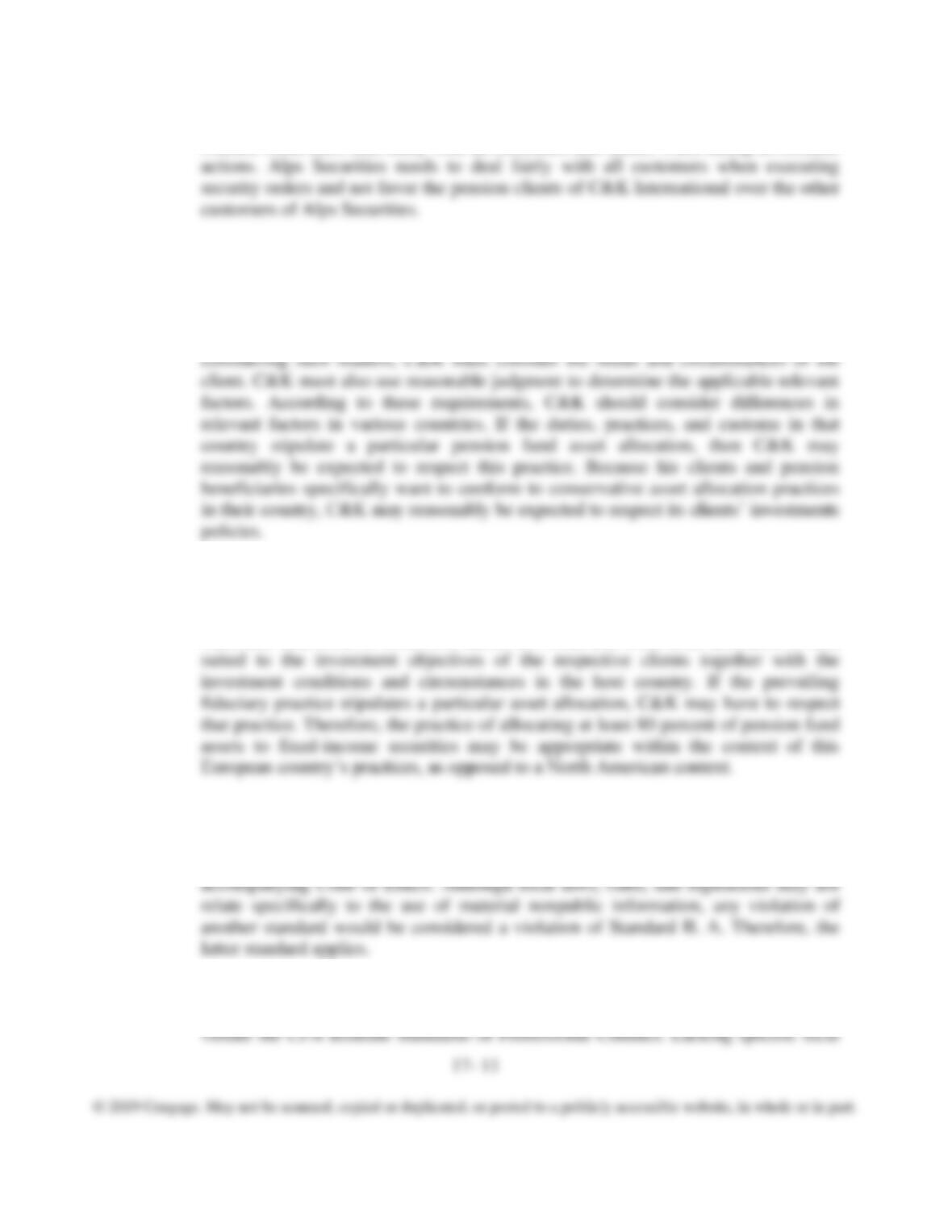
4. According to CFA Institute Standard III. G, Fair Dealing with Customers and
Clients, C&K must deal fairly with all customers and clients when taking investment
9(b). The following CFA Institute Standards of Professional Conduct apply to this situation:
1. According to CFA Institute Standard III. C1, Portfolio Investment Recommendations
and Actions, C&K must, when taking an investment action for a specific portfolio or
client, consider its appropriateness and suitability for such a portfolio or client. In
2. According to CFA Institute Standard VII. C, Fiduciary Duties, Clark should
determine applicable fiduciary duties in that country and comply with them. Clark
must also determine to whom the duties are owed and what asset allocation is best
9(c). The following CFA Institute Standards of Professional Conduct apply in this situation.
1. According to CFA Institute Standard II. A, Required Knowledge and Compliance,
Clark must comply with the CFA Institute Standards of Professional Conduct and the
2. According to CFA Institute Standard II. B, Prohibition Against Assisting Legal and
Ethical Violations, Clark must not knowingly participate in any act that would

17-
12
3. According to CFA Institute Standard II. C, Prohibition Against Use of Material
Nonpublic Information, Clark cannot use insider information in his investment
11.2 The Muellers’ portfolio can be evaluated in terms of the following criteria:
i. Preference for “Minimal Volatility.” The volatility of the Muellers’ portfolio is likely
to be much greater than minimal. The asset allocation of 95 percent stocks and 5
percent bonds indicates that substantial fluctuations in asset value will likely occur
over time. The asset allocation’s volatility is exacerbated by the fact that the beta
ii. Equity Diversification. The most obvious equity diversification issue is the
concentration of 35% of the portfolio in the high beta small cap stock of Andrea’s
company, a company with a highly uncertain future. A substantial portion of the stock
should be sold, with care to tax implications. Another issue is the 90 percent
iii. Asset Allocation (including cash flow needs). The portfolio has a large equity
weighting that appears to be very aggressive. If, for example, they have below
average risk tolerance and limited growth objectives, a more conservative, balanced

11(a). Implied probability that the takeover bid will be successful is:
(b). According to this probability, the deal has a better than a four–in-five chance of being
completed in order to justify purchasing XYZ stock for $42 in the hope of selling at the