Chapter 17 Cash, Payables, and Liquidity Management 483
A17-9. a. Integrated accounts payable, also known as comprehensive accounts payable, provides
a company with outsourcing of its accounts payable or disbursement operations.
b. purchasing (or procurement) card programs serve as a means of reducing the cost of
low-dollar indirect purchases. The purchasing cards are issued to designated employ-
Q17-10. Briefly describe each of the three basic motives for a firm holding cash and short-term
investments. For each of the motives indicate the general form in which the funds are
typically held.
A17-10. The three basic motives are transactions motive, safety motive, and speculative
motive. With the transactions motive, a firm maintains cash and short-term
investments to make planned payments for items such as materials and wages.
Q17-11. What is the firm’s goal in short-term investing? How does it use money market mutual
funds? Describe some of the popular money market financial instruments in each of the
following groups:
a. U.S. Treasuries
b. Federal agency issues
c. Bank financial instruments
d. Corporate obligations
A17-11. Short-term investments must be liquid so the company can cash them in easily when
needed. Preservation of principal is also important since the firm will want to know how
484 Instructor’s Manual
Q17-12. How is interest paid on a discount investment? What is the money market yield (MMY)?
How can the MMY be converted into a bond equivalent yield (BEY)?
A17-12. In the case of a discount investment, the investor pays less than face value at time of pur-
chase, and then receives the face value of the investment at maturity. There are generally
Q17-13. How are the rates on short-term borrowing typically set? What role does either the prime
rate or LIBOR play in this process? What is the effective borrowing rate (EBR)? How
does the EBR differ from the stated all-in rate?
A17-13. The key base rates used in variable rate short-term borrowing are the prime rate, the rate
Solutions to End-of-Chapter Problems
Cash Management
P17-1. Nickolas Industries has daily cash receipts of $350,000. A recent analysis of the firm’s col-
lections indicated that customers’ payments are in the mail an average of 2 days. Once re-
ceived, the payments are processed in 1.5 days. After the payments are deposited, the
receipts clear the banking system, on average, in 2.5 days. Assume a 365-day year.
a. How much collection float (in days) does the firm have?
b. If the firm’s opportunity cost is 11%, would it be economically advisable for the firm
to pay an annual fee of $84,000 for a lockbox system that reduces collection float by
2.5 days? Explain why or why not.
A17-1. a. The firm’s collection float is 2 + 1.5 + 2.5 = 6 days
P17-2. NorthAm Trucking is a long-haul trucking company serving customers all across the con-
tinental United States and parts of Canada and Mexico. At present, all billing activities —
from preparation to collection—are handled by staff at corporate headquarters in Bloom-
ington, Indiana. Payments are recorded and deposits are made once a day in the firm’s
bank, Hoosier National. You have been hired to recommend ways to reduce collection float
and thereby generate cost savings.
a. Suggest and explain at least three specific ways that NorthAm could reduce its collec-
tion float.
b. Assume your preferred recommendation will cut the collection float by four days.
NorthAm bills $108 million per year. If collections are evenly distributed throughout a
365-day year and the firm’s cost of short-term financing is 8%, what savings could be
achieved by implementing the suggestion?
c. If the cost of implementing your recommendation is $100,000 per year, based on your
finding in part (b), should NorthAm implement it?
A17-2. a. Three ways to reduce collection float include:
1. Bill customers continuously within a day of delivery
Collections
P17-3. Qtime Products believes that use of a lockbox system can shorten its accounts receivable
collection period by four days. The firm’s annual sales, all on credit, are $65 million, billed
on a continuous basis. The firm can earn 9% on its short-term investments. The cost of the
lockbox system is $57,500 per year. Assume a 365-day year.
a. What amount of cash will be made available for other uses under the lockbox system?
b. What net benefit (or cost) will the firm receive if it adopts the lockbox system? Should
it adopt the proposed lockbox system?
A17-3. a. Additional cash available: $65,000,000/365 × 4 = $712,329
P17–4. Firm A has annual revenues of $1.6 billion and can reduce its float by four days
using a lockbox system. Due to A’s significant risk, A has a high cost of capital of
22%. Firm B has annual revenues of $850 million and can reduce its float by three
days using a similar lockbox system. Firm B is less risky than Firm A, as evidenced
by B’s cost of capital of 10%. Assuming the lockbox system costs $2 million,
which firm benefits more from using the system? If the two firms merge, making it
necessary to have only one lockbox system for the combined firm, then how much
486 Instructor’s Manual
is the net benefit of having the lockbox system under this circumstance?
A17-4. Firm A savings: $1.6 billion × (4 / 365) × 22% = $3,857,534
P17-5. Quick Burger Inc., a national chain of hamburger restaurants, has accumulated a $27,000
balance in one of its regional collection accounts. It wishes to make an efficient, cost-
effective transfer of $25,000 of this balance to its corporate concentration account, thus
leaving a $2,000 minimum balance in the regional collection account. It has the following
options:
Option 1: EDT at a cost of $2.50 and requiring one day to clear
Option 2: Wire transfer at a cost of $12 and clearing the same day (zero days to clear)
a. If Quick Burger can earn 6% on its short-term investments, assuming a 365-day year,
which of the options would you recommend to minimize the transfer cost?
b. Compare Options 1 and 2, and determine the minimum amount that would have to be
transferred in order for the wire transfer (Option 2) to be more cost-effective than the
EDT (Option 1).
A17-5. Option 1: Opportunity cost of 1/365 × .06 × $25,000 = $4.11 + $2.50 = $6.61
P17-6. Firm OPL has average daily cash inflows (Monday through Saturday) of $15,890,
$13,267, $20,654, $24,956, $37,923, and $42,516, respectively. A wire transfer
deposits money into a concentration account faster by one day if executed Monday
through Thursday and by three days if executed Friday. Assuming that the
additional cost of a wire transfer is $15.62 and that OPL has a cost of capital of
16% annually, on which days should wire transfers be considered? (Note: Saturday
inflows should be combined with Monday inflows because banks close too early on
Saturday to recognize the cash inflow.)
Chapter 17 Cash, Payables, and Liquidity Management 487
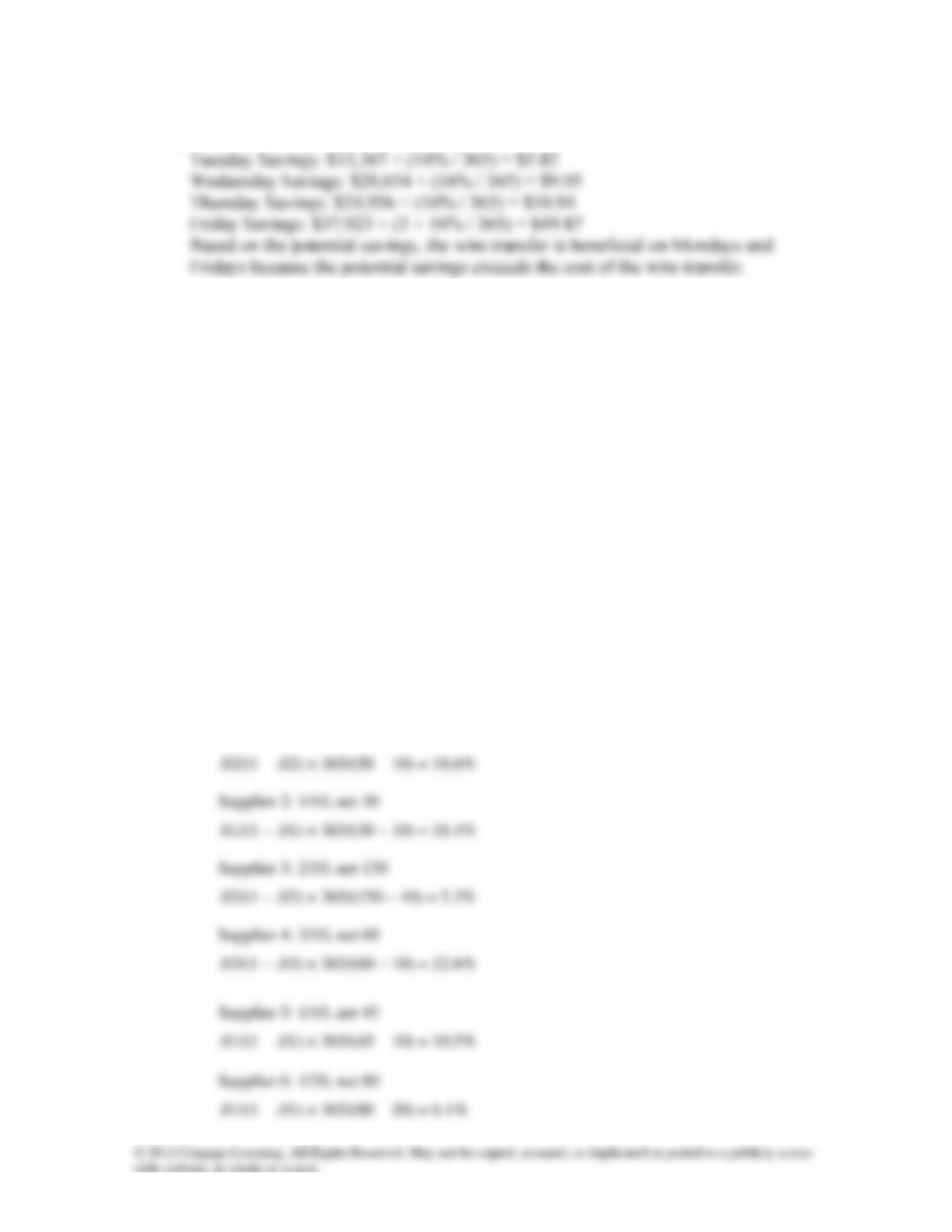
A17-6. Monday Savings: ($15,890 + $42,516) × (16% / 365) = $25.60
Accounts Payable and Disbursements
P17-7. Assume a firm receives the following credit terms from six suppliers and a 365-day year.
Supplier 1: 2/10 net 50
Supplier 2: 1/10 net 30
Supplier 3: 2/10 net 150
Supplier 4: 3/10 net 60
Supplier 5: 1/10 net 45
Supplier 6: 1/20 net 80
a. Determine the interest rate associated with not taking the cash discount and paying at
the end of the credit period for each of the six suppliers’ credit terms.
b. In part (a), you calculated the interest rate associated with not taking the discount for
each suppliers’ credit terms. Now you must decide whether or not to take the cash dis-
count by paying within the discount period. To pay early, you will need to borrow
from your firm’s line of credit at the local bank. The interest rate on the line of credit is
the prime rate plus 2.5%. You can get the most recent prime rate from the Federal Re-
serve at http://www.federalreserve.gov/releases/h15/update. For each suppliers’ terms,
use the current prime rate to determine whether the firm should borrow from the bank
or borrow from the supplier.
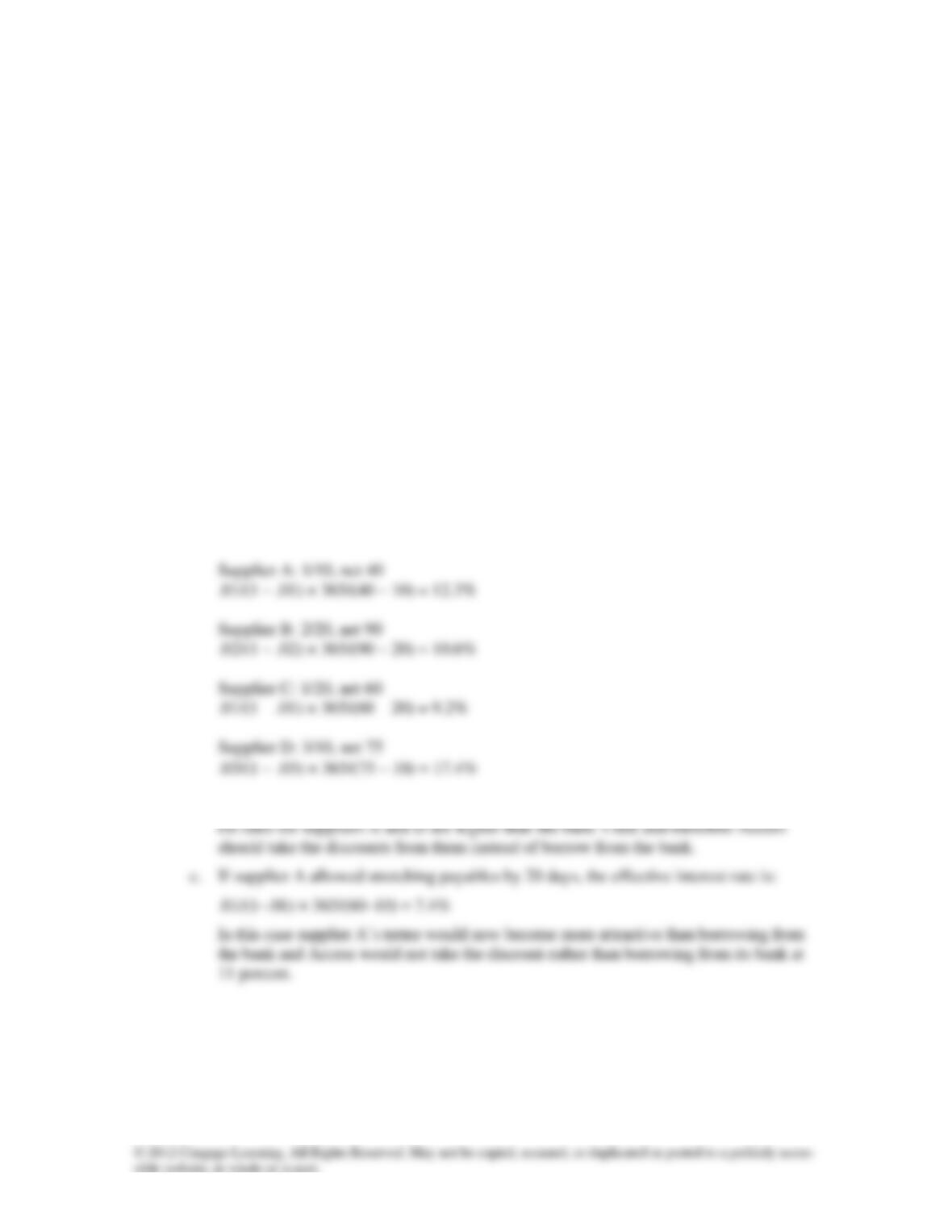
A17-7. a. r = d/(1 – d) × 365/(CP – DP)
Supplier 1: 2/10, net 50
488 Instructor’s Manual
b. Internet exercise – answers will vary.
P17-8. Access Enterprises is vetting four possible suppliers of an important raw material used in
its production process, all offering different credit terms. The products offered by each
supplier are virtually identical. The following table shows the credit terms offered by these
suppliers. Assume a 365-day year.
Supplier Credit Terms
A 1/10 net 40
B 2/20 net 90
C 1/20 net 60
D 3/10 net 75
a. Calculate the interest rate associated with not taking the discount from each supplier.
b. If the firm needs short-term funds, which are currently available from its commercial
bank at 11%, and if each of the suppliers is viewed separately, which, if any, of the
suppliers’ cash discounts should the firm not take? Explain why.
c. Suppose that the firm could stretch its accounts payable to Supplier A (net period only)
by 20 days. How would this affect your answer in part (b) concerning this supplier?
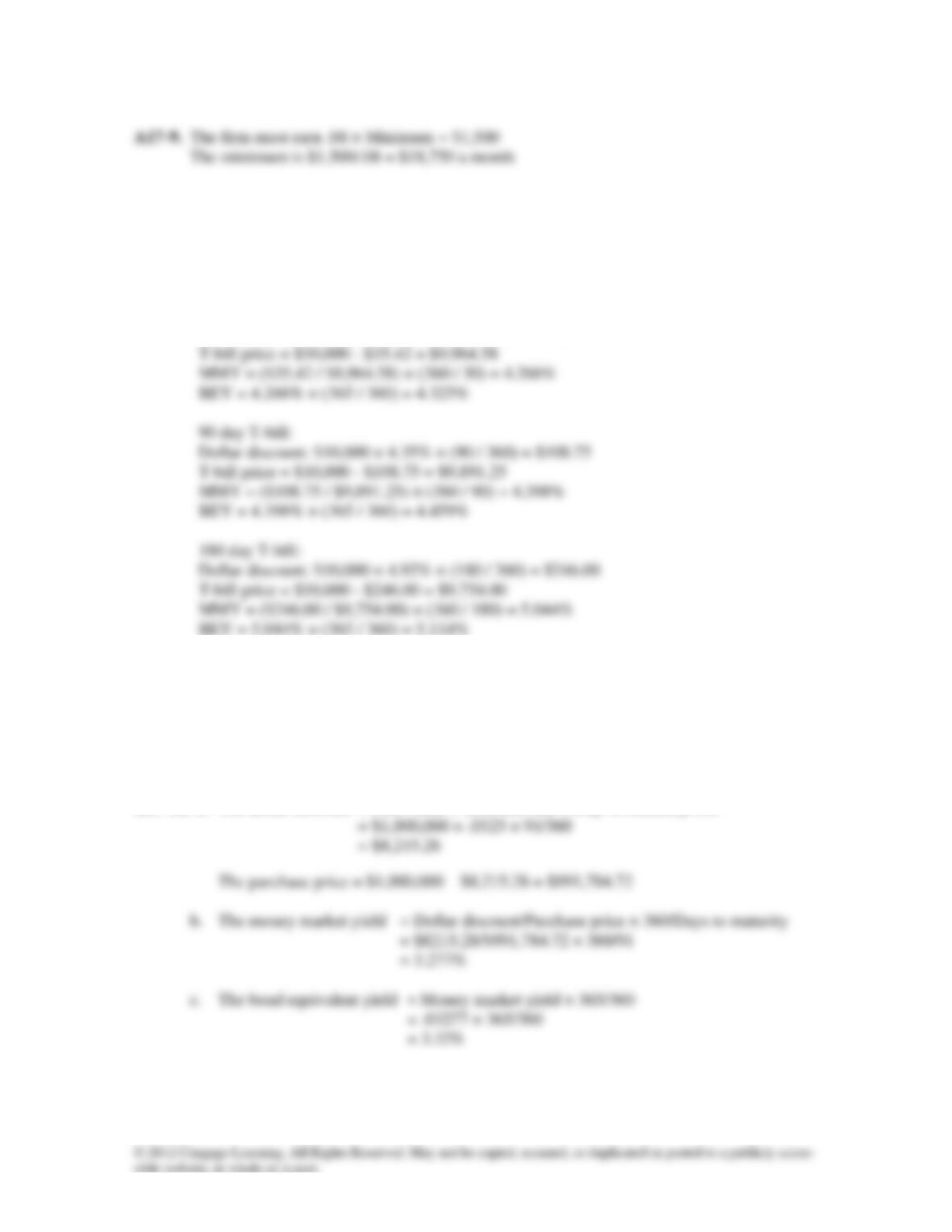
A17-8. a. The interest rate from not taking the discount for
b. Suppliers B and C have interest rates lower than the bank’s 11 percent rate. The inter-
P17-9. Union Company is examining its operating cash management. One of the options the firm
is considering is a zero-balance account (ZBA). The firm’s bank is offering a ZBA with
monthly charges of $1,500, and the bank estimates that the firm can expect to earn 8% on
its short-term investments. Determine the minimum average cash balance that would make
this ZBA a benefit to the firm. Assume a 365-day year.
Chapter 17 Cash, Payables, and Liquidity Management 489
Short-Term Investing and Borrowing
P17-10. Suppose Treasury bills (face value of $10,000) with maturities of 30 days, 90 days, and
180 days sell at the respective annualized discounts of 4.25%, 4.35%, and 4.92%. What are
the respective money market yields for these T-bills? What are their respective bond
equivalent yields?
A17-10.. 30 day T-bill:
Dollar discount: $10,000 × 4,25% × (30 / 360) = $35.42
P17-11. Sager Inc. just purchased a 91-day, $1 million T-bill that was selling at a discount of 3.25%.
a. Calculate the dollar discount and purchase price on this T-bill.
b. Find the money market yield (MMY) on this T-bill.
c. Find the bond equivalent yield (BEY) on this T-bill.
d. Rework parts (a), (b), and (c) assuming the T-bill was selling at a 3.0% discount. What
effect does this drop of 25 basis points in the T-bill discount have on its BEY?
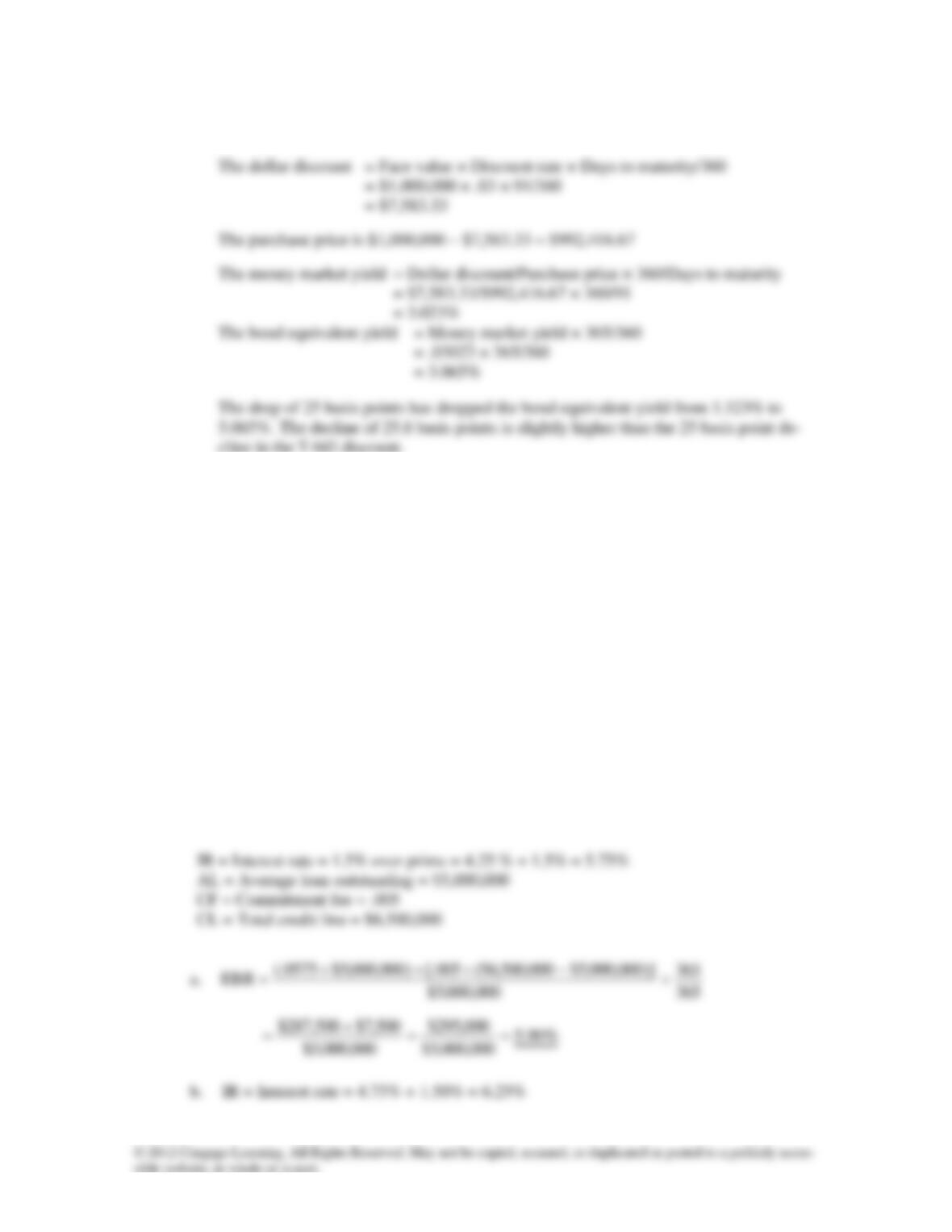
A17-11. a. The dollar discount = Face value × Discount rate × Days to maturity/360
490 Instructor’s Manual
d. Assume the T-bill was selling at a 3% discount:
cline in the T-bill discount.
P17-12. Matthews Manufacturing is negotiating a one-year credit line with its bank, Worldwide
Bank. The amount of the credit line is $6.5 million with an interest rate set at 1.5% above
the prime rate. A commitment fee of 0.50% (50 basis points) will be charged on the un-
used portion of the line. No compensating balances are required, and the loan is made on a
365-day basis.
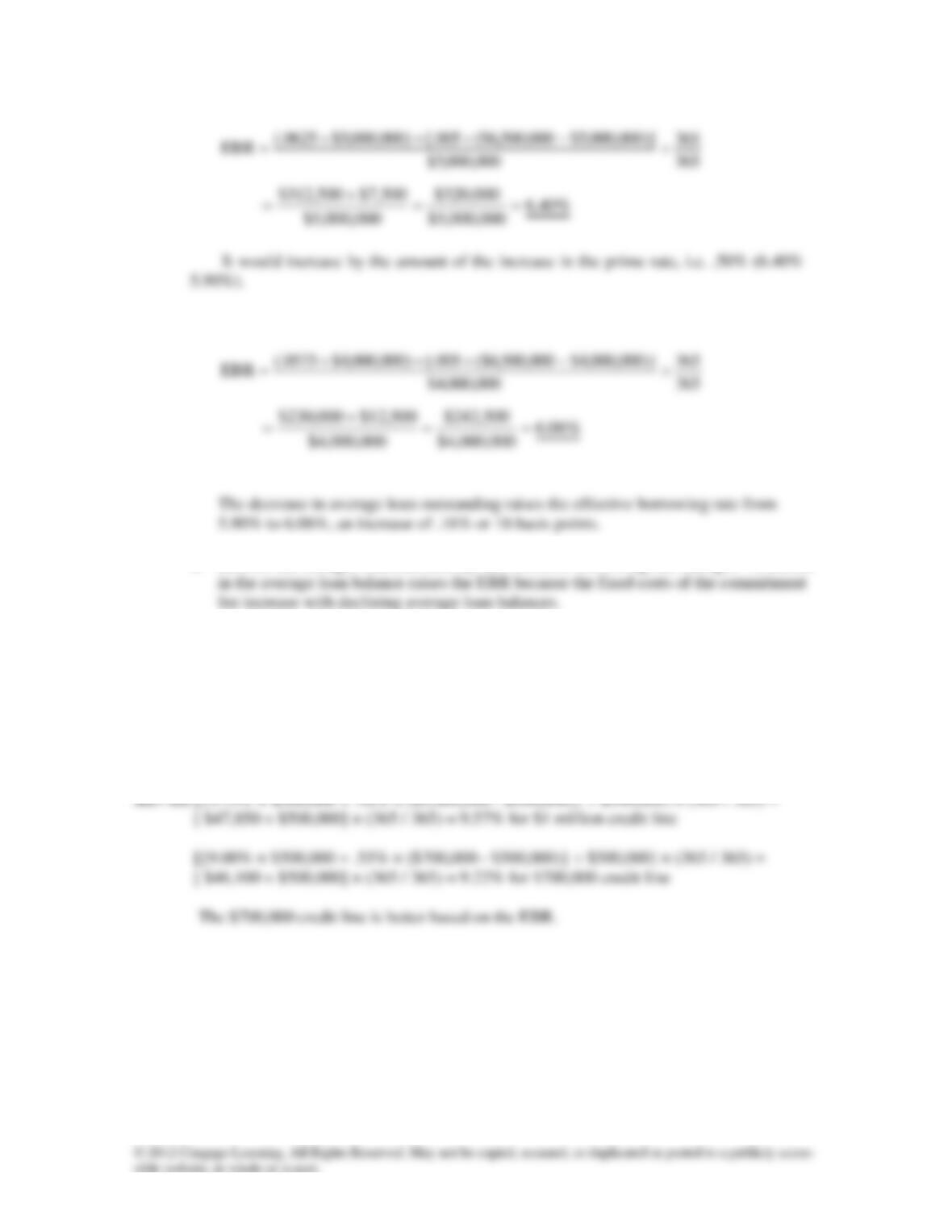
a. If the prime rate is assumed constant at 4.25% during the term of the loan and Mat-
thews’ average loan outstanding during the year is $5.0 million, calculate the firm’s ef-
fective borrowing rate (EBR).
b. What effect would an increase in the prime rate to 4.75% for the entire year have on
Matthews’ effective borrowing rate (EBR) calculated in part (a)?
c. What effect would a decrease in Matthews’ average loan outstanding during the year to
$4.0 million have on the effective borrowing rate (EBR) calculated in part (a)?
d. Using your findings in parts (a), (b), and (c), discuss the effects on Matthewss EBRs of
interest rate changes versus changes in the average loan outstanding.
A17-12. The effective borrowing rate (EBR) is
(IR × AL) + [CF × (CL – AL)]/AL × 365/Days loan outstanding
Chapter 17 Cash, Payables, and Liquidity Management 491
c. AL decreases to $4,000,000 in part (a)
d. Interest rate changes translate directly into effective borrowing rate changes. A decline
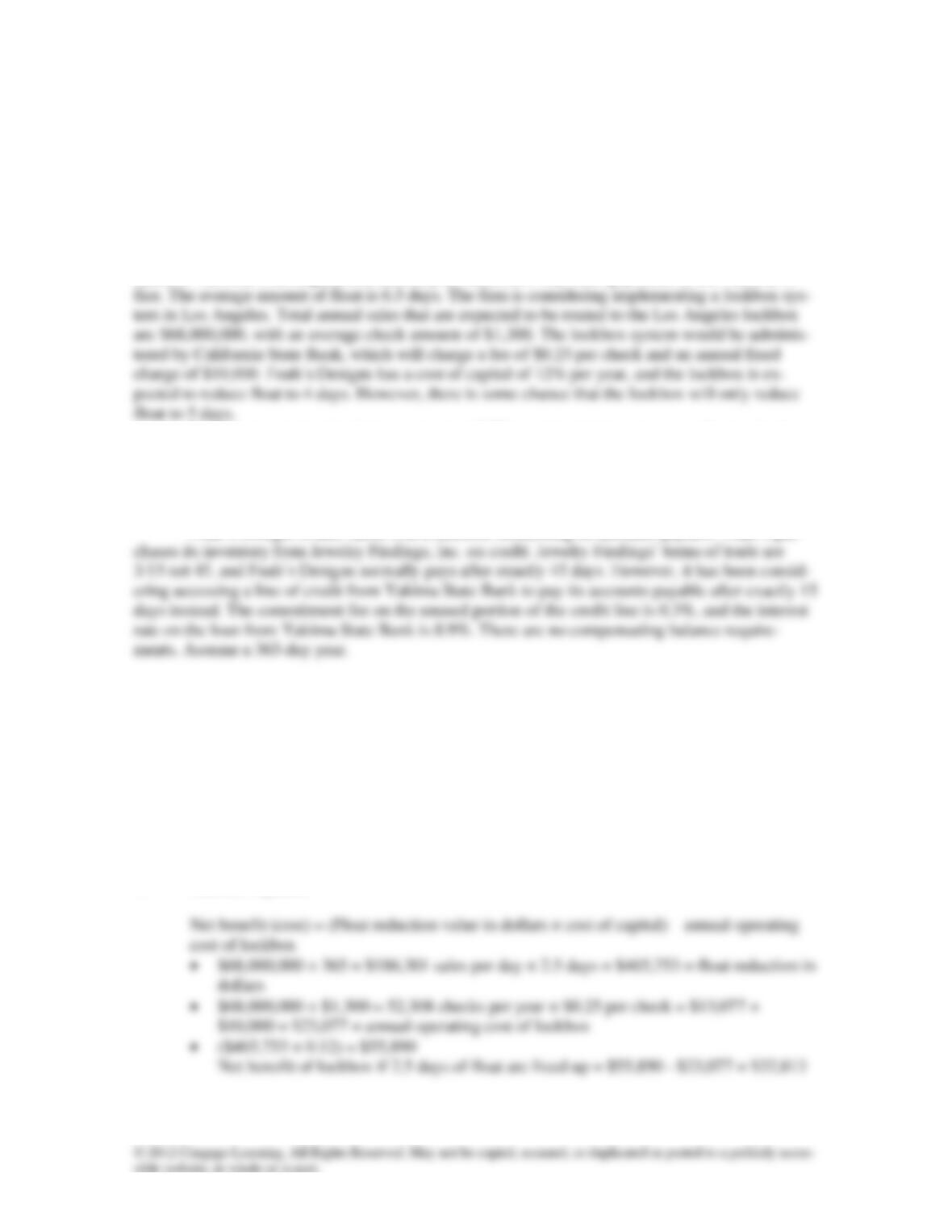
P17-13. Firm MGST is reviewing its 1-year line of credit, currently with an interest rate of 9.15%.
The credit line is for $1 million, but the firm intends to use only half of it throughout the
year. The commitment fee is 42 basis points. Calculate MGST’s effective borrowing rate.
(EBR). MGST is considering lowering the credit line to $0.7 million. The commitment fee
increases to 55 basis points, but the interest rate decreases to 9.00%. Should MGST lower
the credit line based on EBR?
THOMSON ONE Business School Edition: Because P17-14 is based on using a live data base,
answers will vary from moment to moment. This is a chance for your students to use a version of a
tool that CFAs use every day.
492 Instructor’s Manual
Answer to MiniCase
Mini-Case: Liquidity Management
Foah’s Designs sells precious metal jewelry throughout the western half of the United States. It is
based in Yakima, Washington, and currently all customers mail their payments to the Yakima of-
The firm must also decide between using EDT or wire transfers when transferring funds
between California State Bank and its local bank, Yakima State Bank. Using the wire transfer
method would cost $20 per transfer whereas the EDT method would cost only $1.50 per transfer.
However, the wire transfer method would result in the funds arriving at Yakima State Bank one
day sooner.
Foah’s Designs is also faced with a decision concerning its accounts payable. Foah’s pur-
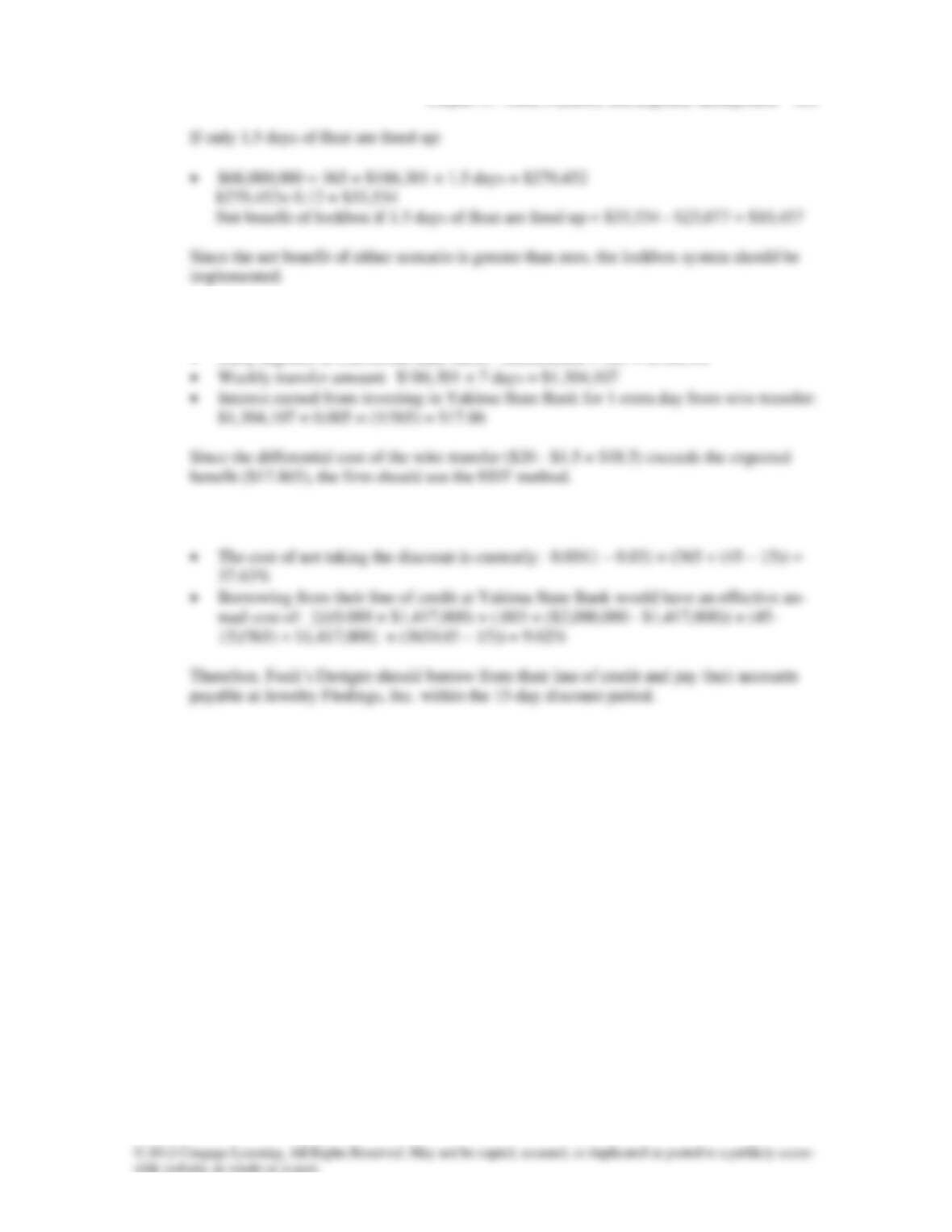
1. Should Foah’s Designs implement the lockbox system?
2. Suppose Foah’s Designs plans to transfer money on a weekly basis (every Tuesday) from Cali-
fornia State Bank to Yakima State Bank. Which transfer method should it use if the interest paid on
its funds in Yakima State Bank is 0.5% higher than what they earn from California State Bank?
3. Assuming that Foah’s Designs has a $2 million line of credit and that its accounts payable aver-
age $1,417,000, determine whether the fi rm should continuing paying Jewelry Findings, Inc., aft
er 45 days or instead should begin accessing the line of credit from Yakima State Bank.
Answer
1. Lockbox System:
Chapter 17 Cash, Payables, and Liquidity Management 493
2. EDT vs. Wire Transfer:
• Daily deposits to California State Bank: $68,000,000 ÷ 365 = $186,301
3. Paying Accounts Payable early: