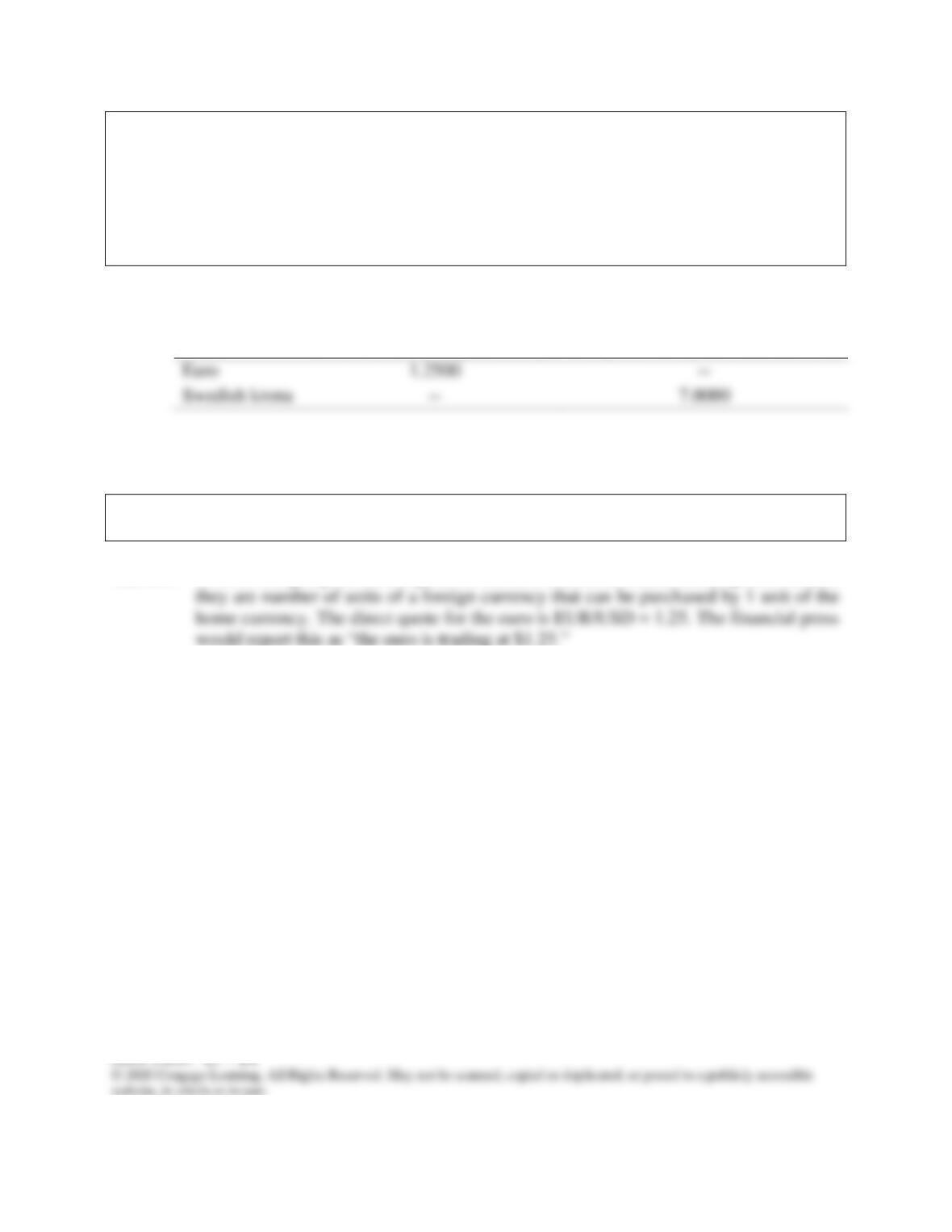
c. Consider the following illustrative exchange rates.
U. S. Dollars required to buy
one unit of foreign currency
Euro 1.2500
Swedish krona 0.1481
U.S. Dollars Required to Buy
One Unit of Foreign Currency
Units of Foreign Currency
Required to Buy One U.S. Dollar
Euro
c. 1. What is a direct quotation? What is the direct quote for euros??
Answer: From a U.S. perspective, the quotes in the first column are called direct quotes because
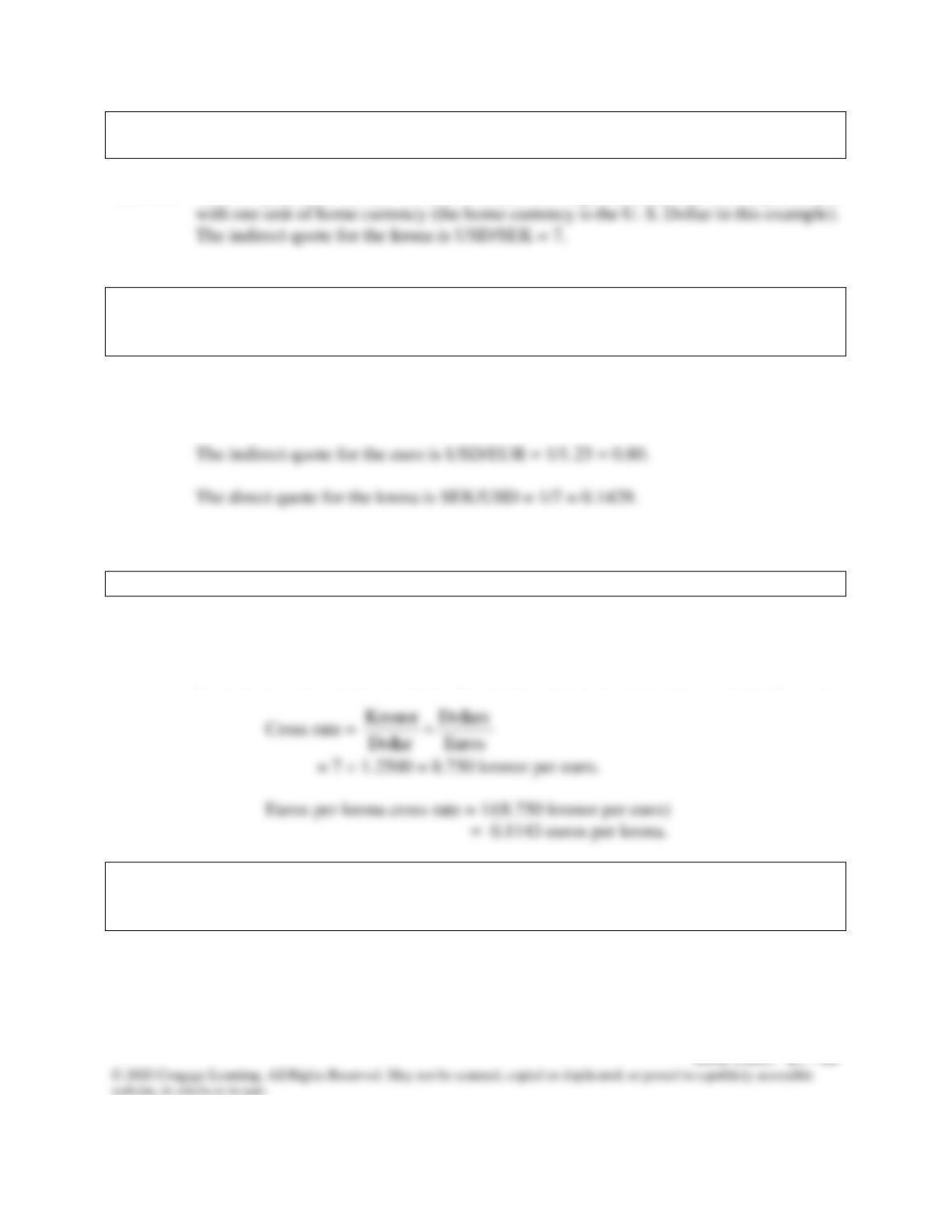
c. 2. What is an indirect quotation? What is the indirect quotation for kronor (the
plural of krona is kronor).
Answer: Indirect quotations are the number of units of foreign currency that can be purchased
c. 3. The euro and British pound usually are quoted as direct quotes. Most other
currencies are quoted as indirect quotes. How would you calculate the indirect quote for a
euro? How would you calculate the direct quote for a krona?
Answer: Indirect quotations are the reciprocal of the direct quotation, and direct quotations are
the reciprocal of the indirect quotation.
c. 4. What is a cross rate? Calculate the two cross rates between euros and kronor.
Answer: The exchange rate between any two currencies which does not involve U. S. Dollars is
a cross rate. Use the exchange rates versus the dollar, so use the direct for the dollars
per euro and the indirect for kronor per dollar. Here is the cross rate for kronor per euro:
c. 5. Assume Possum Products can produce a package of jerky and ship it to France
for $1.75. If the firm wants a 50 percent markup on the product, what should the
jerky sell for in France?
Answer: To achieve the markup, the price in dollars must be ($1.75)(1.50) = $2.625.
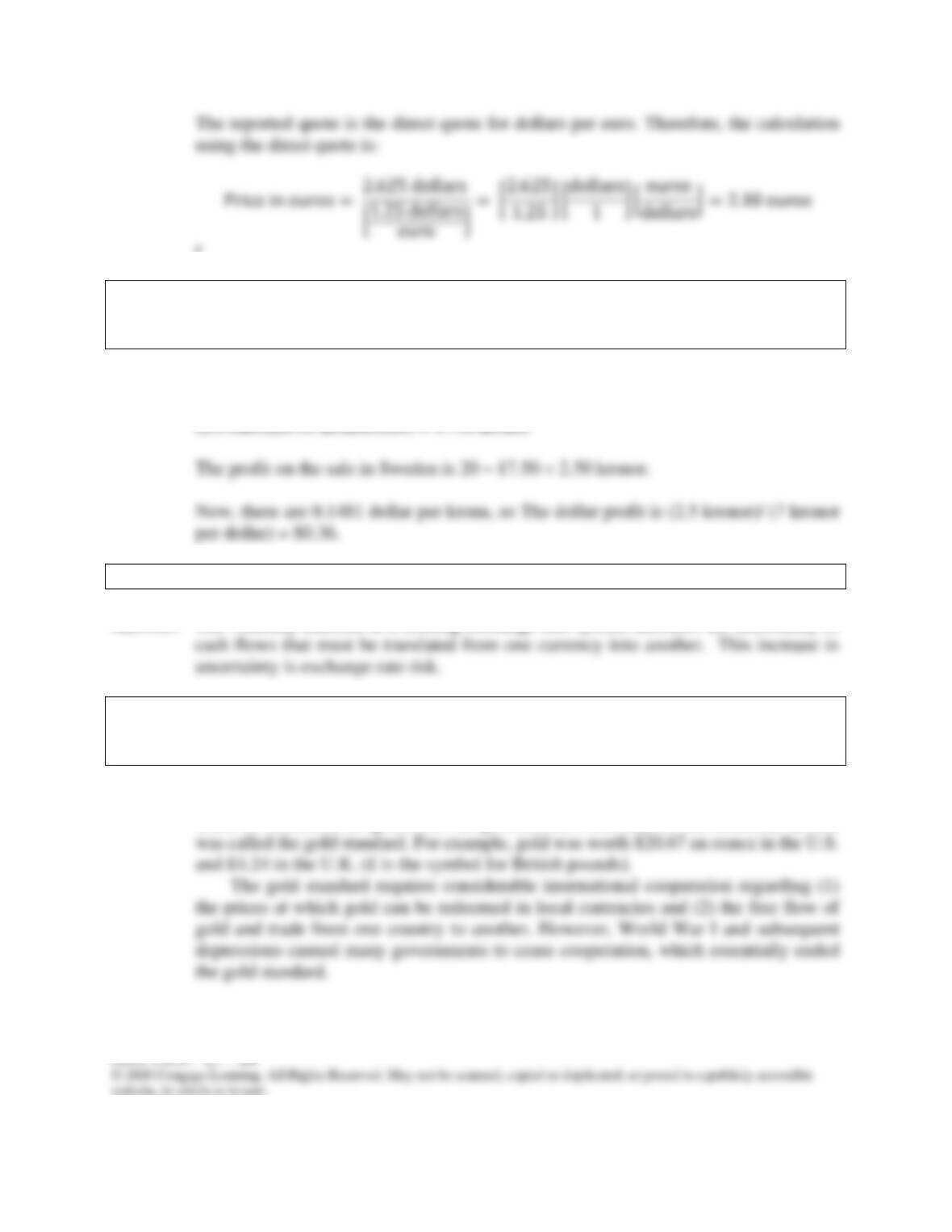
r
c. 6. Now assume Possum Products begins producing the same package of jerky in
France. The product costs 2.0 euros to produce and ship to Sweden, where it can
be sold for 20 kronor. What is the dollar profit on the sale?
Answer: Using the unrounded cross rate of 8.50 kronor per euro, we get:
c. 7. What is exchange rate risk?
d. What is the gold standard monetary system? What is International Monetary
Fund (IMF)? What is the fixed exchange rate system? Briefly describe the current
International Monetary System. What is a monetary union?
Answer: By 1914, governments of most developed countries were issuing paper currencies that
could be redeemed for gold from the government’s treasury, so the monetary system
The current international monetary system for about 30 industrialized nations is a
free floating rate system. In this system, currency exchange rates are allowed to
fluctuate in response to market conditions with a minimum of governmental
intervention. Changes in currency demand can be due to trade deficits (i.e., one nation
imports more from another nation than it exports, causing there to be higher relative
demand for the currency of the bigger exporter). It can also be due to capital
movements. For example, if interest rates are relatively high in one country, then
investors might seek to purchase that country’s securities, which increases demand for
that country’s currency. The IMF classifies about 40 more countries as floating because
they have a little more government intervention than free floating currencies.
A few countries, including China, are in the IMF category of “Other Managed
Arrangements” because the currency policy doesn’t fit into any other IMF category.
For example, China has a currency that is pegged to basket of currencies; however,
China doesn’t tell what currencies are in basket. Sometimes China lets the exchange
rate float, sometimes it manages the currency more actively.

Conversely, a currency that loses value is said to depreciate, and such currencies had
to be devalued under the old fixed rate system.
e. What is a freely convertible currency? What is a partially convertible currency?
What is a nonconvertible currency? What problems arise when a multinational
company operates in a country whose currency is not freely convertible?
Answer: A freely convertible currency is traded in the international currency markets with no
government restrictions. It is also called a fully convertible currency and a hard
currency. Countries with free floating exchange systems also have fully convertible
currencies. In addition, several other floating rate currencies are fully convertible, such
as the New Zealand dollar and the Israeli new shekel.
f. What is the difference between spot rates and forward rates? When is the foreign
currency forward rate selling at a premium to the spot rate? At a discount?
Answer: Spot rates are the rates paid to buy currency for immediate delivery (actually, two days
after the date of the trade). Forward rates are the rates paid to buy currency for delivery
at some agreed-upon date in the future (say, 90 days).
If a dollar buys more of the foreign currency in the spot market than in the forward
market, then the foreign currency is appreciating. Therefore, the forward foreign
currency is selling at a premium.
g. What is interest rate parity? Currently, you can exchange 1 euro for 1.2700
dollars in the 180-day forward market, and the risk-free rate on 180-day securities
is 6 percent in the United States and 4 percent in France. Does interest rate parity
hold? If not, which securities offer the highest expected return?
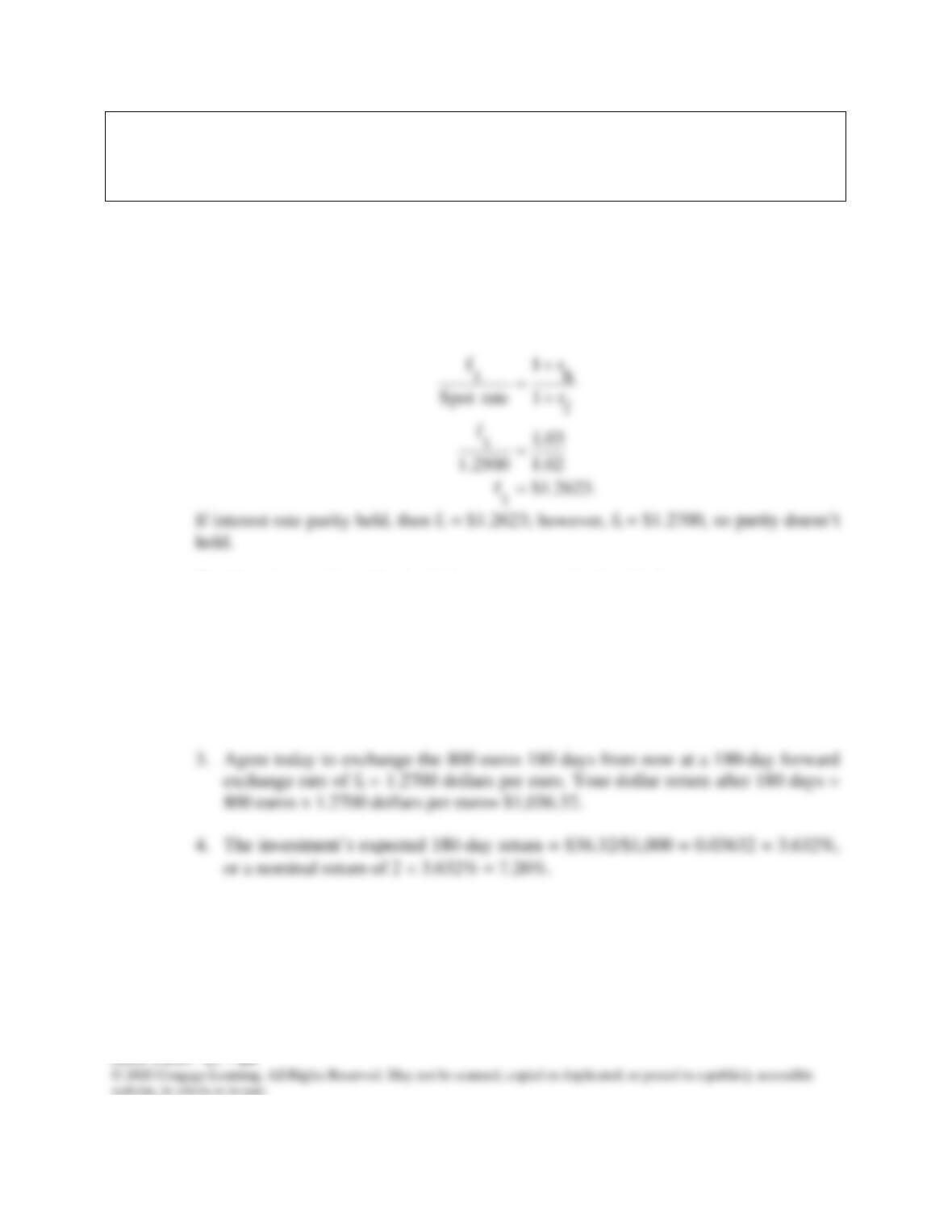
Answer: Interest rate parity holds that investors should expect to earn the same return in all
countries after adjusting for risk. What is the implied forward rate, given the spot rate
of $1.2500?
Spot rate = 1 euro = $1.2500; rh = 6%/2 = 3.00%; rf = 4%/2 = 2.00%.
The French securities offer the highest return as calculated below:
1. Assume you convert $1,000 to euros in the spot market. In the spot market, spot
rate = 0.8000 euros per dollar. Convert $1,000 0.8000 euros/dollar = 800 euros.
2. Invest 800 euros in the 180-day French security which offers a semi-annual return
of 4%/2 = 2%. So, in 180 days you will receive 800 1.02 = 816 euros.
h. What is purchasing power parity? If a package of jerky costs $2.00 a liter in the
United States and purchasing power parity holds, what should be the price of the
jerky package in France?
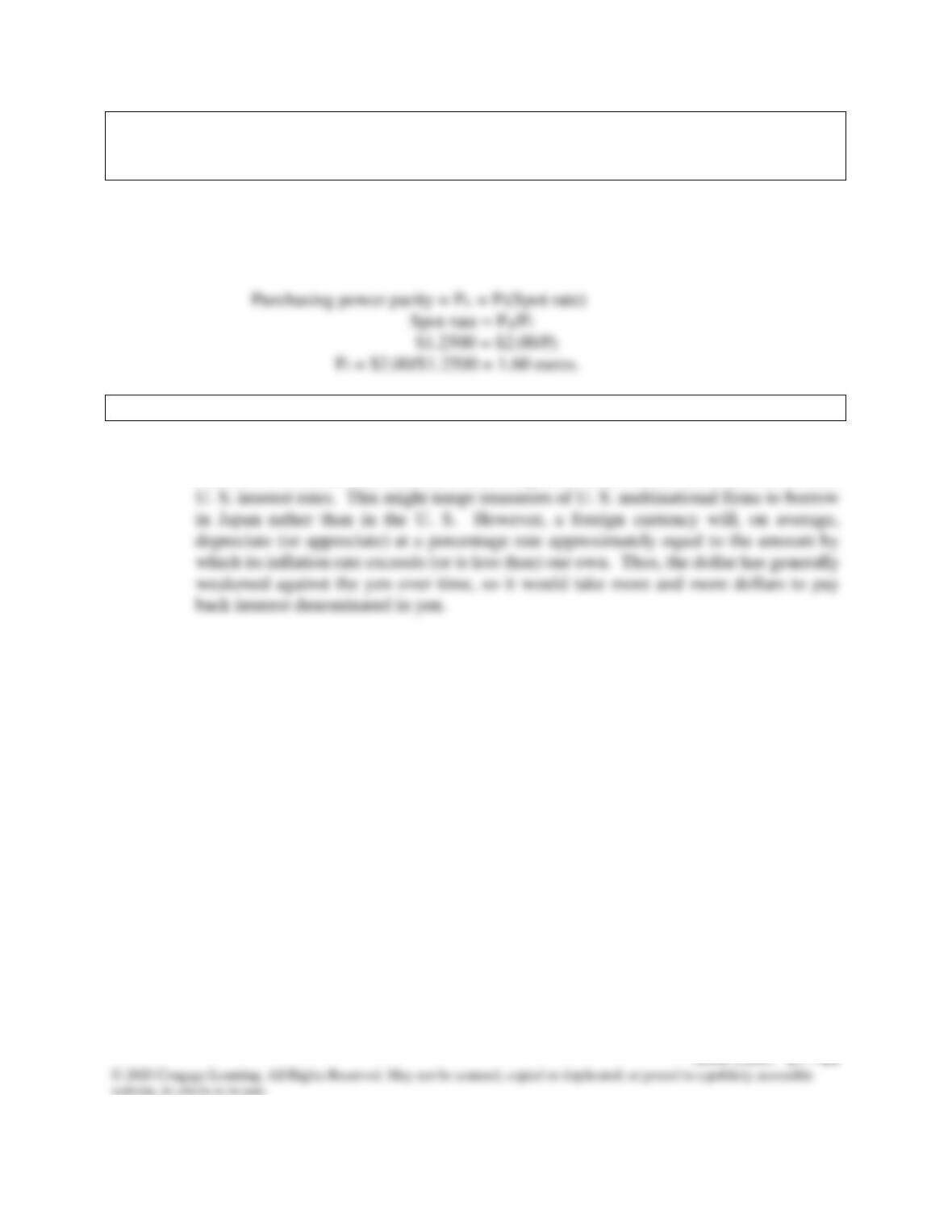
Answer: Purchasing power parity, sometimes referred to as the law of one price (LOP), implies
that the level of exchange rates adjusts so that identical goods cost the same amount in
different countries.
i. What impact does relative inflation have on interest rates and exchange rates?
Answer: To illustrate, consider the situation between Japan and the U. S. Japan has generally
had a lower inflation rate than the U. S., so Japanese interest rates have been lower than
j. Briefly discuss the international capital markets.
Answer: Individuals buy securities issued by foreign governments and firms, and U. S. Firms
issue securities abroad. These transactions take place in the international capital
markets. Here is a brief description of the major international capital markets:
1. A eurodollar is a U. S. dollar deposited in a bank outside the United States. The
major difference between a “regular” dollar and a eurodollar is its location. This
places eurodollars outside the direct control of U. S. monetary authorities, so
regulations such as fractional reserves and FDIC insurance premiums do not apply.
Eurodollars are borrowed by U. S. and foreign individuals, corporations, and
2. International bonds, which are any bond sold outside the country of the borrower,
fall into two categories. Foreign bonds are bonds sold by a foreign borrower, but
denominated in the currency of the country in which they are sold. Thus, when
Bell Canada sells bonds in the U. S. denominated in U. S. dollars, the firm is selling
foreign bonds. In general, foreign bonds have to meet all the regulations of the
k. To what extent do average capital structures vary across different countries?
Answer: There is some evidence that average capital structures vary among the large industrial
countries. One problem, however, when interpreting these numbers is that different
l. Briefly describe a company’s risk exposure if it invests in an international project.
Answer:
1. Exchange Rate Risk Due to Changes in Exchange Rates
Exchange rate risk can be mitigated for short-term cash flows by using
forward contracts, but longer-term cash flows still have exchange risk.
2. Taxation Risk
Prior to 2018, repatriated earnings (less foreign taxes) were subject to U.S.
taxes. U.S. corporate tax rates were higher than rates in most countries, making
repatriation very costly.The U.S. occasionally had grace periods with lower tax
m. Describe the process for evaluating a foreign project. Now consider the following
project. A U.S. company has the opportunity to lease a manufacturing facility in
Japan for two years. The company must spend ¥1 billion initially to refurbish the
plant. The expected net cash flows from the plant for the next two years, in
millions, are: CF1 = ¥500 and CF2 = ¥800. A similar project in the U.S. would have
a risk adjusted cost of capital of 10 percent. What is the project’s NPV?
Answer: The same general principles which apply to domestic capital budgeting also apply to
foreign capital budgeting.
where the exchange rates are expressed in direct quotations.
The indirect spot exchange rate is 110 yen per dollar, so the direct rate is 1/110 =
0.009091 dollars per yen. The expected forward rates are:
Maturity (in years)
rh
rf
Spot rate
($/¥)
Expected
forward rate
($/¥)
1
2.0%
0.05%
0.009091
0.009268
Year
0
1
2
Cash flows in yen
-¥1,000
¥500
¥800
Expected exchange rates
0.009091
Cash flows in dollars
Project cost of capital =
NPV =
n. What is the impact of multinational operations on each of the following financial
management topics?
1. Cash management.
Answer: Although multinational and domestic firms have the same objectives for cash
management and use similar procedures, the multinational firm faces a more complex
task. Since the distances involved are much greater, multinational firms tend to rely
n. 2. Credit management.
Answer: Granting credit is riskier for a multinational firm than for a domestic corporation
because, in addition to the normal risk of default, the credit granting corporation must
n. 3. Inventory management.
Answer: As with other aspects of financial management, inventory management in a
multinational setting is similar to but more complex than that in a purely domestic firm.