Chapter 17
Multinational Financial Management
ANSWERS TO END-OF-CHAPTER QUESTIONS
17-1 a. A multinational corporation is one that operates in two or more countries.
b. The exchange rate specifies the number of units of a given currency that can be
purchased for one unit of another currency. The fixed exchange rate system was in
effect from the end of World War II until August 1971. Under the system, the U. S.
dollar was linked to gold at the rate of $35 per ounce, and other currencies were then
tied to the dollar. Under the floating exchange rate system, which is currently in effect,
the forces of supply and demand are allowed to determine currency prices with little
government intervention.
d. Exchange rate risk refers to the fluctuation in exchange rates between currencies over
time. A convertible currency is one which can be traded in the currency markets and
can be redeemed at current market rates. When an exchange rate is pegged, the rate is
fixed against a major currency such as the U. S. dollar. Consequently, the values of the
pegged currencies move together over time.
g. Repatriation of earnings is the cash flow, usually in the form of dividends or royalties,
from the foreign branch or subsidiary to the parent company. These cash flows must
be converted to the currency of the parent, and thus are subject to future exchange rate
changes. A foreign government may restrict the amount of cash that may be
repatriated. Political risk refers to the possibility of expropriation and to the
unanticipated restriction of cash flows to the parent by a foreign government.
h. A Eurodollar is a U. S. dollar on deposit in a foreign bank, or a foreign branch of a U.
S. bank. Eurodollars are used to conduct transactions throughout Europe and the rest
i. The Euro is a currency used by the nations in the European Monetary Union who signed
the Treaty of Maastricht.
17-2 The U. S. dollar. The primary reason for using the dollar was that it provided a relatively
stable benchmark, and it was accepted universally for transaction purposes.
17-3 Under the fixed exchange rate system, the fluctuations were limited to +1% and -1%.
Under the floating exchange rate system, there are no agreed-upon limits.
17-5 There will be an excess supply of dollars in the foreign exchange markets, and thus, will
tend to drive down the value of the dollar. Foreign investments in the United States will
increase.
17-7 The foreign project’s cash flows have to be converted to U. S. dollars, since the
shareholders of the U. S. corporation (assuming they are mainly U. S. residents) are
interested in dollar returns. This subjects them to exchange rate risk, and therefore requires
an additional risk premium. There is also a risk premium for political risk (mainly the risk
of expropriation). However, foreign investments also help diversify cash flows, so the net
effect on the required rate of return is ambiguous.
17-9 No, interest rate parity implies that an investment in the U. S. with the same risk as a similar
investment in a foreign country should have the same return. Using direct quotes for the
spot rate and forward rate, interest rate parity is expressed as:
f
h
r1
r1
rateSpot
rateForward
+
+
=
.

17-10 Purchasing power parity assumes there are neither transaction costs nor regulations which
limit the ability to buy and sell goods across different countries. In many cases, these
assumptions are incorrect, which explains why PPP is often violated. An additional
SOLUTIONS TO END-OF-CHAPTER PROBLEMS
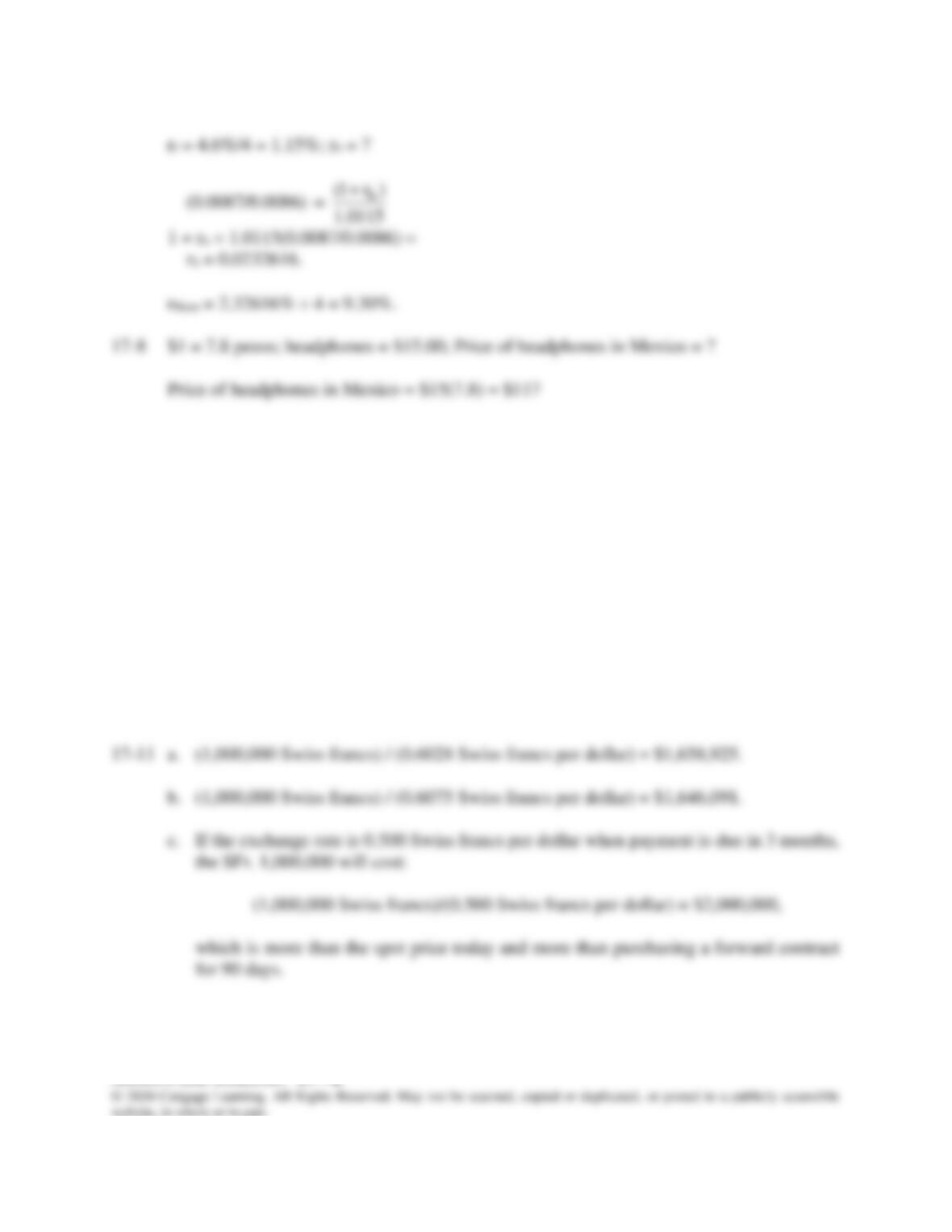
17-2 rNom, 6-month T-bills = 7%; rNom of similar default-free 6-month Japanese bonds = 5.5%;
Spot exchange rate, e0: 1 Yen = $0.009; 6-month forward exchange rate = ft = ?
)r1(
)r1(
e
f
f
h
0
t
+
+
=
.
h
t0
f
(1+r )
f = e (1+r )
ft = $0.009{[1+7%/2)]/[1+ (5.5%/2)]}
= $0.009(1.035/1.0275)
= $0.00907
17-4 Dollars should sell for 1/1.50, or 0.6667 euros per dollar.
17-5 The current exchange rate is 0.60 dollars per Swiss franc. A 10 percent appreciation will
make it 0.66 dollars per Swiss franc. To find Swiss francs per dollar, divide 1 by the
exchange rate: 1/0.66 = 1.5152 Swiss francs per dollar.
17-9 The U. S. dollar liability of the corporation falls from (0.10 dollars per peso)(50,000,000
pesos) = $5,000,000 to (0.09 dollars per peso)(50,000,000 pesos) = $4,500,000,
corresponding to a gain of 500,000 U. S. dollars for the corporation. However, the real
economic situation might be somewhat different. For example, the loan is presumably a
long-term loan. The exchange rate will surely change again before the loan is paid. What
really matters, in an economic sense, is the expected present value of future interest and
principal payments denominated in U. S. dollars. There are also possible gains and losses
on inventory and other assets of the firm. A discussion of these issues quickly takes us
outside the scope of this textbook.
17-10 The automobile’s value has increased because the dollar has declined in value relative to
the yen. The 1983 cost in yen was (245 yen per dollar)(8,000 dollars) = 1,960,000 yen.
At an exchange rate of 80 yen per dollar, this is (1,960,000 yen)/(80 yen per dollar) =
$24,500.00
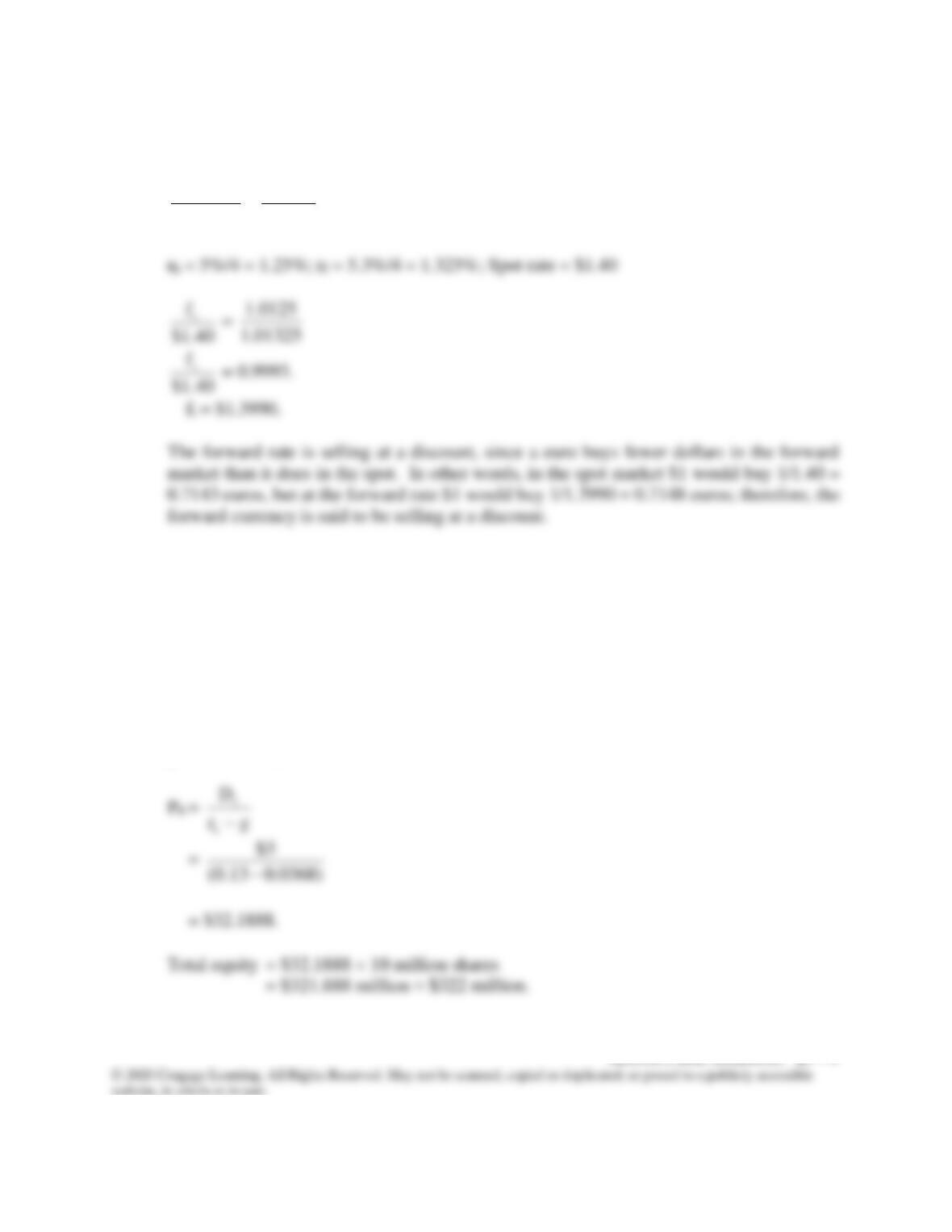
17-12 rNom of 90-day U. S. risk-free securities = 5%; of 90-day German risk-free securities =
5.3%; Spot rate = 1 euro = $1.40; ft selling at premium or discount = ?
)r1(
)r1(
rateSpot
f
f
h
t
+
+
=
.
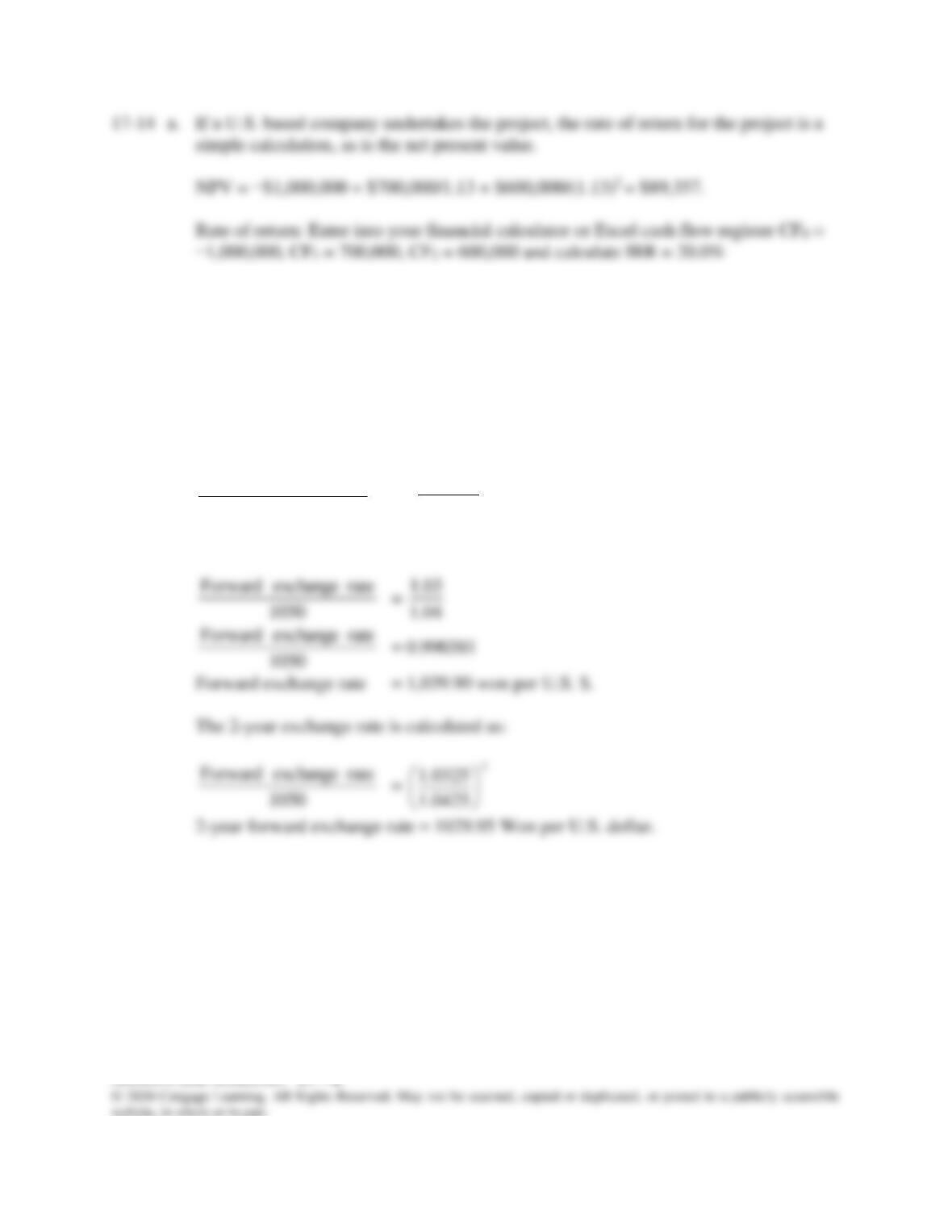
17-13 First, convert the pesos to dollars: D1 = (30 pesos)(0.10 dollars per peso) = 3 pesos.
Second, find the growth rate in dollar denominated pesos. If the peso is depreciating 4% a
year with respect to the dollar, then the exchange rate at t=2 will be (0.10 dollars per
peso)(1 – 0.04) = 0.096 dollars per peso. This is a growth rate of (0.096 – 0.10)/0.10 =
−0.04 = −4%. In other words, the exchange rate is “growing” at the rate it is depreciating.
Therefore, the total growth rate in dollar denominated dividends is:
g = (1 + 0.08)(1 − 0.04) – 1 = 3.68%.
b. This analysis is from the perspective of a Korean investor, so Korea is the home country
and the U.S is the foreign country. The interest rate parity relationship uses direct
quotes for exchange rates; direct quotes are number of units of home currency per unit
of foreign currency. Therefore, a direct quote from a Korean perspective is the number
of won per dollar.
According to interest rate parity, the following condition holds:
rate exchangeSpot
rate exchange Forward
=
t
US
Korea
r1
r1
+
+
For the 1-year forward rate:

c. First, we must adjust the cash flows to reflect Nam Sung’s home currency.
The expected Won cash flows are
Year 0: (−1,000,000 dollars)(1,050 won per dollar) = −1,050.00 million won.

SOLUTION TO SPREADSHEET PROBLEM
17-15 The detailed solution for the spreadsheet problem, Ch 17 P15 Build a Model Solution.xlsx,
is available on the textbook’s Web site.
MINI CASE
With the growth in demand for exotic foods, Possum Products’ CEO Michael Munger is
considering expanding the geographic footprint of its line of dried and smoked low-fat
opossum, ostrich, and venison jerky snack packs. Historically, jerky products have
performed well in the southern United States, but there are indications of a growing
demand for these unusual delicacies in Europe. Munger recognizes that the expansion
carries some risk—Europeans may not be as accepting of opossum jerky as initial research
suggest—so the expansion will proceed in steps. The first step will be to set up sales
subsidiaries in France and Sweden (the two countries with the highest indicated demand),
and the second is to set up a production plant in France with the ultimate goal of product
distribution throughout Europe.
Possum Products’ CFO, Kevin Uram, although enthusiastic about the plan, is
nonetheless concerned about how an international expansion and the additional risk that
entails will affect the firm’s financial management process. He has asked you, the firm’s
most recently hired financial analyst, to develop a 1-hour tutorial package that explains the
basics of multinational financial management. The tutorial will be presented at the next
board of directors’ meeting. To get you started, Uram has supplied you with the following
list of questions.
a. What is a multinational corporation? Why do firms expand into other countries?
Answer: Use the examples given here when discussing why firms “go international.”
1. To seek new markets. Coca-Cola and McDonald’s have expanded around the world
to seek new markets. Likewise, Sony, Toshiba, and other Japanese consumer
electronics manufacturers have aggressively pushed into the u. S.
b. What are the six major factors which distinguish multinational financial
management from financial management as practiced by a purely domestic firm?
Answer: 1. Different currency denominations. Cash flows in various parts of multinational
corporate systems will be denominated in different currencies. Hence, an analysis
of exchange rates, and the effect of fluctuating currency values, must be included
in all financial analyses.
2. Language differences. The ability to communicate is critical in all business matters,
and U. S. business men and women have been notoriously poor in learning other
languages. In effect, it is easier for foreign firms to invade our markets than for us
3. Cultural differences. Different countries, and even different regions in a single
country, have unique cultural heritages that shape values and influence the role of
business in the society. Such differences affect consumption patterns, defining the
appropriate firm goals, attitudes toward risk taking, dealings with employees, and
5. Legal systems. Some countries, such as the U.S. and the U.K., base their legal
systems on common law, which emphasizes prior court decisions and usually
provides stronger protection for investors and property owners. In contrast, civil
law legal systems, such as in France, rely on detailed laws and regulations enacted
by the government. Different legal systems complicate matters ranging from the
simple recording of business transactions to the role played by the judiciary in
resolving conflicts. Such differences can even make procedures that are required in
one part of the company illegal in another part.
6. Taxation. Differences in countries’ tax laws can cause strikingly different after-tax
cash flows for identical transactions.
8. Political risk. A foreign government might place constraints on the transfer of
corporate resources or even expropriate assets within its boundaries. Also, corrupt
government officials might expect gifts or bribes.