Answers and Solutions: 17 – 1
Chapter 17
Multinational Financial Management
ANSWERS TO END-OF-CHAPTER QUESTIONS
17-1 a. A multinational corporation is one that operates in two or more countries.
c. A country has a deficit trade balance when it imports more goods from abroad than it
exports. Devaluation is the lowering, by governmental action, of the price of its
currency relative to another currency. For example, in 1967 the British pound was
devalued from $2.80 per pound to $2.50 per pound. Revaluation, the opposite of
devaluation, occurs when the relative price of a currency is increased.
d. Exchange rate risk refers to the fluctuation in exchange rates between currencies over
time. A convertible currency is one which can be traded in the currency markets and
Answers and Solutions: 17 – 2
f. The spot rate is the exchange rate which applies to “on the spot” trades, or, more
precisely, exchanges that occur two days following the day of trade. In other words,
the spot rate is for current exchanges. The forward exchange rate is the prevailing
g. Repatriation of earnings is the cash flow, usually in the form of dividends or royalties,
from the foreign branch or subsidiary to the parent company. These cash flows must
be converted to the currency of the parent, and thus are subject to future exchange rate
changes. A foreign government may restrict the amount of cash that may be
repatriated. Political risk refers to the possibility of expropriation and to the
unanticipated restriction of cash flows to the parent by a foreign government.
i. The Euro is a currency used by the nations in the European Monetary Union who signed
the Treaty of Maastricht.
17-2 The U. S. dollar. The primary reason for using the dollar was that it provided a relatively
stable benchmark, and it was accepted universally for transaction purposes.
17-5 There will be an excess supply of dollars in the foreign exchange markets, and thus, will
tend to drive down the value of the dollar. Foreign investments in the United States will
increase.
17-6 Taking into account differential labor costs abroad, transportation, tax advantages, and so
17-7 The foreign project’s cash flows have to be converted to U. S. dollars, since the
shareholders of the U. S. corporation (assuming they are mainly U. S. residents) are
17-8 A Eurodollar is a dollar deposit in a foreign bank, normally a European bank. The foreign
bank need not be owned by foreigners—it only has to be located in a foreign country. For
example, a Citibank subsidiary in Paris accepts Eurodollar deposits. The Frenchman’s
17-9 No, interest rate parity implies that an investment in the U. S. with the same risk as a similar
investment in a foreign country should have the same return. Using direct quotes for the
spot rate and forward rate, interest rate parity is expressed as:

17-10 Purchasing power parity assumes there are neither transaction costs nor regulations which
limit the ability to buy and sell goods across different countries. In many cases, these
SOLUTIONS TO END-OF-CHAPTER PROBLEMS
17-1 $1 = 9 Mexican pesos; $1 = 111.23 Japanese yen; Cross rate, yen/peso = ?
17-2 rNom, 6-month T-bills = 7%; rNom of similar default-free 6-month Japanese bonds = 5.5%;
Spot exchange rate, e0: 1 Yen = $0.009; 6-month forward exchange rate = ft = ?
17-3 U. S. Computer = $500; French Computer = 550 euros; Spot rate between euro and dollar
= ?
17-4 Dollars should sell for 1/1.50, or 0.6667 euros per dollar.
17-5 The current exchange rate is 0.60 dollars per Swiss franc. A 10 percent appreciation will
17-6 Cross rate = Swiss francs/dollars dollars/pounds = Swiss francs/pounds
= 1.6 1.5 = 2.4 Swiss francs per pound.
17-7 Spot rate = 1 yen = $0.0086; ft = 1 yen = $0.0087; rNom of 90-day Japanese risk-free
securities = 4.6%; rNom of 90-day U. S. risk-free securities = ?
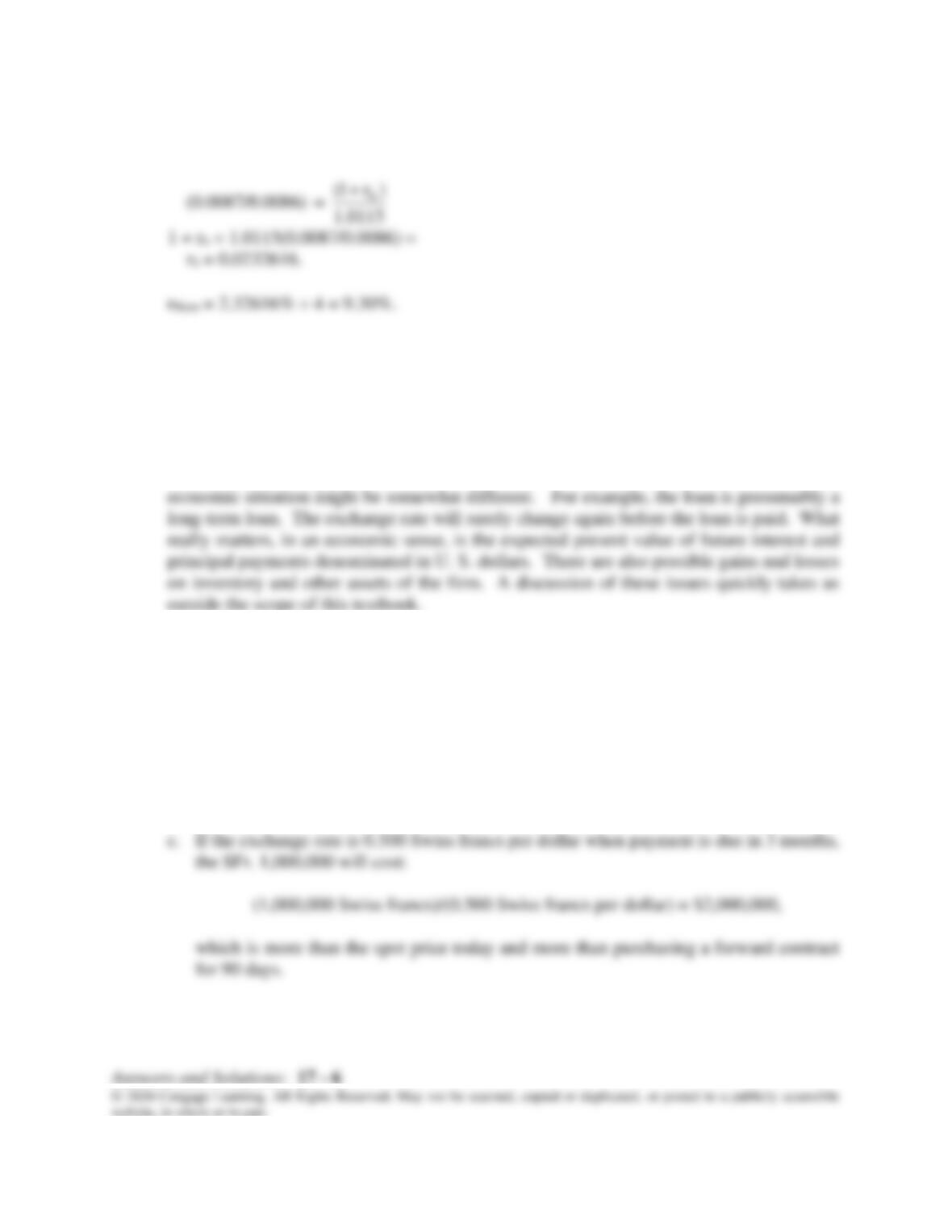
rf = 4.6%/4 = 1.15%; rh = ?
17-8 $1 = 7.8 pesos; headphones = $15.00; Price of headphones in Mexico = ?
Price of headphones in Mexico = $15(7.8) = $117
17-9 The U. S. dollar liability of the corporation falls from (0.10 dollars per peso)(50,000,000
pesos) = $5,000,000 to (0.09 dollars per peso)(50,000,000 pesos) = $4,500,000,
corresponding to a gain of 500,000 U. S. dollars for the corporation. However, the real
17-10 The automobile’s value has increased because the dollar has declined in value relative to
the yen. The 1983 cost in yen was (245 yen per dollar)(8,000 dollars) = 1,960,000 yen.
At an exchange rate of 80 yen per dollar, this is (1,960,000 yen)/(80 yen per dollar) =
$24,500.00
17-11 a. (1,000,000 Swiss francs) / (0.6028 Swiss francs per dollar) = $1,658,925.
b. (1,000,000 Swiss francs) / (0.6075 Swiss francs per dollar) = $1,646,091.
Answers and Solutions: 17 – 7
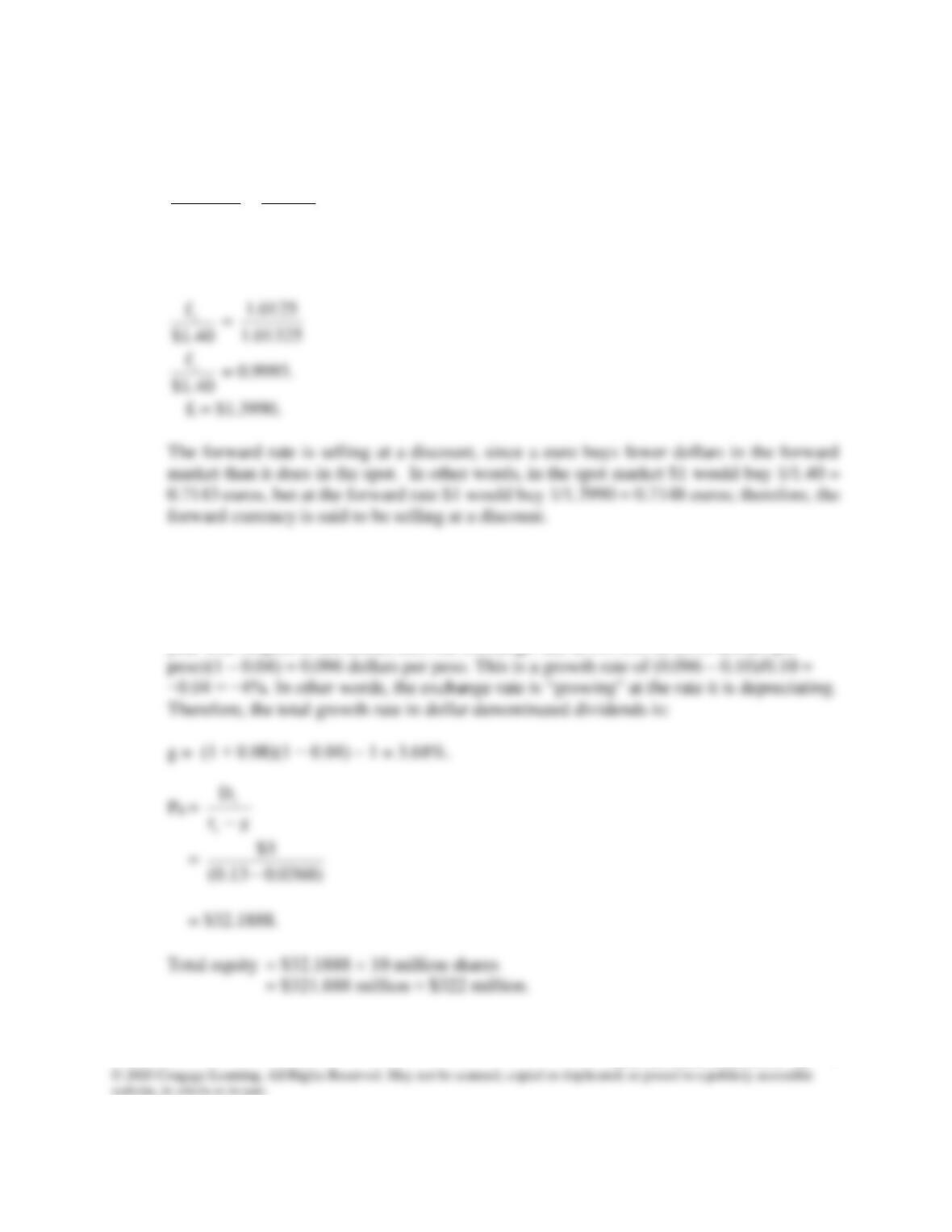
17-12 rNom of 90-day U. S. risk-free securities = 5%; of 90-day German risk-free securities =
5.3%; Spot rate = 1 euro = $1.40; ft selling at premium or discount = ?
)r1(
)r1(
rateSpot
f
f
h
t
+
+
=
.
rh = 5%/4 = 1.25%; rf = 5.3%/4 = 1.325%; Spot rate = $1.40
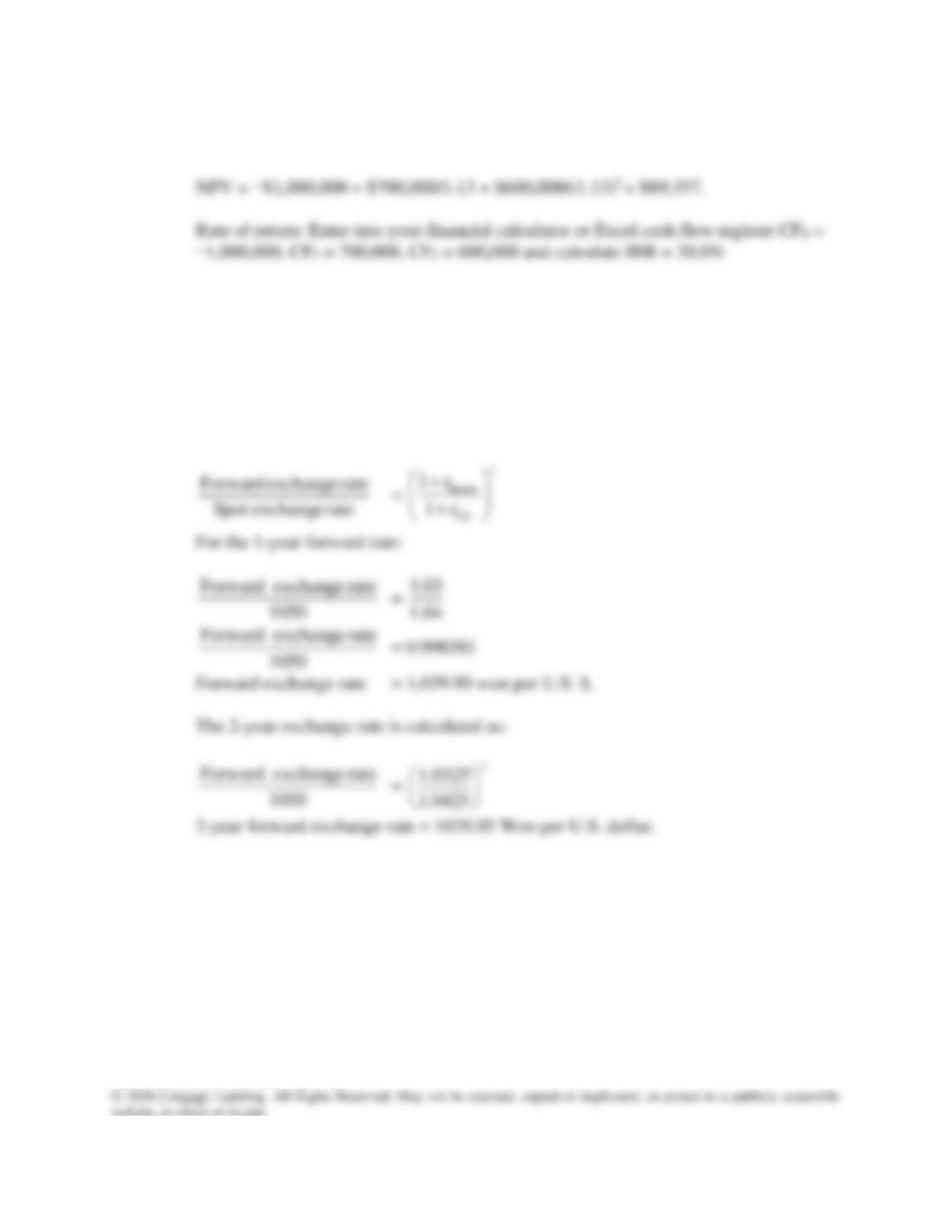
17-13 First, convert the pesos to dollars: D1 = (30 pesos)(0.10 dollars per peso) = 3 pesos.
Second, find the growth rate in dollar denominated pesos. If the peso is depreciating 4% a
year with respect to the dollar, then the exchange rate at t=2 will be (0.10 dollars per
Answers and Solutions: 17 – 8
17-14 a. If a U.S. based company undertakes the project, the rate of return for the project is a
simple calculation, as is the net present value.
b. This analysis is from the perspective of a Korean investor, so Korea is the home country
and the U.S is the foreign country. The interest rate parity relationship uses direct
quotes for exchange rates; direct quotes are number of units of home currency per unit
of foreign currency. Therefore, a direct quote from a Korean perspective is the number
of won per dollar.
According to interest rate parity, the following condition holds:

Answers and Solutions: 17 – 9
c. First, we must adjust the cash flows to reflect Nam Sung’s home currency.
The expected Won cash flows are
Year 0: (−1,000,000 dollars)(1,050 won per dollar) = −1,050.00 million won.

Answers and Solutions: 17 – 10
SOLUTION TO SPREADSHEET PROBLEM
17-15 The detailed solution for the spreadsheet problem, Ch 17 P15 Build a Model Solution.xlsx,
is available on the textbook’s Web site.
Mini Case: 17 – 11
MINI CASE
With the growth in demand for exotic foods, Possum Products’ CEO Michael Munger is
considering expanding the geographic footprint of its line of dried and smoked low-fat
opossum, ostrich, and venison jerky snack packs. Historically, jerky products have
performed well in the southern United States, but there are indications of a growing
demand for these unusual delicacies in Europe. Munger recognizes that the expansion
carries some risk—Europeans may not be as accepting of opossum jerky as initial research
suggest—so the expansion will proceed in steps. The first step will be to set up sales
subsidiaries in France and Sweden (the two countries with the highest indicated demand),
and the second is to set up a production plant in France with the ultimate goal of product
distribution throughout Europe.
Possum Products’ CFO, Kevin Uram, although enthusiastic about the plan, is
nonetheless concerned about how an international expansion and the additional risk that
entails will affect the firm’s financial management process. He has asked you, the firm’s
most recently hired financial analyst, to develop a 1-hour tutorial package that explains the
basics of multinational financial management. The tutorial will be presented at the next
board of directors’ meeting. To get you started, Uram has supplied you with the following
list of questions.
a. What is a multinational corporation? Why do firms expand into other countries?
Answer: Use the examples given here when discussing why firms “go international.”
1. To seek new markets. Coca-Cola and McDonald’s have expanded around the world
Mini Case: 17 – 12
b. What are the six major factors which distinguish multinational financial
management from financial management as practiced by a purely domestic firm?
Answer: 1. Different currency denominations. Cash flows in various parts of multinational
corporate systems will be denominated in different currencies. Hence, an analysis
of exchange rates, and the effect of fluctuating currency values, must be included
in all financial analyses.
Mini Case: 17 – 13