Chapter 17 Cash, Payables, and Liquidity Management
Chapter Overview
Managing the speed at which collections are made and vendors are paid is an important fi-
nancial management activity. The Opening Focus looks at EIPP – electronic invoice presentment
and payment. While businesses expect to place an order and have it shipped immediately, they still
Opening Focus Questions:
1. What are the benefits and costs to the supplier of using EIPP? What are the benefits and costs
to the customer? Who stands to benefit the most? How can these benefits be distributed equi-
tably among suppliers and their customers? In other words, what incentives can be given to
customers to encourage EIPP’s usage?
2. Why are their concerns about technical standards and security issues concerning the implemen-
tation of EIPP?
This chapter looks at:
17-1. Cash Management
17-2. Collections
Technology
2. Smart Concepts. This provides a step-by-step explanation of the costs and benefits of cash
discounts made to encourage customers to pay faster.
4. Smart Solutions. A step-by-step solution to Problem 17-1, calculating collection float and the
costs and benefits of a lockbox system.
5. Smart Solutions. A step-by-step solution to Problem 17-10, calculating the dollar discount,
purchase price, money market yield, and bond equivalent yield on a Treasury bill.
472 Instructor’s Manual
Lecture Guide
Companies are increasingly concerned with minimizing their working capital require-
ments. In general, this has meant collecting money as quickly as possible and paying bills as late
as possible.
17-1 Cash Management
In particular, firms generally want to keep as little of their assets in the form of cash as
17-1a Float
Float is the time it takes for money sent to the firm to be usable by the firm. Students may
17-1b Cash Position Management
Cash position management involves looking at the costs and benefits of collecting funds
quickly and disbursing them slowly, along with managing the firm’s short term borrowing position.
Does the firm have the capacity to borrow to meet short-term needs? What is the cost of this addi-
tional borrowing? How much does the firm need to have in its checking account? What are the
17-2 Collections
The choice of collections systems is largely a matter of the nature of the business. For ex-
17-2a Types of Collection Systems
• Field Banking System: In a field banking system, most collections are made either over the
counter or at a collection office. The main problem with this system involved transferring
Chapter 17 Cash, Payables, and Liquidity Management 473
17-2b Lockbox Systems
The lockbox system is a popular technique for speeding up collections because it affects
17-2c Cash Concentration
Many companies bring in all of their deposits into a single bank. In the SmartPractices
17-2d Funds Transfer Mechanisms
This section details the different vehicles for funds transfer, including depository transfer
checks, automated clearinghouse debit transfers and wire transfers.
17-3 Accounts Payable and Disbursements
Many creditors supply terms to customers to encourage faster payment. The firm must
17-3a Overview of the Accounts Payable Process
17-3b Cash Discounts
17-3c Disbursement Products and Methods
This section looks at firms’ collections strategies including zero balance accounts, con-
trolled disbursements and positive pay. Students can discuss the costs and benefits of each. Each
of these strategies has strong benefits.
474 Instructor’s Manual
17-3d Developments in Accounts Payable and Disbursements
The developments in accounts payable and disbursements are very timely. Companies –
and individuals – are very concerned with fraud and identity theft, problems that have increased
with greater internet usage. Some of the most common issues are:
• Integrated Accounts Payable: This is an outsourcing of accounts payable.
17-4 Short-Term Investing and Borrowing
A firm will want to earn the most interest on its funds and still have them available when
needed.
17-4a Motives for Holding Cash and Short-Term Financial Investments
This section discusses the three motives for holding cash and short-term investments.
• Transaction Motive: This is the motive to keep cash for the daily transactions firms need
17-4b Short-Term Investing
Making sure that cash is available when and where they are needed is a top concern for the cash
manager. Because short-term investments are a substitute for cash, they should be carefully consid-
ered. Some of the options are listed below:
Chapter 17 Cash, Payables, and Liquidity Management 475
• Money Market Financial Instruments: Short-term financial instruments which are primari-
Table 17.1 Money Market Financial Instruments
17-4c Short-Term Borrowing
Short-term lines of credit are often necessary for some companies. The cash manager
needs to make sure that the lines of credit are available if needed.
Cash, Payables, and Liquidity Management Summary
Answers to Concept Review Questions
1. Float refers to funds that have been sent by the payer but are not yet usable funds to the payee.
The four components of float are:
• Mail float − the time delay between when payment is placed in the mail and when it is re-
2. Cash position management involves looking at, on a daily basis, the collection, concentration
3. Smaller firms that do not engage in active cash position management may set a target cash bal-
ance for their checking accounts. Generally this is determined based on transactions require-
4. The primary delay in the collections prices is collections float, a function of mail float, pro-
cessing float and availability float. A primary goal in the collection area is to reduce each of
476 Instructor’s Manual
5. A lockbox system affects all three components of float. Customers mail payments to a post
office box, which is emptied by the firm’s bank. The bank processes each payment and depos-
its the payments in the firm’s account. The bank sends deposit slips to the firm so they can be
6. Firms use cash concentration techniques to bring in lockbox and other deposits to a single
bank, the concentration bank. Cash concentration creates a large pool of funds for use in mak-
ing short-term cash investments, which in turn reduces the transactions costs of short-term in-
7. The firm must balance the benefits and costs of concentrating cash to determine the type and
timing of transfers from its lockbox accounts to its concentration account. The transfer mecha-
8. Accounts payable management is concerned with the time between the purchase of raw materi-
als and the mailing of payment to the supplier. The A/P function examines all incoming invoic-
es and determines the proper amount to be paid. The cash manager matches the invoice to the
purchase order and assures that the goods were actually received. Companies may make full
9. The difference between the payment amount with and without taking the cash discount is in
10. A zero balance account always has an end-of-day balance of zero. This eliminates nonearning
cash balances in corporate checking accounts. A controlled disbursement account is a bank
Chapter 17 Cash, Payables, and Liquidity Management 477
11. Recent developments include integrated accounts payable, providing a company with outsourc-
ing its accounts payable or disbursement operations; purchasing/procurement cards allowing
low-dollar purchases to be collected, with a single, large payment; and imaging services, allow-
12. Short-term investments must be liquid so the company can cash them in easily when needed.
Preservation of principal is also important since the firm will want to know how much cash it
13. U.S. Treasury bills are the benchmark for money market investments. They are safe and highly
14. The key base rates used in variable rate short-term borrowing are the prime rate, the rate of in-
terest charged by the largest U.S. banks on short-term loans to their best business customers
Solutions to Self-Test Problems
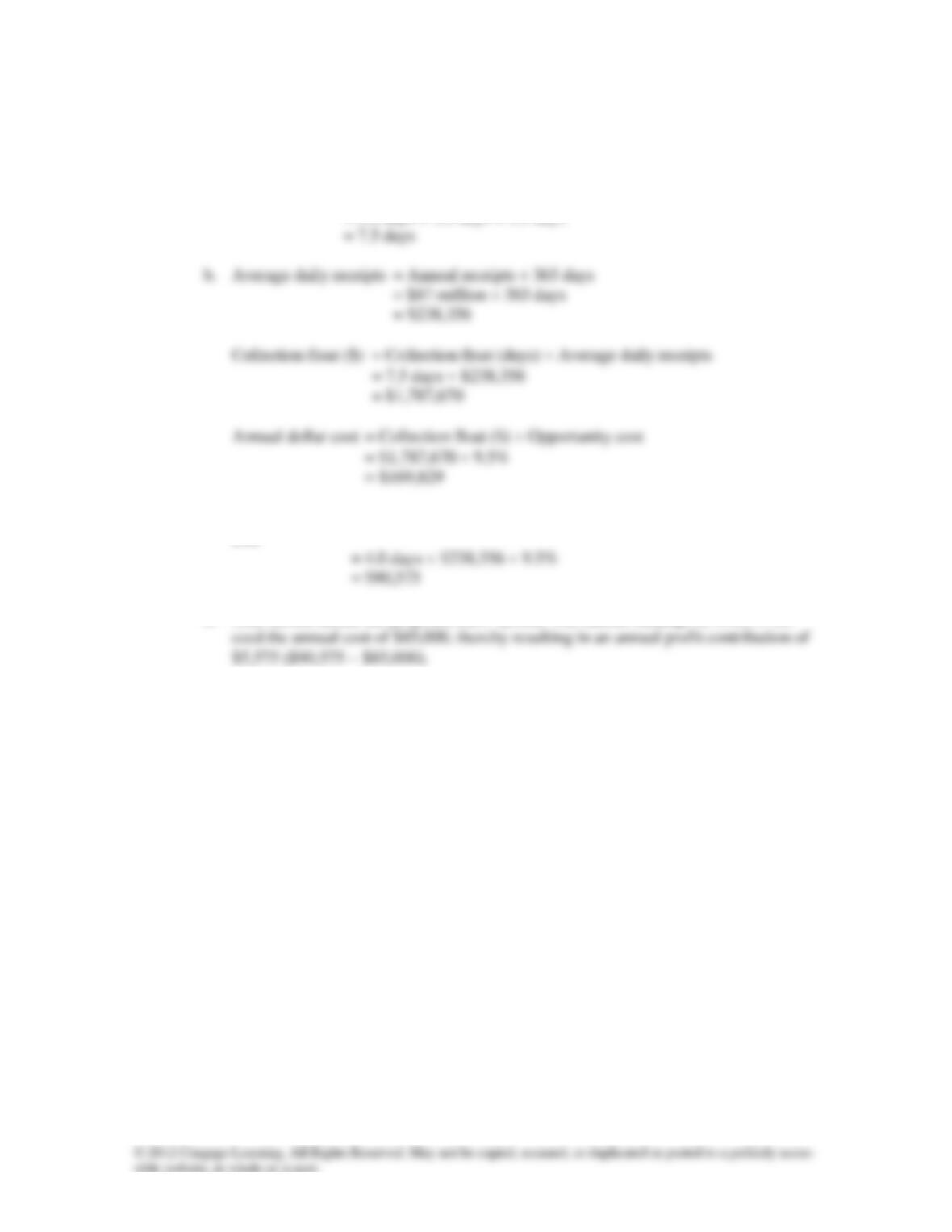
ST17-1. Gale Supply estimates that its customers’ payments are in the mail for 3 days and, once
received, they are processed in 2 days. After the payments are deposited in the firm’s
bank, the funds are made available to the firm by the bank in 2.5 days. The firm esti-
mates its total annual collections, received at a constant rate, from credit customers to be
$87 million. Its annual opportunity cost of funds is 9.5%. Assume a 365-day year.
a. How many days of collection float does Gale Supply have?
b. What is the current annual dollar cost of Gale Supply’s collection float?
c. If the installation of an electronic invoice presentment and payment (EIPP) system
would result in a 4 day reduction in Gale’s collection float, how much could the firm
earn annually on this float reduction?
478 Instructor’s Manual
d. Based on your findings in part (c), should Gale install the EIPP system if its annual
cost is $85,000? Explain your recommendation.
A: a. Collection float = Mail float + Processing float + Availability float
= 3.0 days + 2.0 days + 2.5 days
c. Annual earnings = Float reduction (days) Average daily receipts Opportunity
cost
d. Gale should install the proposed EIPP system. The annual earnings of $90,575 ex-
ST17-2. Derson Manufacturing wishes to evaluate the credit terms offered by its four biggest
suppliers of raw materials. The prime rate is currently 7.0% and Derson can borrow
short-term funds at a spread of 2.5% above the prime rate. Assume a 365-day year and
that the firm always pays its suppliers on the last day allowed by their stated credit terms.
The terms offered by each supplier are listed below:
Supplier 1: 2/10 net 40
Supplier 2: 1/15 net 60
Supplier 3: 3/10 net 70
Supplier 4: 1/10 net 50
a. Calculate the interest rate associated with not taking the discount from each supplier.
b. Assuming the firm needs short-term financing and considering each supplier sepa-
rately, indicate whether the firm should take or not take the discount from each sup-
plier.
c. If the firm did not need any short-term financing, when should it pay each of the
suppliers?
d. If the firm could not obtain a loan from banks and other financial institutions and
needed short-term financing, when should it pay each of the suppliers?
e. Suppose that Derson could stretch its accounts payable (net period only) to 90 days
without damaging its credit rating. What impact, if any, would this have on your rec-
ommendation with regard to Supplier 1 in part (b)? Explain you answer.
Chapter 17 Cash, Payables, and Liquidity Management 479
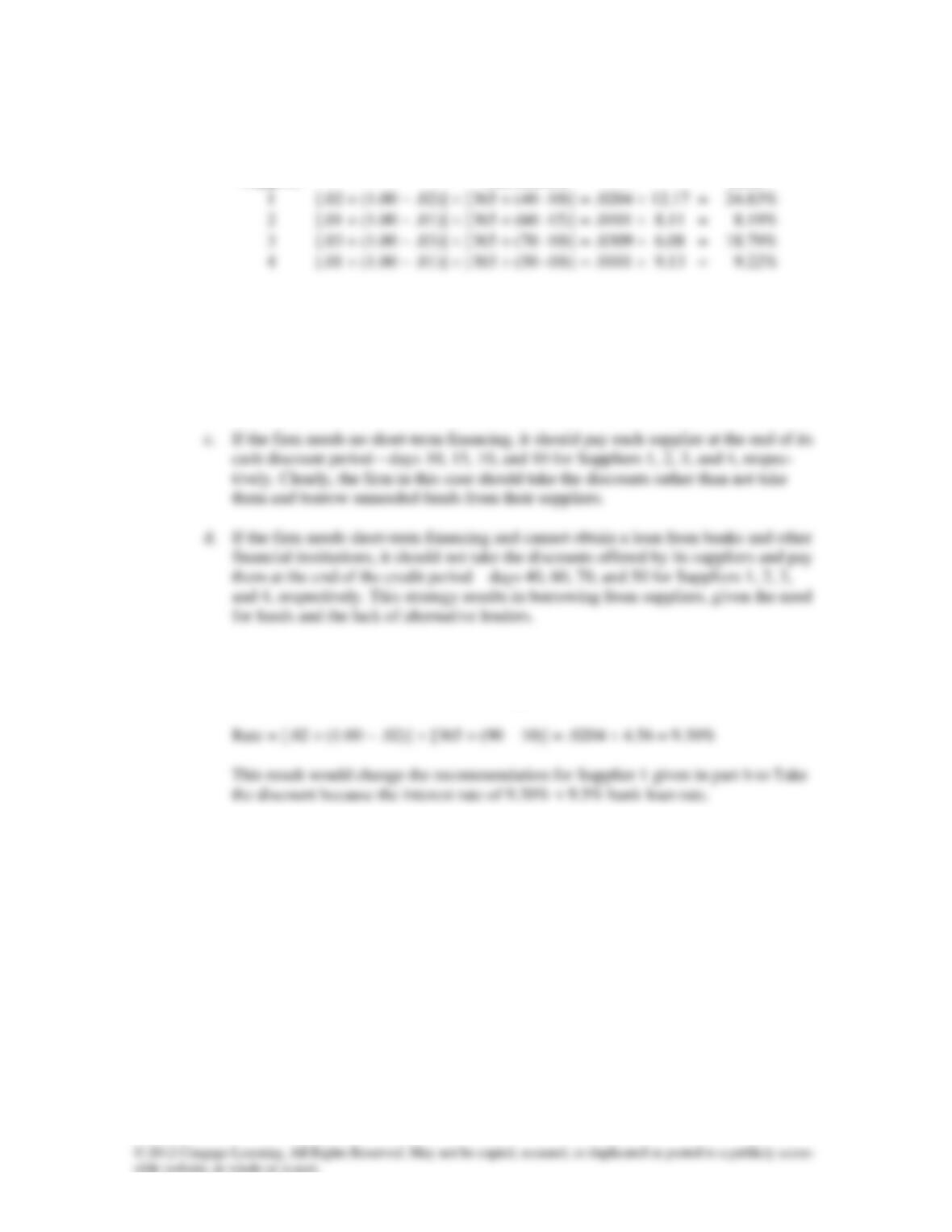
A: a. Rate = [%Discount ÷ (1.00 − %Discount)] [365 ÷ (Credit per. – Cash disc. per.)]
Supplier Calculation Rate
b. Bank loan rate = Prime rate + Spread = 7.0% + 2.5% = 9.5%
Supplier 1: Take the discount: Interest rate of 24.83% > 9.5% Bank loan rate.
Supplier 2: Don’t take discount: Interest rate of 8.19% < 9.5% Bank loan rate.
Supplier 3: Take the discount: Interest rate of 18.79% > 9.5% Bank loan rate.
Supplier 4: Don’t take discount: Interest rate of 9.22% < 9.5% Bank loan rate.
e. If Derson can stretch the net period for Supplier 1 to 90 days without damaging its
credit rating, the firm would effectively be getting 2/10 net 90 terms from Supplier 1.
The interest rate associated with not taking the discount under these terms would be:
ST17-3. Rosa Inc. has arranged a 1-year $2 million credit line with its lead bank. The bank set the
interest rate at the prime rate plus a spread of 1.50%. The prime rate is expected to re-
main stable at 5.25% during the coming year. In addition, the bank requires Rosa to pay
a 0.50% commitment fee on the average unused portion of the line. Assume a 365-day
year.
a. Calculate the effective borrowing rate (EBR) on Rosa’s line of credit during the com-
ing year assuming an average loan balance outstanding during the year is $1.8 mil-
lion.
b. Calculate Rosa’s EBR on the line of credit during the coming year assuming the av-
erage loan balance outstanding during the year is $0.8million.
c. Compare and contrast the EBRs calculated for Rosa Inc. in parts (a) and (b). Explain
the causes of the differences in EBRs.
480 Instructor’s Manual
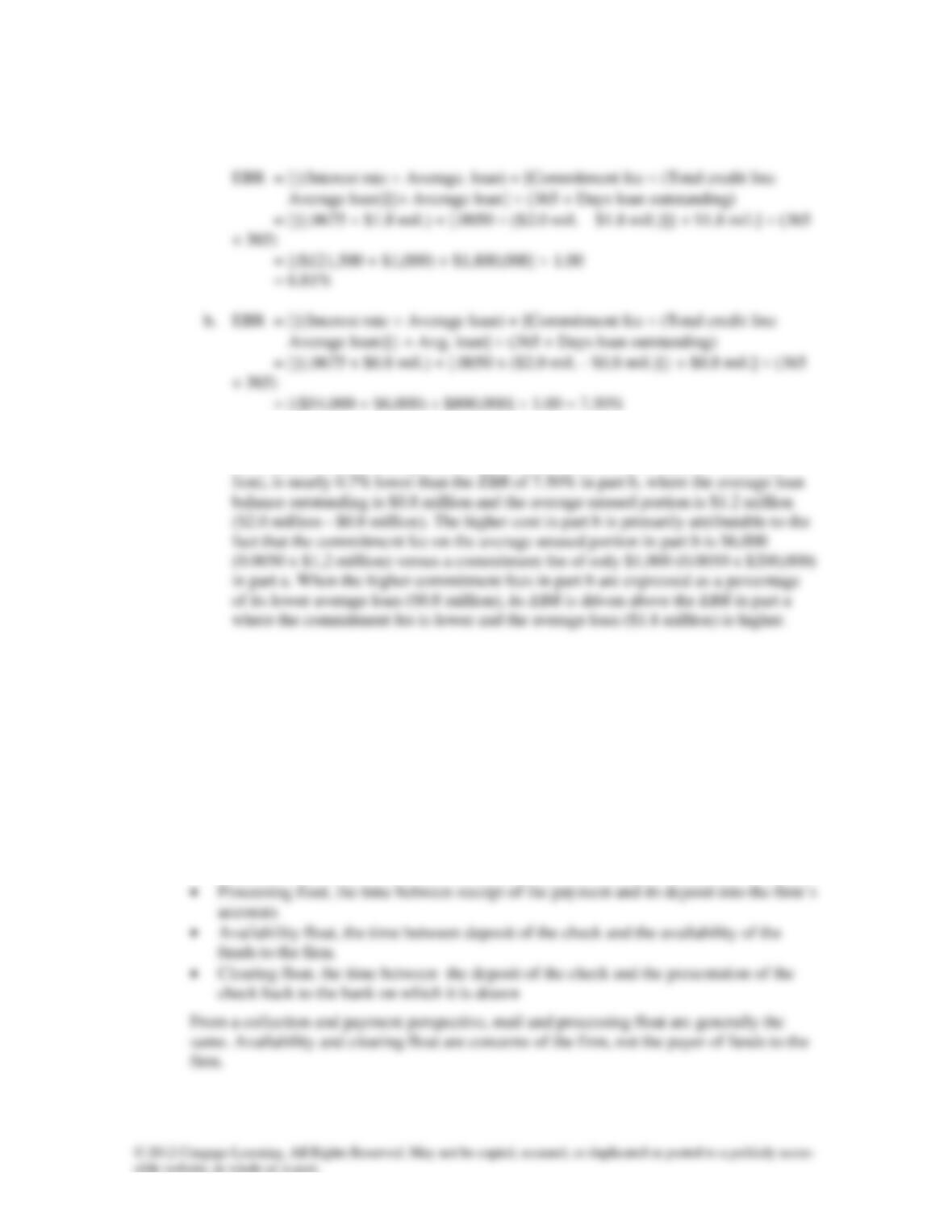
A: a. Interest rate = Prime rate + Spread = 5.25% + 1.50% = 6.75%
c. Note that the EBR of 6.81% in part a, where the average loan balance outstanding is
$1.8 million and the average unused portion is $200,000 ($2.0 million – $1.8 mil-
Answers to End-of-Chapter Questions
Q17-1. What is float? What are its four basic components? Which of these components is the same
from both a collection and a payment perspective? What is the difference between availa-
bility float and clearing float, and from which perspective—collection or payment—is each
relevant?
A17-1. Float refers to funds that have been sent by the payer but are not yet usable funds to the
payee. The four components of float are
• Mail float, the time delay between when payment is placed in the mail and when it is
received.
Chapter 17 Cash, Payables, and Liquidity Management 481
Q17-2. What is cash position management? What types of firms set a target cash balance? Why?
What is the purpose of a bank’s requiring the firm to maintain a minimum balance in its
checking account? How does this relate to a bank account analysis statement?
A17-2. Cash position management involves looking at, on a daily basis, the collection, concentra-
tion and disbursement of funds for the company. The cash manager looks at the amount of
funds to be collected, moves balances to appropriate accounts and funds projected dis-
Q17-3. What is the firm’s goal with regard to cash collections? Describe each of the following
types of collection systems:
a. Field-banking system
b. Mail-based collection system
c. Electronic system
A17-3. The firm’s goal is to collect moneys as quickly as possible. In a field-banking system, most
collections are made over the counter or at a collection office. These systems typically
Q17-4. What is a lockbox system? How does it typically work? Briefly describe the economics
involved in performing a cost-benefit analysis of such a system.
A17-4. A lockbox system affects all three components of float. Customers mail payments to a post
office box, which is emptied by the firm’s bank. The bank processes each payment and de-
posits the payments in the firm’s account. The bank sends deposit slips to the firm so they
Q17-5. Briefly describe each of the following funds transfer mechanisms:
• Automated clearinghouse (ACH) debit transfer
• Wire transfer
Why are wire transfers typically used only for high-dollar transfers?
A17-5. An automated clearinghouse debit transfer is a preauthorized electronic withdrawal from
482 Instructor’s Manual
Q17-6. What is the goal with regard to managing accounts payable as it relates to the cash conver-
sion cycle? Briefly describe the process involved in managing the accounts payable func-
tion.
A17-6. Accounts payable management is concerned with the time between the purchase of raw
materials and the mailing of payment to the supplier. The A/P function examines all in-
Q17-7. How can a firm in need of short-term financing decide whether or not to take a cash dis-
count offered by its supplier? How would this decision change in the event the firm has no
alternative source of short-term financing? How would it change for a firm that needs no
additional short-term financing?
A17-7. The difference between the payment amount with and without taking the cash discount is
in effect the interest payment made by the firm to the supplier. The firm must compare the
Q17-8. Briefly describe each of the following disbursement products/methods:
• Zero-balance accounts (ZBAs)
• Controlled disbursement
• Positive pay
How does a ZBA relate to the firm’s target cash balance?
A17-8. A zero balance account always has an end-of-day balance of zero. This eliminates nonearn-
ing cash balances in corporate checking accounts. Controlled disbursement is a bank ser-
vice that provides early notification of checks that will be presented against a company’s
account on a given day. This allows the firm to determine its cash position and make any
Q17-9. Briefly describe each of the following developments in accounts payable and disburse-
ments.
a. Integrated accounts payable
b. Purchasing/procurement cards