Chapter 17
Dynamic Capital Structures and Corporate Valuation
ANSWERS TO BEGINNING-OF–CHAPTER QUESTIONS
17-1 Arbitrage is generally thought of as the process of buying an item in one market and
simultaneously selling it at a higher price in another market and thus earning a riskless
profit. MM broadened this concept. They show, under a set of assumptions, that personal
debt can be used to cause the risk of two different stocks to be the same but the returns on
the stocks can be different. Then, one could buy the cheaper stock and simultaneously sell
leveraged investor.
It should be noted that many of the arguments against the MM assumptions are valid if
one thinks about individual investors like college professors but less valid if the “investor”
is an institutional investor like a pension fund that has ready access to capital and may not
have to pay taxes. Then, taxes and brokerage costs may really be immaterial, borrowing
Answers and Solutions: 17 – 1
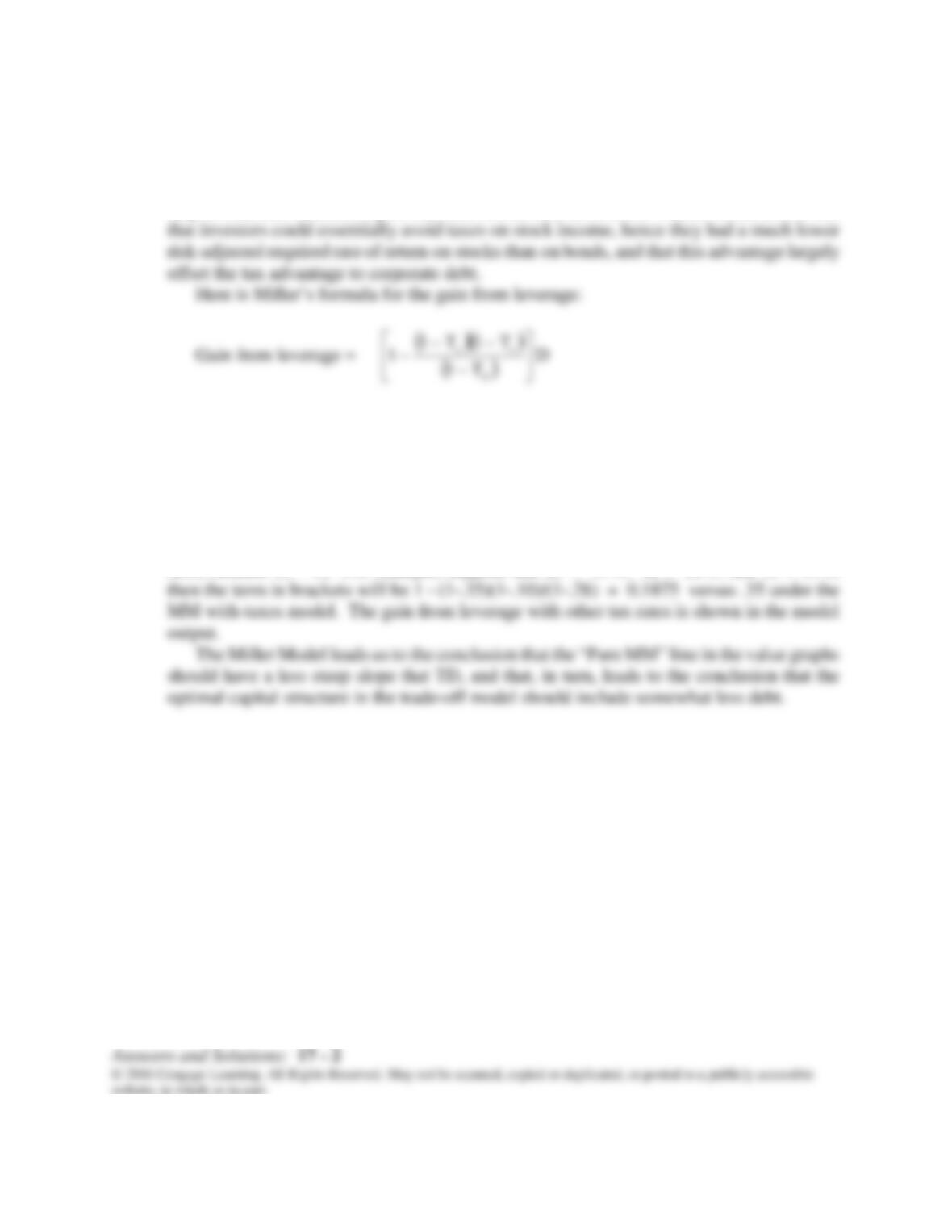
17-2 Miller added personal income taxes to the MM equation. He argued (1) that the personal
tax rate was high on interest income and dividends but much lower on capital gains income,
and (2) that individuals could use various tax shields, including death, to avoid capital gains
taxes, while corporations could retain earnings, use stock buy-back programs, and so on to
help stockholders minimize personal taxes on income from stock. Miller’s conclusion was
Note that if all the tax rates were zero, the gain from leverage would reduce to zero, and
we would be back at the original MM position. Miller personally thought that this was the
most likely situation. Note also that if Ts = Td, i.e., the tax rates on stock and debt income
are equal, then the gain from leverage is equal to TcD, which is the MM with corporate
taxes position.
Most subsequent researchers concluded that Miller had a good point, but the personal
tax advantage of stock only partially, not completely, offset the advantage of corporate
debt, because Td > Ts. For example, suppose that Tc = 35%, Td = 28%, and Ts = 10%,
17-3 Under the MM and Miller assumptions, firms do not grow and the debt tax shield is
discounted at the cost of debt. Under these assumptions the value of the unlevered firm is
VL = VU + TD and the levered cost of equity is rsL = rsU + (rsU – rd)(1–T)(D/S). This
expression for the levered cost of equity also means that the WACC decreases as the level
of debt increases.
However, if firms are allowed to grow, then two differences emerge. First, the present
value of a growing tax shield is larger than the present value of a constant tax shield, so the
contribution to value that the debt tax shield makes is larger. Second, the value of the
growing tax shield doesn’t make any sense if the discount rate is the cost of debt, because
using such a low discount rate allows the value of the growing tax shield to dominate the
17-4 In the MM models, the cash flows to equity are discounted at the unlevered cost of equity,
and the tax shields are discounted at the cost of debt. This would make sense if a company’s
ability to take advantage of its debt tax shield were more strongly related to its ability to
17-5 One of the difficulties in applying the corporate valuation model is that the WACC changes
if the capital structure changes. So if the company you are evaluating has a changing capital
structure, you’ll need to (very carefully) calculate a different WACC for each time period,
and that is quite difficult. This correction doesn’t matter much if the capital structure is
17-6 If corporate debt is actually risky rather than riskless as MM assumed, then managers really
have the option to default if the value of the company isn’t enough to make it worthwhile
to pay the interest or principal on the debt. In the simple case of a levered company with
zero coupon debt, the equity in the firm looks a lot like a call option on the value of the
entire firm, with a strike price equal to the face value of the debt. Viewing equity in this
ANSWERS TO END-OF-CHAPTER QUESTIONS
17-1 a. MM Proposition I states the relationship between leverage and firm value. Proposition
b. MM Proposition II states the relationship between leverage and the cost of equity.
Without taxes, Proposition II is rsL = rsU + (rsU – rd)(D/S). Thus, rs increases in a precise
c. The Miller model introduces personal taxes. The effect of personal taxes is, essentially,
to reduce the advantage of corporate debt financing.
d. The adjusted present value model discounts projected free cash flows and interest tax
shields at the unlevered cost of equity to arrive at the value of operations. You add in
e. The value of the debt tax shield is the present value of the tax savings from the interest
Answers and Solutions: 17 – 5
f. When a firm has debt outstanding it can choose to default if the firm is not worth more
than the face value of the debt. This decision to default when the value of the firm is
17-2 Modigliani and Miller show that the value of a leveraged firm must be equal to the
value of an unleveraged firm. If this is not the case, investors in the leveraged firm will
sell their shares (assume they owned 10%). They will then borrow an amount equal to
10% of the debt of the leveraged firm. Using these proceeds, they will purchase 10%
The assumptions of the MM model are:
• Firms must be in a homogeneous business risk class. If the firms have varying
degrees of risk, the market will value the firms at different rates. The earnings of
the firms will be capitalized at different costs of capital.
Answers and Solutions: 17 – 6
17-3 MM without taxes would support AT&T, although if AT&T really believed MM, they
should not object to Gordon’s 50 percent debt ratio. MM with taxes would lead
17-4 The value of a growing tax shield is greater than the value of a constant tax shield. This
means that for a given initial level of debt a growing firm will have more value from
17-5 If equity is viewed as an option on the total value of the firm with a strike price equal
to the face value of debt then the equity value should be affected by risk in the same
way that an option is affected by risk. An option is worth more if the underlying asset
SOLUTIONS TO END-OF-CHAPTER PROBLEMS
17-1 VL = VU = $500 million.
17-4 VL = VU +
−)g
sU
r(
)
c
T)(D(
d
r
= $800 +
−)03.011.0(
)35.0)(60(05.0
= $800 + $13.125
= $813.125 million.
Answers and Solutions: 17 – 8
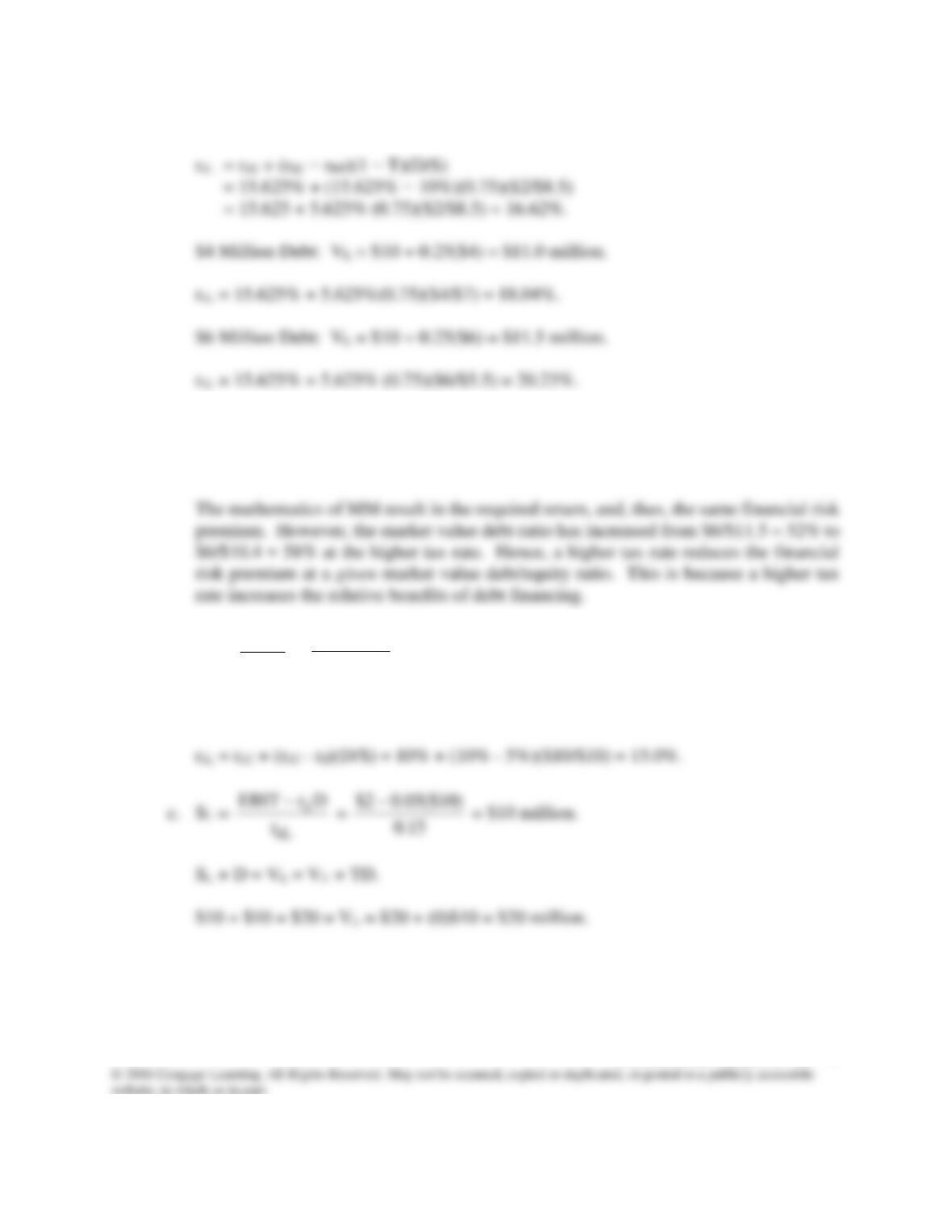
c. $2 Million Debt: VL = VU + TD = $10 + 0.25($2) = $10.5 million.
d. $6 Million Debt: VL = $8.0 + 0.40($6) = $10.4 million.
rsL = 15.625% + 5.625%(0.60)($6/$4.4) = 20.23%.
17-6 a. VU =
sU
r
EBIT
=
10.0
million 2$
= $20 million.
b. rsU = 10.0%. (Given)
Answers and Solutions: 17 – 9
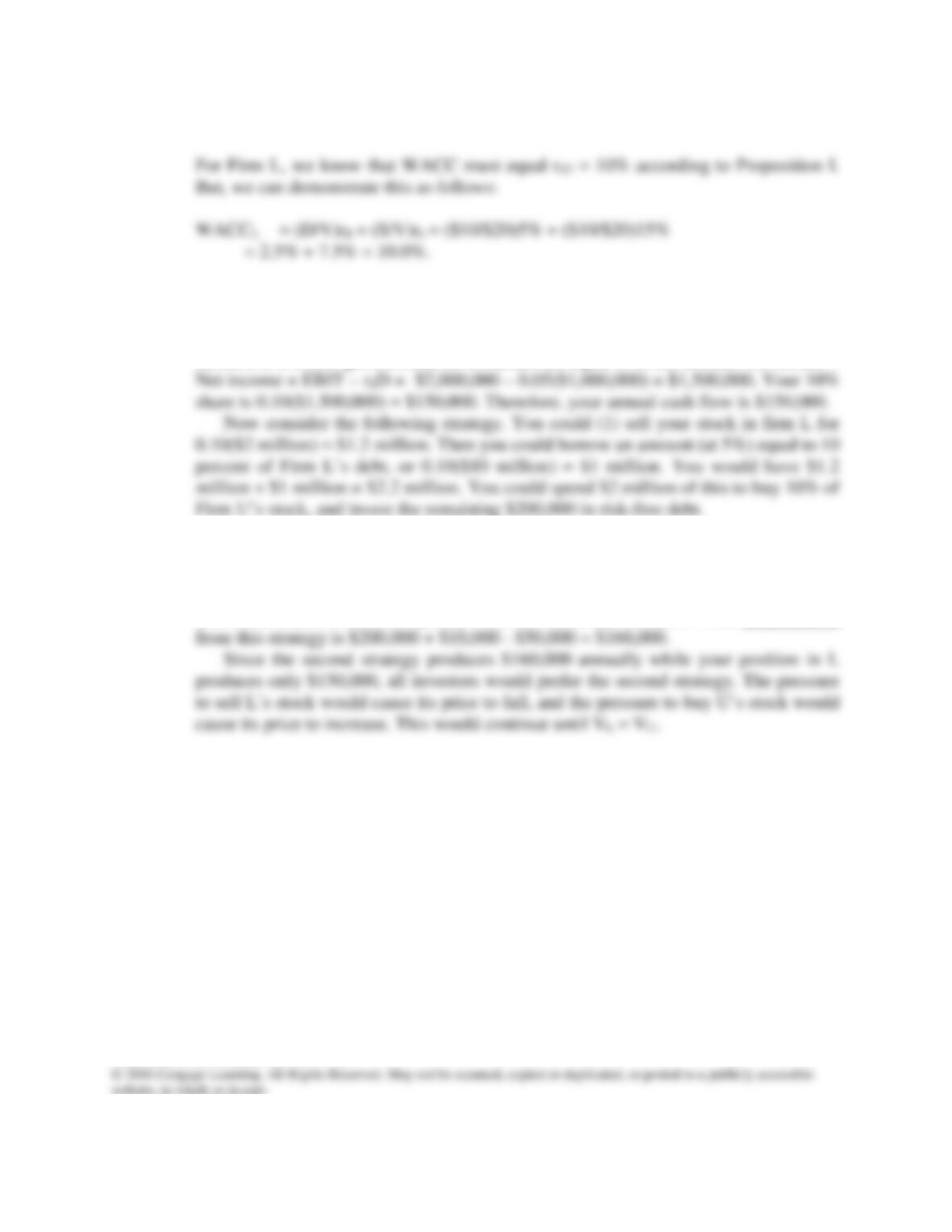
d. WACCU = rsU = 10%.
e. VL = $22 million is not an equilibrium value according to MM. Here’s why. Suppose
you owned 10 percent of Firm L’s equity, worth 0.10($22 million – $10 million) = $1.2
million. Your cash flow is equal to 10% of the dividends paid by the levered firm.
Because it is a zero–growth firm, its dividends are equal to its net income: Dividends =
Your cash stream would now be: (a) 10 percent of firm U’s dividends, which is
$200,000: 0.10(EBITU) = 0.10($2 million) = $200,000; plus (b) the return on the extra
$200,000 profit you invested in risk–free debt, which is $10,000: rd(profit) =
0.05($200,000) = $10,000; minus (c) the interest expense on the $1 million you
borrowed, which is $50,000: rd(loan) = 0.05($1 million)] = $50,000. Your net cash flow
Answers and Solutions: 17 – 10

17-7 a. VU =
sU
r
)T1(EBIT −
=
10.0
)4.01(2$ −
= $12 million.
VL = VU + TD = $12 + (0.4)$10 = $16 million.
d. WACCU = rsU = 10.00%.
WACCL = (D/V)rd(1 – T) + (S/V)rs = ($10/$16)5%(0.6) + ($6/$16)15%
= 7.50%.
17-8 a. VU =
)T1(r
)T1)(T1(EBIT
ssU
sC
−
−−
=
)01(10.0
)01)(4.01(2$
−
−−
= $12 million.
Answers and Solutions: 17 – 11
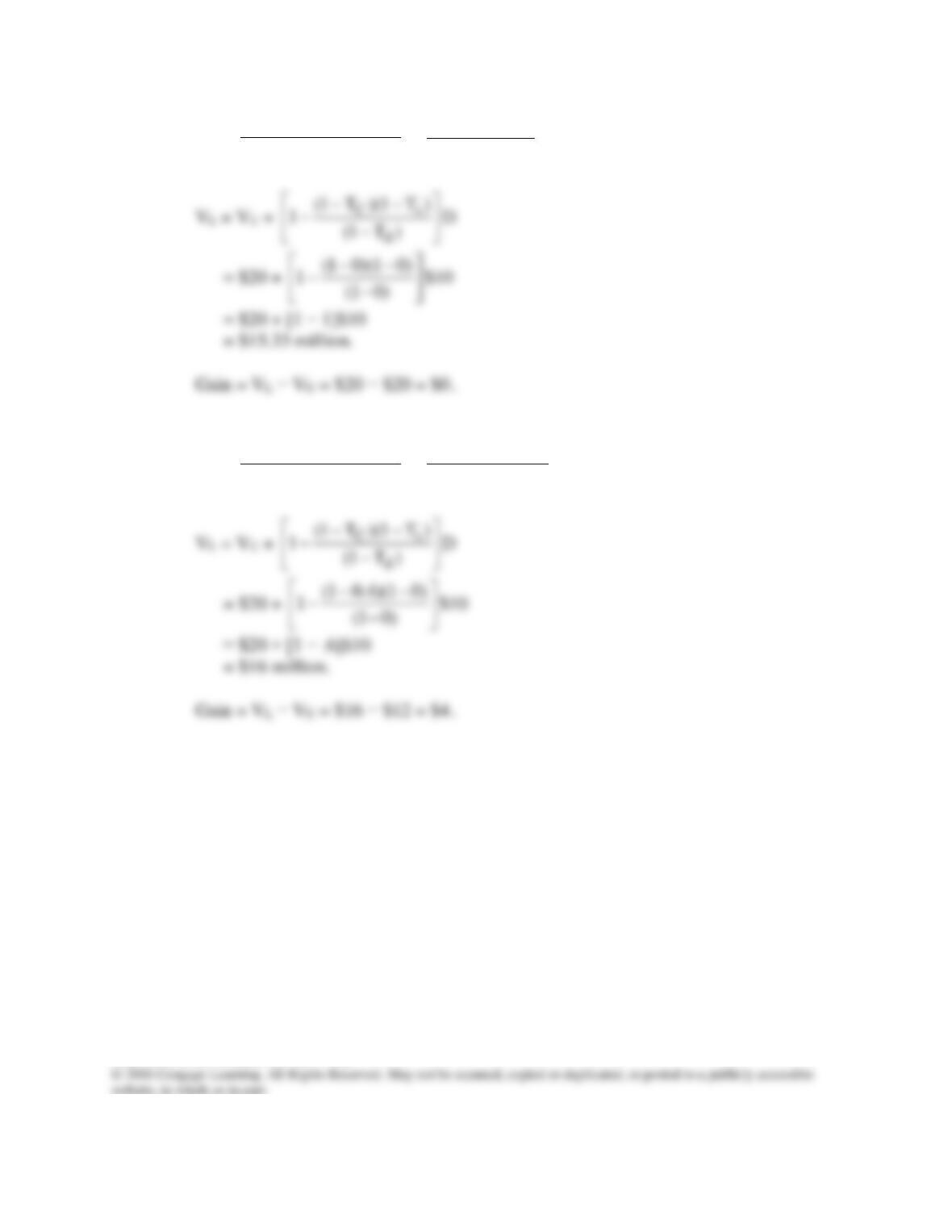
b. VU =
)T1(r
)T1)(T1(EBIT
ssU
sC
−
−−
=
)01(10.0
)01)(01(2$
−
−−
= $20 million.
c. VU =
)T1(r
)T1)(T1(EBIT
ssU
sC
−
−−
=
)01(10.0
)01)(4.0
1(2$
−
−−
= $12 million.
Answers and Solutions: 17 – 12
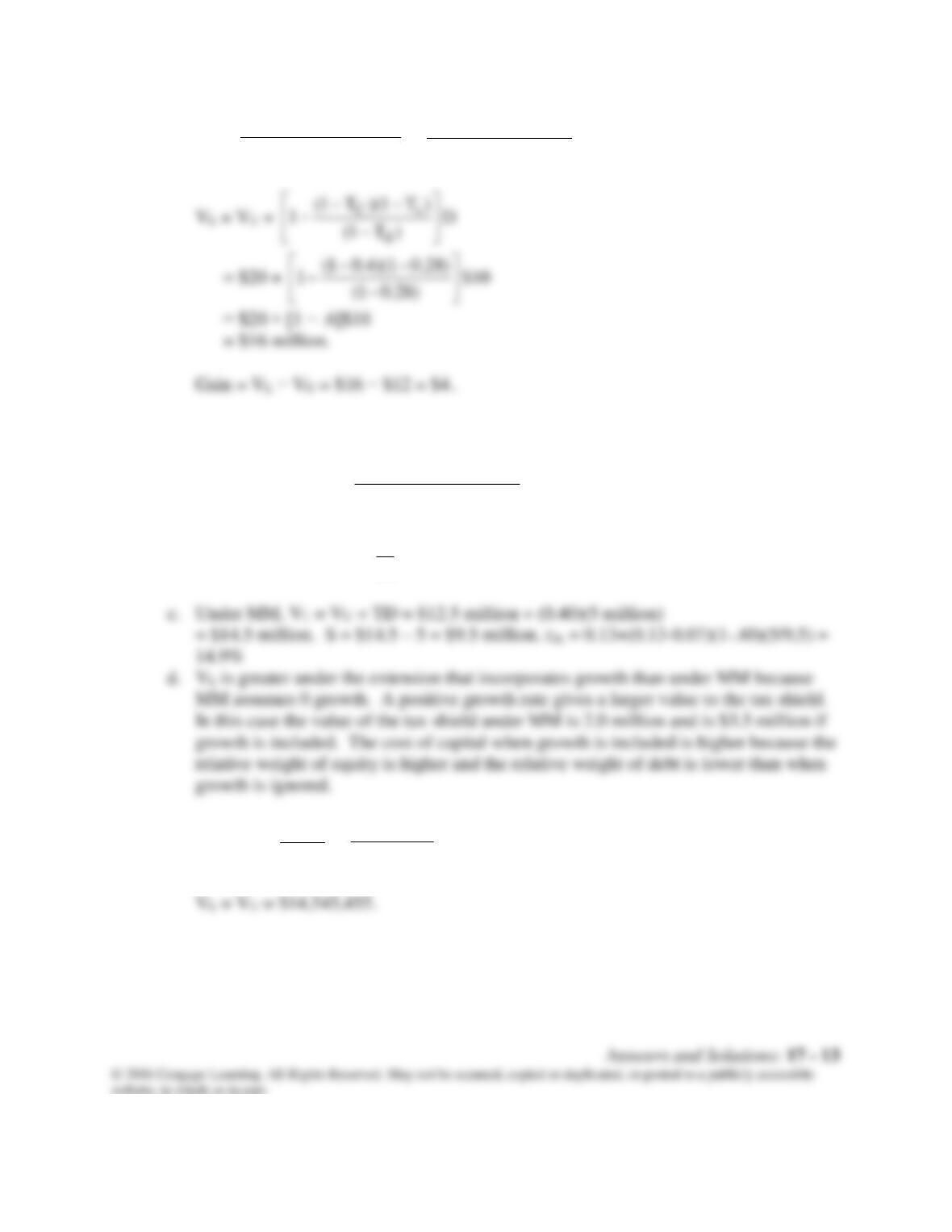
d. VU =
)T1(r
)T1)(T1(EBIT
ssU
sC
−
−−
=
)28.01(10.0
)28.01)(4.01(2$
−
−−
= $12 million.
17-9 a. VU = $500,000/(rsU – g) = $500,000/(0.13 – 0.09) = 12,500,000.
b.
million $16.0
0.09 – 0.13
million 5x 0.40x 0.07
million $12.5V
L
=
+=
. So since
D = 5, S = 16 – 5 = $11.0 million.
11
5
0.07)(0.130.13 r
sL
−+=
= 15.7%
17-10 a. VU = SU =
sU
r
EBIT
=
11.0
000,600,1$
= $14,545,455.
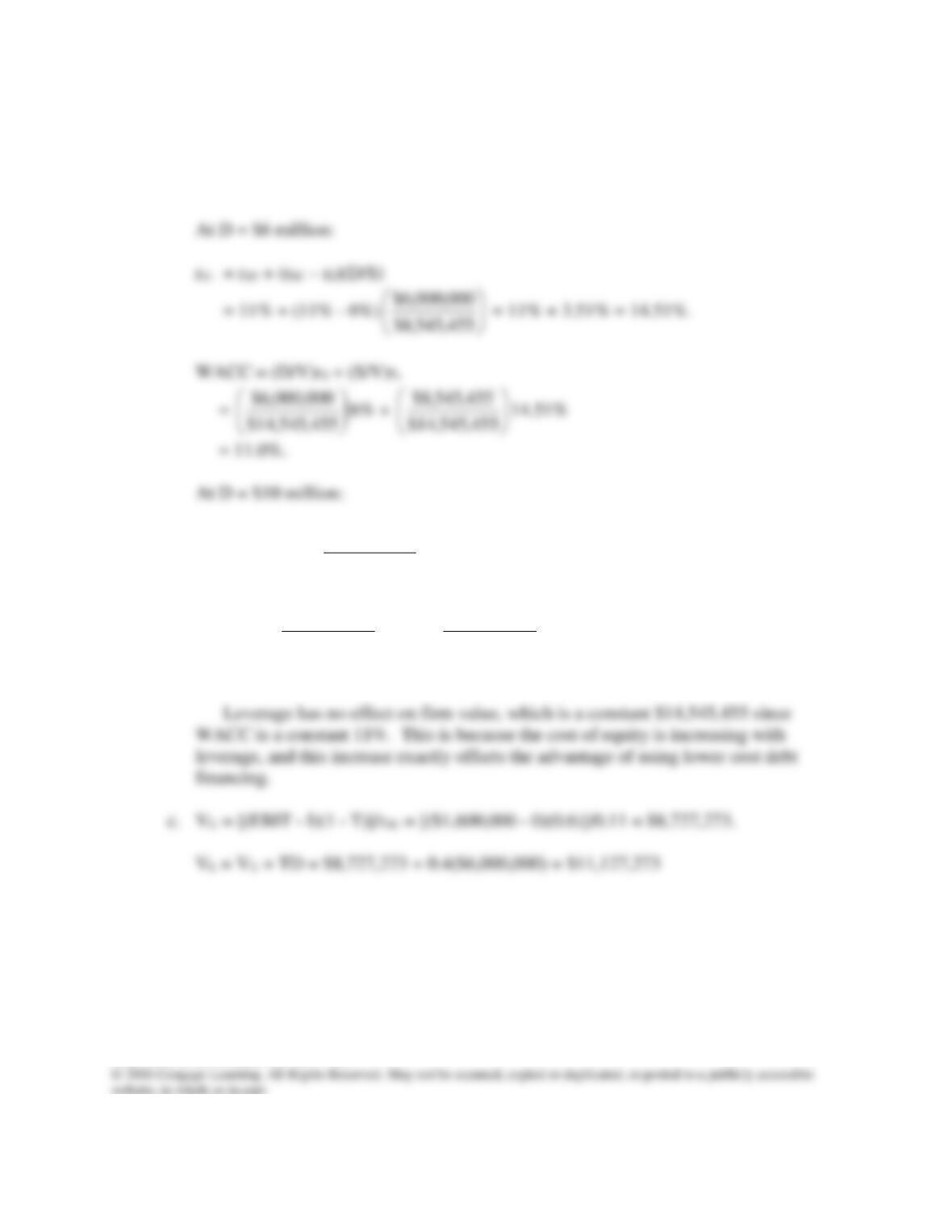
b. At D = $0:
rs = 11.0%; WACC = 11.0%
rsL = 11% + 5%
455,545,4$
000,000,10$
= 22.00%.
WACC =
455,545,14$
000,000,10$
6% +
455,545,14$
455,545,4$
22%
= 11.0%.
Answers and Solutions: 17 – 14
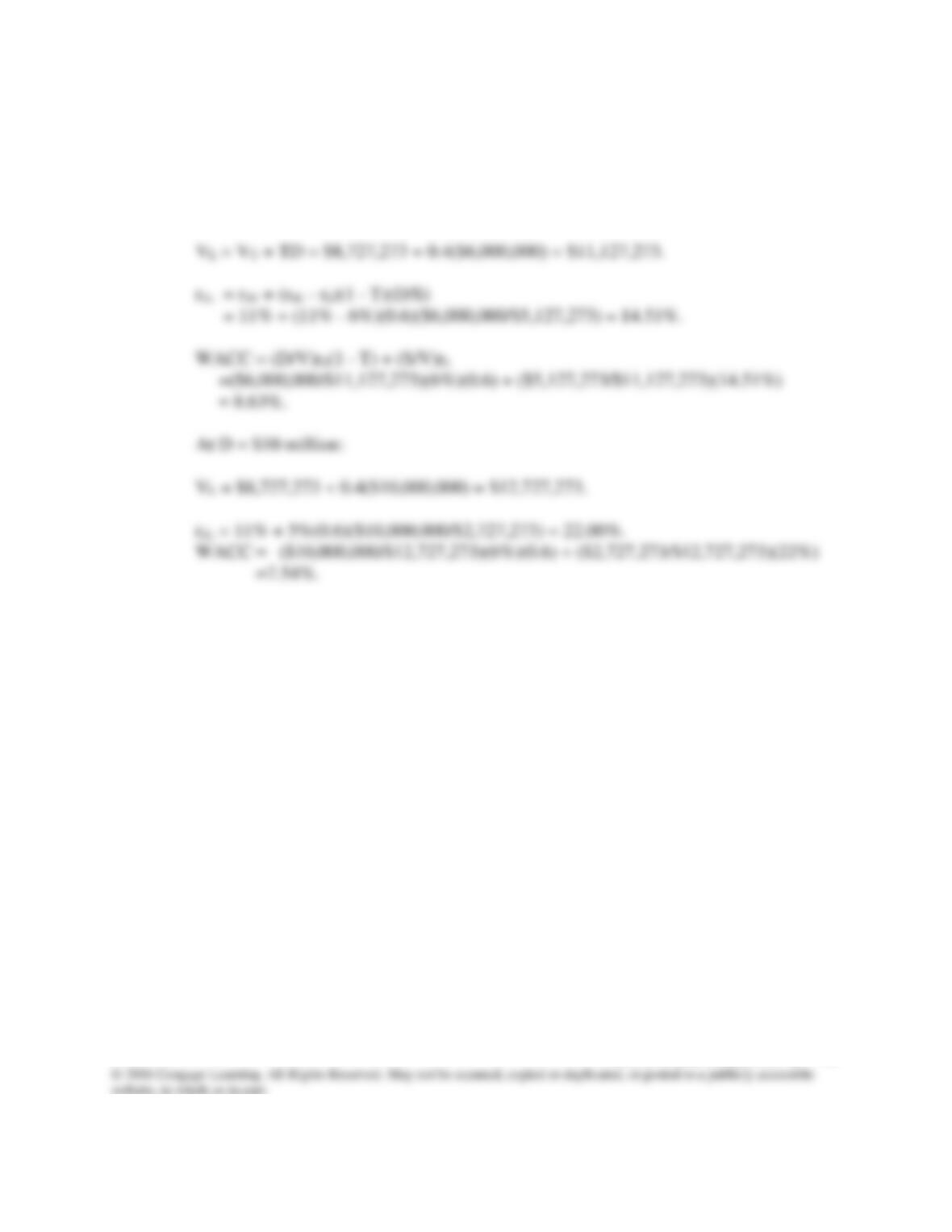
d. At D = $0:
rs = 11.0%. WACC = 11.0%.
At D = $6 million:
Answers and Solutions: 17 – 15
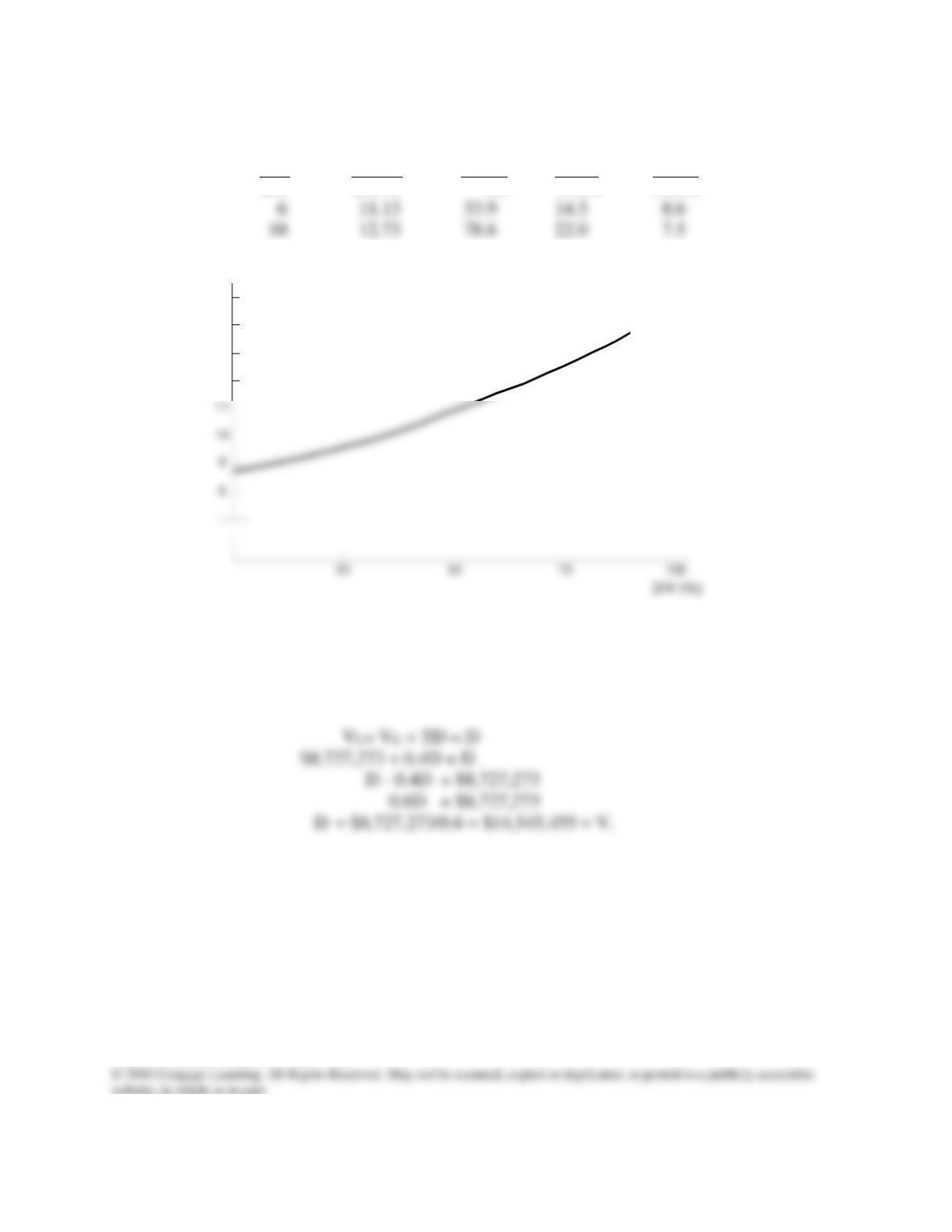
Summary: (in millions)
D V D/V rs WACC
$ 0 $ 8.73 0% 11.0% 11.0%
e. The maximum amount of debt financing is 100 percent. At this level
D = V, and hence
15
14
13
12
Value (Millions of Dollars)
Answers and Solutions: 17 – 16
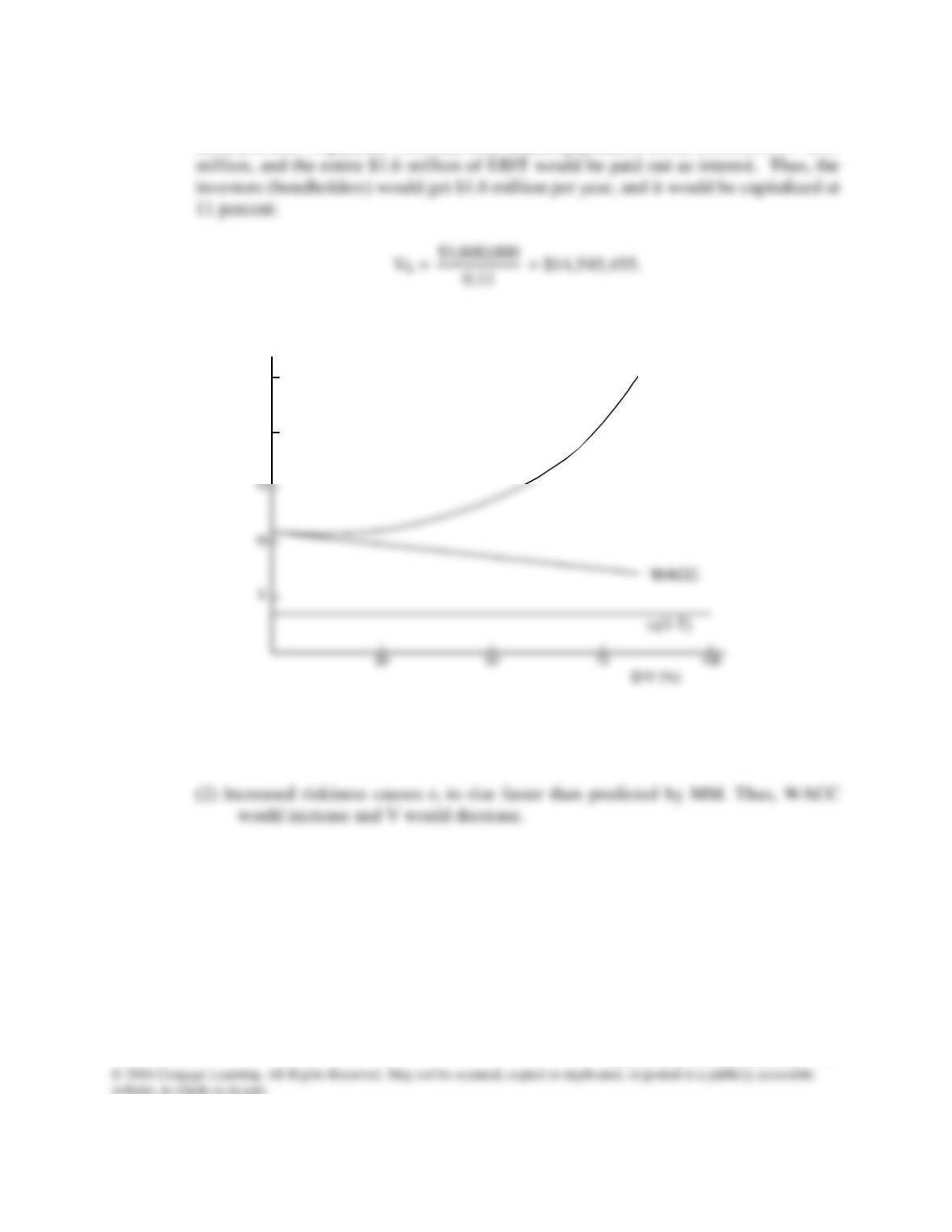
Since the bondholders are bearing the same risk as the equity holders of the unlevered
firm, rd is now 11 percent. Now, the total interest payment is $14,545,455(0.11) = $1.6
f. (1) Rising interest rates would cause rd and hence rd(1 – T) to increase, pulling up
WACC. These changes would cause V to rise less steeply, or even to decline.
25
20
Cost of Capital (%)
kS
rs
Answers and Solutions: 17 – 17