ANSWERS TO CHAPTER QUESTIONS
Chapter 17 Capital Needs Analysis
1) It tells you under the assumptions stated how much money you need to save to reach
your retirement goals.
2) Simple capital needs analysis is a straight line analysis which gives you a one figure
solution to the question how much you should save for retirement. It doesn’t take into
3) Monte Carlo simulation combines key variables, often in random fashion to form
4) Total Portfolio Management is a method of combining all household assets and
liabilities in an overall portfolio and then solving for the efficient mix of those assets.
5) Overhead costs, also called fixed costs or maintenance costs are necessary to maintain
the basics the household is intending to sustain. Like overhead costs for a business
6) No. The comedian’s human asset risk may be high since the comic style may go out
of favor while the government employee may have little likelihood of losing his or
7) A real estate sales position and home prices are probably positively correlated
8) The planning steps in a simple capital needs analysis are as follows:
a) Review Goals
b) Establish risk tolerance and risk.
c) Determine relevant rates and ages for calculations.
d) Develop retirement income, expenses, and required capital withdrawals.
9) Because inflation for expenses and investment returns for assets held will make those
10) The investment rate should be used for assets from time zero to beginning of
retirement period and for future outlays which required lump sum deposits today. The
11) See question 8.
12) Some weaknesses of the withdrawal rate method are that projections are based on
past experience overall in one figure and don’t include the specifics of key variables.
13) One of the main advantages of the withdrawal rate method is its ease of use using a
single figure. Another advantage of using the withdrawal rate is that it gives the client

14) It can create needed adjustments when markets are down sharply; the same flat rate
withdrawal rate of say 4% can represent a much larger portion of the portfolio than
15) Factors that may allow an increase to the withdrawal rate are: an increase in risk
16) Factors that may decrease the withdrawal rate are: a decrease in risk tolerance, an
increase in expected life, lower income, higher expenses, market prices decreasing,
higher than expected inflation, early retirement, and a change in asset allocation.
ANSWERS TO CHAPTER PROBLEMS
Chapter 17 Capital Needs Analysis
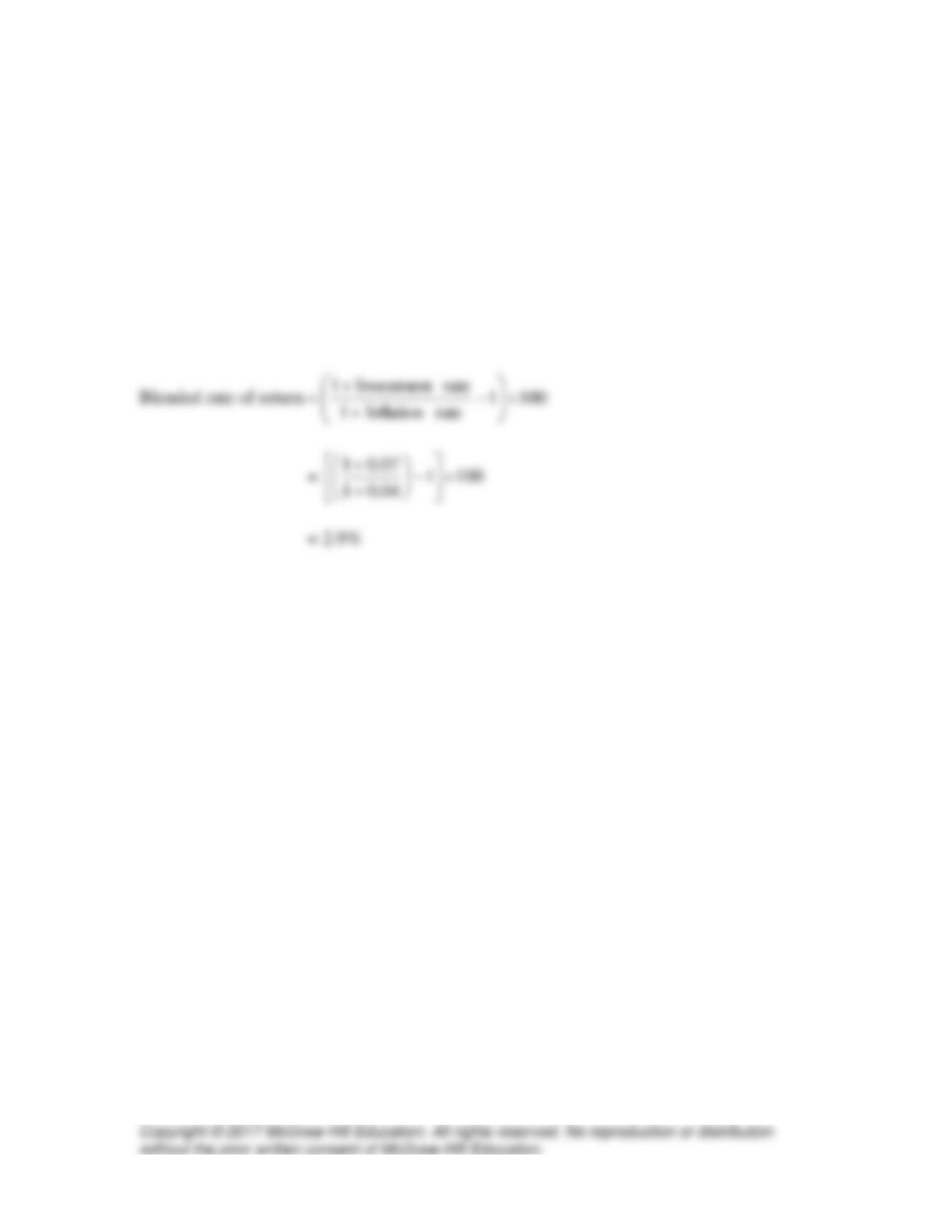
1) If the investment rate of return is 7 percent after tax and the inflation rate is 4 percent,
find the blended rate of return.
Solution:
2) Eleanor needs $40,000 a year to live on in retirement net of the income she will
receive. She will be retiring in 22 years and is funding for a 25-year retirement. The
inflation rate is expected to be 3.5 percent a year and the after-tax return on her
investments 6 percent.
a) How much will she short fall amount to at the beginning of the retirement period?
b) What lump sum will she need at the beginning of the retirement period?
c) What is the required yearly savings?
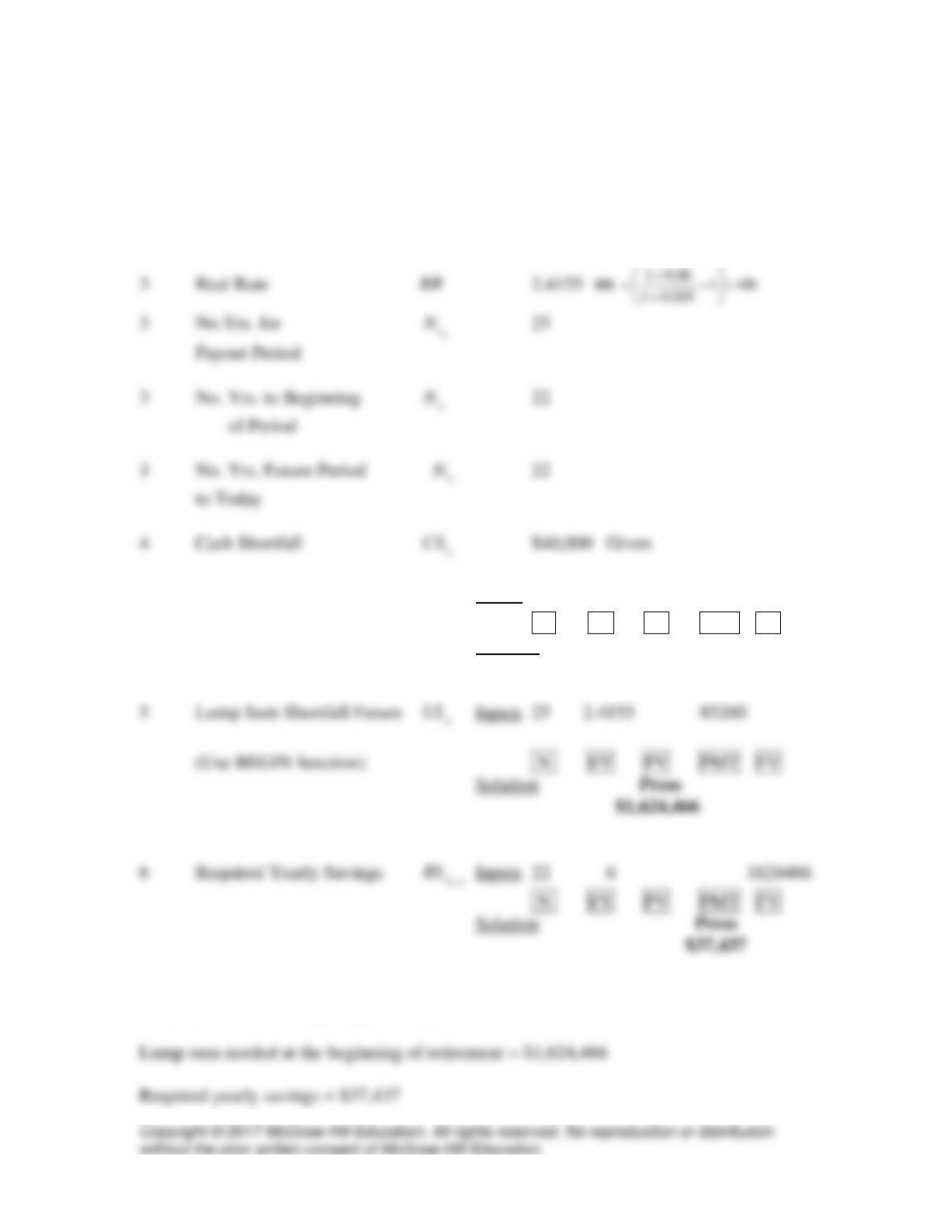
Calculator Solution:
Step Item Symbol Explanation or Calculation
3 Investment Rate IR 6% Given
3 Inflation Rate ER 3.5% Given
5 Cash Shortfall Future
1
t
CS
Inputs 22 3.5 40000
N I/Y PV PMT FV
Solution Press
$85,260
Cash shortfall at the beginning of retirement = $85,260
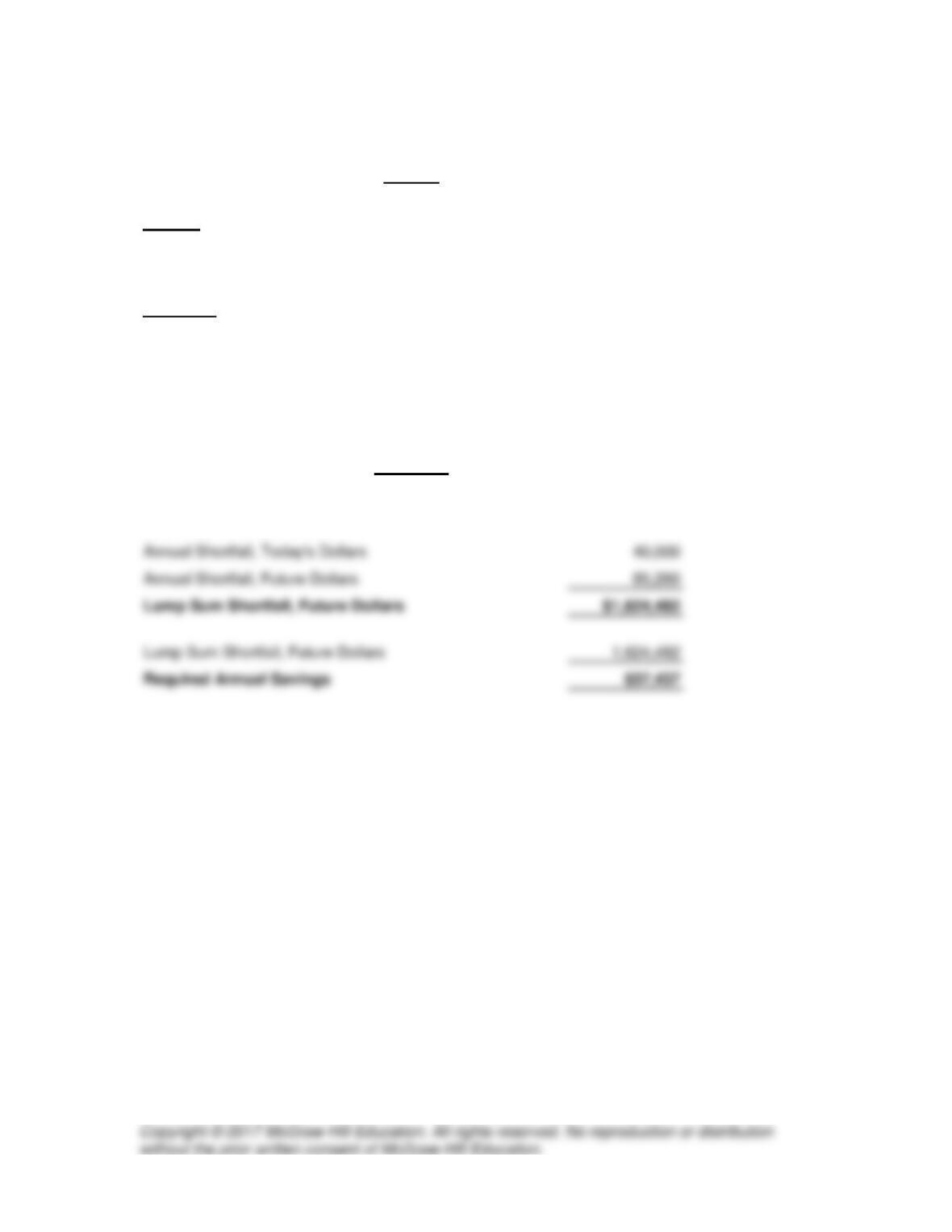
Excel Solution:
General
Years in Pre-Retirement Period 22
Years in Post-Retirement Period 25
Economic
Inflation 3.5%
After-Tax Investment Return 6.0%
Real Return 2.4%
Cash Shortfall, Today‘s Dollars (given) 40,000
Retirement Period 70-91
Inputs
Solution
3) Frank, age 28, wants to calculate his resources in real (inflation-adjusted) terms.
Calculate the amount of resources made available by age 65 retirement if $18,000 a
year is saved. Assume that outflows from ages 65 to 90 are at the rate of $27,000 a
year. The projected inflation rate is 4 percent, and the anticipated investment return is
6 percent.
a) How much in new savings will Frank have available at age 65 before subsequent
withdrawals?
b) How much will he have left at age 90?
c) What is the present value of that sum at age 65?
d) How much will he have to save per year to exactly meet his need?
Note: Questions b) and c) (they appear in red above) should be revised in the text as
follows:
Calculator Solution:
Step Item Revised Explanation or Calculation
Symbol
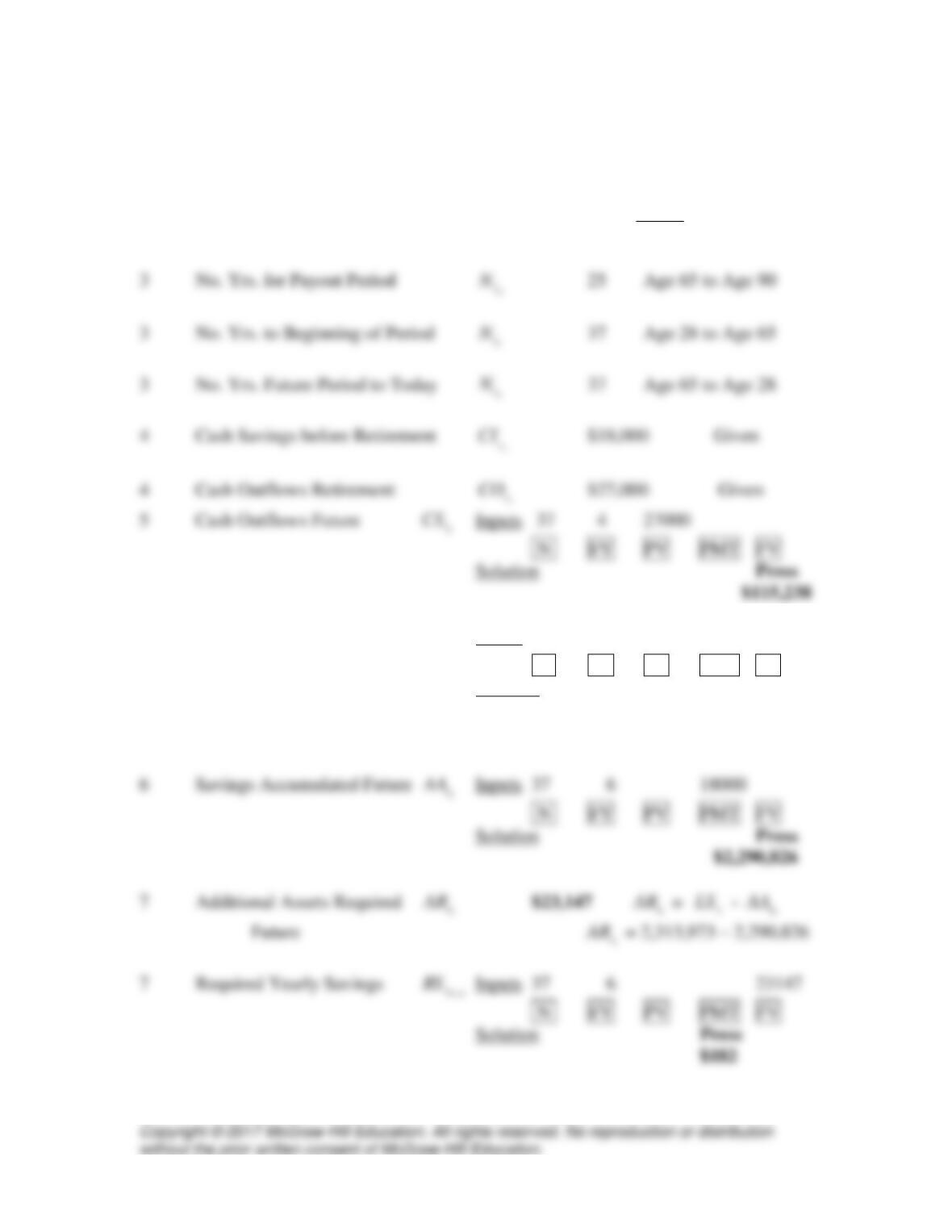
3 Investment Rate IR 6% Given
3 Inflation Rate ER 4% Given
3 Real Rate RR 1.923
1001
04.01
06.01
RR
−
+
+
=
5 Lump Sum Outflows Future
1
t
LS
Inputs 25 1.923 115238
(Use BEGIN function) N I/Y PV PMT FV
Solution Press
$2,313,973
6 Cash Savings Today
o
t
AA
$18,000 Given

a) Frank will have $2,290,826 in accumulated savings at age 65.
b) The amount of the lump sum Frank will need at age 65 is $2,313,973.
Excel Solution:
General
Frank’s Age 28
Frank’s Retirment Age 65
Years in Pre-Retirement Period 37
Years in Post-Retirement Period 25
Frank’s Assumed Age of Death 90
Economic
Inflation 4.0%
After-Tax Investment Return 6.0%
Real Return 1.9%
Frank
Cash Savings 18,000
Cash Outflows in Retirement 27,000
Retirement Period 70-91
Living Expenses in Retirement, Today’s Dollars 27,000
Annual Outflows, Today‘s Dollars 27,000
Savings Accumulated, Future Dollars $2,290,826
Inputs
Solution
4) The Smiths had $110,000 in savings at age 51. They had a desired retirement age of
65. They want to fund through age 92. Assume a 4 percent inflation rate and a 5
percent after-tax rate for investment both pre- and postretirement. They have
household income of $140,000, which is increasing at the rate of inflation. Their
expenditures including taxes are $125,000 a year. They estimate that in retirement
they will receive $28,000 a year together in Social Security and Mr. Smith will
receive a $12,000-a-year pension, both in today’s dollars. Their retirement
expenditures would be $90,000 a year in today’s dollars.
1. Calculate
a) The lump sum needed at retirement.
b) Current assets available at retirement.
c) The difference between needs and resources.
d) Yearly savings needed.
Pre- Retirement Period
Age 51-65
Expenses
Revenues
Post-Retirement Period
Age 65-92
Revenues
Social Security Income
28,000
Step Item Symbol Explanation or Calculation
3 Investment Rate IR 5% Given
3 Inflation Rate ER 4% Given
3 Real Rate RR 0.9615
1001
04.01
05.01
RR
−
+
+
=
4 Cash Inflows
o
t
CI
$40,000 Given
4 Cash Outflows
o
t
CO
$90,000 Given