CHAPTER 16
OPTION CONTRACTS
Answers to Questions
1. A long straddle consists of a long call and a long put on the same stock and profits from
dramatic price movement by the stock. A short straddle involves the sale of a call and a
2. A range forward is actually an option strategy that combines a long call and a short put
(or vice versa) through a costless transaction. Because the options will not have the same
3. Call options give the owner the right, but not the obligation, to purchase yen for a pre-
specified amount of domestic currency. Purchasing an at-the-money call option would
guarantee the current exchange rate over the life of the option. If the yen declines in
value, the call will not be exercised because yen can be purchased more cheaply in the
open market and redeeming the bond issue will be less costly.
4. The other three factors affecting the value of call options and the ways that changes in
them affect value are:
(1). Increases in underlying stock volatility. A call cannot be worth less than zero no
matter how far the stock price falls, but rising stock prices can increase the call’s
value without limit. Therefore, the wider the range within which a stock’s price
(2). The risk-free interest rate. Call value increase with increases in interest rates
(given constant stock prices) because higher interest rates make the ownership of
(3). The exercise price of the option. Call values decrease with increases in the
exercise price. When a call option is exercised, the payoff is the difference
5. Put-call parity indicates that a long position in a stock combined with being short a call
and long a put (with the same strike price) is a risk-free investment. In other words, no
matter what the stock price at expiration, the payoff will be the same. Consequently, any
investment in this portfolio should earn the risk-free return. The three-step process for
valuing options is to
(1). Determine a distribution of future stock prices,
6. The Black-Scholes model is derived by showing how a portfolio of the underlying asset
and risk-free bonds can be created that exactly mimics the price of an option. This
7. If there are no transaction costs, it is only rational to exercise a call option early,
immediately before a dividend payment. This is because it will always be more profitable
to sell the option and buy the stock in the open market rather than exercise the option,
unless there is a dividend. When a firm pays a dividend, the price of the stock usually
8. In the Black-Scholes model, the expected future value of a stock is a function of the risk–
free interest rate and the dividend yield. As long as the risk-free rate is greater than the
dividend yield, the future expected value will be greater than today’s price. The longer
the time period, the higher the expected price. So, as time to expiration increases, there
9. Because the price of an option is positively related to volatility, “buying low vol and
selling high vol” is the same as the idea of “buy low, sell high” for any risky asset if the
10. On October 19, 1987, implied volatilities sky-rocketed. The jump in implied volatility
11. Convertible bonds and preferred stock are both very similar to an ordinary bond (or
perpetuity) and a call option on the firm’s common stock. This is because these
instruments give the holder the option but not the obligation to trade in the existing asset
16 –
5
. CHAPTER 16
Answers to Problems
1. a) and b)
(1 + r) – d (1 + 0.04) – 0.7
OR
Step 1
Set up binomial tree and calculate the option values at expiration for each ending stock
Step 2
Solve for the amount to invest in the stock and the amount to borrow in order to replicate
Step 3
Use the values derived in Step 2 to solve for the value of the option at the beginning of
2.
2(a). Critique of Belief
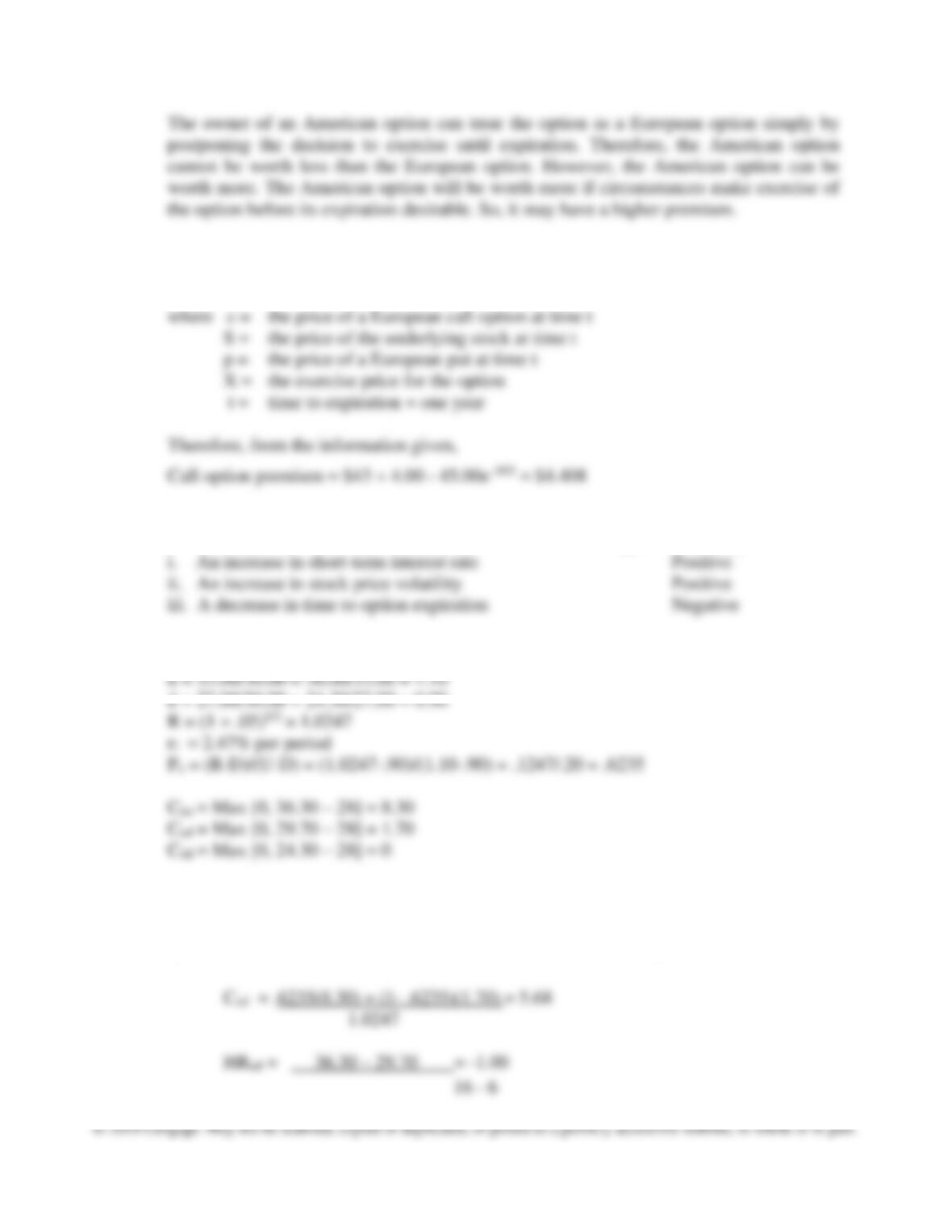
Joel Franklin’s belief is incorrect. There are two fundamental kinds of options: American
style and European style. An American option permits the owner to exercise the option at
2(b). European-Style Option’s Value
The formula to calculate a call option using put-call parity is c = S + p – Xe–rt
where c = the price of a European call option at time t
2(c). Effect of Variables
Effect on Call Option’s Value
3(a) Calculate the following parameters, option values, and hedge ratios at each node:
(i). S = 33
If the stock moves up the option will be worth $8.30 (Cuu); if the stock moves down the
option will be worth $1.70 (Cud). The value of the option and hedge ratio at this node is
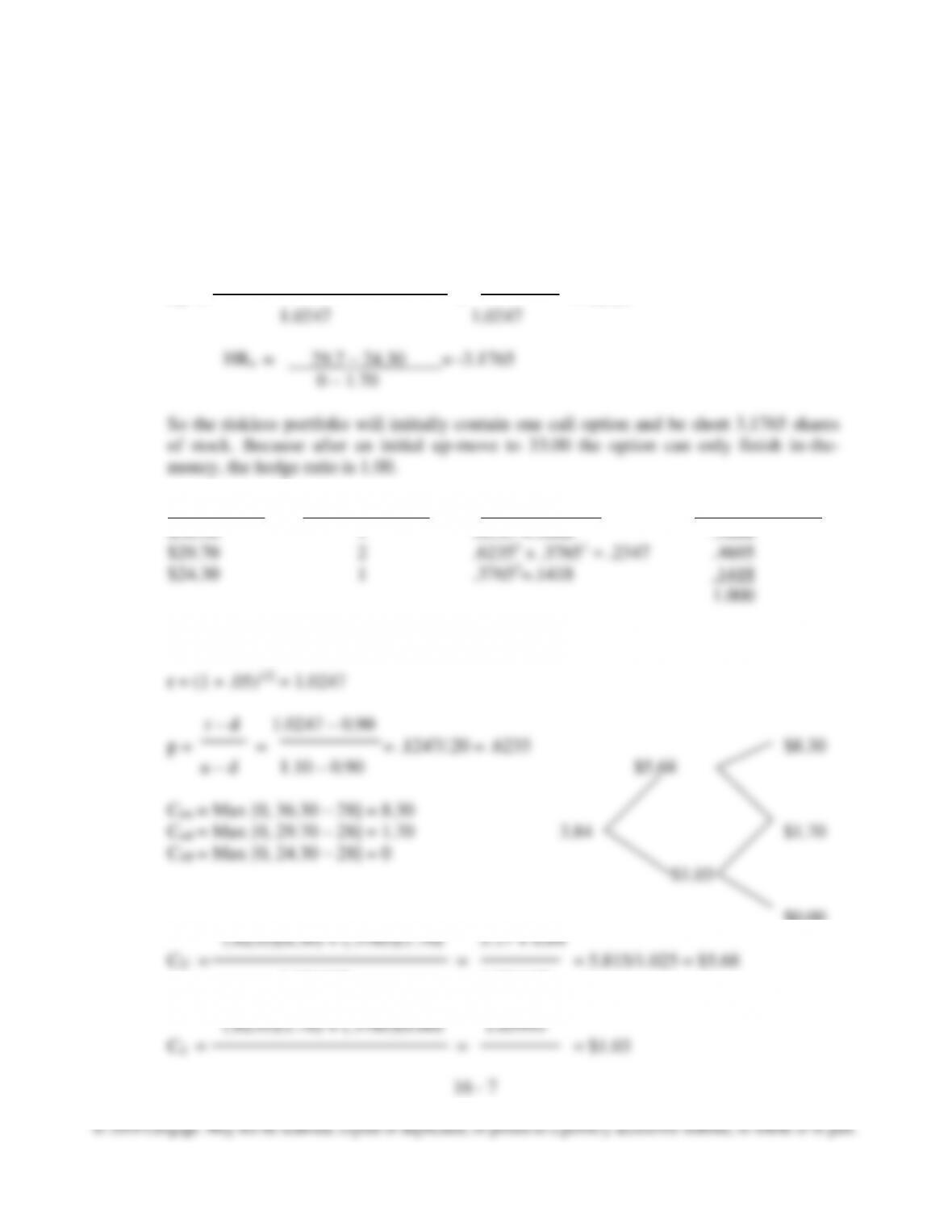
1.70-8.30
3(a)(ii). S = 27
If the stock moves up the option will be worth $1.70 (Cu); if the stock moves down, the
option will be worth $0. The value of the option and hedge ratio at this node is
(.6235)(1.70) + (.3765)(0.00) 1.05995
Cd = = = $1.03
3(b). Ending Price Number of Paths Path Probability Total Probability
$36.30 1 .62352=.3888 .3888
3(c). u = 33.00/30.00 = 36.00/33.00 = 1.10 d = 27.00/30.00 = 24.30/27.00 = 0.90
$0.00
1.024695 1.024695
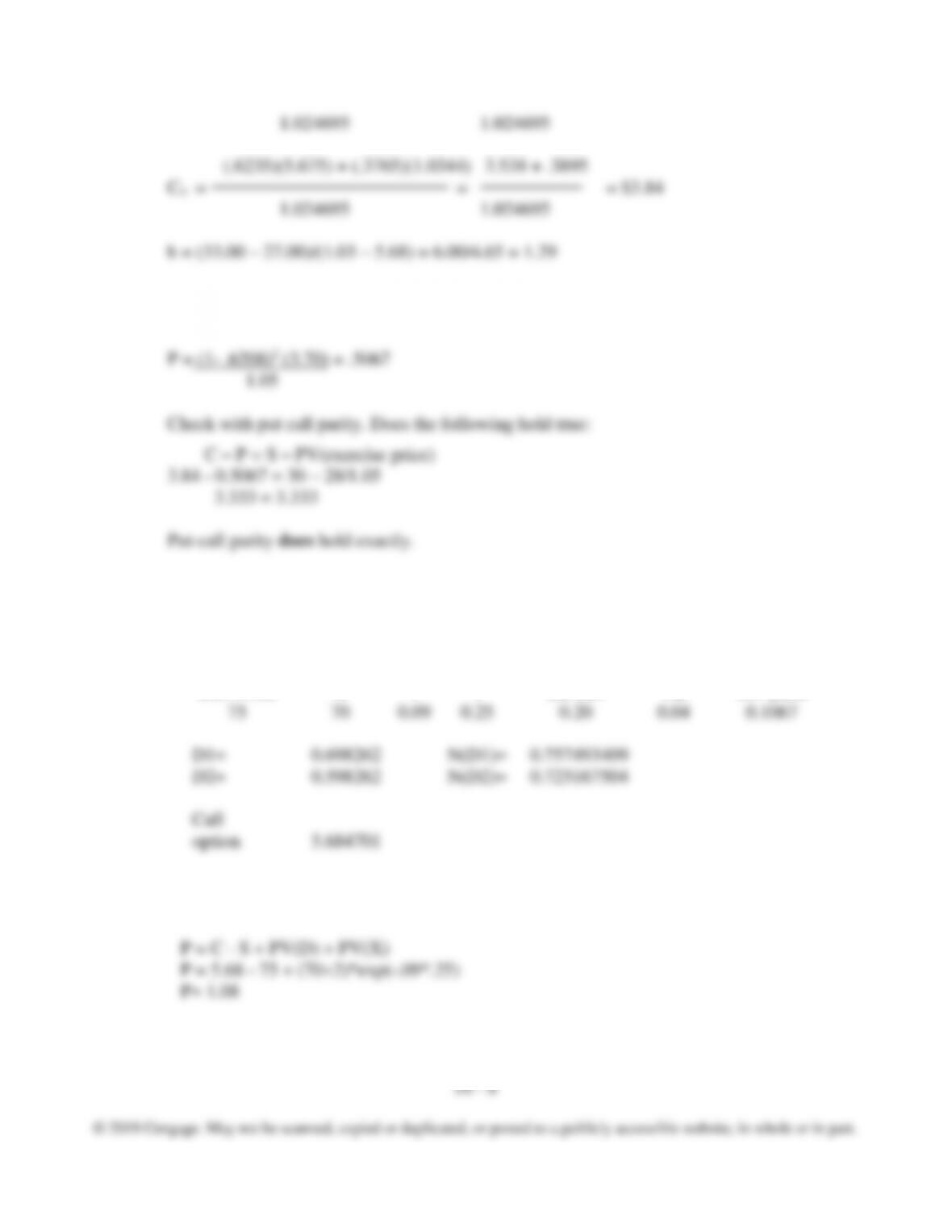
3(d). The only path where the put option has a positive intrinsic value is dd. Its intrinsic value
is $28.00 – $24.30 = $3.70
4(a). One way is to calculate approximate dividend yield: approximate annual dividend yield =
8/75 = .1067
Computing Black-Scholes
Curr Price
X
r
t
Std Dev
Var
Div yield
75
70
0.09
0.25
0.20
0.04
0.1067
D1=
0.698262
N(D1)=
0.757493409
D2=
0.598262
N(D2)=
0.725167504
Call
option
5.684701
4(b). Using put call parity
4(c).
16 –
9
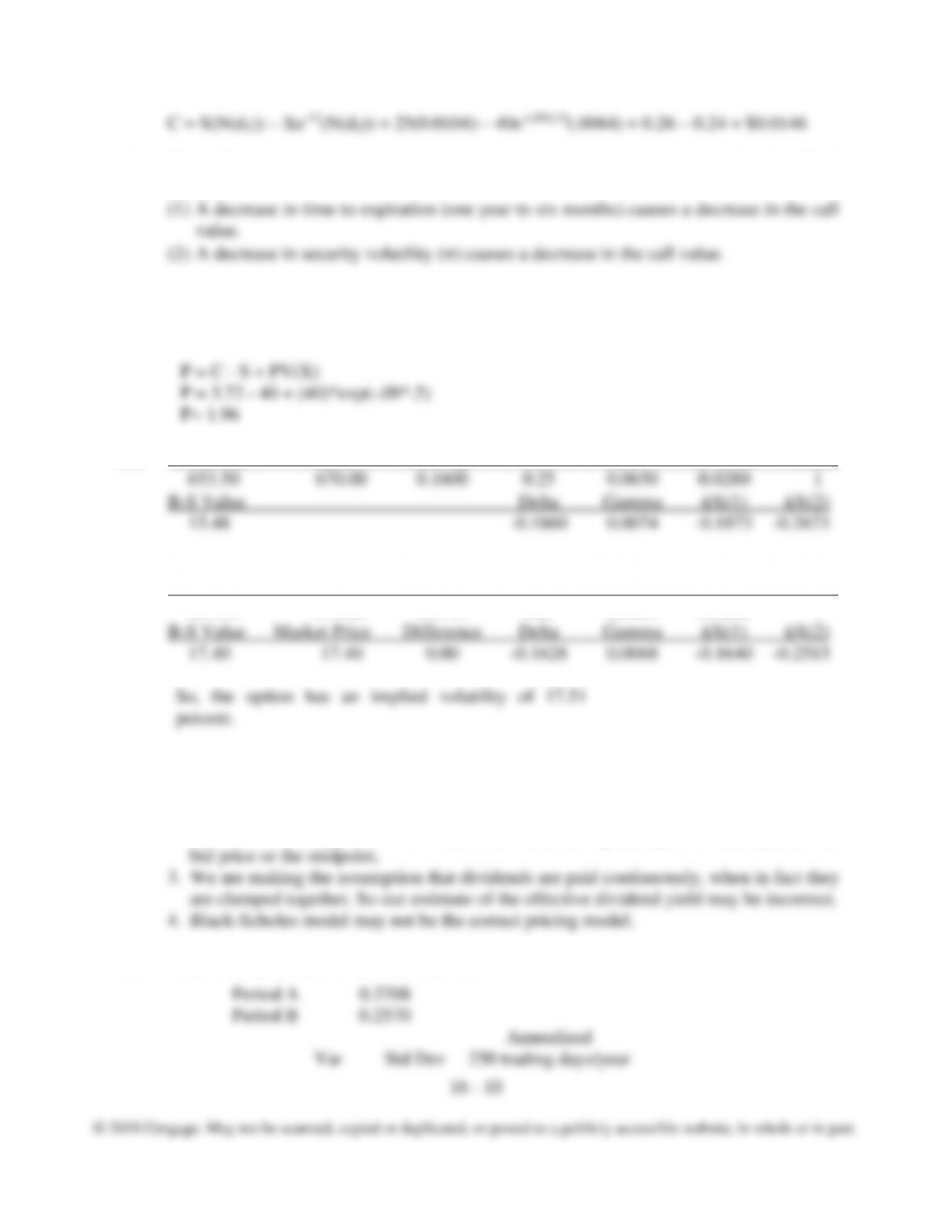
4(d). An increase in the volatility to 30 percent would increase the call’s value. A decrease in
5(a).
Price
Call
Hedge
Ratio
$25
0.0146
0.0103
$30
0.2324
0.0995
$35
1.275
0.34
$40
3.72
0.634
$45
7.47
0.844
$50
11.98
0.9458
$55
16.82
0.984
Computing Black-Scholes
Curr Price
X
r
t
Std Dev
Var
Div yield
75
70
0.09
0.25
0.20
0.04
0.0000
D1
0.964929
N(D1)
0.832709749
D2
0.864929
N(D2)
0.806461088
Call
option
7.256948
5(b). The call value for each level of stock price is lower than those shown in Exhibit 22.12
because:
5(c). For S = 40
Using put call parity
6(a). Asset Price Strike Volatility T R(f) Div. Yield Put/Call
6(b). Asset Price Strike Volatility T R(f) Div. Yield Put/Call
653.50 670.00 0.1751 0.25 0.0650 0.0280 1
6(c). The market price may differ from the estimated price for the following reasons:
1. The quote may be stale. That is the market maker may not have adjusted the price to
reflect new market conditions.
2. Is this a bid or ask price? The ask price win have a higher implied volatility than the
7(a). The volatility estimates are calculated as:
A
Std dev * SQRT
(250)
Price
relatives
0.000292
0.017077
0.270006617
B
Price
relatives
0.000262
0.016193
0.256038281
7(b).
8(a). Cost/Contract x 31,250
long 1.44 Call 0.0422 $1,318.75
June Net Initial Long Call Short Call Long Put Short Put Total Net
USD/GBP Cost 1.44 Profit 1.48 Profit 1.40 Profit 1.44 Profit Profit
1.40 ($15.62) 0 0 0 -1250 ($1,265.62)
1.48 ($15.62) 1250 0 0 0 $1,234.38
Computing Black-Scholes
Curr Price
X
r
t
Std Dev
Var
Div yield
120.625
115
0.0742
0.169863
0.2560
0.065556
0.0365
D1
0.56599
N(D1)
0.714299917
D2
0.460466
N(D2)
0.677409009
Call
option
8.70354
$0.00
($500.00)
($1,000.00)
8(c). This is a simple application of put-call parity
9.
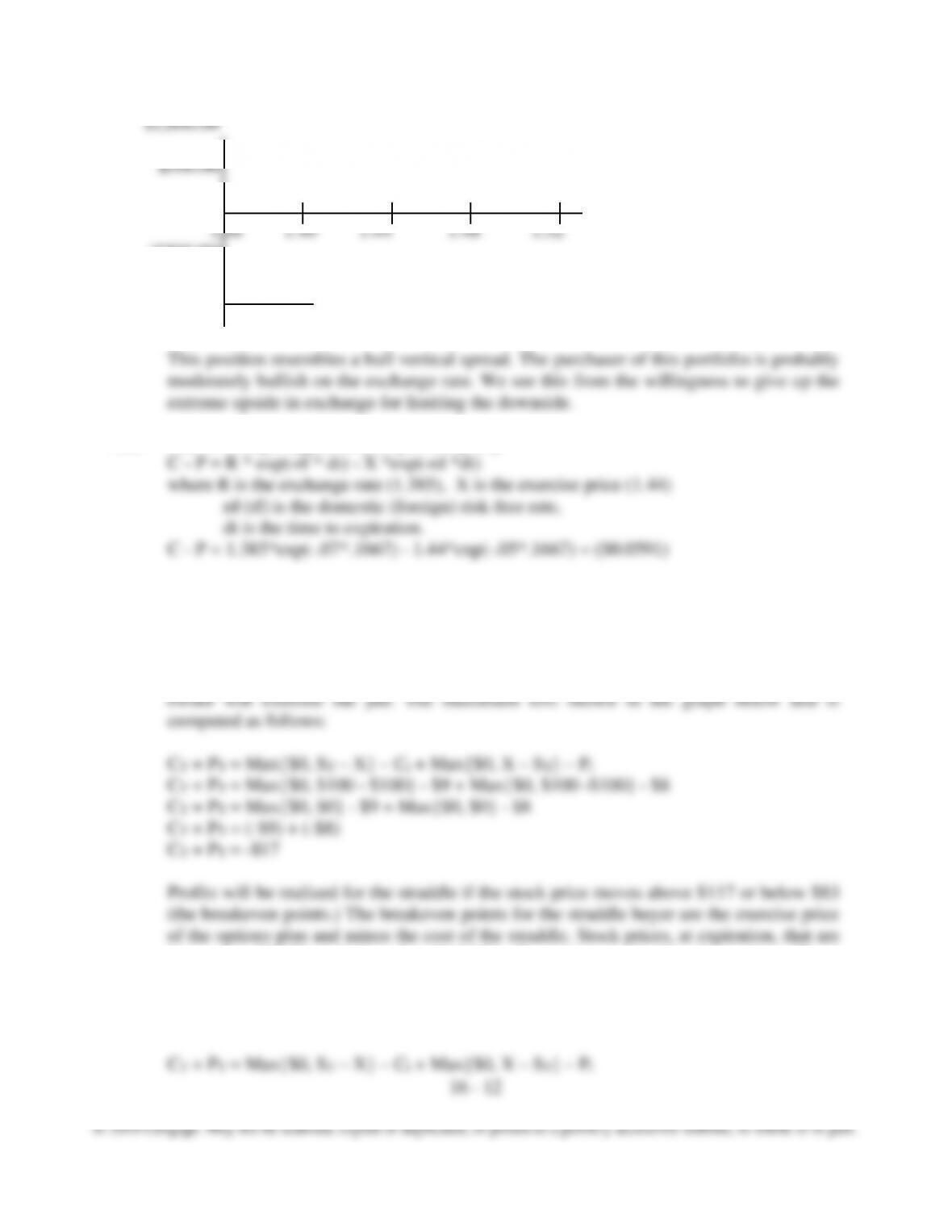
9(a). The maximum loss at expiration for the straddle buyer takes place at the exercise price
and is $17. This is the total cost to purchase the long call and the long put that are
combined to create the straddle. If the stock price exceeds the exercise price, the straddle
owner will exercise the call; if the stock price is less than the exercise price, the straddle
lower than $83.00 or higher than $117.00 will produce a gain for this position. These
gains are shown as the intersection between the payoff profit and the zero profit line in
the graph for this section, given bellow. The breakeven points are those stock prices that
result in zero profit:
16 –
13
9(b). The alternative option combination, consisting of buying a put and a call with the same
expiration dates and the same underlying stock but different strike prices is called a
is $4.50. The breakeven points are calculated by taking the put option strike minus the
combined option premium ($90 – $11 = $79) and taking the call option strike plus the
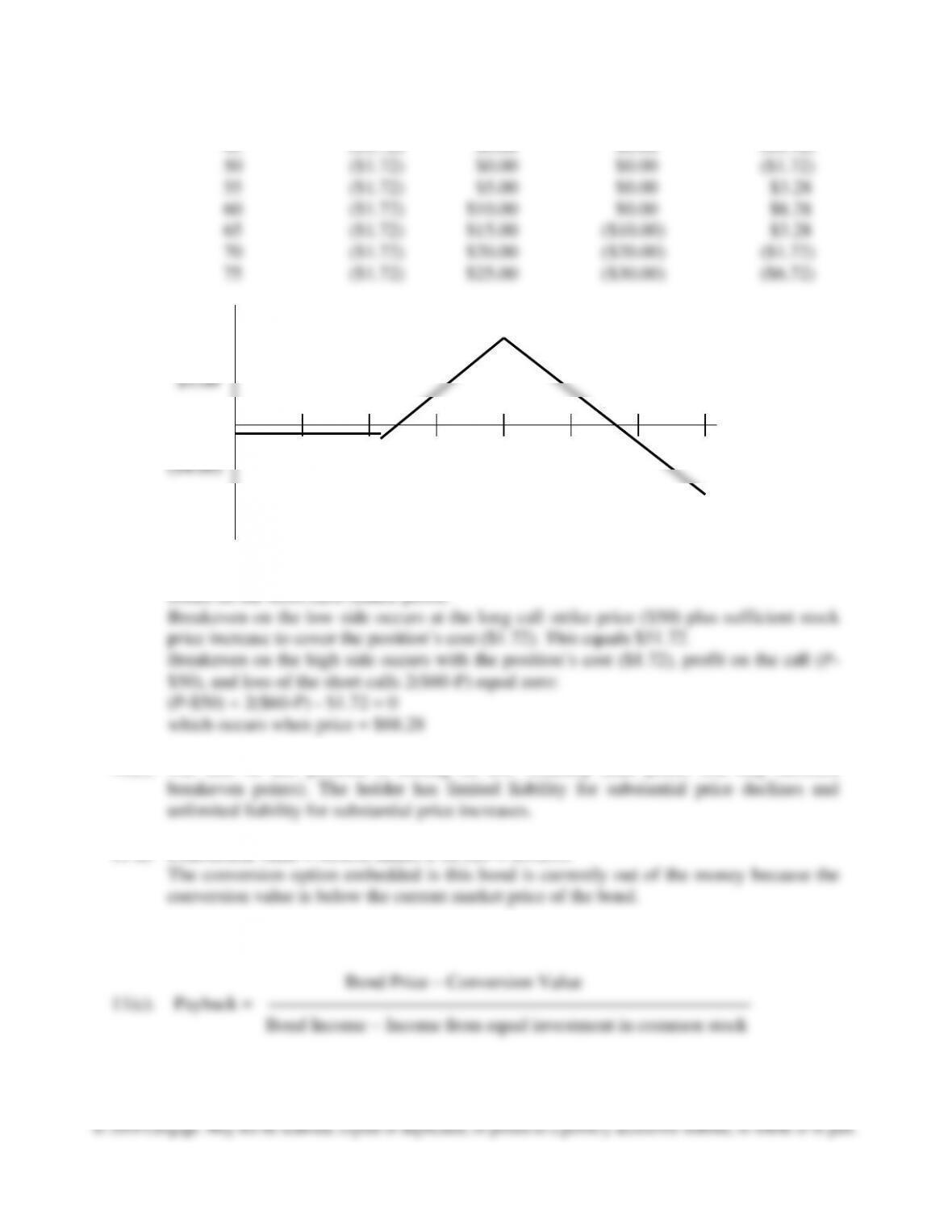
10(a) Price of ARB Profit on Profit on Net Profit on
Stock at Expiration Initial Cost Call #1 Position Call #2 Position Total Position
16 –
14
40 ($1.72) $0.00 $0.00 ($1.72)
45 ($1.72) $0.00 $0.00 ($1.72)
10(b).
$8.00
$0.00
40 45 50 55 60 65 70 75
($8.00)
Breakeven points are $51.72 and $68.28. Maximum profit occurs at $60.
Maximum profit occurs when the short calls are at-the-money; at prices above $60, the
10(c). The user of this position is betting on low volatility (that prices will stay between
11 a). Conversion value = 48.852 shares x 12.125 = $592.33
11(b). Conversion parity price = Bond price/conversion ratio = 965/48.852 = $19.75
16 –
15
14 38.125 1000
11(d). $965.00 = +