
SOLUTION TO SPREADSHEET PROBLEM
16-12 The detailed solution for the problem is available in the file Ch16 P12 Build a Model
Solutions.xls on the textbook’s Web site.
Answers and Solutions: 16 – 14

MINI CASE
Assume you have just been hired as a business manager of PizzaPalace, a regional pizza
restaurant chain. The company’s EBIT was $50 million last year and is not expected to
grow. The firm is currently financed with all equity and it has 10 million shares
outstanding. When you took your corporate finance course, your instructor stated that
most firms’ owners would be financially better off if the firms used some debt. When you
suggested this to your new boss, he encouraged you to pursue the idea. As a first step,
assume that you obtained from the firm’s investment banker the following estimated costs
of debt for the firm at different capital structures:
% Financed With Debt rd
0% —
20 8.0%
30 8.5
40 10.0
50 12.0
If the company were to recapitalize, debt would be issued, and the funds received would be
used to repurchase stock. PizzaPalace is in the 40 percent state–plus–federal corporate tax
bracket, its beta is 1.0, the risk-free rate is 6 percent, and the market risk premium is 6
percent.
a. Using the free cash flow valuation model, show the only avenues by which capital
structure can affect value.
Answer: The basic definitions are:
The impact of capital structure on value depends upon the effect of debt on: WACC
and/or FCF.
Mini Case: 16 – 15
b. (1) What is business risk? What factors influence a firm‘s business risk?
Answer: Businsess risk is uncertainty about EBIT. Factors that influence business risk
b. (2) What is operating leverage, and how does it affect a firm’s business risk? Show
the operating break even point if a company has fixed costs of $200, a sales price
of $15, and variables costs of $10.
Answer: Operating leverage is the change in EBIT caused by a change in quantity sold. The
c. Now, to develop an example which can be presented to PizzaPalace’s management
to illustrate the effects of financial leverage, consider two hypothetical firms:
Firm U, which uses no debt financing, and Firm L, which uses $10,000 of 12
percent debt. Both firms have $20,000 in assets, a 40 percent tax rate, and an
expected EBIT of $3,000.
Mini Case: 16 – 16
1. Construct partial income statements, which start with EBIT, for the two firms.
Answer: Here are the fully completed statements:
Firm U Firm L
Assets $20,000 $20,000
c. 2. Now calculate ROE for both firms.
Answer: Firm U Firm L
BEP 15.0% 15.0%
c. 3. What does this example illustrate about the impact of financial leverage on ROE?
Answer: Conclusions from the analysis:
Mini Case: 16 – 17
Therefore, the use of financial leverage has increased the expected profitability to
shareholders. The higher roe results in part from the tax savings and also because the
stock is riskier if the firm uses debt.
d. Explain the difference between financial risk and business risk.
Answer: Business risk increases the uncertainty in future EBIT. It depends on business factors
e. What happens to ROE for Firm U and Firm L if EBIT falls to $2,000? What does this imply
about the impact of leverage on risk and return?
Answer:
Firm U
Firm L
EBIT
$2,000
$2,000
Interest
$1,200
$2,000
$1,200
Mini Case: 16 – 18
f. What does capital structure theory attempt to do? What lessons can be learned
from capital structure theory? Be sure to address the MM models.
Answer: MM theory begins with the assumption of zero taxes. MM prove, under a very
restrictive set of assumptions, that a firm’s value is unaffected by its financing mix:
Miller later included personal taxes. Personal taxes lessen the advantage of corporate
debt. Corporate taxes favor debt financing since corporations can deduct interest
expenses, but personal taxes favor equity financing, since no gain is reported until
stock is sold, and long-term gains are taxed at a lower rate. Miller’s conclusions with
personal taxes are that the use of debt financing remains advantageous, but benefits
are less than under only corporate taxes. Firms should still use 100% debt. Note:
however, miller argued that in equilibrium, the tax rates of marginal investors would
adjust until there was no advantage to debt.
Mini Case: 16 – 19
One agency problem is that managers can use corporate funds for non-value
maximizing purposes. The use of financial leverage bonds “free cash flow,” and
forces discipline on managers to avoid perks and non-value adding acquisitions.
g. What does the empirical evidence say about capital structure theory? What are
the implications for managers?
Answer: Tax benefits are important. At the optimal capital structure, $1 debt adds about $0.10
to $0.20 to value on average. For the average firm financed with 25% to 30% debt,
this adds about 3% to 6% to the total value. Bankruptcies are costly– costs can be up
to 10% to 20% of firm value. Firms have targets, but don’t make quick corrections
After big stock price run ups, the debt ratio falls, but firms tend to issue equity
instead of debt. This is inconsistent with the trade-off model, inconsistent with the
pecking order theory, but is consistent with the windows of opportunity hypothesis.
Mini Case: 16 – 20
Managers should take advantage of tax benefits by issuing debt, especially if the
firm has a high tax rate, stable sales, and less operating leverage than the typical firm
h. With the above points in mind, now consider the optimal capital structure for
PizzaPalace.
h. (1) For each capital structure under consideration, calculate the levered beta, the cost
of equity, and the WACC.
Answer: MM theory implies that beta changes with leverage. bu is the beta of a firm when it
has no debt (the unlevered beta.) Hamada’s equation provides the beta of a levered
We can repeat this for the capital structures under consideration.
wd D/S b rs
0% 0.00 1.000 12.00%
Mini Case: 16 – 21
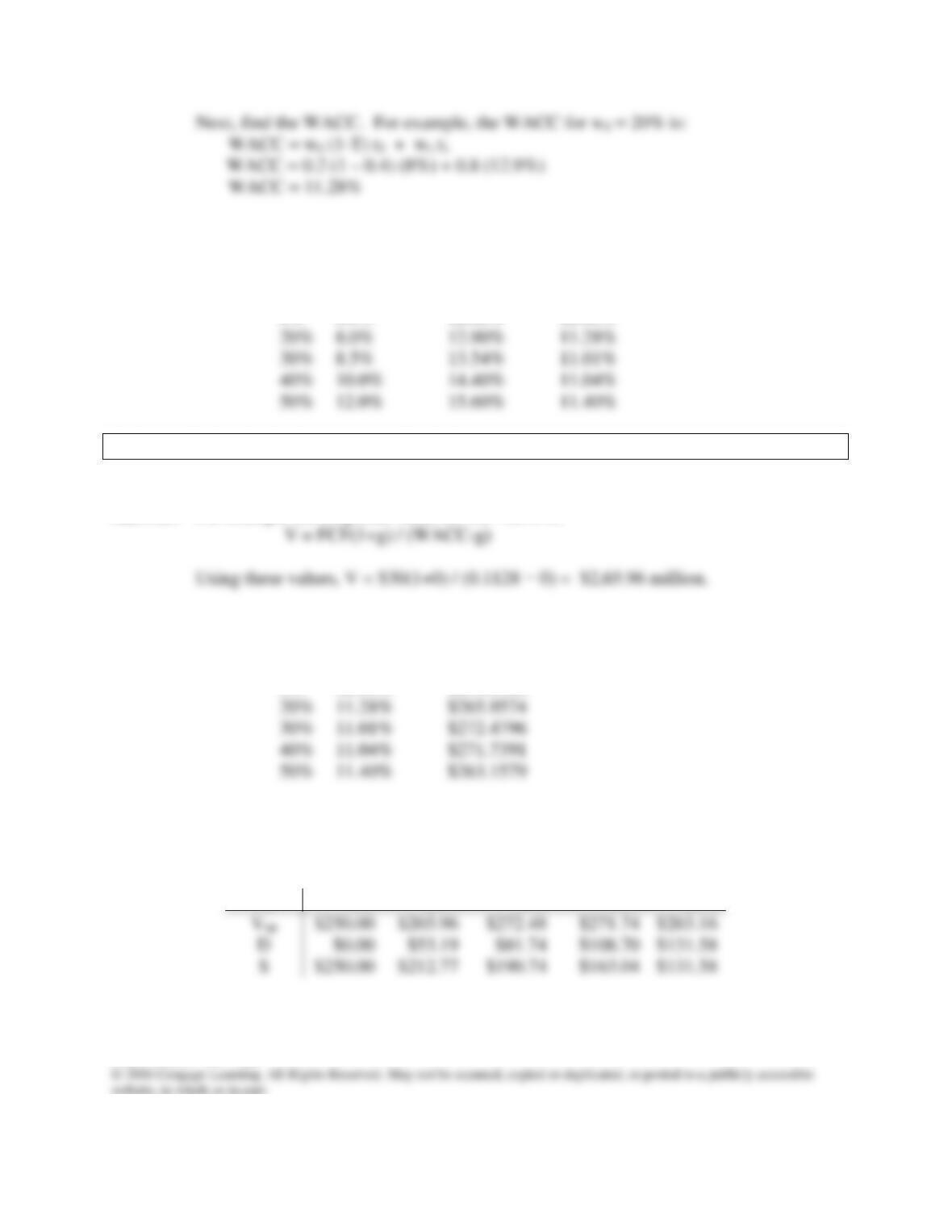
Then repeat this for all capital structures under consideration.
wd rd rs WACC
h. (2) Now calculate the corporate value.
Answer: For example the corporate value for wd = 20% is:
Repeating this for all capital structures gives the following table:
wd WACC Corp. Value
0% 12.00% $250.0000
As this shows, value is maximized at a capital structure with 30% debt.
Debt = wd Vop and S = ws Vop:
wd
0%
20%
30%
40%
50%
Mini Case: 16 – 22
i. Describe the recapitalization process and apply it to PizzaPalace. Calculate the
resulting the value of the debt that will be issued, the resulting market value of
equity, the price per share, the number of shares repurchased, and the remaining
shares. Considering only the capital structures under analysis, what is
PizzaPalace’s optimal capital structure?
Answer:
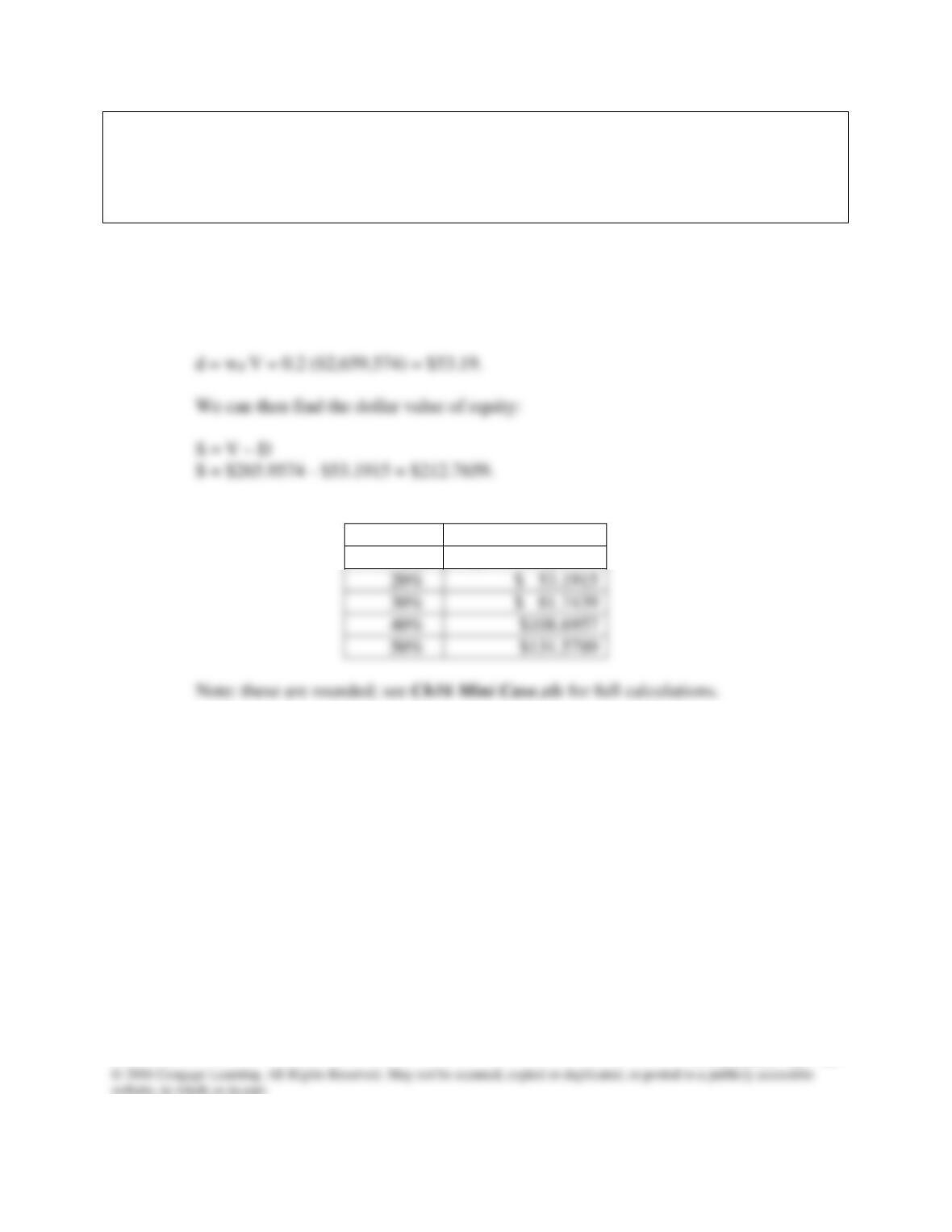
First, find the dollar value of debt. For example, for wd = 20%, the dollar value of
debt is:
We repeat this process for all the capital structures.
wd
Debt, D
0%
$ 0
Mini Case: 16 – 23
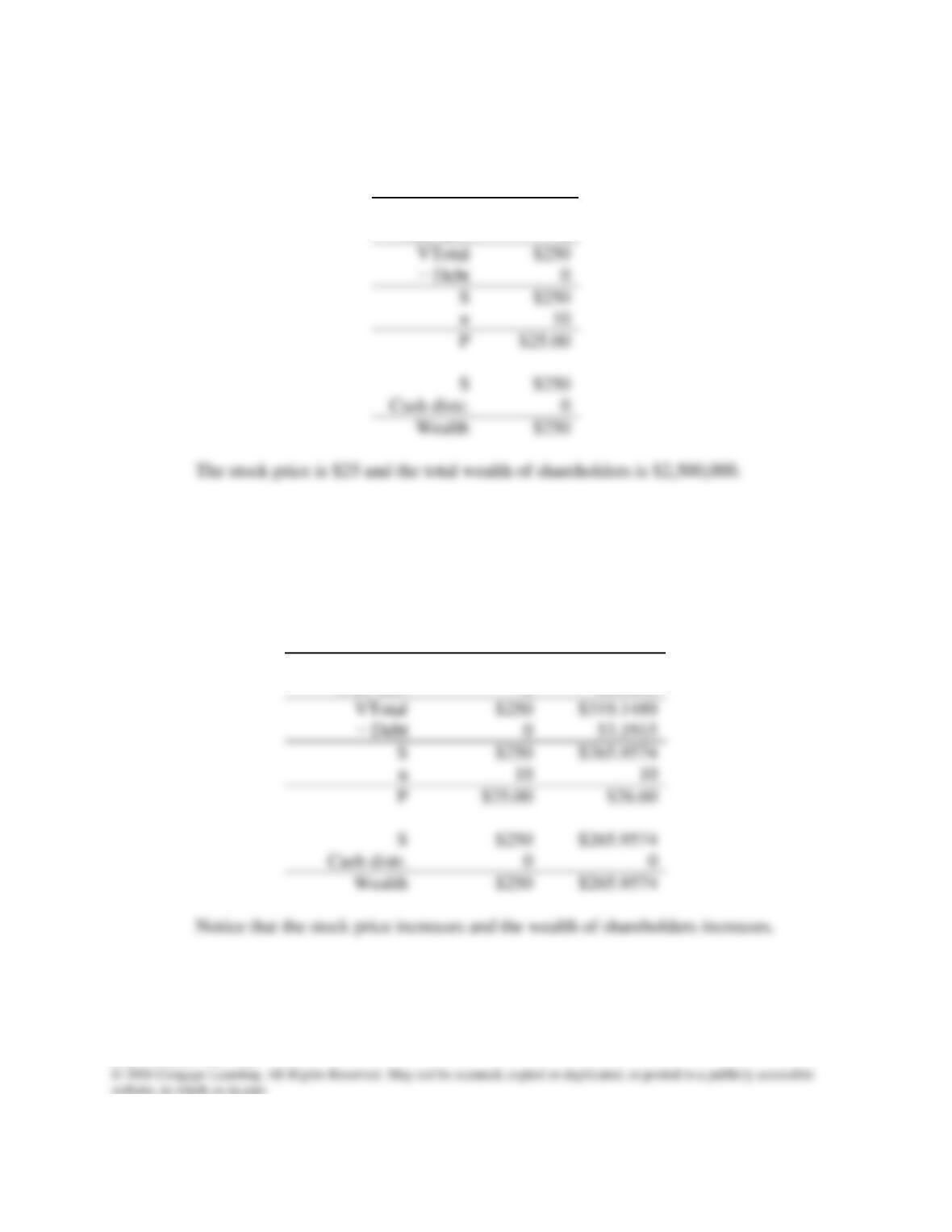
The situation before the recap is:
Before
Debt
Vop
$250
+ ST Inv.
0
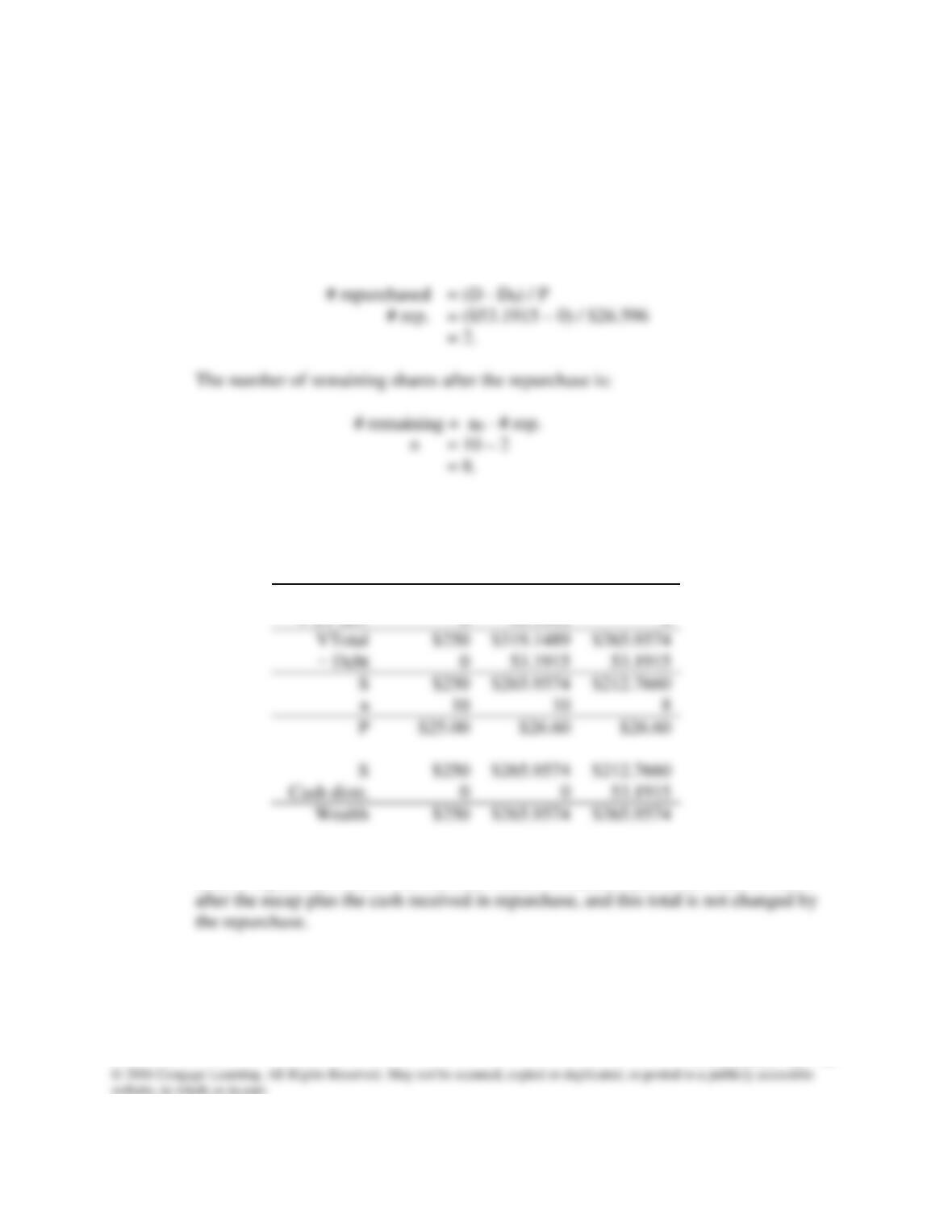
Now consider the situation if the firm moves to a capital structure with wd = 20% by
issuing $53.1915 in debt but has not yet repurchased equity. The firm’s value of
operations increases because its WACC decreases. The firm also temporarily has
$531,915 in short-term investments.
Before Debt
After Debt,
Before Rep.
Vop
$250
$265.9574
+ ST Inv.
0
53.1915
VTotal
$250
$319.1489
0
53.1915
$250
$265.9574
$250
$265.9574
$250
$265.9574
Mini Case: 16 – 24
$250
0
$250
$250
0
$250
The repurchase itself will not change the stock price. If investors thought that the
repurchase would increase the stock price, they would all purchase stock the day
before, which would drive up its price. If investors thought that the repurchase would
decrease the stock price, they would all sell short the stock the day before, which
would drive down the stock price.
The number of shares repurchased is:
Before
Debt
After
Debt,
Before
Rep.
After Rep.
Vop
$250
$265.9574
$265.9574
$250
$319.1489
$265.9574
$250
$265.9574
$212.7660
$250
$265.9574
$212.7660
$250
$265.9574
$265.9574
Notice that the value of the equity declines as more debt is issued, because debt is
used to repurchase stock. But the total wealth of shareholders is the value of stock
Mini Case: 16 – 25
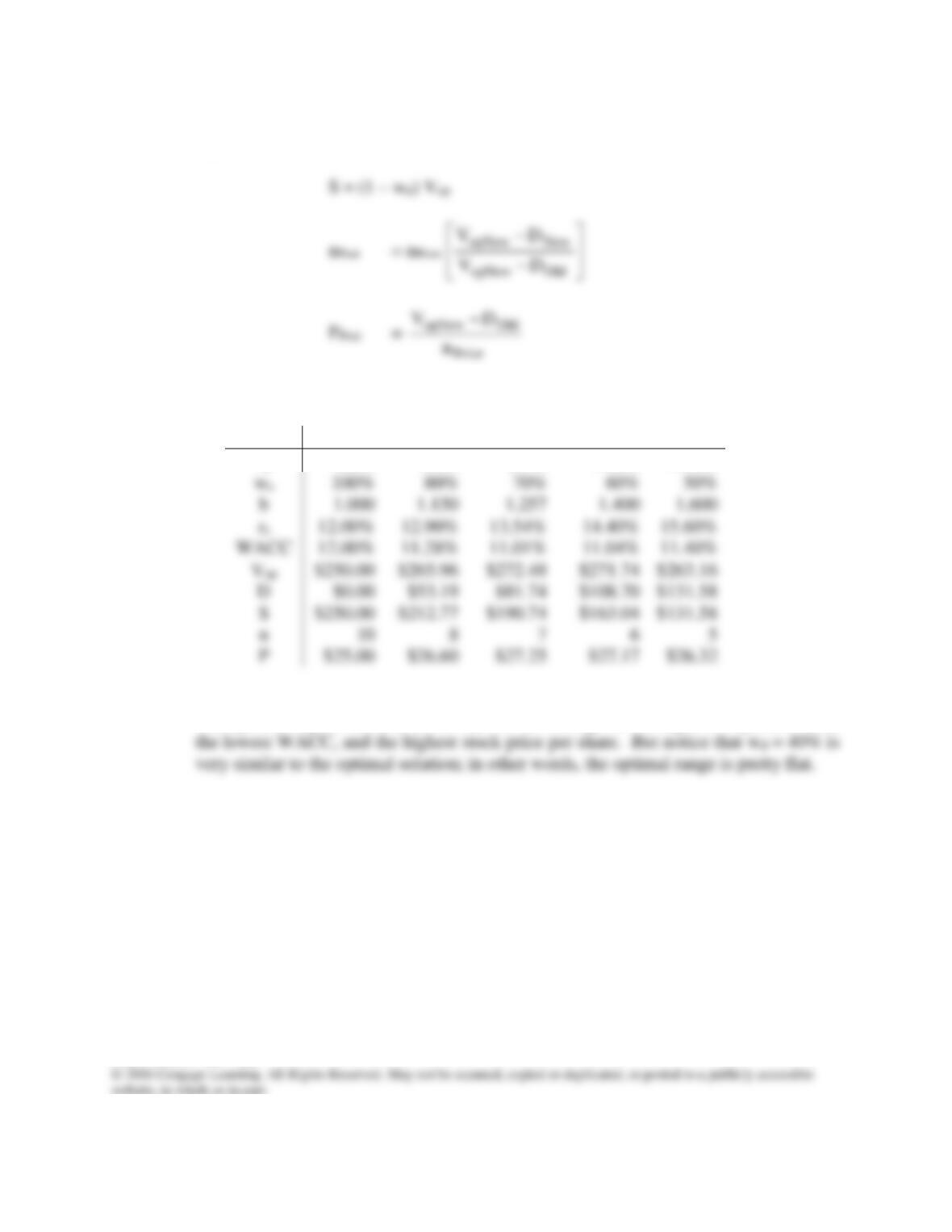
There are some shortcuts we can take to find the values of S, P, and n after the
repurchase:
We apply these relationships for each possible capital structure:
wd
0%
20%
30%
40%
50%
rd
0.0%
8.0%
8.5%
10.0%
12.0%
ws
80%
70%
60%
50%
b
1.150
S
n
P
$25.00
$27.17
The optimal capital structure is for wd = 30%. This gives the highest corporate value,
Mini Case: 16 – 26