Chapter 16 Cash Conversion, Inventory, and Receivables
Management
Chapter Overview
The Opening Focus discusses Apple’s cash management. For three years in a row, Apple
has been named the top cash conversion firm in the world – even higher than WalMart. They even
had a negative cash conversion cycle of 45 days. What does this mean? It means that Apple took
Opening Focus Discussion Question:
1. If a firm has a lot of cash compared to industry and historical benchmarks, why might they not
return it to the owners of the firm?
2. If a firm has too little cash, what elements of its business operations are most at risk?
This chapter looks at:
16.1 The Cash Conversion Cycle
16.2 Cost Trade-offs in Short-Term Financial Management
Technology
1. Smart Practices Video. Vern LoForti, chief financial office for Overland Storage talks about
the importance of working capital management.
2. Smart Practices Video. Jackie Sturm, director of finance for Technology and Manufacturing
4. Smart Concepts. A step-by-step explanation of the trade off between short-term marginal
costs and benefits of increasing account balances.
6. Smart Practices Video. Jon Olson, vice president of finance for Intel Corp. notes the im-
portance of cash to Intel, and therefore the importance of having good collections processes in
442 Instructor’s Manual
7. Smart Excel. A step-by-step solution for Problem 16-3, concerning a firm’s competing plans
for inventory, collections and payment.
9. Smart Excel. An explanation of Problem P16-16, concerning contribution margin, accounts
receivable investment and bad debt expense.
Lecture Guide
A firm can greatly improve its financial picture through efficient management of its working capi-
tal, including cash, accounts receivable, and inventory.
16-1 The Cash Conversion Cycle
The impact of the cash conversion cycle on a firm varies widely across industries and often is
16-1a Operating Cycle
A firm can, however, do its best to manage its cash conversion cycle through turning inventory
over as quickly as possible, collect accounts receivable as quickly as possible, pay accounts paya-
16-1b Cash Conversion Cycle
The time between the when the firm pays for the materials and the point where it receives
Chapter 16 Cash Conversion, Inventory, and Receivables Management 443
16-1c Shortening the Cash Conversion Cycle
In order to maximize shareholder value, the financial manager should manage assets in
16-2 Cost Trade-Offs in Working Capital Accounts
Whenever there is a trade-off – a competing cost and benefit – an optimum quantity can be
Fig 16-2 Trade-Offs In Short-Term Financial Costs
The optimum account balance is at the least cost point on the total cost curve. Short-term
16-3 Inventory Management
Inventory is considered one of the most important assets. And the tracking of inventory is
16-3a Investing in Inventory
16-3b Techniques for Controlling Inventory
• ABC System
o The ABC system is a way to classify costs and then pay the most attention to the
• EOQ Model
o The economic order quantity, a topic often covered in operations management as
444 Instructor’s Manual
• Safety Stock and Reorder Points
o When a firm orders more of an inventory item, it generally will take time for that
item to arrive in the company’s warehouse. When the firm knows how many units
• Material Requirements Planning
o This section details another system discussed in the text, material requirements
• Just-in-Time System
o This section discusses the just in time system or JIT. Under JIT, inventory is
brought into use upon customer demand.
16-4 Accounts Receivable Standards and Terms
This section can be related to earlier financial statement analysis and ratio analysis chap-
16-4a Effective Accounts Receivable Management
16-4b Credit Standards
• Granting Credit to Customers
o Examining the benefits and costs of implementing a credit policy should be done
prior to issuing any type of credit. The type of product can affect the choice of
credit and running credit histories on the customers.
• Student Involvement:
o Ask students how the five Cs can be quantified. What ratios can apply to each
Chapter 16 Cash Conversion, Inventory, and Receivables Management 445
therefore not worth as much in a fire sale in the event of bankruptcy? Or,
would the assets be transferable to another firm at close to full price?
o These sections give an example of credit scoring – applying objective stand-
Table 16.2 Consumer Credit Application Credit Score by WEG Oil
Table 16.3 WEG Oil’s Credit Standards
• Changing Credit Standards
o The next section looks at what goes into a company’s choice concerning its
average collection period. What are the firm’s policies? How thoroughly does
it investigate its customers’ credit standing? How efficient is the billing and
collection department? How well does the firm follow up overdue accounts?
• Example: Effects of Changes in Credit Standards for YMC
o In particular, a firm must be concerned about the impact of a change in credit
o Costs of Investing in AR : These sections work through an example of the costs of
16-4c Credit Terms
Credit terms are terms of sale for customers. For example, terms of net 30 mean that the
Table 16.4 Analysis of Offering a Cash Discount at Masson Industries
446 Instructor’s Manual
16-5 Collecting, Monitoring, and Applying Cash to Receivables
16-5a Collection Policy
A firm must set its collection policy before any other action can be made. This policy is
16-5b Credit Monitoring
Once a process is in place, it should be regularly evaluated. Credit monitoring can be tied to
the previous chapter, which talks about preparing a cash budget. If the collections policy changes,
Table 16.5 Sample Aging Schedule for Accounts Receivable
16-5c Cash Application
Cash application is the process through which a customer’s payment is posted to its ac-
Cash Conversion, Inventory and Receivables Management Summary
This section summarizes the marginal costs and benefits of managing cash, accounts re-
ceivable, inventory and accounts payable.
Answers to Concept Review Questions
1. The firm’s cash conversion cycle represents how quickly a firm turns its product, from paying
for inventory to collecting cash from the customer in payment for finished goods. The financial
2. In order to reduce the length of its cash conversion cycle, the firm should have the least amount
3. There are costs associated with holding too much and too little of each current asset and liabil-
ity. For example, if a firm has a liberal credit policy, it will attract more customers, resulting in
Chapter 16 Cash Conversion, Inventory, and Receivables Management 447
4. A firm with a great deal of short-term financing will have reduced liquidity, but will also have
lower costs, since short-term debt is generally less expensive than long-term debt or equity fi-
5. There are potential conflicts between the finance function view of inventory and that of mar-
keting and production. The financial manager wants to minimize inventory. Funds that are not
tied up in inventory can be used for positive net present value investment. The production func-
6. In the ABC system, inventory is divided into three groups. A items are those in which the firm
has the largest investment and therefore the most intensive control. B items require the next
largest investment and less intensive control than the A items, and C items require the smallest
7. The EOQ model assumes perfect coordination between supplier and user. In reality, the firm
may not be able to predict the exact time a new order will arrive. In order to ensure that pro-
duction runs smoothly, the firm may want to hold safety stocks, extra inventory that takes into
account the probability of shipment delays and faster-than-average usage. The reorder point is
8. A firm’s credit terms typically conform to those of its industry. If they did not, then customers
would be more likely to patronize competitors with more liberal credit policies. The firm can,
9. The five Cs of credit are used to perform in-depth credit analysis but don’t provide a specific
accept or reject decision. Applying the five C’s requires an analyst experienced in reviewing
448 Instructor’s Manual
10. Credit scoring applies statistically derived weights for key financial and credit characteristics to
11. When considering changing credit standards, the firm must look at what impact a change
would have on sales, costs and overall cash flows. A restrictive credit policy could cost the
12. We use only variable costs of sales when estimating the average investment in accounts receiv-
able because the model assumes an increase in sales will not cause fixed costs to increase.
13. Credit terms include when the customer must pay and if the customer receives discounts for
paying before the bill is due. Credit terms are influenced by the nature of the business. For ex-
14. Collection policy refers to the procedures used by a company to collect overdue accounts re-
ceivable. A firm may start with a reminder, form letter, phone call, or visit to encourage cus-
15. A firm should actively monitor accounts receivable to ensure that customers are paying in a
timely manner. For example, are customers complying with the firm’s credit terms or are they
taking longer to pay than the company’s policies allow? At some point the firm may need to
Solutions to Self-Test Problems
ST16-1. Aztec Products wishes to evaluate its cash conversion cycle (CCC). Research by one of the
firm’s financial analysts indicates that on average the firm holds items in inventory for 65
Chapter 16 Cash Conversion, Inventory, and Receivables Management 449
days, pays its suppliers 35 days after purchase, and collects its receivables after 55 days.
The firm’s annual sales (all on credit) are about $2.1 billion, its cost of goods sold repre-
sent about 67% of sales, and purchases represent about 40% of cost of goods sold. Assume
a 365–day year.
a. What is Aztec Products’ operating cycle (OC) and cash conversion (CCC)?
b. How many dollars of resources does Aztec have invested in (1) inventory, (2) ac-
counts receivable, (3) accounts payable, and (4) the total CCC?
c. If Aztec could shorten its cash conversion cycle by reducing its inventory holding
period by 5 days, what effect would it have on its total resource investment found in
part b(4)?
d. If Aztec could shorten its CCC by 5 days, would it be best to reduce the inventory
holding period, reduce the receivable collection period, or extend the accounts paya-
ble period? Why?
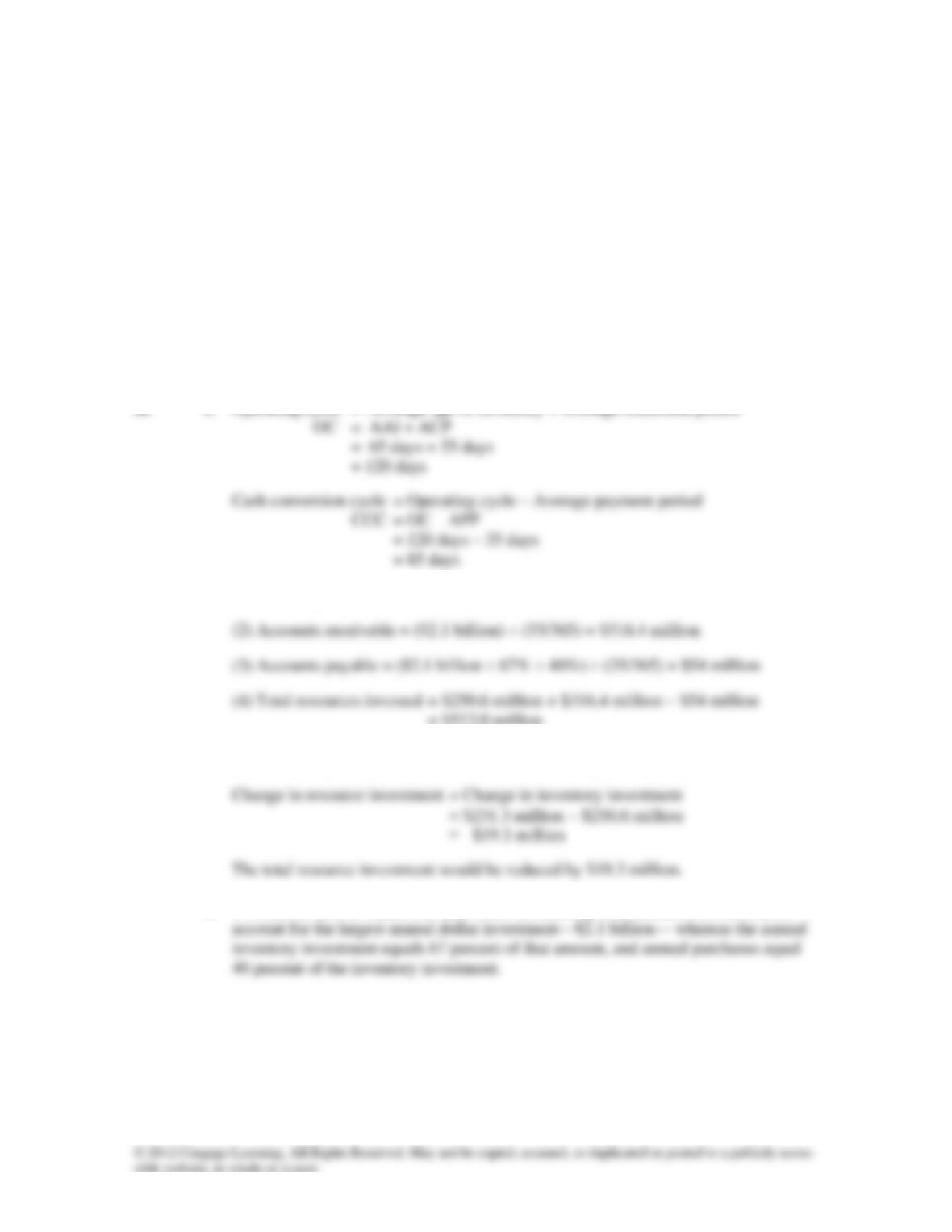
A: a. Operating cycle = Average age of inventory + Average collection period
b. (1) Inventory = ($2.1 billion x 67%) (65/365) = $250.6 million
= $513.0 million
c. New inventory investment = ($2.1 billion 67%) [(65 – 5)/365] = $231.3 million
d. It would be best to reduce the receivable collection period because the receivables
ST16-2. Vargas enterprises wishes to determine the economic order quantity (EOQ) for a critical
and expensive inventory item that is used in large amounts at a relatively constant rate
throughout the year. The firm uses 450,000 units of the item annually, has order costs of
$375 per order, and its carrying costs associated with this item are $28 per unit per year.
The firm plans to hold safety stock of the item equal to 5 days of usage, and it estimates
that it takes 12 days to receive an order of the item once placed. Assume a 365-day year.
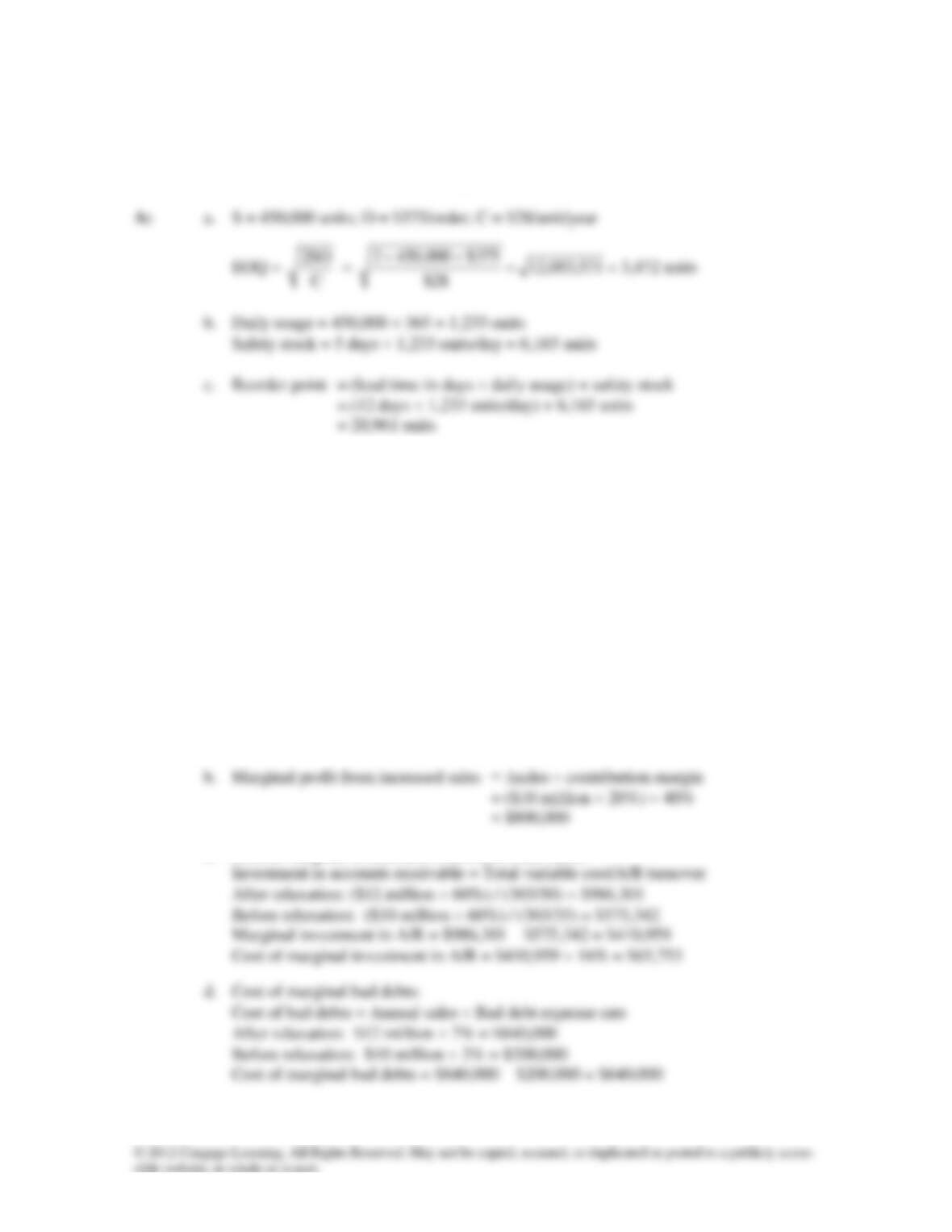
a. Calculate the firm’s EOQ for the item of inventory described above.
450 Instructor’s Manual
b. How many units of safety stock should Vargas hold?
c. What is the firm’s reorder point for the item of inventory being evaluated?
(Hint: Be sure to include the safety stock.)
ST16-3. Belton Company is considering relaxing its credit standards to boost its currently sagging
sales. It expects its proposed relaxation will increase sales by 20% from the current an-
nual level of $10 million. The firm’s average collection period is expected to increase
from 35 days to 50 days and bad debts are expected to increase from 2% of sales to 7%
of sales as a result of relaxing the firm’s credit standards as proposed. The firm’s variable
costs equal 60% of sales and their fixed costs total $2.5 million per year. Belton’s oppor-
tunity cost is 16%. Assume a 365-day year.
a. What is Belton’s contribution margin?
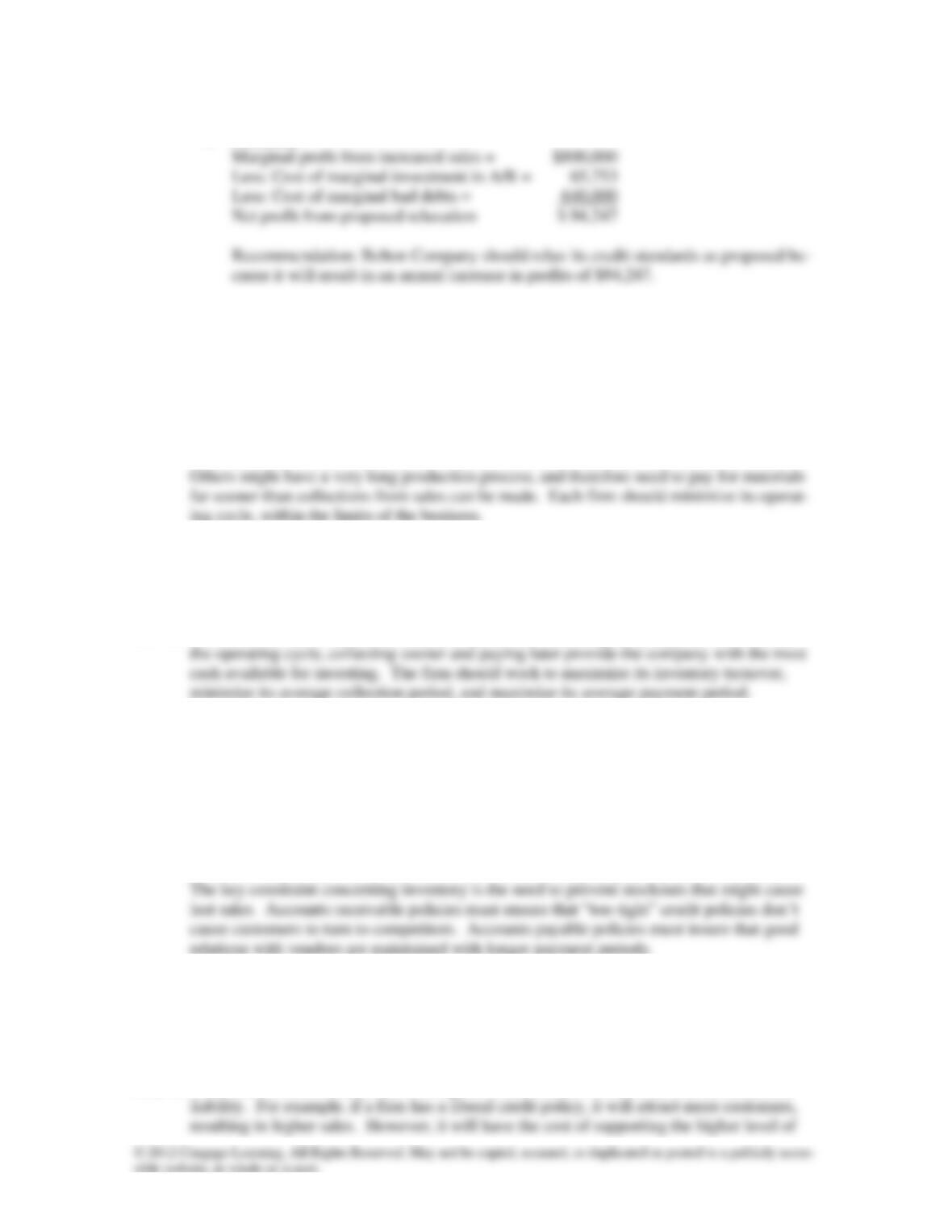
b. Calculate Belton’s marginal profit from increased sales.
c. What is Belton’s cost of the marginal investment in accounts receivable?
d. What is Belton’s cost of marginal bad debts?
e. Use your findings in parts (b), (c), and (d) to determine the net profit (cost) of Bel-
ton’s proposed relaxation of credit standards. Should they relax credit standards?
A: a. Contribution margin = 1.00 – variable cost percentage = 1.00 – 0.60 = 0.40 = 40%
c. Cost of marginal investment in accounts receivable:
Chapter 16 Cash Conversion, Inventory, and Receivables Management 451
e. Summary:
Answers to End-of-Chapter Questions
Q16-1. If you randomly chose a sample of firms and then calculated the operating cycle (OC) of
each firm, what is likely to be the key cause of differences in their operating cycles? What
goal should these firms attempt to achieve with regard to their OCs? How and why?
A16-1. The key cause of differences in operating cycles is the nature of the firm’s business. Some
firms have most of their sales in cash and therefore have minimal accounts receivable.
Q16-2. Why would a firm wish to minimize its cash conversion cycle (CCC) even though each of
its components is important to the operation of the business? What key actions should the
firm pursue to achieve this objective?
A16-2. A firm wishes to convert raw material expense into cash as quickly as possible. As with
Q16-3. Describe the impact that aggressive action aimed at minimizing a firm’s cash conversion
cycle (CCC) would have on the following financial ratios: inventory turnover, average col-
lection period, and average payment period. What are the key constraints on aggressive
pursuit of these strategies with regard to inventory, accounts receivable, and accounts pay-
able?
A16-3. If a firm aggressively minimized its cash conversion cycle, its inventory turnover will in-
crease, average collection period will decrease and average payment period will increase.
Q16-4. What are some of the principal cost trade-offs that the financial manager must focus on
when attempting to manage short-term accounts in a manner that minimizes cash? Prepare
a graph describing the general nature of these cost trade-offs and the optimal level of total
cost.
A16-4. There are costs associated with holding too much and too little of each current asset and
452 Instructor’s Manual
Q16-5. Assume that the financial manager is considering stretching the firm’s accounts payable by
paying its vendors at a later date. What are the key cost trade-offs that would be involved
when making this stretching decision? How would you quantitatively model this decision?
A16-5. If a firm stretches its payments to vendors, it may anger its suppliers and potentially have
Q16-6. What is the primary goal of the financial manager with regard to inventory management?
How does this goal compare to the inventory goals of production and marketing?
A16-6. The financial manager’s goal is to move inventory quickly, which will minimize its in-
Q16-7. What trade-off confronts the financial manager with regard to inventory turnover, inventory
cost, and stockouts? In what way is inventory viewed as an investment?
A16-7. The faster the inventory turnover, the less dollar investment needed. Inventory turnover
refers to the number of times the firm fills up and then empties its warehouse. Inventory
Q16-8. Why is it important for the financial manager to understand the inventory control tech-
niques used by production/operations managers? How does controlling inventory impact a
firm’s profitability?
A16-8. Funds tied up in inventory investment have an opportunity cost. These funds could be in-
vested profitably elsewhere if inventory investment were not needed. The financial man-
Q16-9. What role does the ABC system play in inventory control? What group of inventory items
does the EOQ model focus on controlling? Describe the objective and cost trade-off ad-
dressed by the EOQ model.
A16-9. Funds tied up in inventory investment have an opportunity cost. These funds could be in-
Chapter 16 Cash Conversion, Inventory, and Receivables Management 453
Q16-10.Why would a firm extend credit to its customers given that such an action would lengthen
its cash conversion cycle? What key cost trade-offs would be involved in this decision?
What typically dictates the actual credit terms the firm extends to its customers?
A16-10. A firm might extend credit in order to obtain higher sales. The manager must balance
the higher sales and profits against higher costs of holding more accounts receivable and
Q16-11. Why is using the five C’s of credit the appropriate credit selection procedure for high-
dollar credit requests but not appropriate for high-volume–low-dollar requests, such as
department store credit cards?
A16-11. The five Cs are more appropriate for high dollar clients because applying them requires
Q16-12. What is credit scoring? In what types of situations is it most useful? If you were devel-
oping a credit scoring model, what factors might be most useful in predicting whether or
not a credit customer would pay in a timely manner?
A16-12. Credit scoring applies statistically derived weights for key financial and credit character-
istics to predict whether a potential customer will pay in a timely manner. The score
Q16-13. What are the key variables to consider when evaluating potential changes in a firm’s
credit standards? Why are only variable costs of sales included when estimating the
firm’s average investment in accounts receivable?
A16-13. When considering changing credit standards, the firm must look at what impact a change
would have on sales, costs and overall cash flows. A restrictive credit policy could cost
Q16-14. For a firm contemplating an increase in the cash discount it offers credit customers for
early payment, what key variables should be considered when quantitatively analyzing
this decision? How do the variables used in this analysis differ from those considered
when analyzing a potential change in the firm’s credit standards?
454 Instructor’s Manual
A16-14. If a firm is considering increasing its cash discount, it must look at its own cost of financ-
ing. It is in essence providing financing to its customers. If it can obtain its own financ-
Q16-15. What is credit monitoring? How can each of the following techniques be used to monitor
accounts receivable? What are their attributes?
a. Average collection period
b. Aging of accounts receivable
c. Payment-pattern monitoring
A16-15. Credit monitoring involves the ongoing review of a firm’s accounts receivable to deter-
mine if customers are paying according to the stated credit terms. If customers are not
Solutions to End-of-Chapter Problems
The Cash Conversion Cycle
P16-1. Canadian Products is concerned about managing its operating assets and liabilities effi-
ciently. Inventories have an average age of 110 days, and accounts receivable have an av-
erage age of 50 days. Accounts payable are paid approximately 40 days after they arise.
The firm has annual sales of $36 million, its cost of goods sold represents 75% of sales,
and its purchases represent 70% of cost of goods sold. Assume a 365-day year.
a. Calculate the firm’s operating cycle (OC).
b. Calculate the firm’s cash conversion cycle (CCC).
c. Calculate the amount of total resources Canadian Products has invested in its CCC.
d. Discuss how management might be able to reduce the amount of total resources invest-
ed in the CCC.
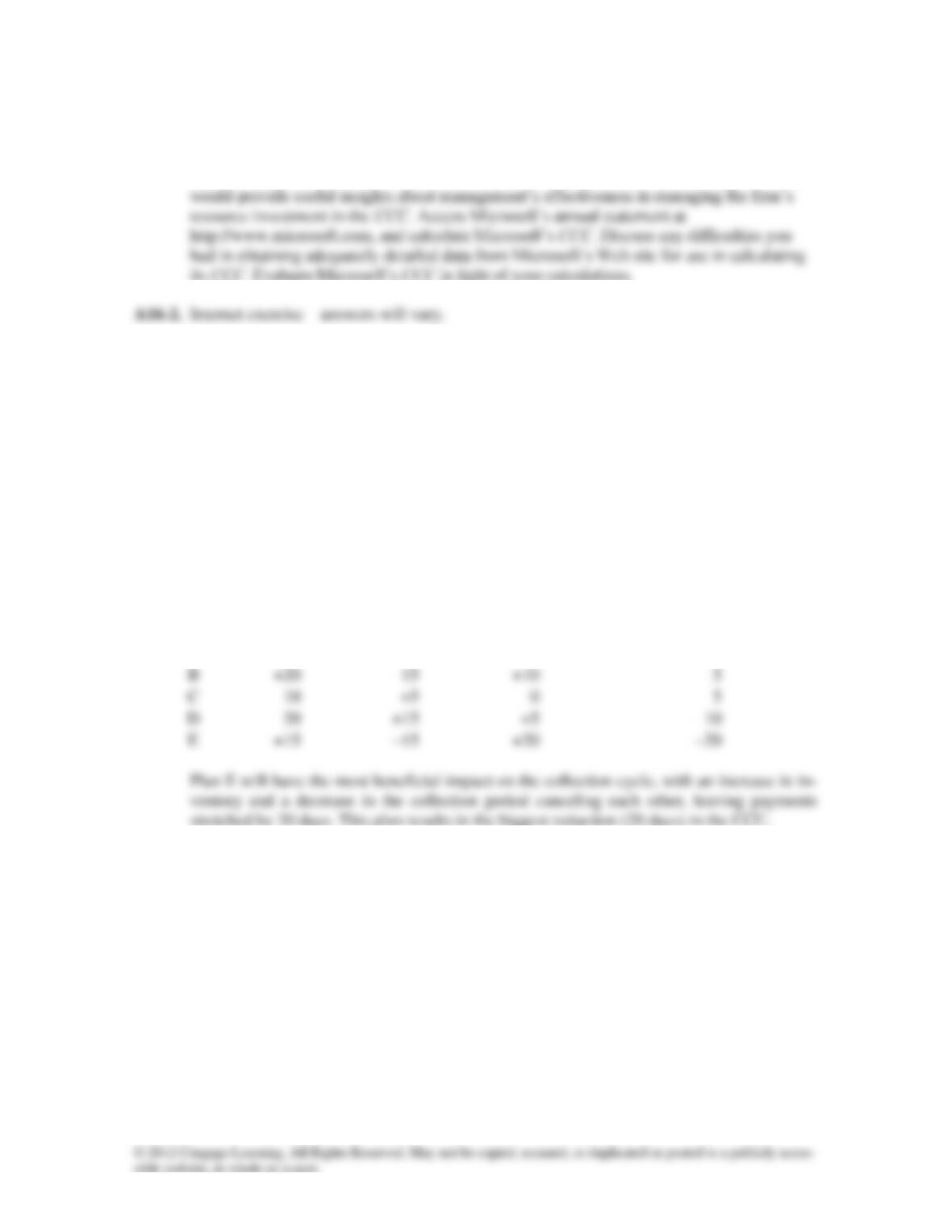
A16-1. a. The firm’s operating cycle is the sum of its average age of inventory (AAI) and aver-
age collection period (ACP) = 110 days + 50 days = 160 days
Chapter 16 Cash Conversion, Inventory, and Receivables Management 455
P16-2. The cash conversion cycle is an important tool for the financial manager in managing the
day-to-day operations of the firm. As an investor, knowing how the firm manages its CCC
P16-3. A firm is weighing five plans that affect several current accounts. Given the five plans and
their probable effects on inventory, receivables, and payables (as shown in the following
table), which plan would you favor? Explain.
Change
Plan
Average Age of
Inventory (days)
Average Collection
Period (Days)
Average Pay-
ment Period
(Days)
A
+35
+20
+10
B
+20
−15
+10
C
−10
+5
0
D
−20
+15
+5
E
+15
−15
+20
A16-3.
Plan
Inventory (I)
Collections (C)
Payments (P)
Change in CCC(I+C–P)
A
+35
+20
+10
+45
–10
–20
P16-4. King Manufacturing turns its inventory 9.1 times each year, has an average payment period
of 35 days, and has an average collection period of 60 days. The firm’s annual sales are
$72 million, its cost of goods sold represents 50% of sales, and its purchases represent 80%
of cost of goods sold. Assume a 365-day year.
a. Calculate the firm’s operating cycle (OC) and cash conversion cycle (CCC).
b. Calculate the firm’s total resources invested in its CCC.
c. Assuming that the firm pays 14% to finance its resource investment in its CCC, how
much would it save annually by reducing its CCC by 20 days if this reduction were
achieved by shortening the average age of inventory by 10 days, shortening the aver-
age collection period by 5 days, and lengthening the average payment period by 5
days?
d. If the 20-day reduction in the firm’s CCC could be achieved by a 20-day change in on-
ly one of the three components of the CCC, which one would you recommend? Ex-
plain.
456 Instructor’s Manual
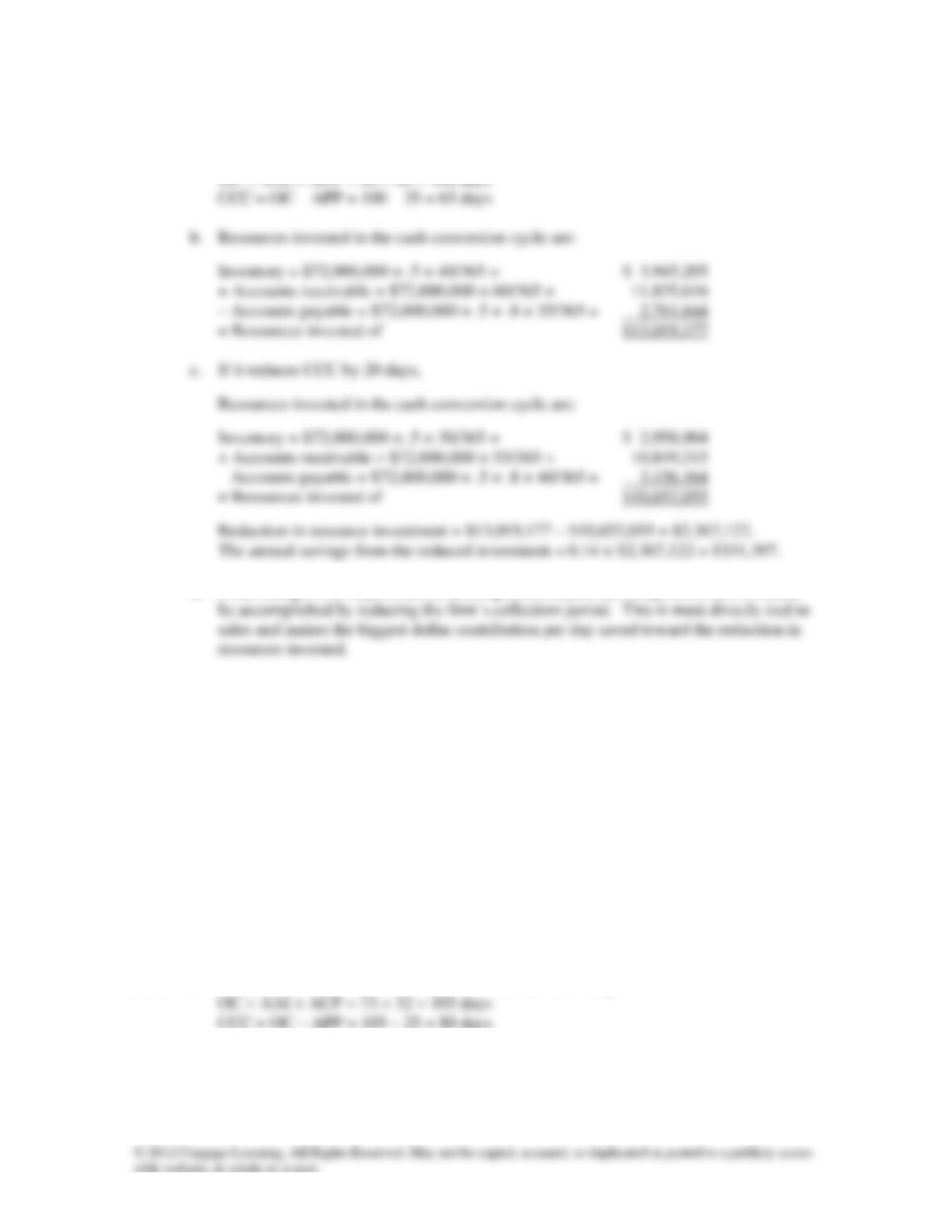
A16-4. a. The firm’s AAI is 365/9.1 = 40 days in inventory on average
d. If the change of 20 days could be accomplished in just one component, then it should
P16-5. Bradbury Corporation turns its inventory five times each year, has an average payment pe-
riod of 25 days, and has an average collection period of 32 days. The firm’s annual sales
are $3.6 billion, its cost of goods sold represents 80% of sales, and its purchases represent
50% of cost of goods sold. Assume a 365-day year.
a. Calculate the firm’s operating cycle (OC) and cash conversion cycle (CCC).
b. Calculate the total resources invested in the firm’s CCC.
c. Assuming that the firm pays 18% to finance its resource investment, how much would
it increase its annual profits by reducing its CCC by 12 days if this reduction were
solely the result of extending its average payment period by 12 days?
d. If part (c)’s reduction in the firm’s CCC could alternatively have been achieved by
shortening either the average age of inventory or the average collection period by 12
days, would you have recommended one of those actions rather than the 12-day exten-
sion of the average payment period specified in part (c)? Which change would you
recommend? Explain.
A16-5. a. The firm’s AAI is 365/5 = 73 days in inventory on average