Chapter 16 Cash Conversion, Inventory, and Receivables Management 457
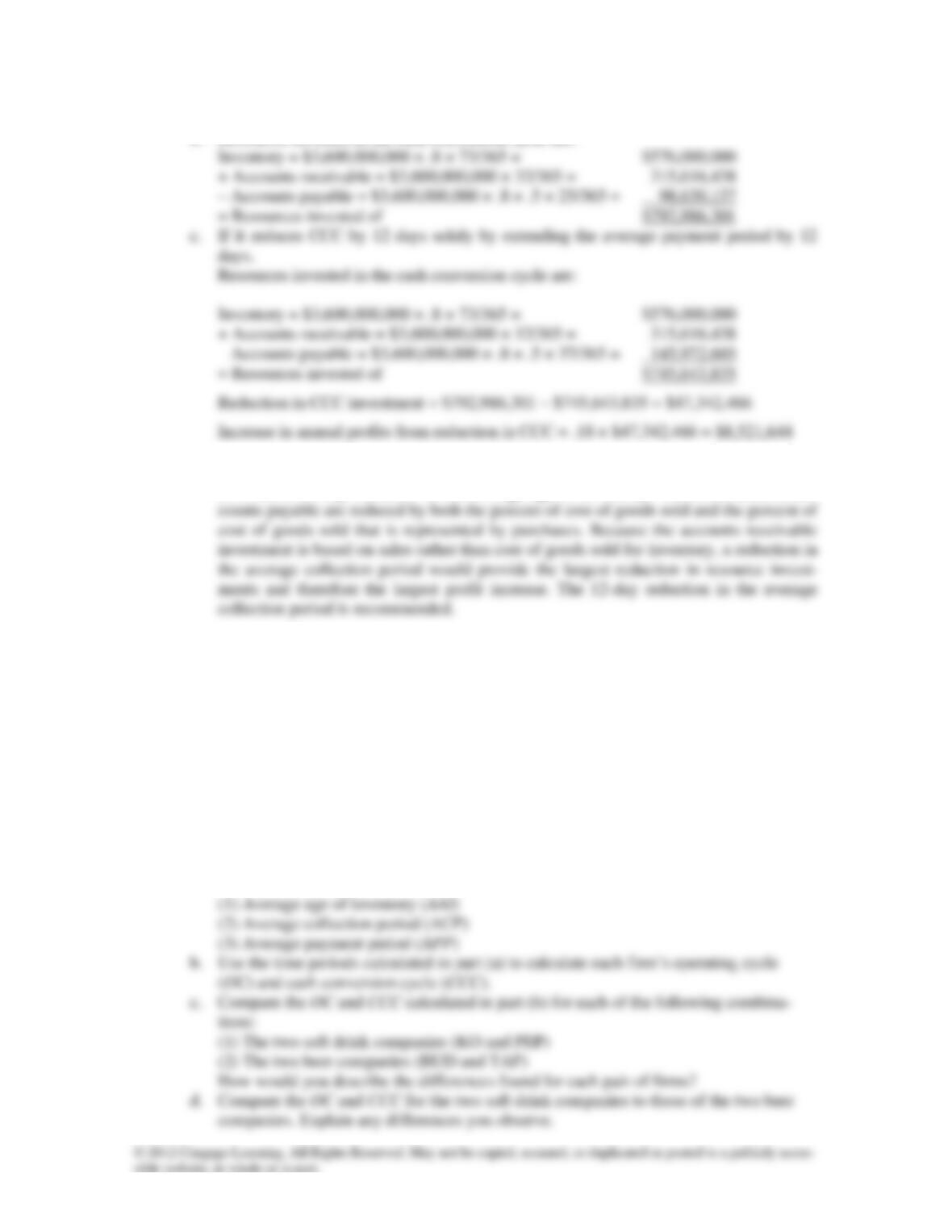
b. Resources invested in the cash conversion cycle are:
d. A 12-day reduction in the average collection period would of have had a bigger impact,
as would a 12-day reduction in the average age of inventory. In the calculation, ac-
P16-6. Go to http://finance.yahoo.com, and input the ticker symbols noted in parentheses follow-
ing each company name below. Under the Financials heading in the left-hand column,
click on “Income Statement” and then “Balance Sheet” to obtain the most recent income
statement and balance sheet for each firm. Use the appropriate financial statement data for
each firm to respond to the following instructions and questions.
Anheuser-Busch Companies, Inc. (BUD)
Coca-Cola Company (KO)
Molson Coors Brewing Company (TAP)
PepsiCo, Inc. (PEP)
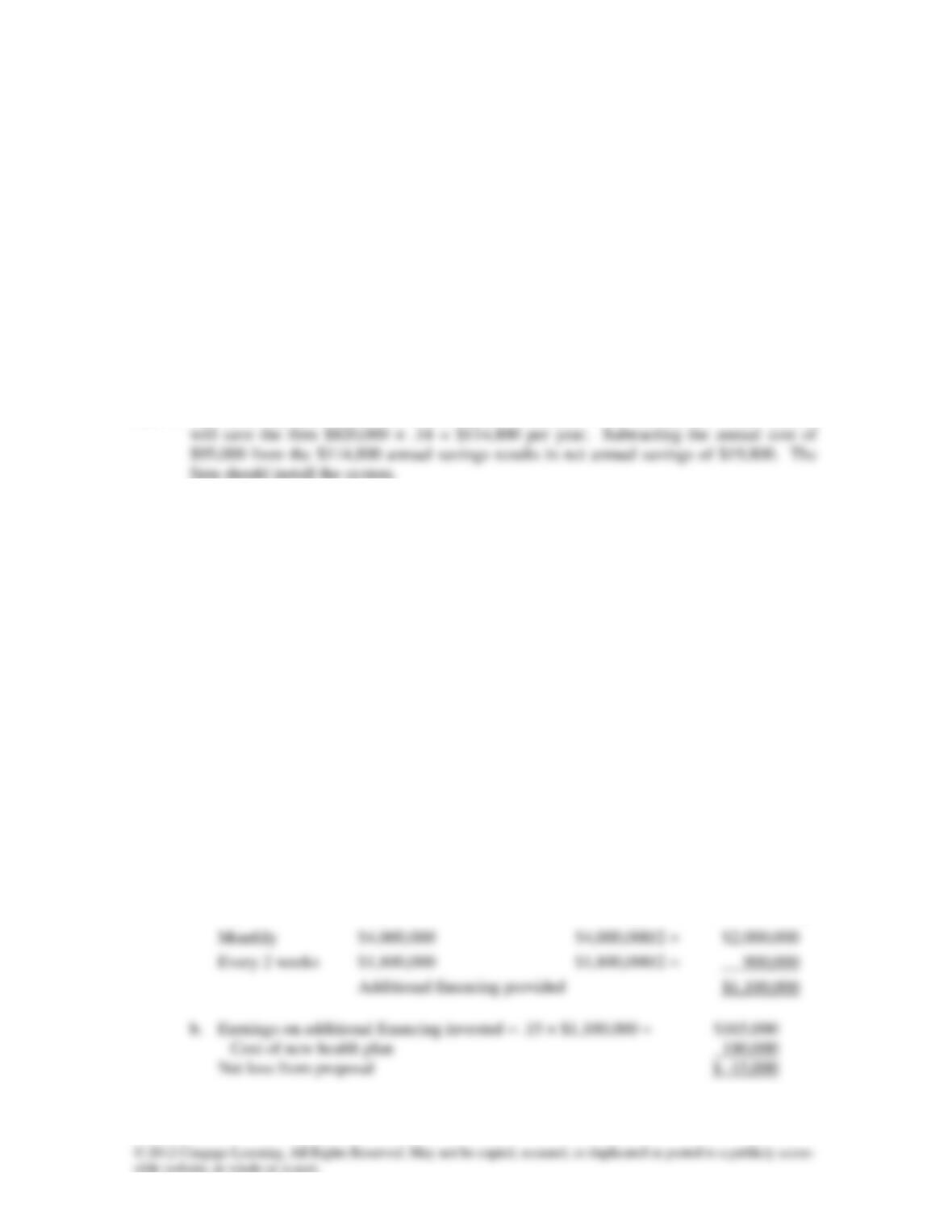
a. Use the formulas given in the chapter to calculate the following time periods (in days)
for each of the firms:
458 Instructor’s Manual
A16-6. Internet exercise – answers will vary.
Cost Trade-Offs in Short-Term Financial Management
P16-7. Geet Industries wants to install a just-in-time (JIT) inventory system in order to significant-
ly reduce its in-process inventories. The annual cost of the system is gauged to be $95,000.
The financial manager estimates that with this system, the firm’s average inventory in-
vestment will decline by 40% from its current level of $2.05 million. All other costs are
expected to be unaffected by this system. The firm can earn 14% per year on equal-risk in-
vestments.
a. What is the annual cost savings expected to result from installation of the proposed JIT
system?
b. Should the firm install the system?
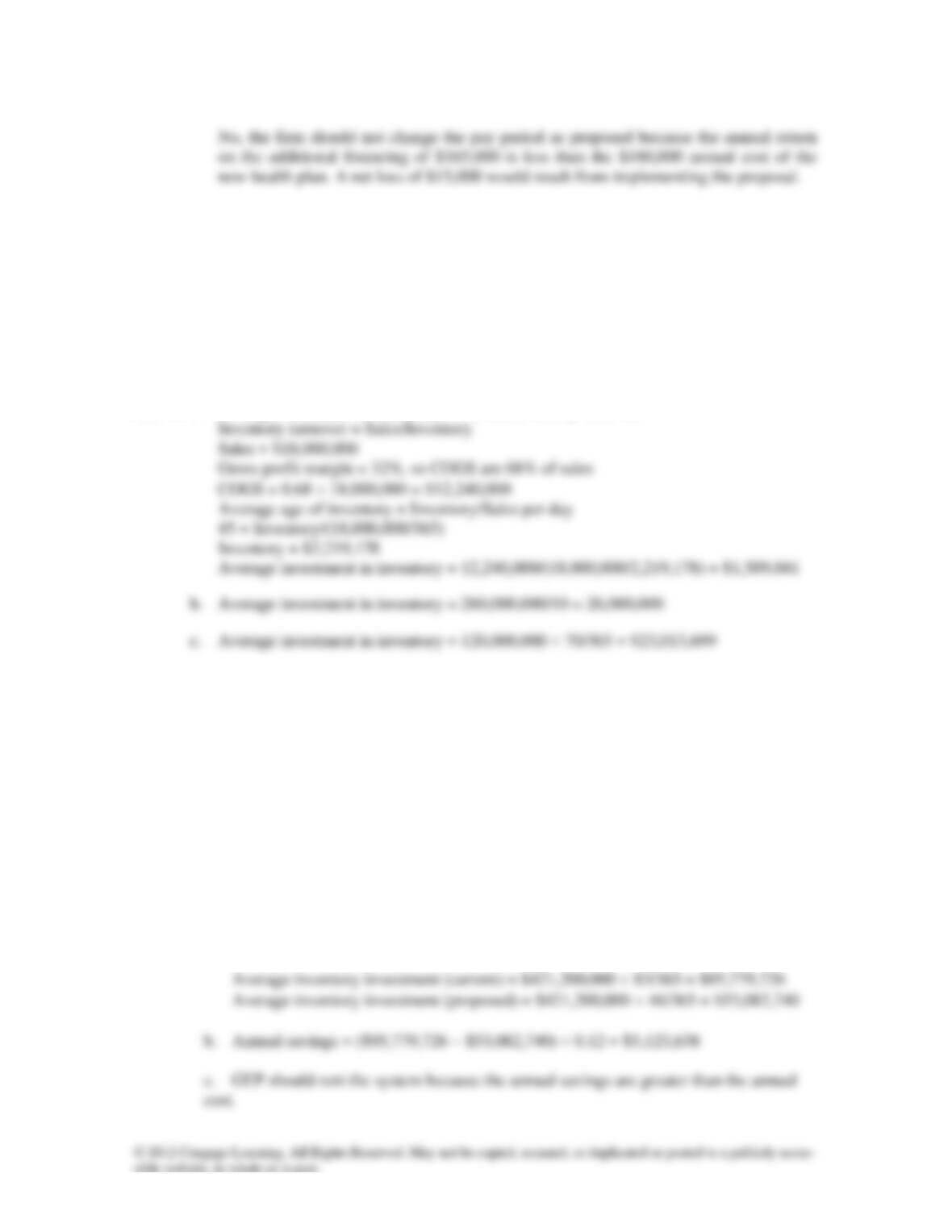
A16-7. The inventory investment will decline by $2.05 million × .40 = $820,000. This decline
P16-8. Sheth and Sons Inc. is considering changing its pay period for its salaried management
from paying salaries every two weeks to paying salaries monthly. The firm’s CFO, Ken
Smart, believes that such action will free up cash that can be used elsewhere in the busi-
ness, which currently faces a cash crunch. In order to avoid a strong negative response
from the salaried managers, the firm will simultaneously announce a new health plan that
will lower managers’ cost contributions without cutting benefits.
Ken’s analysis indicates that the salaried managers’ bimonthly payroll is $1.8 million
and is expected to remain at that level for the foreseeable future. With the bimonthly sys-
tem, there were 2.2 pay periods in a month. Because the managers will be paid monthly,
the monthly payroll will be about $4.0 million (2.2 × $1.8 million). The annual cost to the
firm of the new health plan will be $180,000. Ken believes that because managers’ salaries
accrue at a constant rate over the pay period, the average salaries over the period can be es-
timated by dividing the total amount by 2. The firm believes that it can earn 15% annually
on any funds made available through the accrual of the managers’ salaries.
a. How much additional financing will Sheth and Sons obtain as a result of switching the
pay period for managers’ salaries from every two weeks to monthly?
b. Should the firm implement the proposed change in pay periods?
A16-8. a. The average amounts of financing provided are:
Pay Period
Payroll
Average Amount of Financing
Chapter 16 Cash Conversion, Inventory, and Receivables Management 459
Inventory Management
P16-9. Calculate the average investment in inventory for each of the following situations. Assume
a 365-day year.
a. The firm’s annual sales were $18 million, its gross profit margin was 32%, and its av-
erage age of inventory is 45 days.
b. The firm’s annual sales were $325 million, its cost of goods sold are 80% of sales, and
it turns its inventory 10 times per year.
c. The firm’s annual cost of goods sold total $120 million, and it turns its inventory about
every 70 days.
A16-9. a. Average investment in inventory = COGS/Inventory turnover
P16-10. GEP Manufacturing is mulling over a plan to rent a proprietary inventory control system
at an annual cost of $4.5 million. The firm predicts its sales will remain relatively stable
at $585 million and its gross profit margin will continue to be 28%. GEP expects that as
a result of the new inventory control system, its average age of inventory (AAI) will drop
from its current level of 83 days to about 46 days. The firm’s required return on similar–
risk investments is 12%. Assume a 365-day year.
a. Calculate GEP’s average inventory investment both (1) currently and (2) assuming it
rents the inventory control system.
b. Use your findings in part (a) to determine the annual savings expected to result from
the proposed inventory control system.
c. Based on your finding in part (b), would you recommend that GEP rent the inventory
control system? Explain your recommendation.
A16-10. a. COGS = 1−0.28 = 0.72 of sales
COGS = 0.72 $585,000,000 = $421,200,000
460 Instructor’s Manual
P16-11. Iverson Industries uses 80,000 units of an “A” item of raw material inventory each year.
The firm maintains level production throughout the year, given the steady demand for its
finished products. The raw material order cost is $225 per order and carrying costs are
estimated to be $10.50 per unit per year. The firm wants to maintain a safety stock of 10
days of inventory, and it takes 5 days for the firm to receive an order once it is placed.
Assume a 365-day year.
a. Calculate the economic order quantity (EOQ) for Iverson’s raw material.
b. How large a safety stock (in units) of inventory should the firm maintain?
c. What is Iverson’s reorder point for this item of inventory? (Hint: Be sure to include
the safety stock.)
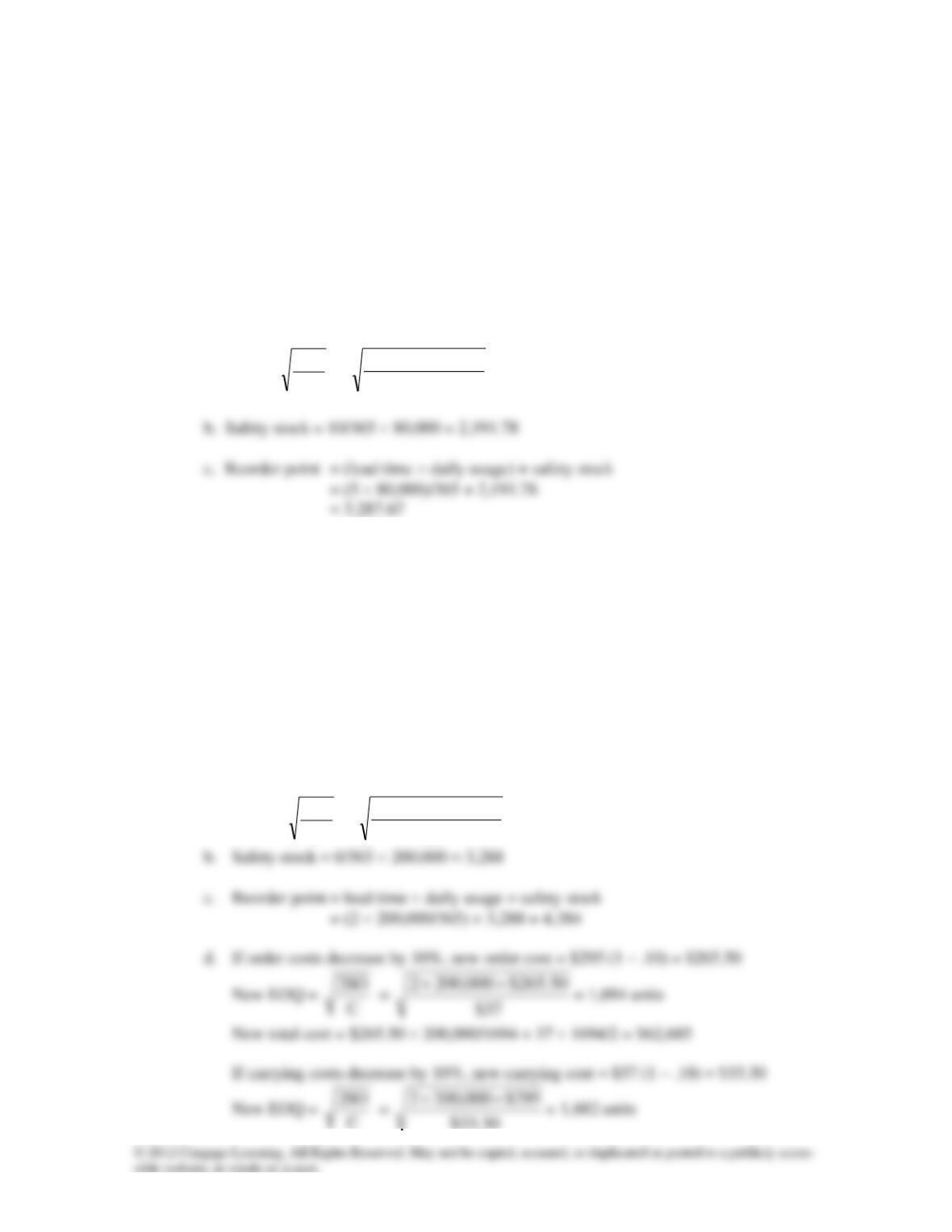
A16-11. a. EOQ =
C
SO2
=
5.10$
225$000,802
= 1,851.64 units
P16-12. Litespeed Products buys 200,000 motors per year from a supplier that can fulfill orders
within two days of receiving them. Litespeed transmits its orders to this supplier elec-
tronically so the lead time to receive orders is two days. Litespeed’s order cost is about
$295 per order and its carrying cost is about $37 per motor per year. The firm maintains
a safety stock of motors equal to six days usage. Assume a 365-day year.
a. What is Litespeed’s economic order quantity (EOQ) for the motors?
b. How large a safety stock (in units) of motors should Litespeed maintain?
c. What is Litespeed’s reorder point for motors? (Hint: Be sure to include the safety
stock.)
d. If Litespeed has an opportunity to reduce either its order cost or its carrying cost by
10%, which of these would result in the lowest total cost at the associated new EOQ?
A16-12. a. EOQ =
C
SO2
=
37$
295$000,2002
= 1,786 units
30.33$
Chapter 16 Cash Conversion, Inventory, and Receivables Management 461
Accounts Receivable Standards and Terms
P16-13. International Oil Company (IOC) uses credit scoring to evaluate gasoline credit card ap-
plications. The following table presents the financial and credit characteristics considered
and weights (indicating the relative importance of each characteristic) used in the credit
decision. The firm’s credit standards are to accept all applicants with credit scores of 80
or higher, to extend limited credit on a probationary basis to applicants with scores high-
er than 70 and lower than 80, and to reject all applicants with scores below 70.
Financial and
Credit Characteristics
Predetermined
Weight
Credit references
.25
Education
.10
Home ownership
.10
Income range
.15
Payment history
.30
Years on job
.10
The firm needs to process three applications that were recently received and scored by
one of its credit analysts. The scores for each of the applicants on each of the financial
and credit characteristics are summarized in the following table.
Financial and
Credit Characteristics
Applicant’s Scores (0-100)
X
Y
Z
Credit references
60
90
80
Education
75
80
80
Home ownership
100
90
60
Income range
70
70
80
Payment history
60
85
70
Years on job
50
60
90
a. Use the data presented to find the credit score for each of the applicants.
b. Recommend the appropriate action that the firm should take for each of the three ap-
plicants.
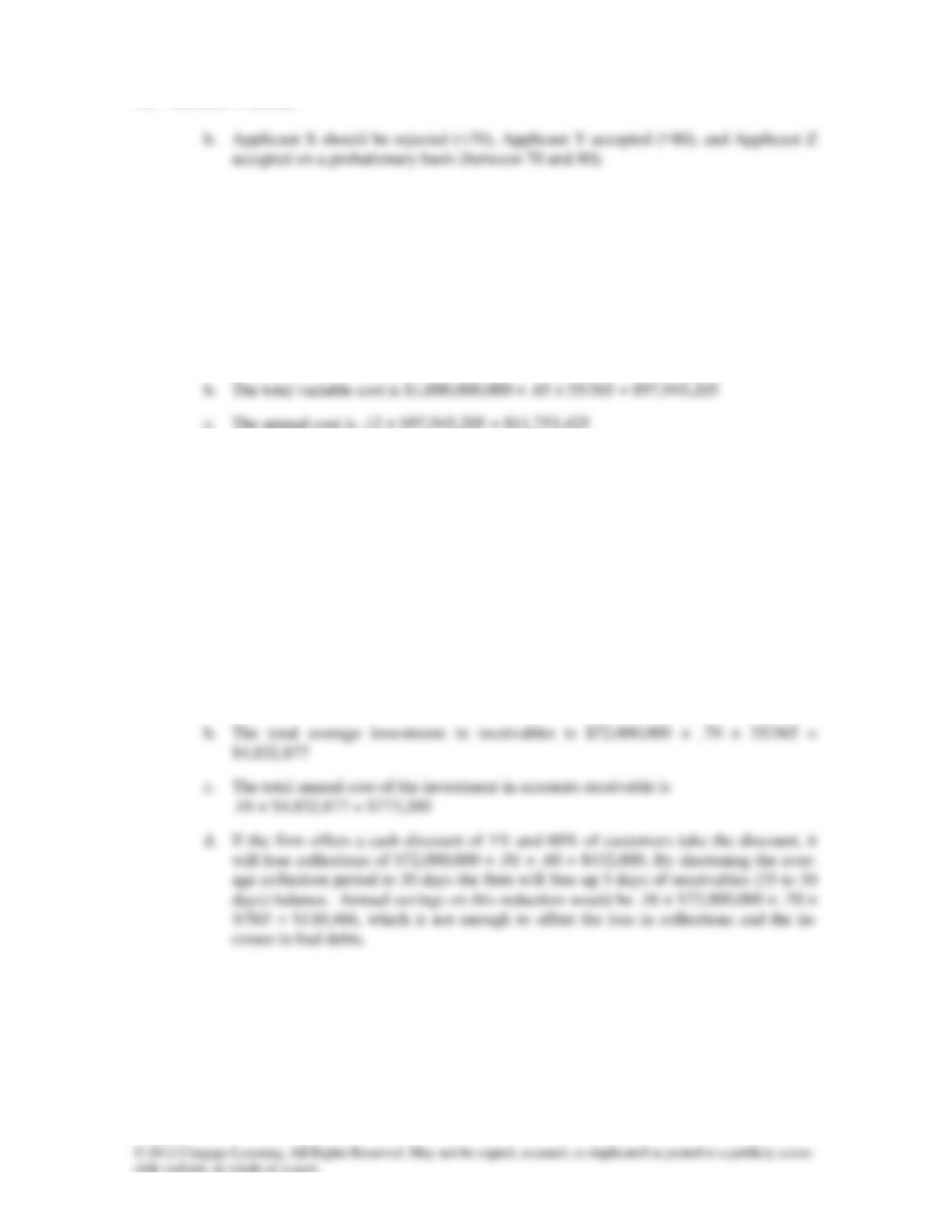
A16-13. a.
Scores
Weighted Scores
Characteristic
X
Y
Z
X
Y
Z
References (.25)
60
90
80
15
22.5
20
Education (.10)
Home (.10)
90
60
10
Income (.15)
History (.30)
Score
462 Instructor’s Manual
P16-14. Barans Company currently has an average collection period of 55 days and annual sales
of $1 billion. Assume a 365-day year.
a. What is the firm’s average accounts receivable balance?
b. If the variable cost of each product is 65% of sales, what is the average investment in
accounts receivable?
c. If the equal-risk opportunity cost of the investment in accounts receivable is 12%,
what is the total annual cost of the resources invested in accounts receivable?
A16-14. a. The firm’s average receivables balance is $1,000,000,000 × 55/365 = $150,684,932.
P16-15. Melton Electronics currently has an average collection period of 35 days and annual
sales of $72 million. Assume a 365-day year.
a. What is the firm’s average accounts receivable balance?
b. If the variable cost of each product is 70% of sales, what is the firm’s average in-
vestment in accounts receivable?
c. If the equal-risk opportunity cost of the investment in accounts receivable is 16%,
what is the total annual cost of the resources invested in accounts receivable?
d. Suppose that Melton can shorten the average collection period to 30 days by offering
a cash discount of 1% for early payment, and 60% of the customers take this dis-
count. Should the firm offer this discount? Assume that its cost of bad debts will rise
by $150,000 per year.
A16-15. a. The firm’s average receivables balance is $72,000,000 × 35/365 = $6,904,110
P16-16. Davis Manufacturing Industries (DMI) produces and sells 20,000 units of a machine tool
each year. All sales are on credit, and DMI charges all customers $500 per unit. Variable
costs are $350 per unit, and the firm incurs $2 million in fixed costs each year.
DMI’s top managers are evaluating a proposal from the firm’s CFO that the firm
relax its credit standards to increase its sales and profits. The CFO believes this change
will increase unit sales by 4%. Currently, DMI’s average collection period is 40 days,
and the CFO expects this to increase to 60 days under the new policy. Bad debt expense
is also expected to increase from 1 to 2.5% of annual sales. The firm’s board of directors
Chapter 16 Cash Conversion, Inventory, and Receivables Management 463
has set a required return of 15% on investments with this level of risk. Assume a 365-day
year.
a. What is DMI’s contribution margin? By how much will profits from increased sales
change if DMI adopts the new credit standards?
b. Under the current credit standards, what is DMI’s average investment in accounts
receivable? What would it be under the proposed credit standards? What is the cost
of this additional investment?
c. What is DMI’s cost of marginal bad debts resulting from the relaxation of its credit
standards?
d. What is DMI’s net profit (or loss) from adopting the new credit standards? Should
DMI relax its credit standards?
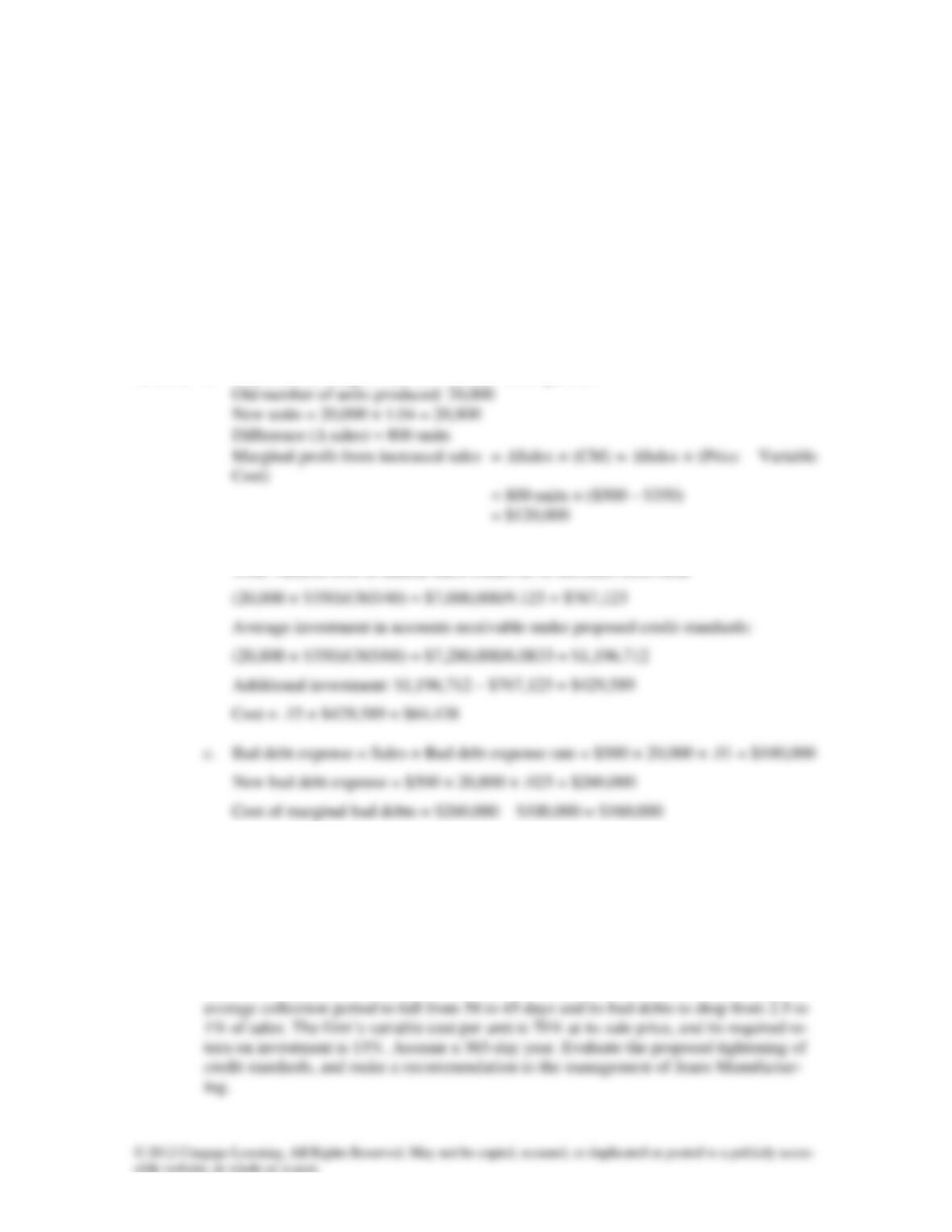
A16-16. a. Contribution margin = ($500 − $350) = $150 per unit
b. Average investment in accounts receivable under current credit standards:
Total variable cost of annual sales/Turnover of accounts receivable
d. The firm’s profit from the additional sales is less than the sum of its cost of addition-
al investment in accounts receivable and its additional bad debt expense. A net loss
of $104,438 would result from the proposed relaxation of credit standards. The firm
should not relax its credit standards.
P16-17. Jeans Manufacturing thinks that it can reduce its high credit costs by tightening its credit
standards. However, as a result of the planned tightening, the firm believes its annual
sales will drop from $38 million to $36 million. On the positive side, the firm expects its
464 Instructor’s Manual
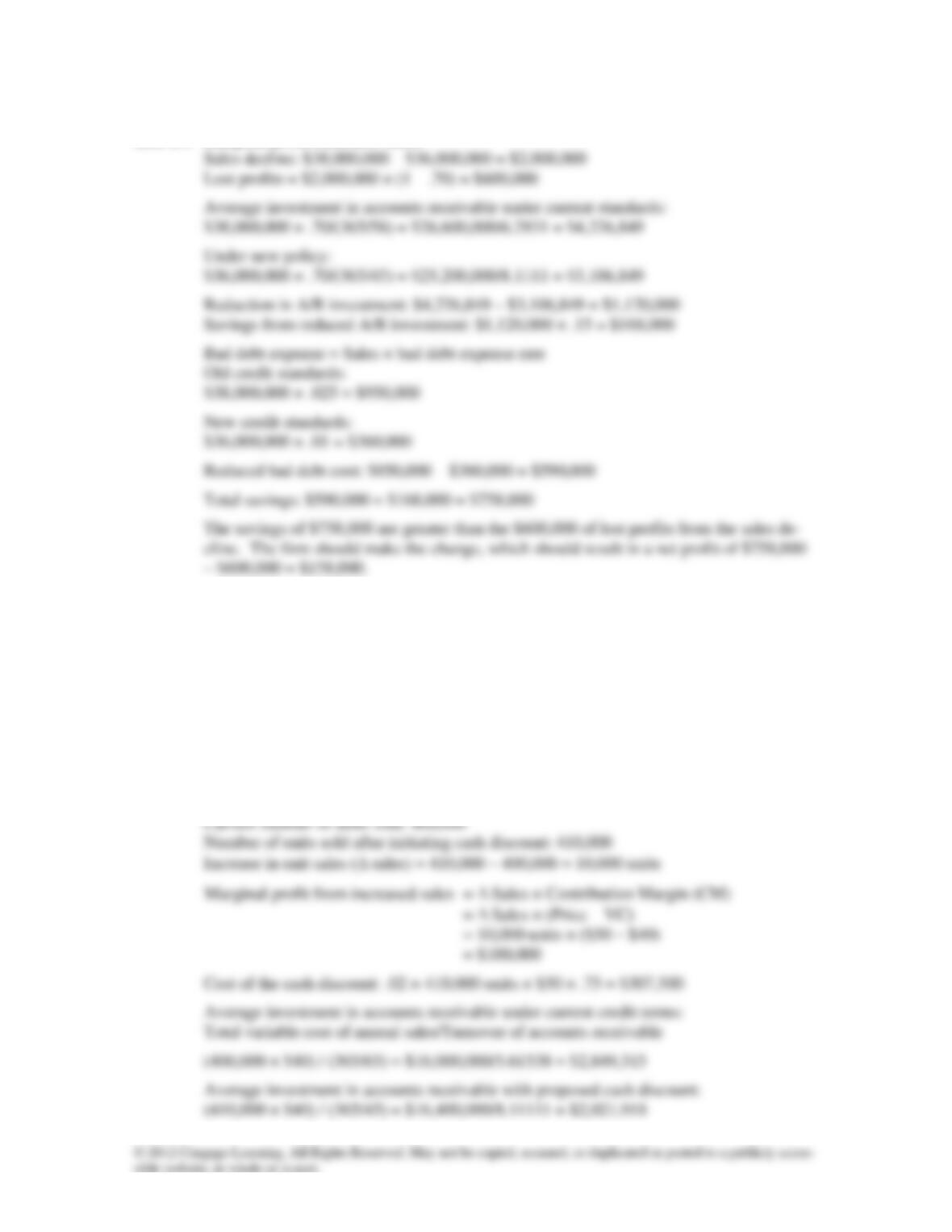
A16-17. Marginal profit from new sales:
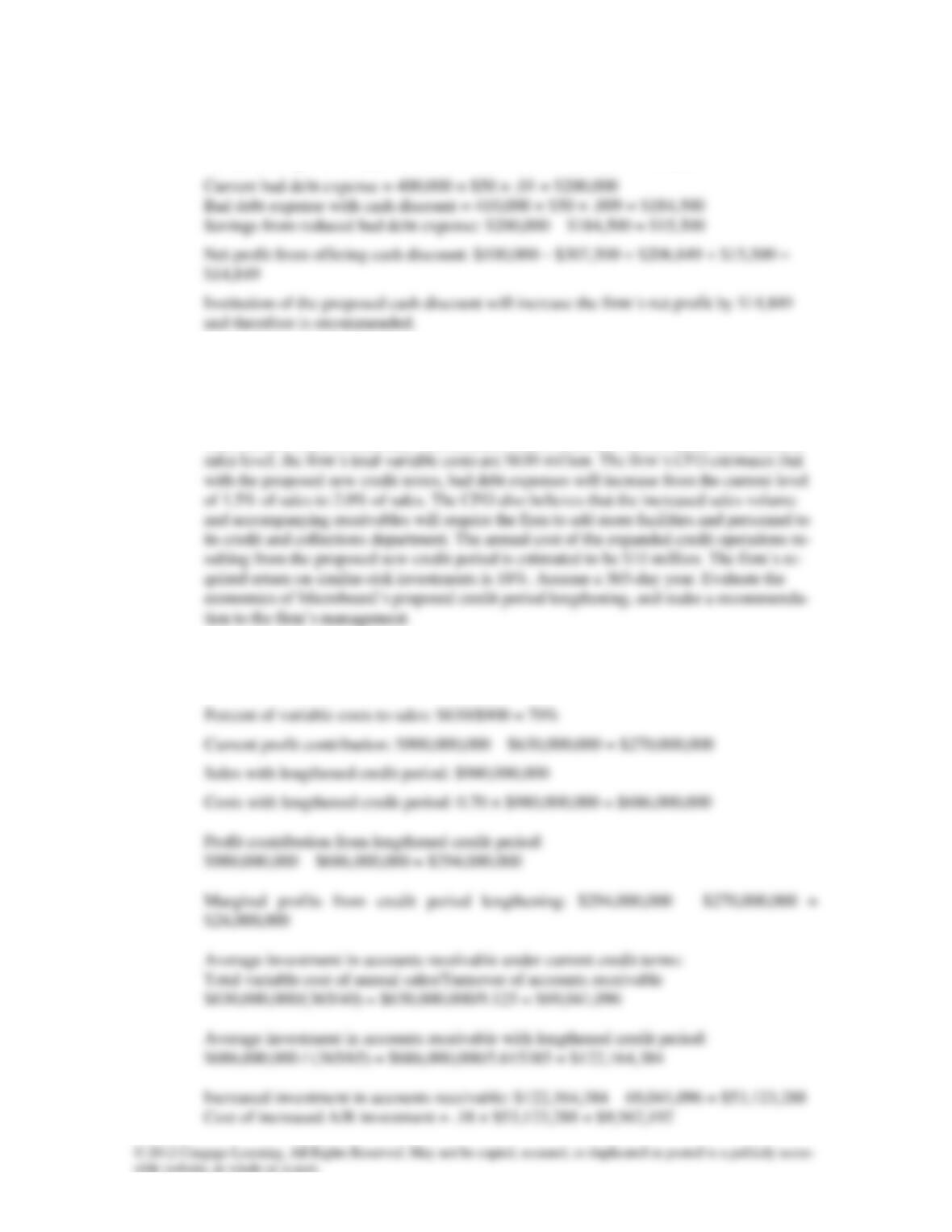
P16-18. Webb Inc. currently makes all sales on credit and offers no cash discounts. The firm is
considering offering a 2% cash discount for payments within 10 days. The firm’s current
average collection period is 65 days, sales are 400,000 units, selling price is $50 per unit,
and variable cost per unit is $40. The firm expects that the changes in credit terms will
result in an increase in sales to 410,000 units, that 75% of the sales will take the discount,
and that the average collection period will fall to 45 days. Bad debts are expected to drop
from 1.0 to 0.9% of sales. If Webb’s required rate of return on investments of similar risk
is 25%, should the firm offer the proposed discount? Assume a 365-day year.
A16-18. Marginal profit from new sales:
Chapter 16 Cash Conversion, Inventory, and Receivables Management 465
Reduced investment in accounts receivable: $2.849,315 – $2,021,918 = $827,397
Annual savings from reduced A/R investment: .25 × $827,397 = $206,849
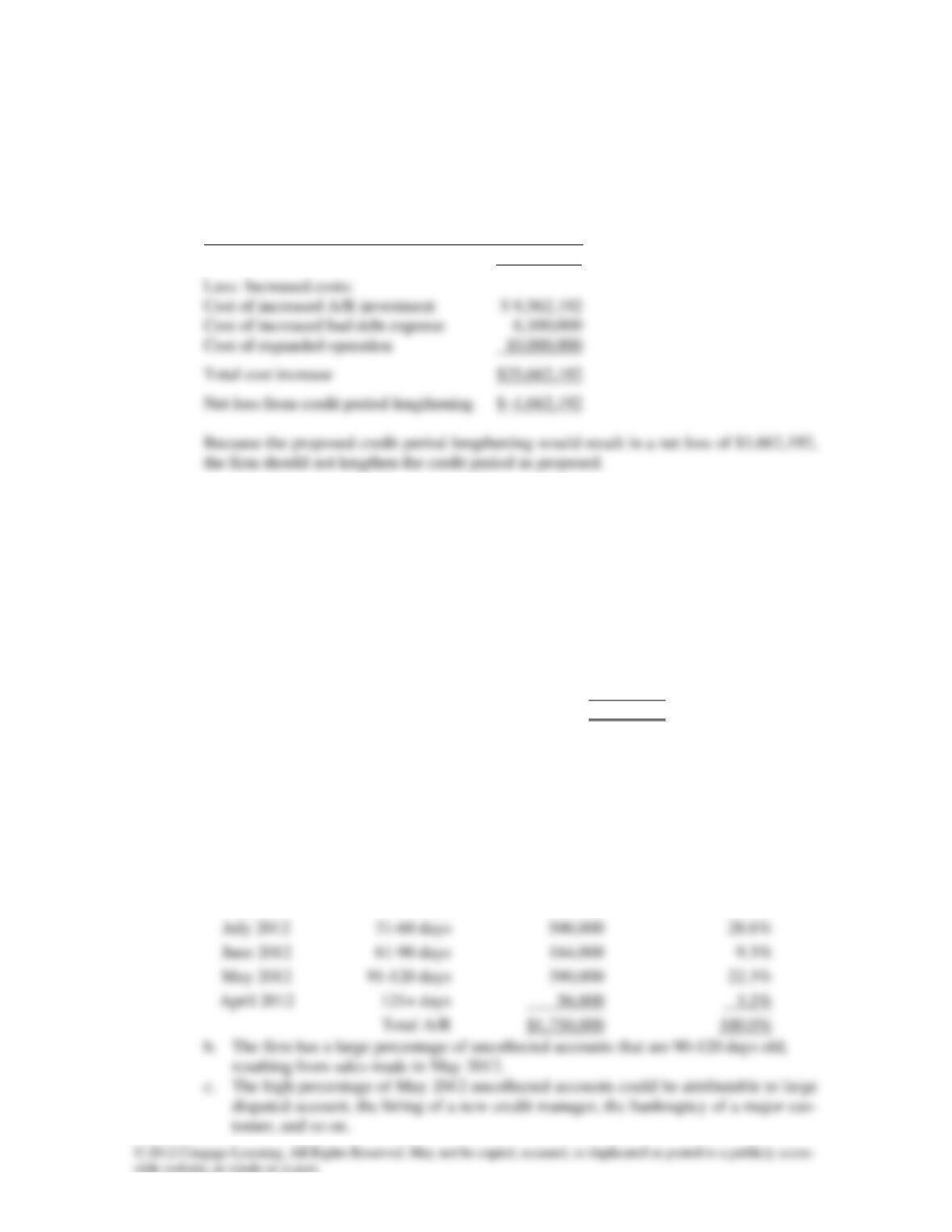
P16-19. Microboard Inc., a major computer chip manufacturer, is thinking of lengthening its credit
period from net 30 days to net 50 days. Presently, its average collection period is 40 days,
and the firm’s CFO believes that with the proposed new credit period, the average collec-
tion period will be 65 days. The firm’s sales are $900 million, and the CFO believes that
with the new credit terms, sales will increase to $980 million. At the current $900 million
A16-19. Current sales: $900,000,000
Current variable costs: $630,000,000
466 Instructor’s Manual
Current bad debt expense = .015 × $900,000,000 = $13,500,000
Bad debt expense with lengthened credit period = .02 × $980,000,000 = $19,600,000
Cost of increased bad debt expense: $19,600,000 – $13,500,000 = $6,100,000
Cost/Benefit Summary .
Increased profit contribution: $24,000,000
Collecting, Monitoring, and Applying Cash to Receivables
P16-20. United Worldwide’s accounts receivable totaled $1.75 million on August 31, 2012. The
table below gives a breakdown of these outstanding accounts on the basis of the month
of the initial credit sale. The firm extends net 30, EOM to its credit customers.
Month of Credit Sale
Accounts Receivable
August 2012
$ 640,000
July 2012
500,000
June 2012
164,000
May 2012
390,000
April 2012
56,000
Total (August 31, 2012)
$1,750,000
a. Prepare an aging schedule for United Worldwide’s August 31, 2012, accounts re-
ceivable balance.
b. Using your findings in part (a), evaluate the firm’s credit and collection activities.
c. What are some probable causes of the situation discussed in part (b)?
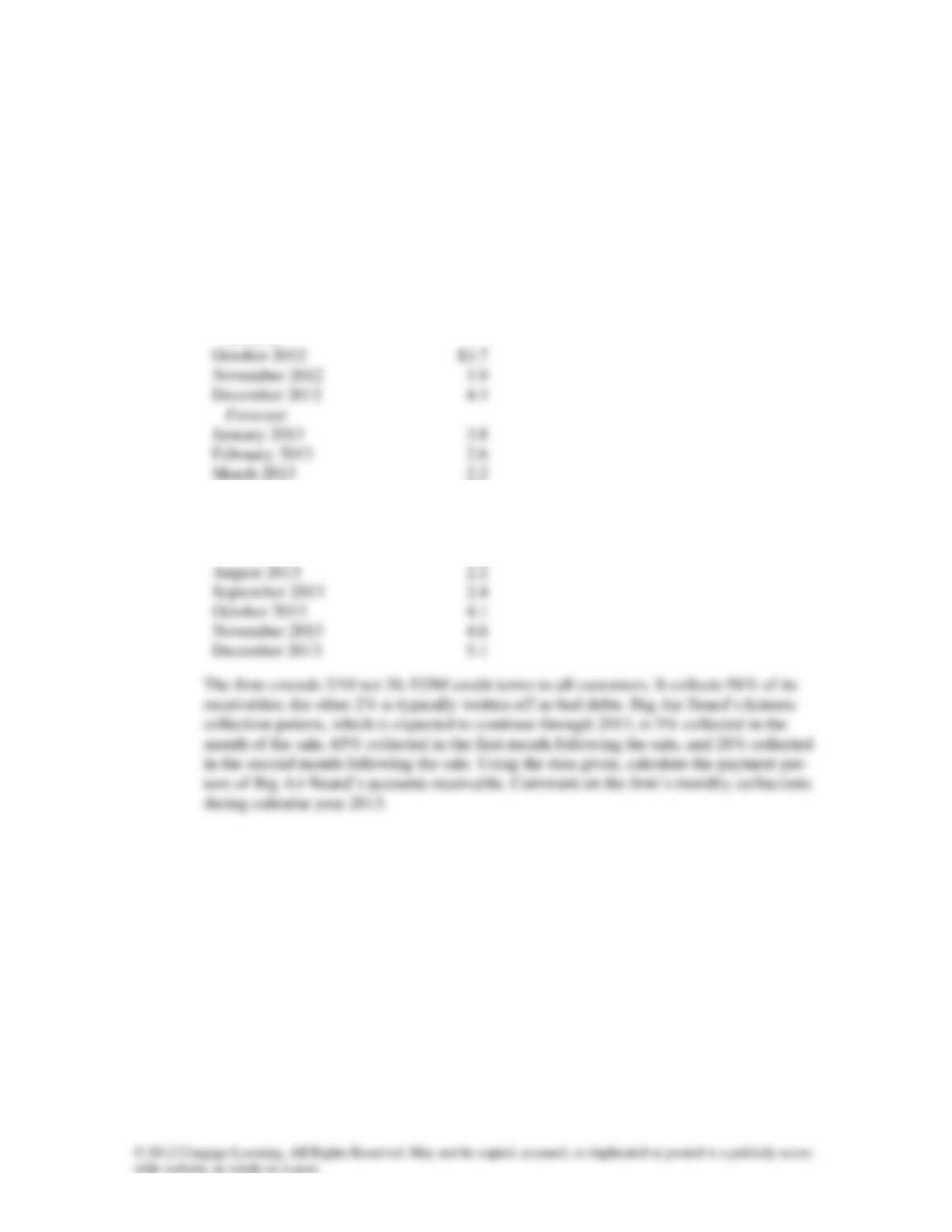
A16-20. a.
Month of Sale
Age of Accounts
Accounts Receivable
Percentage of A/R
Aug 2012
0-30 days
640,000
36.6%
164,000
121+ days
3.2%
Chapter 16 Cash Conversion, Inventory, and Receivables Management 467
P16-21. Big Air Board Company, a global manufacturer and distributor of both surfboards and
snowboards, is in a very seasonal business. Although surfboard sales are only mildly sea-
sonal, the snowboard sales are driven by peak demand in the first and fourth calendar
quarters of each year. The following table gives the firm’s monthly sales for the immedi-
ate past quarter (October through December 2012) and its forecast monthly sales for the
coming year (calendar-year 2013).
Month
Sales
($ in millions)
Historic
October 2012
December 2012
4.3
Forecast
January 2013
3.8
February 2013
2.6
March 2013
2.2
April 2013
1.6
May 2013
1.8
June 2013
1.9
July 2013
2.0
August 2013
2.2
September 2013
2.4
October 2013
4.1
November 2013
4.6
December 2013
5.1
468 Instructor’s Manual
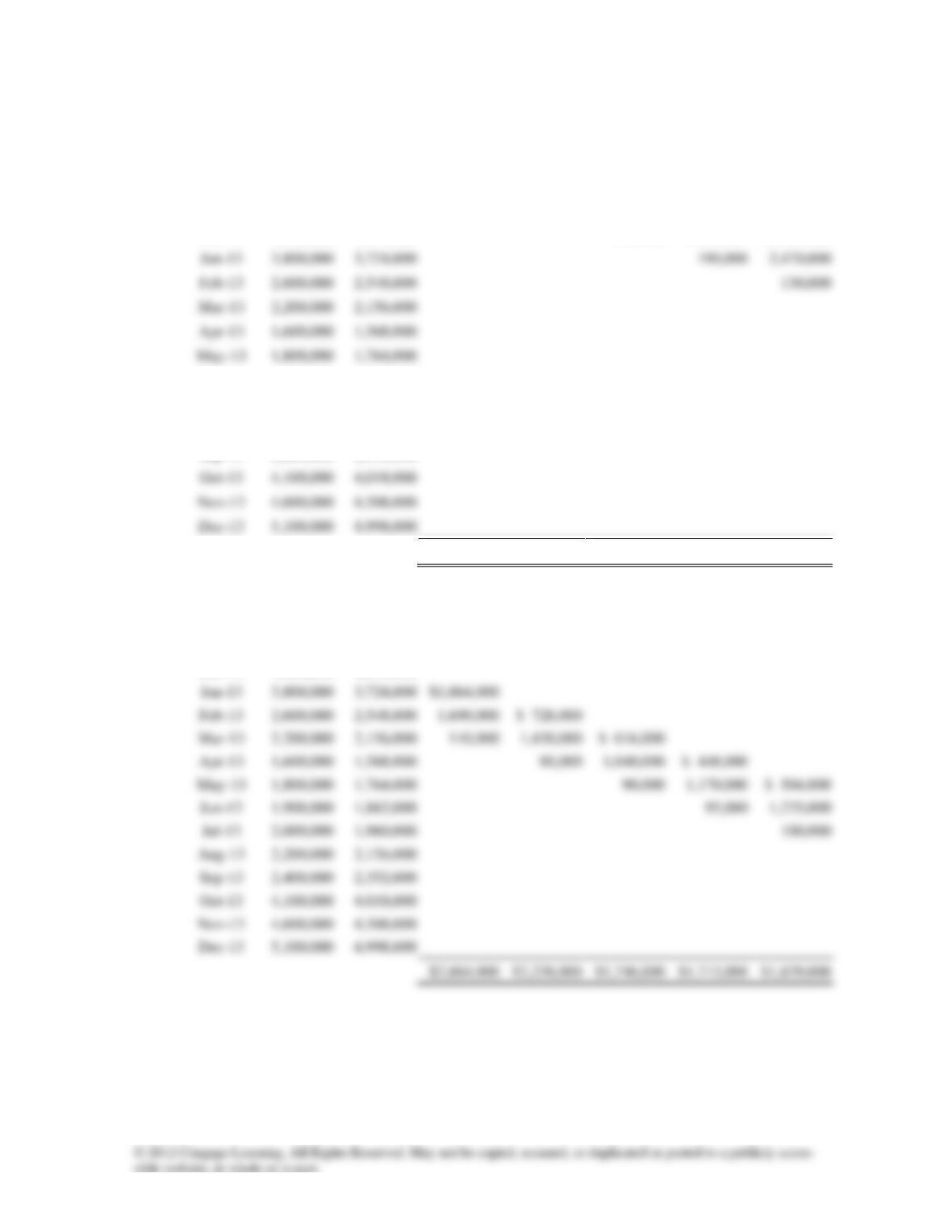
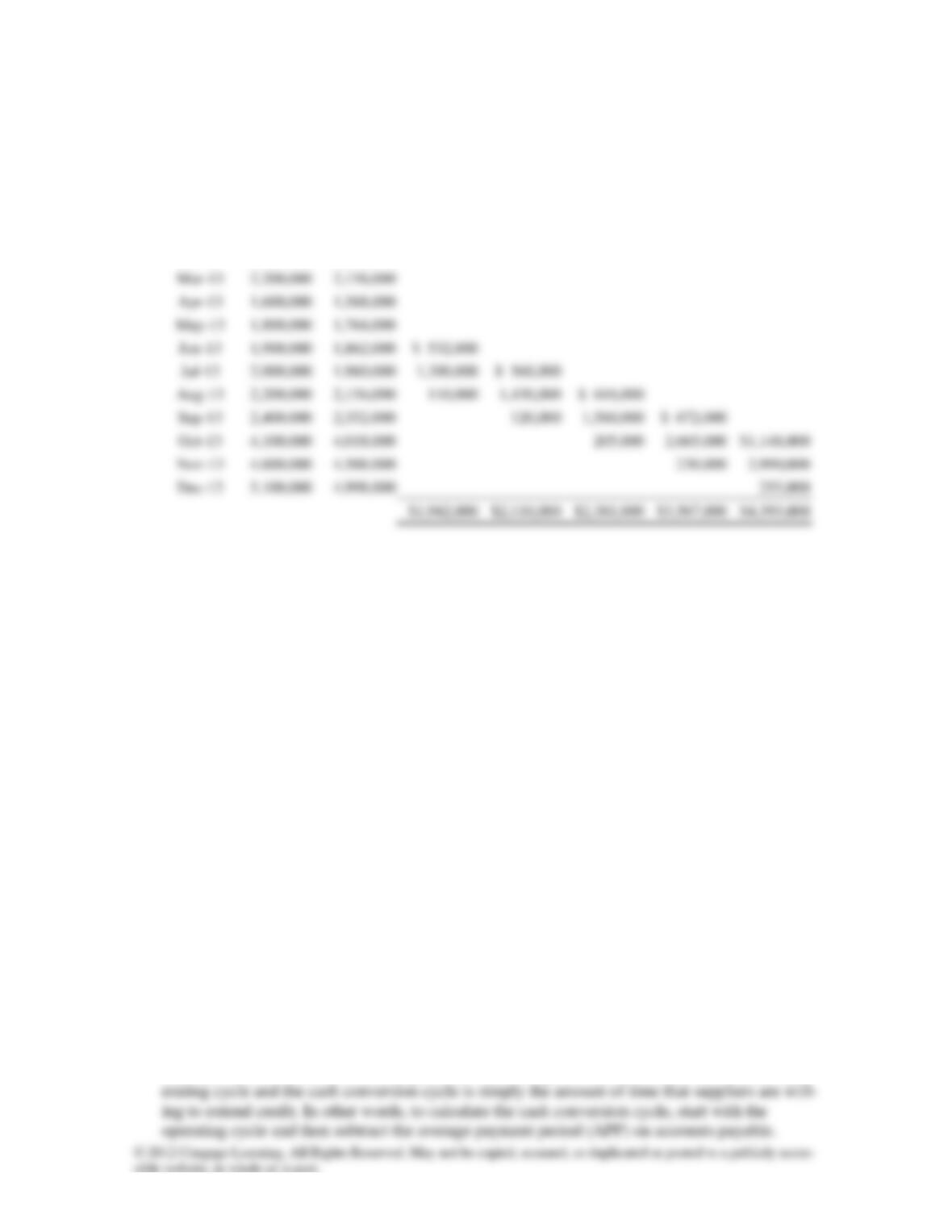
A16-21.
Month
Sales
Collected
October
November
December
January
February
Oct–12
$3,700,000
$3,626,000
$185,000
$2,405,000
$1,036,000
Nov-12
3,900,000
3,822,000
195,000
2,535,000
$1,092,000
Dec–12
4,300,000
4,214,000
215,000
2,795,000
$1,204,000
3,800,000
3,724,000
190,000
2,470,000
Feb-13
2,600,000
2,548,000
2,200,000
2,156,000
1,600,000
1,568,000
1,800,000
1,764,000
Jun-13
1,900,000
1,862,000
Jul-13
2,000,000
1,960,000
Aug-13
2,200,000
2,156,000
Sep-13
2,400,000
2,352,000
Oct–13
4,100,000
4,018,000
Nov-13
4,600,000
4,508,000
Dec–13
5,100,000
4,998,000
Total
$3,786,000
$4,077,000
$3,804,000
Month
Sales
Collected
March
April
May
June
July
Oct–12
$3,700,000
$3,626,000
Nov-12
3,900,000
3,822,000
Dec–12
4,300,000
4,214,000
3,800,000
3,724,000
2,600,000
2,548,000
1,690,000
2,200,000
2,156,000
110,000
1,430,000
1,600,000
1,568,000
1,040,000
1,800,000
1,764,000
1,170,000
Jun-13
1,900,000
1,862,000
1,235,000
2,000,000
1,960,000
Aug-13
2,200,000
2,156,000
Sep-13
2,400,000
2,352,000
Oct–13
4,100,000
4,018,000
Nov-13
4,600,000
4,508,000
Dec–13
5,100,000
4,998,000
$2,864,000
$2,238,000
$1,746,000
$1,713,000
$1,839,000
Chapter 16 Cash Conversion, Inventory, and Receivables Management 469
Month
Sales
Collected
August
September
October
November
December
Oct–12
$3,700,000
$3,626,000
Nov-12
3,900,000
3,822,000
Dec–12
4,300,000
4,214,000
Jan-13
3,800,000
3,724,000
Feb-13
2,600,000
2,548,000
1,600,000
1,568,000
1,800,000
1,764,000
Jun-13
1,900,000
1,862,000
2,000,000
1,960,000
1,300,000
Aug-13
2,200,000
2,156,000
1,430,000
Oct–13
4,100,000
4,018,000
2,665,000
$1,148,000
Nov-13
4,600,000
4,508,000
2,990,000
Dec–13
5,100,000
4,998,000
$1,942,000
$2,110,000
$2,381,000
$3,567,000
$4,393,000
The firm’s collections are high at the beginning of the year, then decline slowly until the
third quarter, when sales begin to increase and drive the fourth quarter collections up.
THOMSON ONE Business School Edition: Because P16-22 and P16-23 are based on using a
live database, answers will vary from moment to moment. This is a chance for your students to use
a version of a tool that CFAs use every day.
Answer to MiniCase
Cash Conversion, Inventory, and Receivables Management
Upon graduation you receive a job offer from Pronto Manufacturing Incorporated. Duties listed
with this job position include responsibilities in implementing the policy and management of cash
conversion, inventory, and receivables. To get ready for the start of this job you decide to review
the following topics.
Assignment
1. What is the cash conversion cycle and what is the difference between it and the operating cy-
cle?
2. What are some ways of shortening the cash conversion cycle?
3. Discuss techniques for controlling inventory.
4. What aspects must managers consider when deciding on a trade credit policy for the firm?
5. Describe the five C’s of credit.
6. What factors should managers consider when determining the company’s collection policy?
Answers
1. The cash conversion cycle is the elapsed time between the points at which a firm pays for raw
materials and at which it receives payment for finished good. The difference between the op-
470 Instructor’s Manual
2. Managers can shorten the cash conversion cycle by (a) turning over inventory as quickly as
possible without stockouts that will result in lost sales, (b) collect accounts receivable as quick-
3. Techniques for controlling inventory include: (a) the ABC System, (b) the EOQ Model, (c)
Safety Stocks and Reorder Points, (d) Materials Requirement Planning, and (e) Just-in-Time
Systems. A firm using the ABC system segregates its inventory into three groups, A, B, and C.
The A group contains items requiring the largest dollar investment, and therefore, control of
4. The first decision a company must make is whether it will offer trade credit at all. There are
many reasons for offering credit, including increasing or facilitating sales, meeting terms of-
fered by competitors, attracting new customers, or providing general convenience. In a typical
business-to-business environment, a company may have to offer trade credit just to generate
5. The five C’s are (1) Character, (2) Capacity, (3) Capital, (4) Collateral, and (5) Conditions.
Character refers to the applicant’s record of meeting past obligations. The lender would consid-
er the applicant’s past payment history, as well as any pending or resolved legal judgments
against the applicant. The question addressed here is whether this applicant will pay its ac-
count, if able, within the specified credit terms. Capacity is the applicant’s ability to repay the

Chapter 16 Cash Conversion, Inventory, and Receivables Management 471
6. The approach to collections may be a function of the industry and the competitive environ-
ment. For many delinquent accounts, a reminder, form letter, telephone call, or visit may facili-
tate customer payment. At a minimum, the company should generally suspend further sales