CHAPTER 16: MANAGING THE MULTINATIONAL FINANCIAL SYSTEM
1
CHAPTER 16
MANAGING THE MULTINATIONAL FINANCIAL SYSTEM
Chapter 16 describes the nature of the multinational financial system and why the ability to shift profits
and funds internally is potentially of far greater value to the MNC than to the purely domestic firm. It
points out that the value of the multinational financial system arises out of the firm’s ability to use it to
take advantage through arbitrage of market imperfections and tax differences. The three principal forms
of arbitrage opportunities discussed include:
1. TAX ARBITRAGE. By shifting profits from units located in high-tax nations to those in lower-tax nations
or from those in a taxpaying position to those with tax losses, MNCs can reduce their tax burden.
2. FINANCIAL MARKET ARBITRAge. By transferring funds among units, MNCs may be able to circumvent
3. REGULATORY SYSTEM ARBITRAGE. Where subsidiary profits are a function of government regulations
(e.g., where a government agency sets allowable prices on the firm’s goods) or union pressure, rather
than the marketplace, the ability to disguise true profitability by reallocating profits among units may
provide the MNC with a negotiating advantage.
1.a. What is the internal financial transfer system of the multinational firm?
1.b. What are its distinguishing characteristics?
1.c. What are the different modes of internal fund transfers available to the MNC?
2. How does the internal financial transfer system add value to the multinational firm?
3. California, like several other states, applies the unitary method of taxation to firms doing
business within the state. Under the unitary method a state determines the tax on a company’s
worldwide profit through a formula based on the share of the company’s sales, assets, and
payroll falling within the state. In California’s case, the share of worldwide profit taxed is
calculated as the average of these three factors.
3.a. What are the predictable corporate responses to the unitary tax?
3.b. What economic motives might help explain why Oregon, Florida, and several other states
have eliminated their unitary tax schemes?
4. In comparisons of a multinational firm’s reported foreign profits with domestic profits, caution
must be exercised. This same caution must also be applied when analyzing the reported profits
of the firm’s various subsidiaries. Only coincidentally will these reported profits correspond to
actual profits.
4.a. Describe five different means that MNCs use to manipulate reported profitability among
their various units.
4.b. What adjustments to its reported figures would be required to compute the true profitability
of a firm’s foreign operations so as to account for these distortions?
4.c. Describe at least three reasons that might explain some of these manipulations.
5. It has been found that U.S.-controlled companies, on the average, earned higher returns on
5.a. What are some economically plausible reasons (other than tax evasion) that would explain the
low rates of return earned by foreign-owned companies in the U.S.? Consider the
consequences of the debt-financed U.S. investments made by foreign companies as well as the
depreciation of the U.S. dollar.
ANSWER. Buying binge in the U.S. meant big interest payments on acquisition debt and huge
5.b. Could the differences in returns be attributed to the risks faced by U.S.-controlled companies
outside of the U.S. and the foreign-controlled companies operating in the U.S.? Explain.
5.c. A study reveals that a majority of foreign-controlled companies in the U.S. started their U.S.
operations only during the late-1980s, while U.S.-controlled companies had been operating
abroad for decades before that. Could the difference in returns be explained by experience?
If not, why not?
ADDITIONAL CHAPTER 16 QUESTIONS AND ANSWERS
1. In what aspect of an MNC’s multinational financial system does its value reside?
2. Under what circumstances is leading and lagging likely to be of most value?
3. What are the principal advantages of investing in foreign affiliates in the form of debt instead of
equity?
SUGGESTED SOLUTIONS TO CHAPTER 16 PROBLEMS
1. Suppose Navistar’s Canadian subsidiary sells 1,500 trucks monthly to the French affiliate at a
transfer price of $27,000 per unit. The Canadian and French marginal tax rates on corporate
income are assumed to equal 45% and 50%, respectively.
1.a. Suppose the transfer price can be set at any level between $25,000 and $30,000. At what
transfer price will corporate taxes paid be minimized? Explain.
1.b. Suppose the French government imposes an ad valorem tariff of 15% on imported tractors.
How would this affect the optimal transfer pricing strategy?
1.c. If the transfer price of $27,000 is set in euros and the euro revalues by 5%, what will happen
to the firm’s overall tax bill? Consider the tax consequences both with and without the 15%
tariff.
1.d. Suppose the transfer price is increased from $27,000 to $30,000 and credit terms are extended
from 90 days to 180 days. What are the fund-flow implications of these adjustments?
ANSWER. Ignoring taxes, the month-by-month cash flows from the French affiliate to the Canadian
affiliate before and after the changes in the transfer price and credit terms are:
Cash
Flow/Month
($ million)
1
2
3
4
5
6
7+
New
2. Suppose a U.S. parent owes $5 million to its English affiliate. The timing of this payment can be
changed by up to 90 days in either direction. Assume the following effective annualized
after-tax dollar borrowing and lending rates in England and the U.S.
Lending
(%)
Borrowing
(%)
United States
4.0
3.2
2.a. If the U.S. parent is borrowing funds while the English affiliate has excess funds, should the
parent speed up or slow down its payment to England?
2.b. What is the net effect of the optimal payment activities in terms of changing the units’
borrowing costs and/or interest income?
3. Suppose that DMR SA, located in Switzerland, sells $1 million worth of goods monthly to its
affiliate DMR Gmbh, located in Germany. These sales are based on a unit transfer price of
$100. Suppose the transfer price is raised to $130 at the same time that credit terms are
lengthened from the current 30 days to 60 days.
3.a. What is the net impact on cash flow for the first 90 days? Assume that the new credit terms
apply only to new sales already booked but uncollected.
ANSWER. This problem can best be worked by examining cash flows under the new setup and then
3.b. Assume the tax rate is 25% in Switzerland and 50% in Germany and that revenues are taxed
and costs deducted upon sale or purchase of goods, not upon collection. What is the impact on
after-tax cash flows for the first 90 days?
4. Suppose a firm earns $1 million before tax in Spain. It pays Spanish tax of $0.52 million and
remits the remaining $0.48 million as a dividend to its U.S. parent. Under current U.S. tax law,
how much U.S. tax will the parent owe on this dividend?
ANSWER. Under current U.S. tax law, the firm’s U.S. tax owed on the dividend is calculated as follows:
5. Suppose a French affiliate repatriates as dividends all the after-tax profits it earns. If the
French income tax rate is 50% and the dividend withholding tax is 10%, what is the effective
tax rate on the French affiliate’s before-tax profits, from the standpoint of its U.S. parent?
ANSWER. Assume the French affiliate earns $1 million before tax. It then pays $500,000 in French
ADDITIONAL CHAPTER 16 PROBLEMS AND SOLUTIONS
1. Suppose that covered after-tax lending and borrowing rates for three units of Eastman
Kodak—located in the U.S., France, and Germany—are:
Lending
(%)
Borrowing
(%)
United States
France
Germany
3.1
3.0
3.2
3.9
4.2
4.4
Currently, the French and German units owe $2 million and $3 million, respectively, to their U.S. parent.
The German unit also has $1 million in payables outstanding to its French affiliate. The timing of these
payments can be changed by up to 90 days in either direction. Assume that Kodak U.S. is borrowing
funds while both the French and German subsidiaries have excess cash available.
1.a. What is Kodak’s optimal leading and lagging strategy?
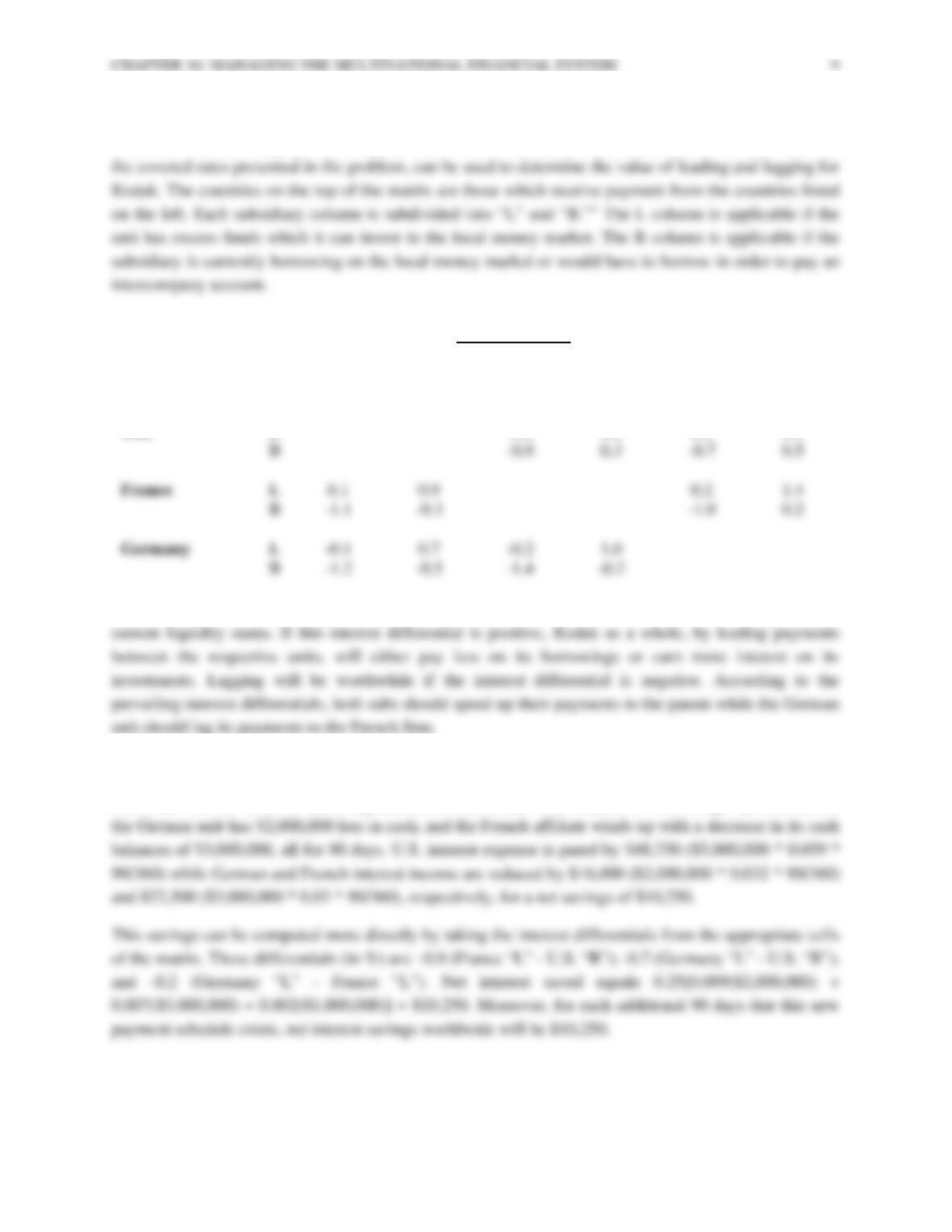
ANSWER. The following matrix of effective after-tax dollar interest rate differentials, which is based on
Receiving Units
U.S.
France
Germany
Paying Units
L
B
L
B
L
B
U.S.
L
-0.1
1.1
0.1
1.3
The entries refer to the dollar interest differentials that exist between each pair of affiliates given their
1.b. What is the net profit impact of these adjustments?
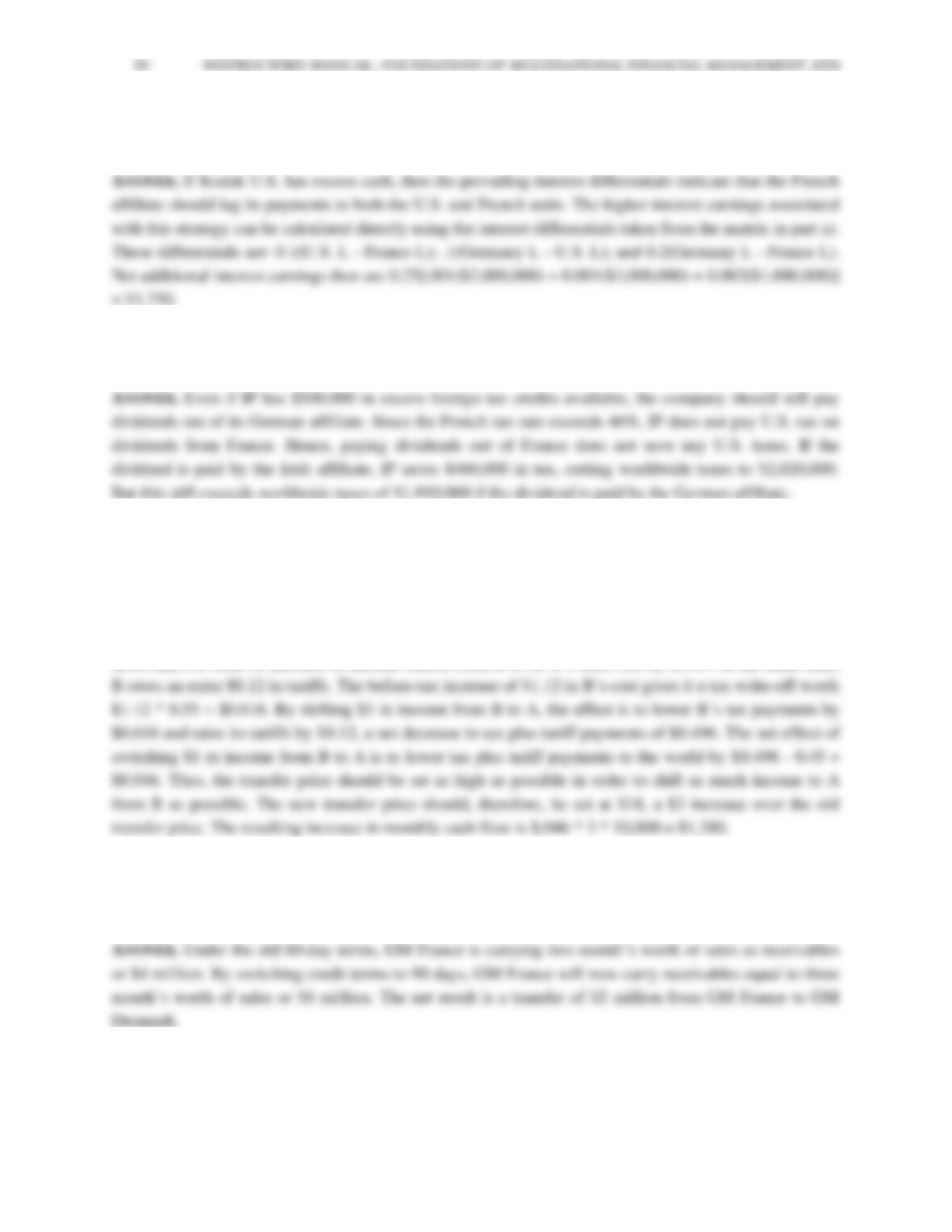
ANSWER. The net effect of these adjustments is that Kodak U.S. reduces its borrowings by $5,000,000,
ED.
1.c. How would Kodak’s optimal strategy and associated benefits change if the U.S. parent has
excess cash available?
2. Suppose that in the section titled Dividends, International Products has $500,000 in excess
foreign tax credits available. How will this situation affect its dividend remittance decision?
3. Suppose affiliate A sells 10,000 chips monthly to affiliate B at a unit price of $15. Affiliate A’s
tax rate is 45%, and affiliate B’s tax rate is 55%. In addition, affiliate B must pay an ad
valorem tariff of 12% on its imports. If the transfer price on chips can be set anywhere between
$11 and $18, how much can the total monthly cash flow of A and B be increased by switching to
the optimal transfer price?
ANSWER. For each $1 increase in income shifted from B to A, A’s taxes rise by $0.45. At the same time,
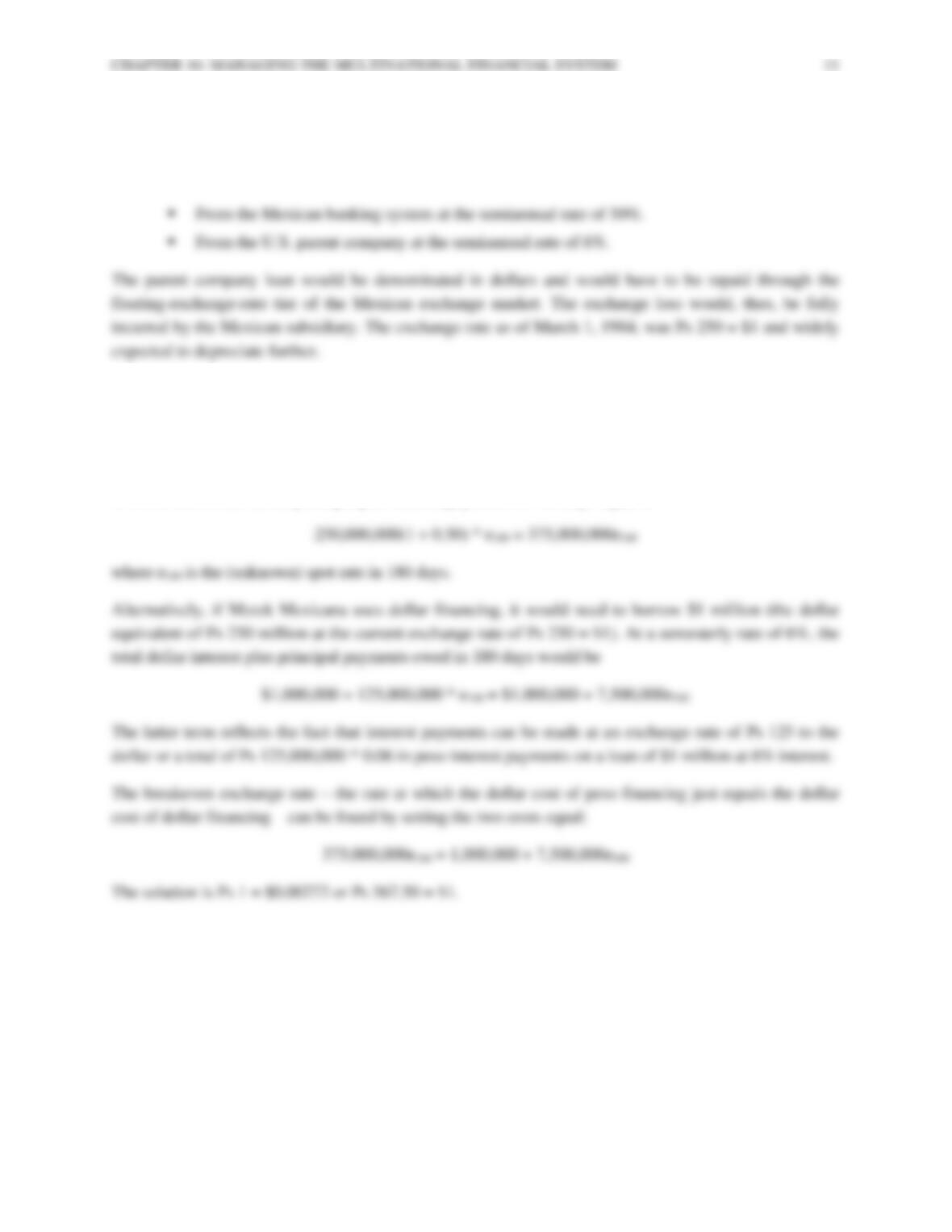
4. Suppose GM France sells goods worth $2 million monthly to GM Denmark on 60-day credit
terms. A switch in credit terms to 90 days will involve a one-time shift of how much money
between the two affiliates?
5. Merck Mexicana SA, the wholly owned affiliate of the U.S. pharmaceutical firm, is considering
alternative financing packages for its increased working capital needs resulting from growing
market penetration. Ps 250 million are needed over the next six months and can be financed as
follows:
5.a. If interest payments can be made through the stabilized tier of the Mexican exchange market
where the dollar is worth Ps 125, what is the break-even exchange rate on the floating tier
that would make Merck Mexicana indifferent between dollar and peso financing?
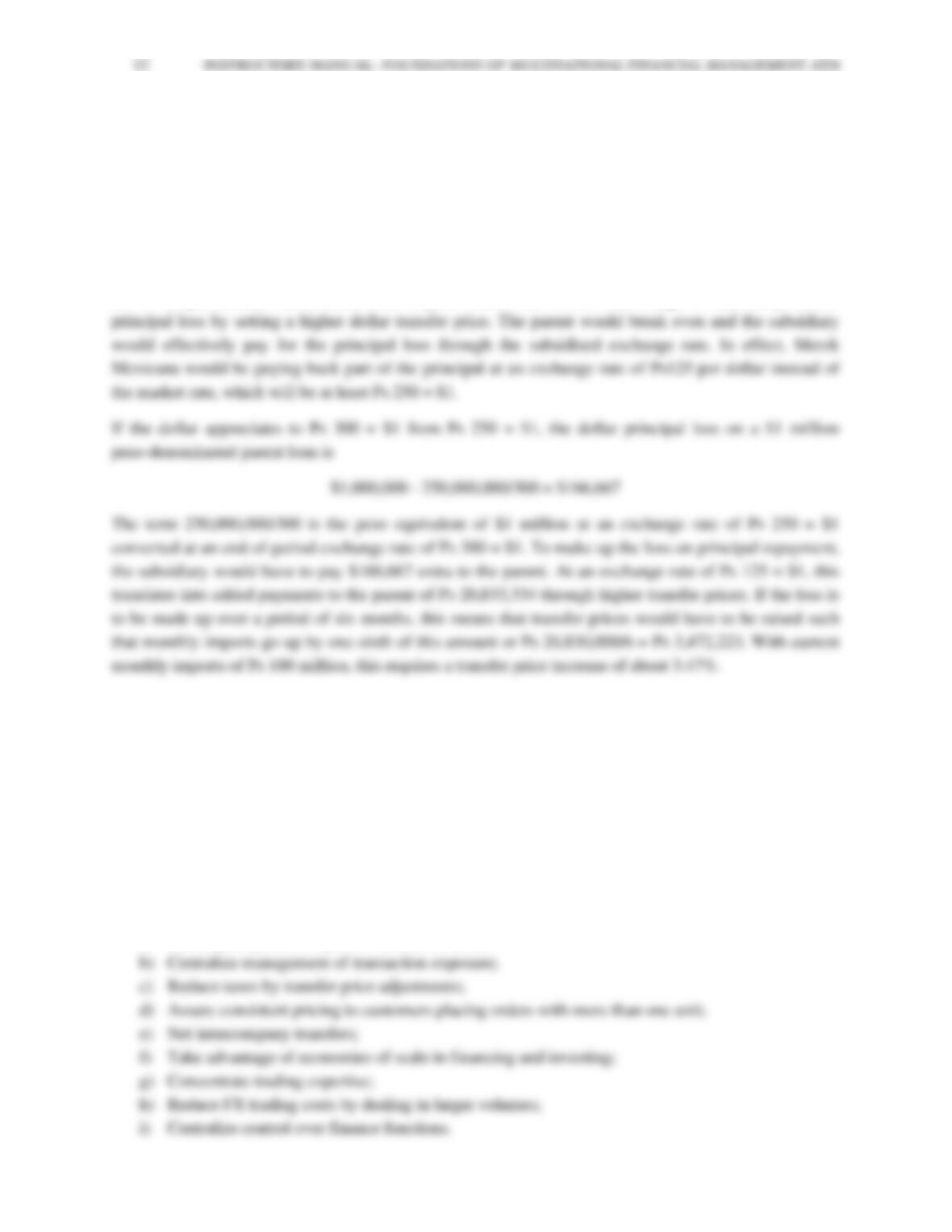
ANSWER. If it borrows pesos from the Mexican bank at a 180-day interest rate of 50%, Merck Mexicana
will owe before-tax dollar principal plus interest payments in 180 days equal to
ED.
5.b. Merck Mexicana imports from its U.S. parent $500,000 worth of chemical compounds
monthly, payable on a 90-day basis. Suppose that the parent adjusts its transfer prices so that
Merck Mexicana must now pay $700,000 monthly for its chemical supplies. All payments for
imports of chemicals involved in the manufacture of pharmaceuticals are transacted through
the stabilized tier of the exchange market. At the current exchange rate of Ps 250 = $1, what is
the net before-tax annual benefit to Merck of this transfer price increase?
ANSWER. Because the importation of chemical compounds is carried out through the subsidized tier (i.e.,
at Ps 125 per dollar) Merck could lend in pesos rather than dollars but charge its subsidiary for the
6. A well-known U.S. firm has a reinvoicing center (RC) located in Geneva. The reinvoicing center
handles an annual sales volume of $1.2 billion – $700 million in interaffiliate sales and the rest
in third-party sales. The RC buys goods manufactured by the parent company or other
subsidiaries and reinvoices the product to other affiliates or third parties. Many of these trades
are with “low-volume, highly complex countries.” When buying the goods, the RC takes title to
them, but it does not take actual possession of the goods. The RC pays the selling company in its
own currency and receives payment from the purchasing company in its own currency. What
benefits can such a center provide?
ANSWER. The reinvoicing center can provide several benefits to its parent company. It can:
a) Shift liquidity from surplus to deficit affiliates;

CHAPTER 16: MANAGING THE MULTINATIONAL FINANCIAL SYSTEM
13
NOTES ON INTERAFFILIATE TRANSACTIONS
1. Overview
2. Transfer pricing
a) Tax effects
b) Section 482
3. Invoicing currency
a) Importer’s currency
4. Leads and lags
a) Shifting liquidity
b) Costs and benefits
i. Take advantage of interest differentials
Borrowing Rate Lending Rate

14 INSTRUCTORS MANUAL: FOUNDATIONS OF MULTINATIONAL FINANCIAL MANAGEMENT, 6TH
ED.
Germany
+ –
c) Information requirements
i. intercompany payables and receivables
5. Dividend planning
a) Tax considerations
6. Global tax planning
a) U.S. taxation of foreign source income
i. Branches versus subsidiaries
b) Information requirements
i. Tax rates by affiliate

CHAPTER 16: MANAGING THE MULTINATIONAL FINANCIAL SYSTEM
15
c) Information requirements
i. Intercompany payables and receivables