3. Quick ratio = $400,000/$1,500,000 = 0.27.
The quick ratio indicates that current assets, excluding inventory, are only sufficient
to cover 27% of current liabilities, which is very bad.

SPREADSHEET PROBLEM
16-18 The detailed solution for the spreadsheet problem, Ch16 P18 Build a Model
Solution.xlsx, is available on the textbook’s Web site.
MINI CASE
Karen Johnson, CFO for Raucous Roasters (RR), a specialty coffee manufacturer, is
rethinking her company’s working capital policy in light of a recent scare she faced when
RR’s corporate banker, citing a nationwide credit crunch, balked at renewing RR’s line of
credit. Had the line of credit not been renewed, RR would not have been able to make payroll,
potentially forcing the company out of business. Although the line of credit was ultimately
renewed, the scare has forced Johnson to examine carefully each component of RR’s working
capital to make sure it is needed, with the goal of determining whether the line of credit can
be eliminated entirely. In addition to (possibly) freeing RR from the need for a line of credit,
Johnson is well aware that reducing working capital will improve free cash flow.
Johnson also knows that decisions about working capital cannot be made in a
vacuum. For example, if inventories could be lowered without adversely affecting operations,
then less capital would be required, and free cash flow would increase. However, lower raw
materials inventories might lead to production slowdowns and higher costs, and lower
finished goods inventories might lead to stock-outs and loss of sales. So, before inventories
are changed, it will be necessary to study operating as well as financial effects. The situation
is the same with regard to cash and receivables. Johnson has begun her investigation by
collecting the ratios shown below.
RR
Industry
Current
1.75
2.25
Quick
0.92
1.16
Total liabilities/assets
58.76%
50.00%
Turnover of cash and securities
16.67
22.22
Days sales outstanding (365-day basis)
45.63
32.00
Inventory turnover
10.80
20.00
Fixed assets turnover
7.75
13.22
Total assets turnover
2.60
3.00
Profit margin on sales
2.07%
3.50%
Return on equity (ROE)
10.45%
21.00%
Payables deferral period
30.00
33.00
a. Johnson plans to use the preceding ratios as the starting point for discussions with
RR’s operating team. Based on the data, does RR seem to be following a relaxed,
moderate, or restricted current asset usage policy?
Answer: A company with a relaxed current asset usage policy would carry relatively large
amounts of current assets relative to sales. It would be guarding against running out of
stock or of running short of cash, or losing sales because of a restrictive credit policy.
b. How can one distinguish between a relaxed but rational working capital policy
and a situation in which a firm simply has excessive current assets because it is
inefficient? Does RR’s working capital policy seem appropriate?
Answer: RR may choose to hold large amounts of inventory to avoid the costs of “running
short,” and to cater to customers who expect to receive their coffee immediately. RR
may also choose to hold high amounts of receivables to maintain good relationships
c. Calculate the firm’s cash conversion cycle given annual sales are $660,000 and
cost of goods represent 80% of sales. Assume a 365-day year.
Answer: A firm’s cash conversion cycle is calculated as:
period
conversion
Inventory
+
Average
collection
period
–
period
deferral
Payables
=
cycle
conversion
Cash
d. Is there any reason to think that RR may be holding too much inventory?
e. If RR reduces its inventory without adversely affecting sales, what effect should
this have on free cash flow: (1) in the short run and (2) in the long run?
Answer: A one-time reduction in inventory causes an identical one-time increase in free cash
f. Johnson knows that RR sells on the same credit terms as other firms in its
industry. Use the ratios presented earlier to explain whether RR’s customers pay
more or less promptly than those of its competitors. If there are differences, does
that suggest RR should tighten or loosen its credit policy? What four variables
make up a firm’s credit policy, and in what direction should each be changed by
RR?
Answer: RR’s DSO is 45.63 days as compared with 32 days for the average firm in its industry.
This suggests that RR’s customers are paying less promptly than those of its
competitors. Because the firm’s DSO is higher than the industry average, the firm
should tighten its credit policy in an attempt to lower its DSO.
also tend to decrease sales, especially when a competitor’s credit period is longer than
the firm’s own credit period. The effect of the credit period on bad debt expense is
indeterminate.
In order to qualify for credit in the first place, customers must meet the firm’s credit
standards. These dictate the minimum acceptable financial position required of
customers to receive credit. Also, a firm may impose differing credit limits
g. Does RR face any risks if it tightens its credit policy?
Answer: A tighter credit policy may discourage sales. Some customers may choose to go
elsewhere if they are pressured to pay their bills sooner.
h. If the company reduces its DSO without seriously affecting sales, what effect
would this have on its free cash flow (1) in the short run and (2) in the long run?
Answer: Similar to the situation with inventory, a one-time reduction in DSO causes an identical
i. What is the impact of higher levels of accruals, such as accrued wages or accrued
taxes? Is it likely that RR could make changes to accruals?
Answer: Higher levels of accruals increase free cash flow. No, RR could not make greater use
of its accruals. Accruals arise because (1) workers are paid after they have actually
provided their services, and (2) taxes are paid after the profits have been earned. Thus,
j. Assume that RR purchases $200,000 (net of discounts) of materials on terms of
1/10, net 30, but that it can get away with paying on the 40th day if it chooses not
to take discounts. How much free trade credit can the company get from its
equipment supplier, how much costly trade credit can it get, and what is the
percentage cost of the costly credit? Should RR take discounts?
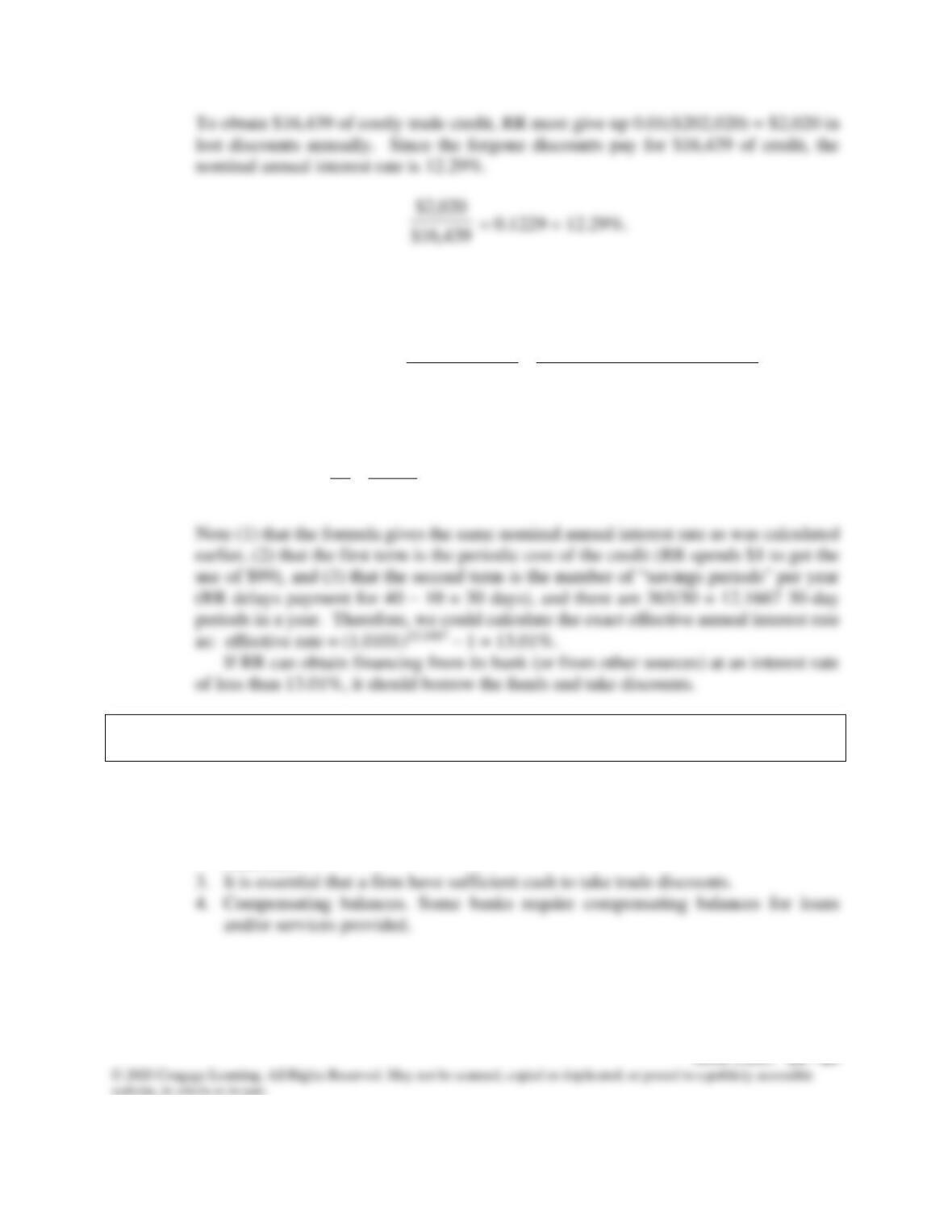
Answer: If RR’s net purchases are $200,000 annually, then, with a 1% discount, its gross
purchases are $200,000/0.99 = $202,020. Net daily purchases from this supplier are
$200,000/365 = $547.94.
If the discount is taken, then RR must pay this supplier at the end of Day 10 for
purchases made on Day 1, on Day 11 for purchases made on day 2, and so on. Thus,
in a steady state, RR will on average have 10 days’ worth of purchases in payables, so,
Here is a formula that can be used to find the nominal annual interest rate of costly
trade credit:
credit tradeof
cost Nominal
=
.
period discount taken aysD
Days536
% iscount D– 1
% iscountD
−
In this situation,
%.912.2 = 290.12 = 1667.12 0.0101 =
10 – 40
536
99
1
k. Cash doesn’t earn interest, so why would a company have a positive target cash
balance?
Answer: 1. Transactions balances. A company must have some cash to pay current bills.
2. Precautionary balances (i.e.,“Safety stock”) to handle unexpected needs. These
balances can be low if a company has credit line or other holdings of short-term
securities.
l. What might RR do to reduce its target cash balance without harming operations?
Answer: 1. Synchronize cash inflows and outflows.
2. Use float.
3. Use lockboxes.
m. RR tries to match the maturity of its assets and liabilities. Describe how RR could
adopt either a more aggressive or more conservative financing policy.
Answer: There are three alternative current asset financing policies: aggressive, moderate, and
relaxed. A moderate financing policy matches asset and liability maturities. (Of course
exact maturity matching is not possible because of (1) the uncertainty of asset lives and
(2) some common equity must be used and common equity has no maturity.) With this
strategy, the firm minimizes its risk that it will be unable to pay off maturing
obligations. An aggressive financing policy occurs when the firm finances all of its
fixed assets with long-term capital, but part of its permanent current operating assets
n. What are the advantages and disadvantages of using short-term debt as a source
of financing?
Answer: Although using short-term credit is generally riskier than using long-term credit, short-
term credit does have some significant advantages. A short-term loan can be obtained
much faster than long-term credit. Lenders insist on a more thorough financial
examination before extending long-term credit. If a firm’s needs for funds are seasonal
or cyclical, it may not want to commit to long-term debt because: (1) flotation costs
o. Would it be feasible for RR to finance with commercial paper?
Answer: It would not be feasible for RR to finance with commercial paper. Commercial paper
is unsecured, short-term debt issued by large, financially strong firms and sold
primarily to other business firms, to insurance companies, to pension funds, to money
market mutual funds, and to banks. Maturities are generally 270 days (9 months) or
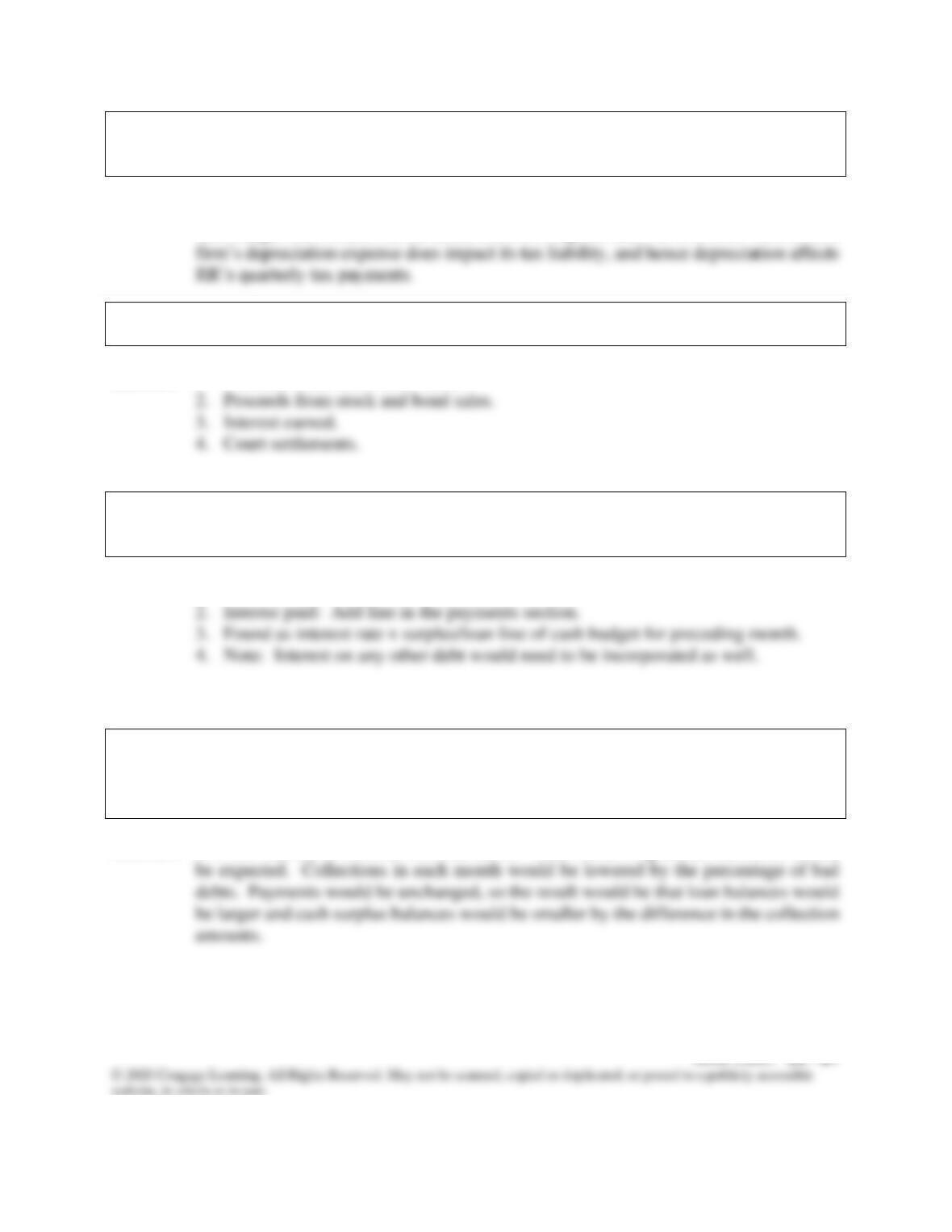
p. In an attempt to better understand RR’s cash position, Johnson developed a cash
budget. Data for the first 2 months of the year are shown below. (Note that
Johnson’s preliminary cash budget does not account for interest income or
interest expense.) She has the figures for the other months, but they are not
shown. After looking at the cash budget, answer the following questions.
RR’S CASH BUDGET FOR JANUARY AND FEBRUARY
November December January February March April
Sales
(1) Sales (Gross) $71,218 $68,212.00 $65,213.00 $52,475.00 $42,909 $30,524
Purchases:
(6) 0.85(Forecasted Sales
2 Months From Now) $44,603.75 $36,472.65 $25,945.40
Payments
(7) Payments For Purchases 44,603.75 36,472.65
(8) Wages And Salaries 6,690.56 5,470.90
(9) Rent 2,500.00 2,500.00
(10) Taxes
(11) Total Payments $53,794.31 $44,443.55
e. 1. What does the cash budget show regarding the target cash level?
e. 2. Should depreciation expense be explicitly included in the cash budget? Why or
why not?
Answer: No, depreciation expense is a noncash charge and should not appear explicitly in the
cash budget that focuses on the actual cash flowing into and out of a firm. However, a
e. 3. What are some other potential cash inflows besides collections?
Answer: 1. Proceeds from fixed asset sales.
e. 4. How can interest earned or paid on short-term securities or loans be incorporated
in the cash budget?
Answer: 1. Interest earned: Add line in the collections section.
e. 5. In her preliminary cash budget, Johnson has assumed that all sales are collected
and thus that RR has no bad debts. Is this realistic? If not, how would bad debts
be dealt with in a cash budgeting sense? (Hint: Bad debts will affect collections
but not purchases.)
Answer: It is not realistic to assume zero bad debts. When credit is granted, bad debts should