Chapter 16
Foreign Exchange Derivative Markets
Outline
Foreign Exchange Markets and Systems
Spot Market
Factors Affecting Exchange Rates
Differential Inflation Rates
Forecasting Exchange Rates
Technical Forecasting
Foreign Exchange Derivatives
Forward Contracts
International Arbitrage
Locational Arbitrage
Chapter 16: Foreign Exchange Derivative Markets ❖ 2
Key Concepts
1. Identify factors that influence exchange rates.
POINT/COUNTER-POINT:
Do Financial Institutions Need to Consider Foreign Exchange Market
Conditions When Making Domestic Security Market Decisions?
POINT: No. If there is no exchange of currencies, there is no need to monitor the foreign exchange
market.
COUNTER-POINT: Yes. Foreign exchange market conditions can affect an economy or an industry and
therefore affect the valuation of securities. In addition, the valuation of a firm can be affected by currency
movements because of its international business.
Questions
1. Exchange Rate Systems. Explain the exchange rate system that existed during the 1950s and 1960s.
How did the Smithsonian Agreement in 1971 revise it? How does today’s exchange rate system differ
from the earlier system?
ANSWER: The 1950s and 1960s were part of the Bretton Woods era, in which currency values were
2. Dirty Float. Explain the difference between a freely floating system and a dirty float. Which type is
more representative of the United States system?
ANSWER: A free float implies that currencies are market determined without government
3. Impact of Quotas. Assume that European countries impose a quota on goods imported from the
United States, and that the United States does not plan to retaliate. How could this affect the value of
the euro? Explain.
Chapter 16: Foreign Exchange Derivative Markets ❖ 3
4. Impact of Capital Flows. Assume that stocks in the United Kingdom become very attractive to U.S.
investors. How could this affect the value of the British pound? Explain.
5. Impact of Inflation. Assume that Mexico suddenly experiences high and unexpected inflation. How
could this affect the value of the Mexican peso according to purchasing power parity (PPP) theory?
ANSWER: High Mexican inflation would cause an increased Mexican demand for U.S. goods
6. Impact of Economic Conditions. Assume that Switzerland has a very strong economy, placing
upward pressure on both its inflation and interest rates. Explain how these conditions could place
pressure on the value of the Swiss franc and determine whether the franc’s value will rise or fall.
ANSWER: A stronger economy will cause an increased Swiss demand for U.S. goods, which places
7. Central Bank Intervention. The Bank of Japan desires to decrease the value of the Japanese yen
against the U.S. dollar. How could it use direct intervention to achieve this goal?
8. Conditions for Speculation. Explain the conditions under which a speculator would like to take a
speculative position in which it will invest in a foreign currency today, even when the speculator has
no use for that currency in the future.
ANSWER: A speculator may invest in a currency if it expects the currency to appreciate.
9. Risk from Speculating. Seattle Bank just took speculative positions by borrowing Canadian dollars
and converting the funds to invest in Australian dollars. Explain a possible future scenario that could
adversely affect the bank’s performance.
ANSWER: If the Canadian dollar appreciates against the U.S. dollar, while the Australian dollar
Chapter 16: Foreign Exchange Derivative Markets ❖ 4
10. Impact of a Weak Dollar. How does a weak dollar affect U.S. inflation? Explain.
ANSWER: A weak dollar tends to cause higher prices paid by U.S. firms for foreign supplies and
11. Speculating With Foreign Exchange Derivatives. Explain how foreign exchange derivatives could
be used by U.S. speculators to speculate on the expected appreciation of the Japanese yen.
ANSWER: U.S. speculators could attempt to lock in an exchange rate at which they could exchange
Advanced Questions
12. Interaction of Capital Flows and Yield Curve. Assume a horizontal yield curve exists. How do you
think the yield curve would be affected if foreign investors in short-term securities and long-term
securities suddenly anticipate that the value of the dollar will strengthen? (You may find it helpful to
refer to the discussion of the yield curve in Chapter 3.)
ANSWER: Open-ended. Foreign investors may purchase more U.S. securities than before to benefit
13. How the Euro’s Value May Respond to Prevailing Conditions. Consider the prevailing conditions
for inflation (including oil prices), the economy, interest rates, and any other factors that could affect
exchange rates. Based on prevailing conditions, do you think the euro’s value will likely appreciate or
depreciate against the dollar for the remainder of this semester? Offer some logic to support your
answer. Which factor do you think will have the biggest impact on the euro’s exchange rate?
ANSWER: This question is open-ended. It requires students to apply the concepts that were presented
14. Obtaining Credit from the European Central Bank. What are the consequences to a government
in the Euroone when it obtains credit from the ECB?
Chapter 16: Foreign Exchange Derivative Markets ❖ 5
15. Impact of Abandoning the Euro on Eurozone Conditions. Explain the possible signal that would
be transmitted to the market if a country abandoned its use of the euro.
ANSWER: If a country abandoned use of the euro, it might signal the possible abandonment by other
countries that presently participate in the euro. If MNCs and large institutional investors outside of
CRITICAL THINKING QUESTION
Central Bank Intervention as a Policy Tool Recently, a government official in Europe stated that the
European Central Bank needs to weaken the euro so as to improve the European economy. Write a short
essay that explains the logic behind this recommendation, and state whether you believe the strategy
would be successful.
ANSWER
A weak euro would make other currencies expensive for European companies and consumers, which can
discourage them from buying other currencies to import products or to invest in other countries. Thus, it
Interpreting Financial News
Interpret the following comments made by Wall Street analysts and portfolio managers.
b. “Our use of currency options resulted in an upgrade in our credit rating.”
The use of currency options resulted in lower exchange rate risk, so the firm’s credit rating was
upgraded.
Chapter 16: Foreign Exchange Derivative Markets ❖ 6
Managing in Financial Markets
You are the manager of a stock portfolio for a financial institution, and approximately 20 percent of your
stock portfolio is in British stocks. You expect the British stock market to perform well over the next
year, and you plan to sell the stocks one year from now (and will convert the British pounds received to
dollars at that time). However, you are concerned that the British pound may depreciate against the dollar
over the next year.
a. Explain how you could use a forward contract to hedge the exchange rate risk associated with
your position in British stocks.
b. If interest rate parity holds, does this limit the effectiveness of a forward rate contract as a hedge?
Interest rate parity does not limit the effectiveness of a forward hedge on a portfolio of British
c. Explain how you could use an options contract to hedge the exchange rate risk associated with
your position in stocks.
You could purchase put option contracts on pounds that would allow you to sell pounds at a
d. Assume that while you are concerned about the potential decline in the pound’s value, you also
believe that the pound could appreciate against the dollar over the next year. You would like to
benefit from the potential appreciation of the pound but wish to hedge against the possible
depreciation of the pound. Should you use a forward contract or options contracts to hedge your
position? Explain.
You should purchase put options on pounds so that you have the flexibility to let the options
Problems
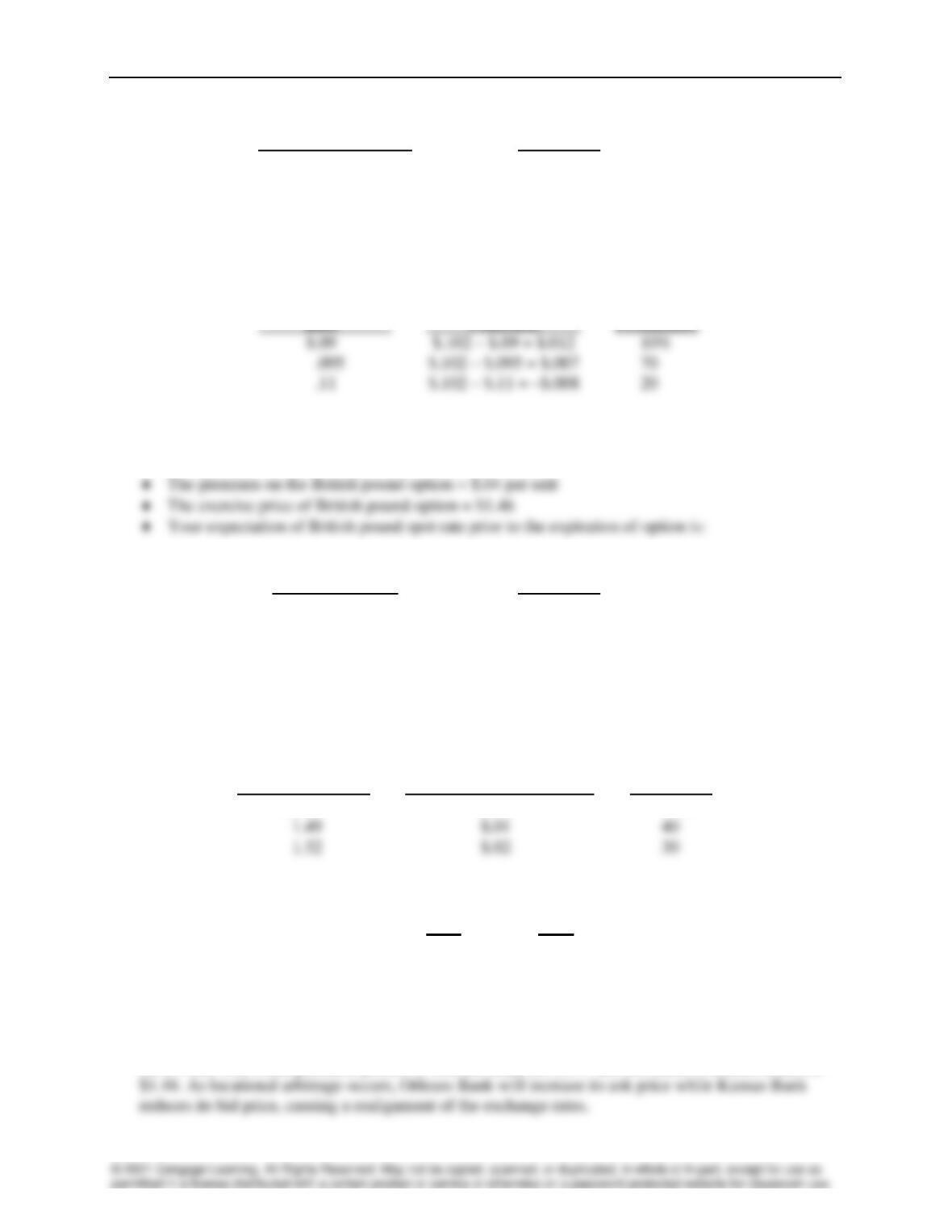
1. Currency Futures. Use the following information to determine the probability distribution of per
unit gains from selling Mexican peso futures.
The spot rate of peso is $.10.
Chapter 16: Foreign Exchange Derivative Markets ❖ 7
Possible Outcome for
Future Spot Rate Probability
.09 10%
.095 70%
.11 20%
ANSWER:
Possible Outcome Gain per Unit from
for Future Spot Selling Futures
2. Currency Call Options. Use the following information to determine the probability distribution of
net gains per unit from purchasing a call option on British pounds:
The spot rate of the British pound = $1.45
Possible Outcome for
Future Spot Rate Probability
$1.48 30%
1.49 40%
1.52 30%
ANSWER:
Gain per Unit from
Possible Outcome Purchasing a Call Option
for Future Spot (After Accounting for
Rate Premium Paid) Probability
$1.48 –$.02 30%
3. Locational Arbitrage. Assume the following exchange rate quotes on British pounds:
Bid Ask
Orleans Bank $1.46 $1.47
Kansas Bank 1.48 1.49
Explain how locational arbitrage would occur. Also explain why this arbitrage will realign the
exchange rates.
ANSWER: One could purchase pounds at Orleans Bank for $1.47 and sell them to Kansas Bank for
Chapter 16: Foreign Exchange Derivative Markets ❖ 8
4. Covered Interest Arbitrage. Assume the following information:
British pound spot rate = $1.58
British pound one-year forward rate = $1.58
British one-year interest rate = 11%
U.S. one-year interest rate = 9%
Explain how U.S. investors could use covered interest arbitrage to lock in a higher yield than 9
percent. What would be their yield? Explain how the spot and forward rates of the pound would
change as covered interest arbitrage occurs.
5. Covered Interest Arbitrage. Assume the following information:
Mexican one-year interest rate = 15%
U.S. one-year interest rate = 11%
If interest rate parity exists, what would be the forward premium or discount on the Mexican peso’s
forward rate? Would covered interest arbitrage be more profitable to U.S. investors than investing at
home? Explain.
ANSWER: If interest rate parity exists, the forward premium (discount) is:
Flow of Funds Exercise
Hedging With Foreign Exchange Derivatives
Carson Company expects that it will receive a large order from the government of Spain. If the order
occurs, Carson will be paid about 3 million euros. Since all of its expenses are in dollars. Carson would
like to hedge this position. Carson has contacted a bank, with brokerage subsidiaries that can help it hedge
with foreign exchange derivatives.
a. How could Carson use currency futures to hedge its position?
Chapter 16: Foreign Exchange Derivative Markets ❖ 9
b. What is the risk of hedging with currency futures?
If Carson does not receive the order, it will still need to sell 3 million euros as of the settlement
c. How could Carson use currency options to hedge its position?
Carson could purchase put options on euros, which allow it the option to sell euros at a specified
exchange rate.
d. Explain the advantage and disadvantage to Carson of using currency options instead of currency
futures.
Currency put options do not obligate Carson to sell euros in the future. Therefore, if Carson does
not receive the order and the euro’s value declines over time, it can let the option contract expire.
Solution to Integrative Problem for Part 5
Choosing Among Derivative Securities
1. The scenario suggests that the United States will rebound from the recession, which should place
upward pressure on interest rates (primarily because of an increase in the demand for loanable funds,
as spending increases). If interest rates rise, the savings institution should hedge. Assuming that
2. Economic conditions will likely improve, so that stock prices will rise. While this is a subjective
3. Since interest rates will likely increase, there is reason to consider hedging the bond portfolio. The
proper hedge would be to sell bond index futures. The pension fund would not wish to buy bond
index futures because it would be even more exposed to interest rate risk.
Chapter 16: Foreign Exchange Derivative Markets ❖ 10
4. A short position (selling bond index futures) in a U.S. bond index will not necessarily be an effective
hedge against the interest rate risk of non-U.S. bonds. Interest rates in the United Kingdom will not
always move in tandem with U.S. interest rates. Therefore, prices of these bonds could decline even
To hedge against the risk of a stronger dollar (a weaker pound), the manager could sell currency
futures contracts on the pound. If the pound’s value declines, there would be a gain on the currency
futures position, which can offset the adverse effect on the value of the international mutual fund. If
the manager desired a hedge with more flexibility, put options on the pound could be purchased. In