Answers and Solutions: 16 – 1
Chapter 16
Supply Chains and Working Capital Management
ANSWERS TO END-OF-CHAPTER QUESTIONS
16-1 a. Working capital is a firm’s investment in short-term assets—cash, marketable
securities, inventory, and accounts receivable. Net working capital is current assets
minus current liabilities. Net operating working capital is operating current assets
minus operating current liabilities.
d. Current assets consist of permanent current assets and temporary current assets. These
current assets can be financed with short-term debt, long-term debt, or a mixture. A
maturity matching financing policy matches asset and liability maturities—permanent
current assets are financed with long-term capital and temporary current assets are
financed with short-term debt. This is also referred to as a “self-liquidating” approach
because the short-term debt is paid off as the temporary current assets decline.
With an aggressive current asset financing policy, some of the permanent current
assets are financed with long-term capital but the remainder is financed with short-term
debt.
Answers and Solutions: 16 – 2
dividing accounts receivable by sales per day. The cash conversion cycle is the length
of time between the firm’s actual cash expenditures on productive resources (materials
and labor) and its own cash receipts from the sale of products (that is, the length of time
between paying for labor and materials and collecting on receivables.) Thus, the cash
conversion cycle equals the length of time the firm has funds tied up in current assets.
The payables deferral period is the average length of time between a firm’s purchase
of materials and labor and the payment of cash for them. It is calculated by dividing
accounts payable by credit purchases per day (COGS/365).
h. Trade discounts, which are also called cash discounts, are price reductions that
suppliers offer customers for early payment of bills.
i. Credit policy is defines the policies and procedures for granting and collecting credit.
There are four elements of credit policy, or credit policy variables. These are credit
period, credit standards, collection policy, and discounts.
The credit period is the length of time for which credit is extended. If the credit
period is lengthened, sales will generally increase, as will accounts receivable. This
will increase the financing needs and possibly increase bad debt losses. A shortening
of the credit period will have the opposite effect.
Answers and Solutions: 16 – 3
k. Accruals are continually recurring short-term liabilities, especially accrued wages and
accrued taxes. Trade credit is debt arising from credit sales and recorded as an account
receivable by the seller and as an account payable by the buyer.
l. Stretching accounts payable is the practice of deliberately paying accounts payable late.
Free trade credit is credit received during the discount period. Credit taken in excess
of free trade credit, whose cost is equal to the discount lost is termed costly trade credit.
16-2 The two principal reasons for holding cash are for transactions and compensating balances.
The target cash balance is not equal to the sum of the holdings for each reason because the
same money can often partially satisfy both motives.
16-3 False. Both accounts will record the same transaction amount.
Answers and Solutions: 16 – 4
16-5 If an asset’s life and returns can be positively determined, the maturity of the asset can be
matched to the maturity of the liability incurred to finance the asset. This matching will
ensure that funds are borrowed only for the time they are required to finance the asset and
16-6 From the standpoint of the borrower, short-term credit is riskier because short-term interest
rates fluctuate more than long-term rates, and the firm may be unable to repay the debt. If
16-7 This statement is false. A firm cannot ordinarily control its accruals since payrolls and the
timing of wage payments are set by economic forces and by industry custom, while tax
payment dates are established by law.
16-8 Yes. If a firm is able to buy on credit at all, if the credit terms include a discount for early
16-9 Commercial paper refers to promissory notes of large, strong corporations. These notes
have maturities that generally vary from one day to 9 months, and the return is usually 1½
to 3½ percentage points below the stated prime rate, and up to ½ of a percentage point
above the T-bill rate. Most commercial paper outstanding is issued by financial
institutions.
Answers and Solutions: 16 – 5
SOLUTIONS TO END–OF-CHAPTER PROBLEMS
16-1 COGS = $10,000,000; Inventory turnover = COGS/Inventory = 2.
Inventory = COGS/(Inventory turnover)
=
2
000,000,10$
= $5,000,000.
If Turnover = 5, how much cash is freed up?
5
000,000,10$
16-2 DSO = 17; Sales/Day = $3,500; A/R = ?
16-3 Nominal cost of trade credit =
1530
536
97
3
−
= 0.0309 24.33 = 0.7526 = 75.26%.
Effective cost of trade credit = (1.0309)24.33 – 1.0 = 1.0984 = 109.84%.
16-6 a. 0.3(10) + 0.7(50) = 38 days.
b. $1,500,000/365 = $4,109.59 sales per day.
16-7 a.
1 365
99 5
= 73.74%.
b.
2 365
98 50
= 14.90%.
2 365
2 365
16-8 a. Nominal cost of trade credit = Cost per period 𝗑 (Number of periods per year)
Nominal cost of trade credit = (Disc. Pct.
100– Disc. Pct.) (365
Total credit days-Disc. period)
Answers and Solutions: 16 – 7
16-9 Sales per day =
365
500,562,4$
= $12,500.
Discount sales per day = 0.5($12,500) = $6,250.
A/R attributable to discount customers = $6,250(10) = $62,500.
A/R attributable to nondiscount customers:
Alternatively,
DSO = $437,500/$12,500 = 35 days.
16-10 Accounts payable:
Nominal cost =
80
536
97
3
= (0.03093)(4.5625) = 14.11%.
Answers and Solutions: 16 – 8
EAR cost = (1.03093)4.5625 – 1.0 = 14.91%.
16-11 a.
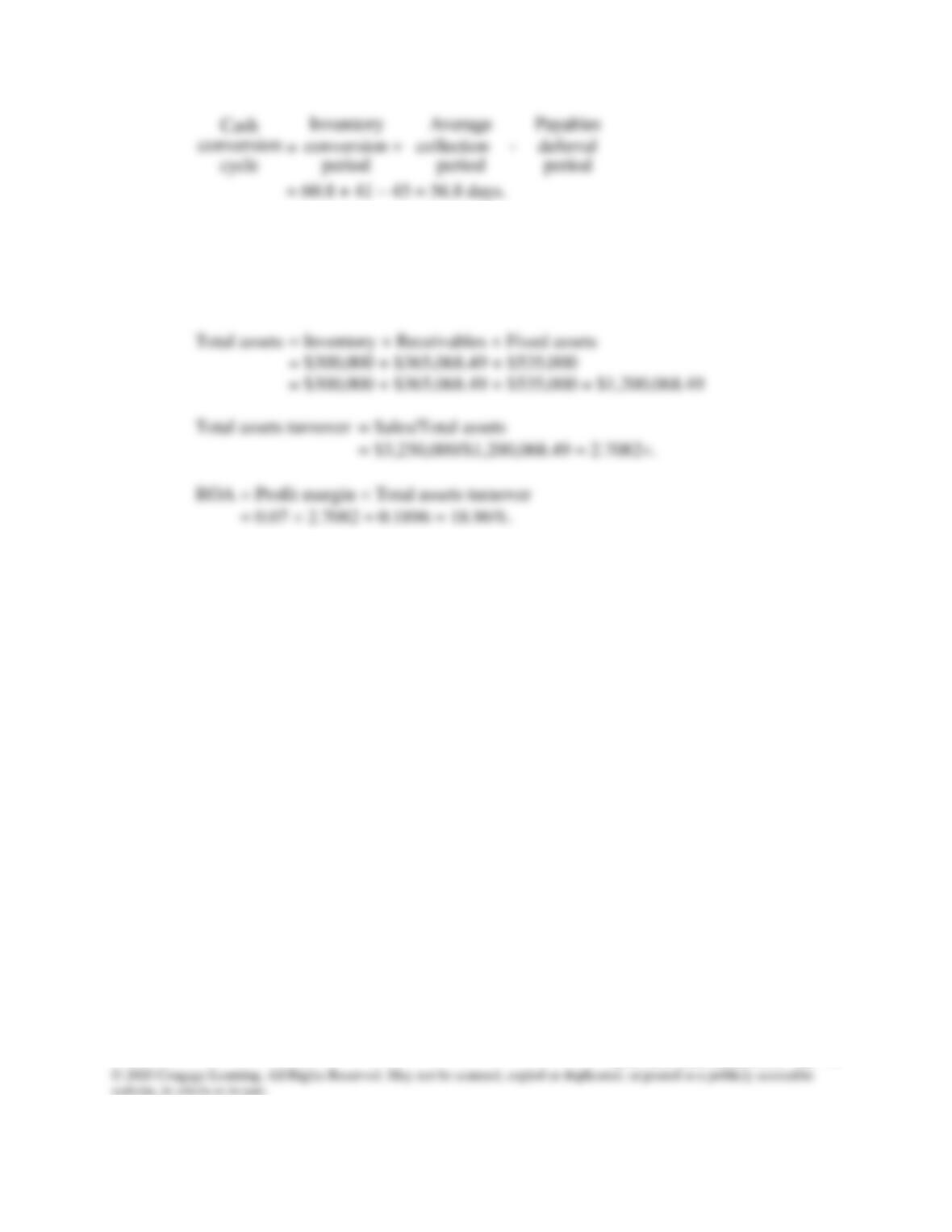
cycle
conversion
Cash
=
period
deferral
Payables
–
period
collection
Average
period
conversion
Inventory +
= 50 + 35 – 25 = 60 days.
Inv. conversion period =
COGS/365
.Inv
50 =
Inv.
$3,504,000/365
Inv. = $480,000.
16-12 a. First, express inventory turnover in terms of COGS and inventory.
Inventory turnover = COGS/Inventory. This implies:
Average collection period = DSO = 41.0 days.
Payables deferral period = PDP = 45.0 days.
Answers and Solutions: 16 – 9
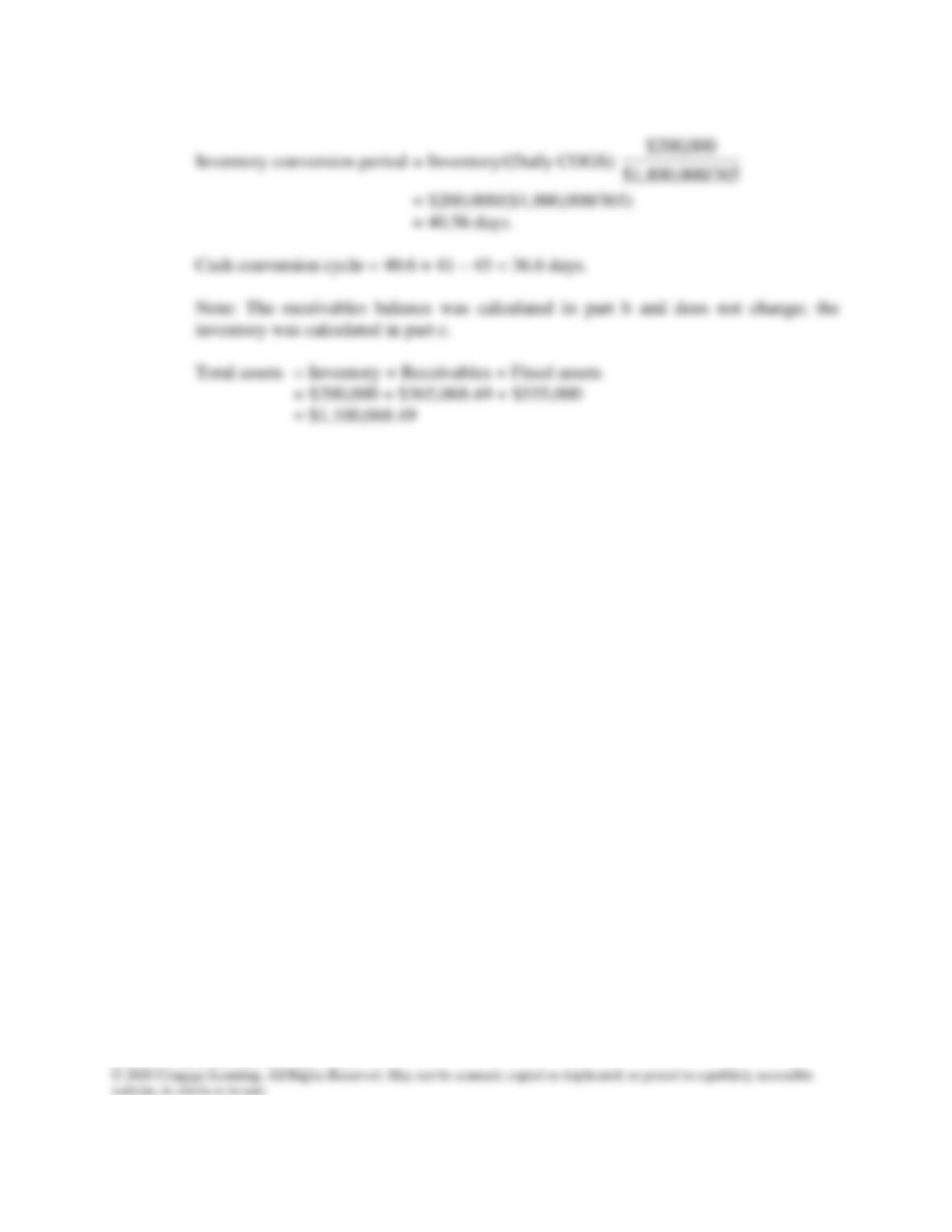
b. Inventory = $300,000 (as calculated in part a).
DSO = Receivables/(Daily sales)
Receivables = DSO(Daily sales) = 41($3,250,000/365) = $365,068.49
c. Inventory turnover = COGS/Inv.
Inventory = COGS/(Inventory turnover)
= $1,800,000/9
= $200,000
Answers and Solutions: 16 – 10
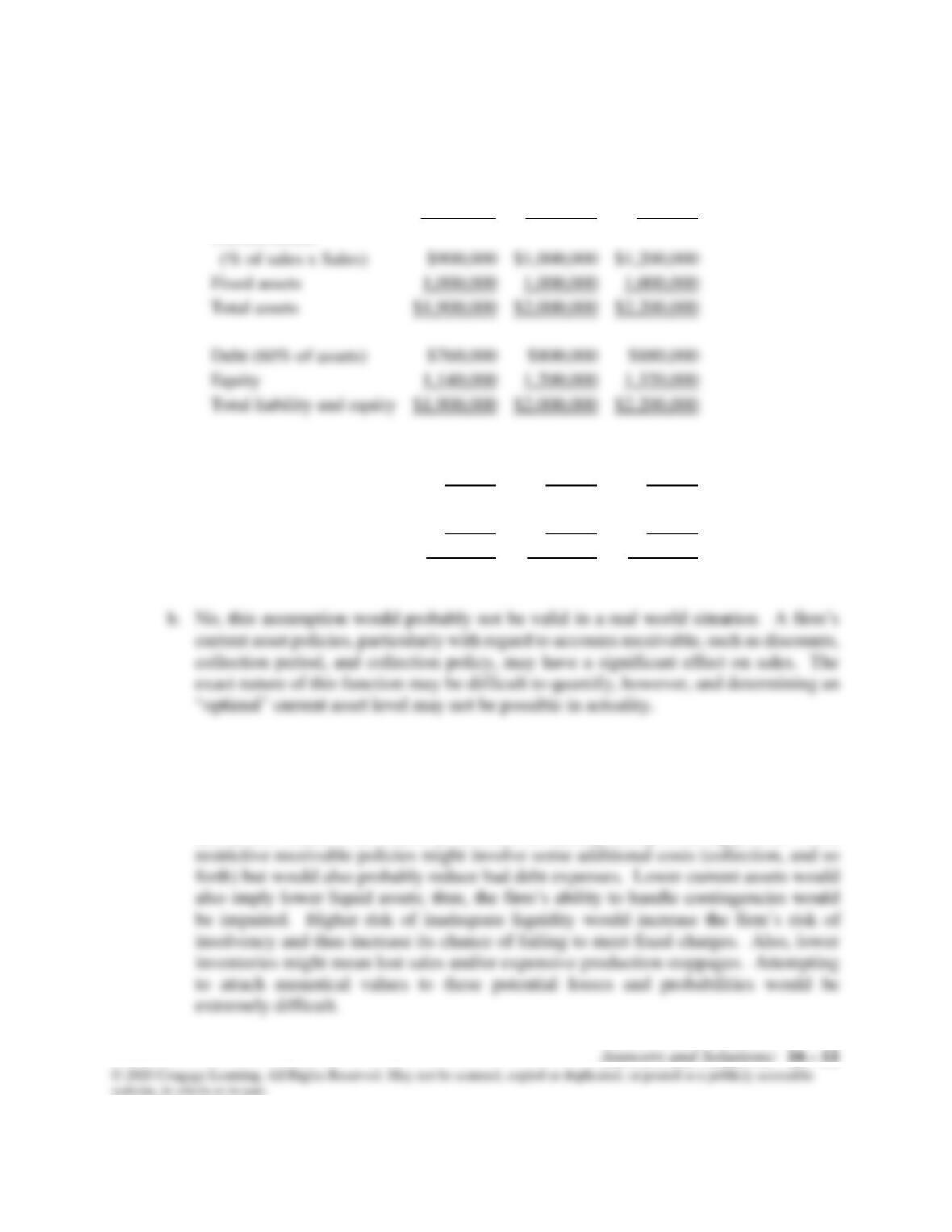
Total assets turnover = Sales/TA = $3,250,000/$1,100,068.49 = 2.9544.
ROA = Profit margin Total assets turnover
ROA = .07 2.9544 = 0.2068 = 20.68%.
16-13 a.
Current year sales are expected to be $1,600,000x(1.25) = $2,000,000.
Return on equity may be computed as follows:
Restricted
Moderate
Relaxed
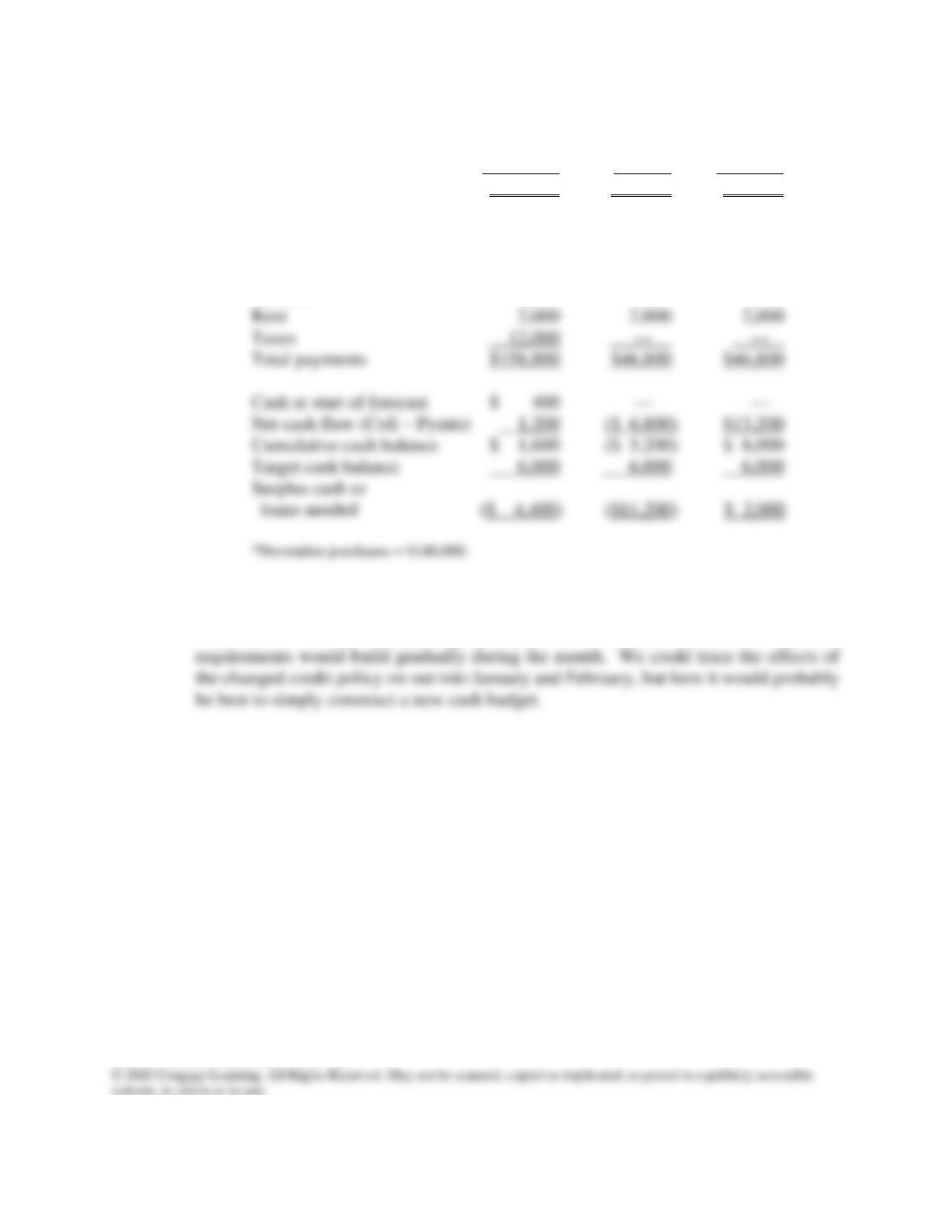
Current assets
(% of sales x Sales)
$900,000
$1,000,000
$1,200,000
Fixed assets
Total assets
$1,900,000
$2,000,000
$2,200,000
Debt (60% of assets)
$760,000
$800,000
$880,000
Total liability and equity
$1,900,000
$2,000,000
$2,200,000
EBIT (12% of sales)
$240,000
$240,000
$240,000
Interest (8%)
60,800
64,000
70,400
Pre-tax earnings
$179,200
$176,000
$169,600
Taxes (25%)
44,800
44,000
42,400
Net income
$134,400
$132,000
$127,200
Return on equity
11.79%
11.00%
9.64%
c. As the answers to Part a indicate, the restricted policy leads to a higher expected return.
However, as the current asset level is decreased, presumably some of this reduction
comes from accounts receivable. This can be accomplished only through higher
discounts, a shorter collection period, and/or tougher collection policies. As outlined
above, this would in turn have some effect on sales, possibly lowering profits. More
Answers and Solutions: 16 – 12
16-14 a. Collections and Purchases:
December January February
Sales (Collections) $160,000 $40,000 $60,000
Purchases 40,000 40,000 40,000
Payments for purchases 140,000* 40,000 40,000
Salaries 4,800 4,800 4,800
b. If the company began selling on credit on December 1, then it would have zero receipts
during December, down from $160,000. Thus, it would have to borrow an additional
$160,000, so its loans outstanding by December 31 would be $164,400. The loan
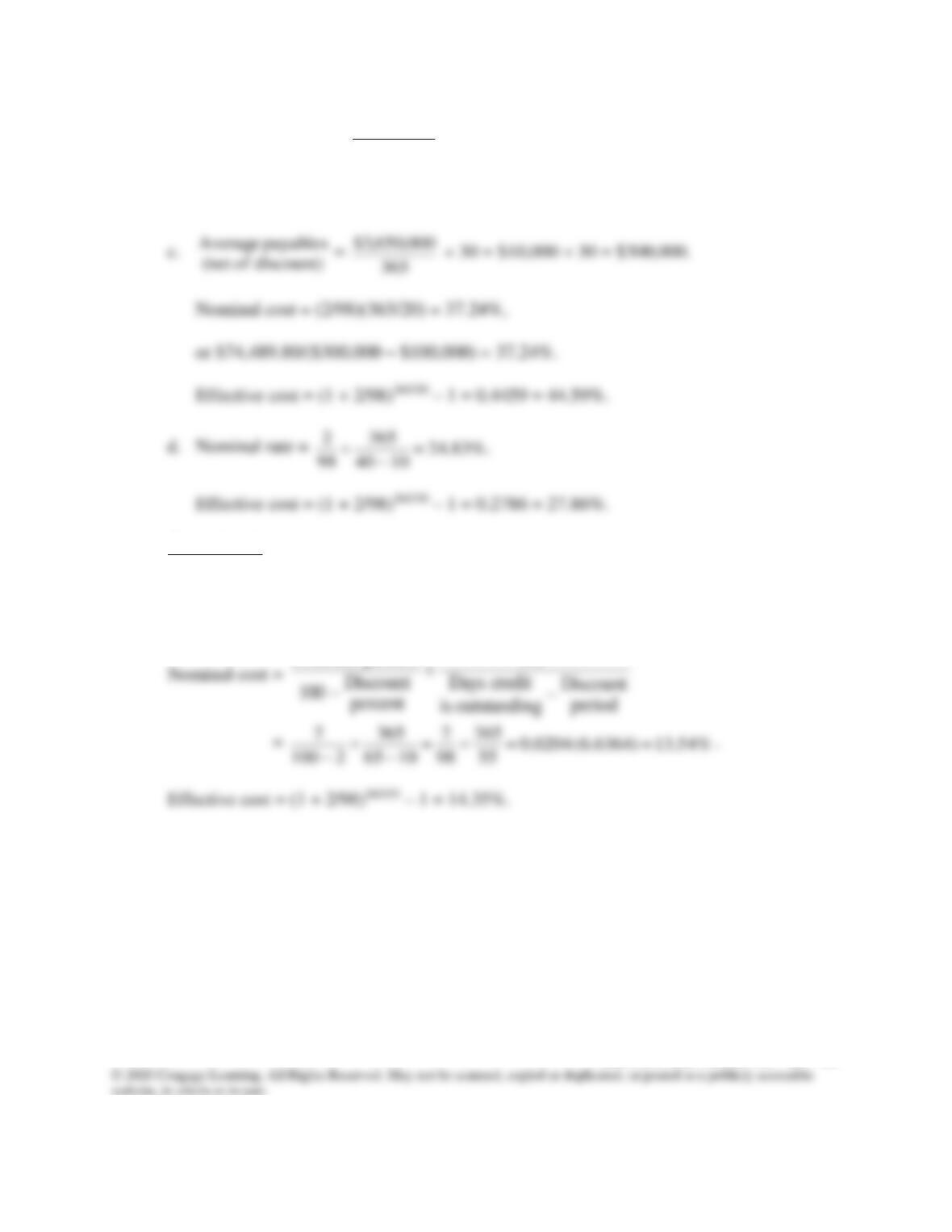
Answers and Solutions: 16 – 13
16-15 a.
payable
accounts Average
=
days 365
000,650,3$
10 days = $10,000 10 = $100,000.
b. There is no cost of trade credit at this point. The firm is using “free” trade credit.
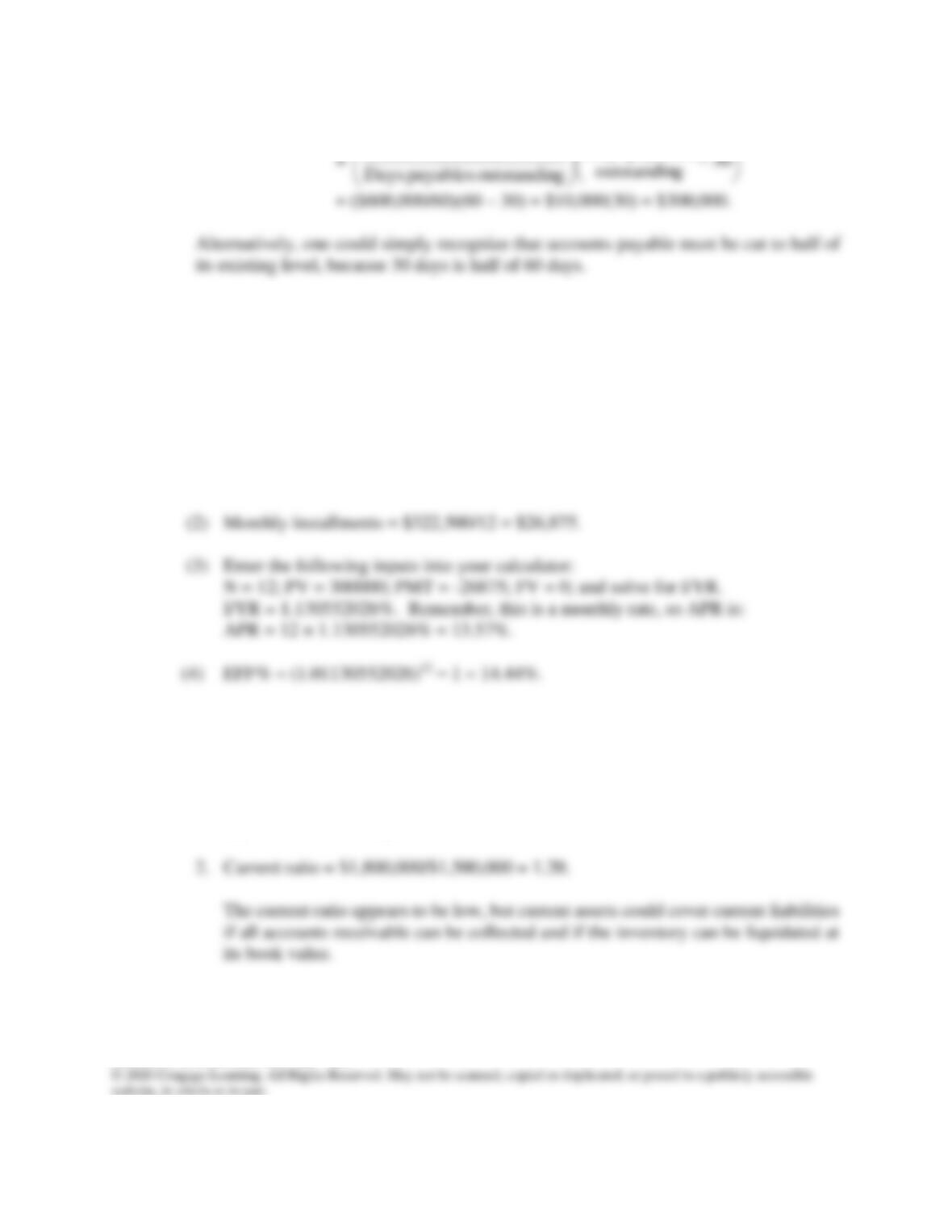
16-16 Trade Credit
Terms: 2/10, net 30. But the firm plans delaying payments 35 additional days, which is
the equivalent of 2/10, net 65.
365
percentDiscount
Answers and Solutions: 16 – 14
16-17 a. Size of bank loan = (Purchases/Day)(Days late)
−
30
payables Days
Purchases
b. Simple interest rate per day = Nominal rate/Days in year
= 0.08/360 = 0.000222222.
Interest charge for month = Rate per day × Loan amount × Days in month
= 0.000222222 × $300,000 × 30
= $2,000.
c. (1) $300,000 × 0.075 = $22,500.
Loan amount = $300,000 + $22,500 = $322,500.
d. Given the limited information, the decision must be based on the rule-of-thumb
comparisons, such as the following:
1. Debt ratio = ($1,500,000 + $700,000)/$3,000,000 = 73%.
Raattama’s debt ratio is 73%, as compared to a typical debt ratio of 50%. The firm
appears to be undercapitalized.