ANSWERS TO CHAPTER QUESTIONS
Chapter 16 Stocks, Bonds, and Mutual Funds
1) Classification Maturity in Years
Money market 0-1
2) Bond maturity dates are correlated with risk. The longer the maturity date the higher
3) Bond ratings provide an assessment, by an independent authority of the risk of default
in interest and principal payments. When ratings are below BBB the authorities are
indicating that they cannot express the opinion that the bonds will likely not have a
default.
4) The three types of bond risks are:
a) Default Risk – The risk of non payment of interest or principal.
5) Bond coupon yield is the annual coupon divided by the par value (usually $1,000).
6) Preferred shares are somewhere between common shares and bonds but closer to
bonds. Like common shares there is no guarantee to repay the sum invested but like
7) Technical analysis generally uses past price and volume to predict future returns.
Fundamental analysis uses a broad array of publicly available information to identify
the “true worth” of an investment and determine whether it is worth purchasing or
holding.
8) A dividend discount model says the current worth of an investment is equal to the
current value of all of its future dividend. So it requires knowledge of the growth rate
9) An open end fund management company stands ready to buy and sell shares at net
asset value. A closed end fund management offers shares at a point in time much like
10) A load fund sells at a price which includes an upfront or continuing commission to
the seller. A true no-load fund provides no commission to the selling agent.
11) The characteristics of the three prominent types of load fuds are as follows:
a) Type A Funds – An upfront commission to the selling agent.
12) Separate accounts assets are placed in an individual client account while mutual
funds pool together many clients’ assets.
13) An exchange traded fund is one in which shares track an independent index of
14) The Sharpe ratio and the alpha coefficient both attempt to measure risk adjusted
performance. The Sharpe ratio uses standard deviation which tracks return results
15) No. The benchmark is wrong. The DJIA is an index of large companies. The
16) The four key steps in selecting a mutual fund are:
a) Compare Fund Returns – use as benchmark funds like the one selected.
b) Look at Fund Risk – Pay attention to such risk measures as standard deviation and
ANSWERS TO CHAPTER PROBLEMS
Chapter 16 Stocks, Bonds, and Mutual Funds
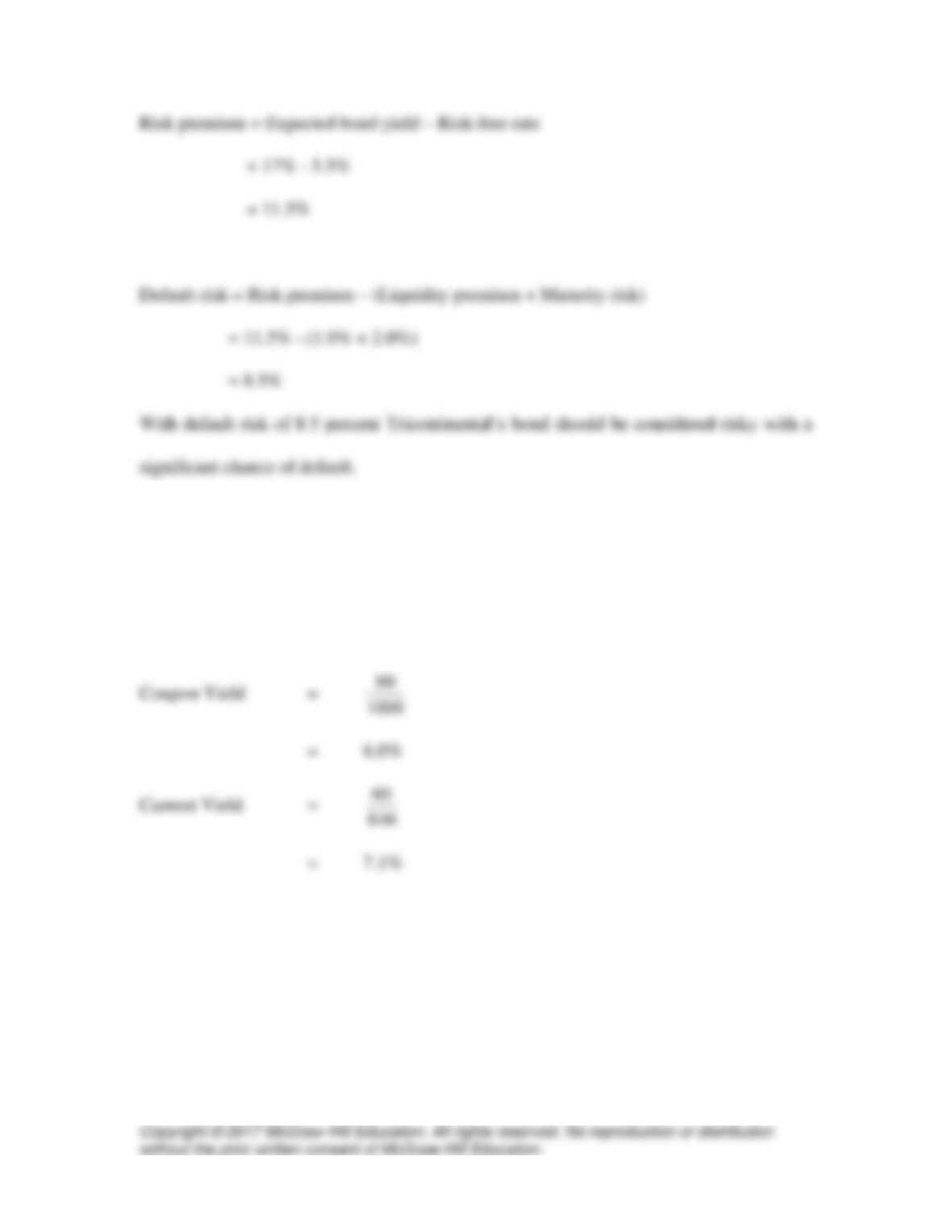
1) Tricontinental’s bond had a liquidity risk of 1 percent, a maturity risk of 2 percent, a
pure rate of return of 1.5 percent, and an inflation premium of 4.0 percent. If the
expected bond yield was 17 percent, what was the default risk? What does your
answer indicate about this bond?
Excel Solution
Tricontinental Bond
Pure Rate of Return 1.5%
Tricontinental Bond
Pure Rate of Return 1.5%
2) Multicolor Corp. had an annual coupon of $60.00, a face value of $1,000, and a
market value of $840. Calculate the coupon yield and the current yield.
Solution:
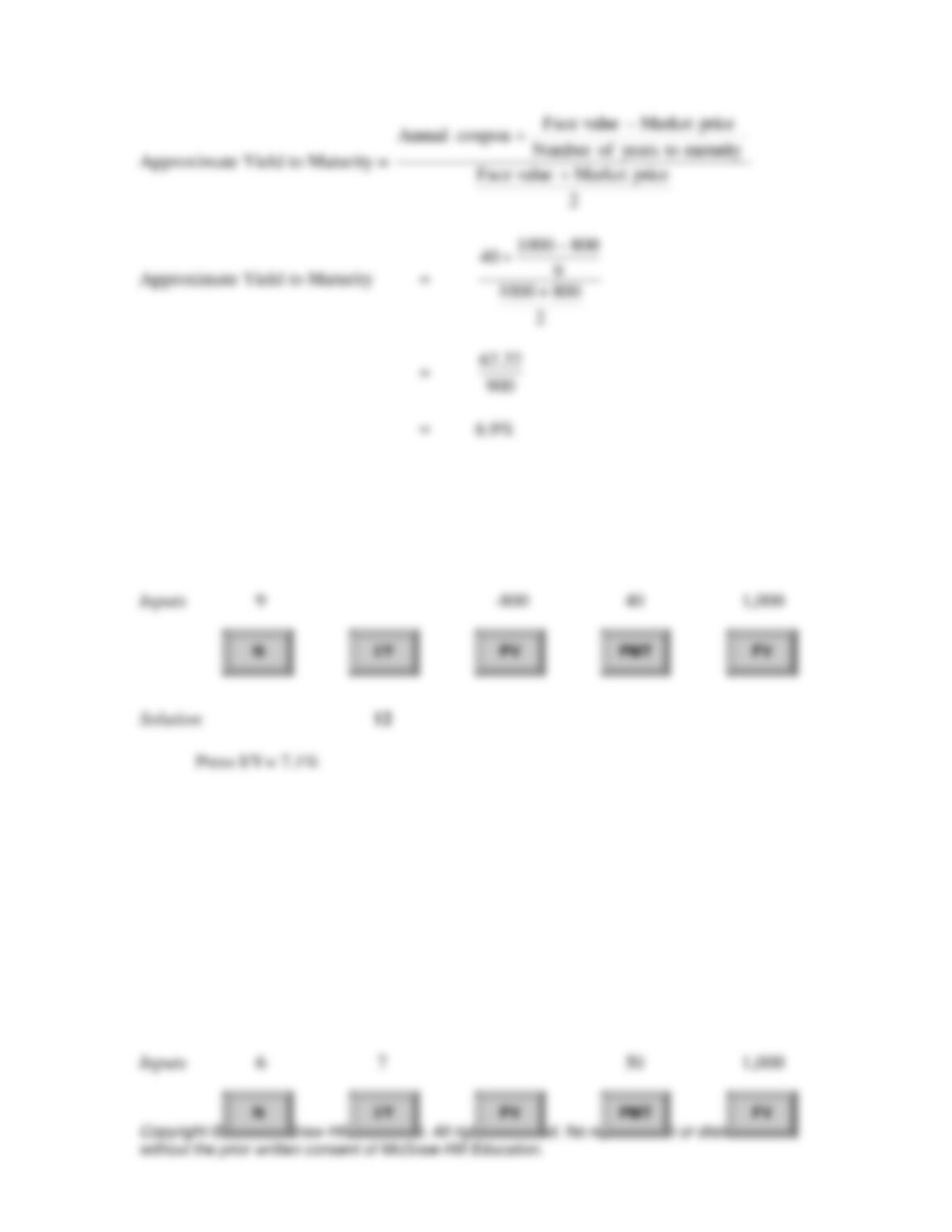
3) Beth bought a bond at $800 with annual coupon payments of $40. If the bond is due
in nine years and has a par value of $1,000, what is her yield to maturity under both
the approximate method and the more exact method?
Solution:
Yield to Maturity
Calculator Solution
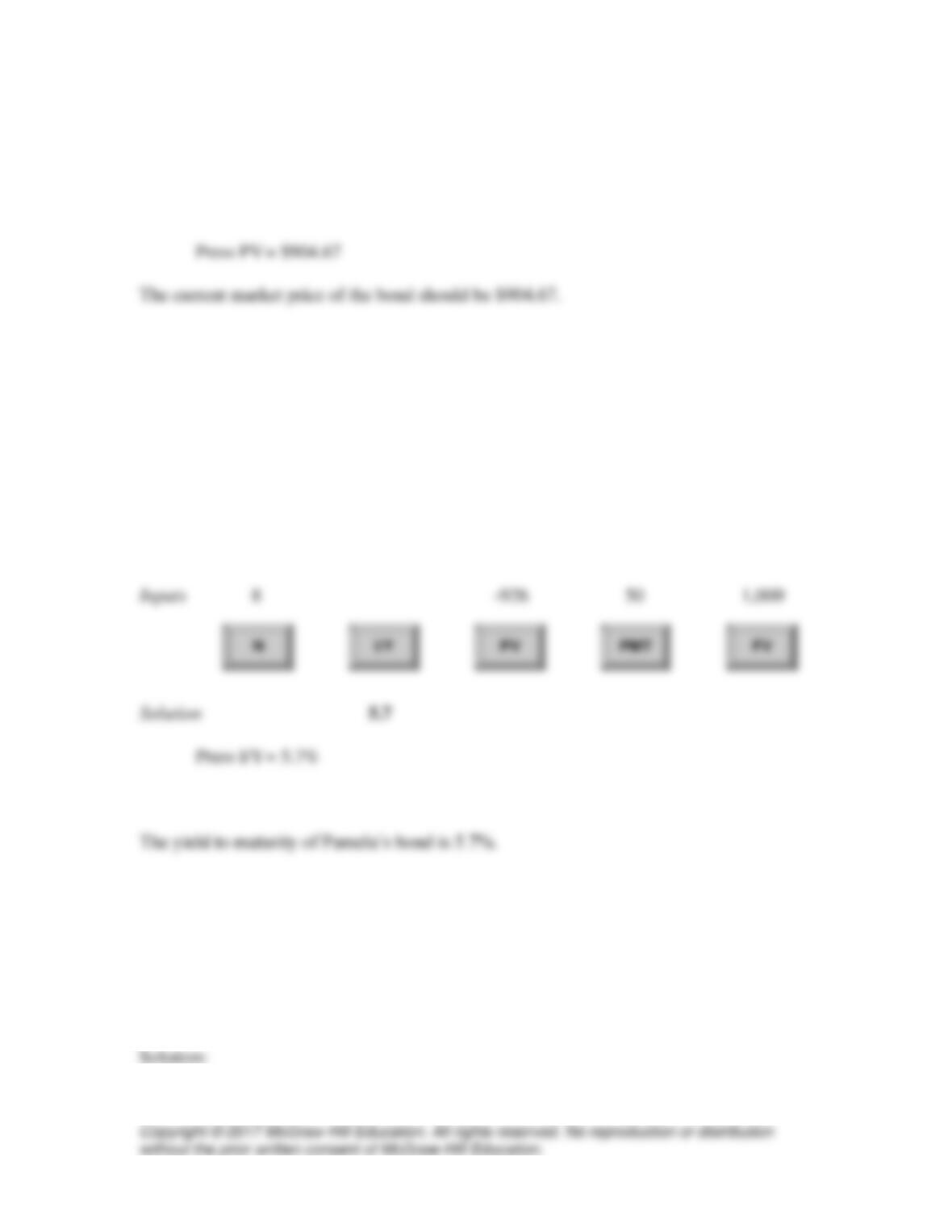
4) If a bond has annual interest payments of $50 and a par value of $1,000, with six
years to maturity, what is its current market value if bonds like it are currently
offering a 7 percent yield?
Calculator Solution
Solution 904.67
5) Pamela bought a bond for $926 with a face value of $1,000 and an annual coupon of
$50. If the bond matures in 18 years, what is her yield to maturity?
Calculator Solution
6) If a preferred stock has annual payments of $6.00 and a required rate of return of 8
percent, what is its current price?
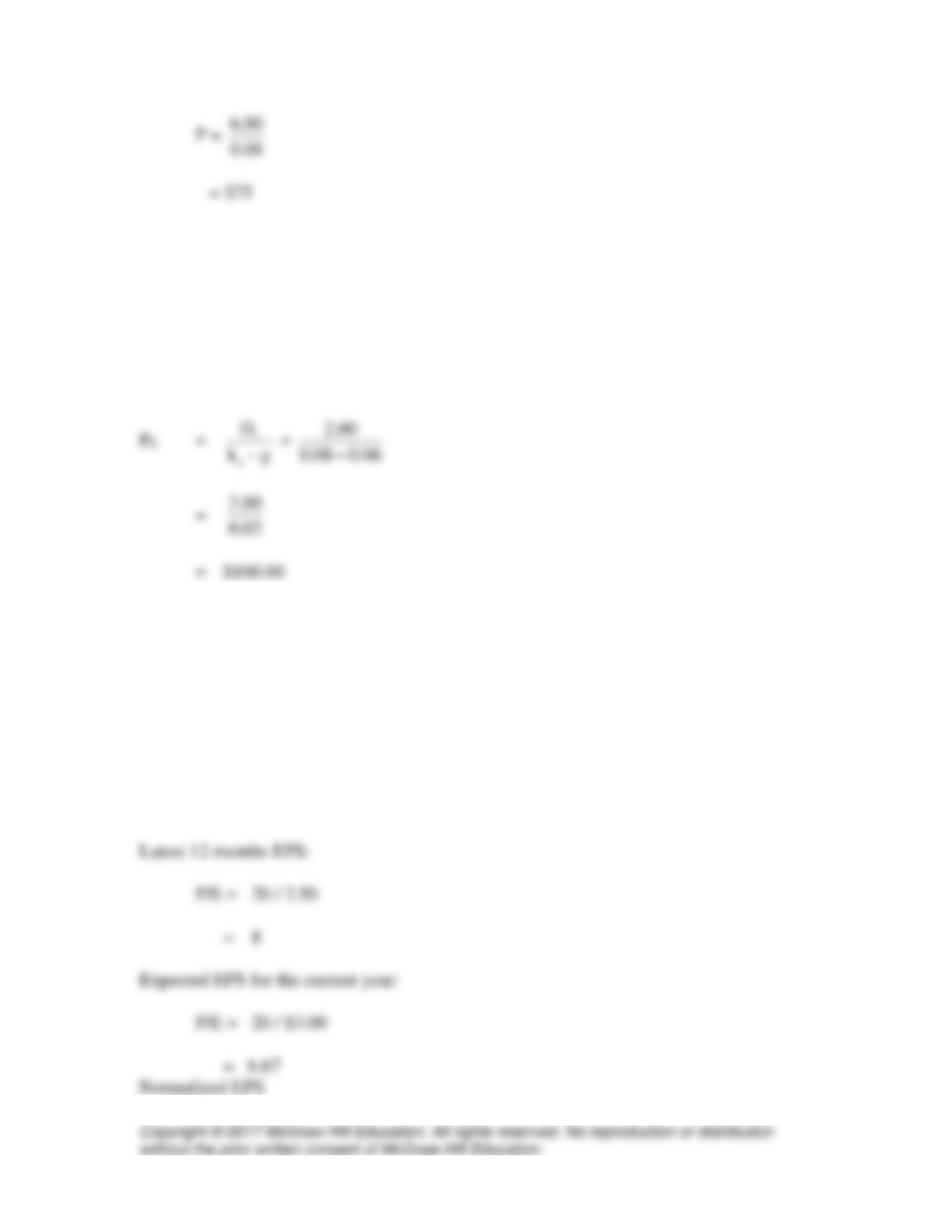
7) Y Co. has a projected dividend of $2.00, has a required rate of return of 8 percent,
and is expected to grow 6 percent a year. Solve for its anticipated stock price.
Solution:
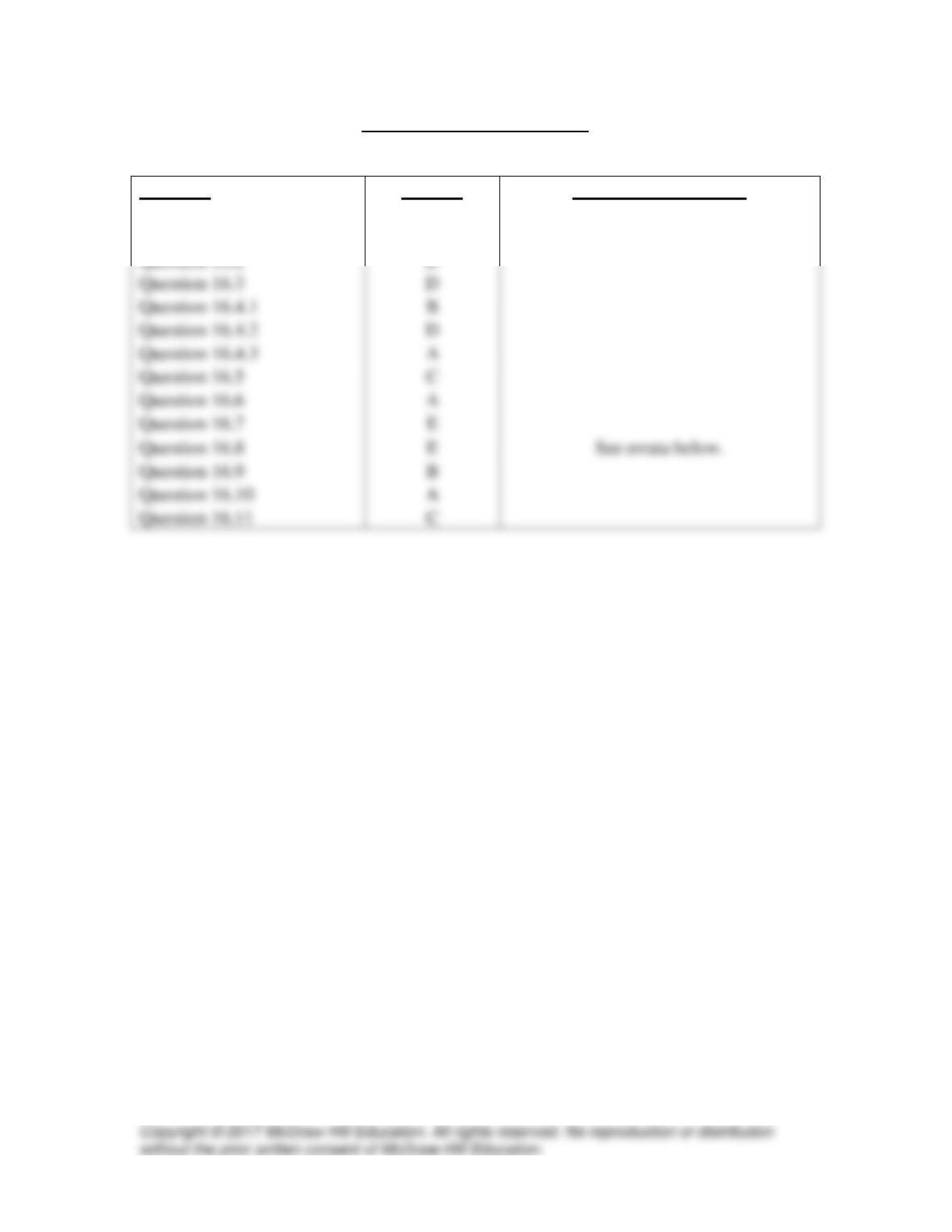
8) X Co. has the latest 12 months’ earnings per share (EPS) of $2.50, expected EPS in
the current year of $3.00, and normalized EPS of $4.00. If its current stock price is
$20, solve for its three P/E multiples based on the separate time frames given.
Solution:

Answers to CFP® Questions
Question
Answer
Author’s Explanation
Question 16.1
B
Question 16.2
D
Question 16.3
D
Question 16.4.1
B
Question 16.4.2
D
Question 16.4.3
A
Question 16.5
C
Question 16.6
A
Question 16.7
Question 16.8
Question 16.9
B
Question 16.10
A
Question 16.11
C
ERRATA TO CFP® CERTIFICATION EXAMINATION QUESTIONS AND
PROBLEMS
16.8
The alternative a. should read “the par value of the common stock”
SOLUTIONS TO SELECTED CFP® CERTIFICATION EXAMINATION
PROBLEMS
1
16.5
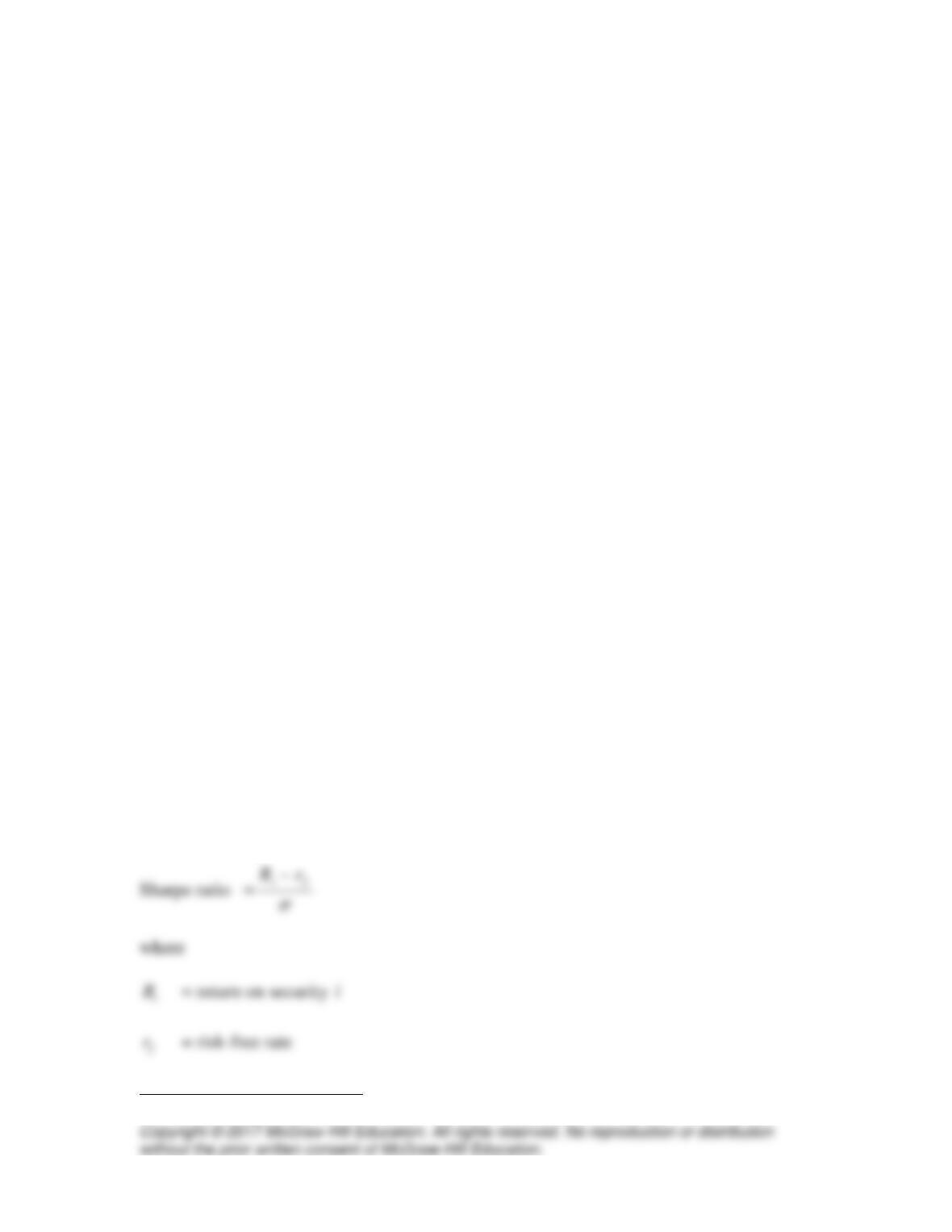
The Performance Fund had returns of 19 percent over the evaluation period and the
benchmark portfolio yielded a return of 17 percent over the same period. Over the
evaluation period, the standard deviation of returns from the fund was 23 percent and the
standard deviation of returns from the benchmark portfolio was 21 percent. Assuming a
risk-free rate of return of 8 percent, which one of the following is the calculation of the
Sharpe index for the fund over the evaluation period?
a. .3913
b. .4286
c. .4783
d. .5238
e. .5870
Solution:
1
The solutions supplied are those of the author and not of the CFP Board.
16.7
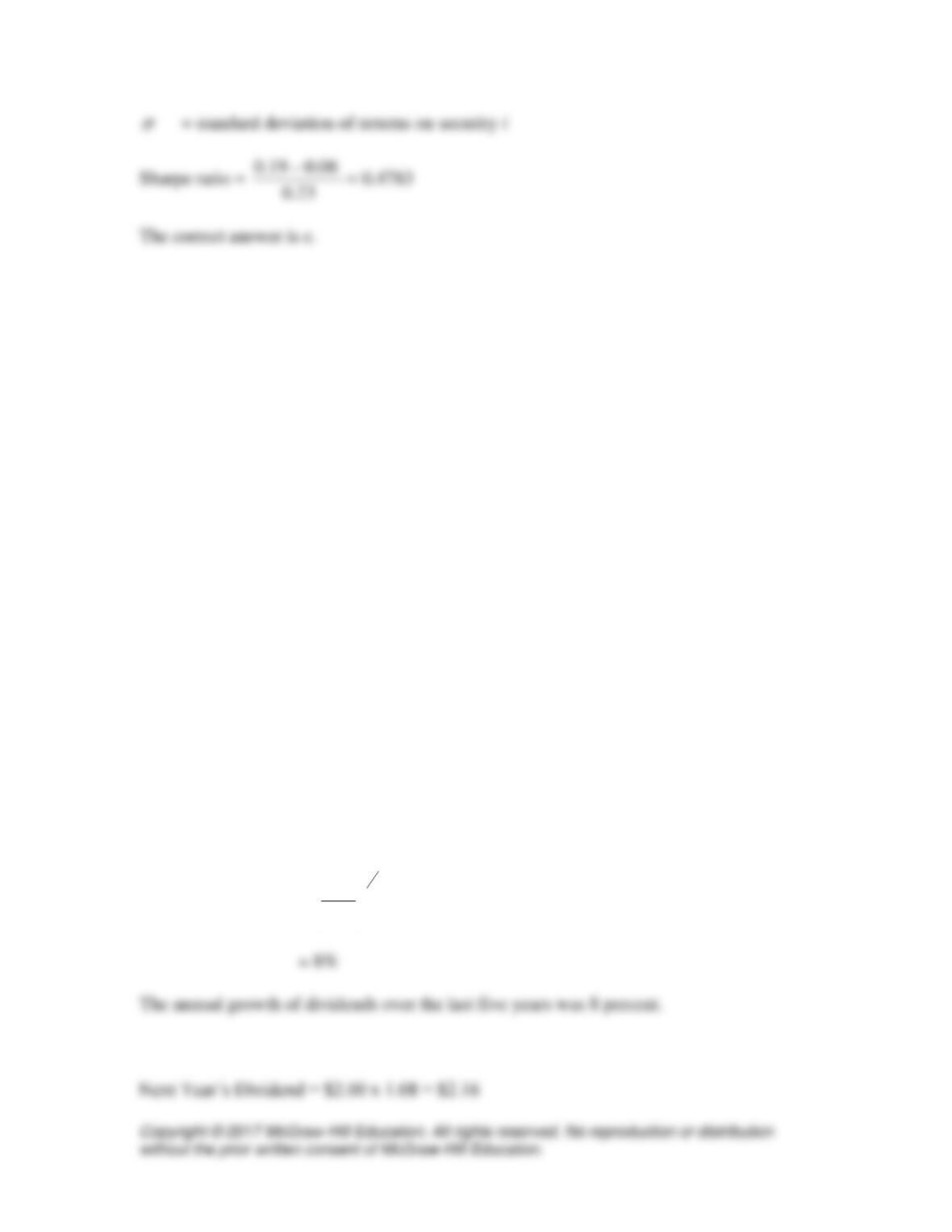
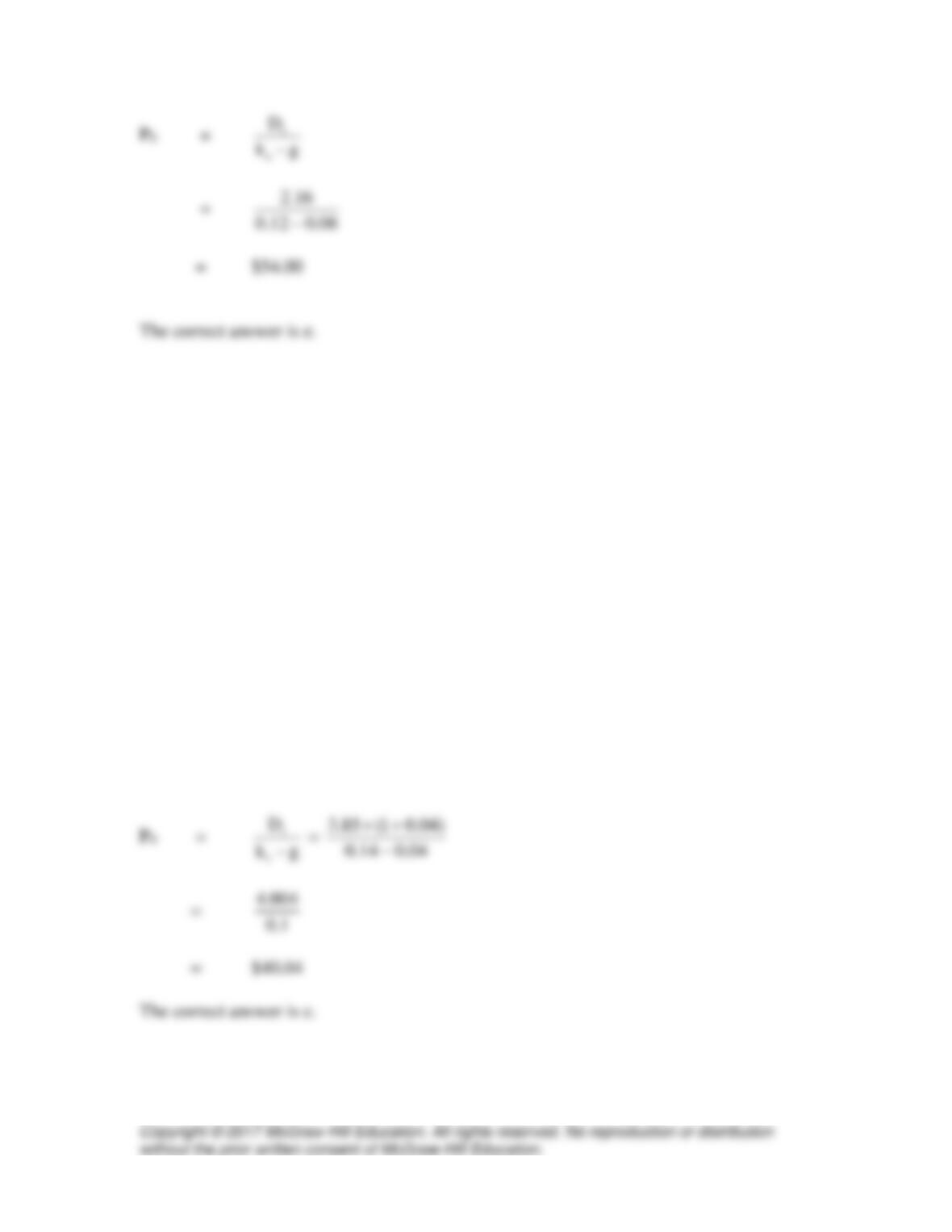
The current annual dividend of ABC Corporation is $2.00 per share. Five years ago, the
dividend was $1.36 per share. The firm expects dividends to grow in the future at the
same compound annual rate as they grew during the past five years. The required rate of
return on the firm’s common stock is 12 percent. The expected return on the market
portfolio is 14 percent. What is the value of a share of common stock of ABC
Corporation using the constant dividend growth model?
a. $11
b. $17
c. $25
d. $36
e. $54
Solution:
Dividend Growth =
1
36.1
00.2 5
1
−
16.11
The Zeta Corporation’s current dividend is $3.85. If future dividends are expected to
grow at 4 percent forever, which of the following amounts should Zeta stock sell for if
the required rate of return on the stock is 14 percent?
a. $28.57
b. $38.50
c. $40.04
d. $41.60
Solution: