Chapter 16
Capital Structure Decisions
ANSWERS TO BEGINNING-OF–CHAPTER QUESTIONS
16-1 Business risk is the risk inherent in the firm’s operating income. It is measured by the
standard deviation of expected future operating income. It is affected by many factors,
including the firm’s ability to raise prices if costs increase, the extent to which sales can be
predicted, and operating leverage, which reflects the use of fixed costs, or costs that do not
decline with decreases in sales. If a firm uses more operating leverage than an otherwise
implicitly assumed that the firm’s sales are independent of its use of operating leverage.
However, this might not be true. Higher fixed costs are generally accompanied by lower
variable costs, and producers with low variable costs can, under certain conditions, achieve
a monopoly position by doing the following: (1) Charge a price that is above their own
(low) variable cost but below the variable costs of other producers. (2) The high cost
16-2 Financial leverage relates to the use of fixed charge securities (debt and preferred stock).
Since the charges associated with debt and preferred are fixed, they do not decline when
sales and operating profits decline. Therefore, the more debt and preferred the firm uses,
the greater the risk borne by the common stockholders
If the firm is exposed to a great deal of business risk, then its operating income is subject
16-3 Modigliani and Miller are Nobel Prize winning financial economists who did pioneering
work on capital structure theory. They concluded that, under a specific set of assumptions,
16-4 If managers thought MM were correct—i.e., that their assumptions were true—then they
would use 100% debt. Since firms do not generally set capital structures with 100% debt,
16-5 The trade–off theory modifies MM and brings in the effects of bankruptcy, taxes, and so
forth. Whereas MM produce precise results under specific assumptions, the trade-off
theory produces nebulous, imprecise results. Still, the trade-off results are more consistent
with real world observations than are the MM results. See the graph on a separate tab in
16-6 When companies finance with stock, they bring in new investors. If management thinks
that things in the future will be a lot better, they would not want to bring in new equity
investors, as this would mean more shares outstanding and a dilution of the current equity.
So, if management sees good times ahead, the preferred financing vehicle is debt.
16-7 The optimal capital structure is the debt/equity mix that causes the firm’s value to be
maximized. This same structure also minimized the WACC.
16-8 The primary focus should be on the market value capital structure for a number of reasons:
Answers and Solutions: 16 – 3
Firms are interested in maximizing market values, so decisions should be based on
market values and the effects of different actions on those values.
Book values measure historical costs, whereas market values reflect expected cash
such as real estate or inventories, and if those assets’ market values are close to their book
values, then analysts may focus on book values because they are easier to quantify.
However, in this instance, it really doesn’t matter if one uses book or market values,
because book values are a good proxy for market values. However, when book and market
values depart, no competent analyst pays much attention to book value figures.
coming out of school today should be learning how to use the available technology to make
technically correct decisions.
Finally, we should note that the tab labeled M-B in the model (also shown in the output
at the end of these answers) shows the errors in WACCs based on book values. If the
market and book values of the firm’s securities are approximately equal, there is no error,
16-9 Finance theory suggests that firms should use at least some debt in order to gain the benefits
of interest deductibility and perhaps other advantages. Most firms do indeed use some
debt. So, if a firm announced a recapitalization in which it will issue some debt and use
the proceeds to retire common equity, investors would probably respond favorably, raising
Answers and Solutions: 16 – 4

ANSWERS TO END-OF-CHAPTER QUESTIONS
16-1 a. Capital structure is the manner in which a firm’s assets are financed; that is, the right–
hand side of the balance sheet. Capital structure is normally expressed as the
percentage of each type of capital used by the firm—debt, preferred stock, and common
equity. Business risk is the risk inherent in the operations of the firm, prior to the
b. Operating leverage is the extent to which fixed costs are used in a firm’s operations. If
a high percentage of a firm’s total costs are fixed costs, then the firm is said to have a
high degree of operating leverage. Operating leverage is a measure of one element of
c. Reserve borrowing capacity exists when a firm uses less debt under “normal”
conditions than called for by the tradeoff theory. This allows the firm some flexibility
to use debt in the future when additional capital is needed.
16-2 Business risk refers to the uncertainty inherent in projections of future ROIC = ROEU.
Answers and Solutions: 16 – 6
16-5 If sales tend to fluctuate widely, then cash flows and the ability to service fixed charges
will also vary. Such a firm is said to have high business risk. Consequently, there is a
16-6 Public utilities place greater emphasis on long–term debt because they have more stable
sales and profits as well as more fixed assets. Also, utilities have fixed assets which can
16-7 EBIT depends on sales and operating costs. Interest is deducted from EBIT. At high debt
16-8 The tax benefits from debt increase linearly, which causes a continuous increase in the
firm’s value and stock price. However, financial distress costs get higher and higher as
SOLUTIONS TO END-OF-CHAPTER PROBLEMS
16-1 QBE = F/(P – V) = $500,000/($75 – $50) = 20,000.
16-2 If wd = 0.2, then wce = 1 – 0.2 = 0.8. So D/S = wd/we = 0.2/0.8.
16-3 If the company had no debt, its required return would be:
rs,U = rRF + bU RPM = 5.5% + 1.0(6%) = 11.5%.
16-4 SPost = (1 – wd)(VopNew) = (1 – 0.4)($500) = $300 million.
16-7 a. Here are the steps involved:
(1) Determine the variable cost per unit at present, V:
(2) Determine the new profit level if the change is made:
Answers and Solutions: 16 – 8
(3) Determine the incremental profit:
(4) Estimate the approximate rate of return on new investment:
Since the return exceeds the 15 percent cost of equity, this analysis suggests that the
firm should go ahead with the change.
b. The change would increase the breakeven point:
c. It is impossible to state unequivocally whether the new situation would have more or
less business risk than the old one. We would need information on both the sales
probability distribution and the uncertainty about variable input cost in order to make
this determination. However, since a higher breakeven point, other things held
constant, is more risky. Also the percentage of fixed costs increases:
Answers and Solutions: 16 – 9
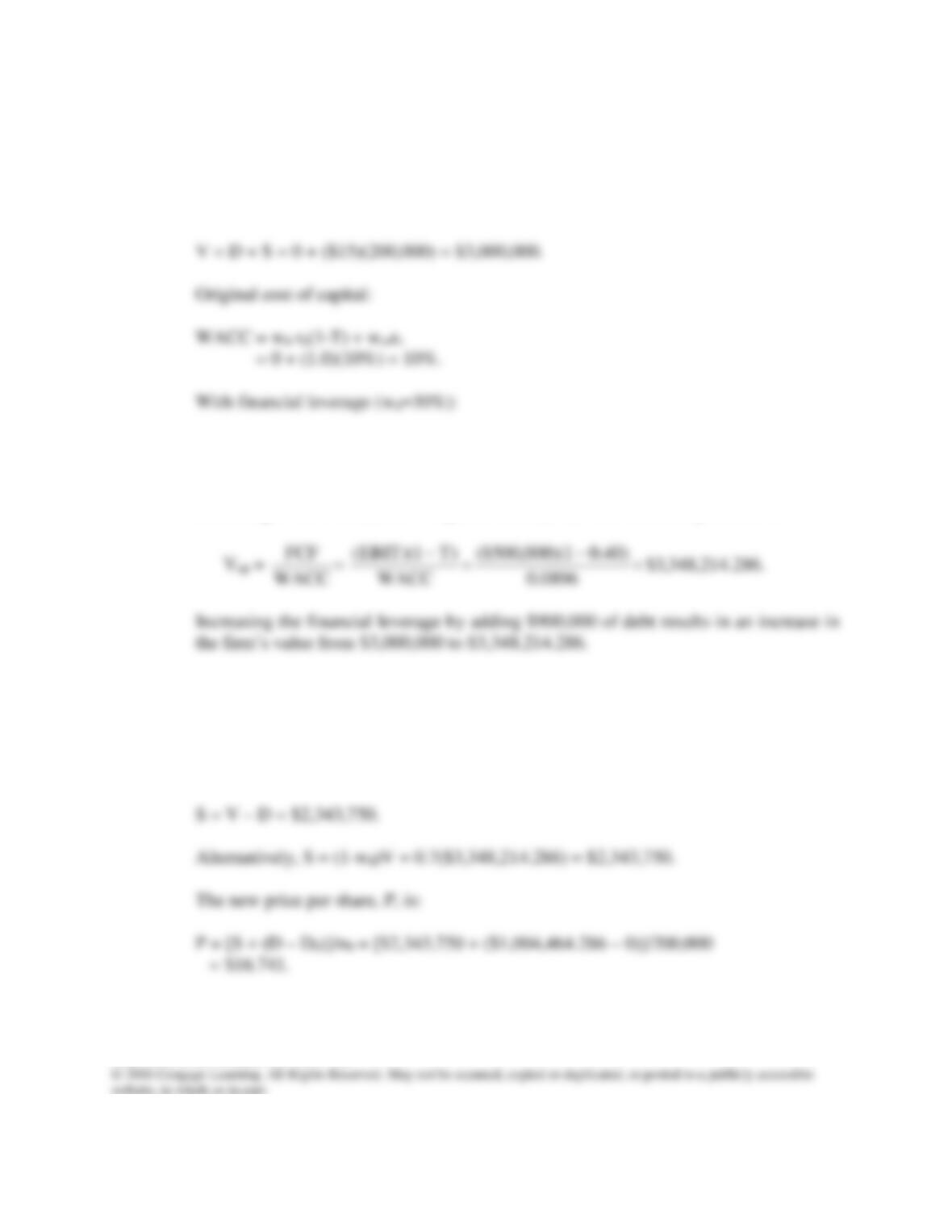
16-8 a. Original value of the firm (D = $0):
We are given that the book value of assets is equal to the market value of assets, so the
value is $3,000,000. Alternatively, we can calculate the value as the sum of the debt
(which is zero) and the stock (200,000 shares at a price of $15 per share):
WACC = wd rd(1–T) + wcers
= (0.3)(7%)(1-0.40) + (0.7)(11%) = 8.96%.
Because growth is zero, FCF is equal to EBIT(1-T). The value of operations is:
b. Using its target capital structure of 30% debt, the company must have debt of:
D = wd V = 0.30($3,348,214.286) = $1,004,464.286.
Therefore, its value of equity is:
Answers and Solutions: 16 – 10
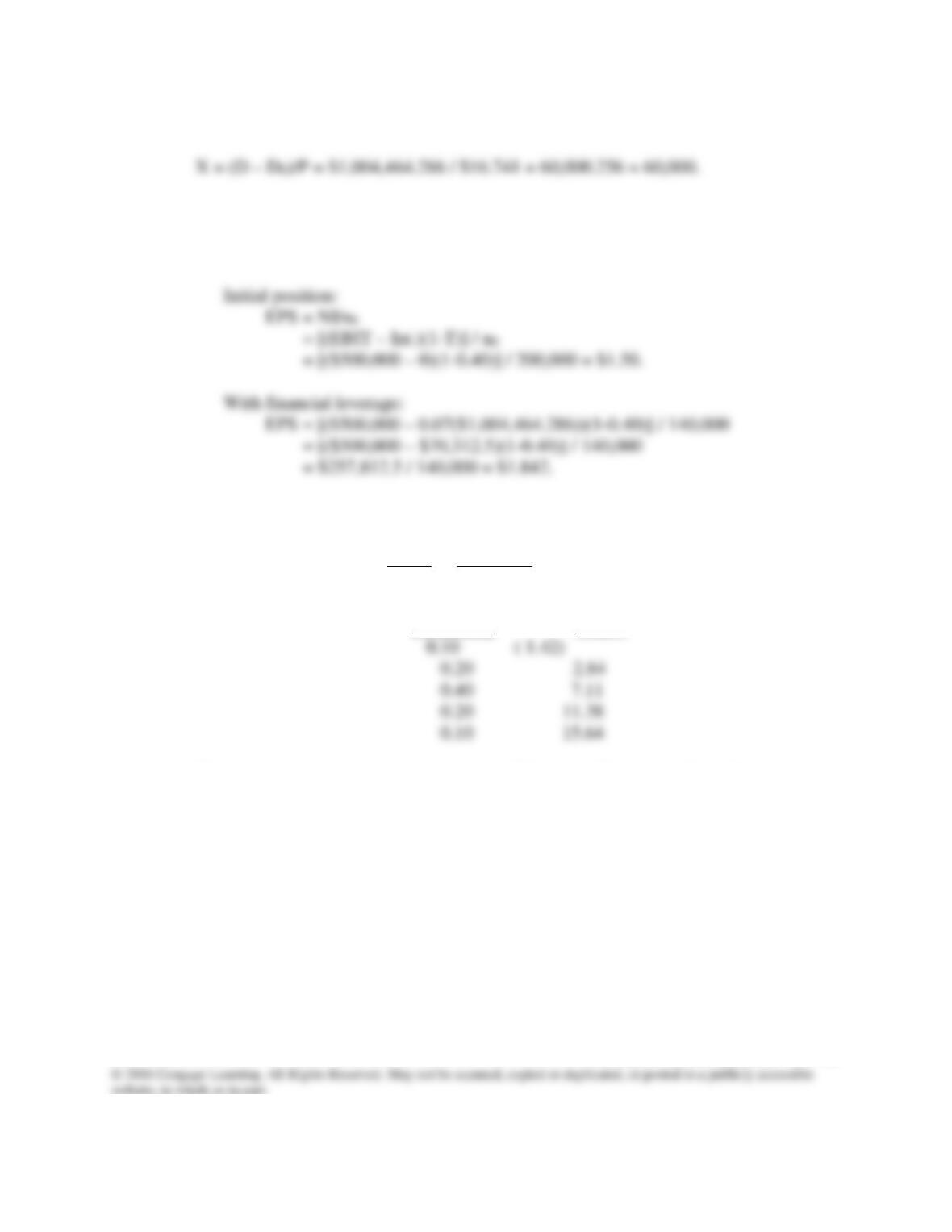
c. The number of shares repurchased, X, is:
The number of remaining shares, n, is:
n = 200,000 – 60,000 = 140,000.
Thus, by adding debt, the firm increased its EPS by $0.342.
d. 30% debt: TIE =
I
EBIT
=
5.312,70$
EBIT
.
Probability TIE
The interest payment is not covered when TIE < 1.0. The probability of this occurring
is 0.10, or 10 percent.
Answers and Solutions: 16 – 11
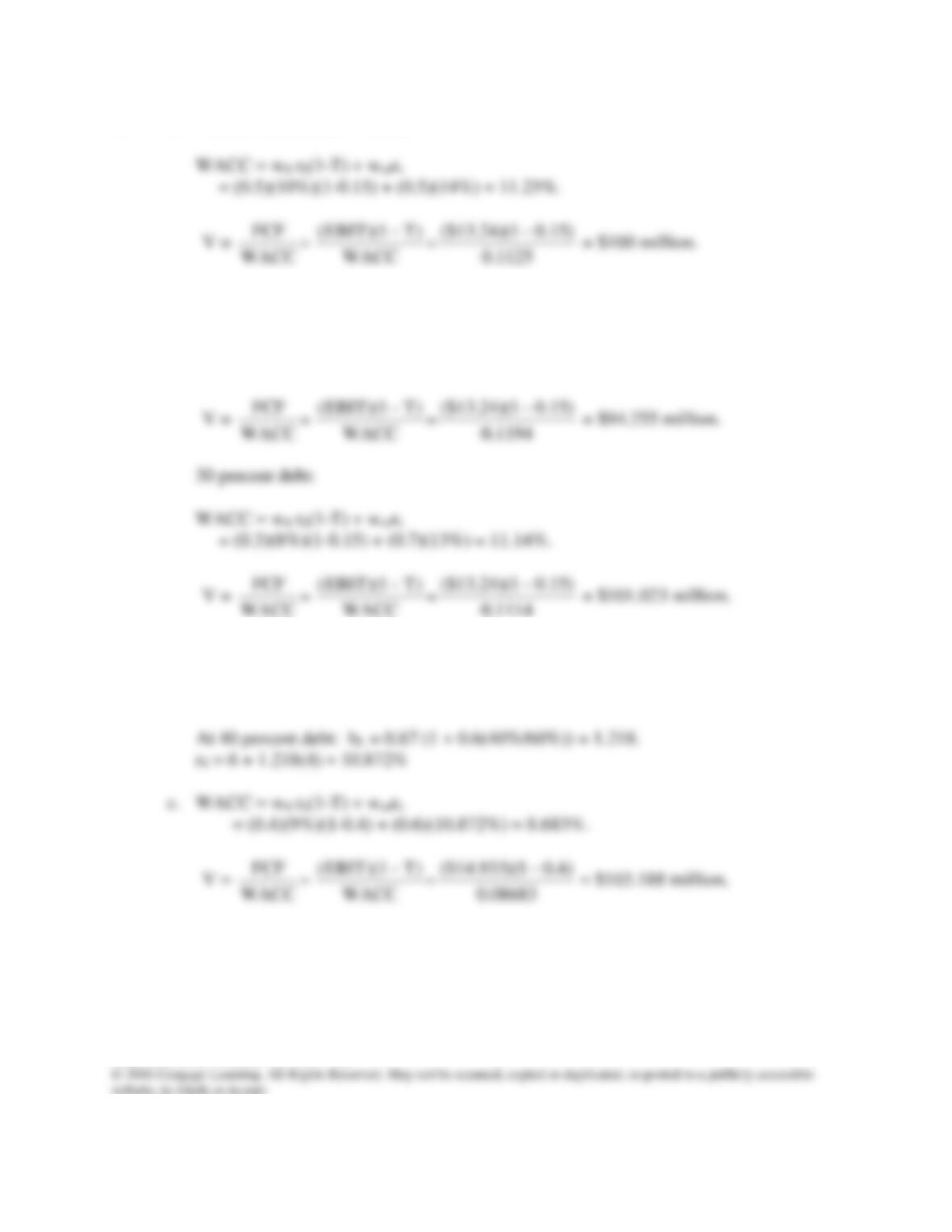
16-9 a. Present situation (50% debt):
70 percent debt:
WACC = wd rd(1–T) + wcers
= (0.7)(12%)(1–0.15) + (0.3)(16%) = 11.94%.
16-10 a. BEA’s unlevered beta is bU=b/(1+ (1–T)(D/S))=1.0/(1+(1–0.40)(20/80)) = 0.870.
b. b = bU (1 + (1–T)(D/S)).
Answers and Solutions: 16 – 12
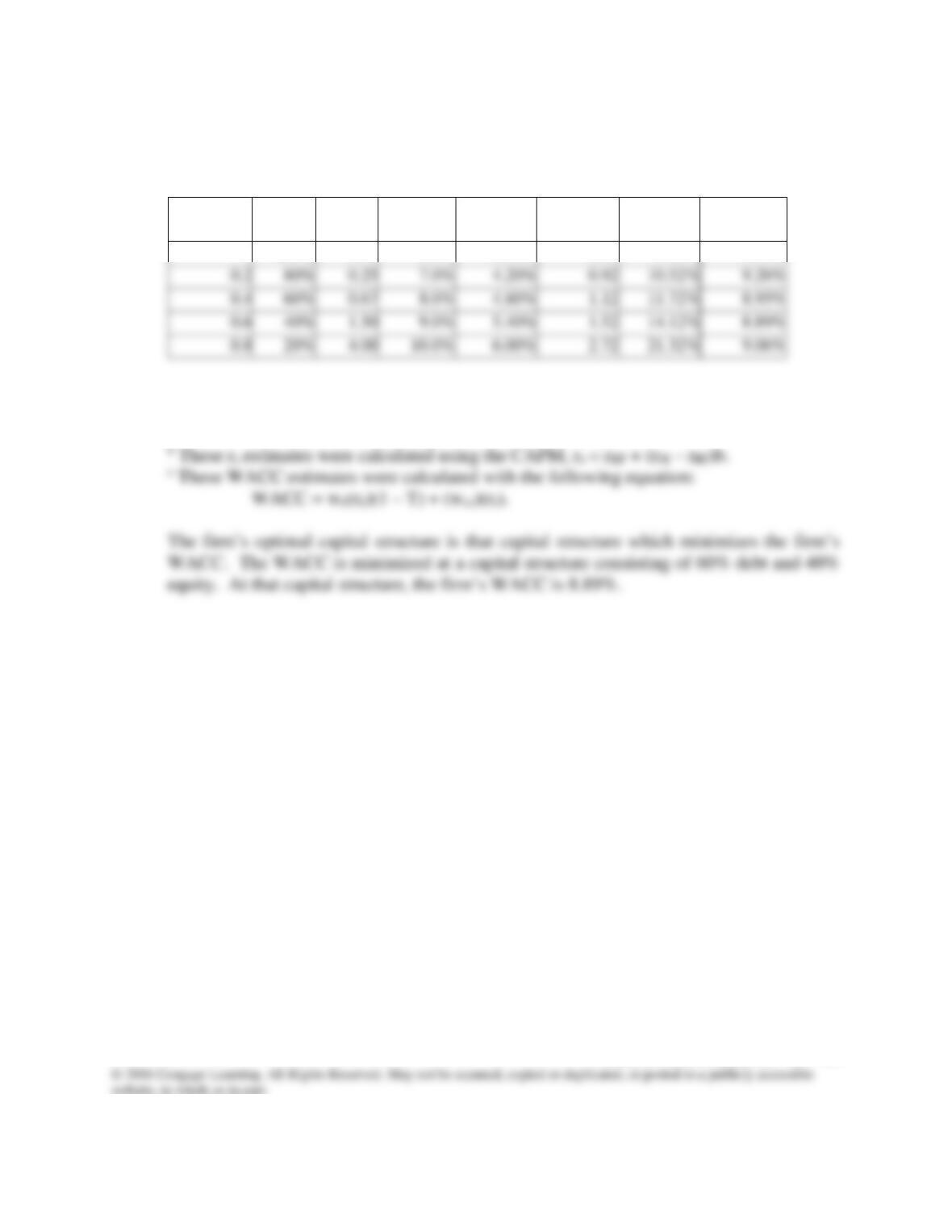
16-11 Tax rate = 40% rRF = 5.0%
bU = 0.8 rM – rRF = 6.0%
From data given in the problem and table we can develop the following table:
wd
wce
D/S
rd
rd(1 – T)
Levered
beta
a
rs
b
WACC
c
0
100%
0.00
6.0%
3.60%
0.80
9.80%
9.80%
Notes:
a These beta estimates were calculated using the Hamada equation,
b = bU[1 + (1 – T)(D/S)].
Answers and Solutions: 16 – 13
0.25
7.0%
4.20%
0.92
9.26%
0.67
8.0%
4.80%
1.12
8.95%
1.50
9.0%
5.40%
1.52
8.89%
4.00
10.0%
6.00%
2.72
9.06%