Answers and Solutions: 15 – 1
Chapter 15
Distributions to Shareholders:
Dividends and Repurchases
ANSWERS TO BEGINNING-OF-CHAPTER QUESTIONS
15-1 Investors who prefer a high payout policy would generally (a) need current cash income
and (b) be in a low income tax bracket. Those who prefer a low payout would not need
cash currently and would be in a high tax bracket. Universities and other tax-exempt
institutions, and many retirees, are examples of those who prefer cash dividends, while
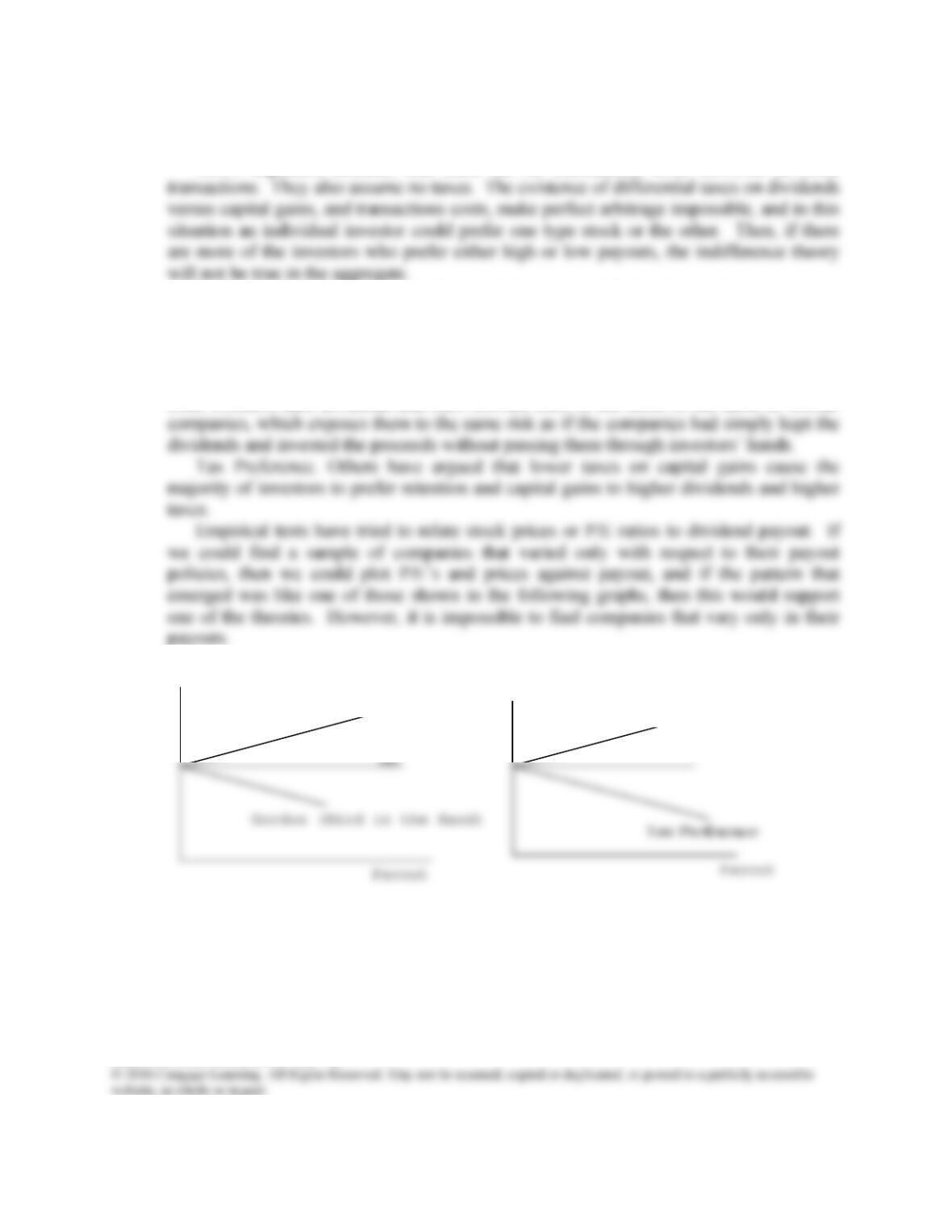
15-2 Here are the three theories, which are illustrated in the BOC model. They should be
thought of as applying to investors in the aggregate and not to each individual investor,
because, obviously, different individuals will certainly have different preferences.
MM Indifference. Investors in the aggregate don’t care. Those who like dividends
Answers and Solutions: 15 – 2
Had L’s stock had the higher price, then its holders who did not want dividends could
sell it, buy H, and then use the excess dividends to buy more of H’s stock.
MM’s argument assumes that there are no transactions costs involved in stock
Bird in the Hand. There’s an old proverb that says “a bird in the hand is worth two in
the bush.” Myron Gordon, who developed the Discounted Dividend Model, argued that
investors think a dividend in the hand is less risky than a potential capital gain in the
bush. This leads to the conclusion that rs falls as the payout ratio is increased. MM
criticized Gordon and called his position “the bird in the hand fallacy.” MM argued that
most investors take dividends and then reinvest them in the stock of the same or similar
Things other than payout are simply never held constant. In particular expected
growth rates vary across companies, so a high price could be associated with a high
expected growth rate, not necessarily a high payout ratio. Also, we can’t measure either
rs or expected g precisely. So, the tests have not been conclusive.
G
ordon
(
Bird in the Hand
)
Tax Preference
S
tock Price
rs
Answers and Solutions: 15 – 3
15-3 Historically, companies have been reluctant to cut their dividends–they don’t cut
dividends unless things really look horrible to management. Moreover, investors know
about management’s reluctance to cut dividends. Therefore, if a firm cuts its dividends,
investors take this as a negative signal—a sign that the firm is in grave danger–and the
stock tanks. As a result, firms are reluctant to raise their dividend unless they are
confident that future earnings and cash flows will be strong enough to support the higher
The clientele effect means that a firm, through its dividend policy, attracts a set of
investors who wants the particular policy the firm follows. For example, if a firm follows
a policy of paying out most of its earnings as dividends, it will attract a clientele of
investors who are in low tax brackets and who desire high current cash income rather
than future capital gains. A company with a low payout policy would attract high tax
bracket investors who wanted to save rather than spend currently their corporate income.
another.
Signaling and clientele effects make empirical tests more difficult—they make it
harder to sort out whether investors in the aggregate prefer dividends or retention. Note
too that different investors are likely to prefer different policies. Therefore, if a firm
changes its policy, some will like it while others will dislike it, and it may look like
investors are indifferent when they really care, but in opposite directions. Of course, if
Answers and Solutions: 15 – 4
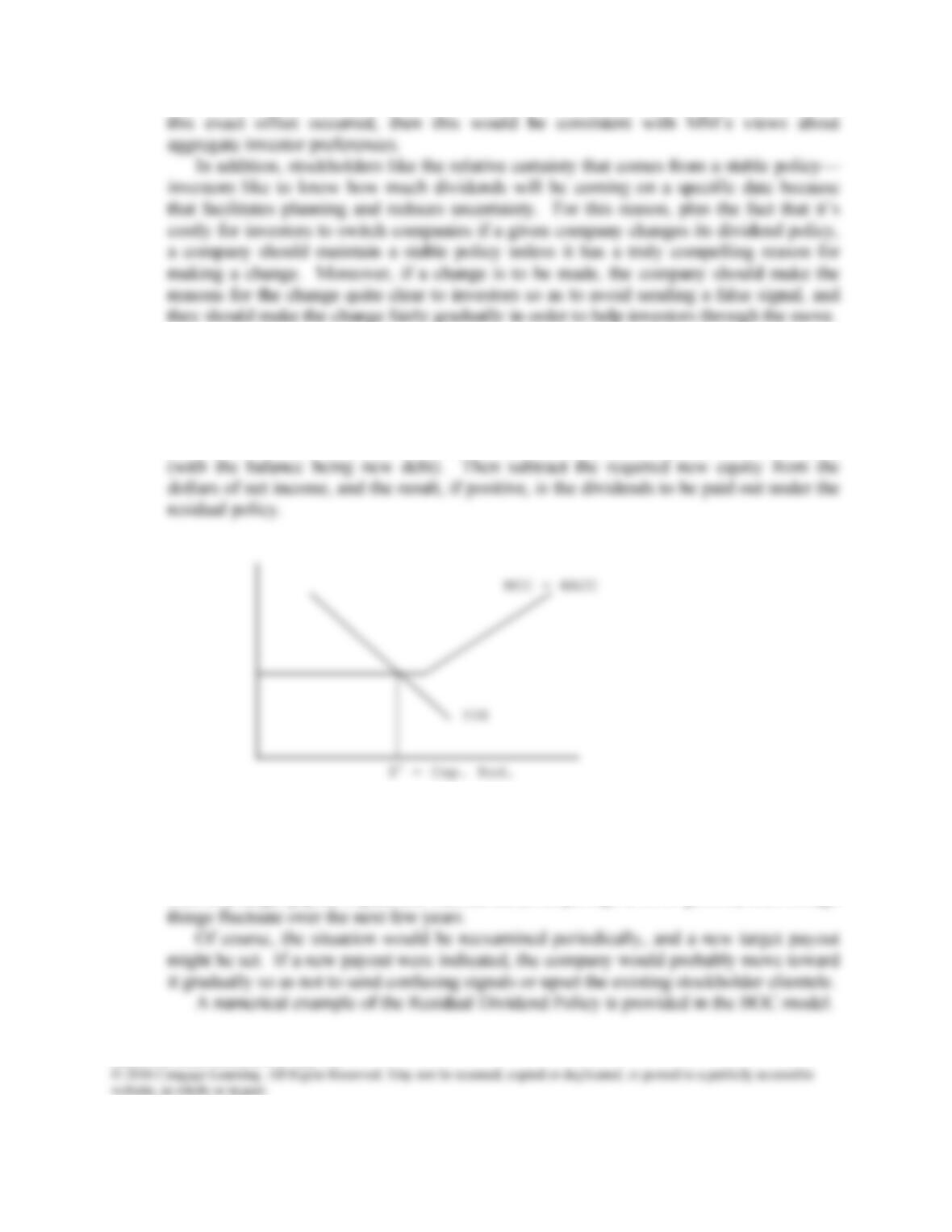
15-4 Residual implies left over, and the residual dividend policy implies that dividends are
paid only after the company has used all necessary earnings to finance its capital budget.
Note in the following graph that the firm has a cost of capital schedule and an investment
opportunity schedule, and the optimal capital budget is found at the intersection of those
two curves, at $*. Multiply $* times the optimal equity ratio to get the required equity
The dividends as thus determined would vary from year to year as the IOS and MCC
curves shift, and as net income varies. That would lead to fluctuating dividends, which
would not be good. Therefore, in practice the residual model is used, with “normalized”
data for say the next 5 years, to find a target payout ratio. Then, the dividend that comes
from that target payout is paid and maintained (with perhaps a bit of growth) even though
15-5 The last decade has witnessed a major shift toward using share repurchases in lieu of cash
dividends to distribute cash to investors. If a firm has a clientele of mainly high tax
bracket stockholders who do not want cash income, this would suggest that repurchases
would be a good way to dispose of surplus cash flow. On the other hand, if most of its
stockholders wanted cash income and were non-taxed institutions and/or low tax bracket
15-6 In a stock split, shareholders receive additional shares at no cost. For example, in a 2 for
1 split, each stockholder would receive the same number of new shares as he or she
currently holds. Thus, someone who has 100 shares would receive another 100 shares,
15-7 If such a law were to pass, it would make stocks more attractive to investors, so the pre–
tax required return on stocks (rs) would decline relative to the required return on debt (rd).
That would lead to a shift in capital structures toward a higher percentage of equity. It
Answers and Solutions: 15 – 6
ANSWERS TO END-OF-CHAPTER QUESTIONS
15-1 a. The optimal distribution policy is one that strikes a balance between dividend yield
and capital gains so that the firm’s stock price is maximized.
b. The dividend irrelevance theory holds that dividend policy has no effect on either the
price of a firm’s stock or its cost of capital. The principal proponents of this view are
c. The information content of dividends is a theory which holds that investors regard
dividend changes as “signals” of management forecasts.
Thus, when dividends are raised, this is viewed by investors as recognition by
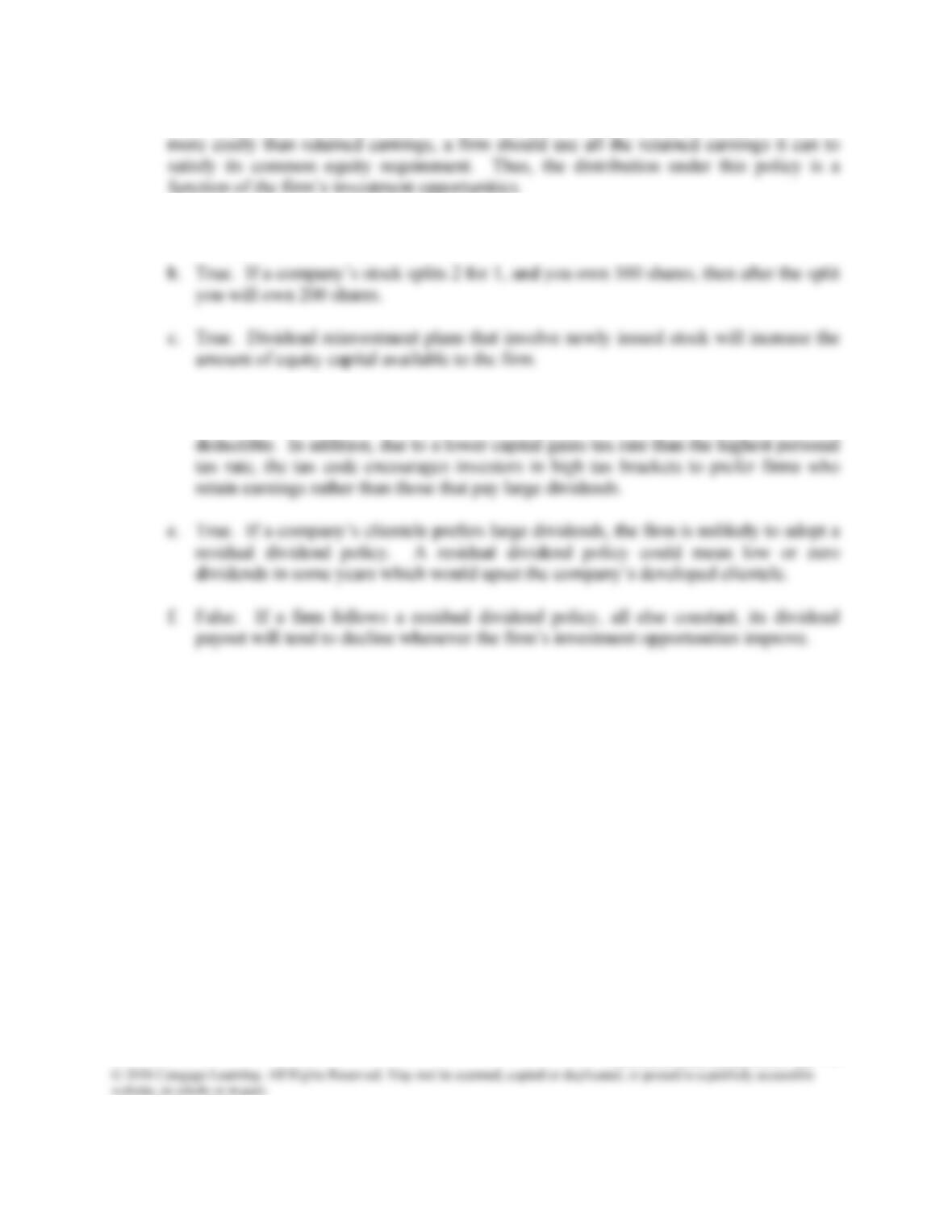
d. The residual distribution model states that firms should make distributions only when
more earnings are available than needed to support the optimal capital budget. An
Answers and Solutions: 15 – 7
e. The declaration date is the date on which a firm’s directors issue a statement
declaring a dividend. If a company lists the stockholder as an owner on the holder-of-
record date, then the stockholder receives the dividend. The ex-dividend date is the
f. Dividend reinvestment plans allow stockholders to automatically purchase shares of
common stock of the paying corporation in lieu of receiving cash dividends. There
g. In a stock split, current shareholders are given some number (or fraction) of shares for
each stock owned. Thus, in a 3-for-1 split, each shareholder would receive 3 new
shares in exchange for each old share, thereby tripling the number of shares
Answers and Solutions: 15 – 8
15-2 a. From the stockholders’ point of view, an increase in the personal income tax rate
would make it more desirable for a firm to retain and reinvest earnings.
Consequently, an increase in personal tax rates should lower the aggregate payout
ratio.
b. If the depreciation allowances were raised, cash flows would increase. With higher
c. If interest rates were to increase, the increase would make retained earnings a
relatively attractive way of financing new investment. Consequently, the payout ratio
d. A permanent increase in profits would probably lead to an increase in dividends, but
e. If investment opportunities for firms declined while cash inflows remained relatively
constant, an increase would be expected in the payout ratio.
f. Dividends are currently paid out of after-tax dollars, and interest charges from before-
15-3 The difference is largely one of accounting. In the case of a split, the firm simply
increases the number of shares and simultaneously reduces the par or stated value per
Answers and Solutions: 15 – 9
15-4 The residual distribution policy is based on the premise that, since new common stock is
15-5 a. True. When investors sell their stock they are subject to capital gains taxes.
d. False. The tax code, through the tax deductibility of interest, encourages firms to use
debt and thus pay interest to investors rather than dividends, which are not tax
Answers and Solutions: 15 – 10
SOLUTIONS TO END-OF-CHAPTER PROBLEMS
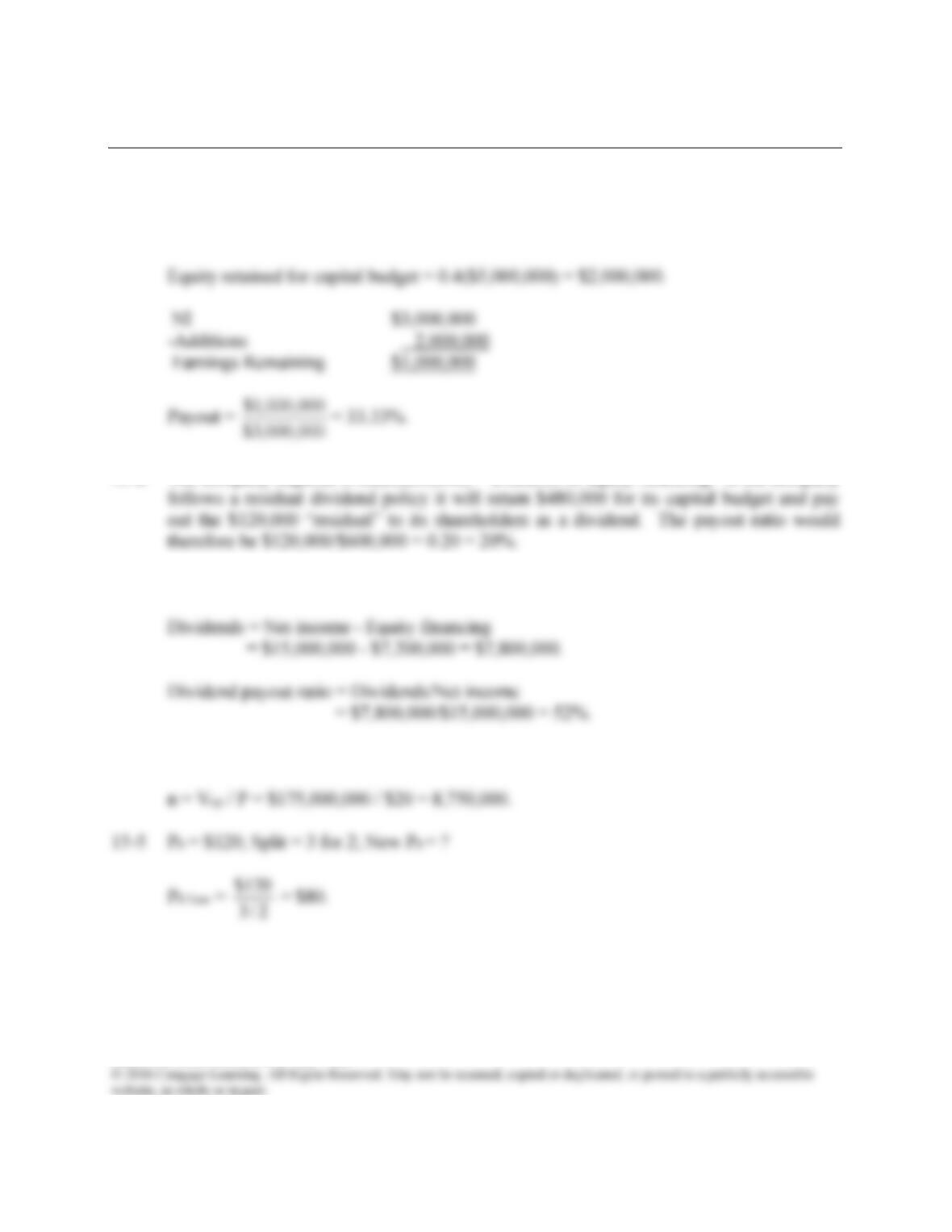
15-1 60% Debt; 40% Equity; Capital Budget = $5,000,000; NI = $3,000,000;
PO = ?
15-2 The company requires 0.40($1,200,000) = $480,000 of equity financing. If the company
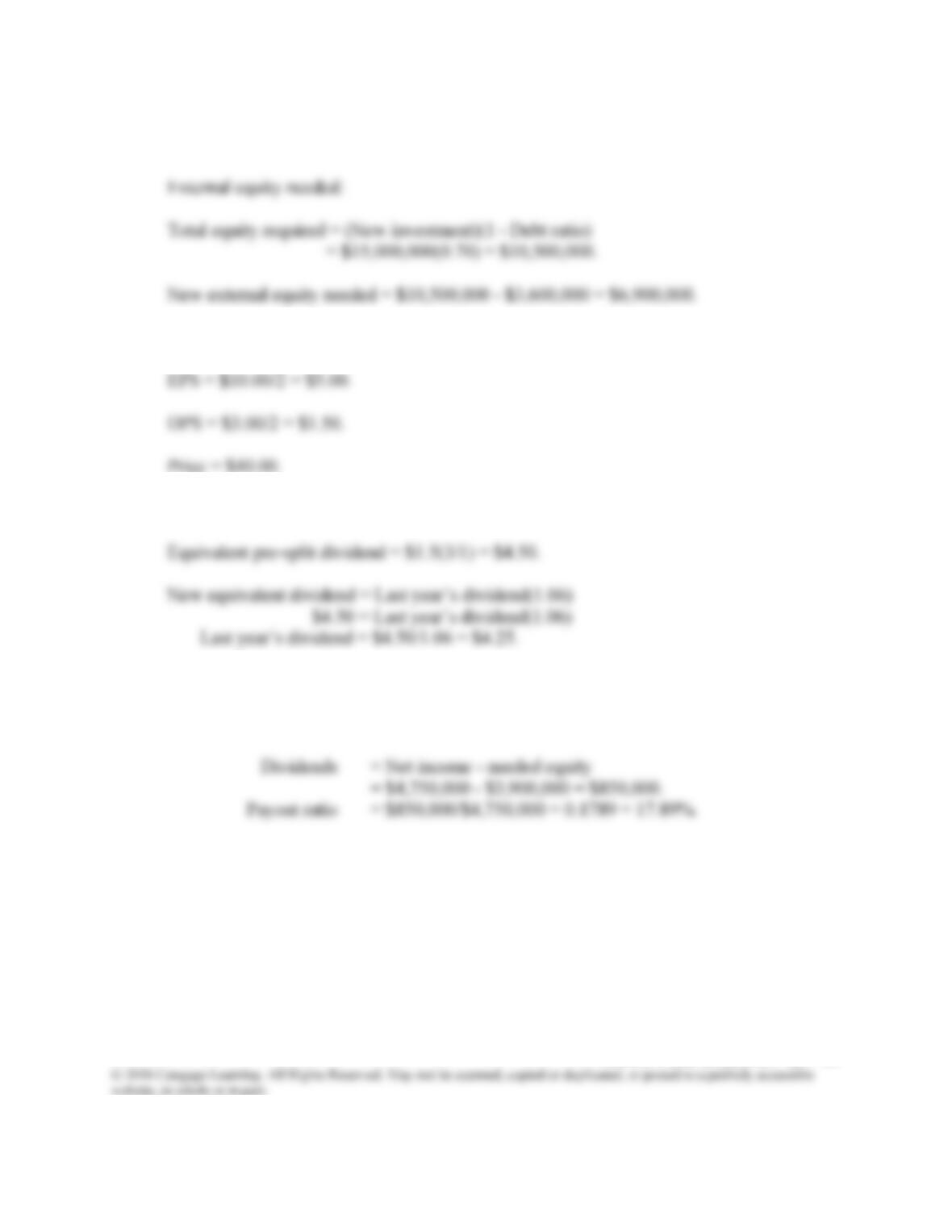
15-3 Equity financing = $12,000,000(0.60) = $7,200,000.
15-4 Vop = (n0 P) − Extra cash = (10,000,000 x $20) − $25,000,000 = $175,000,000.
Answers and Solutions: 15 – 11
15-6 Retained earnings = Net income (1 – Payout ratio)
= $8,000,000(0.45) = $3,600,000.
15-7 Number of shares = 2,000(2) = 4,000.
15-8 DPS after split = $1.50.
15-9 Capital budget should be $6 million since the company will accept all independent
projects whose IRR exceeds the project’s cost of capital. We know that 65% of the $6
million should be equity. Therefore, the company should pay dividends of:
Answers and Solutions: 15 – 12
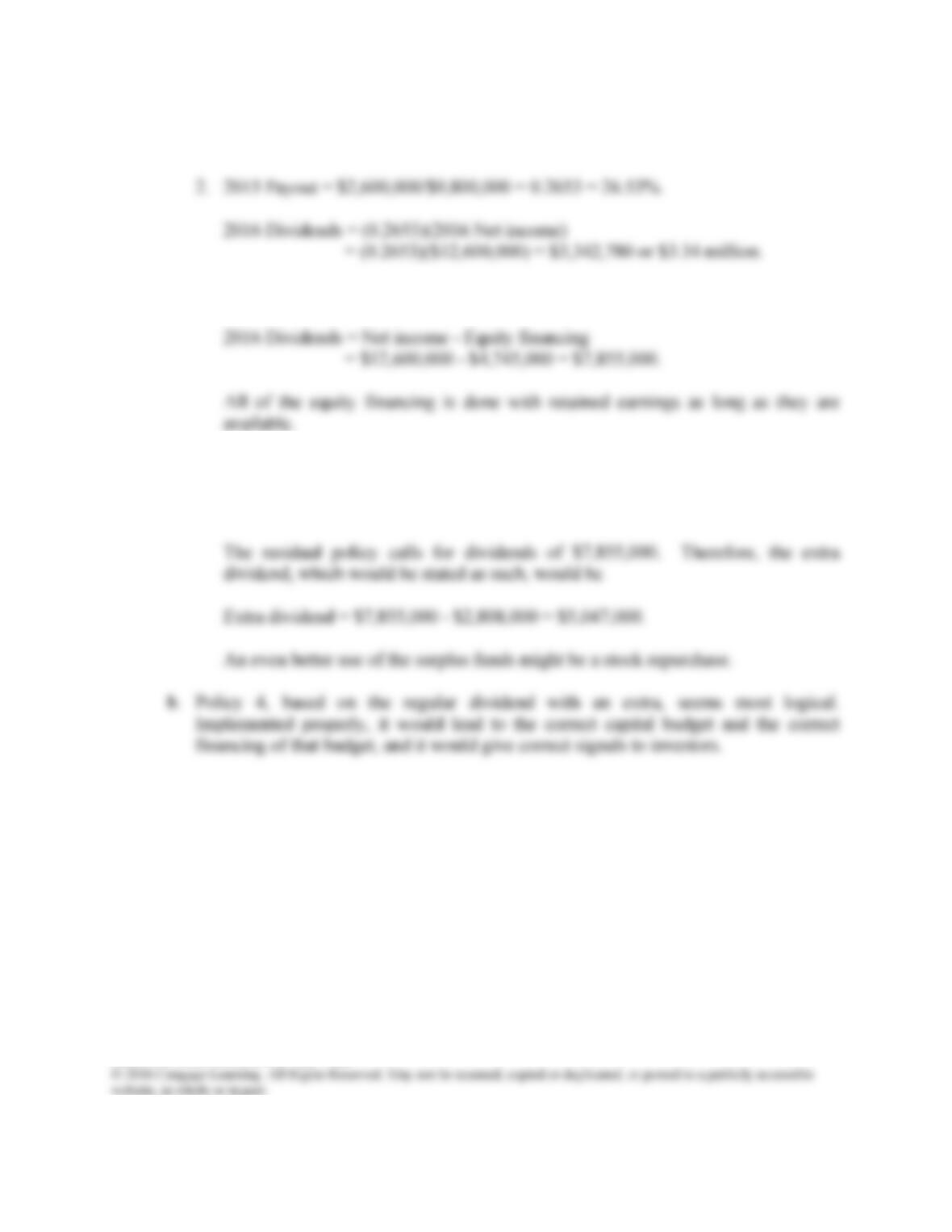
15-10 a. 1. 2016 Dividends = (1.08)(2015 Dividends)
= (1.08)($2,600,000) = $2,808,000.
3. Equity financing = $7,300,000(0.65) = $4,745,000.
4. The regular dividends would be 8% above the 2015 dividends:
Regular dividends = (1.08)($2,600,000) = $2,808,000.
Answers and Solutions: 15 – 13
15-11 a. Capital Budget = $15,000,000; Capital structure = 70% equity, 30% debt.
b. According to the residual dividend model, only $500,000 is available for dividends:
d. No. If the company maintains its $2.00 DPS, only $9 million of retained earnings
will be available for capital projects. However, if the firm is to maintain its current
capital structure, $10.5 million of equity is required. This would necessitate the
company having to issue $1.5 million of new common stock.
e. Capital Budget = $15 million; Dividends = $2 million; NI = $11 million.
Capital Structure = ?
Answers and Solutions: 15 – 14
f. Dividends = $2 million; Capital Budget = $15 million; 70% equity, 30% debt; NI =
$11 million.
= $1,500,000.
g. Dividends = $2 million; NI = $11 million; Capital structure = 70% equity, 30% debt.
RE Available = $11,000,000 – $2,000,000
= $9,000,000.
h. The firm can do one of four things:
(1) Cut dividends.