Introduction to Corporate Finance, Fourth Edition Booth, Cleary, Rakita
Chapter 15: Mergers and Acquisitions
Multiple Choice Questions
1. Section: 15.1 Types of Takeovers
Learning Objective: 15.1
Level of difficulty: Intermediate
2. Section: 15.1 Types of Takeovers
Learning Objective: 15.1
Level of difficulty: Intermediate
3. Section: 15.2 Securities Legislation
Learning Objective: 15.2
Level of difficulty: Intermediate
4. Section: 15.3 Friendly versus Hostile Takeovers
Learning Objective: 15.3
Level of difficulty: Intermediate
5. Section: 15.3 Friendly versus Hostile Takeovers
Learning Objective: 15.3
Level of difficulty: Intermediate
6. Section: 15.3 Friendly versus Hostile Takeovers
Learning Objective: 15.3
Level of difficulty: Intermediate
7. Section: 15.3 Friendly versus Hostile Takeovers
Learning Objective: 15.3
Level of difficulty: Intermediate
Introduction to Corporate Finance, Fourth Edition Booth, Cleary, Rakita
8. Section: 15.4 Motivations for Mergers and Acquisitions
Learning Objective: 15.4
Level of difficulty: Basic
9. Section: 15.4 Motivations for Mergers and Acquisitions
Learning Objective: 15.4
Level of difficulty: Intermediate
10. Section: 15.4 Motivations for Mergers and Acquisitions
Learning Objective: 15.4
Level of difficulty: Intermediate
11. Section: 15.4 Motivations for Mergers and Acquisitions
Learning Objective: 15.4
Level of difficulty: Intermediate
12. Section: 15.5 Valuation Issues
Learning Objective: 15.5
Level of difficulty: Intermediate
13. Section: 15.5 Valuation Issues
Learning Objective: 15.5
Level of difficulty: Basic
Introduction to Corporate Finance, Fourth Edition Booth, Cleary, Rakita
14. Section: 15.5 Valuation Issues
Learning Objective: 15.5
Level of difficulty: Intermediate
Practice Problems
Basic
15. Section: 15.1 Types of Takeovers
Learning Objective: 15.1
Level of difficulty: Basic
Solution:
An acquisition occurs when one firm (the acquiring firm or bidder) completely absorbs another
16. Section: 15.3 Friendly versus Hostile Takeovers
Learning Objective: 15.3
Level of difficulty: Basic
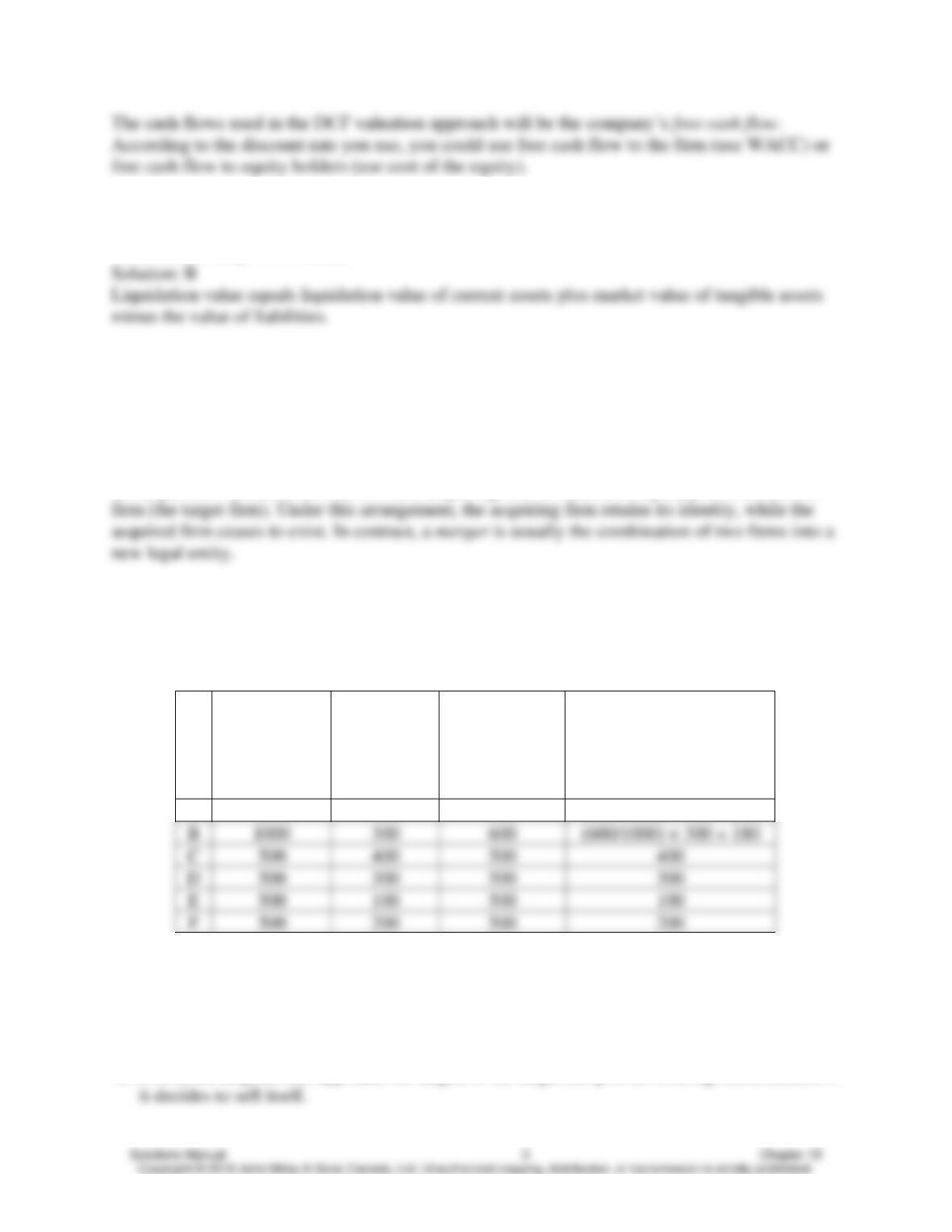
Solution:
Total shares
tendered by
Vendall
shareholders
Mr.
VanDuun’s
tendered
shares
Total
number of
shares
accepted by
Bynum
Number of Mr.
VanDuun’s shares
accepted by Bynum
A
1000
400
600
(600/1000) × 400 = 240
1000
300
600
(600/1000) × 300 = 180
400
500
D
300
500
100
500
200
500
17. Section: 15.3 Friendly versus Hostile Takeovers
Learning Objective: 15.3
Level of difficulty: Basic
Solution:
Friendly acquisition:
1) At first, the acquirer can approach the target, or the target can post an offering memorandum if
Introduction to Corporate Finance, Fourth Edition Booth, Cleary, Rakita
18. Section: 15.3 Friendly versus Hostile Takeovers
Learning Objective: 15.3
Level of difficulty: Basic
Solution:
Common defensive tactics against a takeover include:
a. The Board can recommend rejection of the offer, and shareholders may heed their advice.
19. Section: 15.3 Friendly versus Hostile Takeovers
Learning Objective: 15.3
Level of difficulty: Basic
Solution:
When a hostile tender offer is launched, external parties always look for certain clues. The most
20. Section: 15.4 Motivations for Mergers and Acquisitions
Learning Objective: 15.4
Level of difficulty: Basic
Solution:
Horizontal M&A occurs when two firms in the same industry combine. Vertical M&A occurs
Introduction to Corporate Finance, Fourth Edition Booth, Cleary, Rakita
21. Section: 15.4 Motivations for Mergers and Acquisitions
Learning Objective: 15.4
Level of difficulty: Basic
Solution:
Economies of scale refer to the benefits of getting bigger.
22. Section: 15.4 Motivations for Mergers and Acquisitions
Learning Objective: 15.4
Level of difficulty: Basic
Solution:
Financing synergies of M&A:
1) Reduced cash flow variability. Cash flow volatility tends to be lower for larger entities,
23. Section: 15.4 Motivations for Mergers and Acquisitions
Learning Objective: 15.4
Level of difficulty: Basic
Solution:
1) The evidence suggests that the target firm shareholders gain the most. These gains consist of a
Introduction to Corporate Finance, Fourth Edition Booth, Cleary, Rakita
24. Section: 15.6 Accounting for Acquisitions
Learning Objective: 15.6
Level of difficulty: Basic
Solution:
Under the purchase method, one firm basically assumes all of the assets and liabilities of the
Intermediate
25. Section: 15.2 Securities Legislation
Learning Objective: 15.2
Level of difficulty: Intermediate
Solution:
a 50.1%
26. Sections: 15.2 Securities Legislation and 15.4 Motivations for Mergers and Acquisitions
Learning Objective: 15.2 and 15.4
Level of difficulty: Intermediate
Solution:
The board acquired a company solely because it appeared to be “cheap.” Acquisitions need to fit
Introduction to Corporate Finance, Fourth Edition Booth, Cleary, Rakita
27. Section: 15.6 Accounting for Acquisitions
Learning Objective: 15.6
Level of difficulty: Intermediate
Solution:
Challenging
28. Section: 15.4 Motivations for Mergers and Acquisitions
Learning Objective: 15.4
Level of difficulty: Challenging
Solution:
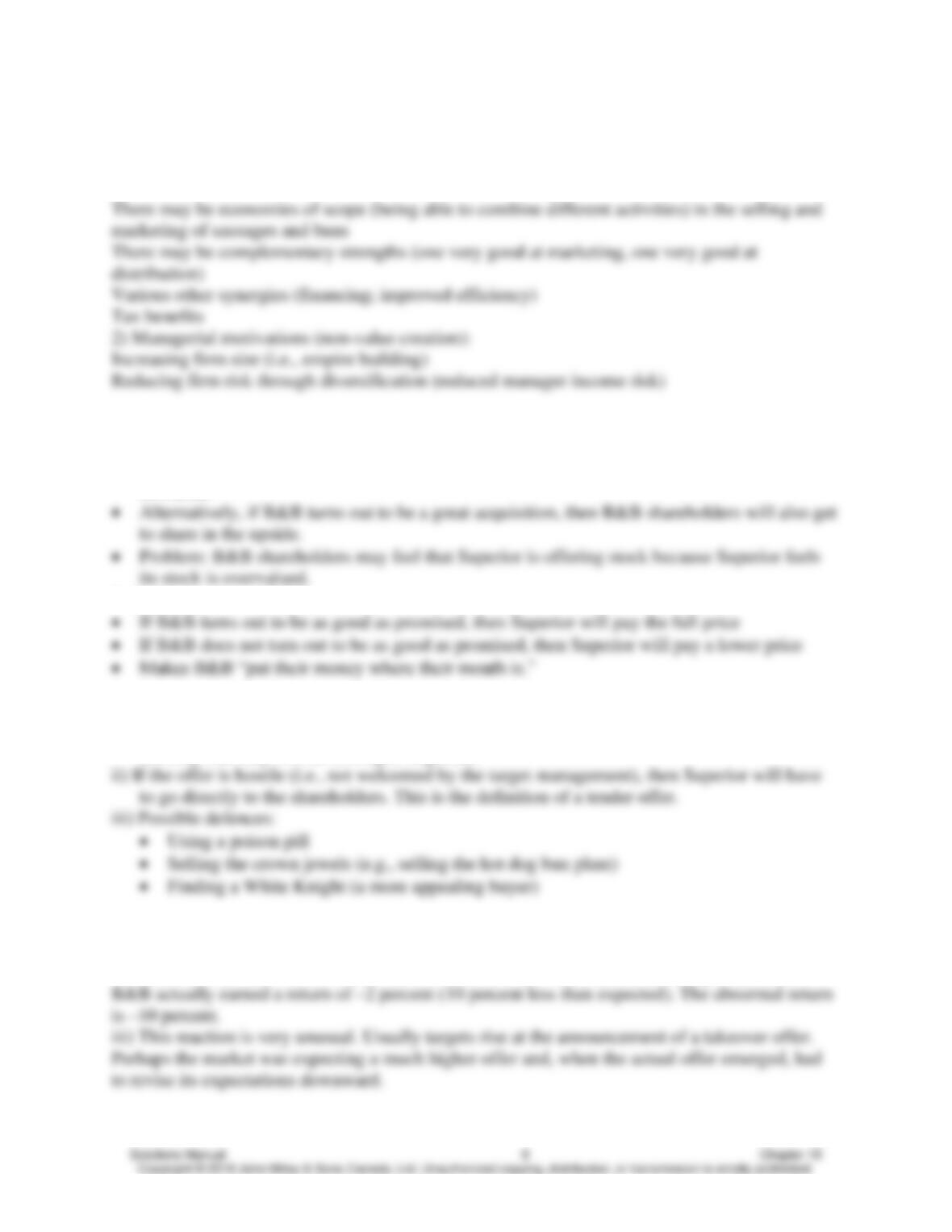
a.
i) The current price of the target is $22 per share.
Scenario
Bidder
price
Target
price
Profit on long
position
Profit on short
position
Total
profit
Bidder price
does not change
$16
$32
$32 – $22 = $10
2(16 – 16) = $0
$10
Bidder price
$32
$64
$64 – $22 = $42
$10
Bidder price
$10
2(16 – 5) = $22
$10
29. Sections: 15.3 Friendly versus Hostile Takeovers; 15.4 Motivations for Mergers and
Acquisitions 15.5; and Valuation Issues
Learning Objective: 15.3, 15.4, and 15.5
Introduction to Corporate Finance, Fourth Edition Booth, Cleary, Rakita
Level of difficulty: Challenging
Solution:
a. Two possible motives for this acquisition are:
1) Value creation:
b. There are two ways Carla can structure the deal to limit the risk to Superior Sausage:
1) Stock offer
• If B&B turns out to be a bad acquisition, then B&B shareholders will have to share in the
downside
2) Earnout
c.
i) The takeover is likely to be hostile, given her comments about the management of B&B; it is
unlikely that they will be willing to negotiate.
d.
i) We expected a return of 0% + 2 × 4% = 8% (using CAPM).
ii)The abnormal return is the difference between the observed return and the expected return.
Introduction to Corporate Finance, Fourth Edition Booth, Cleary, Rakita
Use the following information to answer practice problems 30 to 34.
Sales
$1,750,000
Cost of goods sold
450,000
Depreciation
400,000
Interest
150,000
Income tax
275,000
Dividends
300,000
Common shares outstanding
500,000
P/EBITDA
10x
30. Section: 15.5 Valuation Issues
Learning Objective: 15.5
Level of difficulty: Challenging
Solution:
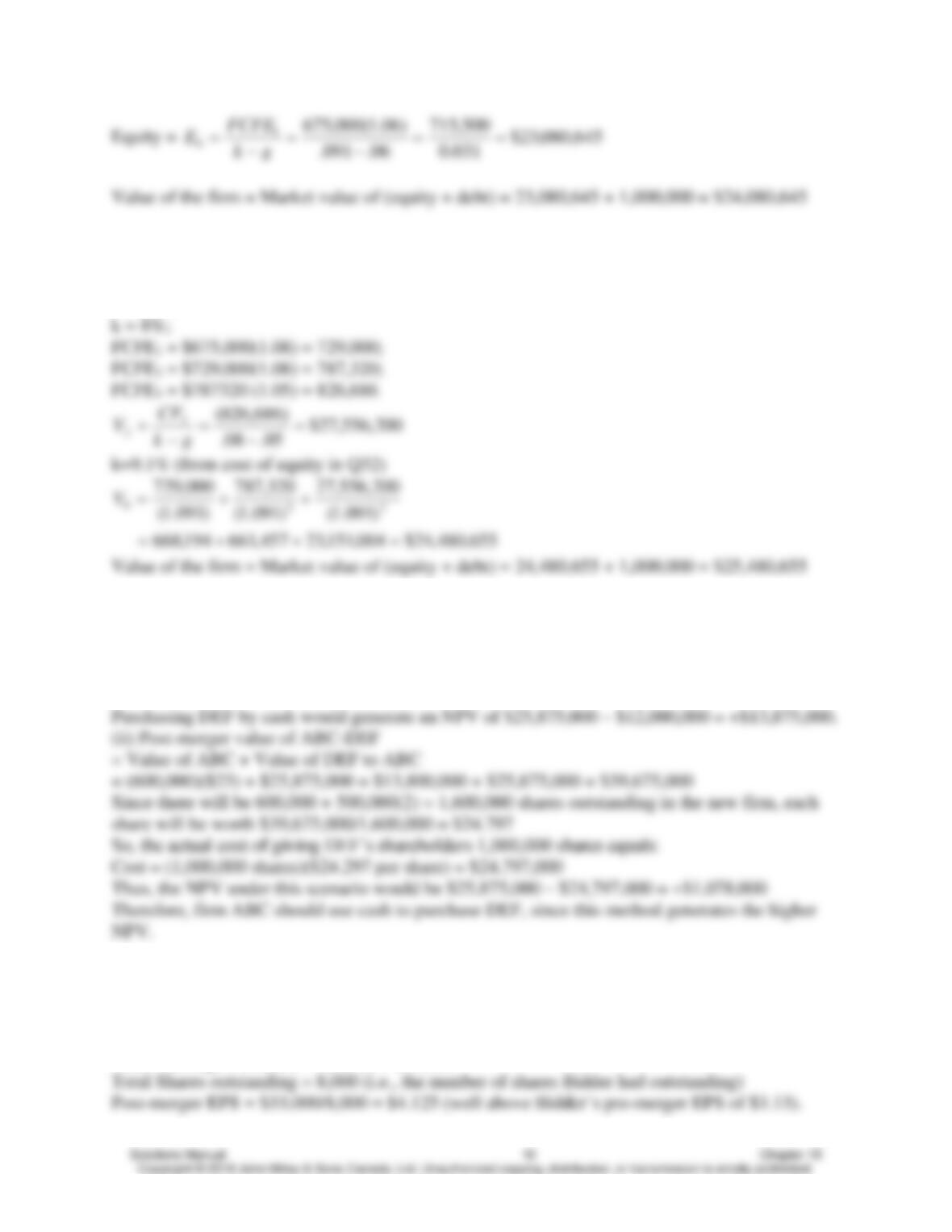
31. Section: 15.5 Valuation Issues
Learning Objective: 15.5
Level of difficulty: Challenging
Solution:
32. Section: 15.5 Valuation Issues
Learning Objective: 15.5
Level of difficulty: Challenging
Solution:
33. Section: 15.5 Valuation Issues
Learning Objective: 15.5
Level of difficulty: Challenging
Solution:
Introduction to Corporate Finance, Fourth Edition Booth, Cleary, Rakita
34. Section: 15.5 Valuation Issues
Learning Objective: 15.5
Level of difficulty: Challenging
Solution:
35. Section: 15.5 Valuation Issues
Learning Objective: 15.5
Level of difficulty: Challenging
Solution:
(i) Cash: The cost is $24 × 500,000 = $12,000,000
36. Section: 15.5 Valuation Issues
Learning Objective: 15.5
Level of difficulty: Challenging
Solution:
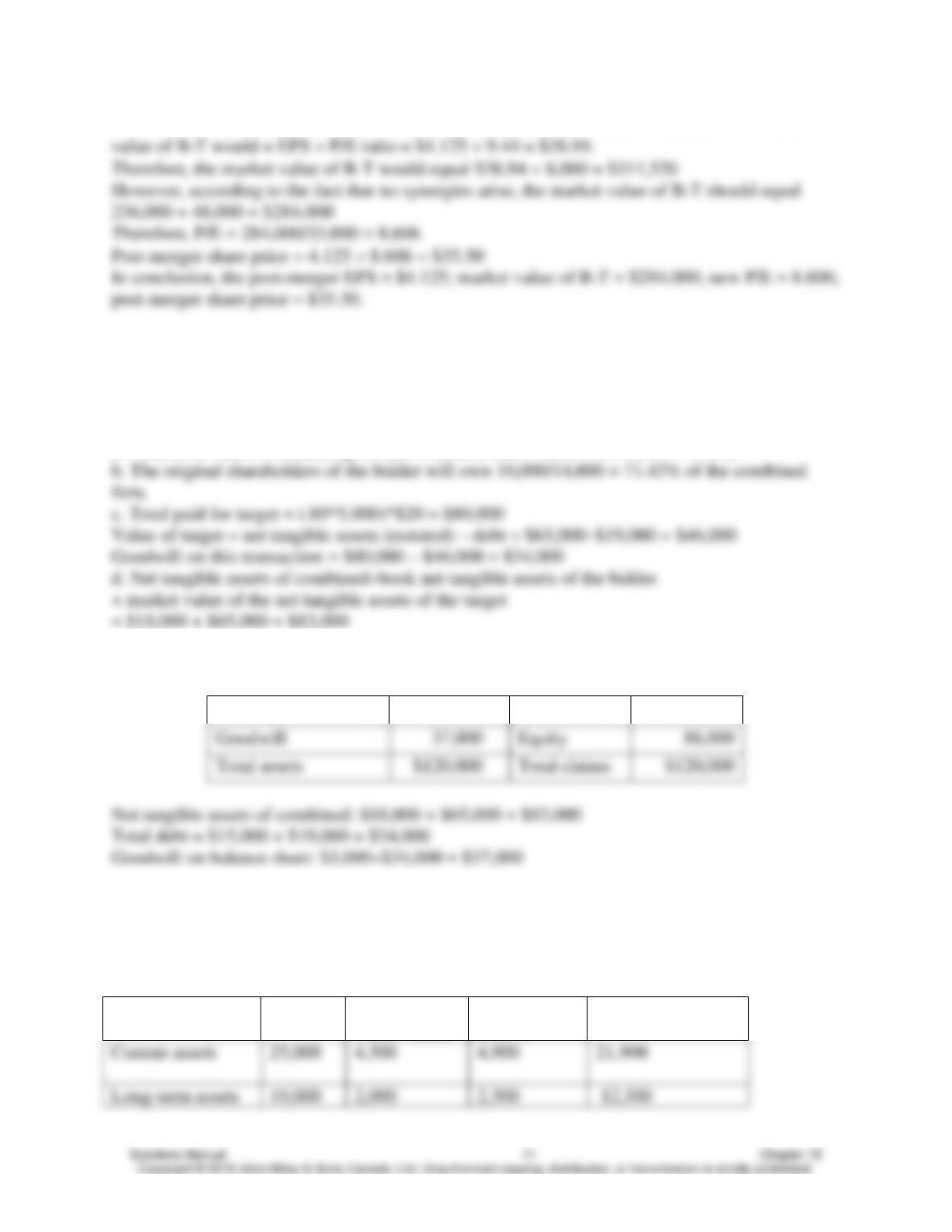
Total Earnings = $25,000 + $8,000 = $33,000
Introduction to Corporate Finance, Fourth Edition Booth, Cleary, Rakita
Notice that if the market was inefficient and the P/E ratio for the Bidder remained at 9.44, the
37. Section: 15.6 Accounting for Acquisitions
Learning Objective: 15.6
Level of difficulty: Challenging
Solution:
a. Number of shares outstanding for the combined firm: 10,000+.80*5,000 = 14,000
e. Combined firm balance sheet as of 31/12/1x
Net tangible assets
$83,000
Total debt
$34,000
38. Section: 15.6 Accounting for Acquisitions
Learning Objective: 15.6
Level of difficulty: Challenging
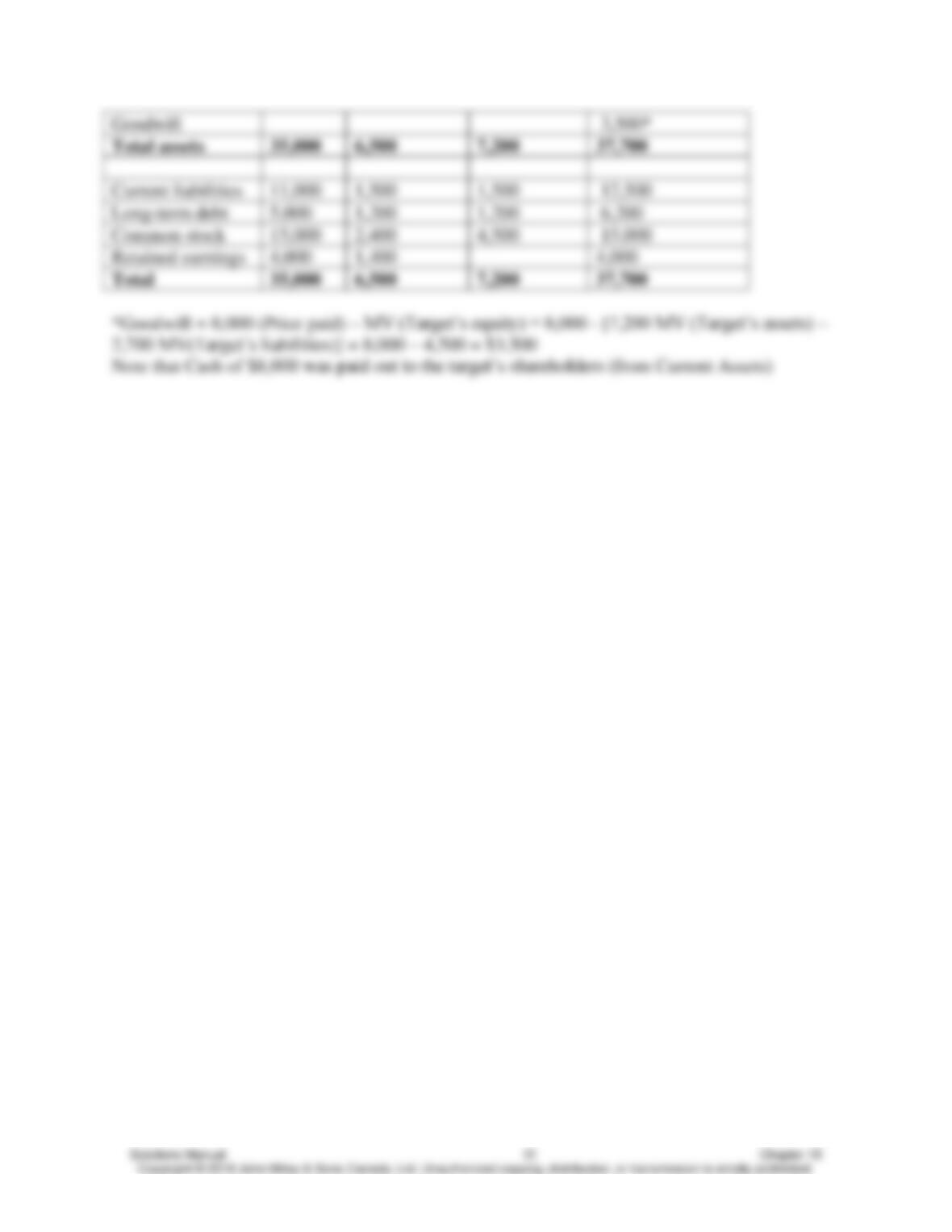
Solution:
Bidder
Target
(book value)
Target
(FMV)
B-T(post-merger)
Introduction to Corporate Finance, Fourth Edition Booth, Cleary, Rakita
Introduction to Corporate Finance, Fourth Edition Booth, Cleary, Rakita
Answers to Concept Review Questions
15.1 Types of Takeovers
Concept review questions
1. What is the difference between an acquisition and a merger?
An acquisition occurs when one firm (the acquiring firm or bidder) completely absorbs another
2. What is an amalgamation?
In an amalgamation, a new company is created and both sets of shareholders have to agree to
exchange their existing shares for shares in the new company. This means that, in a genuine
3. What is the majority of the minority rule?
15.2 Securities Legislation and Takeovers
Concept review questions
1. What is a tender?
Shareholders tender is the acceptance of the offer by signing the authorizations sent to them; in
2. What is a takeover circular?
3. What is a creeping takeover?
15.3 Friendly versus Hostile Takeovers
Introduction to Corporate Finance, Fourth Edition Booth, Cleary, Rakita
Concept review questions
1. What goes into a confidentiality agreement and why do people sign them?
The target firm can disclose more information by setting up a data room where it can keep
2. What is due diligence?
3. What is a shareholder rights plan?
A shareholder rights plan, also known as a poison pill, is a plan passed by a vote of the board of
4. What are some standard takeover defences?
5. When is it best to mount a hostile bid?
It is best to mount a hostile bid when the following conditions are satisfied. First, the business is
15.4 Motivations for Mergers and Acquisitions
Concept review questions
1. What is the difference between vertical and horizontal mergers?
A horizontal merger occurs when two firms in the same industry combine. In a vertical merger, a
2. What is an extension M&A, an overcapacity M&A, and a geographic roll-up M&A?
Extension M&A extends a firm’s expertise. An overcapacity M&A occurs when too many firms
3. What financial synergies are possible in an M&A transaction?
Introduction to Corporate Finance, Fourth Edition Booth, Cleary, Rakita
4. What tax benefits can occur in an M&A?
Tax benefits occur when one firm has substantial operating loss credit that it cannot take
advantage of because it is not operating profitably. These losses are valuable since they can be
5. What is the empirical record on the success of M&As in the 1990s?
In the 1990s, many international M&A such as Chrysler and Daimler-Benz, Seagram and Martel
6. What is SVAR and why do managers prefer to finance with shares than cash?
15.5 Valuation Issues
Concept review questions
1. What is the difference between value and price?
Value generically means a willingness to sell or to buy; that is, we are talking about supply and
2. What is fair market value?
Fair market value is the highest price obtainable in an open and unrestricted market between
3. What key multiples are used in valuing companies?
4. Why do differing capital structures cause problems with using P/E multiples?
5. What is free cash flow?
Introduction to Corporate Finance, Fourth Edition Booth, Cleary, Rakita
Free cash flow is used in the DCF approach. It is the free cash flow to equity holders, since it
expenditures.
6. When does EPS increase when using a share swap?
15.6 Accounting for Acquisitions
Concept review questions
1. Explain how the purchase method gives rise to goodwill.
The purchase method is an accounting method for business combinations where one firm
2. How is goodwill treated for accounting purposes in Canada and the United States?
Goodwill is the access amount of a target firm’s purchase price over fair market value of its