Chapter 15 Financial Planning
Chapter Overview
The Opening Focus looks at Sony and its outlook for 2012. In 2011, Sony lost 3.2 billion yen but
forecasted a much brighter 2012. It expects 7.5 trillion in revenue and 80 billion yen in profits due
Opening Focus Discussion Questions:
1. If you are among the financial executives at Sony, what do you think represents the next set of
market movements in technology that you would hear them anticipating? How does a firm
plan for disasters such as the earthquake and tsunami that Sony faced?
2. How can any firm best evaluate the potential for the eventual success or failure of its plans?
This chapter covers:
15-1. Overview of the Planning Process
Technology
1. Smart Practices Video. Jackie Sturm, director of finance for technology and manufacturing
for Intel Corp, talks about overall business plans and how they impact the annual planning
process.
5. Smart Practices Video. Beth Acton, former vice president and treasurer of Ford Motor Co.,
talks about the long cycle time for developing new products and the implications of this long
lead time on business planning.

416 Instructor’s Manual
Lecture Guide
15-1 Overview of the Planning Process
Before a company can plan for its future, it must have goals and a strategy to meet those
15-1a Successful Long-Term Planning
15-1b The Role of Finance in Long-Term Planning
15-2 Planning for Growth
Once the plan is determined, it is up to the finance function to assess whether the plan is
feasible. Can the necessary money be raised? The instructor can bring in the opening focus story –
15-2a Sustainable Growth
While high growth is generally desirable, a goal most firms strive to achieve, many small
businesses have grown too quickly, and were unable to come up with sufficient cash to continue
the business. Point out that having a great idea is not a sure-fire guarantee of success. A firm must
have a sound business plan and sufficient capital to carry out that plan.
• Sustainable Growth Model
o In the sustainable growth model, note how the variables interact. If the firm has a

Chapter 15 Financial Planning 417
to students that reducing dividend payouts to increase growth is difficult to achieve
15-2b Pro Forma Financial Statements
Pro forma financial statements have fallen into some disfavor with the recent accounting
scandals. Some firms were accused of painting too rosy a picture of the future with their publicly-
released pro forma statements. What can a company do to ensure that its future predictions are
credible? For example, the firm could release past pro forma statements and compare them to
actual statements to show how accurate their predictions have been in the past.
• Example: Zinsmeister Shoes
o This section presents a current balance sheet and income statement for Zinsmeister
• External Funds Required (EFR) for Zinsmeister Shoes
o Using the numbers from the previous example, Zinsmeister’s external funds needs
Table 15.1 Financial Statement for 20112 ($ thousands)
Table 15.2 Pro Forma Financial Statements for 2013 ($thousands)
15-3 Planning and Control
15-3a Short-Term Financing Strategies
Firms are faced with fluctuating sales, even if the long-term trend is upward. A firm has a choice
of strategies to finance the variations:
1. Conservative – using more expensive long-term debt to finance both permanent and temporary
needs.

418 Instructor’s Manual
Figure 15.2 Quarterly Sales and Total Current Assets for The Hershey Company (1992
through the fourth quarter of 2009)
This section presents graphs of the short-term financing strategies available to Hershey.
15-3b The Cash Budget
Cash is the lifeblood of a firm. A firm with continual liquidity problems may not stay in
business very long. Cash budgets generally start with a sales forecast. Point out that one of the
• Example: Farrell Industries
o Cash Receipts : This section begins the development of a cash budget for Farrell
o Schedule of Projected Cash Receipts for Farrell Industries
▪ Using the information given in the previous section, the instructor can
show how much money from each month’s sales is actually collected and
therefore part of cash receipts.
Table 15.3 Schedule of Projected Cash Receipts for Farrell Industries
o Cash Disbursements for Farrell Industries
o Projected Cash Disbursements for Farrell Industries
▪ Using the information in the previous two sections, the instructor can develop,
line by line, the cash disbursements for Farrell.
o Net Cash Flow, Ending Cash, Financing Needs and Excess Cash
▪ Once the cash budget is developed, the analyst can see exactly how much
Table 15.4 Schedule of Projected Cash Disbursements for Farrell Industries ($ thousands)
o Cash Budget for Farrell Industries
▪ Once the firm has completed its cash budget it must decide what to do with
Table 15.5 Cash Budget for Farrell Industries ($ thousands)
Financial Planning and Management Summary
The main takeaways from the chapter are listed in this last section.
Answers to Concept Review Questions
1. If a firm decides to make a major investment in modernizing production facilities, then such an
investment will require a great deal of cash. This could mean that the firm will have to cut
3. The return on investment (ROI) is an accounting based ratio of a firm’s earnings to its assets.
Economic value-added or (EVA®) is the after-tax net operating profits less the cost of funds
4. The optimal growth rate is the rate that maximizes shareholder wealth. Another way to say this
is the optimal growth rate is the rate that occurs when a firm pursues all positive NPV projects.
The optimal growth rate may or may not equal the sustainable growth rate given the firm’s

420 Instructor’s Manual
5. Current asset accounts like cash and inventory often growth at a slower rate than sales because
there is a buffer stock motivation for holding these assets. Firms keep extra cash on hand to
6. The matching financing strategy does not imply that current assets equal current liabilities.
7. Firms prepare cash budgets to ensure that they have temporary financing in place to cover
temporary shortfalls of cash and to ensure that temporary excess cash balances can be invested
8. The more uncertain a firm’s cash flows are, the greater is the risk that an unplanned for cash
Solutions to Self-Test Problems
ST15-1. Use the following key financial data from the most recent annual report of Rancho, Inc.
to answer the following questions.
Sales $12.7 million
Net income $ 1.3 million
Total assets $ 7.6 million
Total equity $ 5.2 million
Dividends $ 0.3 million
The firm’s CFO wishes to use this data to estimate the firm’s sustainable growth rate.
a. Use the data provided to calculate Rancho’s net profit margin, assets–to-equity ratio,
asset turnover ratio, and its dividend payout ratio.
b. Use your findings in part (a) to find Rancho’s sustainable growth rate.
c. Interpret the sustainable growth rate calculated in part (b). Does this rate of growth
assure shareholder wealth maximization? Explain.
d. If the firm’s board feels that it is best for its shareholders if the firm grows more
slowly, what alterations in each of the baseline assumptions would be necessary to
achieve this objective?
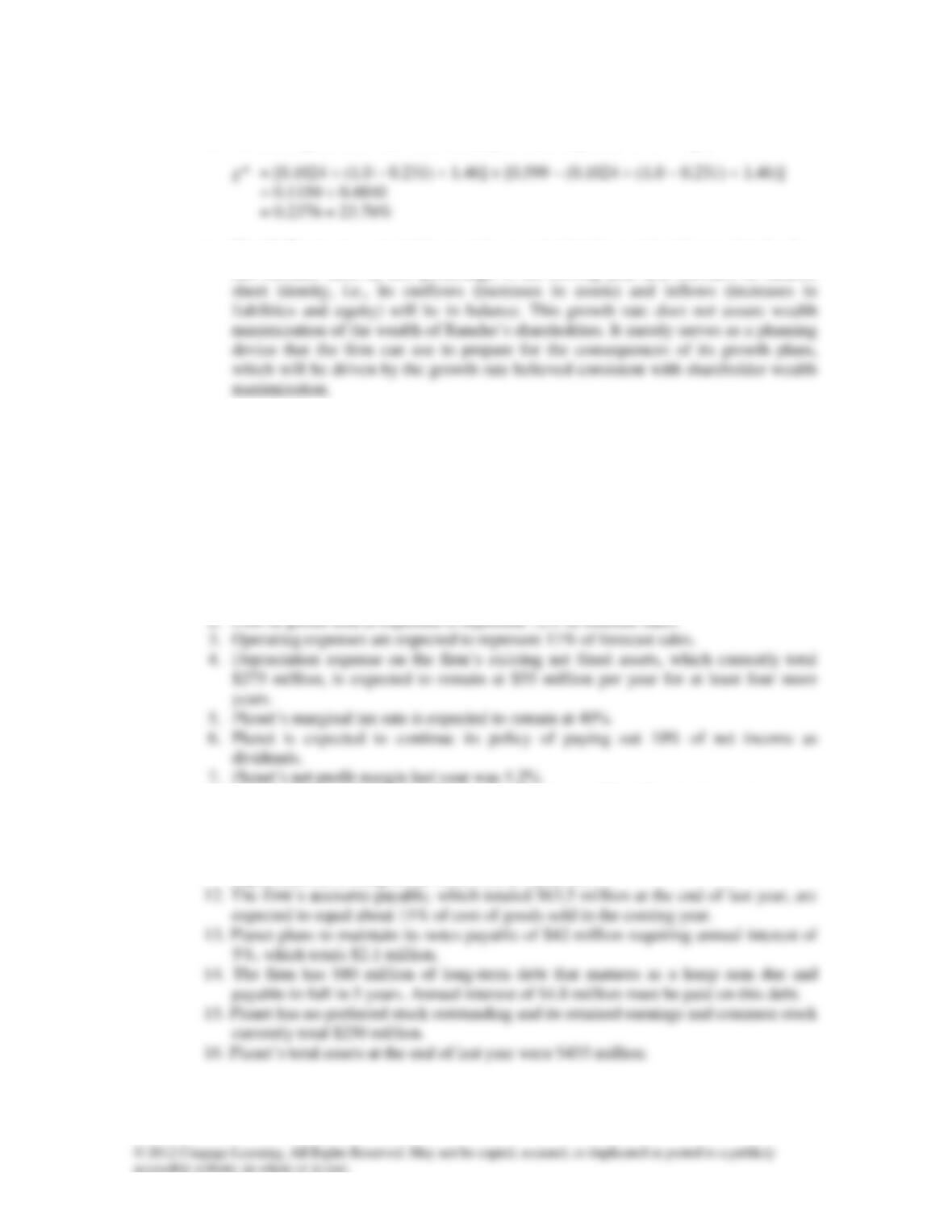
A: a. m = net profit margin = $1.3 million ÷ $12.7 million = 0.1024
Chapter 15 Financial Planning 421
b. Substituting the relevant values from part a into Equation 15.1, we get
c. The 23.76 percent sustainable growth rate calculated in part b indicates that the firm
can increase sales by this percentage in the coming year and maintain its balance
d. A lower profit margin (clearly not a good idea), a decrease in asset turnover (clearly
not a good idea), a decrease in leverage, or an increase in the dividend payout ratio
would lower Rancho’s sustainable growth rate. Clearly the best strategy for lowering
the firm’s sustainable growth rate would be to either reduce leverage or pay out a
larger percentage of net income as dividends.
ST15-2. Planet Inc. wishes to construct a pro forma income statement and a pro forma balance
sheet for the coming year using the following data.
1. Sales are forecast to grow by 5% from $809.5 million last year to $850 million in the
coming year.
8. Planet wishes to maintain a minimum cash balance of $8 million in the coming year.
9. The firm’s accounts receivable are expected to equal about 15% of sales.
10. The firm’s inventory has historically averaged about 12% of cost of goods sold.
11. Planet is planning to invest an additional $35 million in fixed assets that will be
depreciated on a straight-line basis over a 7-year life.
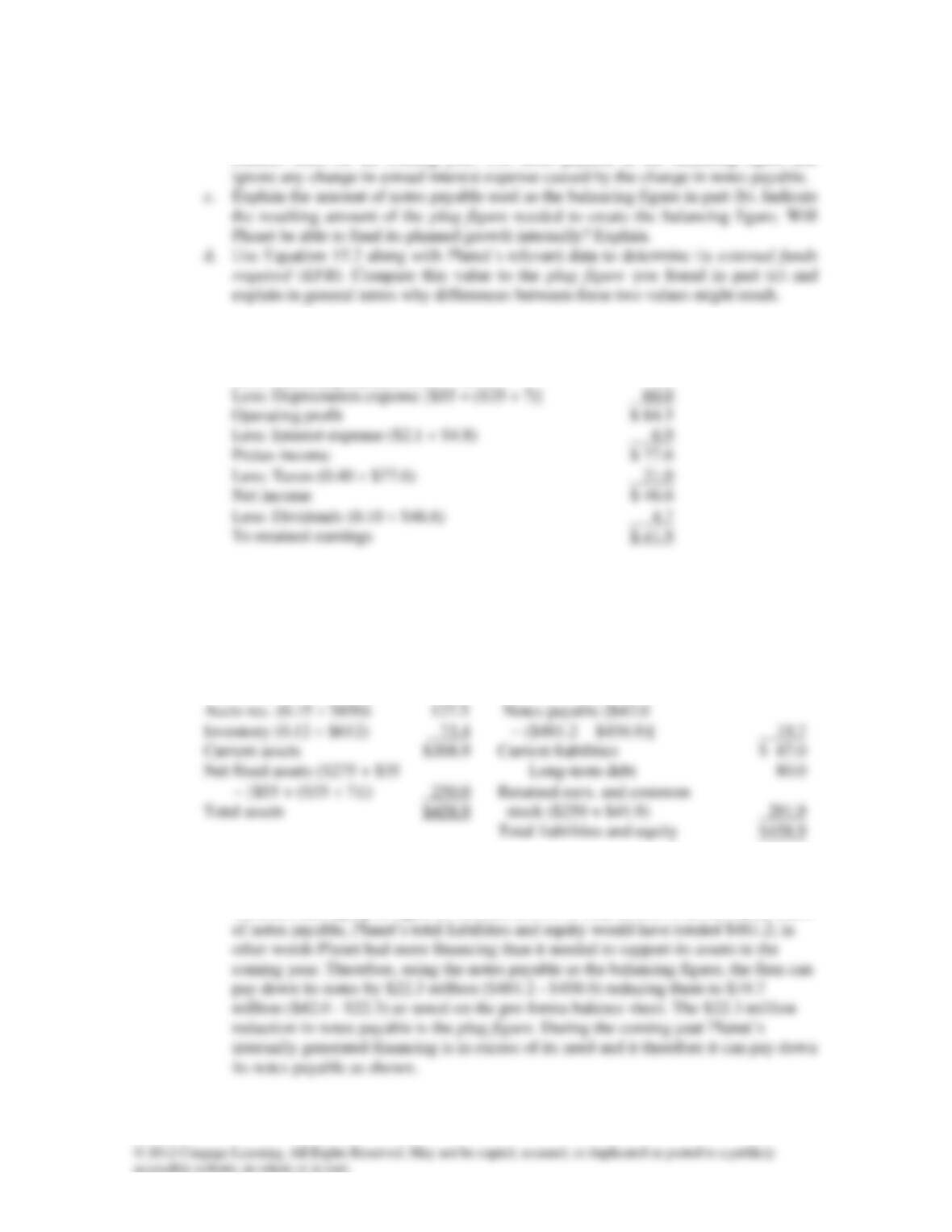
a. Use the preceding data to prepare Planet’s pro forma income statement for the
coming year.
422 Instructor’s Manual
b. Use the data provided and your findings in part (a) to prepare Planet’s pro forma
balance sheet for the coming year. Use notes payable as the balancing figure and
A: a. Sales: $850.0
Less: COGS (72% 850) 612.0
Less: Operating expense (0.11 $850) 93.5
b.
Planet Inc.
Balance Sheet
For the End of the Coming Year
($ in millions)
______________________________________________________________________________________________
Cash $ 8.0 Accounts payable (0.11 $612) $ 67.3
c. The balancing figure of $19.7 of notes payable resulted from the fact that the initial
notes payable of $42.0 were more than was necessary to allow Planet’s total
liabilities and equity to equal its forecast $458.9 of total assets. With the initial $42.0

Chapter 15 Financial Planning 423
d. Using the data provided, the values of the key variables needed to apply Equation
15.2 to find the external funds required (EFR) are:
A/S = $435 million ÷ $809.5 million = 0.5374
Substituting these values into Equation 15.2 we get Planet’s external funds required
(EFR):
ST15-3. Sportif, Inc.’s financial analyst has compiled sales and total cash disbursement estimates
for the coming months of January through May. Historically, 60% of sales are for cash,
with the remaining 40% collected in the following month. The ending cash balance in
January is $1,000. The firm’s minimum cash balance is $1,000. The analyst plans to use
this data to prepare a cash budget for the months of February through May.
Month
Sales
Total Cash
Disbursements
January
$ 5,000
$6,000
April
10,000
a. Use the data provided to prepare Sportif’s cash budget for the four months of
February through May.
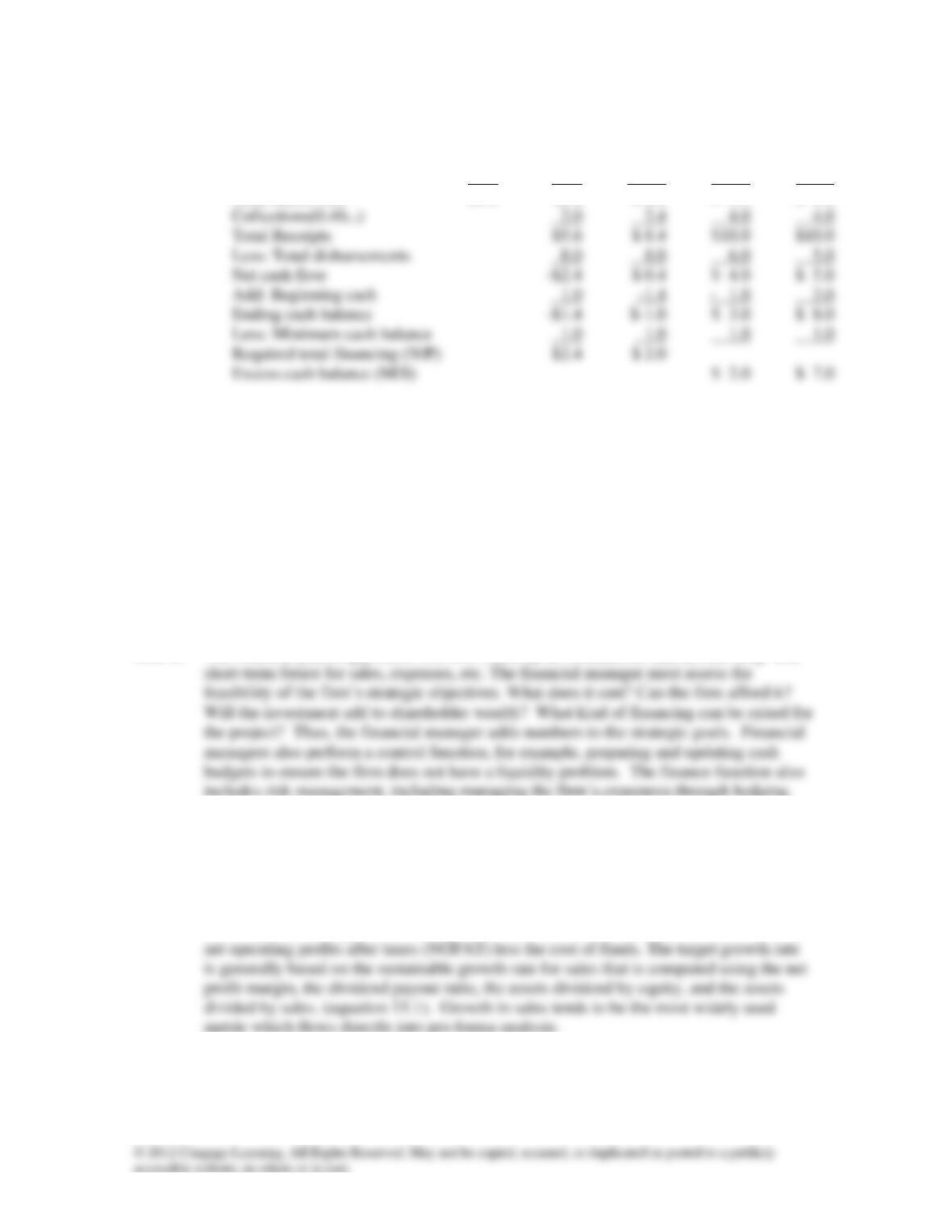
424 Instructor’s Manual
A: a. Jan. Feb. Mar. Apr.
May
Sales ($000) $5.0 $6.0 $10.0 $10.0 $10.0
Cash sales(0.60) $3.0 $3.6 $ 6.0 $ 6.0 $ 6.0
b. Based on the cash budget prepared in part a, Sportif will need to be able to borrow
up to $2.4 thousand to cover its shortages in the months of February and March.
c. Sportif would have accounts receivable of $4.0 thousand at the end of May. The
receivables would represent the 40% of May’s sales of $10.0 thousand that would be
uncollected at that time.
Answers to End-of-Chapter Questions
Q15-1. What is the financial planning process? What is a strategic plan? Describe the roles that
financial managers play with regard to strategic planning.
A15-1. The financial planning process is a firm’s attempt to forecast the future, both long– and
includes risk management, including managing the firm’s exposures through hedging.
Q15-2. Briefly describe the following popular growth targets: (1) accounting-based return on
investment (ROI), (2) economic value added (EVA®), and (3) target growth rate of sales
or assets. Which is most widely used, and why?
A15-2. All three measures require information from the firm’s financial statements. ROI is the
same as ROA and equals the earnings after taxes divided by the total assets. EVA is the
Q15-3. In the sustainable growth model, what does the word sustainable mean? In what ways
can the sustainable growth model highlight conflicts between a firm’s competing
objectives?

Chapter 15 Financial Planning 425
A15-3. Sustainable growth refers to how fast a firm can grow while maintaining a balance
between its sources and uses of funds. It states how much growth a company can
achieve with its current profit margin, asset efficiency, retained earnings and leverage.
Q15-4. With reference to Equation 15.1, explain how each of the variables influences the firm’s
sustainable growth rate. If high leverage allows a firm to increase its sustainable growth
rate, does that mean higher leverage is necessarily good for the firm?
A15-4. In equation 15-1, a higher asset turnover ratio (greater asset efficiency) means a higher
sustainable growth rate. A lower dividend payout ratio means higher growth, as does a
Q15-5. A firm chooses to grow at a rate above its sustainable rate. What changes might we
expect to see on the firm’s financial statements in the next year? What changes would
result from growing at a rate below the firm’s sustainable rate?
A15-5. If a firm chooses to grow at a rate above its sustainable rate, you might see higher debt
(the firm borrows to increase its asset to equity ratio), more retained earnings (the firm
Q15-6. Describe the differences between top-down and bottom-up sales forecasting methods.
Describe advantages and disadvantages of each. Do you think one approach is likely to
be more accurate than the other?
A15-6. A top-down sales forecast relies heavily on macroeconomic and industry forecasts. A
firm could use a statistical model or subscribe to a forecast made by firms specializing in
Q15-7. What is the logic of the percentage-of-sales method for constructing pro forma
statements? On a year–to–year basis, which balance sheet and income statement items do you

426 Instructor’s Manual
think will fluctuate most closely with sales, and which items are not likely to vary as directly
with sales volume?
A15-7. The logic behind percent of sales method for calculating pro forma statements is that
most accounts increase or decrease as sales increase or decrease. This may not be a
Q15-8. Why does it make sense to let the firm’s cash balance or a short-term liability account
serve as the plug figure in pro forma projections? Why not use gross fixed assets as the
plug figure?
A15-8. It makes sense to have cash or short-term debt as the plug. If a firm has excess cash, it
will likely put it into a safe, short-term investment, such as a money market security.
Q15-9. Why might pro forma statements and the equation for external funds required (EFR)
yield different projections for a firm’s financing needs?
A15-9. There may be a discrepancy between the results of the external funds requirement
Q15-10. What is the difference between the conservative strategy, the aggressive strategy, and the
matching strategy for funding the long-term trend and the seasonal fluctuations in a
firm’s total current assets? Which strategy is most risky? Which is least profitable?
A15-10. In a conservative strategy, the firm makes sure it has enough long-term financing to
cover its permanent investment in fixed and current assets and additional seasonal
Q15-11. How is a cash budget different from a set of pro forma financial statements? Why do you
think that firms typically create cash budgets at higher frequencies than they create pro
forma financial statements?

Chapter 15 Financial Planning 427
A15-11. Cash budgets show when cash is received and when it is paid. This may be different
from when expenses and revenues are “booked” on a pro forma balance sheet or income
Q15-12. Explain how slower inventory turnovers, slower receivables collections, or faster
payments to suppliers would influence the numbers produced by a cash budget.
A15-12. Slower inventory turns means more cash is tied up in inventory – more of an inventory
Solutions to End-of-Chapter Problems
Planning for Growth
P15-1. Go to http://finance.yahoo.com or another financial website, and download the most recent
two years’ balance sheets and income statements for a firm of your choice. Do not choose a
firm that issued or retired a significant amount of common stock in either year.
A15-1. Internet exercise – answers will vary.
P15-2. Eisner Amusement Parks reported the following data in its most recent annual report:
Sales $42.5 million
Net income $3.8 million
Dividends $1.1 million
Assets $50.0 million
Eisner is financed 100% with equity. What is the company’s sustainable growth rate?
A15-2. Eisner’s sustainable growth requires a profit margin, dividend payout ratio, assets to equity
and assets to sales ratios.