CHAPTER 15: FOREIGN TRADE AND SHORT-TERM FINANCING
1
CHAPTER 15
FOREIGN TRADE AND SHORT-TERM FINANCING
This chapter is primarily factual, describing the various institutions and details involved in financing
foreign trade. The most important documents encountered in bank-related financing are the draft, which is
a written order to pay; the letter of credit, which is a bank guarantee of payment provided that certain
stipulated conditions are met; and the bill of lading, the document covering title and actual shipment of
the merchandise by a common carrier. Other documents of lesser importance include the commercial and
consular invoices and insurance certificate.
The section on short-term financing discusses the alternative financing options available to
companies. It emphasizes how exchange rate changes affect the home currency costs of borrowing in
different currencies. The domestic analogy is calculating real borrowing costs, factoring in inflation and
nominal interest rates. In this edition,
Key Points
1. The functions of these instruments, and hence the rationale for their existence, are:
▪ To reduce both buyer and seller risk.
2. Each instrument evolved over time as a rational response to the additional risks in international trade
3. The existence of government programs that provide subsidized export financing, such as the U.S.
5. In formulating a borrowing strategy, the key factors and objectives associated with that strategy must
be consistent with our understanding of the way in which financial markets work.
7. In the absence of forward contracts, firms can either attempt to minimize expected costs or establish
some trade-off between reducing expected costs and reducing the degree of cash flow exposure. The
latter goal involves offsetting operating cash inflows in a currency with financing cash outflows in
that same currency. In general, the borrowing decision should be integrated with the hedging decision.
SUGGESTED ANSWERS TO CHAPTER 15 QUESTIONS
1. What are the basic problems arising in international trade financing and how do the main
financing instruments help solve those problems?
ANSWER. The main problems arising in international trade financing are the risks that both buyer and
seller bear in cross border trade, how to allocate those risks in a way that ensures that those best able to
2. The different forms of export financing distribute risks differently between the exporter and
the importer. Analyze the distribution of risk in the following export financing instruments.
2.a. Confirmed, revocable letter of credit
2.b. Confirmed, irrevocable letter of credit
2.c. Open account credit
2.d. Time draft, D/A
ANSWER. A time draft D/A removes some of the risk faced by the exporter. Documents evidencing title
2.e. Cash with order
ANSWER. Cash payment at the time of order provides the exporter with the greatest protection, because
2.f. Cash in advance
ANSWER. Cash in advance, prior to shipment or upon delivery of the goods, provides the exporter with a
2.g. Consignment
2.h. Sight draft
ANSWER. With a sight draft, the importer receives no credit. This lessens the credit risk to the exporter.
3. Describe the different steps and documents involved in exporting motors from Kansas to Hong
Kong using a confirmed letter of credit, with payment terms of 90 days sight. What alternatives
are available to the exporter to finance this shipment?
ANSWER. The exporter will receive a letter of credit addressed to itself, written and signed by a bank
acting on behalf of the buyer. In the letter, the bank promises it will honor drafts drawn on itself if the
4. Explain the advantages and disadvantages of each of the following forms of export financing.
4.a. Banker’s acceptances
ANSWER. The low-risk nature of banker’s acceptances mean that they trade at rates very close to those on
4.b. Discounting
ANSWER. An advantage of discounting is that the discount rate for trade paper is often lower than interest
4.c. Factoring
ANSWER. Through factoring, firms can shift credit risks to the factor, who is often in a better position to
4.d. Forfaiting
5. What are the potential advantages and disadvantages of countertrade for the parties involved?
ANSWER. Countertrade is less efficient than using cash or credit because the products taken in trade are
not liquid. Sellers factor these costs into the price they charge countertrading buyers. Both parties,
therefore, bear costs.
6. What are the three basic types of bank loans? Describe their differences.
ANSWER. The major forms of bank financing include overdrafts, discounting, and term loans. Term loans
INSTRUCTORS MANUAL: FOUNDATIONS OF MULTINATIONAL FINANCIAL MANAGEMENT, 6TH ED.
6
ADDITIONAL CHAPTER 15 QUESTIONS AND ANSWERS
1. To “meet the competition” from its counterparts overseas, Eximbank will mechanically match
the terms of a loan provided by a rival export-financing agency – including the interest rate –
when it finances U.S. exports.
1.a. What problems might arise from this rule of matching nominal interest rates?
ANSWER. The effective subsidy associated with a particular interest rate equals the market interest rate
1.b. As of January 15, 1988, the minimum interest rate on government-supplied export credits to
rich countries was set at a flat rate of 10.4% for all nations providing such credits. What
problems might arise with this rule? Comment on which governments would push for such a
rule. Which would be against it?
ANSWER. High-inflation countries tend to have high nominal interest rates while low-inflation countries
1.c. How should minimum interest rates on export credits be set so as to ensure comparability
across countries?
ANSWER. The best approach would be to tailor the minimum rate to each country according to its level of
1.d. Suppose that instead of subsidizing interest rates, governments turn to export insurance
subsidies. Is this move an improvement vis-á-vis export-credit subsidies? Explain.
ANSWER. The most important aspect of providing export-credit insurance subsidies instead of subsidizing
1.e. Why has the U.S. government fought against export-credit subsidies?
2. One of the purposes of Eximbank is to absorb credit risks on export sales that the private sector
will not accept. Comment on this purpose.
3. Comment on the following statement: “Eximbank does not compete with private financial
institutions. It offers assistance only in cases in which the export-credit transaction would not
take place without its help. Eximbank does not offer direct-loan assistance to foreign buyers
when private institutions will provide comparable financing on reasonable terms.”
ANSWER. The market always provides financing on “reasonable” terms. Competition among financial
4. These questions relate to the Foreign Credit Insurance Association.
4.a. Describe the different risks covered by FCIA. Why does the FCIA require coinsurance?
ANSWER. FCIA insurance offers protection from political and commercial risks to U.S. exporters: The
private insurers cover commercial risks, and the Eximbank covers political risks. The exporter (or the
4.b. What factors affect the insurance premium charged by the FCIA?
4.c. Describe the basic features of a typical FCIA short-term policy.
ANSWER. Rather than sell insurance on a case-by-case basis, the FCIA approves discretionary limits
4.d. Describe the basic features of a typical FCIA medium-term policy.
ANSWER. Medium-term insurance is guaranteed by Eximbank and covers big-ticket items sold on credit
5. Low-cost export financing is often a bad sign. Explain.
ANSWER. A country that has a comparative advantage in the manufacture of certain products does not
6. What is countertrade? Why is it termed a sophisticated form of barter?
SUGGESTED SOLUTIONS TO CHAPTER 15 PROBLEMS
1. Texas Computers (TC) recently has begun selling overseas. It currently has 30 foreign orders
outstanding, with the typical order averaging $2,500. TC is considering the following three
alternatives to protect itself against credit risk on these foreign sales:
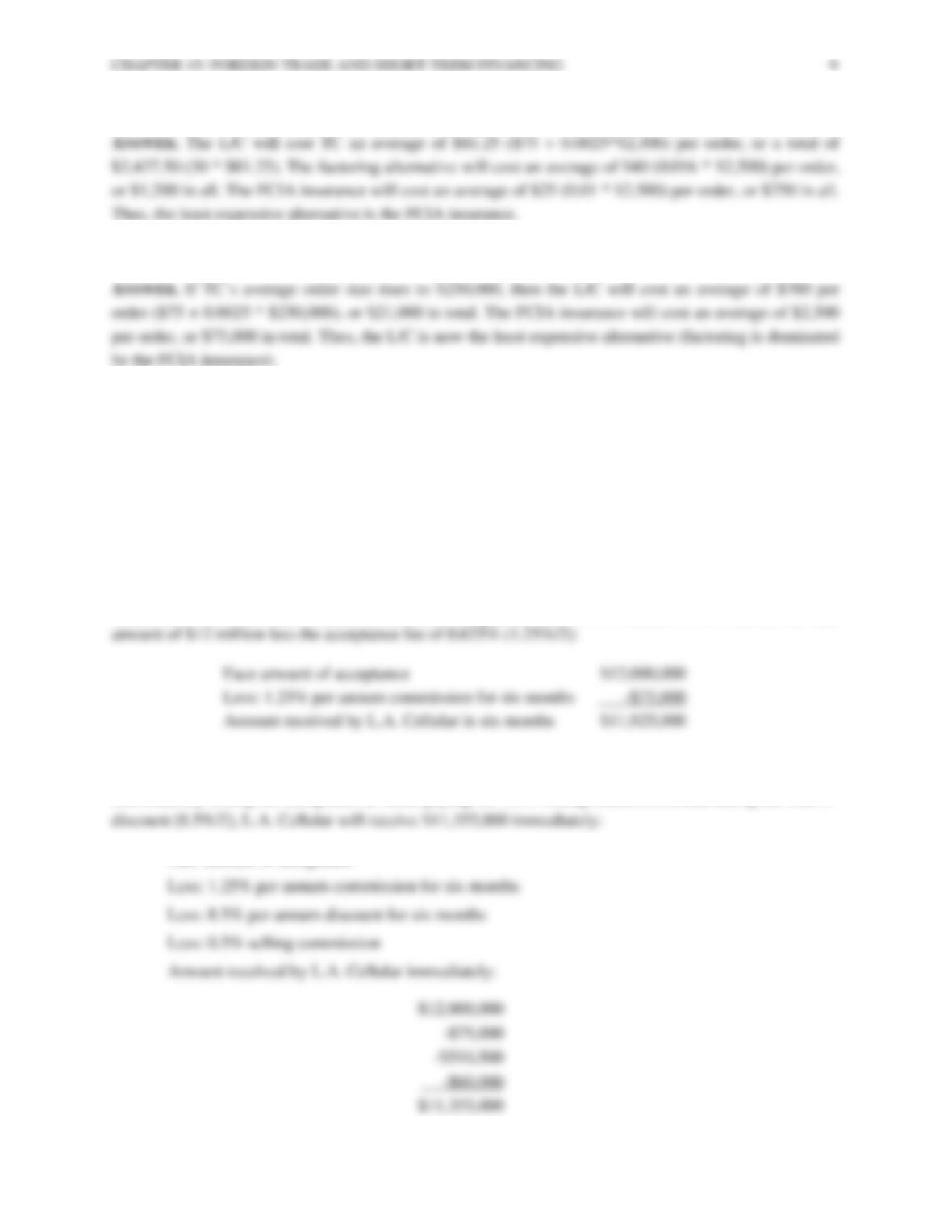
1.a. Which of these alternatives would you recommend to Texas Computers? Why?
1.b. Suppose that TC’s average order size rose to $250,000. How would that affect your decision?
2. L.A. Cellular has received an order for phone switches from Singapore. The switches will be
exported under the terms of a letter of credit issued by Sumitomo Bank on behalf of Singapore
Telecommunications. Under the terms of the L/C, the face value of the export order,
$12 million, will be paid six months after Sumitomo accepts a draft drawn by L.A. Cellular. The
current discount rate on 6-month acceptances is 8.5% per annum and the acceptance fee is
1.25% per annum. In addition, there is a flat commission, equal to 0.5% of the face amount of
the accepted draft, that must be paid if it is sold.
2.a. How much cash will L.A. Cellular receive if it holds the acceptance until maturity?
ANSWER. If L.A. Cellular chooses to hold the acceptance, then in six months it will receive the face
2.b. How much cash will it receive if it sells the acceptance at once?
ANSWER. By selling the acceptance at once, paying the 0.5% selling commission, and taking the 4.25%
Face amount of acceptance
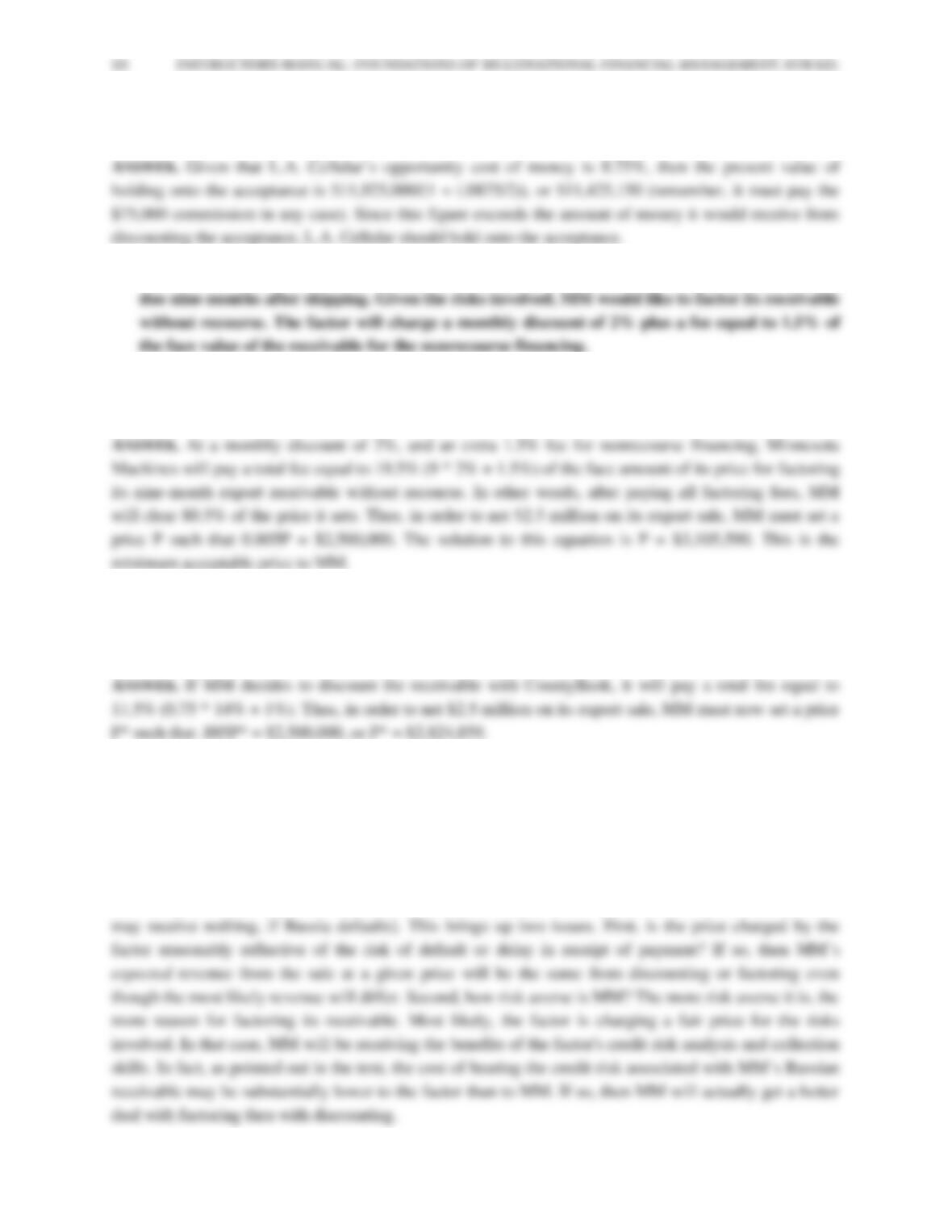
2.c. Suppose L.A. Cellular’s opportunity cost of funds is 8.75% per annum. If it wishes to
maximize the present value of its acceptance, should it discount the acceptance?
3. Suppose Minnesota Machines (MM) is trying to price an export order from Russia. Payment is
3.a. If Minnesota Machines desires revenue of $2.5 million from the sale, after paying all factoring
charges, what is the minimum acceptable price it should charge?
3.b. Alternatively, CountyBank has offered to discount the receivable, but with recourse, at an
annual rate of 14% plus a 1% fee. What price will net MM the $2.5 million it desires to clear
from the sale?
3.c. Based on your answers to parts a and b, should Minnesota Machines discount or factor its
Russian receivables? MM is competing against Nippon Machines for the order, so the higher
MM’s price, the lower the probability that its bid will be accepted. What other considerations
should influence MM’s decision?
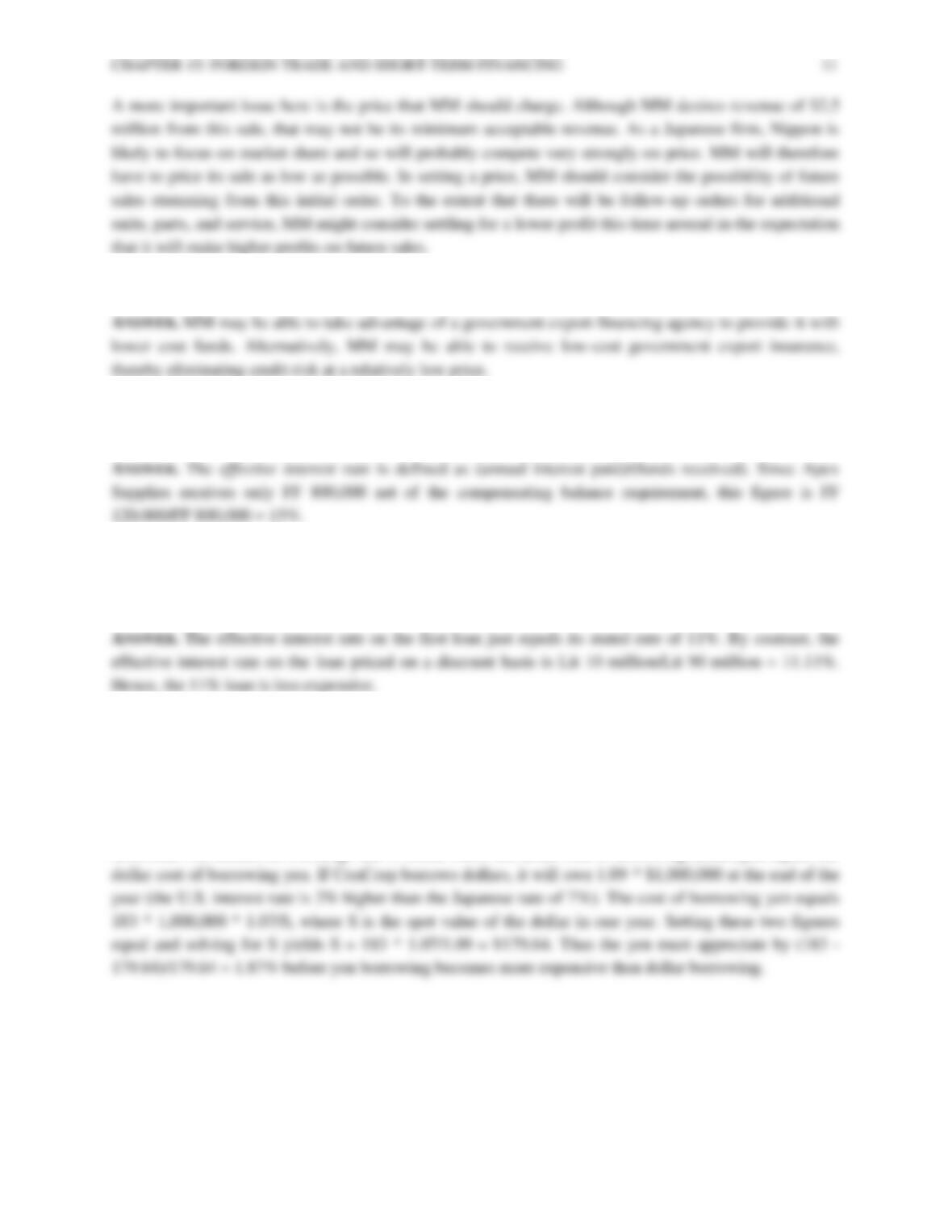
ANSWER. Based purely on net revenue, MM should plan on discounting its receivable. However, this
would expose it to credit risk. Credit risk reduces MM’s expected revenue from this sale (at the extreme it
3.d. What other alternatives might be available to MM to finance its sale to Russia?
4. Apex Supplies borrows FF 1 million at 12%, payable in one year. If Apex is required to maintain
a compensating balance of 20%, what is the effective percentage cost of its loan (in FF)?
5. The Olivera Corp., a manufacturer of olive oil products, needs to acquire Lit 100 million today
to expand a pimento-stuffing facility. Banca di Roma has offered them a choice of an 11% loan
payable at maturity or a 10% loan on a discount basis. Which loan should Olivera choose?
6. If Consolidated Corp. issues a Eurobond denominated in yen, the 7% interest rate on the $1
million, one-year borrowing will be 2% less than rates in the U.S. However, ConCorp would
have to pay back the principal and interest in Japanese yen. Currently, the exchange rate is
¥183 = $1. By how much could the yen rise against the dollar before the Euroyen bond would
lose its advantage to ConCorp?
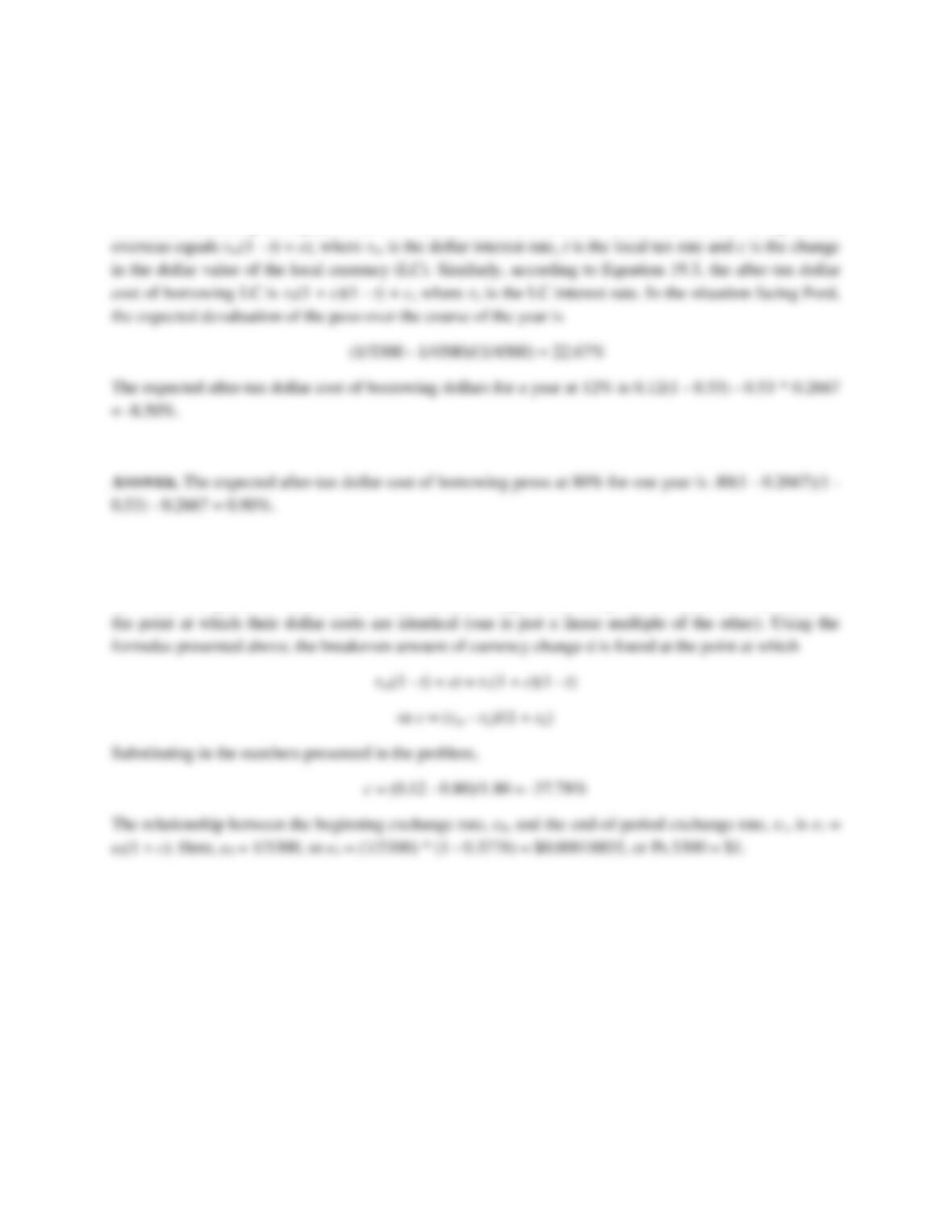
ANSWER. The breakeven exchange rate is found where the dollar cost of borrowing dollars just equals the
INSTRUCTORS MANUAL: FOUNDATIONS OF MULTINATIONAL FINANCIAL MANAGEMENT, 6TH ED.
12
7. Ford can borrow dollars at 12% or pesos at 80% for one year. The peso:dollar exchange rate is
expected to move from $1 = Ps 3300 currently to $1 = Ps 4500 by year end.
7.a. What is the expected after-tax dollar cost of borrowing dollars for one year if the Mexican
corporate tax rate is 53%?
ANSWER. According to Equation 19.4 in Section 19.4, the after-tax dollar cost of borrowing dollars
7.b. What is Ford’s expected after-tax dollar cost of borrowing pesos for one year?
7.c. At what end-of-year exchange rate will the after-tax peso cost of borrowing dollars equal the
after-tax peso cost of borrowing pesos?
ANSWER. The point at which the peso costs of borrowing dollars and pesos are identical is the same as